
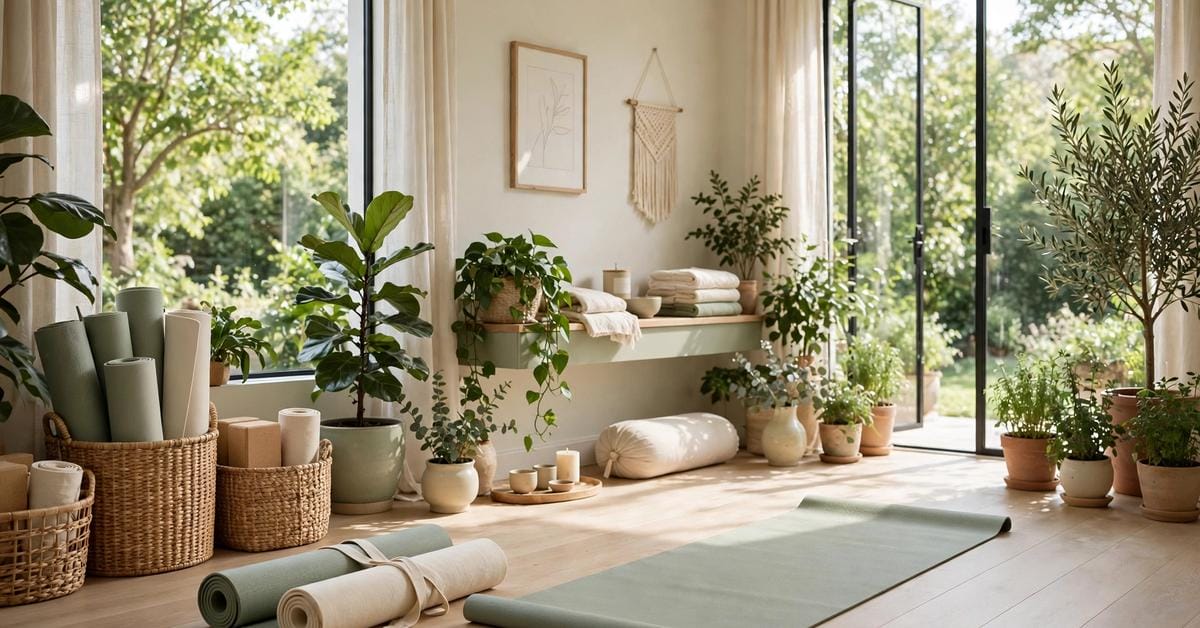
A spare corner, a cleared floor and a door that closes: a home yoga studio asks for almost nothing — and gives back the one room in the house where nobody wants anything from you.
These seventy-five ideas cover the home yoga studio only: choosing and laying out the space, floors and mats, light and colour, storage for props, mirrors and sound, and the small-room versions — practical design throughout, with the practice itself left to you and your teacher.
1. Home Yoga Studio Ideas at a Glance
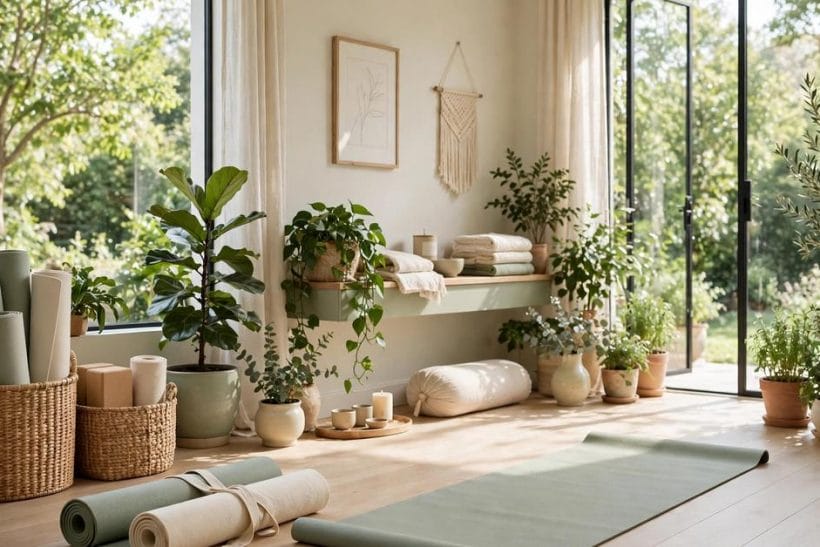
The central entity is the home yoga studio: a dedicated or dual-purpose space whose attributes are a clear floor large enough for a mat and movement in every direction, a surface with grip and give, calm light that can soften, quiet colours, storage that swallows the props, and a door or divider that protects the hour. This post keeps one slice of the studio family: the workspace cousin — desk, easel and daylight for making things — lives in art studio ideas; the whole room in its sitting form answers to the living room ideas pillar; and the bedroom that borrows a practice corner is the colour pair over in yellow bedroom ideas. Here the room is emptied on purpose, and every idea serves the emptying. The feature photograph shows the arrangement at its most attainable: a mat on warm boards, a plant, folded blankets stacked as furniture, and light doing the decoration.
| Question | Short answer |
|---|---|
| How much space does a home studio need? | Room for a mat with clearance to stretch, step and lie in every direction — a cleared corner of a larger room serves most people better than a cramped whole room |
| What is the best floor? | A stable, even surface with some warmth and give — timber, cork or a quality mat over boards; deep carpet fights balance, bare stone fights joints |
| Does it need to be a separate room? | No — it needs a boundary: a door, a screen, a rug’s edge and a routine. The boundary matters more than the walls |
| What should I buy first? | A mat that grips and stays flat, then storage for it; the room is furnished by removal, so most early spending is on taking things out |
| Can it double as a guest room or office? | It is the natural dual-purpose room — provided the second job folds, stacks or wheels away, leaving the floor honestly clear |
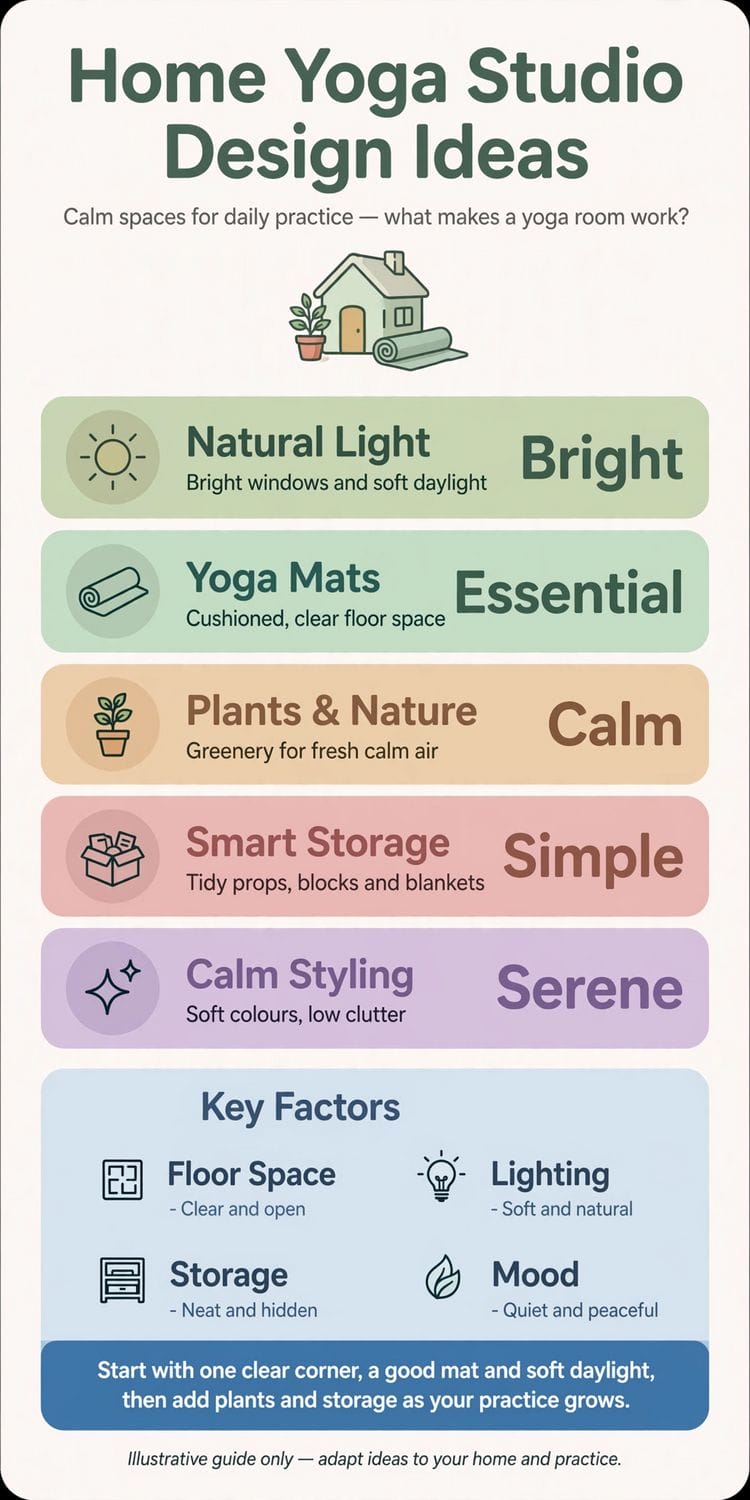
2. Choosing the Space: Room, Corner or Landing
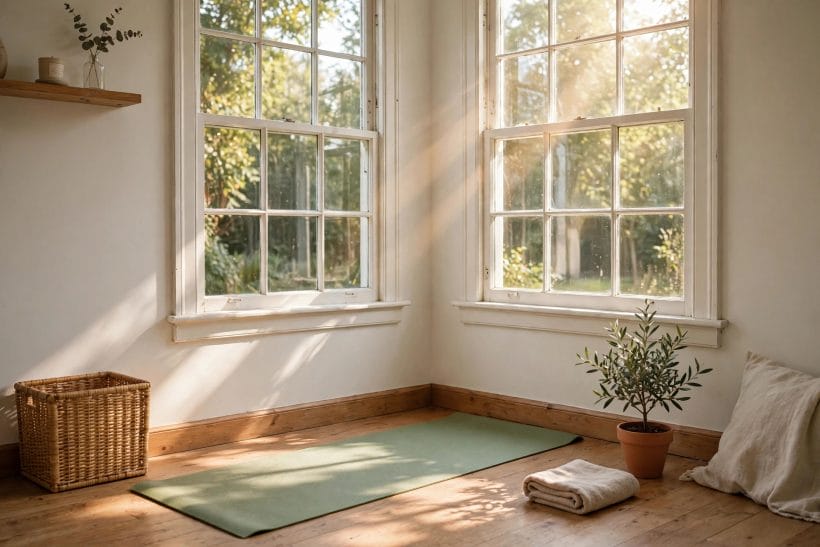
Before furniture, before colour: the studio begins as a decision about where the mat lives. These are the candidate spaces in most homes, and the honest test each must pass — a full stretch in every direction without meeting furniture.
1. The spare room, claimed properly
A spare room is the obvious studio and the most common disappointment, because spare rooms collect everything homeless. Claim it properly: the bed folds or goes, the boxes find real homes, and the room’s first identity becomes the practice.
2. The bedroom corner
A corner of the main bedroom works when it is visually separate — a rug defining it, the mat stored rolled in a basket, a plant marking the boundary. Practising where you sleep asks the corner to feel like a different place.
3. The landing or wide hallway
Landings are the house’s wasted width, and a mat fits more landings than expected. A runner stored rolled, a wall rail for props, and the space earns a daily purpose instead of a decorative one.
4. The garden room or conservatory
Light, plants and a view of green make garden rooms natural studios. Mind the practical side: glare at low sun, cold floors in winter, and heat at midday — sheers and a rug solve most of it.
5. The garage or outbuilding conversion, stated generally
A cleaned, insulated outbuilding makes a fine dedicated studio; the work is in warmth, ventilation and a floor you would happily lie on. Any structural or electrical work belongs to qualified trades and local rules, as everywhere in this post.
6. The living room, by arrangement
Where the living room must host practice, agree the arrangement as a household: furniture on castors or light enough to shift, the mat’s home beside the sofa, and a screen or curtain to close the space. Ritual makes it work.
7. Test the space at your practice hour
Stand in the candidate space when you actually practise: dawn glare, evening noise, the neighbour’s television, the household’s traffic. A beautiful space at the wrong hour is the wrong space.
8. Measure the stretch, not the room
Lie on the floor and stretch fully in every direction; mark where hands and feet reach. That honest oval is the studio’s true floor plan — everything else in the room arranges itself around it.
9. Keep a door, or fake one
An interruptible practice is a shorter practice. A closing door is best; failing that, a screen, a curtain on a rail, or headphones and a household agreement. The boundary is a design feature, not a luxury.
3. Layouts: The Mat, the Wall and the Clear Zone
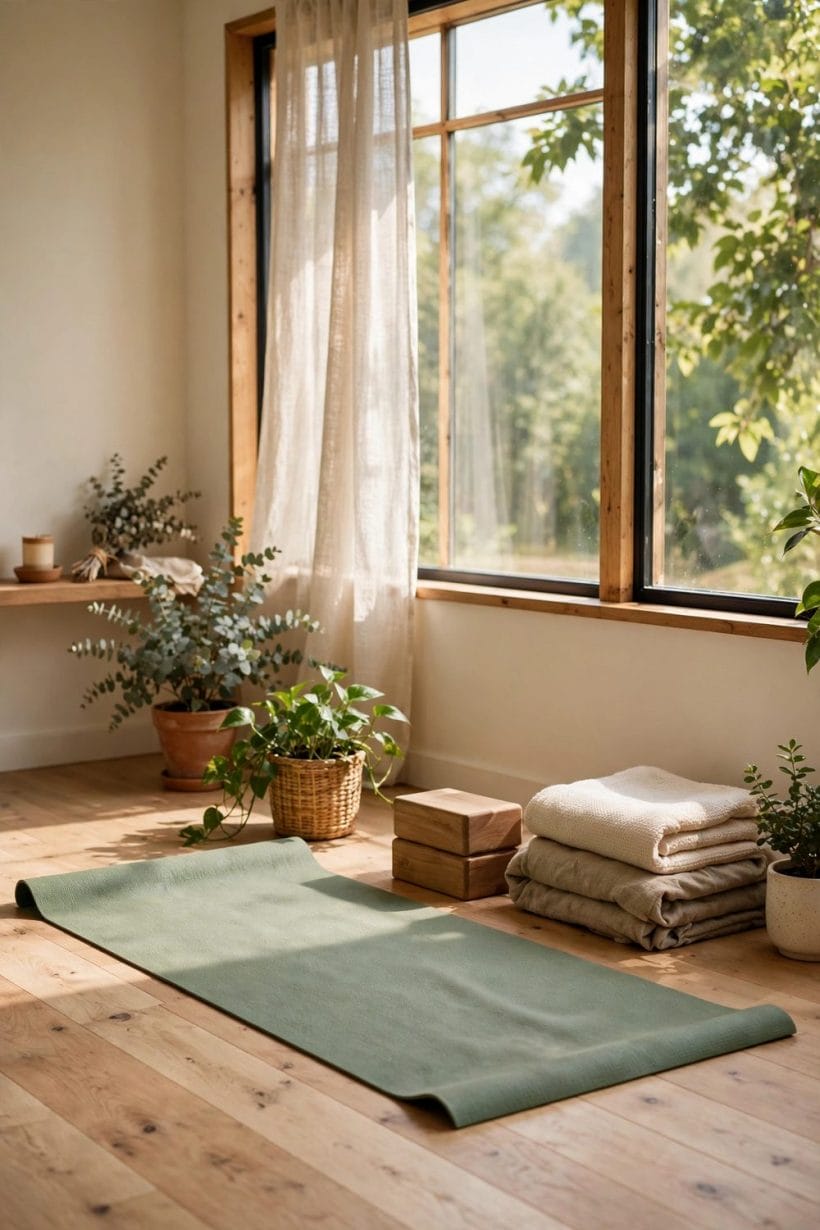
Studio layout is mostly negative space arranged well. These layouts place the mat, use the wall as equipment, and keep the clear zone sacred against the creep of ordinary life.
10. Mat parallel to the long wall
The natural first layout: mat along the room’s longest wall, wall available for support, window light arriving from the side rather than into the eyes. Simple, and most studios never need more.
11. Mat facing the window
Facing green and daylight lifts a morning practice; facing a blank wall settles an evening one. If the room allows both, let the mat rotate with the hour rather than fixing the room to one mood.
12. The wall as your second teacher
One bare stretch of wall is studio equipment: support for inversions and stretches, alignment for standing work. Keep it bare on purpose — no shelves, no frames at body height, nothing to negotiate with.
13. A prop station at the mat’s head
Blocks, strap, bolster and blanket within arm’s reach of the mat’s top corner ends the mid-practice wandering that breaks concentration. A low shelf, a basket or a bench: one station, everything in it.
14. The clear zone marked by a rug
A large flat rug under and around the mat draws the studio’s border on the floor — inside it, nothing else lives. In shared rooms the rug is the whole architecture of the studio, and it works.
15. Furniture pushed to a single wall
In dual-purpose rooms, gather everything against one wall — desk, chair, storage — and let the other three sides stay empty. The room reads as a studio with a desk in it, not a desk room with a mat problem.
16. A folding screen for instant enclosure
A screen across the corner converts shared space in seconds and folds away flat. Choose one tall enough to sit behind the eye line when you are on the mat; the enclosure is psychological, and it is enough.
17. Low furniture only, below the sight line
Seated and lying, your world is the room’s lower half. Keep studio furniture low — benches, floor cushions, low shelves — and the space feels taller, calmer and larger than its measurements.
18. A small altar shelf or intention corner
Many practitioners keep one small composed spot — a candle, a plant, an object with meaning — as the room’s focal point. Kept tiny and tidy, it gives the eye a resting place and the room its centre.
4. Floors, Mats and the Surface Question
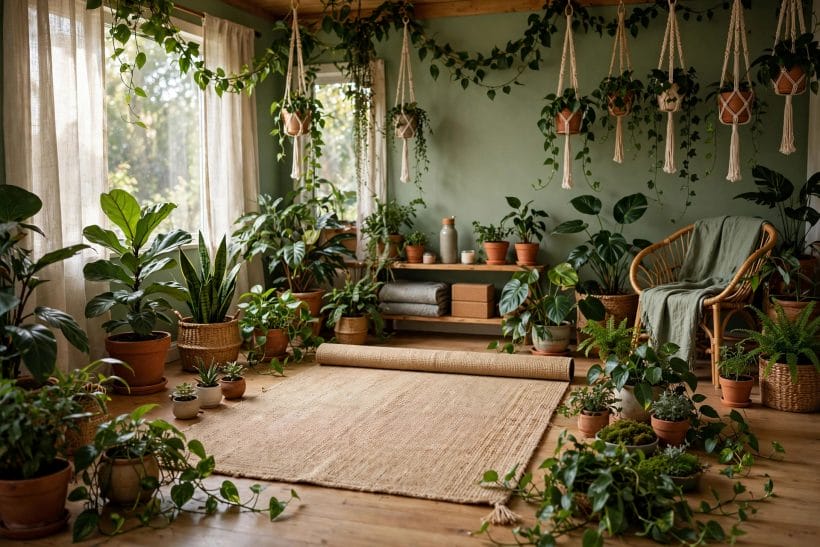
You will spend more time in contact with this floor than with any furnishing in the house. These choices balance grip, warmth and kindness to joints — stated generally, because bodies and floors both vary.
19. Timber floors: the studio classic
Warm, even and honest underfoot, boards are the surface most studios are photographed on for a reason. A mat grips them well; check for splinters and draughty gaps in older floors before the first winter practice.
20. Cork for warmth and give
Cork is quietly kind — warm to lie on, softly forgiving, naturally grippy. It suits studios over cold subfloors and anyone whose practice is floor-heavy. Seal and maintain it as its maker directs.
21. The mat itself: grip before cushion
A mat that creeps or curls ruins more practice than a thin one. Prioritise a surface that grips floor and hands, lies flat at the corners, and is long enough that your whole body is on it, not negotiating its edges.
22. A rug under the mat for cold floors
On stone, tile or draughty boards, a flat woven rug under the mat insulates and silences. Keep it thin and firm — deep pile under a mat turns standing work into balancing on a mattress.
23. Extra padding where the floor work is
A folded blanket or a second thin mat at the end where floor postures happen adds kindness exactly where knees and hips ask for it, without softening the standing zone.
24. Heated floors and simple warmth
A warm floor transforms winter practice; where fixed heating is absent, a rug, a pre-warmed room and socks for the still parts do most of the same work. Warmth is a design feature here, not an indulgence.
25. Tiles and stone: beautiful, with conditions
Stone and tile look serene and feel honest in summer, but they are cold and unforgiving — fine with a good mat and rug system, poor bare. In bathrooms-turned-studios, manage water and slip with extra care.
26. Carpet: work with what exists
Deep carpet fights standing balance; a firm mat over it, or a large flat board or rug as a practice platform, restores stability. Short-pile carpet under a grippy mat is workable for most gentle practice.
27. A floor you can clean in minutes
The studio floor meets bare feet and faces. Smooth, sweepable surfaces win; whatever you choose, if cleaning it is a project, it will not be clean. Simplicity here is a practice decision.
5. Light: Windows, Sheers and Evening Calm
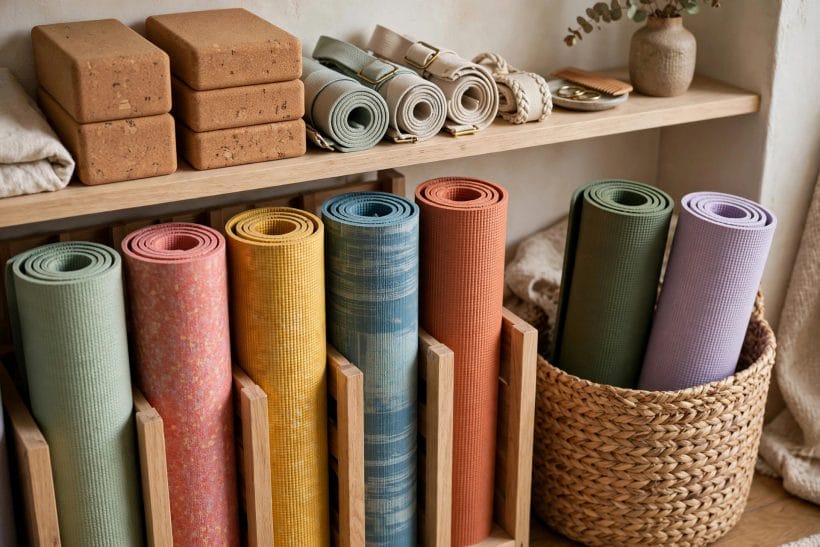
Light sets the studio’s mood more than any object: bright and green for mornings, low and warm for evenings. These choices give the room both registers without glare in the eyes at the wrong moment.
28. Sheers to soften direct sun
A linen sheer across the window keeps the light and removes the glare — lying on a mat means looking at the ceiling and window more than in any other room, so softness overhead matters.
29. Face the mat away from the brightest pane
Arrange the practice axis so strong light arrives from the side or behind, not straight into upturned eyes. A quarter-turn of the mat solves what blackout blinds would over-solve.
30. A dimmer or lamp for the evening register
Evening practice wants one warm lamp, low and shaded, rather than ceiling light. If the room has a dimmer, the studio inherits a whole mood for free; candlelight, used safely, is the oldest version.
31. North light for evenness
Rooms lit from the north hold a steady, shadowless light that flatters slow practice and screens alike. If you can choose the room by its light, this is the one artists and practitioners have always shared.
32. Blackout options for restorative sessions
For rest and stillness in bright rooms, a blind or heavier curtain that can truly darken the space earns its place. It is the one place the studio borrows the bedroom’s tricks.
33. Plants on the sill to filter and frame
A sill of green filters light, softens the window’s rectangle and gives the gaze somewhere kind to rest. Trailing plants at the window’s edge are the studio’s cheapest decoration — the leaf-first instinct that tropical interior design builds whole rooms around, borrowed here at window scale.
34. Keep screens from glaring
If you follow classes on a screen, place it out of the direct window line and at a height visible from standing and seated positions. A small shelf or stand dedicated to it ends the wobbling-stack problem.
35. Warm bulbs, matched and few
One or two warm light sources beat many cool ones. Consistency keeps the room’s colour calm at night, and a single lamp’s pool of light suits the inward turn of evening practice.
36. A window seat or cushion for the pause
Somewhere soft to sit before and after — a cushion by the window, a folded blanket on a bench — stretches the studio’s usefulness beyond the mat and gives visitors to the room a place that is not the floor.
6. Colours and Calm Finishes
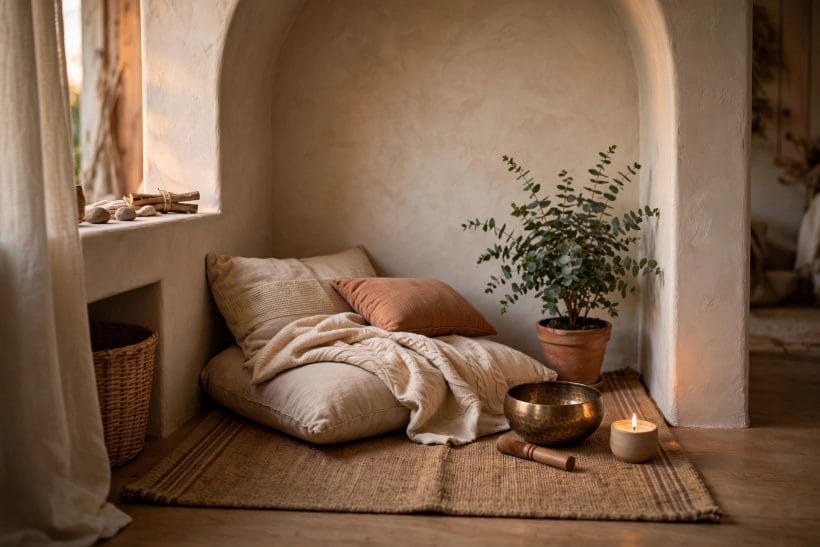
Studio colour works at the speed of breathing: quiet backgrounds, one living green, natural materials. These palettes keep the room’s visual volume low without making it empty or cold.
37. Warm white and cream: the base note
A warm white wall reflects soft light, hides the room’s awkwardness and lets the mat, the plants and the body be the colour. It is the default for good reason, and the easiest to live beside daily.
38. Sage and eucalyptus greens
Muted greens are the studio’s favourite accent colour — the plant effect, extended to a wall or a cabinet. Keep them greyed and gentle; the room should feel like shade, not like a smoothie.
39. Clay, sand and plaster tones
Earthy neutrals — clay, sand, warm plaster — give the room a grounded, slightly ancient calm that suits slow movement. They pair naturally with timber and linen, the studio’s staple materials.
40. One deep wall for focus
A single deep wall — forest, ink, charcoal-plum — behind the mat’s focus point gives the eye a restful depth to settle on. Keep the other walls pale so the depth stays a backdrop, not an enclosure.
41. Timber as the colour scheme
Where walls must stay plain, let wood supply the palette: a timber floor, a bench, shelf and stool in mixed warm woods. It is the oldest studio scheme and the hardest to get wrong.
42. Avoid visual noise at eye level
Busy wallpaper, crowded galleries and high-contrast patterns sit exactly where a practising eye rests. If you love pattern, put it in a cushion or a rug border — below the sight line, where it charms without chattering.
43. The mat as the room’s colour decision
The mat is the largest coloured object in the studio. Choosing it in a deep, calm tone — or a natural fibre finish — settles the whole palette; a lurid mat makes the room argue with it daily.
44. Natural textiles only, where you can
Cotton blankets, linen cushions, wool throws: the studio is a room of skin contact, and natural fibres feel and age accordingly. Their slight irregularity is also the room’s texture — calm needs some grain.
45. Repaint small: the studio forgives experiments
A studio is the cheapest room to repaint — little furniture, few fiddly edges. If a colour tempts you, this is the room to learn in; a weekend restores calm if the experiment fails.
7. Storage for Mats, Blocks and Props
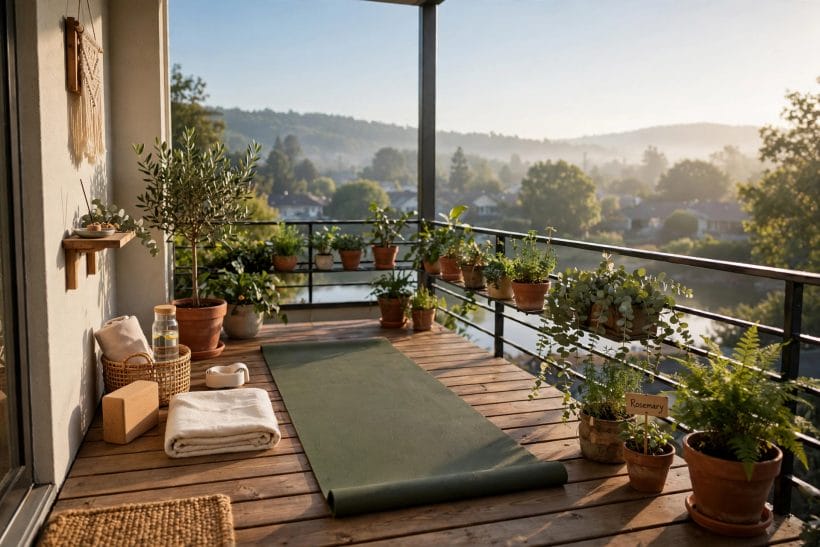
A studio stays a studio only if its equipment disappears gracefully. These storage ideas keep props beautiful in view or honestly out of it — the test being that resetting the room takes minutes, not a project.
46. The rolled-mat basket
A tall woven basket by the door swallows rolled mats and reads as decoration the rest of the day. It is the single most useful storage object in the home studio, and the prettiest.
47. A low bench with the props beneath
A simple bench along the wall seats the pre-practice pause and stores blocks, straps and a bolster in its shadow below. One piece of furniture, two jobs, no visual noise.
48. Wall hooks and a rail for straps and bands
Straps, bands and a spare towel hang neatly from a rail of hooks at the room’s edge — visible, tidy, and dry. Keep the rail outside the bare practice wall the layout depends on.
49. Blankets folded as furniture
A stack of folded practice blankets on a low stool is storage that looks like styling. In natural fibres and the room’s palette, the pile earns its place in every photograph of the room.
50. A lidded box for the small things
Eye pillows, incense, a timer, spare hair ties — the studio’s small clutter collects in one lidded box or drawer. When the lid closes, the room is calm again.
51. Shelves sized to the blocks
One shelf at exactly block height, in the prop station at the mat’s head, ends the stacking and toppling. Measure the shelf to the props you own; generic shelving wastes the studio’s scarcest resource — clear wall.
52. The wardrobe or cupboard studio
Where the room is shared, a single cupboard that takes everything — mats upright, props shelved, blankets folded — is the whole storage strategy. Doors closed: a sitting room. Doors open: a studio.
53. A wheeled caddy for shared spaces
In dual-purpose rooms, a small trolley or crate on castors carries the kit in and out in one trip. The studio assembles and dissolves in minutes, which is what makes the routine survivable.
54. Nothing stored on the practice floor
The rule that protects all the others: storage lives at the room’s edges, never in the clear zone. The moment the floor becomes a shelf, the studio starts its slow return to spare room.
8. Mirrors, Sound and Screens
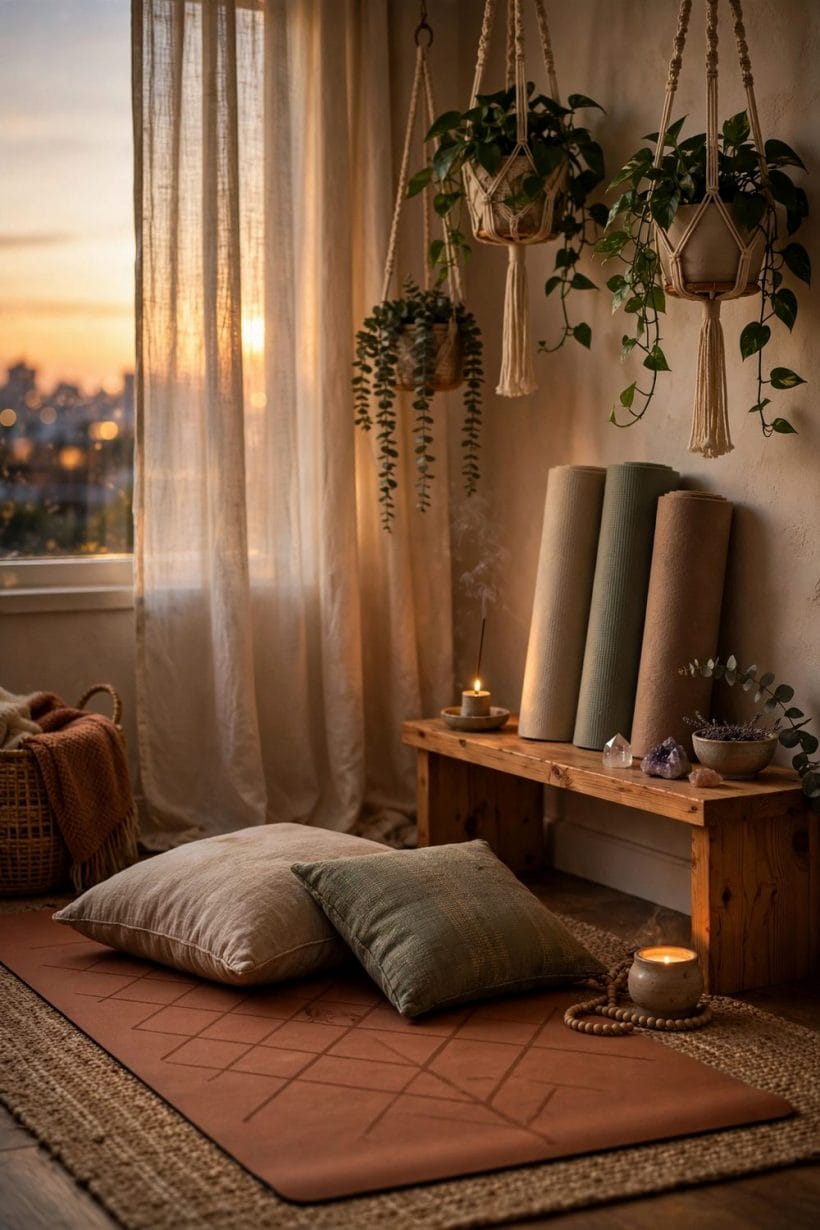
The studio’s technology is modest — a mirror if you want one, sound if you like it, a screen if you follow classes — and each piece earns its place or stays out. These are the balanced versions.
55. A mirror, used deliberately
A mirror helps alignment and doubles light, but it also invites self-consciousness. Compromise: one mirror on the side wall, or a covered mirror — a curtain or screen across it — for the inward parts of practice.
56. A leaning floor mirror for small rooms
A tall leaning mirror makes a corner studio feel twice its size and needs no fixing. Angle it to reflect the window and plants rather than the room’s stored clutter.
57. Sound: one small speaker, out of sight
Music and guided sessions need only a small speaker on the prop shelf. Keeping it out of the sight line keeps the room analogue in feeling even when the class is digital.
58. Soft furnishings as the acoustic treatment
Rugs, blankets and curtains already in the room do the acoustic work — a bare hard studio echoes unpleasantly. If the room rings, add textile before adding technology.
59. The screen on a stand, not a stack
A tablet or laptop for classes belongs on a small dedicated stand at mat height range — visible standing, seated and lying. A wobbling pile of books is the one piece of studio furniture everyone regrets; the considered version of screen placement is the whole subject of media wall living room ideas.
60. Cables and chargers, banished to the box
One charging spot inside the prop box or cupboard keeps every cable out of the practice zone. Bare feet and cable snakes are enemies; design them apart.
61. A door sign or household signal
The humblest studio technology: a closed door everyone respects, or a small sign during practice hours. The room’s calm is partly a social arrangement, and arranging it once beats negotiating it daily.
62. Scent, kept simple and safe
If scent belongs in your practice, keep it minimal — fresh air first, perhaps a candle used with the usual care, or a plant doing the work. Strong fragrance in a small breathing space argues with the practice.
63. A clock you can ignore
A quiet clock on the wall behind the mat’s usual facing lets timed practice run without a phone in the room. The phone, ideally, is the one device the studio never admits.
9. Small Corners, Shared Rooms and Real Life
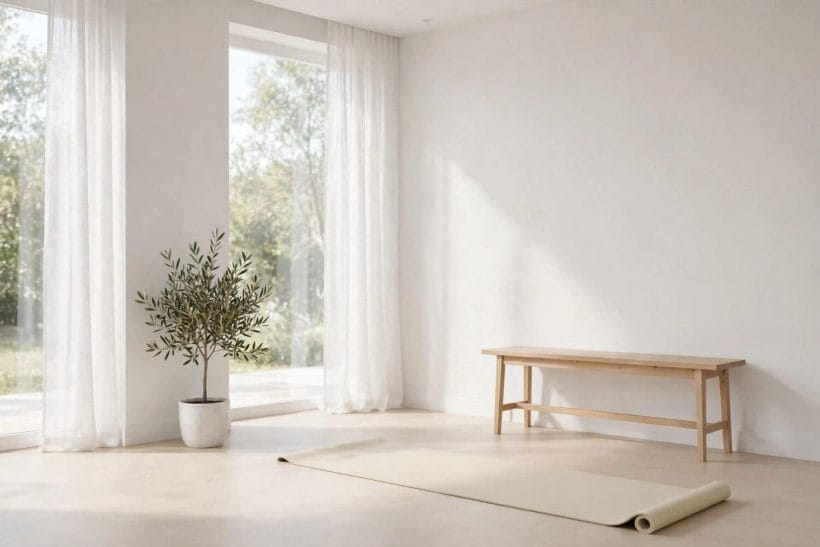
Most home studios are corners pretending bravely, and most succeed. These small-space versions keep the essentials — clear floor, calm light, stored props, a boundary — at the scale real homes offer, the same discipline the tiny house living room interior design collection applies to sitting space.
64. The corner studio, fully committed
Choose the corner, then commit: rug down, mat basket beside it, plant on the sill, screen or curtain for enclosure. A corner treated as a room outperforms a room treated as an afterthought.
65. Under-stair and alcove studios
Alcoves and under-stair spaces fit seated and floor practice beautifully even where standing room is short. Match the practice to the architecture instead of fighting it, and the odd space becomes the favourite one.
66. The fold-away desk pairing
Office by day, studio by evening works when the desk folds, the chair rolls into it, and the mat unrolls over the same floor. Two rituals, one room, neither apologising to the other.
67. Guest room mathematics
A sofa bed or a folding futon instead of a permanent double returns most of the floor to the studio. Guests stay a few nights a year; the practice is daily — furnish for the daily.
68. A balcony or terrace practice ledge
Where climate and privacy allow, an outdoor ledge — mat stored just inside the door, a rail plant, a weatherproof box — extends the studio into the garden for the bright months.
69. Children’s hours, grandparents’ hours
In shared family homes the studio is often a time rather than a place: the same clear floor, claimed by routine at an agreed hour. Design supports it — everything on wheels, everything with a home.
70. The five-minute reset
Judge every studio decision by the reset: can the room return from ordinary life to practice in five minutes, alone, without irritation? If yes, the design is right, whatever it looks like.
10. Costs, Care and Choosing Well
The home studio is the cheapest room in the house to create and the easiest to spoil by buying. These closing decisions keep the spending honest and the room in daily use.
71. The honest cost drivers
Money goes, in order, to the floor if it needs help, the mat, storage that makes the routine survivable, and light control. Decoration is last because the room is decorated by emptiness — most studios improve as things leave.
72. Buy the mat once, properly
The one piece of equipment used every session deserves the budget’s respect: grip, flatness and length over colour and pattern. A good mat outlasts a decade of practice; a poor one is replaced yearly and resented daily.
73. Second-hand and borrowed first
Benches, baskets, screens and stools are all findable second-hand, and their slight age suits the room. Live with borrowed arrangements before buying furniture — the studio you need is smaller than the studio you imagine.
74. Care: air, sweep, wash, repeat
The studio’s maintenance is a ritual in itself: air the room, sweep the floor, wipe the mat, wash the blankets. Five unglamorous minutes that keep bare feet and deep breaths welcome.
75. Let the room grow with the practice
Begin with the corner and the basket; let months of practice argue for every addition. A studio assembled slowly, each piece earned by use, ends up exactly fitted to the person who practises in it.
Final Considerations
Roll out the mat at your usual hour and look at the room from the mat’s height: clear floor, kind light, props within reach, the door’s promise respected. If the space settles you before you begin, the design has done all its work — the rest is practice.
A home yoga studio earns its place by being several good decisions at once — a space honestly claimed, a floor kind to joints, light that can soften, storage that makes the routine effortless, and a boundary the household honours. Keep the claims modest and the splits clean — the workspace with the studio post, the sitting room with its pillar — and let this room be what it is: the quietest square metres in the house, furnished by removal and kept by routine.

0 Comments