
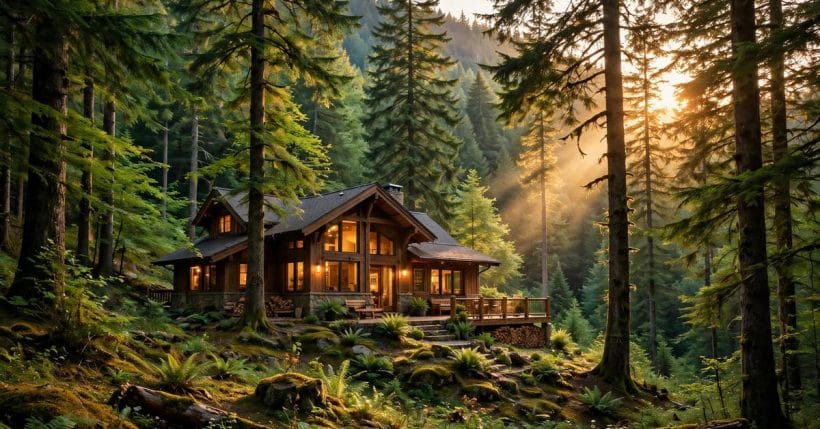
Every woodland house begins as a daydream: morning light through leaves, birdsong instead of traffic, a door that opens onto trees. The houses that live up to the dream are the ones whose owners planned for the forest as it is — shade, damp, wildlife, fire risk and all — rather than the forest of the photograph.
This guide works through a house in the woods in the order the decisions arrive: choosing the clearing, siting and reaching the house, living with canopy light, building in materials that belong, and keeping the place safe through the seasons. Timber-built relatives like barn homes share much of this ground; the woodland setting has its own rules, and they are all here.
1. A House in the Woods at a Glance
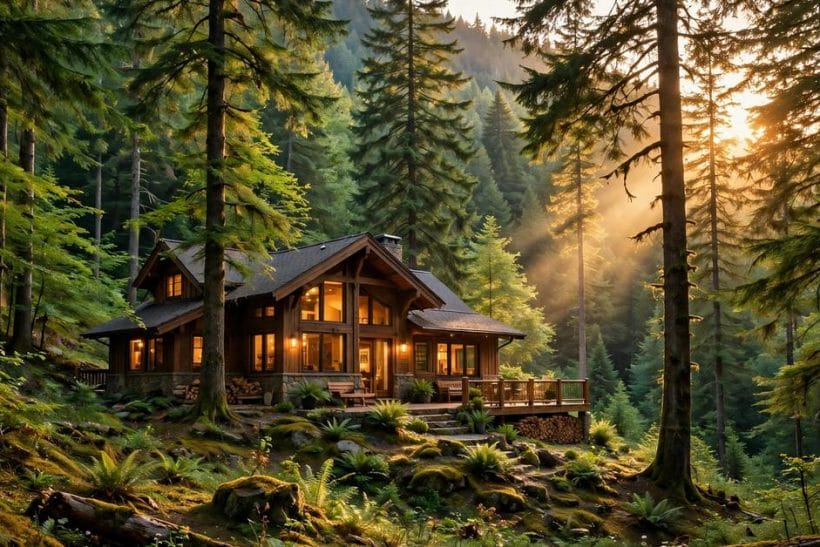
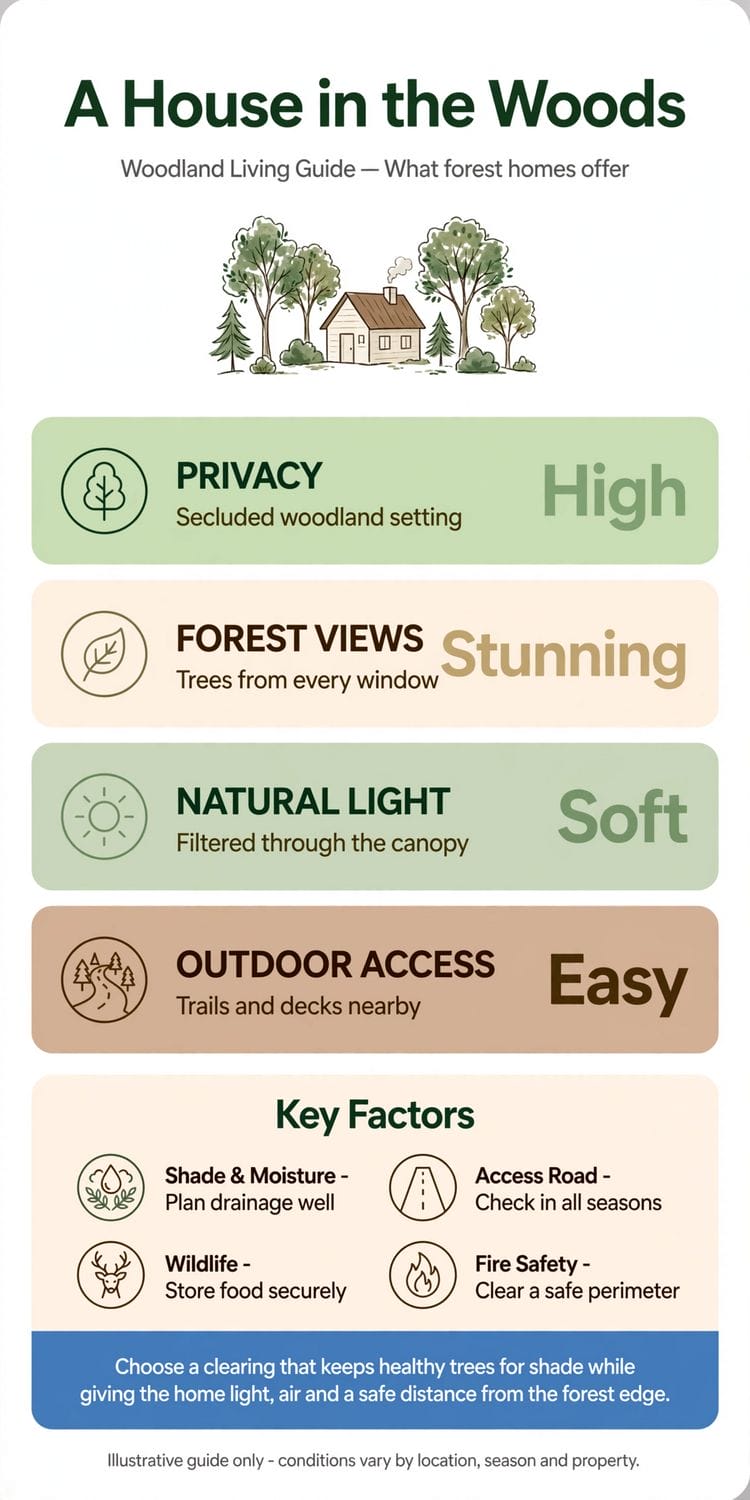
A woodland house is a home set within or at the edge of established trees, where the forest is the garden and the setting does the decorative work. Its rewards are privacy, shelter, views of green from every window and a microclimate that softens summer heat and winter wind. Its costs are equally real: less direct sun, more moisture, leaf and branch management, wildlife as neighbours, and access that must work in every season. The sections below take each in turn, honestly.
| Question | Short answer |
|---|---|
| What is the ideal site? | A gentle clearing with healthy trees kept at a safe distance, sun reaching the roof for part of the day |
| What is the biggest design factor? | Light — the canopy filters it, so windows, orientation and interior finishes must be planned around soft, shifting light |
| What surprises new owners most? | Moisture and maintenance — gutters, roofs and paths need a rhythm of clearing the suburbs never teach |
| Is fire a real concern? | In dry forest regions yes — a cleared perimeter, ember-safe detailing and an access plan are part of the design, not extras |
| Who thrives in a woodland house? | Households that want quiet, wildlife and seasons — and accept the upkeep as part of the pleasure |
2. Choosing the Clearing
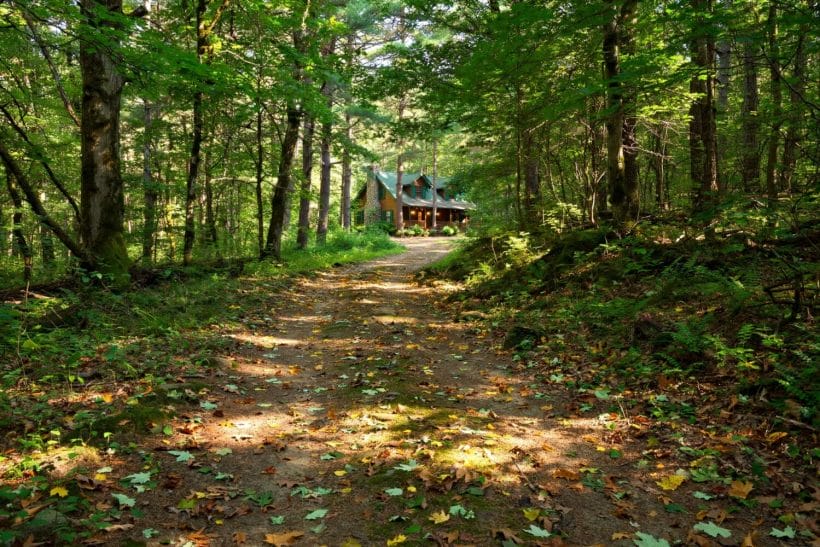
The best woodland houses keep most of their trees. A total clearing throws away shade, shelter, privacy and the very point of the address, and it leaves the house exposed to wind and view. The skill is editing: removing trees that threaten, sicken or crowd, and keeping the healthy frame of woodland around the walls. Walk the site in more than one season if you can — a clearing that glows in June can sit in deep, damp shade from November to March, and the trees you keep will decide the house’s light for decades. Note where water gathers after rain, where the breeze moves, and which trees lean, creak or drop limbs; the forest tells you where the house wants to be, if the visit is long enough to listen.
Read the trees themselves as part of the survey. A healthy woodland edge — mixed ages, full canopies, saplings coming on — will shelter the house for decades and regenerate its own windbreak. A stand of same-age trees in decline promises a decade of removals and a slowly vanishing setting. Keep veteran trees where they stand safely: they carry the birds, bats and character that younger planting takes a generation to replace. And feather the clearing’s edge rather than cutting it hard — a graded margin of shrubs and smaller trees softens wind, hides the house gently, and stops the clearing from reading as a scar in the canopy from every viewpoint but your own.
3. Siting and Access
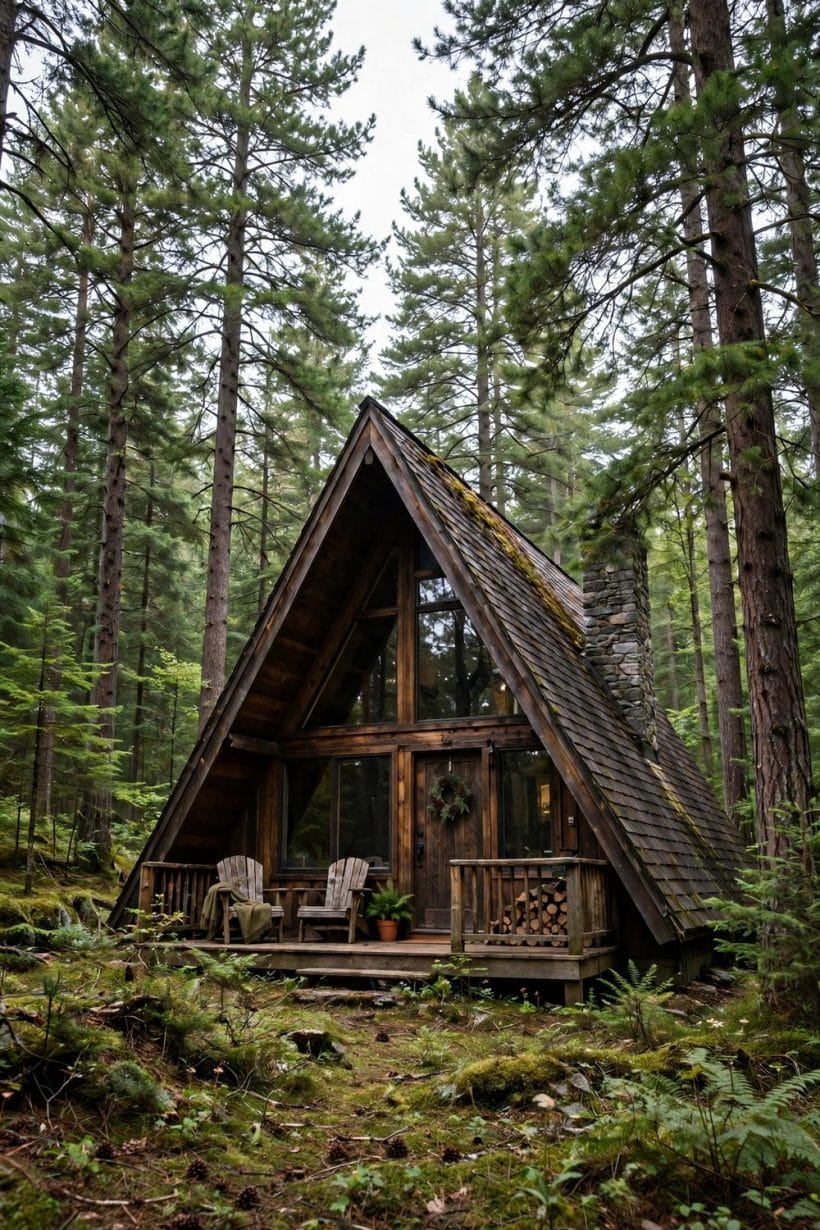
Place the house where the ground is driest and the access shortest. A track that winds beautifully in summer can become an expedition in ice, mud or flood, and everything a household needs — fuel, food, help — travels that track. Check the route in all seasons before committing, as the banked guidance for forest homes always insists: gradient for winter grip, drainage where the track dips, and room for a delivery vehicle to turn. Set the building a sensible distance from the largest trees — far enough that roots, shade-thirsty moss and falling limbs are managed risks rather than annual events. Structures like pole barn homes solve rural access pragmatically; a woodland house can borrow that honesty while keeping its own softer face.
Orientation deserves its own decision before the footprint is fixed. Give the long, glazed side of the house the best of the available light — in practice the direction where the canopy is thinnest or the slope falls away — and put stores, stairs and bathrooms on the shaded side where daylight matters least. Remember the invisible siting too: wells, septic runs, power and water lines all cost more per metre through root-filled ground, and tight access raises the price of every delivery during the build itself. A site that looks idyllic and prices terribly is a common woodland story; the builders’ quotes, gathered before purchase, are part of the romance’s due diligence.
4. Light Under the Canopy
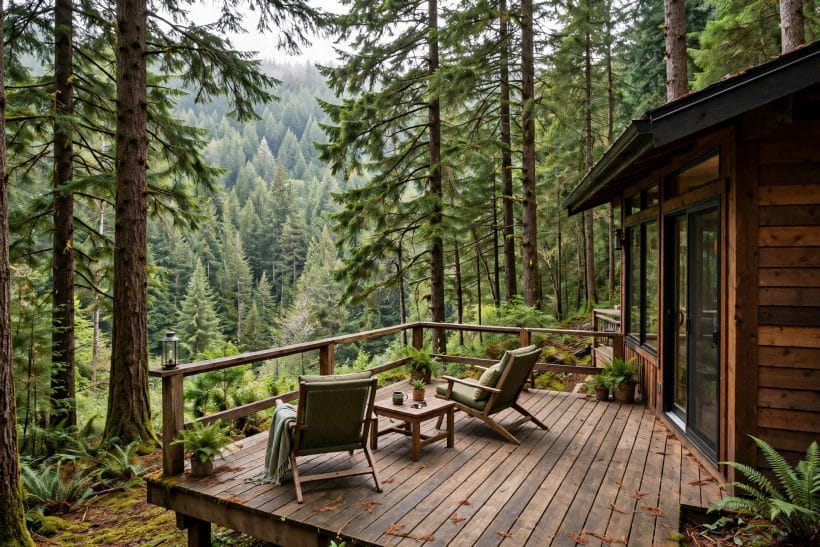
Filtered light is the woodland house’s signature interior condition — soft, green-tinted and constantly moving. Design with it rather than against it. Tall windows on the sunniest elevation gather what the canopy allows; pale interior finishes bounce it deeper into the plan; and rooms are arranged so the ones lived in by day sit where the light actually lands. A kitchen marooned on the shaded side will feel cave-like by October however large its windows are. Skylights over stairs and halls borrow light from above the lower branches and can transform the centre of the plan. Accept, too, what the forest gives back: the moving pattern of leaf-light on a wall is a decoration no wallpaper has ever matched.
Finishes inside should be chosen under the canopy’s green tint, not the showroom’s white light. Blues go grey, creams go sage, and whites take a permanent hint of the leaves outside — test every paint and fabric in the room it will live in, across a full day, before committing. Warm materials forgive the tint: natural wood, wool, linen and leather all sit happily in green light, which is why woodland interiors return to them so reliably. For the hours when the canopy wins entirely, plan layered artificial light — warm lamps at sitting height rather than a single ceiling glare — so winter afternoons feel lamplit rather than lightless.
5. Materials that Belong
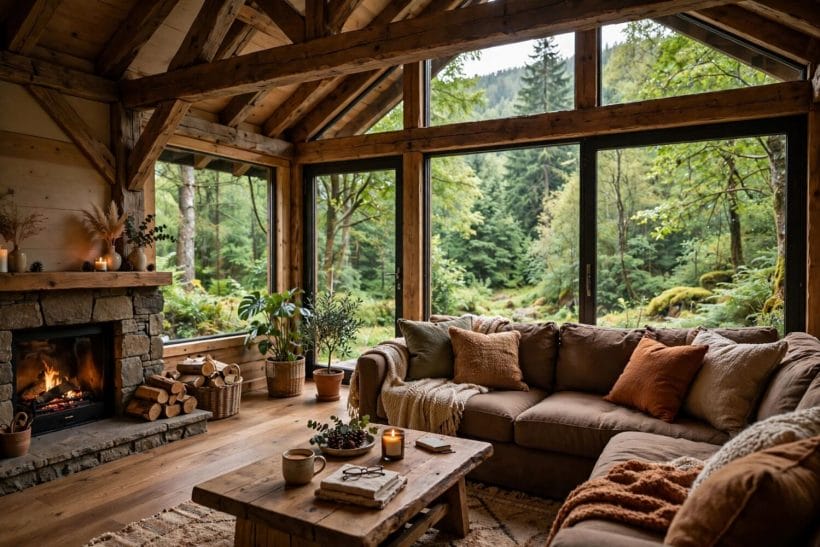
Timber cladding, stone at the base, a roof in a muted mineral tone — woodland houses look right when their materials could have come from the site itself. The modern rustic ideas post works this palette for interiors and exteriors alike; in the woods it has an extra duty, because the house is seen against bark and leaf all year. Timber weathers to silver-grey and disappears gracefully into the trunks; stone grounds the building against the forest floor and shrugs off the splash-back of a damp climate. Avoid bright, urban finishes: a glossy white box in deep woodland looks less like architecture and more like something delivered by mistake. Whatever the palette, detail for moisture — generous overhangs, ventilated cladding cavities, and gutters sized for a roof that collects leaves as faithfully as rain.
The details that fail first in woodland are the small metal ones: flashings, fixings and mesh. Use corrosion-resistant metals throughout, stainless where it is hidden and permanent, and fine mesh at every vent and eaves gap — the same screens that stop embers stop insects and small animals looking for a dry address. Raise timber off the ground on a stone or masonry plinth deep enough to defeat splash-back and discourage rot, and choose durable heartwood or properly treated timber for any board that lives in permanent shade. None of this shows in photographs; all of it decides whether the house still looks settled, rather than besieged, in its tenth wet winter.
6. Roofs, Leaves and Water
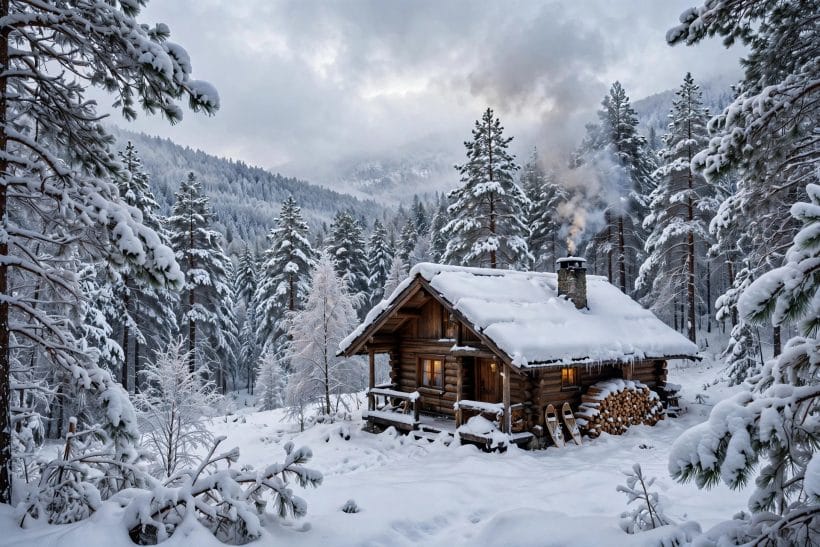
A woodland roof works harder than any other. It sheds not just rain but a steady fall of leaves, needles, twigs and seeds, and it sits in shade that keeps it damp long after suburban roofs have dried. Steep pitches shed debris best; simple roof forms with few valleys deny leaves their favourite dams. Gutters need guards or a clearing rhythm — an overflowing gutter in a forest is a monthly event, not an annual one. Water management continues at the ground: the drip line around the house should fall away to drains or gravel trenches, because a shaded, leaf-fed soil holds moisture against foundations with real persistence. Plan the wood store under cover while you are at it — a house heated by its own forest keeps its fuel dry as a matter of design, not luck.
Moss and shade are the roof’s quiet tenants. A shaded roof stays wet, and wet roofs grow moss that lifts edges and holds more water against them; keep overhanging branches cut back from the roof plane so sun and air can reach it, and clear growth gently on a rhythm rather than attacking it in a crisis. Where winters bring snow, remember that a woodland roof sheds late and sometimes all at once — keep paths, wood stores and parked cars out of the slide line, and never plant the bed you love under the eaves’ drop zone. The roof that is designed for its forest — steep, simple, ventilated, reachable — asks little; the roof that ignores it asks constantly.
7. Fire, Safety and Distance
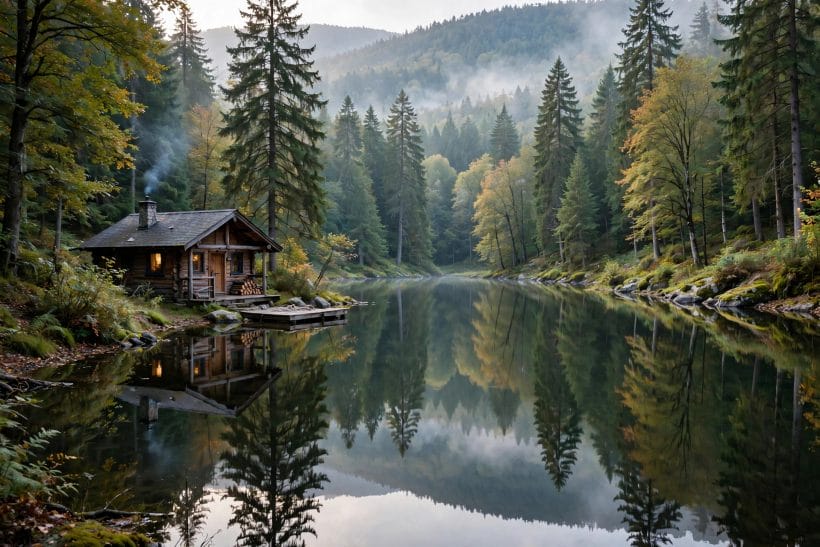
In regions where forest fires are a known risk, the house’s safety is designed, not hoped for. Keep a cleared, low-fuel perimeter around the building — gravel, lawn or managed ground rather than shrubs against the walls. Choose roofing and cladding with fire behaviour in mind, screen vents and gaps against embers, and keep the access track passable for the vehicles that would need it. Local fire guidance varies and should be followed where it exists; the principle everywhere is the same: distance, non-combustible edges, and nothing stored against the house that burns easily. Even outside fire regions, distance is the woodland house’s general safety rule — from dead limbs overhead, from trees whose lean has begun, and from the flood line of the stream that looks so harmless in August.
Build the safety habits into the year rather than the emergency. Walk the trees within reach of the house each autumn with a professional eye every few years — dead wood removed early is a small bill, removed by a storm it is a roof. Know the way out in the dark and keep it clear; keep the house’s setting honestly described to insurers and services, since a woodland address changes response routes and times. And store what burns — fuel, timber, machinery — in its own shelter away from the walls, the same discipline the wood store already taught. Safety in the woods is mostly this: nothing dangerous close, nothing important unreachable.
8. Wildlife and Boundaries
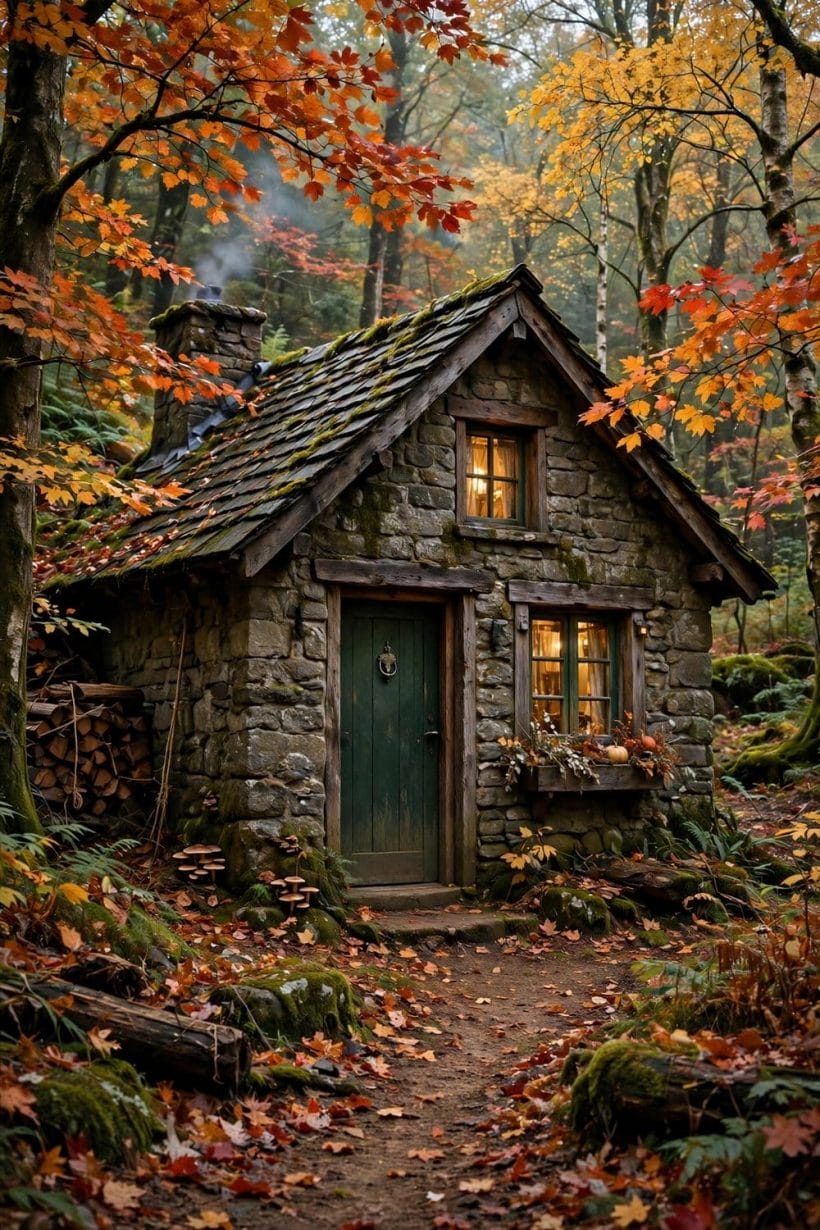
The forest was occupied first. Deer will garden for you, birds will nest in the eaves, and smaller creatures will test every gap in the building’s skin with professional persistence. The workable attitude is boundary-setting without warfare: store food and feed securely, as the woodland guidance puts it — bins that latch, stores that seal, nothing edible left to advertise the house as a restaurant. Mesh the vents, cap the chimney, and seal the eaves; plant the beds you care about inside a fence and let the rest be browsed in peace. Households that accept the cabin side of woodland living — part guest in the forest, part keeper of it — settle fastest; the house feels less besieged and more accompanied.
Gardens inside the boundary need the same realism. Fence the beds you truly care about — deer treat unfenced planting as a buffet with a view — and choose the outer planting from what browsing pressure cannot ruin: tough, plentiful, self-seeding things that share gracefully. Nesting and breeding seasons set their own calendar for tree work and clearing in many places, and protected species can make a particular tree or bank untouchable; check the local position before major work, as a matter of law as much as courtesy. A woodland garden run on these terms loses a battle here and there and wins the larger peace.
9. Living with the Seasons
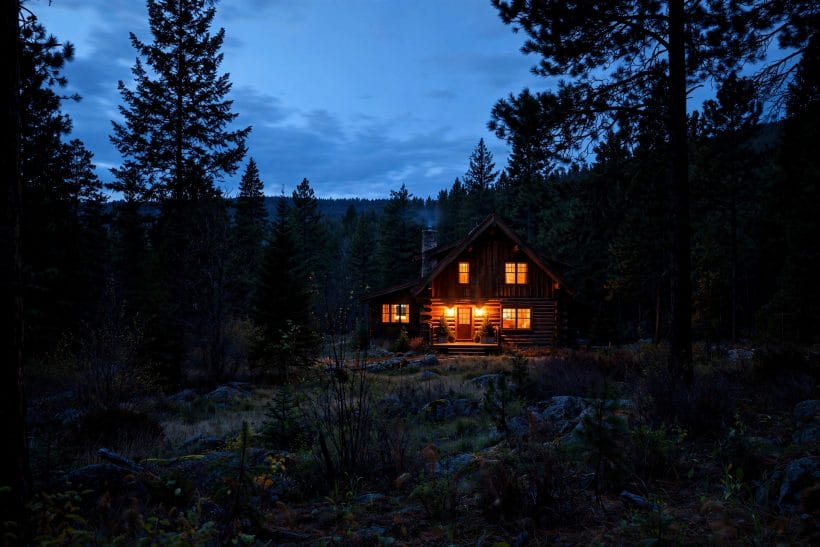
No setting teaches the year like woodland. Spring arrives as light before it arrives as warmth, when the canopy is still bare and the floor erupts in flowers. Summer is the green room itself — cool, shaded, private. Autumn is the maintenance season and the spectacle in one: gutters, roofs and paths all demand their rhythm while the colour lasts. Winter strips the house back to structure and smoke, and tests the access, the fuel store and the roof’s snow manners. Interiors lean into the cycle: the rustic interior palette of wood, wool and lamplight is not a style choice here so much as the house agreeing with its setting. Owners who keep a small seasonal checklist — track, gutters, chimney, perimeter, store — find the year runs as a rhythm rather than a series of ambushes.
Heating follows the same rhythm. A wood-burning stove suits the setting and the fuel supply, but the fuel must be cut, stacked and dried a full season ahead — the wood store is a calendar, not a cupboard. Damp, not cold, is the winter enemy indoors: steady background warmth and honest ventilation keep a shaded house dry where blasts of heat between cold spells invite condensation onto every cool wall. Live by those two rules and the woodland house in January is what the dream promised — lamplit, woodsmoke-scented, and quieter than anywhere else on earth.
10. Costs and Practical Checks
Woodland living’s costs are mostly rhythm rather than catastrophe, but they should be counted before the dream is bought. Tree work is the headline: budget for periodic professional attention to the trees within falling distance, and for the clearing and gutter rhythm the canopy imposes. Access is the second: a long private track is the household’s own road, maintained at the household’s expense. Then come the quieter items — damp management, more frequent exterior painting or oiling in shade, and the logistics of deliveries, waste and services at the end of a forest road. None of it outweighs the setting for the right household; all of it should be priced with open eyes.
Add the service realities to the same honest list. Deliveries may carry distance charges or refuse the track in bad weather; trades are fewer and travel further; a well, a septic system and a long private drive are the household’s own infrastructure to maintain. Connectivity — signal, broadband, post — varies by hollow and hillside and should be tested, not assumed, by anyone who works from the house. None of these are arguments against the woods. They are the difference between a woodland house that runs smoothly and one that surprises its owners monthly, and every one of them can be known before the purchase rather than after. Compact woodland plans, like the timber-frame cabin plans in the published collection, show how modest footprints keep every one of these rhythms affordable.
Final Considerations
A house in the woods is a negotiation with a living place, and the houses that succeed are the ones that keep negotiating — clearing a little, planting a little, watching the trees and the water, and letting the forest stay the senior partner. Choose the clearing with patience, build in materials that belong, design for the filtered light rather than mourning the sun, and keep the safety distances as faithfully as the view. Do that, and the daydream survives contact with reality: a house the forest seems to have been expecting.


0 Comments