
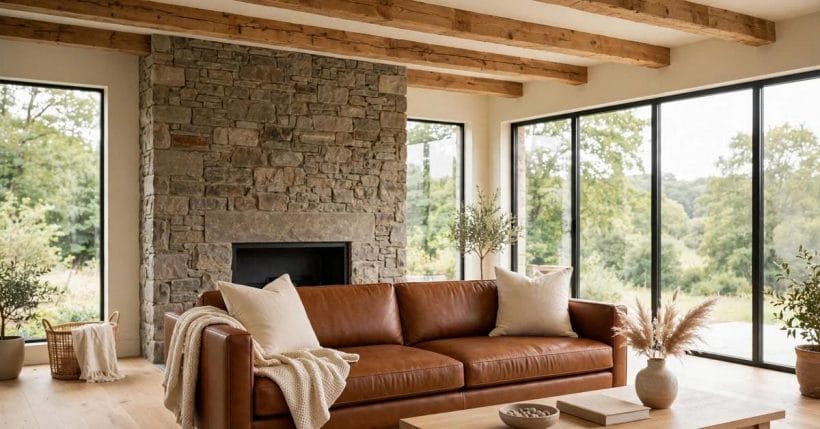
Some rooms are built from trees and stone and patience. Modern rustic is the style that remembers them — rough timber and honest iron, given clean lines and room to breathe.
These seventy-five modern rustic ideas work the mix through materials, colour, furniture and finishing touches, at every size from cabin to city flat. The sitting room, where the style usually starts, is planned whole in living room ideas; this post is about the language itself.
1. Modern Rustic Ideas at a Glance
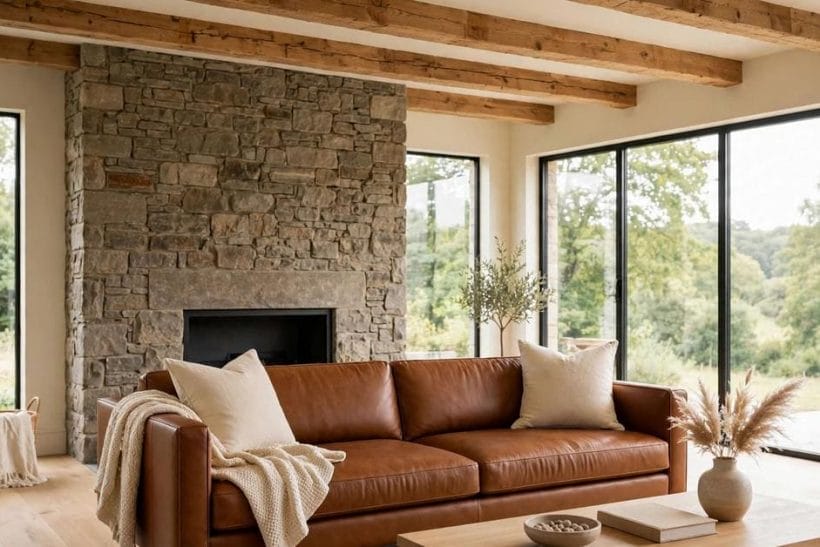
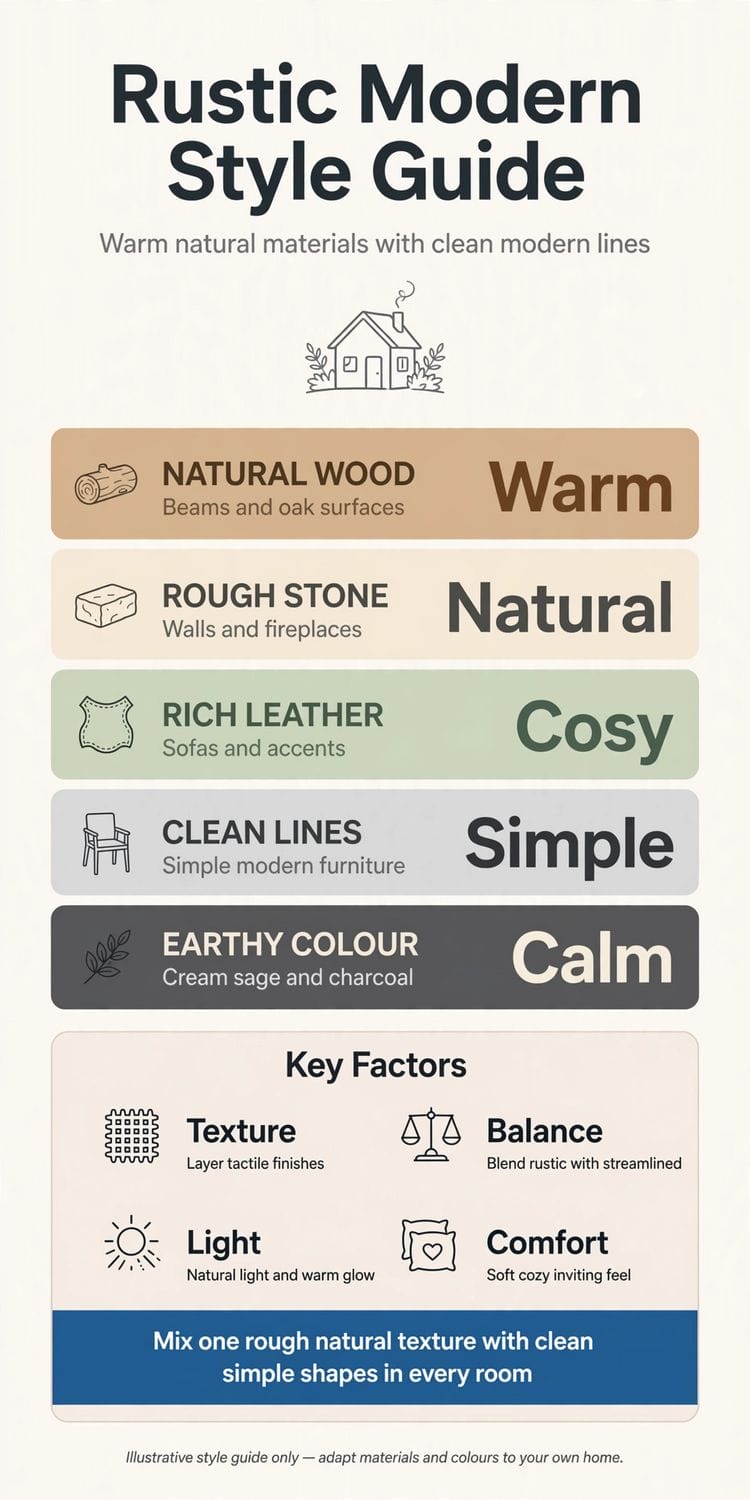
Modern rustic is an interior style that pairs rustic materials — reclaimed timber, stone, iron, leather, linen and wool, left matte and allowed to age — with modern design discipline: clean lines, edited possessions and generous empty space. Its centre of gravity is the material, not the ornament: a room succeeds when its oldest piece and its plainest piece look like relatives. It suits cottages and conversions naturally, and small modern flats surprisingly, because its furniture is solid, few and made to be kept. It is also a forgiving style for real households: its finishes improve with use, its textiles wash, and its idea of tidiness is a basket rather than a bare surface.
| Question | Short answer |
|---|---|
| What makes a room modern rustic? | Rustic materials carried on modern lines, with space left around both |
| What is the palette? | Warm whites, oat, stone, clay and wood browns, with black as punctuation |
| Reclaimed or new materials? | Reclaimed where it shows, new and plain where it works — patina cannot be faked |
| How much rustic is enough? | Weathered pieces in the minority, carrying the story; quiet modern pieces around them |
| What kills the style? | Theme clichés, gloss finishes and clutter without provenance |
2. The Modern Rustic Mix: Old Bones, Clean Lines
Modern rustic is a negotiation between two honesties: the rustic love of real material, weather and weight, and the modern love of clean lines, clear space and nothing kept without a reason. Neither side wins outright. The timber is left rough but the clutter is edited away; the sofa is tailored but its throw is hand-loomed. These seventy-five ideas work that balance room by room, starting with the mix itself. The style sits between two neighbours on this site: the fuller farmhouse treatment of farmhouse home design ideas on one side, and the layered pattern of victorian rooms on the other — modern rustic borrows the farmhouse’s materials and refuses its ornaments.
1. Start with one genuinely old thing
Every convincing modern rustic room has an anchor with a past: a scrubbed pine table, a beam with adze marks, a door reborn as a headboard. Build around that one piece and let everything else be calm, plain and new.
2. Let modern lines do the tidying
Rustic material without modern discipline becomes a junk shop. Flat-front cabinets, straight-edged shelving and unadorned upholstery keep the room’s outline crisp so the rough textures can be enjoyed rather than tripped over.
3. Keep the ratio honest
A room that is all rustic reads as a theme; a room that is all modern reads as a showroom. Aim for weathered pieces in the minority, carrying the story, with quiet modern pieces doing the everyday work around them.
4. Choose patina over distressing
Real wear — a table’s ring marks, a floor’s soft sheen — cannot be faked convincingly, and factory-distressed finishes date faster than either parent style. Buy old where it matters, buy plain where it does not.
5. Give every rough surface a smooth neighbour
A stone wall behind a tailored sofa, a raw beam above a sleek kitchen: contrast is the style’s engine. Rough beside rough is a cave; smooth beside smooth is a clinic.
6. Edit like a modernist, gather like a farmer
The gathering instinct fills shelves with finds; the editing instinct removes half of them. Modern rustic lives at the midpoint: fewer objects than a farmhouse, warmer ones than a loft.
7. Respect the building’s own era
A modern rustic scheme flatters beams, stone and brick that belong to the house. In a new flat it still works, but the rustic layer must be carried by furniture and textiles rather than pretend architecture.
8. Use black as the hinge
Blackened steel, iron and one or two black-framed pieces stitch the two styles together: modern in line, rustic in material, dark enough to outline both. It is the style’s most useful colour after wood brown.
9. Leave the imperfections that are structural
The wonky beam, the stone that bulges, the floorboard that dips — modern rustic keeps them and designs around them. Character is the one finish that cannot be bought by the tin.
10. Avoid the theme-park traps
Sliding barn doors on every opening, antlers as a logo, stencilled farm words on the wall: the style dies by its clichés. One barn reference per house is charm; five is a gift shop.
11. Let the room stay quiet
The finished test: a modern rustic room should feel calm before it feels styled. If the eye keeps snagging on rustic signals, remove one. Quiet is the modern half keeping its promise.
3. Materials: Raw Timber, Stone, Iron and Linen
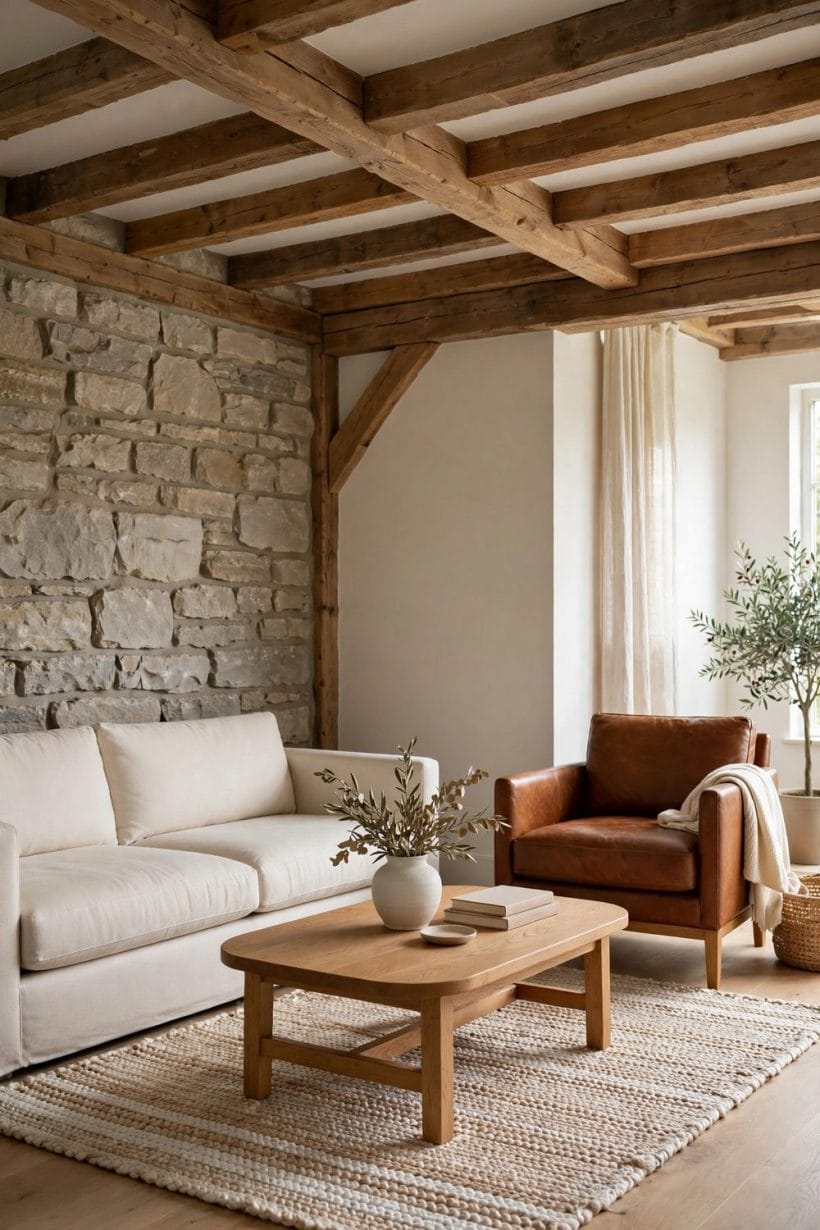
Materials are the style’s vocabulary, and it speaks in a short list of words it pronounces perfectly: timber with its grain showing, stone with its weight unhidden, iron, leather, linen, wool and clay. The short list is the discipline — a material outside it must argue its way in, and most cannot. The treatment of each is the same — honest, matte and allowed to age — whether the piece carrying it is two centuries old or made last spring.
12. Reclaimed timber with its history left on
Old joists, barn boards and scaffold planks bring saw marks, nail holes and a century of light in their grain. Used for shelves, mantels and table tops, they are the style’s fastest route to authenticity.
13. New oak, finished matte
Where reclaimed wood is impractical, new oak with a matte oil rather than a glossy varnish reads as its younger brother: same grain, same warmth, none of the plastic shine that betrays modern timber.
14. Stone as the heavy accent
A stone fireplace wall, a slate hearth or a single boulder of a doorstep gives the room geological calm. Stone should be used the way it occurs in old buildings — structurally, at the base of things.
15. Blackened steel and honest iron
Shelf brackets, lamp bases, stair rails and fire tools in black metal draw the modern line through rustic rooms. The finish should look forged or powder-coated, never chromed.
16. Linen in its natural shades
Flax linen — curtains, cushion covers, a loose sofa throw — softens every hard material it touches and wrinkles without apology. Its undyed oat and stone shades are the palette’s foundation.
17. Wool for weight and winter
A wool rug or blanket brings the barnyard’s warmth indoors in civilised form. Choose flat weaves and honest patterns; the material is decoration enough.
18. Leather that improves with use
One leather chair or a pair of worn leather cushions ages in public, darkening where hands fall. In a style built on patina, leather is the only upholstery that keeps its side of the bargain.
19. Clay, terracotta and stoneware
Pots, jugs and lamp bases in fired earth connect the room to the garden and the kitchen garden. Unglazed finishes sit best; the shine stays in the modern half’s glass and steel.
20. Concrete, used sparingly
A polished concrete floor or a single concrete-topped table cools a wood-heavy scheme and nods to the modern half. More than one large concrete gesture turns rustic warmth into warehouse chill.
21. Glass kept clear and simple
Modern rustic glass is a window, a lamp shade, a vase — never coloured, cut or patterned. Its job is to disappear so the materials around it can be seen.
22. What to leave out
High-gloss lacquer, mirrored finishes, crystal and gilt belong to other styles’ stories. In a modern rustic room they read as shouting. Matte is the manner; shine is the exception that proves it.
4. Colour and Light: The Warm-Neutral Palette
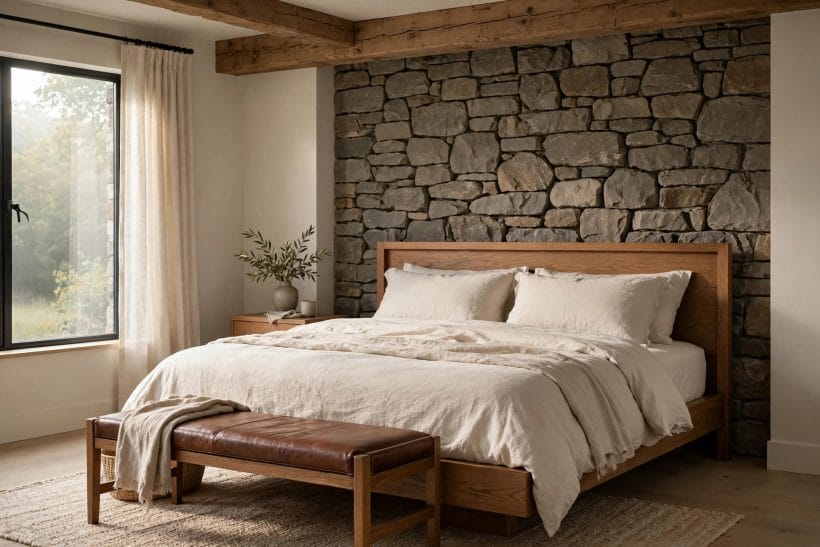
The colour scheme can be written on one line: warm whites, oat, stone, clay, wood browns, one black accent and one green plant. Modern rustic colour is really material colour — the palette is chosen by picking the timber, stone and textiles first and letting paint follow them, pale on the walls so the materials can speak.
23. Warm white walls, never blue-white
The wall colour that flatters timber and stone has a drop of yellow or grey in it — chalk, bone, limewash. Blue-whites make wood look orange and stone look dirty; warm whites make both look intended.
24. Paint woodwork the wall colour
Skirtings, doors and window frames in the same warm neutral as the walls remove visual chopping and let furniture carry the interest. The modern half approves; the rustic half never notices.
25. Let the timber set the temperature
Honey oak warms a scheme, walnut deepens it, weathered grey-brown cools it. Choose the wood tone first and treat it as the room’s largest colour — because it is.
26. Stone and clay as mid-tones
Between pale walls and dark wood, the scheme needs its middle register: stone grey, clay pink-brown, the grey-green of dried herbs. Cushions, rugs and pottery fill it naturally.
27. Black in small, repeated doses
One black object shouts; four whisper together. Repeat black in a lamp, a frame, a rail and a handle and it becomes the scheme’s punctuation rather than its headline.
28. Green arrives as a plant
The style’s green is alive: a fig in the corner, herbs on the sill, a branch in a stoneware jug. Painted green is welcome on a door or a dresser; the living kind does the rest.
29. Daylight treated as a material
North light cools the palette, south light gilds it. Test paint and fabric at the window they will live beside, and remember the rustic materials change character beautifully across the day.
30. Lamplight low and warm
Evenings in a rustic room belong to low, shaded, warm lamps — the modern equivalent of firelight. Overhead white light flattens texture and kills the style’s whole evening argument.
31. A fireplace or its stand-in
Where a real fire exists it is the room’s sun. Where it does not, a cluster of candles in an iron holder or a wood stove’s small cousin keeps the hearth idea alive without fakery.
32. Colour in the bedroom: duskier
Bedrooms take the palette one shade deeper — clay instead of oat, walnut instead of oak — while the family’s wider colour questions live in living room ideas and the bedroom pillar; here, dusk is the brief.
33. Test on the rough, not the smooth
Paint and fabric samples must be judged against the room’s roughest surface — the beam, the stone — because that contrast is where the scheme will succeed or fail.
5. Furniture and Layout: Heavy Pieces, Breathing Room
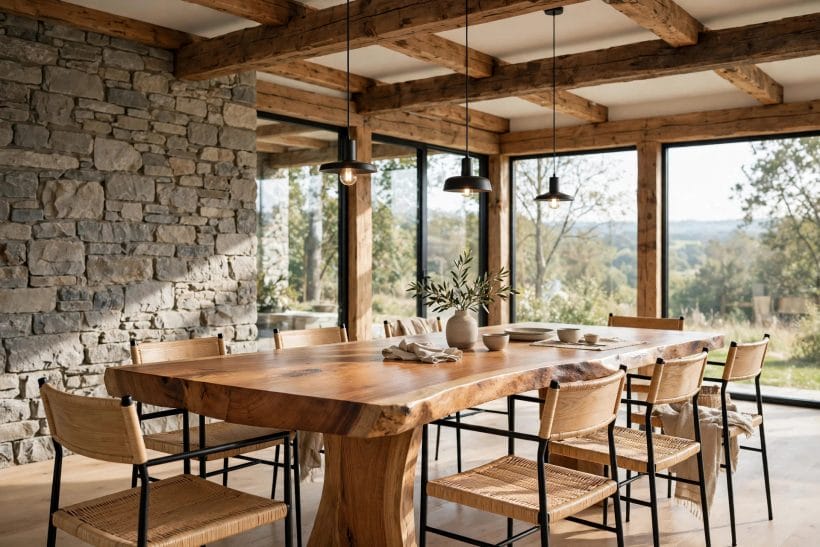
Modern rustic furniture is chosen by weight and edited by space: fewer pieces than a farmhouse parlour, each one solid enough to matter, arranged with the airy gaps a modern room demands. Weight is literal as well as visual: the style distrusts furniture that can be lifted with one hand. The layout rule is simple — heavy things low and against walls, light things few and in the middle of nothing.
34. One farmhouse table, honestly sized
The dining table is the style’s flagship: thick top, plain legs, room for elbows and laptops and harvests alike. Size it to the room’s daily life, not to the largest dinner of the year.
35. Moulded or plain modern chairs around it
Pairing the old table with clean modern chairs — moulded, wishbone-plain or simple leather — is the mix in a single gesture, and it keeps the dining set from becoming a costume.
36. A tailored sofa in a natural fabric
The sofa should be the room’s most modern piece: straight arms, plain weave, cushions that hold their shape. Rustic softness arrives by throw and cushion, not by slouch.
37. Open shelving, ruthlessly edited
Open shelves suit the style’s honesty and punish its clutter. Keep them for the beautiful and the daily: bowls, boards, glasses, one plant. Everything else earns a door.
38. A bench where chairs would fuss
A plain bench at the table, the bed’s foot or the hall wall seats flexibly, tucks away completely and carries the farmhouse memory without a single ornament.
39. Low furniture under low ceilings
In cottages and conversions, keep storage and seating low and let the walls breathe above them — the same headroom logic as an attic, applied with modern pieces.
40. Sideboards instead of units
One long, low sideboard in oak or painted pine organises a living room better than a wall of fitted units, and it can leave with you when you move. The rustic half prefers furniture to joinery.
41. Beds with wooden headboards, plainly made
A headboard of vertical boards or a single wide plank is the bedroom’s rustic signature; dress it with linen and the modern half is satisfied by the absence of everything else.
42. Desks and work corners in the same language
A plank desk on steel legs, a plain chair and one good lamp bring work into the scheme without an office accent. The style works for a living, not just a look.
43. Leave gaps on purpose
Empty floor between rug and wall, clear wall between pictures, air around the table: the breathing room is what makes visitors call the room modern before they call it rustic.
44. Buy the best wood, accept the plainest design
The style’s budget rule: spend on material, save on ornament. A plain oak table outlasts and out-charms a carved pine one at the same price, every year of its life.
6. Room by Room: Kitchen, Bathroom and Bedroom Translations
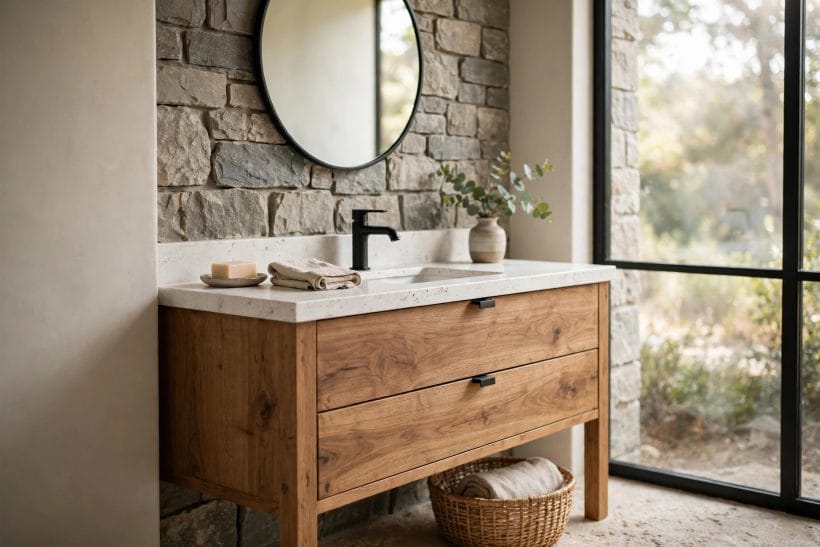
The mix translates differently in every room, because each room’s work is different: the kitchen leans on timber and steel, the bathroom on stone and water, the bedroom on textiles. What follows is the style carried through the house’s working rooms, one honest material decision at a time.
45. The kitchen: flat fronts, rough island
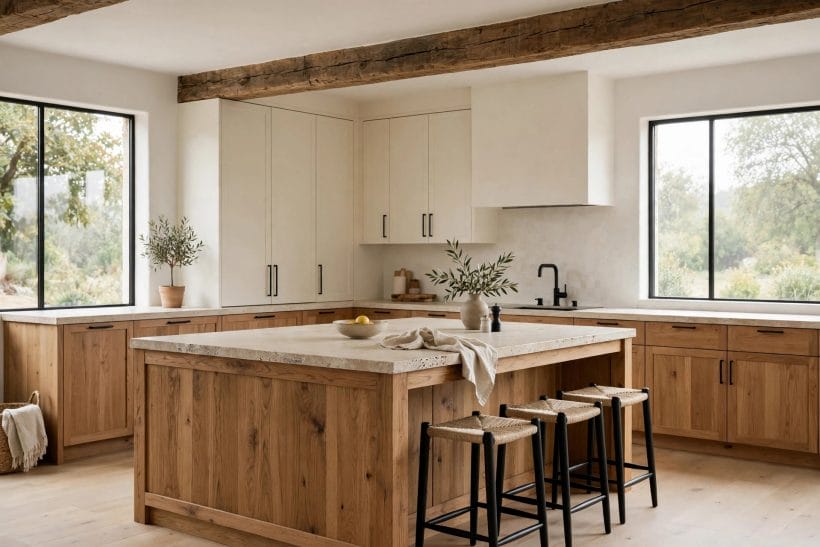
Flat-front cabinets in a warm neutral, a rough timber or stone island, open shelves for the daily dozen things and everything else behind doors — the modern rustic kitchen in one sentence.
46. Butler sinks and bridge taps
A deep ceramic sink and a plain bridge tap carry the farmhouse memory in the kitchen’s hardest-working corner. Keep the lines simple and the metal unlacquered so it ages with the room.
47. The range as the room’s hearth
A plain range cooker in black or cream anchors the kitchen the way a fireplace anchors a sitting room. Around it, the scheme can stay quiet; the cooker is the picture.
48. Bathroom stone, bathroom calm
Tumbled stone or stone-effect tiles, a wooden vanity front and black taps translate the mix to the bathroom: wet-room practical, farmhouse warm, and calm above all.
49. A wooden bath board and stool
The smallest rustic gestures — a bath board in oak, a three-legged stool for the towel — civilise a plain modern bathroom without a single tile being changed.
50. Bedroom textiles do the rustic work
In the bedroom, materials soften: washed linen bedding, a wool throw, a rug with some age in it. The furniture can be almost entirely modern; the bed carries the story.
51. The landing and hall: first impressions
A bench, hooks on a board, a runner and one basket: the hall in this style is a farmhouse porch brought indoors, and it sets the house’s tone in four objects.
52. Children’s rooms without the theme
Wood, wool and one cheerful colour translate the style for children — sturdy furniture, washable natural textiles and toys in baskets. Rustic’s durability is a parenting strategy.
53. The utility and boot room, taken seriously
Stone flags or their practical cousins, a deep sink, hooks and shelves: the back rooms are where rustic materials began, and the style honours them by keeping them beautiful and useful.
54. Garden rooms and studios
A shed, studio or garden room in timber and glass is the style’s holiday home: one material inside and out, furnished with the house’s spare chair and its best lamp.
55. Where the farmhouse living room leads
The sitting room remains the style’s headquarters, and its fullest treatment on this site is farmhouse living room ideas — the rustic pieces gathered there lean modern when the lines around them stay clean.
7. Small Spaces and Real Life: Tiny Homes, Apartments and Families
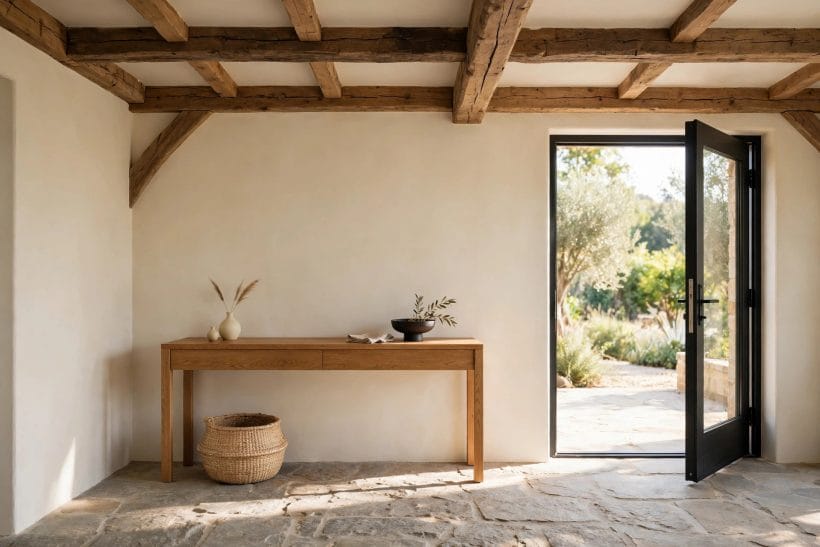
Modern rustic is secretly a small-space style: it began in cottages and cabins where every object worked, and it asks the same questions a tiny home asks — is it solid, does it serve, can it stay. Brought into small modern rooms, its warmth solves the exact coldness that makes compact modern interiors feel temporary.
56. The tiny-home proof
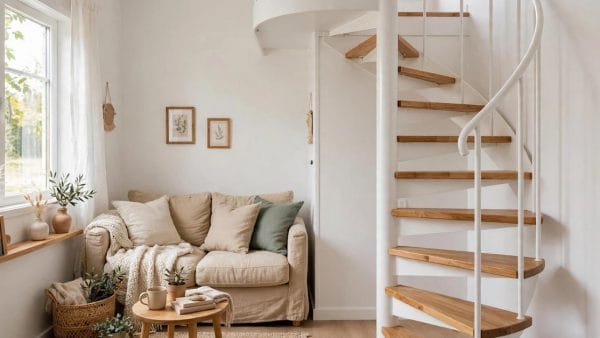
In rustic tiny house interior projects the mix is structural: timber cladding, one black rail, linen curtains, nothing else needed. Small spaces do not dilute the style; they concentrate it.
57. One wall of timber in a flat
A city apartment takes the style in doses: a timber-clad wall or a pair of beams that are honestly furniture, not fake architecture — a headboard wall, a shelf run, a window seat.
58. Scale down the pieces, not the honesty
Small rooms need smaller tables and slimmer sofas, but the materials stay real. A small oak table beats a large foil-wrapped one at every meal it serves.
59. Transitional calm for rentals
The renter’s version leans on the portable layer — textiles, lamps, a rug, one old chair — the same translation that transitional living room ideas makes between period rooms and modern lives.
60. Family-proof the finishes
Matte oil wipes clean, wool hides crumbs, leather forgives crayons longer than fabric, and stone does not care about any of it. The style was invented by people with muddy boots.
61. Dogs, boots and the back door
A rustic house plans its dirt: a bench and hooks at the door, a washable runner, floors that show mud honestly and clean easily. Design for the dog and the humans relax.
62. Work-from-home corners
The plank desk corner, the good chair and the lamp: rustic modern absorbs a job into a room without turning either into an office, because both sides of the style value plain, solid tools.
63. Storage that looks like furniture
Trunks, baskets, a dresser, the bench with a lift-up seat — in small homes storage must be visible, so the style makes it handsome enough to deserve the room.
64. Heat and light in small rooms
Wood tones warm small north rooms measurably in feel; pale walls and one mirror return the light. Small rustic rooms should be dressed like cabins: warm, plain, lamplit.
65. The one-room test
A studio flat in this style zones by rug and light: bed corner in linen dusk, work corner in clean lines, kitchen corner in steel and stone — one palette, three temperatures of it.
8. Finishing Touches: Textiles, Greenery and Gathered Objects
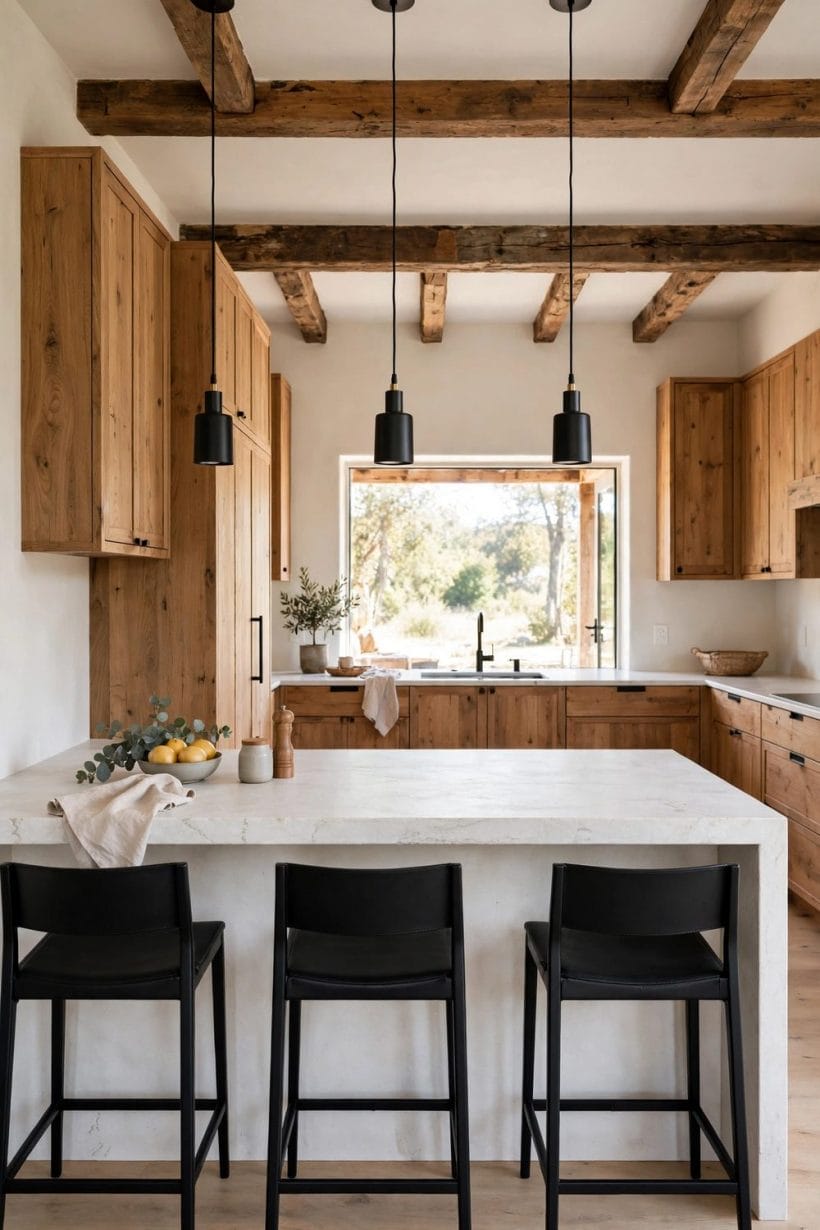
The last layer decides whether a modern rustic room feels gathered or decorated. The rule of the layer is provenance: objects that were made, grown, found or inherited outrank objects that were merely bought, and every object must be able to answer the modern half’s question — why are you here?
66. Throws in wool and washed cotton
One throw over the sofa’s arm, one at the bed’s foot: the textile layer that can change the room’s temperature and colour in an afternoon, and wash when life happens.
67. Cushions few and large
Two large cushions in linen or grain-sack stripes beat six small ones in a pattern war. Scale is the modern half’s contribution to softness.
68. Baskets as the universal container
A basket for logs, one for toys, one for the knitting and one for the door’s harvest of gloves: woven storage is the style’s tidiness, honest about what it holds.
69. Branches, not arrangements
A single branch in a tall stoneware vase, greenery cut from the garden, herbs in a pot — the style’s flowers are whatever is growing, arranged by being left alone.
70. Candles in iron and glass
Candlelight is the style’s evening signature, carried in black iron holders and plain glass. Group them where a fire would be and the room understands at once.
71. Pictures in plain frames, hung low
Few pictures, plainly framed — wood or black — hung at sitting eye height. Landscapes, maps and family photographs all qualify; the frame’s quiet is the point.
72. Books as building material
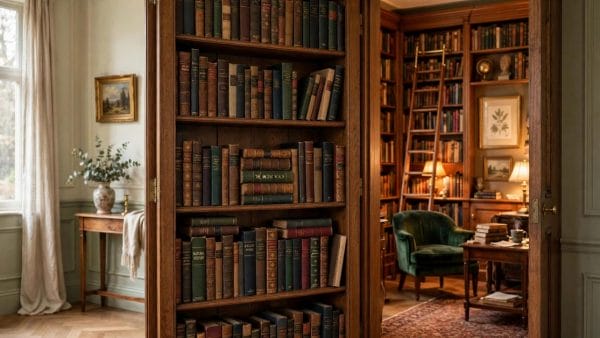
A stack of cloth-bound books on the hearth, the shelf of cookbooks by the range: books bring colour, weight and evidence of a life, which is the style’s whole argument.
73. Old tools as sculpture
A wooden plane, a pair of iron shears, the grandfather’s level on the shelf — tools that made things earn their display in a style that honours making. One or two, never a museum.
74. Scent: wood, wool and soap
The style smells of its materials: firewood by the hearth, a wool rug in sun, plain soap in the bathroom. Scented products that imitate these lose to the real things every time.
75. The neighbour test
Set the finished room beside industrial home design ideas and the difference instructs: where industrial celebrates the factory, modern rustic celebrates the farm and the forest — same honesty, warmer address.
9. Checks and Mistakes: Before the First Purchase or the First Fitting
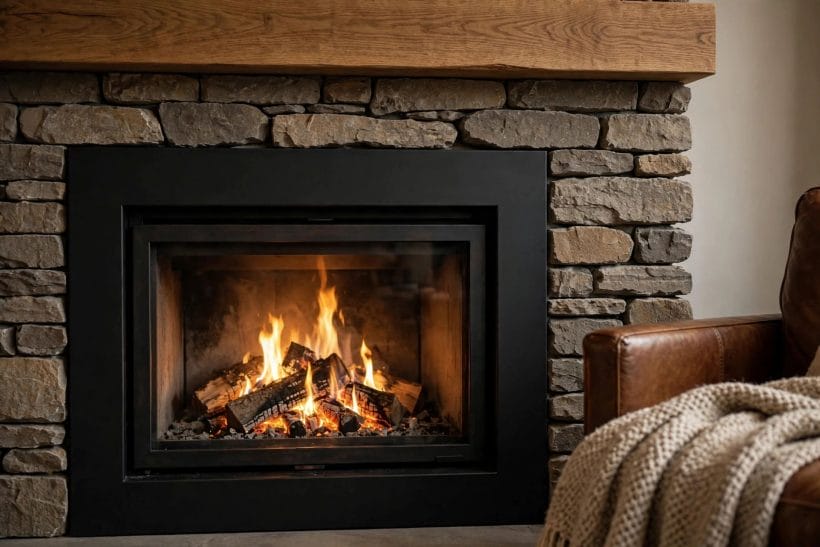
Test every purchase against both halves: would the modernist keep it, and would the farmer trust it? Pieces that fail either test — flimsy antiques, sterile novelties — are the ones that make schemes wobble.
Smell and sound are diagnostics too: a modern rustic room should smell faintly of wood and wool and sound soft underfoot. Rooms that smell of packaging and echo like offices have bought the look without the materials.
Beware the single-source room: a scheme bought entire from one shop, however tasteful, has no provenance to gather. The style is assembled over time, and its rooms improve with every honest addition.
Check the light before the layout: rough textures need grazing light to read as character rather than dirt. A stone wall in flat light is a grey wall; the same wall lamplit is the room.
10. Costs and Pulling It Together
The money in a modern rustic scheme follows the materials: timber and stone first, because they are the scheme; upholstery second, in natural fabrics that age kindly; the gathered layer last and slowest, bought piece by piece as the right things appear. Paint is the cheapest element and should be chosen last, to flatter what is already there.
Pull the design together by deciding the room’s one old thing — the anchor with a past — and letting its tone of wood, weight and wear set the terms for everything modern that joins it.
Final Considerations
Modern rustic endures because it is not really a fashion: it is the old farmhouse contract — real materials, plain forms, nothing wasted — rewritten for rooms that also love order and air.
Start with one honest material and one clean line, keep both promises in every purchase after, and the room will gather itself.

0 Comments