

Two tiny houses can sit side by side on the same sunny plot and need completely different solar systems. The difference is never the roof — it is the daily load list hiding inside each home. If you have been asking how much solar power does a tiny house need, this guide gives you the audit-first method: count every load, size panels, batteries and inverter from that number, and check the result against winter, not summer.
1. At a Glance: Sizing Solar in Brief
Solar sizing is a chain of decisions, each depending on the step before it. Your daily energy use, in watt-hours, sets everything else: panels must replace it on an average winter day, batteries must carry you through nights and cloudy weather, and the inverter must handle the biggest combination of appliances you realistically run at once. Do the audit honestly and the rest is simple arithmetic.
| Step | What it decides | Why it matters |
|---|---|---|
| Energy audit | Your total daily watt-hours | Every other component is sized from this single figure |
| Panel array | How much energy you harvest each day | It must cover daily use in winter sun, not just summer sun |
| Battery bank | How much energy you can store | It sets your autonomy through nights and cloudy spells |
| Inverter | How much power you can draw at once | It must cover peak loads and motor starting surges safely |
| Mounting | Where the array lives | Orientation, shade and access decide real-world output |
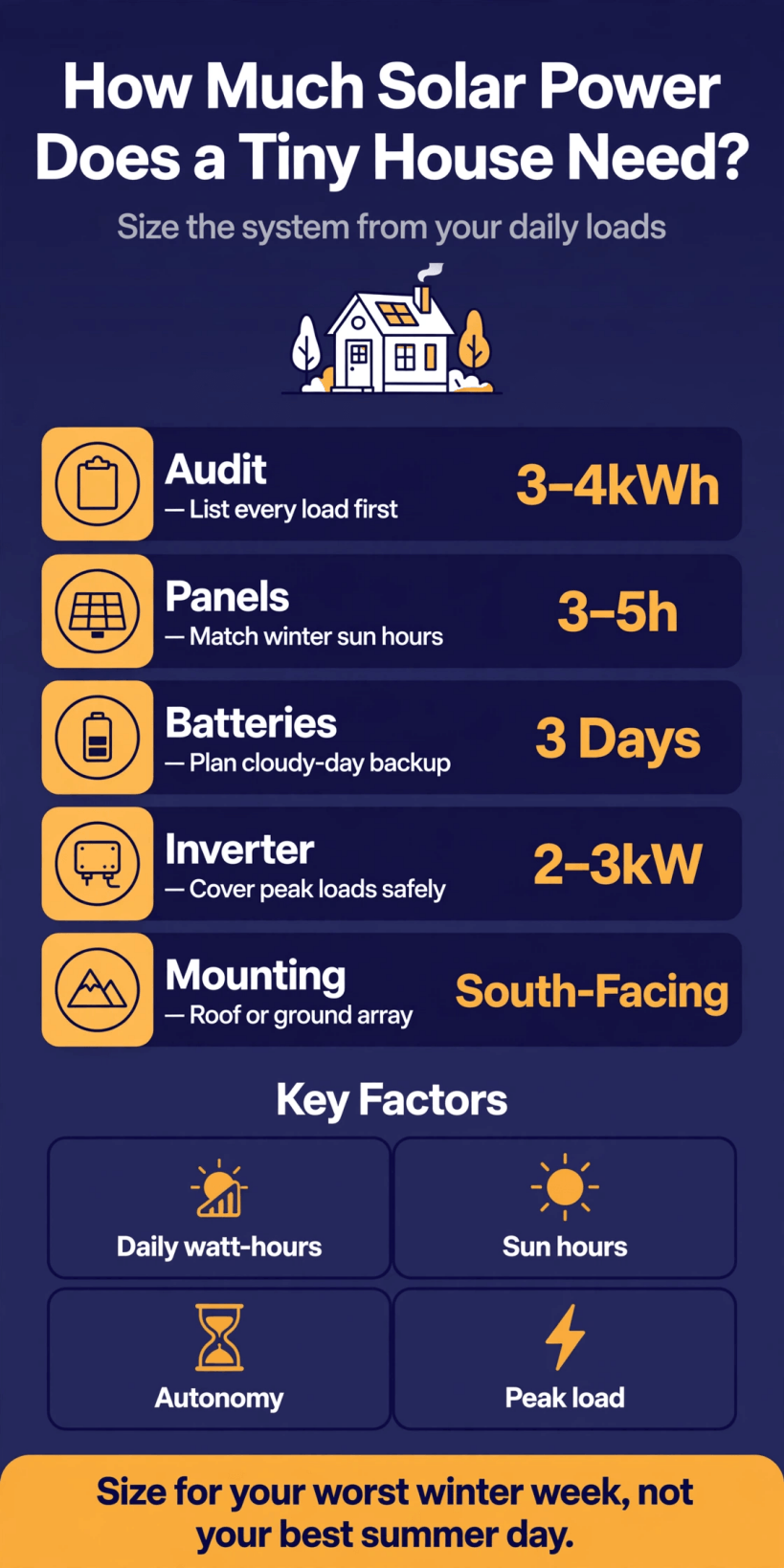
The sizing chain at a glance: audit first, then panels, batteries, inverter and mounting — in that order, every time.
Think of the system as a water tank: the battery bank is the tank, your appliances are the tap, and the panels are the pipe refilling it. A huge tank with a thin pipe still runs dry over a cloudy week, and a fat pipe feeding a tiny tank wastes sunshine once the tank is full. Balance is what makes the system feel effortless.
2. Start with an Energy Audit: List Every Load
The energy audit is a simple inventory: every electrical device in the house, how many watts it draws, and how many hours it runs on a typical day. Multiply watts by hours and you get watt-hours, the currency of the whole design. Work through the house space by space — kitchen, bathroom, living area, loft, and the easily forgotten utility loads such as water pumps, ventilation fans, phone chargers and the standby draw of electronics that sip power around the clock.
Use each appliance’s rating label where you can, treating it as a starting point. Some loads cycle — a refrigerator does not run its compressor all day — so estimate realistic running time instead of multiplying by twenty-four hours. Heating and cooking deserve special honesty: electric resistance heat and full-size electric cooking usually break a modest solar budget, which is why many tiny houses pair solar with another fuel for heat. Our overview of off-grid solar energy systems for tiny homes shows how the pieces fit together.
Finally, audit for the life you actually live, then add a margin for guests and work-from-home days. An audit built on wishful thinking fails every December; one built on your worst normal week produces a system you stop thinking about entirely.
3. Daily Watt-Hours: Turning the Audit into a Number
Once the list exists, the maths is deliberately boring: watts multiplied by hours, added up. The worked example below is illustrative only. It invents a hypothetical tiny house household with stated assumptions — a small efficient refrigerator, LED lighting, one laptop worker, and a single induction hob used briefly — purely to demonstrate the method. Your own audit will produce a different total, and that difference is exactly the point.
| Illustrative load (assumed) | Assumed watts | Assumed hours/day | Watt-hours/day |
|---|---|---|---|
| LED lighting throughout | 30 | 2 | 60 |
| Small efficient refrigerator (cycling) | 75 average | 8 effective | 600 |
| Laptop for remote work | 50 | 3 | 150 |
| Phones and small charging | 25 | 2 | 50 |
| Water pump | 100 | 1 | 100 |
| Ventilation fan | 40 | 3 | 120 |
| Single induction hob (brief cooking) | 800 | 1 | 800 |
| Illustrative total | 1,880 Wh per day |
Read the table the way a designer does. The refrigerator and hob dominate; the lights are almost rounding error. That shape — a few big loads and a long tail of small ones — is typical, even though every figure here is hypothetical. It also shows where savings are cheapest: a more efficient fridge moves the total far more than swapping one lamp. The sizing walkthrough in our guide to solar panel kits for tiny homes and battery bank sizing applies the same logic to kit-based systems.
Keep two versions of your total: a normal day and a heavy day. Size panels around the normal day in winter conditions and the battery around the heavy day, and you build in resilience without paying for the worst case in every component.
4. Panel Sizing: Sun Hours, Season and Roof vs Ground Mount
Panels are rated in watts, but what you actually harvest is watt-hours: panel watts multiplied by the useful sun hours your site receives, reduced by real-world losses from heat, wiring, dust and conversion. Sun hours are not daylight hours — they are the equivalent hours of full-strength sun, and they swing dramatically between summer and winter at most latitudes. This is why the honest answer to how much solar power does a tiny house need always starts with your worst month, not your best one.
Using the illustrative example from the previous section: a household needing roughly 1,880 watt-hours a day, in a place assumed to offer three and a half useful sun hours in winter, would divide 1,880 by 3.5 to get a little over 500 watts, then round upward for losses — landing somewhere in the region of a modest array rather than a huge one. Every input there is an assumption for demonstration; your winter sun hours and your audit total are the two numbers that matter, and both must come from your site and your life.
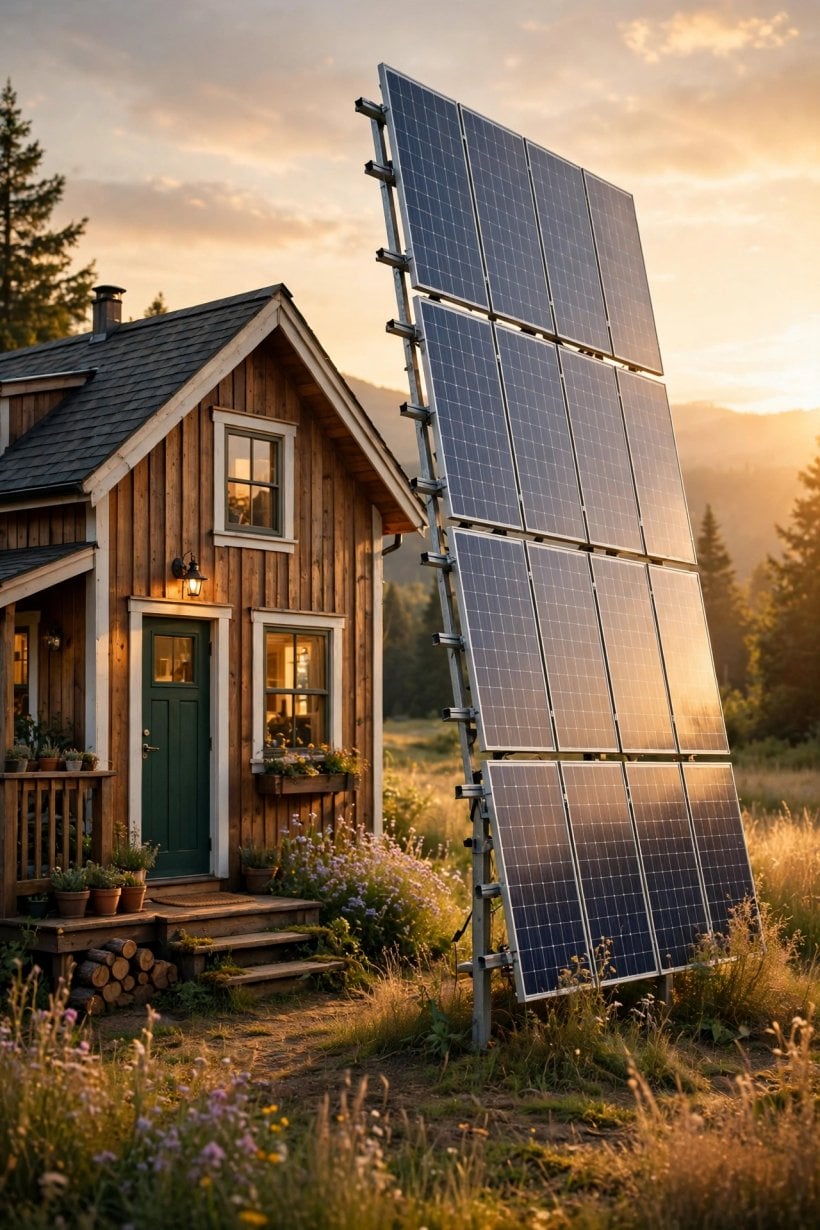
Placement is the other half of panel sizing. A tiny house roof is convenient and travel-ready, but it fixes the tilt and direction wherever the house happens to sit, and roof space on a small footprint is limited. A ground-mounted array can be angled properly, expanded later and cleaned without a ladder, at the cost of cable runs and a fixed parking spot. Layouts designed around the array from the start avoid the worst compromises — see our solar-ready tiny house layouts for floor plans that reserve roof and utility space for exactly this purpose.
5. Battery Bank: Chemistry, Capacity and Days of Autonomy
The battery bank stores the day’s harvest for the evening, the night and the inevitable grey stretch. Its useful capacity, again in watt-hours, should cover your daily total multiplied by the number of sunless days you want to ride out — your days of autonomy — adjusted for how deeply your chosen battery chemistry is comfortable being discharged. As a general rule of thumb, lithium-based batteries tolerate deeper regular discharge than traditional lead-acid, which is happiest when only part of its capacity is used each cycle; that difference changes the size of bank you need to buy for the same usable energy.
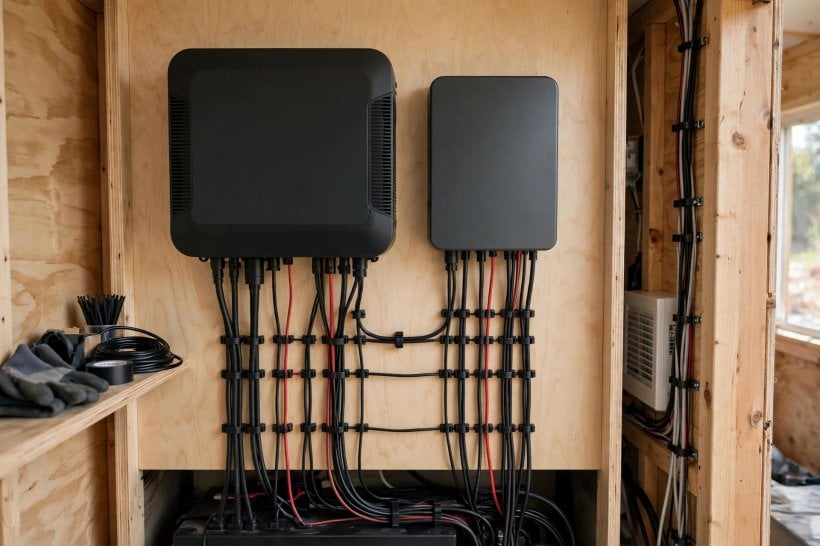
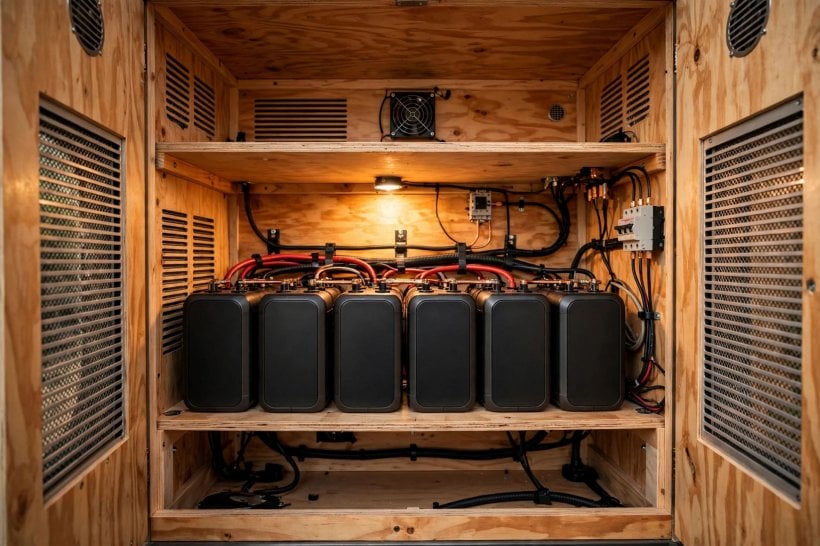
Where the bank lives matters almost as much as its size. Batteries want a ventilated, temperature-moderate space with short, thick cable runs to the inverter — usually a utility closet, a bench void designed for the purpose, or an insulated exterior box. Weight matters too: a large bank is heavy, should sit low over the trailer, and counts against the same payload as everything else you own. Plan it into the build, not into whatever corner remains.
Monitoring closes the loop. An honest battery monitor teaches you your own consumption faster than any article can, and protects against the slow, deep discharges that shorten battery life.
6. Inverter and Charge Controller: The Supporting Cast
The inverter turns stored DC battery power into the AC power household appliances expect, and it is sized on a different question from everything else: not how much energy per day, but how much power at one moment. Add up the loads you might genuinely run together — hob plus pump plus laptop, say — and choose an inverter comfortably above that peak, with surge capacity for motor starts. An inverter sized only for the daily average will trip on the first ambitious breakfast.

The charge controller stands between panels and batteries, regulating the harvest and protecting the bank from overcharge. The common rule of thumb is to match the controller to the array’s output with headroom, and to prefer the more efficient MPPT type where the budget allows, especially when panel voltage and battery voltage differ significantly. Both devices also interact with the rest of the house wiring more than beginners expect; if your house also takes shore power, the relationship between inverter, converter and panel needs planning as one system — our guide to tiny house electrical wiring for 30-amp vs 50-amp hookups covers that side of the design in detail.
Buy these components for reliability rather than headline numbers. An inverter’s waveform, idle consumption and protection behaviour shape daily life far more than a peak watt figure printed large on the box.
7. Wiring, Mounting and Safety on a Tiny House
Good components fail early in bad installations. Cable sizing follows a simple principle: DC runs, especially between batteries and inverter, should be short and generously thick, because voltage drop and heat both rise quickly in undersized cable at low voltages. Every run needs appropriate fusing close to the source, tidy routing away from sharp edges and water, and connections torqued and protected rather than twisted and hoped for. This is the section of the build where professional help earns its fee most clearly — a qualified electrician checking or completing the high-current DC work is money spent on sleep quality.

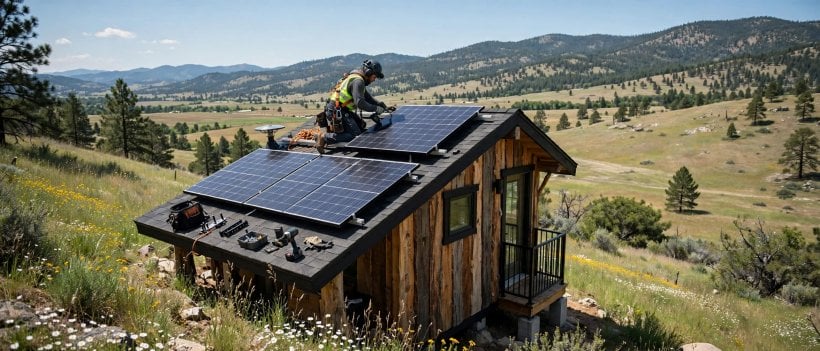
Mounting hardware deserves the same respect. Roof penetrations must be flashed and sealed as roofing first and solar second; rails and clamps should be rated for the wind loads of a house that may travel at highway speed. Ground mounts trade those problems for simpler ones: solid footings, cleanable tilt, and cable runs protected from strimmers, rodents and standing water. In both cases, plan access — a panel you cannot reach never gets cleaned or inspected.
Finally, think in systems: a disconnect you can reach, labelling a future owner can understand, and ventilation where equipment asks for it. Solar is a safe way to power a small home only when these unglamorous details are treated as design, not finishing touches.
8. Grid-Tied, Hybrid or Fully Off-Grid?
Not every tiny house solar system is an island. A grid-tied house uses the utility supply as its infinite battery, adding panels mainly to cut bills; a hybrid house keeps a modest battery for outages and load-shifting while staying connected; a fully off-grid house carries everything itself, which is the design this guide’s audit method is built for. The right choice depends less on ideology than on where the house will sit and how reliable that connection is.
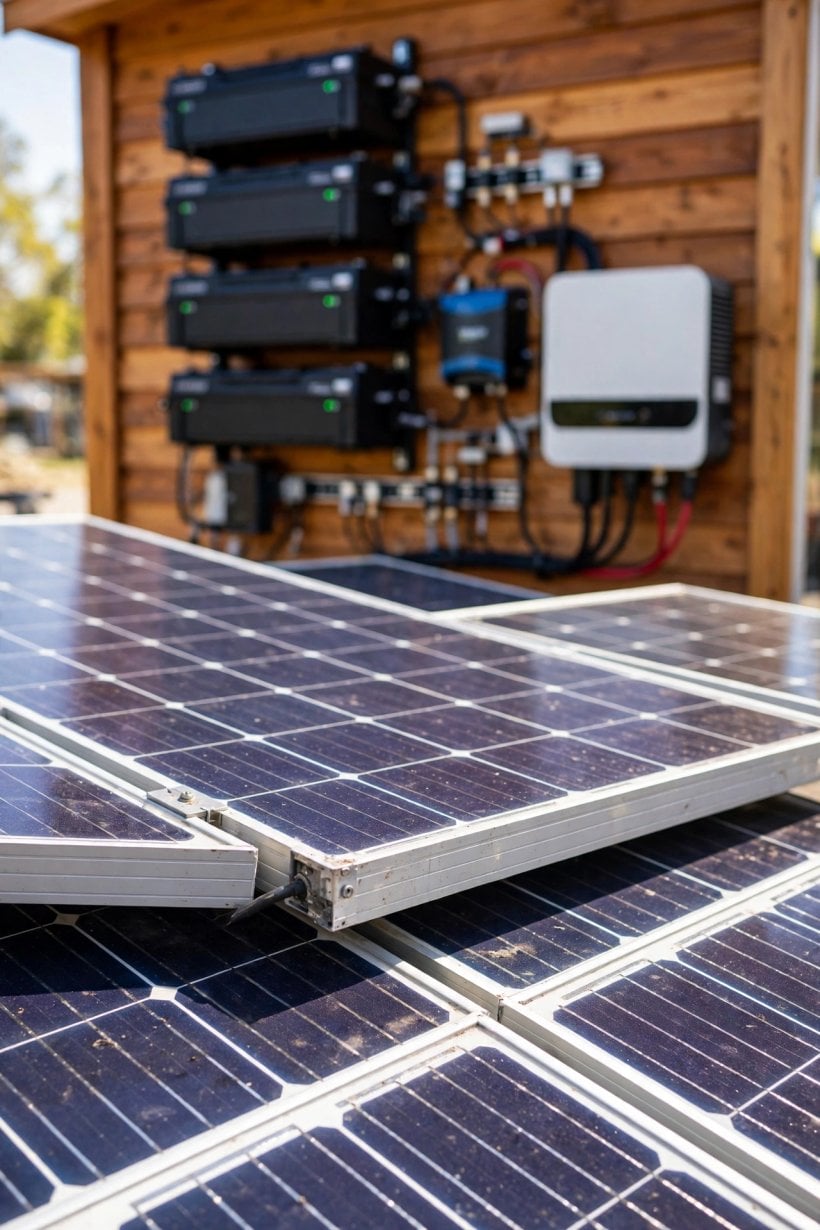
Each step toward independence costs capacity. Off-grid means the winter-sized array and multi-day bank described above; hybrid usually means a smaller bank for evenings and short outages; grid-tied can shrink storage to almost nothing. Mobile houses often do best with a hybrid heart: proper solar and storage for boondocking, plus clean shore-power integration for parks. Our broader guide to off-grid energy systems compares the options tiny houses pair with solar.
Decide this question before buying anything, because it changes every size downstream. Owners who drift into off-grid life with a grid-tied shopping list spend twice; owners who choose deliberately, even modestly, rarely do.
9. Costs in Typical Ranges and What Drives Them
Solar budgets for tiny houses spread across a wide typical range, from compact do-it-yourself setups at the lower end to professionally installed, high-autonomy systems that cost several times more — and the spread is explained by choices, not by luck. The drivers are consistent: battery capacity is usually the single biggest cost centre, panel wattage is comparatively cheap per unit of energy, and installation labour, mounting hardware, cable and protective equipment quietly claim a larger share than most first budgets expect.
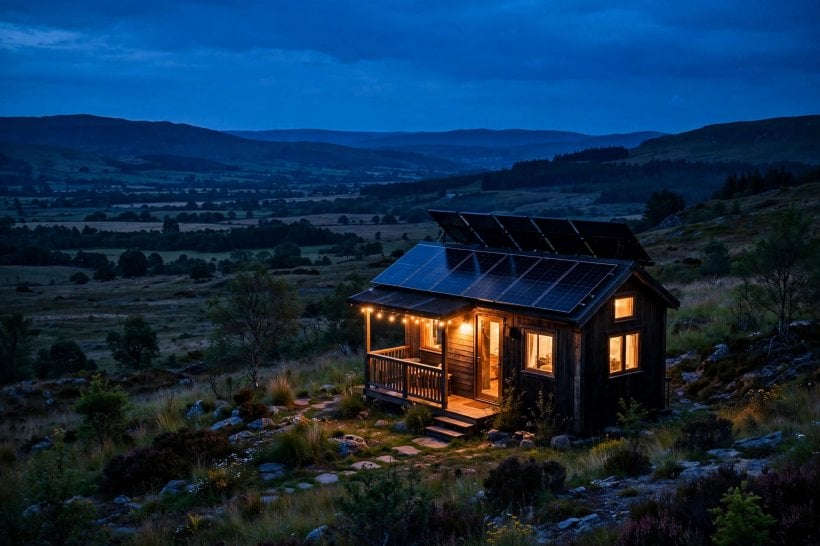
Spend on the essentials in order: enough battery to live on, an inverter you can trust, safe installation — then expand the array, the easiest component to grow later if mount and controller were chosen with headroom. Money is most often wasted on the mirror image: oversized panels feeding an undersized bank, or premium components undermined by thin cable. For how panel pricing itself breaks down, see our explainer on how much solar panels for a tiny house typically cost.
Treat any single headline figure — including any in this guide’s illustrative examples — as a starting point for your own quotes, not as a promise. Climate, autonomy, chemistry and labour move real projects a long way in both directions.
10. Maintenance and Mistakes That Shrink a System
Solar asks little, but not nothing. Panels need occasional cleaning where dust, pollen or snow accumulate, mounts and seals deserve an annual look, battery terminals and firmware want periodic attention, and the system’s own monitor will tell you quietly when output drifts from expectation. A simple seasonal routine — clean, inspect, compare this month’s harvest with last year’s — catches most problems while they are still cheap. Our dedicated routine for solar panel maintenance lays out that checklist in full.
The mistakes that shrink systems are nearly all made on day one. Sizing from summer sun. Auditing the house you wish you lived in instead of the one you do. Forgetting standby loads and winter heating fans. Buying the bank before the audit, the inverter before the peak-load list, or cable by price instead of by run and current. Each is understandable, and each is avoidable with the order of operations in this guide: audit, daily total, winter panels, storage for autonomy, inverter for peaks, safe installation.
The encouraging truth is that tiny houses are solar’s natural habitat. Small roofs constrain, but small, honest loads are a superpower — a well-audited tiny house can run comfortably on a system a conventional home would call a starter kit, provided it was designed from the loads outward.
Final Considerations
There is no universal panel count that answers every tiny house, and any source that offers one without asking about your refrigerator, your winters and your workday is selling certainty instead of engineering. The reliable path is the one walked here: list every load, turn it into daily watt-hours, size the array for your worst month, give the battery bank the autonomy your life requires, and let the inverter cover your real peaks. Do that, and the question that started this guide answers itself — in numbers belonging to your house alone.


5 Comments