

In Alaska, a tiny home can be a year-round house outside Anchorage, a cabin-style retreat on the Kenai, or a compact base in the Interior — and winter treats each of those projects very differently.
Comparing tiny house builders alaska therefore starts with specification, not style: which builder type fits your land, your heating and insulation needs, and the distance the finished home has to travel.
1. Alaska Builders at a Glance
The infographic for this guide compares four builder types, and the first of them is named for this state’s defining condition. At the top sit cold-climate custom builders, who design an Arctic-spec home around your site and give you the most control. Below them come semi-custom builders working from existing plans with options, shell builders who hand over a weather-tight shell for a DIY finish, and kit and plan sellers, where you build and the headline cost is lowest. The ladder is really a ladder of responsibility: the further down it you go, the more of the cold-weather problem-solving, project management and finishing work moves from a professional’s desk onto yours.
| Builder type | What they deliver | What the infographic highlights |
|---|---|---|
| Cold-climate custom builders | Arctic spec, designed for your site | Most control over insulation, heating and layout |
| Semi-custom builders | Plans plus options | Mid-range, adapting proven designs |
| Shell builders | Weather-tight shell | DIY finish, with the interior left to you |
| Kit and plan sellers | You build | Lowest cost, with construction in your hands |
The four key factors printed on the graphic are insulation, heating, delivery and warranty, and in Alaska the first two are not details to confirm at the end. They are the design. A home that loses heat faster than its system can replace it, or whose pipes freeze during the first serious cold snap, fails at its basic job however charming it looks in photographs. The tip on the infographic makes the same point plainly: in Alaska the specification matters more than the style, so ask about insulation and freeze protection first, before floor plans, finishes or anything else. Every section that follows in this guide is really an expansion of that single sentence.
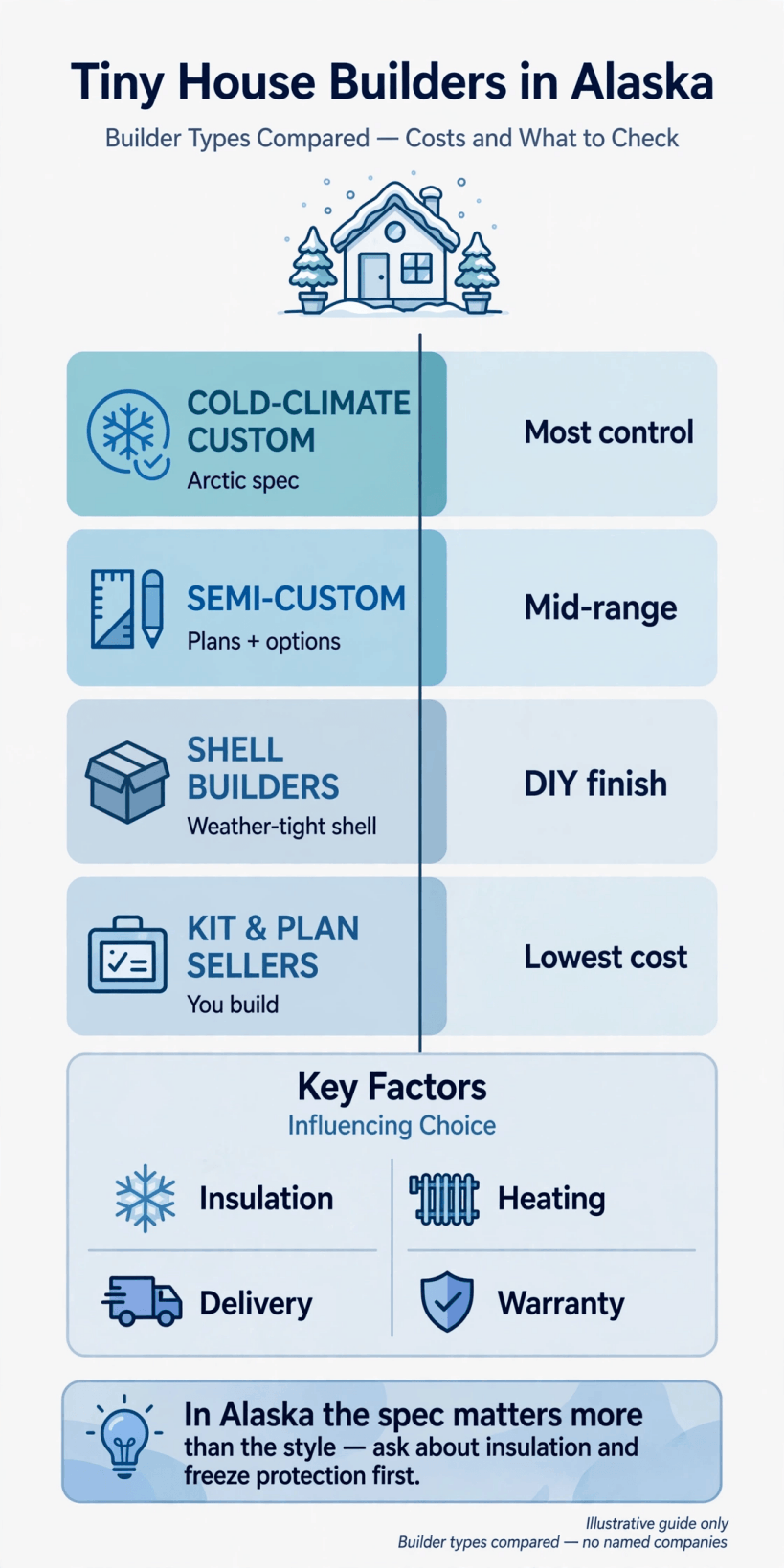
Alaska at a glance: four builder types compared, from Arctic-spec custom builds to kits, and the four key factors — insulation, heating, delivery and warranty — to test every candidate against.
2. Start With Your Borough, Your City and Your Site
Alaska’s land rules are intensely local, and the state contains multitudes: organised boroughs with planning departments, incorporated cities with their own ordinances, and large areas where formal zoning is light or absent but practical rules still govern what works. Do not mistake light zoning for no homework. Septic and wastewater expectations, water supply, setbacks, driveway and access requirements, and whether a home on wheels counts as a dwelling at all are questions to put to the borough or city office that covers your parcel, and to any state office whose remit covers your wastewater or water plans. Get the answers in writing while the project is still a conversation.
Then study the site itself with Alaskan honesty. How does access look in breakup season, not just on a dry summer afternoon? Where does snow get pushed or piled, and will it block doors, vents or the route a delivery vehicle needs? Is the ground stable, seasonally wet, or affected by frost movement or permafrost, all of which are questions for local knowledge and, where the stakes justify it, professional advice. Our building a tiny house checklist, from first questions to move-in day sequences those land checks, and our overview of how to get a tiny house built, from first sketch to finished home shows where they sit in the wider build order.
Ask each builder what they have placed in your borough or region and what the ground and the season taught them there. Alaska is big enough that experience near Anchorage does not automatically transfer to the Interior, the Kenai or the Southeast, where rainfall rather than deep cold writes the specification. A builder who asks detailed questions about your parcel before quoting is behaving like someone who has been surprised by Alaskan ground before, and that is the kind of experience you are trying to hire.
3. Check Licensing, Certification and Insurance
Verify the business before you admire the product. Ask for the builder’s licence or registration details where they apply, confirm they are current, and make sure the legal name on the documents is the name that will sign your contract. Ask what insurance covers the build in the workshop, the home in transit and the work of any subcontractors, and get a clear answer about who is responsible at each stage. In a state where a delivery can involve long highway miles and difficult final approaches, the in-transit answer matters far more than buyers usually realise until something tests it.
Certification is the second half of the credential check. Establish what the finished home will be built and inspected as — a code-built dwelling, a manufactured or modular unit, or a certified recreational vehicle — because that label follows the home into placement conversations, financing, insurance and resale. Our explainer on how building codes treat unconventional small homes sets out why the distinction matters. Then ask who inspects the work at each stage, what documents you receive at handover, and whether the builder’s standard documentation matches what your borough, lender and insurer will want to see for a home intended to be lived in through an Alaskan winter.
Do the reference work properly. Look the business up through independent channels, read feedback for patterns about winter performance and aftercare rather than opening-day delight, and ask to speak with past customers whose homes have already survived at least one full cold season. Ask those customers the only question that really counts: did the home stay warm, did the water keep flowing, and when something needed attention, how did the builder respond? Answers from a February that has already happened are worth more than any promise about a February still to come.
4. Insulation, Heating and Freeze Protection Come First
This is the section where Alaska separates serious builders from stylists. A tiny home has a high ratio of surface to volume, so heat escapes through walls, floor, roof, windows and every poorly sealed joint, and the specification has to answer that arithmetic. Ask each builder to walk you through the whole thermal envelope: insulation in the floor as well as the walls and roof, window specification, how the building is sealed against air leakage, and how ventilation is handled so that a tightly sealed home does not trade warmth for condensation and stale, damp air. In cold climates, moisture driven into wall and roof assemblies is a slow, hidden problem, and a good builder will raise it before you do.
Heating deserves the same depth. Ask what the primary heating system is, how it performs at the temperatures your area actually reaches rather than its average winter day, what it runs on and how that fuel is stored and delivered to your site, and what the backup plan is when the primary system stops or a storm interrupts supply or power. Ask, too, how the home protects you during an absence: a tiny home left unheated or under-heated with water in its lines is a burst pipe waiting for a cold night, and freeze protection for plumbing — routing, insulation, heat tracing where used, and a clear drain-down procedure — should be explained as a designed system, not an afterthought.
Snow and structure complete the cold-weather interview. Roof design and snow load expectations vary across the state, and your builder should be designing for your area’s conditions and able to explain the reasoning. Ask where snow sheds from the roof — ideally not onto the entry, the vents or the fuel store — and how the home is anchored against wind on an exposed site. None of this is pessimism. It is the normal specification conversation for a house that must work hardest precisely when help is furthest away and daylight is shortest.
5. Questions to Ask Every Builder
Take the same written list to every candidate, record the answers on the day, and compare documents rather than personalities afterwards. In Alaska the list needs to reach beyond the usual contract questions into winter performance and logistics, because those are the subjects on which projects here succeed or struggle.
- What insulation, sealing and window specification will the home have, in writing?
- What heats the home at the coldest temperatures my area reaches, and what is the backup?
- How exactly is the plumbing protected from freezing, including while I am away?
- What certification will the finished home carry, and who inspects it, at which stages?
- What does the quoted price include, and what — delivery above all — does it leave out?
- How will the home reach my site, in which season, and who has assessed the access?
- What is the payment schedule, and what milestone triggers each payment?
- What warranty covers the home, and how is warranty work handled at my distance?
Judge the manner of the answers alongside their content. Builders who specify in numbers and documents, who ask as many questions about your site and your winter as you ask about their product, and who are frank about what their homes are not designed to do are giving you the working relationship you want. Evasion about heating costs, freeze protection or delivery, and enthusiasm that depends on you not comparing quotes, should weigh against a candidate exactly as a poor reference would.
6. Delivery Across Distance, Water and Season
Delivery is a design constraint in Alaska, not a final errand. Much of the state is not connected to the contiguous road system at all, and even on the road system, distances are long and final approaches can involve gravel roads, seasonal softness, ferry connections or barge schedules for communities off the highways. Establish at the very first serious conversation how a finished home would actually reach your parcel: by road the whole way, by ferry or barge for part of the journey, or not at all in the form you are imagining — because a home that cannot be delivered as designed has to be redesigned, shipped in sections, or built another way entirely.
Season governs what is sensible. Ask each builder which delivery window they would choose for your site and why, what ground or weather conditions would postpone the move, and who decides. Agree who prepares the site — the base or foundation system suited to your ground, clear access, room to manoeuvre, and utility positions — and who levels, anchors and connects the home on arrival. On ground affected by frost movement, the foundation conversation deserves particular care and local advice: what works on a stable, well-drained gravel pad may be the wrong answer a few miles away.
Write the delivery into the contract as a described operation: who pays for each leg of transport, who insures the home while it moves, what happens financially if weather or schedules push the date, and what condition the home must be in when you accept it. Photograph the home on arrival, walk it with the delivery team, check doors, windows, plumbing and systems after it is set and levelled, and record every snag in writing before the team leaves. In Alaska, the people who delivered your home may not be back in your area soon, which makes that arrival inspection doubly important.
7. Warranty, Aftercare and the Long Winter
Warranty questions carry extra weight where the builder may be hundreds of miles from the home. Before signing, have each candidate explain, plainly and in writing, what the warranty covers — structure, roof and envelope, plumbing and electrical systems, heating equipment, and appliances — and for how long each part is covered. Then ask the operational question that matters at a distance: when something fails in January, what actually happens? Does a technician travel, can a local tradesperson be authorised to repair at the builder’s cost, are parts shipped, and how are emergencies like loss of heat or a burst pipe prioritised over cosmetic snags?
Read the paperwork for the home’s systems as carefully as the builder’s own warranty, because heating equipment and appliances usually carry manufacturers’ cover with their own conditions, sometimes including servicing requirements. Ask what documentation arrives with the home: manuals, warranty registrations, certification and inspection papers, and the maintenance schedule the home expects — filters, seals, ventilation cleaning, and the checks that keep freeze protection working. A well-documented handover, walked through in person, is part of the product.
Finally, think about parts and knowledge over the home’s life. Compact homes pack systems tightly, and knowing where shut-offs, access panels and drains are is essential knowledge, not trivia. Ask the builder to show you, and to leave the locations in writing. The builders who serve remote customers well tend to design for owner competence: clear labelling, sensible access, and honest guidance about what you can maintain yourself and what should wait for a professional. That attitude at handover is a fair preview of every interaction that follows.
8. What Drives the Cost in Alaska
Honest cost talk in Alaska is about drivers, not headline figures, and this guide quotes no prices because a bare number divorced from specification and freight would mislead. The first driver is builder type itself: an Arctic-spec custom build pays for design and one-off engineering of the thermal envelope, a semi-custom build adapts proven cold-weather designs, a shell transfers interior labour to you, and a kit transfers nearly all labour — along with the need to make a plan genuinely buildable in this climate — onto your own shoulders.
The second driver is the cold-climate specification, and it is the wrong place to hunt for savings. Insulation depth, window quality, air sealing and ventilation, a heating system sized and fuelled for your winters, freeze-protected plumbing, and a roof and foundation approach suited to your snow and ground conditions all cost money inside the build, and most of them are somewhere between difficult and impossible to upgrade later. The third driver is logistics. Freight and delivery distance, any ferry or barge legs, site preparation on difficult ground, utility and septic or wastewater work, and fuel storage can together rival a large share of the build for sites far from the builder’s workshop, and seasonal timing can move those costs as surely as specification does.
So compare like an accountant: one sheet, the same rows for every builder — home as specified, certification and inspection, every leg of transport, site preparation and foundation, utility connections, and your own contingency. Interrogate any quote that sits far below the others by finding its empty rows. In Alaska, an unusually light quote most often means freight is excluded, the specification is a milder-climate one wearing northern clothing, or site works have been silently assumed to be someone else’s problem. Discovering which, while you are still comparing, is the cheapest education this process offers.
9. Warning Signs That Should Slow You Down
Certain answers should stop a project in its tracks until they improve. A builder who cannot or will not state the insulation and heating specification in writing is asking you to buy the single most important part of an Alaskan home on trust. So is one who promises delivery to a community or a site they have never assessed, dismisses freeze protection as a detail, or suggests that placement, wastewater and certification questions will somehow sort themselves out. In this state, the details are the house.
Commercial pressure is the second family of warnings. Prices that expire immediately, discouragement from comparing quotes or speaking to past owners, and payment schedules that run far ahead of verified progress all shift risk onto you. The opposite failure — everything friendly and nothing documented — is just as hazardous, particularly where distance makes informal arrangements hard to enforce or even to revisit. Deposits, specification, change orders, delivery responsibilities and warranty promises belong in a contract whoever you hire, and competent northern builders already work that way because their customers, sensibly, insist on it.
Use small tests before committing to big ones. Send three precise questions about specification and delivery and time the quality of the reply. Ask to see a home that has been through winters, not only a fresh showpiece, and ask its owner the February question about warmth, water and aftercare. Visit a workshop if you can and look at how homes in progress are sealed, insulated and organised. The character a builder shows on an ordinary enquiry, with nothing yet at stake, is the character that will handle your frozen pipe, your delayed barge or your failed inspection. Believe the evidence of it.
10. Compare Final Quotes Side by Side
Finish with a single comparison sheet and the discipline to fill it honestly. Give every serious candidate a column and every subject in this guide a row: builder type, insulation and window specification, heating system and backup, freeze protection, certification and inspection, contract and payment schedule, each leg of delivery, site and foundation works, and warranty handling at your distance. Empty cells are not savings; they are questions that have not yet been asked. Price each builder on the full sheet, including the site and freight rows, because in Alaska the home is only part of what you are buying.
Weigh, beside the totals, how each builder handled the northern questions. Who asked about your ground, your access in spring, your fuel and your coldest weeks before quoting? Whose specification read like it was written for your region rather than a generic catalogue? A higher quote with documented cold-climate specification, a deliverable route to your land and references who stayed warm is very often the cheaper decision over the life of the home, since the costly failures here — frozen systems, an undeliverable home, a placement that should never have been attempted — are the ones that cannot be fixed with a phone call.
The method in this guide travels, even where the specification changes completely. Readers comparing warmer states can use our guide to tiny house builders in Alabama and the checks that matter there, while the sibling guides for tiny house builders in Arizona, tiny house builders in Arkansas and tiny house builders in Delaware, and our earlier guide to tiny house builders in Maryland and how to choose between them, each adapt the same builder-type comparison to their own land, weather and rules. In every state, keep the order this guide has used: land first, specification and credentials next, quotes last.
Final Considerations
An Alaskan tiny home succeeds or fails on specification, logistics and paperwork far more than on looks. Choose the builder whose type fits how you want to live, whose insulation, heating and freeze protection are documented rather than described, whose delivery plan reaches your actual parcel in a sensible season, and whose warranty still means something at your distance in the middle of winter. Work through the checks in order, insist on the important answers in writing, and let a builder earn your commitment step by step. A home chosen that way stands a far better chance of being what every Alaskan home must be: warm, working and welcome in February.


0 Comments