

Arizona holds two tiny-house climates in one state: low desert that bakes through long summers, and high country where winter nights bite — and a build that suits one can disappoint in the other.
Sorting through tiny house builders arizona is therefore a specification exercise: match the builder type, the heat and cooling design and the county rules to the exact patch of Arizona you have.
1. Arizona Builders at a Glance
This guide’s infographic compares four builder types rather than naming companies, and that is the right starting frame for Arizona, where the difference between a good and a bad purchase is usually specification and paperwork rather than brand. Custom builders design and build the whole home with you, and give the most control. Semi-custom builders start from proven plans and let you adjust them, in the mid-range. Shell builders deliver a weather-tight shell for a DIY finish. Kit and plan sellers hand you the materials or the drawings, and you build, at the lowest headline cost. Each step down that ladder moves work, risk and problem-solving from the builder to you.
| Builder type | What they deliver | What the infographic highlights |
|---|---|---|
| Custom builders | Full design-build | Most control over design, orientation and finishes |
| Semi-custom builders | Plans plus options | Mid-range, adapting existing floor plans |
| Shell builders | Weather-tight shell | DIY finish, with the interior work yours |
| Kit and plan sellers | You build | Lowest cost, with construction in your hands |
The four key factors on the graphic are heat specification, cooling, delivery and warranty — a list that tells you where Arizona projects are won and lost. A tiny home is a small volume wrapped in sun-facing surfaces, so how it is insulated, shaded and cooled decides whether it is a pleasure or an oven by mid-afternoon. The tip printed on the infographic says it directly: desert heat is the real test, and you should ask how the build handles the hottest days your part of the state serves up. The rest of this guide works through those factors in the order a careful buyer meets them: land and rules, credentials, heat design, questions, delivery, warranty, cost and warning signs, then the final comparison.
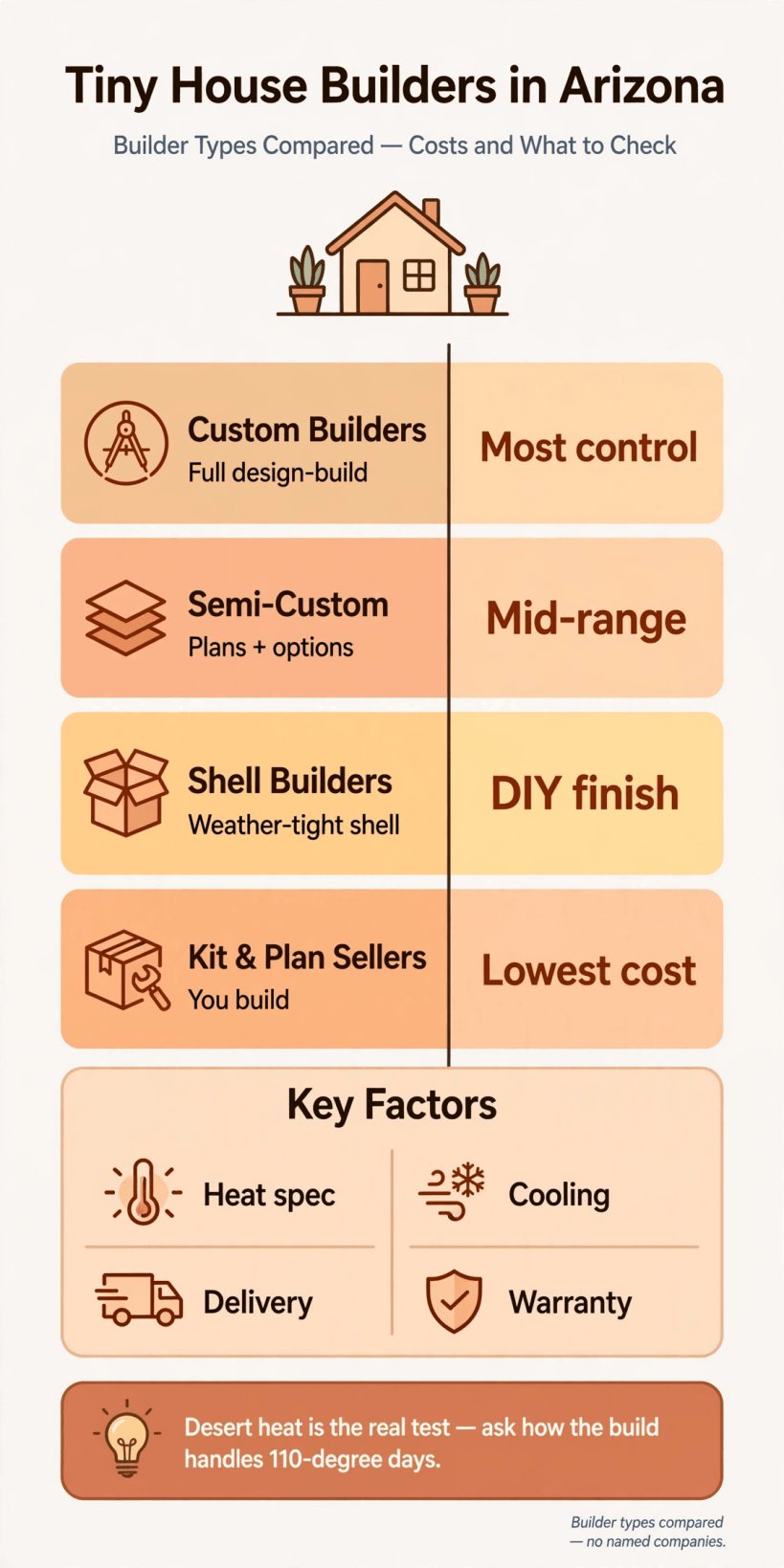
Arizona at a glance: four builder types compared, and the four key factors — heat specification, cooling, delivery and warranty — to test every candidate against.
2. Start With County and City Rules, Not Floor Plans
Arizona’s tiny-house rules are written locally, and they vary in ways that surprise buyers moving within the state. Counties, incorporated cities and towns each answer the placement questions that decide a project: the minimum size a dwelling must reach, setbacks, foundation expectations, whether a home on wheels is treated as a dwelling, a park model or a recreational vehicle, and whether a small second home is allowed behind an existing house. Homeowners associations add another layer in many subdivisions, and a parcel that looks rule-free on a map can carry recorded restrictions that matter more than zoning. Start with the planning office for your exact parcel, and get the classification and permit answers in writing before a design is chosen.
Layer the practical checks underneath the legal ones. In desert areas, water is a first-order question: is the parcel served, is there a well, or would water need to be hauled, and what does each answer mean for permits and daily life? Add septic or sewer arrangements, power access, and drainage — desert ground can look harmless for months and then move a remarkable amount of water in a single monsoon storm, so ask how your site handles runoff, washes and flash flooding. Our building a tiny house checklist, from first questions to move-in day orders those checks, and our overview of how to get a tiny house built, from first sketch to finished home maps the sequence that follows once the land is understood.
Then test builders against your parcel, not their brochure. Ask what they have placed in your county or city, which classification those homes used, and what the local office asked about. A builder fluent in your jurisdiction’s forms and inspectors will talk about your land in specifics within minutes. One who has never delivered near you is not automatically disqualified — but the learning curve will be travelled at your expense, and your comparison should price that honestly.
3. Check Licensing, Certification and Insurance
Begin with the business on paper. Ask for the builder’s licence or registration details where they apply, verify they are current, and confirm the legal name on those documents matches the name on your contract and invoices. Ask what insurance covers the build, the transport and any subcontracted work, and who is responsible at each stage. These are routine questions for a professional operation, and the ease with which they are answered tells you a great deal about the operation itself.
Certification decides what your home legally is. A tiny home may be built and inspected to a residential code, produced as a manufactured or modular unit, or certified as a recreational vehicle or park model, and the label carries consequences for where it may be placed, how it can be financed and insured, and what it is worth to a future buyer. Our explainer on how building codes treat unconventional small homes walks through those consequences. Ask which standard your home will meet, who inspects it at each stage, what documentation arrives at handover, and whether that paperwork matches what your county or city, lender and insurer expect for the way you intend to live in it.
Verify independently before you commit. Search the business through channels the builder does not control, read owner feedback for patterns about cooling performance and aftercare rather than delivery-day enthusiasm, and ask for past customers you may contact — ideally including one in a similar climate zone, desert or high country, to yours. A builder whose homes stay comfortable through an Arizona summer and whose paperwork satisfied the local office has evidence behind the sales talk, and good builders are usually glad to let that evidence speak.
4. Design for Heat First, and Respect the High Country
In low-desert Arizona, the central design problem is keeping heat out and removing what gets in. Interrogate the thermal specification as a system: insulation in roof, walls and floor; protection against radiant gain through the roof; window sizes, placement and solar performance; shading for the largest glass areas; and the orientation the builder recommends for your site, since a home rotated the wrong way presents its biggest windows and its longest wall to the hardest sun. Ask how the builder would site and shade the home on your parcel specifically. Vague answers about good insulation are not a heat strategy.
Cooling is a capacity question, not an appliance brand question. Ask what system the home uses, how its capacity was matched to a small, sun-exposed volume in your climate zone, what it will cost to run through a long cooling season in qualitative terms, and how the home behaves during the hottest afternoons rather than on an average day. Ask also about the humbler details that decide comfort: ventilation for cooking moisture and night flushing where evenings cool, ceiling height and air movement, and where the outdoor unit sits so its noise and hot exhaust do not claim your small outdoor living space. The infographic’s advice — ask how the build handles extreme desert heat days — should be a literal question in every interview.
Remember the other Arizona while you do it. Buyers heading for higher elevations trade the heat problem for cold nights, freezing pipes and, in some areas, snow — sometimes within the same county as desert floor. A specification that is perfect for the valley can be wrong for the mountains, which is why this guide keeps returning to your parcel rather than the state average. Tell every builder your elevation and your intended season of use, and listen for the specification to change in response. If the answer is identical for both climates, you are listening to a catalogue, not a builder.
5. Questions to Ask Every Builder
Use one written list for every candidate, record the answers the same day, and compare paperwork rather than personalities afterwards. Arizona’s version of the list leans hard on heat, water and delivery, because those are the subjects that decide whether a project here is comfortable, legal and finished.
- What is the full heat specification — insulation, windows, shading — in writing?
- What cooling system is fitted, how was it sized for my climate zone, and what does it cost to run?
- What certification will the home carry, who inspects it, and what documents do I receive?
- What exactly does the quoted price include, and what does it leave for me to arrange?
- How have you handled placement and permits in my county or city before?
- What is the water and wastewater plan for a site like mine, and who arranges it?
- How will the home be delivered, in what season and heat conditions, and who assessed my access?
- What warranty covers structure, envelope and cooling equipment, and how is a claim handled?
Score the process as well as the answers. Builders who ask about your parcel’s orientation, elevation and water before quoting, who specify in documents, and who explain trade-offs plainly are demonstrating the habits that carry a project through a monsoon delay or a failed inspection. Pressure to sign quickly, reluctance to involve past customers, and heat answers that rely on adjectives rather than specification are evidence too, and none of it is encouraging.
6. Delivery, Site Works and Setting Up in the Desert
Plan delivery as part of the design, not as a date at the end of it. Arizona sites range from paved suburban lots to desert parcels reached by graded roads that cross washes, and the last stretch decides whether delivery day is routine or a rescue. Ask early who visits or assesses the site, what the delivery vehicle needs in turning room and firm ground, and what seasonal conditions — monsoon storms, flooded crossings, extreme heat for the crew and the equipment — could move the date. A builder who schedules desert deliveries with the season in mind is showing experience you will benefit from.
Agree the site works in writing before the truck rolls: base or foundation preparation suited to your soil, the exact position and orientation of the home, agreed with sun and drainage both in mind, and the utility connections — power, water and sewer or septic — positioned to meet it. Then agree the work of the day itself: who levels and anchors the home, who connects and tests each service, who skirts or seals the base, and who checks that doors, windows and the cooling system behave once the home has settled. Shade structures, if they are part of your plan, belong in this conversation too, because their footings and positions interact with the home’s placement.
Treat the transport terms as contract terms. The agreement should say who pays for delivery, who insures the home on the road, what happens if weather postpones the move, and the condition the home must be in when you accept it. Photograph everything on arrival, walk through with the delivery team before they leave, test the cooling while they are still there to advise, and log every snag in writing on the day. Small problems recorded early are warranty administration; small problems remembered later are arguments.
7. Warranty, Aftercare and Desert Wear
Every new home generates follow-up work, and in Arizona the follow-up list has a local accent: seals and exterior finishes stressed by sun and heat, cooling equipment working long seasons, dust finding its way into everything during storms. Before you sign, have each builder explain the warranty in plain terms — what covers structure and roof, what covers plumbing and electrical systems, what covers the cooling system, and what belongs to equipment manufacturers rather than the builder — and how long each part runs. Then ask how a claim actually works from your distance: who travels, who can be authorised locally, and how a failed cooling system in summer is prioritised against a cosmetic snag.
Ask what documentation arrives with the home and what maintenance the builder expects from you. Manuals, warranty registrations, certification and inspection paperwork, and a plain maintenance schedule — filters, seals, drainage checks around the base after storms, and the care exterior finishes need under strong sun — are part of the product. Compact homes hide their systems behind fitted joinery, so a handover that shows you every shut-off, panel and access point is worth real money the first time something needs attention quickly.
Judge aftercare by evidence wherever you can find it. Past customers can tell you whether warranty calls were answered in days or in weeks, and whether the fix lasted. A builder with a slightly shorter warranty honoured promptly and locally may serve you better than a longer promise administered from far away by voicemail. In a state where a cooling failure is a habitability problem, not an inconvenience, that difference is not fine print. It is the warranty.
8. What Drives the Cost in Arizona
This guide quotes no prices, deliberately: a bare figure without its specification and inclusions would mislead you. Compare the drivers instead. Builder type is the first. A custom design-build buys design time, site-specific orientation and shading decisions and one-off problem solving. A semi-custom build spreads the cost of proven plans. A shell stops the builder’s invoice where your own labour begins. A kit or plan moves almost all labour — and the responsibility for making a design heat-worthy — onto you. Each is a legitimate route; each is a different purchase wearing a similar photograph.
The specification is the second driver, and in the desert it is dominated by the fight against heat: insulation depth, roof treatment, window performance and shading, a properly sized cooling system, and the quality of sealing and ventilation. High-country buyers swap some of that spend for cold protection. The third driver is the site, where Arizona routinely surprises newcomers: clearing and grading, driveway work across washes, water supply solutions, septic or sewer, power runs across distance, base and anchoring, permits and inspections, and delivery to remote ground can add up to a major share of the whole project — sometimes rivalling the difference between builder types.
Build one cost sheet with identical rows for every candidate — home as specified, certification and inspections, delivery, site preparation, utility works, and a contingency you hold — and fill every cell before comparing totals. When one quote is dramatically lighter, hunt for the empty rows. In this market a low number usually signals excluded delivery, thin heat specification, or site works silently assumed to be your problem. All three discoveries are cheap while you are comparing quotes and expensive after the home exists, pointed the wrong way on an unprepared pad, in July.
9. Warning Signs That Should Slow You Down
Pause on any builder who cannot state the heat and cooling specification in writing, who treats county or city placement questions as formalities that will somehow not apply, or who quotes delivery to land they have never seen, across country they have never asked about. In Arizona those are not administrative details. Heat performance decides daily life for much of the year, classification decides whether the home may legally sit where you intend, and access decides whether it arrives at all.
Treat sales pressure as data. Expiring discounts, claims that comparison shopping will lose you your slot, and payment schedules that run well ahead of visible, verified progress all move risk from the builder to you. Be just as wary of the purely informal operation, however charming: deposits, specification, change orders, delivery responsibilities and warranty all belong in a contract, and a professional will already work that way. If a builder’s paperwork is thin, imagine resolving a cooling failure or a cracked panel with that paperwork, because that is exactly what you would be doing.
Run small tests before the big commitment. Send three precise questions about heat specification, water and delivery timing, and judge the answers for specificity and speed. Visit a finished home in your climate zone in the afternoon, not the morning, and ask its owner about summer comfort and aftercare. Look at homes in progress to see how sealing, insulation and joinery are actually done when no customer is watching. The builder you meet during easy enquiries is the builder who will handle your monsoon delay or your failed inspection. Let the evidence, not the brochure, make the decision.
10. Compare Final Quotes Side by Side
Close the process with one sheet and every serious candidate on it. Rows for builder type, heat specification, cooling system and sizing, certification and inspection, contract and payment schedule, delivery and site works, water and wastewater arrangements, and warranty handling; a column per builder; and no empty cells allowed at decision time. An empty cell is an unasked question wearing the disguise of a saving, and the desert has a way of pricing unasked questions later, with interest.
Read the totals last, and the behaviour first. Which builder asked about orientation, elevation and water before quoting? Whose specification changed intelligently between a desert parcel and a high-country one? Whose past customers described summers as comfortable and warranty calls as answered? A somewhat higher quote from a builder whose answers were local, documented and testable is frequently the cheaper decision across the home’s life, because Arizona’s expensive failures — an unplaceable home, an unliveable afternoon temperature, a delivery defeated by a wash — are failures of homework, not of workmanship, and homework is visible in the quote if you know how to read it.
The comparison method itself travels well. Our guide to tiny house builders in Alabama and the checks that matter there applies it under Gulf-influenced storms and humidity, and the sibling guides for tiny house builders in Alaska, tiny house builders in Arkansas and tiny house builders in Delaware, together with our earlier guide to tiny house builders in Maryland and how to choose between them, each adapt the same builder-type ladder to their own land, weather and rules. Wherever the land is, the order holds: rules first, specification second, quotes last.
Final Considerations
The right Arizona builder is a match, not a ranking: the type that fits how much work you want to own, a heat or cold specification honestly designed for your elevation and your sun, paperwork that satisfies your county or city, a delivery plan that respects your access and your season, and a warranty that works at your distance. Take the checks in this guide in order, insist on the important answers in writing, and let each builder earn the next step. Chosen that way, the home that settles onto your parcel stands a far better chance of being cool in summer, legal on paper and loved in practice.


0 Comments