

In a tiny wardrobe, how clothes are folded matters as much as how many there are. Marie Kondo folding turns every garment into a neat standing rectangle, so one shallow drawer can hold, and reveal, what a stacked pile would bury.
This step-by-step guide covers the basic fold, then adapts it garment by garment, tops, trousers, small items and bulky knits, ending with drawers you can read at a glance.
1. At a Glance: The File Fold in Three Steps
The whole technique is one central idea, the file fold, expressed in three steps and one storage rule. Learn the table below and you have learned the method; the rest of this guide is practice, garment by garment.
| Step 1 | Fold in the sides — make a rectangle |
| Step 2 | Fold in half lengthwise |
| Step 3 | Fold into thirds — it stands upright |
| Store | File, don’t stack — see everything |
| Key Factor: Rectangles | Every item starts as a rectangle |
| Key Factor: Thirds | The final fold is into thirds |
| Key Factor: Upright | Items stand, not lie in piles |
| Key Factor: Visibility | Every item visible at a glance |
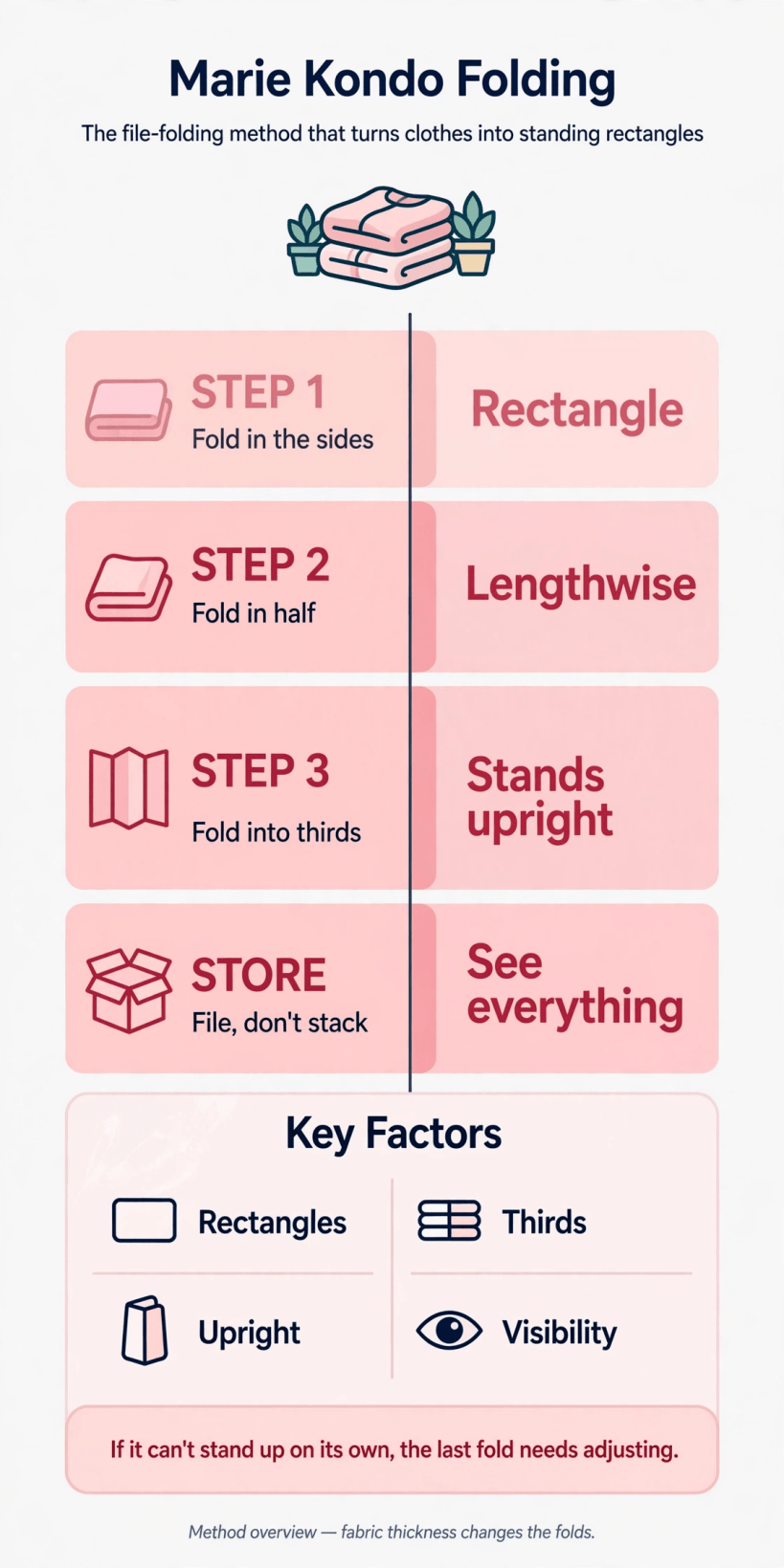
The file fold at a glance: fold in the sides to a rectangle, fold in half lengthwise, fold into thirds so it stands upright, then file it, never stack it.
And keep the summary’s test in your pocket for every garment that follows: if it can’t stand up on its own, the last fold needs adjusting. That single check, applied honestly, is the difference between a drawer that stays filed and one that slumps back into a pile within a week.
2. Why File Folding Works in Tiny Wardrobes
Stacking hides clothes. The bottom of every pile becomes a forgotten layer, worn rarely, crushed often, and rediscovered only during a full, annoying excavation. Filing inverts the problem: every item stands in a row like books on a shelf, its folded edge facing up, so the whole drawer reads in one glance and any single piece lifts out without disturbing its neighbours.
The space economics are just as strong. A standing rectangle uses the full height of a drawer instead of spreading across its floor, so shallow drawers, the kind tiny houses and small flats actually have, suddenly work as complete wardrobes. Garments also keep their shape better, because nothing bears weight from above, and the daily act of choosing becomes calmer: what you own is visible, countable, and evidently enough, or evidently too much, which is its own useful information.
This is why the method pairs so naturally with the wider tiny-living philosophy across this site, from the built-in efficiency of the sunken greenhouse (walipini) build to the ordered beds of the herb garden layouts by bed size and sun. In each case the trick is identical: arrange things so you can see everything, reach anything, and waste nothing, neither space nor the contents it holds.
3. Before You Fold: The Quick Sort and Setup
Folding works best on a wardrobe that has already been honestly edited. Empty the drawer or rail completely, handle each item once, and keep only what you actually wear and like wearing; folding clothes you resent merely organises resentment into rectangles. What leaves, leaves now, to donation, recycling or the rag bag, and what stays goes through the wash or a good airing so the drawer restarts genuinely fresh.
Set up like a person who intends to finish. A flat, clear surface at a comfortable height, bed, table or clean floor, is your folding board; good light helps you smooth seams properly; and a drawer, box or basket beside you receives each finished item immediately, because a surface covered in standing rectangles collapses the moment you bump it. Group the pile by type before you begin, all tops together, all trousers together, so your hands learn one garment’s fold and repeat it into a rhythm.
Finally, measure your storage before folding your first item. The finished height of a folded piece should match the drawer’s depth, and that target measurement quietly governs how many folds each garment gets. Fold one test piece, stand it in the drawer, and check the fit; adjust once here and every later piece inherits the correction, a small upfront kindness like choosing a layout in advance, as cooks do with the complete solar oven guide.
4. The Basic Fold, Step by Step: T-Shirts and Tops
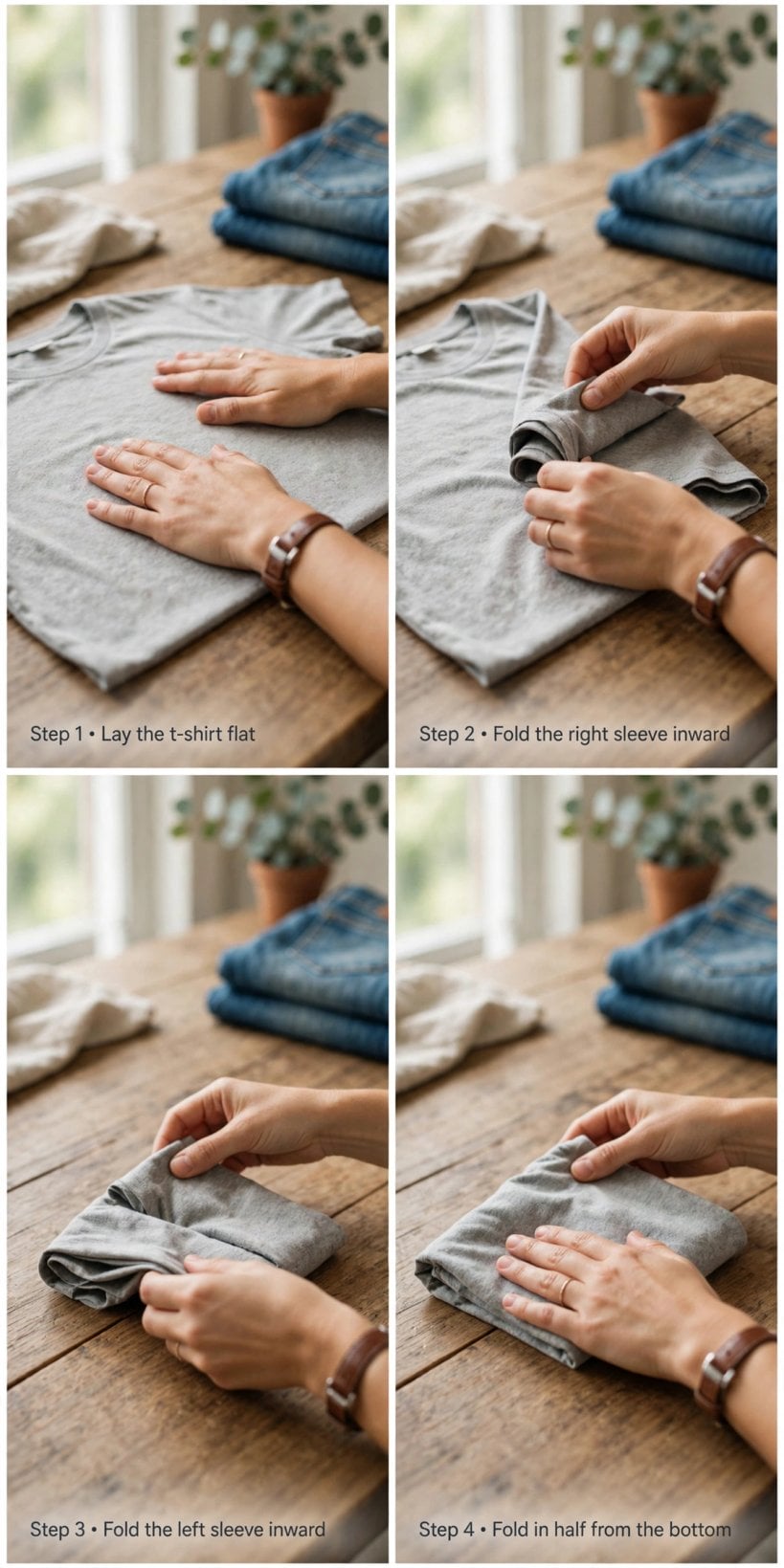
Take a basic top and lay it flat, face down, smoothing it with your palms. Step one: fold in the sides. Bring one side toward the centre, fold the sleeve back neatly so it lies within the body’s width, and repeat on the other side. What remains is the method’s foundation shape, a clean rectangle, with no corners straying and no sleeve escaping to make bulk.
Step two: fold the rectangle in half lengthwise, bringing the bottom hem up toward the neckline, and smooth again. Step three: fold the resulting strip into thirds, one end over, then the other, adjusting that final fold until the package stands upright on its folded edge without toppling. The thirds are not sacred geometry; they are a means to a standing end, so a longer top may want its thirds uneven, and a short one may fold happily in a slightly different rhythm.
Work through the tops pile without pausing to file each piece, standing finished items in a row in your box like dominoes that support one another. By the fifth top your hands will know the sequence, sides, half, thirds, stand, and the pile will shrink with the calm, mechanical pleasure of a job whose rules fit on an index card. Smooth as you go: every crease you press out with a palm now is a crease the drawer will not set into the fabric later.
5. Shirts, Blouses and Dresses: Adapting the Rectangle
Buttoned shirts fold from the same recipe with two adjustments. Fasten a few buttons so the body holds its shape, lay the shirt face down, and fold the sides in as before, guiding the sleeves to lie straight down along the folded body rather than across it, because sleeves folded across the back create a ridge that ruins the rectangle. Then half, then thirds, standing the finished shirt with its collar end as part of the package, filed among its fellows where a hanging rail once monopolised it.
Blouses and lighter tops ask for gentler handling: smoother fabric, slower smoothing, and folds into thirds that may need to be looser so slippery cloth keeps its grip. If a fabric truly refuses to stand, and some silky ones will, file it rolled snugly beside the standing items or grant it a small divider section, because the system’s goal is visibility, not ideological purity about one technique.
Dresses divide by cut. Straight, simple dresses fold exactly like long tops, sides in, half, thirds, perhaps with an extra fold to meet the drawer’s height. Wide or flowing skirts resist, and for those the honest answer is that a tiny wardrobe’s single short hanging space, if it has one, is earned by precisely the garments that cannot file. Curate what hangs, file everything else, and the rail stays as readable as the drawers, in the spirit of the broader systems in smart tiny house design ideas.
6. Trousers, Jeans and Skirts
Trousers begin by folding in half along their length, leg to leg, smoothing the seat and aligning hems and waistband. Fold any overhang at the seat inward so the silhouette straightens into the now-familiar long rectangle, then fold in half lengthwise, and finish into thirds. Denim stands with particular willingness thanks to its stiffness; softer tailored trousers may need their thirds adjusted, and crease-conscious pairs can be folded so the thirds fall away from the formal crease line.
Jeans and heavier bottoms give the sturdiest rectangles in the wardrobe and make excellent structural neighbours, filing at the ends of a row to bookend softer items. Shorts fold in miniature: sides or seat tucked straight, half, then thirds or a simple half if they already meet the drawer’s height, and they file happily in the shallowest drawers alongside underwear and sleepwear.
Skirts follow their fabric. Straight and pencil styles fold like trousers and file well; pleated skirts should be folded along their pleats with minimal cross-folding, and very full skirts, like flowing dresses, may earn hanging space instead. The judgement is always the same and always practical: an item is filed if filing keeps it visible, uncrushed and easy to lift out, and it is stored another way without guilt when it cannot.
7. Underwear, Socks and the Small Items
Small items are where filing delights most, because a drawer of filed underwear reads like a well-kept shop display and takes seconds to use. For underwear, fold the sides to the centre to make a small rectangle, then fold into thirds from bottom to top, and stand each piece in rows within a shallow box or drawer divider. Briefs, boxers and vests all follow the same miniaturised logic, and none of it needs to be precise to work beautifully.
Socks are treated with more respect than the traditional ball, which stretches elastic and hides pairs inside a lump. Lay one sock on the other, fold into thirds for short socks or in half and thirds for longer ones, and stand the resulting small packets in rows. Pairs stay findable, elastic lasts longer, and the morning rummage disappears entirely, a tiny daily dividend that compounds across a year of mornings.
Bras keep their shape best stored nested in a row, cups aligned, rather than folded in half, and they file at the end of a small-items box where nothing compresses them. Accessories join the system by the same token: ties and scarves fold into soft rectangles and file in narrow sections, belts coil in a small box, and gloves pair, fold and file together. In a tiny wardrobe every category gets a visible home, because invisible storage is where duplicates and losses breed.
8. Sweaters, Hoodies and Bulky Pieces
Bulky knits test the method and reward adaptation. Lay the sweater flat, fold the sides and sleeves inward to form the rectangle, sleeves lying diagonally down the body where their bulk spreads evenly, then fold in half and into thirds with a looser hand than cotton wants. Thick fabric makes its own rules, exactly as the summary warns that fabric thickness changes the folds, so expect two folds where a T-shirt took three sections, and judge by standing, not by arithmetic.
Hoodies add one feature: the hood. Fold it flat against the back first, then proceed as for a sweater, sides in over it, so its bulk sits inside the rectangle rather than erupting from it. Pockets and drawstrings tuck inside the folds. The finished parcel is plump but upright, and filing several together, graded by thickness, keeps a winter drawer as legible as a summer one.
Very bulky items, the season’s thickest knit or padded layer, may simply be too deep for a drawer, and here the system flexes again: one neat, visible stack on an open shelf, folded in the same rectangle discipline, beats a drawer forced shut on a springy mountain. The principle survives the exception, because the shelf stack holds only a few like items, each visible, each removable, which is the entire point wearing a different hat, as with the simple-tech choices in best dumb phones for minimalists.
9. Filing the Drawers: Order, Dividers and Seeing Everything
File in an order your mornings will thank you for. Group by category first, tops with tops, then within each group arrange by colour from light to dark or by weight from fine to thick, so the eye travels the row like a contents page. Face every folded edge upward and keep the rows snug, neither jammed nor loose; a row that is too loose slumps, and a slumping row is simply a pile waiting to happen.
Dividers earn their keep in wide drawers: simple boxes, baskets or even sturdy repurposed packaging create the narrow channels in which standing rows behave. Shallow boxes inside deep drawers rescue wasted height by creating a lift-out upper storey for small items. Whatever you use, keep it plain and washable, because the container’s job is to disappear behind the order it enables, a principle any tiny-space dweller will recognise from an honest decision guide to getting a tiny house.
Then maintain the miracle with thirty-second habits. Return each laundered item to its exact row while the drawer is open anyway; pull items from the row without dragging neighbours; and refold the occasional escapee the moment you notice it, not during some future grand tidy. Filing systems do not fail dramatically; they erode through small exceptions, and they survive through equally small fidelities repeated without drama.
A useful way to begin is the one-drawer challenge: choose the drawer you open most often, empty it completely, fold only the clothes you reach for weekly, and file them back with a little breathing room to spare. Live with that single drawer for seven days and notice what changes: choosing takes seconds, returning laundry takes a minute, and the clothes you skipped stand out as honest candidates for the next edit. Most people find the experiment converts them faster than any argument, because the evidence is sitting in their own bedroom, standing upright in a row. From there the rest of the wardrobe follows drawer by drawer, at laundry pace, until the whole tiny system runs on the same quiet rule of visibility first, and folding becomes a habit attached to the wash rather than a project attached to a free weekend.
10. Troubleshooting: When It Won’t Stand Up
The summary gives the master diagnostic plainly: if it can’t stand up on its own, the last fold needs adjusting. A parcel that topples is usually folded too tall for its thickness, so refold the thirds more compactly; a parcel that slumps sideways is usually folded too loosely or unevenly, so tighten the sides, even the layers, and let the final third carry the structure. Adjust once, test by standing it on the table, and only then file it.
Fabric quarrels have fabric answers. Slippery cloth wants to be filed snugly between sturdier neighbours or rolled within its section; very thin cloth may need an extra fold to give it body; stiff cloth needs fewer, flatter folds and room not to spring. Creasing concerns reverse the usual worry: because filed items bear no weight, creases come mainly from over-tight folds in tailored pieces, cured by looser thirds and by keeping formal items at a row’s end where pressure is least.
And when a drawer relapse happens, because a busy month defeated everyone in the house at some point, treat it as housekeeping, not failure. Empty one drawer only, refold its contents in one sitting of a few minutes, and enjoy the disproportionate pleasure of the restored row. The method’s durability lies in these cheap resets: no special equipment, no purchased system, just rectangles, thirds, upright, visibility, restored whenever they are wanted.
Final Considerations
Fold in the sides to a rectangle, fold in half lengthwise, fold into thirds until it stands, and file it where you can see it: that is the whole craft, and it will quietly reorganise first a drawer, then a wardrobe, then the morning itself. Start with one category of clothing, tops are the kindest teachers, file one drawer, and live with it for a week before judging. Tiny wardrobes reward exactly this kind of small, complete system, and few systems repay so little learning with so much daily calm.


0 Comments