

A perfectly made bed is not a hotel trick or a stylist’s performance — it is thirteen ordinary steps in the right order, most of them taking less than a minute, and the difference they make is the difference between a bed that was covered and a bed that was made.
This article carries the thirteen steps in full, in sequence: the preparation that precedes them, the foundation layers, the flat sheet and its corners, the duvet and its cover, the pillows, and the finish — then the same routine adapted to small rooms, the mistakes that undo it, and what it honestly costs.

1. A Perfectly Made Bed at a Glance
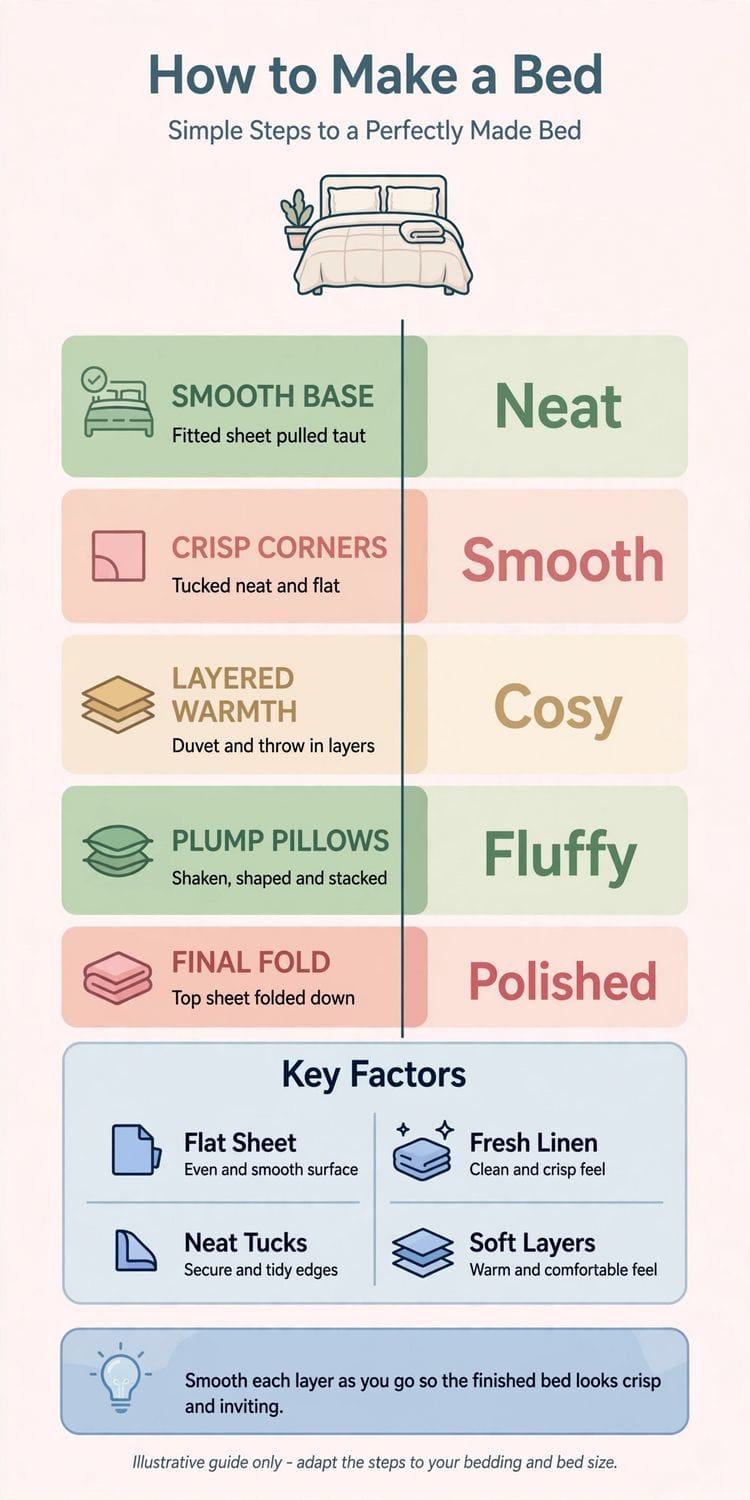
Making a bed perfectly is a layering discipline: each layer is laid centred, smoothed from the middle outward, and anchored before the next begins, so that no wrinkle is ever covered up — only prevented. The sequence runs mattress outward: protector, fitted sheet, flat sheet, warm layer, duvet, pillows, finish. The steps below assume an ordinary bed and ordinary linen; where the household’s bed differs — a loft, a wall-side bed, no flat sheet — the adaptations follow the steps.
| Question | Short answer |
|---|---|
| How long does it take? | About ten minutes once the order is learned; most of it is the duvet cover |
| What is the most important step? | The fitted sheet, anchored corner by corner in diagonal order — everything sits on it |
| What is a hospital corner? | The diagonal fold that tucks a flat sheet’s foot neatly under the mattress |
| Do I need special linen or tools? | No — fit matters more than finery, and hands do the work |
| What finishes the bed? | The fold-back, the throw banded at the foot, and one smoothing pass judged from the doorway |
2. Before You Begin: The Bed, the Linen and Ten Honest Minutes

Everything the thirteen steps need is ordinary: the bed itself, a fitted sheet, a flat sheet if the household uses one, a duvet in its cover or a blanket in its place, pillowcases for the pillows, and whatever finishing layer — coverlet, throw, quilt — the bed wears by day. Nothing is laundered, ironed or bought for this article; a perfectly made bed is a technique, not a purchase.
Two habits precede the steps and decide half their result. The first is airing: a bed left open to the room for a while before making — covers thrown back while breakfast happens — dries the night’s warmth out of the layers and makes the finished bed fresher than any spray. The second is order: the steps run from the mattress outward and from the bottom layer up, and no step is improved by being done out of turn.
The one tool worth having
A spare pillowcase or a soft cloth kept with the linen, for smoothing. Hands do most of the work in this article, and the final passes — over the duvet, along the fold — are handwork by design. Everything else is already in the bedroom.
One thing is worth checking before the first step, because no order of making can cure it: fit. A fitted sheet whose pockets are shallower than the mattress — protector included — will escape its corners however it is anchored, and pillowcases much larger than their pillows will swamp them however they are plumped. Where the making keeps failing at the same place, suspect the fit before suspecting the technique; the steps below assume linen that belongs to the bed it is dressing.
3. The Foundation Steps: Clear, Protect and Fit the First Sheet

Step 1: Strip the bed back to the mattress, air it, and sort the linen in making order
Take everything off — duvets, sheets, pillowcases — shaking each piece out as it comes, away from the bed, and leave the bare mattress open to the room; even a short airing changes how the finished bed feels at night. Lay the pieces out in the order they will go on: protector, fitted sheet, flat sheet, duvet or blanket, pillowcases, finishing layer. Hunting for the fitted sheet’s corners mid-make is where most beds lose their crispness and their makers lose their patience.
Step 2: Fit the mattress protector smooth and square
The protector goes on first and matters more than its invisibility suggests: every wrinkle in it prints through the sheet above and is felt all night. Pull it flat at each corner, smooth it palm-down from the centre outward, and let it sit a moment before the sheet follows.
Step 3: Anchor the fitted sheet, corner by corner
Work the corners in a diagonal order — top left, bottom right, then the other two — pulling each deep pocket fully under and smoothing the surface toward the corner just fixed. A fitted sheet anchored this way stays anchored; one walked around the bed in a circle is usually loose by the second corner. Finish with a palm passed over the whole surface: any ridge found now is a ridge slept on tonight, and this is the last moment it can be removed without unmaking something above it.
4. The Flat Sheet and the Warm Layer

Step 4: Lay the flat sheet square, finished side down
Centred so its fall is even on both sides, top edge at the mattress’s head, patterned or finished side facing down — so that when the top is folded back, the good face shows. Smooth it from the centre to the edges, and let the sides hang free for now.
Step 5: Tuck the foot with hospital corners
At the foot, tuck the sheet’s end under the mattress, then take each side corner up in a diagonal fold — the classic hospital corner — and tuck the side in smooth. The foot of a made bed is its tailoring: crisp corners at the bottom are what make the whole thing read as deliberate.
Step 6: Add the blanket or warm layer evenly
If a blanket sits between sheet and duvet, lay it as the sheet was laid: centred, smoothed, its top edge a hand’s width below where the fold-back will come, tucked at the foot with the same corners. In warm months this layer is the duvet itself, and the next steps simply move up a layer.
5. The Duvet: Into Its Cover and Onto the Bed

Step 7: Put the duvet inside its cover without a wrestling match
Turn the cover inside out, reach in and take its two top corners in your hands, grip the duvet’s top corners through the cover, and shake the cover down over the duvet like a pillowcase over a pillow. Fasten the closure, then shake the whole thing once more so the filling settles to its corners. If the duvet bunches toward the middle over the following nights, the corners inside the cover are wandering — ties or clips at the corners, where the cover allows them, end the wandering for good.
Step 8: Lay the duvet centred, with an even fall on both sides
Carry it to the bed and lay it by its top corners: centred on the bed, an equal fall of duvet on each side, its top edge level with where the pillows will end. An uneven fall at this moment is the uneven bed of every photograph — correct it now, at arm’s length, not later by tugging.
Step 9: Fold back the top in one clean line
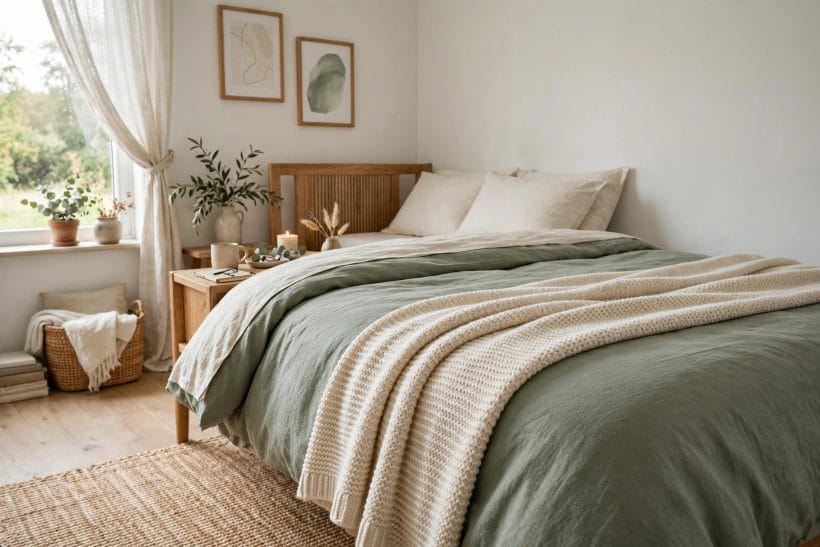
Fold the duvet’s top — with the flat sheet’s top folded over it where a sheet is used — down in one straight fold, wide enough to read as a design decision. This fold-back is the made bed’s signature: it shows the sheet’s good side, invites the sleeper in, and hides the exact place where pillows will meet layers.
6. Pillows: Dressed, Plumped and Placed

Step 10: Dress the pillows and plump them back to shape
Pillowcase on with the pillow shaken down into it corner by corner, the open end tucked or folded neatly, then the pillow plumped — punched at its sides, shaken by its corners — until it holds its shape standing. A pillow dressed carelessly sleeps badly and makes the bed look tired before anyone has touched it.
Step 11: Place the pillows in their order
Sleeping pillows first, standing against the headboard or lying at their sleeping angle, then any second pair in front, then — if the bed wears them — the decorative cushions last and fewest. The order matters less than the principle behind it: the bed should take under a minute to unmake at night, or the making will quietly stop happening.
7. The Finish: Throws, Smoothing and the Step Back

Step 12: Add the throw or coverlet, folded at the foot
The finishing layer goes across the foot — folded lengthwise into a band, laid straight, its edge parallel to the foot of the bed. It is the bed’s colour statement and its practical extra layer in one, and its straightness is the maker’s signature at a glance.
Step 13: Smooth everything once, then step back and judge
One final pass: palms over the duvet from centre to edges, the fold-back’s line checked, pillows squared, the throw’s edge straightened. Then step to the doorway — the angle the room is actually seen from — and correct the one thing the eye finds. A made bed is finished from the doorway, not from above.
That is the thirteenth step, and it is the one that separates a bed that was made from a bed that was made well. The doorway test costs ten seconds and it is where crooked duvet falls, uneven pillow lines and the throw’s quiet drift are all caught at once. It is also where the bed’s colour is judged: in a serene scheme like the ones in white bedroom ideas the throw band carries nearly all the colour there is, while against the deep tones of black bedroom schemes it is the pale throw that does the lifting — either way, the doorway is where the choice proves itself.
8. Making Beds in Small Rooms and Tiny Homes

A bed made against a wall, in an alcove or in a loft is made by the same thirteen steps with two adjustments. Work from the open side and make the far side’s tucks by kneeling on the mattress and reaching — the corners can still be anchored in diagonal order — and keep the finishing layers few, since every layer on a wall-side bed is a layer wrestled twice a day.
In the smallest rooms the made bed is also the room’s daytime furniture, which argues for the full routine rather than against it: a bed with a fold-back, a banded throw and two upright pillows reads as a daybed or a sofa’s cousin, and it returns the room to the household until night. The wider context — rooms that earn their keep twice — is the ground of the bedroom planning surveyed in bedroom ideas, where the bed’s daytime face is designed as carefully as its night one.
Loft and bunk beds
The steps compress but do not change: protector and sheet fitted from the ladder or standing on the frame where it is safe, duvet laid and folded from the open side, one pillow only. What a loft bed cannot take is ceremony — keep its finishing layer to the throw, and its making stays a two-minute habit rather than a weekly event.
Day beds and sofa beds
A bed that is also the day’s sofa is made to a slightly different finish: the fold-back becomes a neat top edge, the pillows stand in a row along the wall as cushions, and the throw lies where sitters will not drag it to the floor. The thirteen steps still run underneath — the fitted sheet anchored, the layers smoothed — because a sofa bed that is made loosely by day sleeps badly by night, and its maker ends up doing the work twice. It is the arrangement the small flats in modern bedroom ideas depend on: one piece of furniture, two duties, and the making is what switches it between them.
9. Checks and Mistakes: Wrinkles, Slipping Corners and Lumpy Layers
The made bed’s enemies are few and known. A fitted sheet that pops its corners is usually a sheet whose pockets are shallower than the mattress is deep — protector included — or one anchored in a circle rather than diagonally; re-fit by the diagonal order once, and if it still escapes, the sheet and the mattress are simply mismatched, and no technique will marry them.
Wrinkles that return by noon belong to linen pulled drum-tight at making and creeping back as it relaxes; smooth firmly, but let the layers lie at their natural tension and they will hold their faces longer. A duvet that lumps has filling that was never shaken to its corners inside the cover — repeat the cover step with the shake, rather than patting the lumps through the cloth.
The household mistakes are gentler: too many cushions, so the bed is unmade onto the floor every night and the making quietly stops; layers out of season, so the bed is stripped to a sheet by midnight; and the fitted sheet put straight from the line onto the bed without the protector smoothed beneath it, printing its wrinkles through everything. None of these needs money. All of them are cured by the order in this article.
One more check, made weekly rather than daily: wash the linen on the household’s own rhythm — bedding against skin earns its laundering — and let the mattress air fully on sheet-change day, protector off, window open where there is one. The thirteen steps make the bed; the weekly airing keeps it worth making.
And a check made seasonally: the pillows themselves. A pillow that stays folded when bent double, or that no amount of plumping at step eleven will persuade back to loft, has finished its service — making will disguise it for a photograph but not for a neck. Replace one pillow at a time as they fail and the bed’s comfort never falls off a cliff; the making steps, unchanged, will simply start working again.
10. Costs and Pulling It Together
The honest cost of a perfectly made bed is time: roughly ten honest minutes once the order is learned, most of them in the duvet cover and the final smoothing. Nothing in the thirteen steps requires a purchase. Where money can be spent usefully, it is on fit rather than finery — a fitted sheet whose pockets match the mattress, pillowcases that match the pillows, a protector that lies flat — the unglamorous pieces the eye never sees and the sleeper always feels.
Spend nothing on making tools until the technique has been lived with for a month. If a gap appears — the duvet that will not stay in its cover’s corners, the sheet that will not stay on the mattress — it will name its own remedy, usually ties or grips of the simplest kind, bought once. The thread to pull through the whole article is order: layers in sequence, corners in diagonal, judgement from the doorway. The order is the entire secret, and it is free.
The routine also bends honestly with the seasons rather than breaking. In summer the warm layer thins or goes, the fold-back deepens to show more sheet, and the throw becomes decoration rather than duty; in winter the blanket returns and the duvet rides higher. The steps do not change — only the cast does — which is why a household that learns the thirteen in any one season owns them in all four. Layered schemes built this way are the quiet machinery behind the calmest rooms in this series — the tonal layers of gray bedroom ideas and the rich ones in purple bedroom ideas are, underneath the colour, exactly this order of layers made well.
Final Considerations
A perfectly made bed is a small daily proof that order is a technique rather than a talent: thirteen steps, none of them difficult, all of them ruined by being rushed or rearranged. Learned once, the sequence runs on habit — and the bedroom is the better for it every single day.
Make it tomorrow morning in the order given, doorway test included, and the routine will already feel less like instructions and more like the way the bed is made.




0 Comments