

Purple bedrooms carry an unfair reputation — too bold, too sweet, too hard to live with — handed down from a few badly judged rooms. Handled with any discipline, purple is instead the most restful of the strong colours: it deepens at dusk exactly when a bedroom should, flatters lamplight, wood and brass, and offers a range that runs from near-neutral lavender to a plum so deep it behaves like a warm black.
This collection works the colour the way a decorator would: choosing the shade against the room’s real light, placing it on walls, bed and furniture in ranked order, pairing it with the colours it loves, and finishing with the small-room and renter routes that make it possible almost anywhere. The central entity is the purple bedroom itself — a room whose colour is a decision, not an accident.
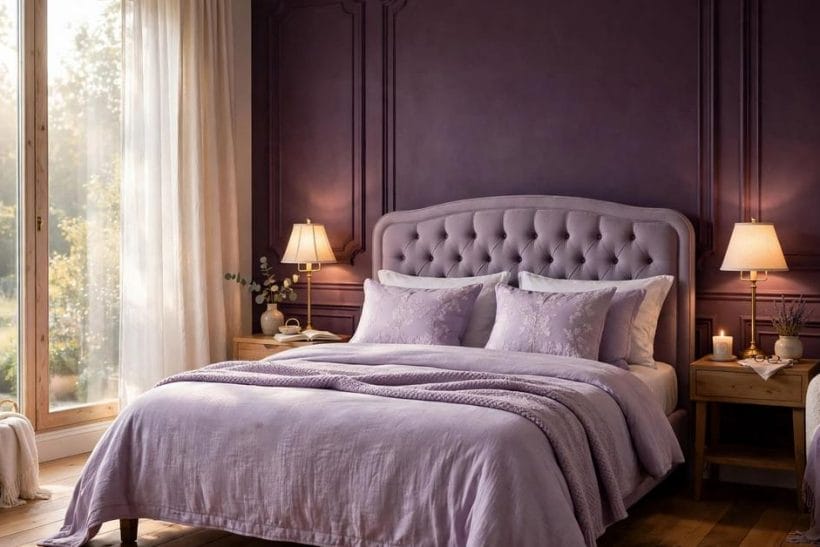
1. Purple Bedroom Ideas at a Glance
The purple bedroom is the colour-led room of the bedroom ideas pillar in this collection: one shade family chosen against the room’s light, one lead surface carrying it, and every textile, timber and metal ranked beneath it. Its attributes are shade (plum to lavender), placement (walls, bed, joinery, textiles), pairing (greens, greys, creams and warm metals) and light (daylight managed, lamplight warm). Get those four settled and the individual choices below become easy.
| Question | Short answer |
|---|---|
| What is the safest first purple? | Lavender or lilac on walls, or plum in the bedding — the two lowest-regret entries. |
| Which purple suits a dark room? | A warm, red-leaning plum; cool violets turn cold under grey light. |
| What colours pair with purple? | Sage green, grey, cream, blush and navy — plus brass and warm timber. |
| How do I keep it calm, not sugary? | One lead shade, ranked supporting shades, texture over pattern, white as referee. |
| Can purple work in a small bedroom? | Yes — one complete deep wrap, or pale walls with the depth in textiles. |
| Can renters have a purple bedroom? | Yes — bedding, curtains, rug and accessories carry the whole scheme. |
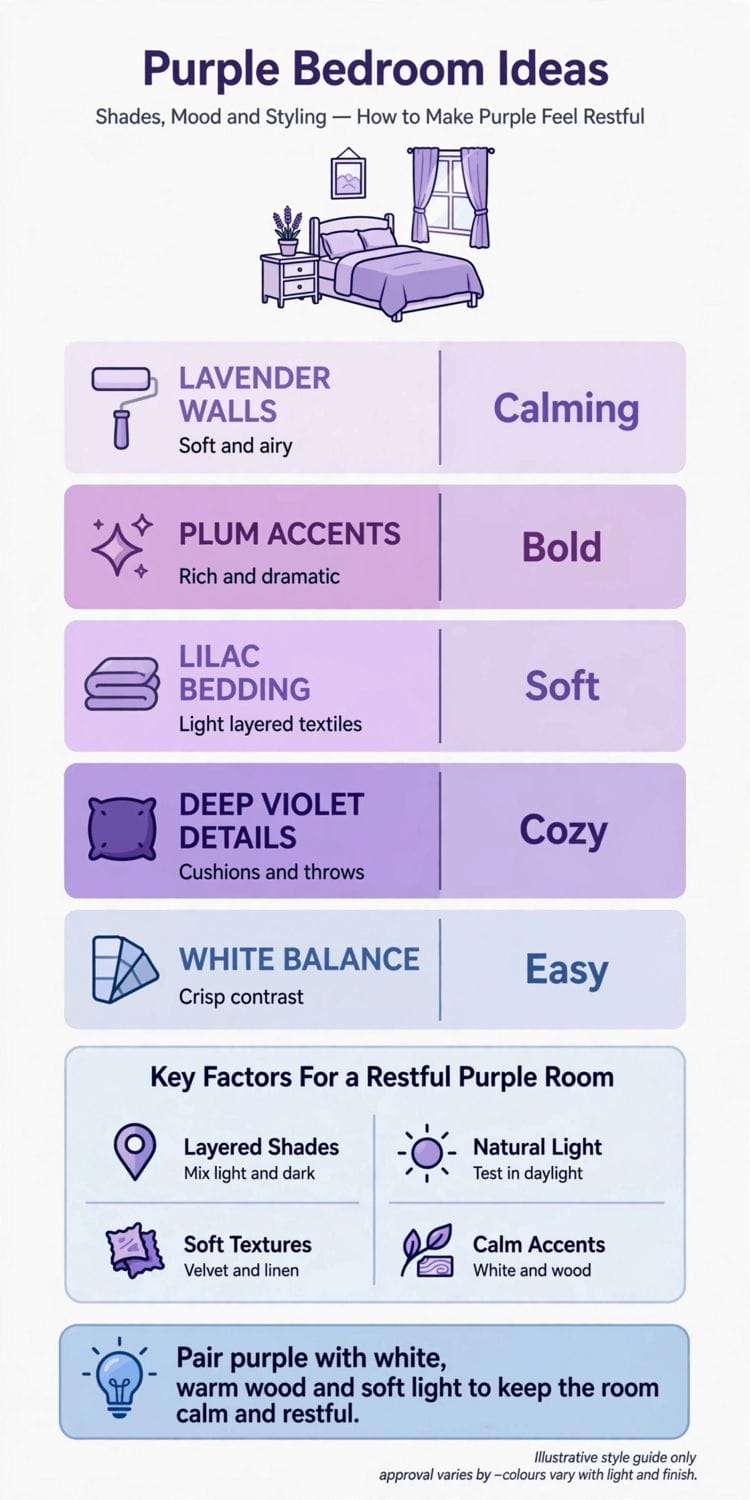
2. Choosing the Purple: Shade, Depth and the Room’s Own Light
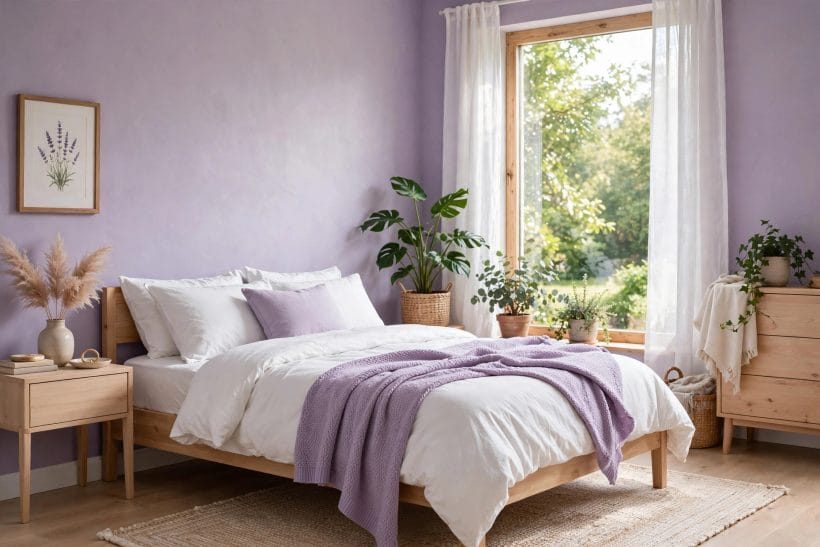
Purple is not one colour but a family that runs from near-black plum to the palest lavender, and a bedroom succeeds or fails on which member of the family is chosen and where it is asked to work. This section is the choosing: depth, undertone and the light the room actually receives.
1. Start with the shade family, not a single swatch
Plum, aubergine, lilac, lavender, mauve and violet behave like different colours because they are. Deep shades make a room feel enclosed and restful; pale ones read almost as neutrals with a mood.
2. Test purple on the wall it will live on
Purple is famously two-faced: a chip that looks grey-lilac in the shop can turn blue or pink at home.
3. Read the undertone before anything else
Every purple leans warm or cool. Red-leaning purples feel cosy and traditional; blue-leaning ones feel crisp and modern. Hold the swatch against the room’s fixed elements — floor, wardrobe doors, bed frame — and the lean shows itself at once.
4. Let north light push you warmer
A bedroom that faces away from the sun receives cool, grey light all day, and a cool purple in it can turn cold and flat.
5. Use the deepest purple in the smallest dose
Near-black aubergine is the most luxurious member of the family and the easiest to overdose. One wall, a headboard, a pair of velvet cushions — the deep shade works like punctuation.
6. Lavender as the quiet neutral
The palest purples earn their place as alternatives to grey or beige: they give a bedroom a tint of personality while behaving like a neutral behind wood, white and natural linen.
7. Keep one purple in charge
A scheme can layer several purples, but one must lead and the rest support. Let the lead shade own the largest surface and repeat the supporting shades in smaller textiles.
8. Judge purple at night, not at noon
Bedrooms are evening rooms. A shade that charms in morning sun may turn murky under warm bulbs or vanish into gloom.
9. Sample the fabrics, not just the paint
Purple in velvet, linen, wool and silk are four different colours wearing the same name, because each fibre drinks light differently.
10. Mind the floor’s vote
Warm timber floors flatter warm purples and fight cool ones; pale or grey floors reverse the contest. The floor is the room’s largest fixed colour after the walls, so choose the purple against it, not against a white sample card.
11. Decide how purple the room should feel
Before choosing anything, settle the ambition in plain words: a purple room, a room with purple in it, or a neutral room with one purple moment. Each is a legitimate answer with a different shopping list.
3. Walls and Large Surfaces: Where the Colour Carries
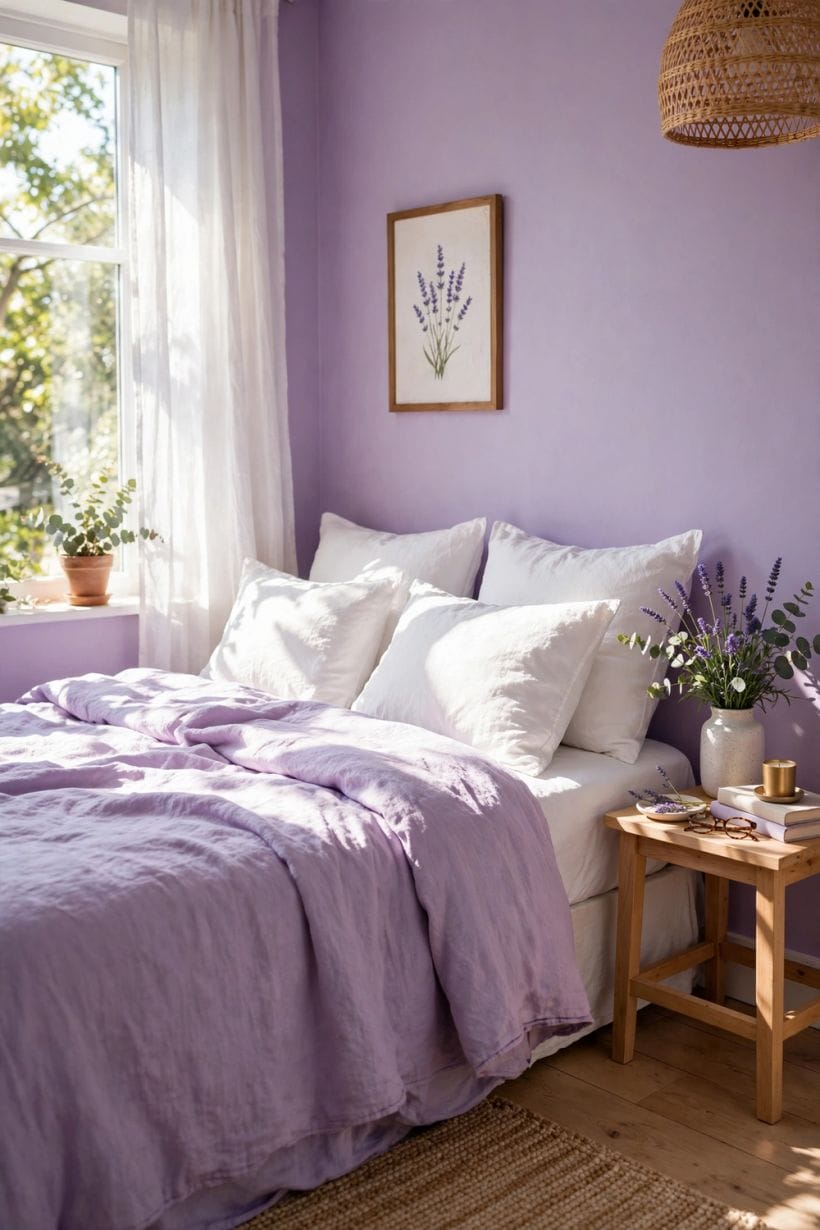
Where purple sits matters as much as which purple it is. Walls, ceilings, built-in joinery and large textiles each carry the colour at a different volume, and the room’s character is set by the largest of them. These ideas place the colour on the big surfaces, in descending order of commitment.
12. All four walls in a mid plum
The full commitment: mid-depth plum on every wall wraps the room in a single mood and makes white bedding and pale wood glow against it. It suits rooms with decent windows and owners who sleep better in enclosure.
13. One statement wall behind the bed
The classic placement, and still the most forgiving: purple behind the headboard gives the room its colour story from the doorway, while the other walls stay pale and borrow the tint by reflection.
14. Purple below a picture rail, calm above
Splitting the wall horizontally — colour low, pale above — gives a traditional room its purple without lowering the ceiling visually.
15. A lavender wash on walls, white on woodwork
The palest approach: lavender-tinted walls with clean white architraves and doors. The contrast keeps the room feeling fresh rather than sweet, and the purple reads as atmosphere rather than decoration.
16. Wallpaper with a purple ground
A patterned paper carries purple differently from paint: the colour arrives broken up by motif, softer and more traditional. Small-scale prints in plum and cream suit period rooms; large botanical repeats make a modern statement wall.
17. Purple panelling for a tailored look
Painted wall panelling in a deep shade gives the colour architecture to hold onto: the shadow lines do half the decorating.
18. The ceiling as the fifth wall
A pale lilac ceiling over white walls tints the whole room gently, the way a lampshade tints light. It is the boldest low-commitment move available: invisible from the corridor, transformative from the bed, and repaintable in an afternoon.
19. Built-in wardrobes painted to match
Wardrobes and cupboards painted in the wall colour dissolve into the room and make a small bedroom feel larger; painted in a deeper purple than the walls, they become the room’s furniture-architecture.
20. A purple rug as the floor’s answer
Where walls must stay neutral — rented rooms, resale caution, a partner’s veto — a large rug carries the colour at floor level, where it anchors the bed and warms the first step of the morning.
21. Curtains that carry the colour to the window
Full-length curtains in plum or violet give a pale room its purple at the edges, and they colour the daylight that passes through them.
22. Two-tone walls for a room that works twice
Bedrooms that double as studies benefit from a colour boundary: purple at the sleeping end, a calmer neutral at the desk end.
4. The Bed: Bedding, Layers and the Headboard
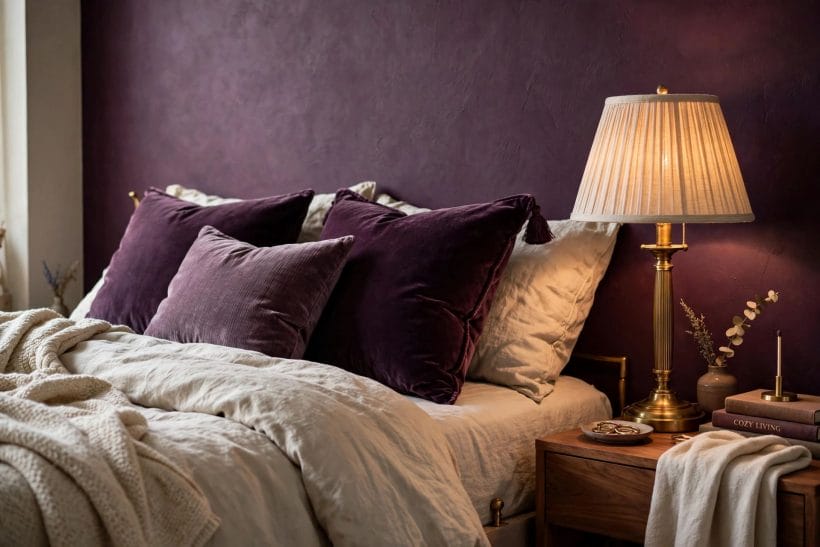
The bed is the largest piece of furniture in the room and the natural home of its colour. Bedding is also the easiest purple to change, wash and season-swap, which makes the bed the scheme’s flexible centre. These ideas dress the bed in purple at every level of boldness.
23. White bedding against purple walls
The hotel solution, and the calmest: crisp white bed linen in front of a purple wall never clashes, never dates and always looks deliberate. Interest comes from texture — a waffle throw, a linen duvet, a quilted coverlet — rather than from more colour.
24. Purple bedding in a neutral room
Reverse the arrangement for a room whose walls stay pale: a plum or violet duvet set becomes the colour event, changeable with the laundry.
25. Layered shades on one bed
Build the bed in ranked purples: pale lilac sheets, a mid violet duvet, a deep plum throw folded at the foot. The gradient reads as one idea in three strengths, which is how colour behaves in nature and in every fabric shop’s display bed.
26. Velvet for depth, linen for ease
A purple velvet throw or cushion drinks light and looks twice as saturated as the same dye in cotton; washed linen looks chalkier and calmer. Choose the fibre by the mood: velvet for the jewel-box room, linen for the airy one.
27. The upholstered headboard as colour anchor
A headboard upholstered in aubergine or violet gives the bed its purple permanently, freeing bedding to stay white or patterned. Buttoned and traditional shapes suit period rooms; plain padded panels suit modern ones.
28. Patterned bedding on a plain purple ground
A floral or geometric duvet that contains the wall’s purple — among other colours — ties the bed to the room without a flat match.
29. A single purple throw, deliberately placed
The smallest dose that still registers: one plum throw across the foot of an otherwise white bed. It works because everything else defers to it.
30. Seasonal swapping: deep for winter, pale for summer
Purple’s range makes it the easiest colour to season-swap. Deep plum and velvet for the dark months; lavender and cotton for the light ones.
31. Cushions as the colour’s testing ground
Two or three cushions are where a doubtful household can trial purple cheaply before committing to curtains or paint. Buy the cushions in the exact candidate shade, live with them a month, and let the bed cast the deciding vote.
32. A purple quilt or coverlet as the heirloom layer
A quilted coverlet in violet or plum, folded at the foot or spread over white linen, adds the stitched texture that flat duvets lack and carries the colour in a traditional key.
33. Bedside purple: the objects you wake to
A purple alarm clock, a violet glass of water, a lilac notebook on the bedside table — the smallest scale of the colour is the one seen first every morning.
5. Furniture and Storage in a Purple Room
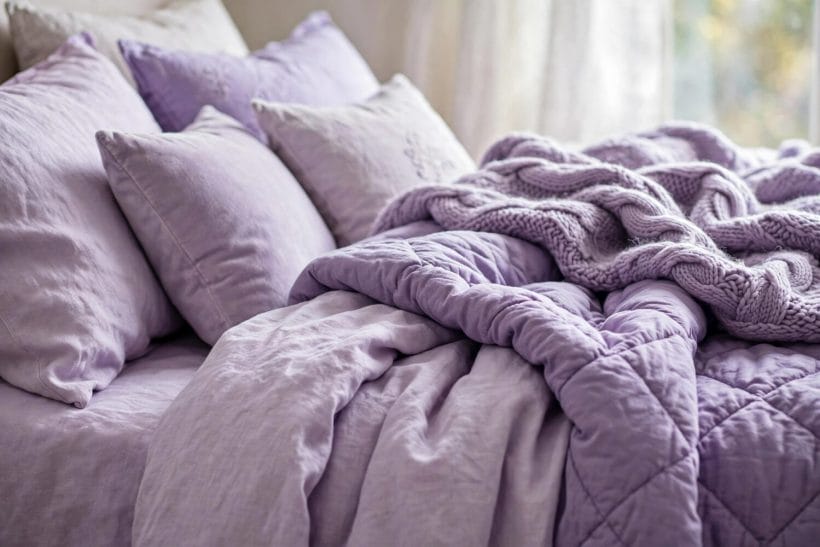
Furniture in a purple bedroom has two jobs: hold its own against a strong colour, and store a room’s worth of clothes without turning the walls into a cupboard exhibition. Timber tones, painted pieces and metals each strike a different bargain with purple, and these ideas work through them.
34. Warm timber against cool purple
Oak, walnut and other warm woods are purple’s oldest partners: the wood’s warmth keeps a cool violet room from turning chilly, and the purple makes pale timber look richer than it is.
35. Painted furniture in a deeper shade
A chest of drawers or a bedside table painted one step deeper than the walls gives a room its tailored, built-in feeling even when the pieces are freestanding and secondhand.
36. White furniture to keep purple light
In a small or dark bedroom, white and pale-painted furniture returns light to the room and stops deep walls from closing in. The contrast is crisp and cottage-like, and it lets the walls carry a braver shade than the room could otherwise hold.
37. Black accents for a sharper edge
A black metal bed frame, black picture frames or a black lamp base sharpen a purple scheme and stop it drifting toward the sugary. Use black as punctuation — a few definite pieces — rather than as a second scheme competing for the room’s attention.
38. Brass and gold warm the jewel tones
Plum and aubergine with brass handles, mirror frames and lamp fittings is the classic jewel-box combination: the metal warms the purple, and the purple makes modest brass look expensive. Keep the metal family consistent across the room’s small fittings for a designed feel.
39. A purple chair makes the corner
Most bedrooms have one chair that holds clothes and intentions.
40. Wardrobes that disappear or declare themselves
Decide the wardrobe’s role plainly: painted the wall colour, it disappears and the room feels bigger; painted deep purple or left in dark timber, it declares itself as the room’s main furniture wall.
41. Bedside tables matched in colour, not in shape
A pair of bedside tables in the same painted shade but different shapes gives a purple room its relaxed symmetry: the colour matches, the silhouettes don’t have to.
42. A dressing table in the light
If the room holds a dressing table, give it the window wall and let the purple gather elsewhere; faces need honest light, not tinted shadow.
43. Storage that hides the colour’s rivals
The fastest way to ruin a purple scheme is the visible clutter of everything that isn’t purple: chargers, books, gym bags, the chair of clothes.
44. One antique piece against the colour
A single old piece — a mahogany chest, a gilt mirror, a worn leather chair — gives a purple bedroom its history and stops a new scheme feeling like a showroom.
6. Pairing Colours: What Purple Sits With
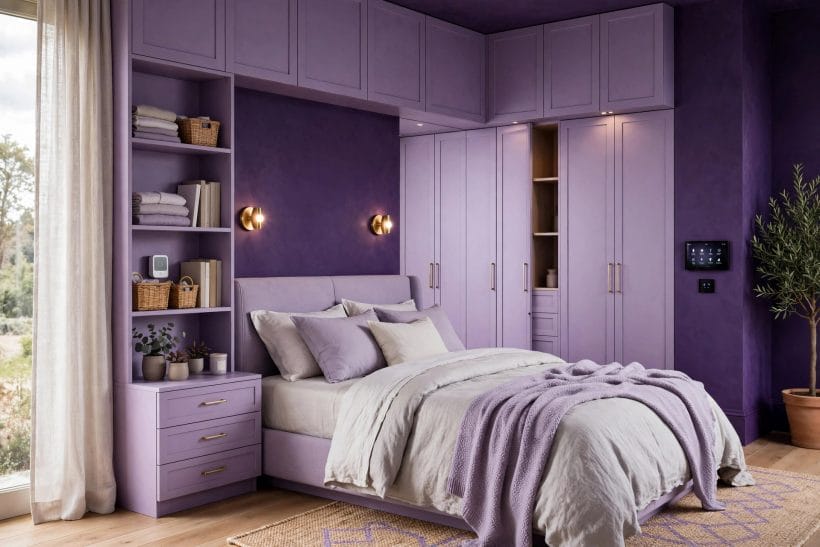
Purple’s reputation for difficulty comes from bad pairings, not from the colour itself. It has reliable partners — greens opposite it on the wheel, warm metals, every neutral — and a few traps. These pairings are the proven ones, with the living room’s version of the colour linked as the pair to this post.
45. Purple and sage: the wheel’s own answer
Green sits opposite purple, and the softest greens — sage, eucalyptus, grey-green — are its most restful partners in a bedroom: a sage throw or a green plant against plum walls calms both colours.
46. Purple with grey: the modern cool scheme
Grey is purple’s nearest neutral relative, and grey bedding, a grey carpet or grey-painted furniture lets a violet room feel contemporary rather than romantic.
47. Purple and blush: the soft gradient
Pale pink is purple’s warm neighbour, and blush cushions or a blush throw on lavender or plum bedding make the gentlest of colour stories.
48. Purple with navy: deep on deep
Two deep colours can share a bedroom when texture separates them: navy bedding against aubergine walls, or the reverse, with white linen as the breathing space between. The result is cocooning and deliberate, best in rooms with good morning light to wake the scheme up.
49. Purple and cream: the traditional softening
Cream — not bright white — is the classic softener for traditional purples: cream curtains, a cream wool throw and cream lampshades take a plum room toward the country house and away from the boutique hotel.
50. The living-room pair: same family, different room
This bedroom’s colour has a sibling downstairs: the purple living room ideas collection works the same family in a sociable key. Linking the two rooms by shade — the same plum in a bedroom wall and a living-room cushion — makes a whole house feel considered rather than coincidental.
51. Purple with natural fibres: jute, rattan, linen
Natural textures are a pairing in themselves: a jute rug, a rattan basket and unbleached linen take the formality out of purple and make it liveable for households suspicious of glamour. The fibres’ warm beige grounds the colour the way soil grounds a flower bed.
52. Purple and silver-grey metals for a cooler light
Chrome, nickel and pewter fittings cool a purple room the way brass warms it. Choose the metal by the room’s temperature problem: a hot, sunny plum room can be calmed by silver-grey hardware; a cold lilac room usually wants the brass instead.
53. One accent colour, repeated three times
Whatever partner colour is chosen — sage, blush, mustard, teal — it should appear at least three times in the room: cushion, throw, and one object. Fewer repeats read as an accident; three reads as a decision.
54. Mustard and ochre: the small hot accent
A touch of mustard against purple is the boldest of the proven pairings — the two colours sharpen each other — and a little goes a very long way: one cushion, a lampshade lining, a picture’s mount.
55. What to keep away from purple
Orange-red woods, scarlet accents and yellow-based creams all fight purple’s blue heart and make it look bruised.
7. Light, Windows and the Evening Room
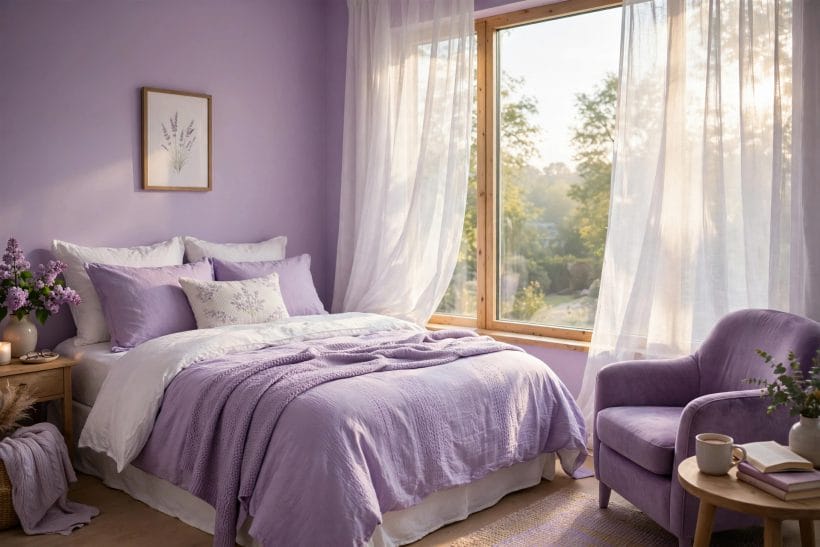
Purple is the colour most changed by light: it deepens at dusk, greys at noon and glows under warm bulbs. A purple bedroom therefore has to be lit deliberately, with daylight managed and lamplight planned, rather than left to a single ceiling fitting.
56. Warm bulbs for warm evenings
Warm-white bulbs flatter every purple, pulling the red forward and softening the blue; cool daylight bulbs do the reverse and can make a plum room feel like a corridor.
57. Two bedside lamps, low and shaded
Bedside lamps with fabric shades throw purple’s favourite light: low, warm and sideways, striping the wall colour with gentle shadow.
58. Sheer curtains for violet daylight
A sheer or voile layer behind heavier curtains lets daylight arrive filtered, and white sheers in front of a purple wall borrow the faintest tint of it. The arrangement also buys privacy in overlooked rooms without surrendering the morning light that wakes the colour gently.
59. Blackout sense behind the beauty
Bedrooms must darken properly, whatever the scheme. If the purple curtains are unlined showpieces, add a blackout layer or a blind behind them so the colour choice never costs sleep. Deep-coloured rooms forgive a black blind’s presence entirely — it vanishes into the scheme.
60. A mirror to double the lamplight
A mirror placed to catch a bedside lamp doubles the warm light and gives a deep-coloured wall its answering glow.
61. Pale ceilings and floors as the light reserve
When walls go deep, the ceiling and floor become the room’s light reserve. Keep both pale — a white ceiling, a light rug over dark boards — and a plum room stays luminous at its edges even at noon.
62. Dimming for the colour’s best hour
Purple’s finest hour is half-light, so give the room a dimmer or low-wattage evening setting if the wiring allows.
63. Candles and the occasional glow
Real or good imitation candlelight does for purple what it does for faces — flatters without mercy.
64. Testing curtain fabric against the glass
Curtain fabrics are backlit by day, which changes them: a dense plum can read almost black against bright glass, while a pale violet can wash to grey.
65. One picture light or sconce for the artwork
Purple rooms hold artwork beautifully, especially gilt-framed and pale-mounted pieces. A single sconce or picture light above the room’s main picture gives the wall an evening focal point and stops the television — if the room has one — from owning the wall by default.
8. Small Rooms, Renters and Low-Commitment Purple
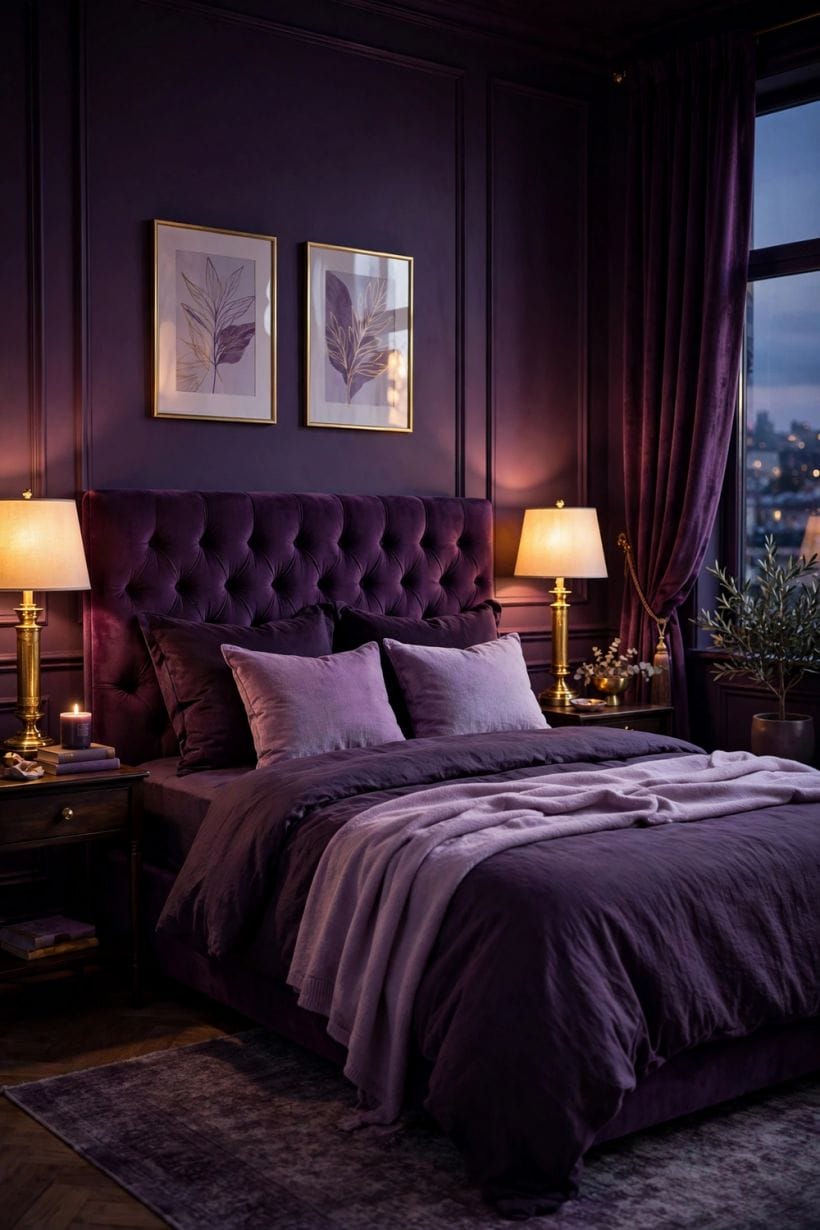
Purple is often ruled out of small bedrooms on the theory that dark colours shrink rooms, and out of rented ones on the theory that landlords object. Both theories are weaker than they look. These ideas take the colour into small rooms and temporary homes honestly — and collect this post’s links to its sibling bedroom collections.
66. Deep colour can enlarge a small room’s feel
A small bedroom wrapped in one deep purple, skirting and doors included, loses its visible corners and can feel larger than the same room in patchy pale colours.
67. The pale-purple route for the cautious small room
If the full wrap is too brave, lavender walls with white bedding keep a small room bright while still giving it a colour identity — the approach detailed among the small bedroom ideas in this collection’s bedroom cluster. Add the depth in the textiles, where it can be changed at laundry scale.
68. Bedding-first for renters
Where paint is forbidden, the bed is the colour: a plum duvet set, matching cushions and a throw give a rented room its purple without touching a wall.
69. Removable wallpaper and fabric panels
Peel-and-stick papers in purple prints now cover a statement wall and leave without a trace, and a fabric panel hung behind the bed does the same job with pins.
70. Purple in the accessories only
Lampshades, cushions, a vase, a picture frame, a bedside rug: a trail of purple objects through a neutral room reads as a scheme when the shade is consistent.
71. Borrow the grey bedroom’s discipline
The gray bedroom ideas collection teaches the restraint that purple rooms also need: limited palette, texture over pattern, everything earning its place. Purple with grey’s discipline is a calm room; purple without it is a sweetshop. The two colour collections are natural partners and share most of their furniture advice.
72. Borrow the coastal bedroom’s lightness
The coastal bedroom ideas in this cluster pair pale colour with white and natural fibre — and their formula translates directly: swap the coastal blue for lavender and the same airy room appears, with driftwood tones becoming warm timber and sea-glass green becoming sage.
73. Keep resale in the back of the mind
If the house may be sold soon, spend the purple on the removable layers — bedding, curtains, rug, cushions — and keep the paint either pale or confined to one wall.
74. The guest room is the place to be brave
Spare bedrooms forgive boldness because nobody lives with the result daily, and guests remember a plum or violet room fondly precisely because it is not beige.
75. One wall, one bed, one decision at a time
The staged route into a purple bedroom: this month the statement wall, next the bedding, later the curtains if the first two pleased.
9. Checks and Mistakes: Before the First Purchase or the First Fitting
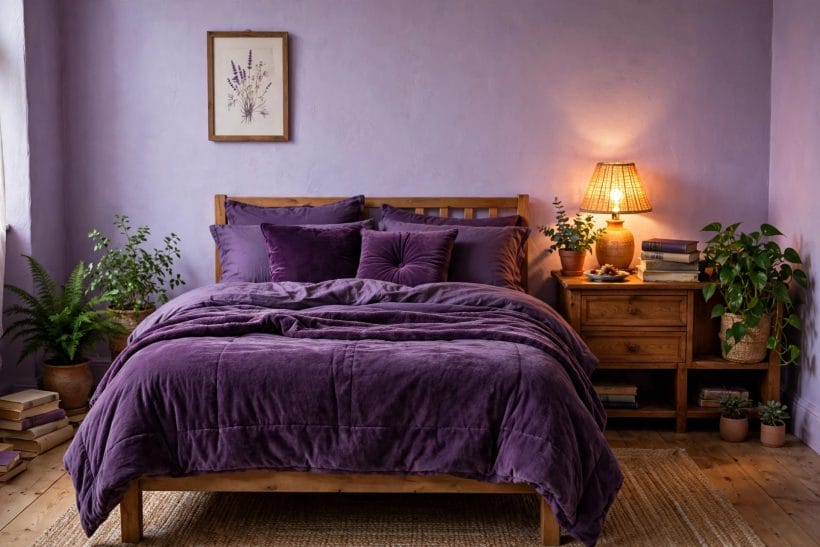
Stand at the bedroom door at dusk, lamps on, and audit the room the way a guest would: is one purple clearly in charge, or are three arguing? Are the largest surfaces calm and the boldness living in the changeable layers? Is the floor’s colour at peace with the walls?
Test before committing the expensive layers. Paint belongs after the fabric samples have lived in the room a week; curtains belong after the bedding has proved the palette; the headboard belongs last of all, when the shade family is no longer a hypothesis but a household fact.
Check the practicalities the photographs skip: blackout behind the pretty curtains, bulbs of the right warmth in every fitting, washable covers where children and dogs share the bed, and a paint finish on joinery that can survive the vacuum cleaner’s weekly negotiations.
10. Costs and Pulling It Together
Purple asks for no special budget — the same paint, bedding and curtains cost what any colour costs — but it punishes random buying more than most, because unmatched purples quarrel in public. The money discipline is sequence: samples first, the lead surface second, the supporting textiles third, and nothing in a shade that has not been checked against the swatches.
Hold the whole field together through the home design ideas hub, where this colour pair’s living-room sibling and the wider bedroom cluster sit side by side. A house whose rooms share a colour family, each in its own strength, feels designed at the level of the whole home — which is the level guests actually experience.
Final Considerations
A purple bedroom is not a gamble; it is a ranking exercise. Choose the shade against the room’s own light, give it one surface to own, let the bed carry the flexible layers, and keep every other colour in a supporting role. Do that, and the colour with the difficult reputation becomes the room the household is quietly proudest of.
Start where the commitment is smallest — cushions, a throw, a tester pot — and promote the colour only as it earns the room. Purple rewards patience more than bravery, and the bedrooms in this collection that work best are the ones where every shade was chosen, tested and given a job.


0 Comments