
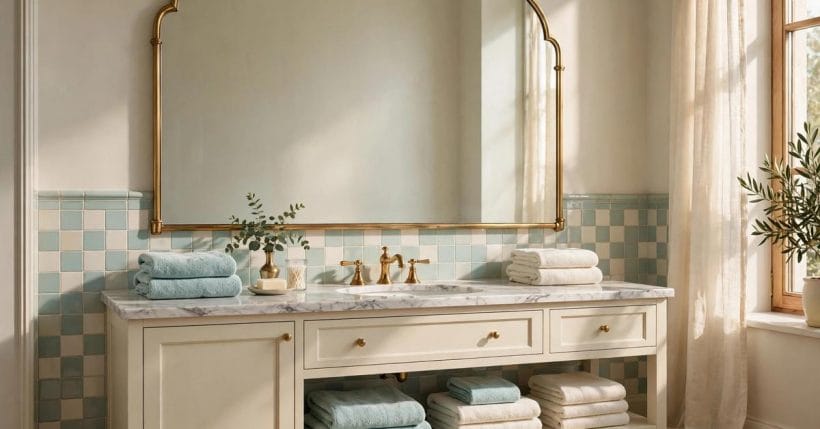
A bathroom can survive an ordinary basin, plain tiles and a modest vanity — but the mirror over the vanity is the one surface every face meets every morning, and it is judged more closely than anything else in the room.
This post stays with that one surface: the shapes worth choosing, the sizes that serve the basin below, frames and finishes, the light that makes the glass useful, and the storage that can hide behind it.
1. Mirror Over Vanity Ideas at a Glance
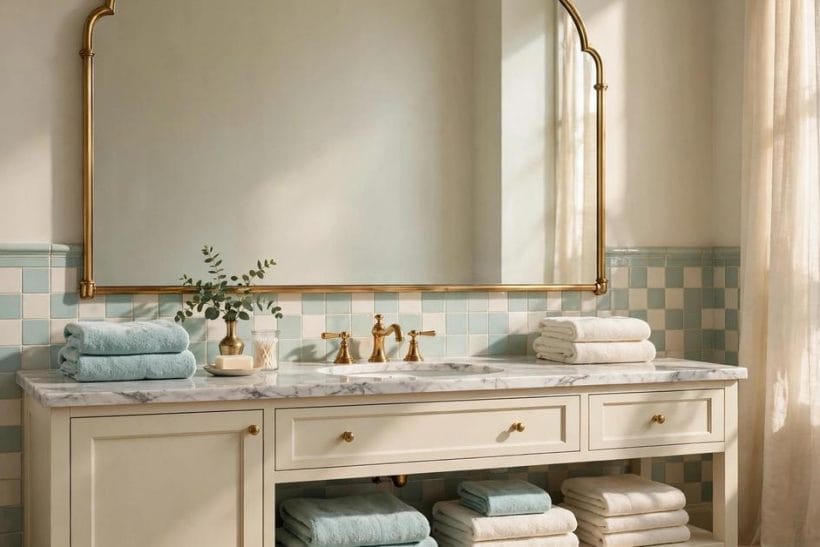
A mirror over the vanity is a working tool dressed as a decoration: its size is set by the basin and the vanity, its height by the faces that use it, and its value by the light it works with.
| Question | Short answer |
|---|---|
| What decides the mirror’s size? | The vanity and the basin: narrower than the cabinet, centred on the user |
| One wide mirror or two over a double vanity? | Two, where two people get ready at once; one wide sheet where light matters most |
| How high should it hang? | Centre of the glass at the eye level of its regular users |
| What light suits a mirror best? | Light at the face — sconces at the sides, a bar above, or a backlit glass |
| Can a mirror hold storage too? | Yes: a mirrored cabinet is the small bathroom’s hardest-working fitting |
2. Shapes: Round, Rectangular, Arched and Everything Between
The shape is the first decision and the one the room is judged by. General bathroom planning sits behind this post in the wider bathroom ideas survey; here everything narrows to the glass over the vanity — its outline, its size, its frame and its light.
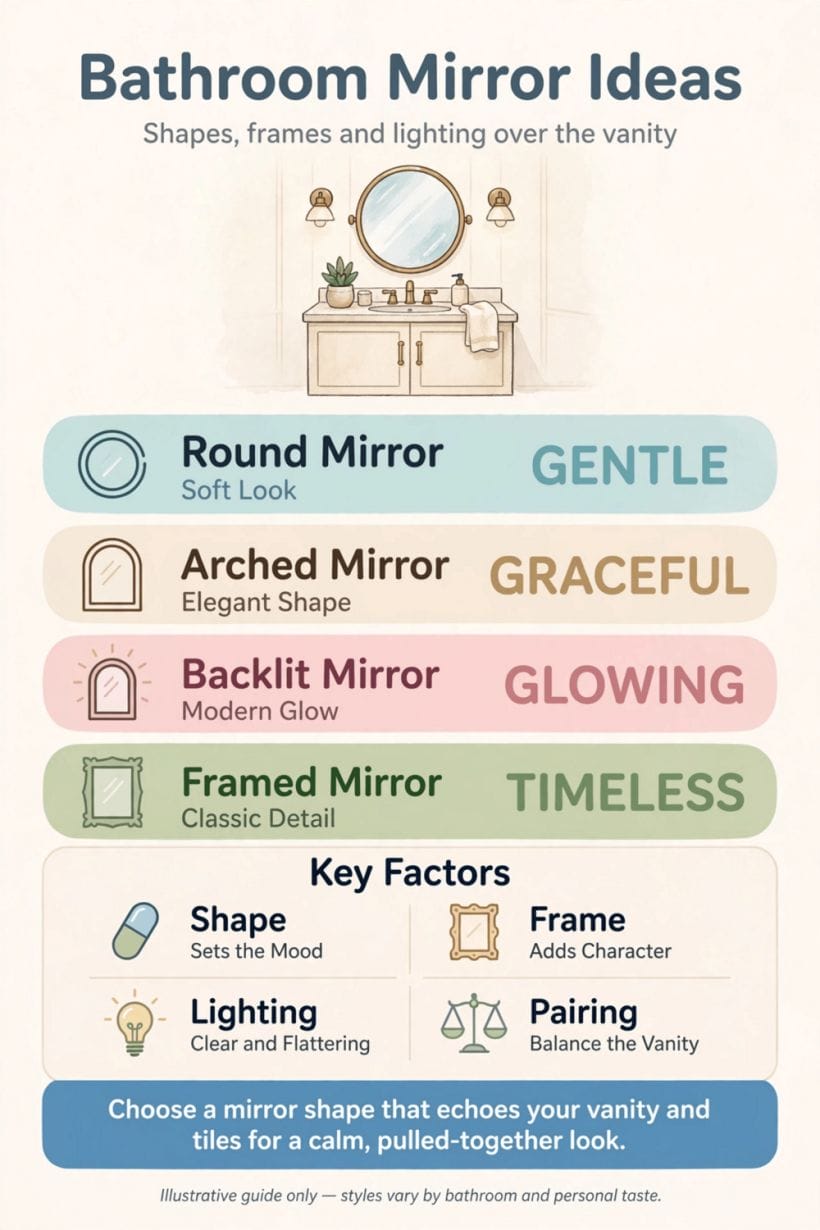
1. Choose a round mirror to soften a square room
A circle over the vanity takes the edge off a bathroom full of right angles — tiles, basin, cabinet — and gives the wall one calm curve.
2. Run a wide rectangle for a clean, tailored wall
A rectangular mirror echoes the vanity’s own geometry and reads as order. Kept a hand’s width inside the cabinet edges, it looks deliberate; run wider than the vanity and it starts to argue with the room.
3. Pick an arch to echo a doorway or a tiled niche
An arched mirror borrows its curve from architecture. Over a vanity it lifts the eye and flatters both traditional rooms and plain modern ones, especially where an arched shower screen or doorway already sets the theme.
4. Use an oval where the ceiling is low
An oval stretches a round mirror upward, giving height to a room that lacks it. It is the classic choice over a pedestal basin and in older houses, and it pairs naturally with wall lights at either side.
5. Try a pill or capsule shape for a soft modern note
The capsule — a rectangle with fully rounded ends — brings the softness of the circle with the reach of a rectangle.
6. Pair two slim mirrors over a double vanity
Two narrow mirrors, one over each basin, divide a double vanity into two personal stations. The wall between them becomes a place for a sconce or a shelf, and each user gets glass centred on their own basin.
7. Commit to one wide mirror wall over a double run
A single sheet of glass spanning both basins makes a small bathroom feel twice its size and bounces light the whole length of the room.
8. Choose a scalloped or wavy edge for a playful room
A wavy-edged mirror brings a deliberate lightness to a family bathroom or a guest cloakroom. Keep everything else plain so the one gesture reads as charm rather than clutter.
9. Let a pivot mirror bring an old-fashioned note
Mirrors on pivot brackets, tilted a few degrees, belong to the era of the freestanding basin and still earn their place: the tilt serves shorter and taller users from the same glass, and the brackets become jewellery for the wall.
10. Use a faceted or bevelled shape to catch the light
A bevelled edge acts as its own frame, throwing a fine line of light around the glass. On a plain wall it gives a frameless mirror the finished quality it would otherwise lack.
11. Match the mirror’s shape to the basin below it
Round over round, square over square: echoing the basin’s geometry is the quietest way to make a vanity wall look designed. Break the echo only when the mirror is meant to be the room’s one surprise.
3. Sizing the Mirror to the Vanity and the Basin
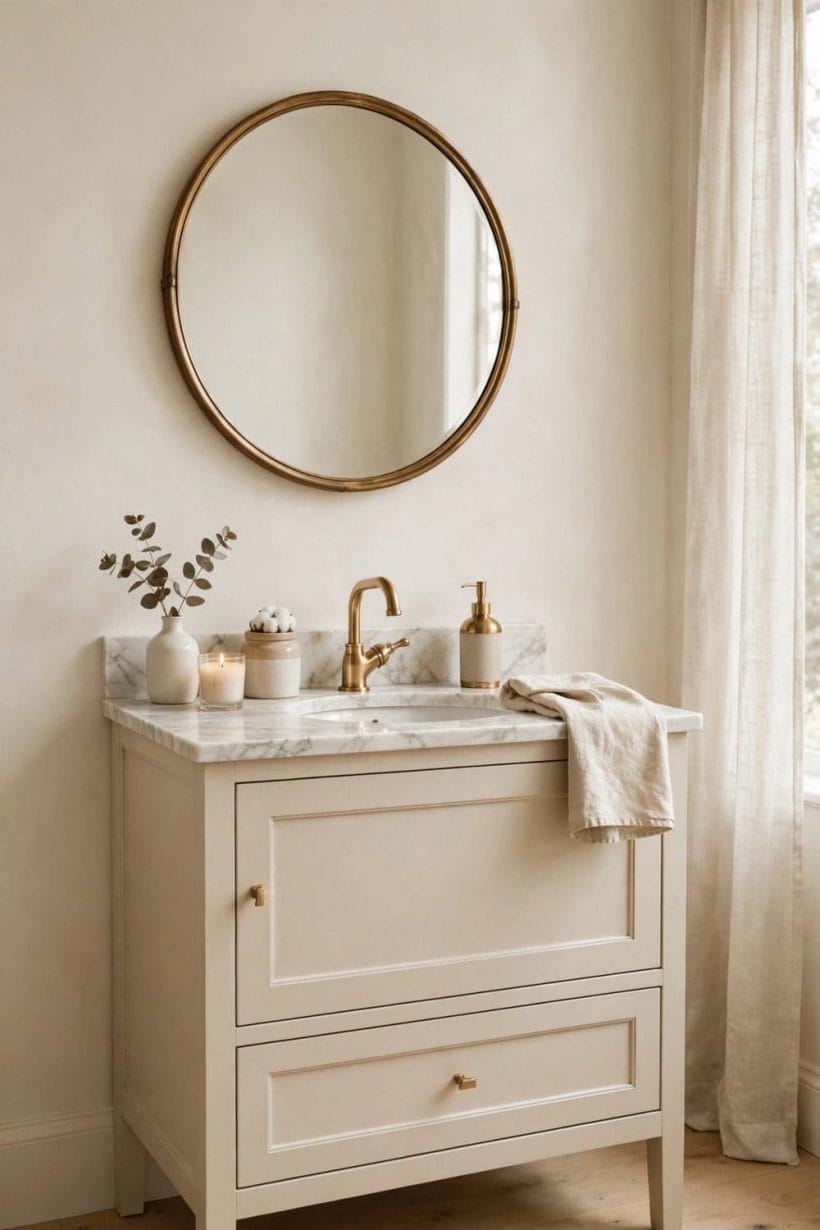
Size is where good mirrors are won or lost, and it is judged against the vanity, not the wall. In shared rooms the basin arrangement leads — the worked examples in double sink bathroom planning show the vanities these mirrors sit over.
12. Keep the mirror narrower than the vanity
The standing rule: glass a few centimetres inside the vanity’s width at each side. A mirror that overhangs its cabinet looks accidental from every angle except straight-on, and straight-on is not how a room is lived in.
13. Centre the glass on the basin, not on the wall
Where a basin sits off-centre on its bench, the mirror follows the basin. Faces are what mirrors serve; a glass centred on the room but not on the user fails at its only job.
14. Give each user their own width of glass
Over a double vanity, two mirrors of basin width serve better than one grand sheet when two people get ready at once. Each face gets flat, undistorted glass directly ahead, with no leaning across.
15. Let a tall mirror do the work in a narrow room
Height is free in a way width is not. A tall mirror over a narrow vanity draws the eye up, reflects more of the room’s light, and suits the proportions of a cloakroom or an ensuite carved from a cupboard.
16. Stop the mirror short of the splashback line
Glass that runs down to the bench collects toothpaste, water spots and cleaning streaks at its bottom edge. A modest gap above the splashback keeps the mirror cleaner and lets the splashback read as its own band.
17. Widen the mirror when the room needs light more than storage
A broad mirror is a light tool: it doubles whatever the window or the fittings give. In a windowless bathroom, width of glass can matter more than another cupboard, and it is the cheaper renovation of the two.
18. Size a shared mirror for the shorter user too
A mirror hung for the tallest person in the house quietly excludes everyone else. Hung so its lower edge serves the shortest regular user — with the tilt trick or a longer sheet — it serves the whole household.
19. Use a full-width mirror to unite an awkward vanity wall
Where the vanity wall holds a window offset, a nib wall or an uneven run of units, one long mirror pulls the composition together, giving the eye a single calm plane instead of a series of apologies.
20. Match mirror width to the light fitting above it
A light bar much narrower or wider than the glass beneath it looks like a measuring error. Size the two together — fitting first if it is fixed — so the wall reads as one designed stack.
21. Leave breathing room at the sides in a tiled room
Where tiles are the room’s pattern, a mirror that crowds the corners leaves no rest for the eye. A margin of tile at each side frames the glass the way a mount frames a picture.
22. Test the size with painter’s tape before ordering
Tape the mirror’s outline on the wall and live with it through a morning’s routine. It costs nothing and settles arguments about width and height that no measurement on paper ever quite settles.
4. Frames and Finishes: Wood, Metal and Frameless Edges
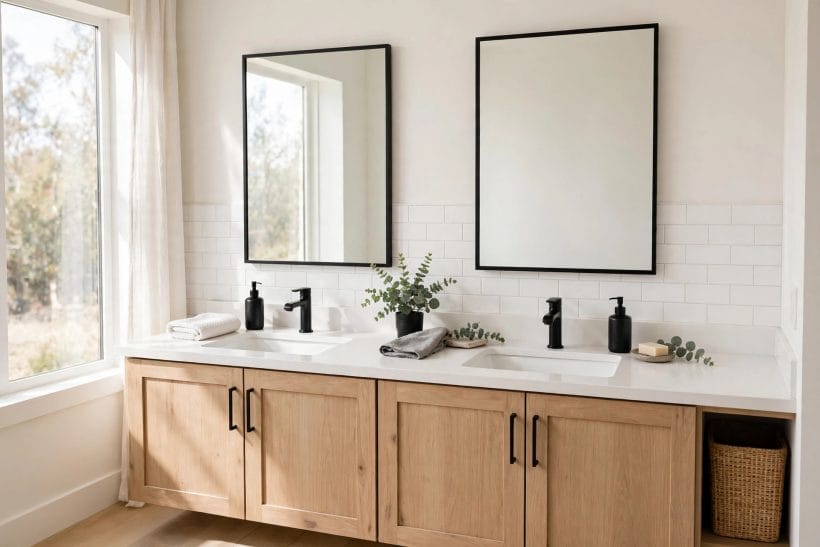
The frame decides whether the mirror reads as furniture, as jewellery or as pure architecture. Cabinet finishes set the terms here — the pairings worked through in bathroom with gray cabinets ideas show how a mirror’s metal should answer the cabinetry below it.
23. Choose frameless glass for the calmest wall
A polished-edge frameless mirror disappears into the room, reflecting without commenting. It is the right choice where tiles or colour already carry the wall, and the easiest mirror to keep clean at its edges.
24. Frame it in timber to warm a white room
A wooden frame — oak, walnut, or a painted finish — brings the one natural material a tiled bathroom often lacks.
25. Use black metal for a crisp, graphic edge
A slim black frame draws a deliberate line around the glass and partners black taps and shower frames.
26. Let brass or brushed gold carry the room’s warmth
Warm metals flatter skin in the reflection and sit happily beside marble, timber and cream tiles. Keep the mirror’s metal the same as the taps’ so the vanity wall reads as one set of decisions.
27. Repeat the tap finish in the frame for a matched set
Mirror frame, taps, handles, light fittings: one metal, one finish, carried through. Mismatched metals can work when they are clearly deliberate — two finishes, evenly balanced — but accidental mixtures always look like replacements.
28. Pick a chunky frame to give a plain mirror presence
A deep, wide frame turns the mirror into the vanity wall’s main picture. It suits large rooms and plain tiles, and it lets a modest sheet of glass hold a wall that would otherwise dwarf it.
29. Try a tiled frame where the wall is tiled
A border of the wall’s own tiles, or a contrast mosaic, frames the mirror in the room’s material.
30. Use a bevel as the frame on a budget
A wide bevel catches light on all four sides and finishes the glass without any added material. It is the traditional answer in period bathrooms and still the most elegant of the inexpensive ones.
31. Choose a leather-strapped round mirror for a relaxed note
A round mirror hung from a strap brings a softness that fixed glass cannot. It suits guest bathrooms and relaxed, natural schemes, and its slight informality lowers the temperature of a very tailored room.
32. Match a mirrored frame to a glamorous scheme
Mirrored and antiqued-glass frames multiply light and suit rooms built around shine — marble, chrome, glass shelving. Use them where the room’s mood is evening rather than morning.
33. Seal timber frames against bathroom steam
Wood beside a shower lives in steam. A frame in a wet room needs a finish made for the conditions and joins that will not open; state the room’s humidity honestly when ordering, or choose metal and keep the timber for the dry end of the room.
5. Lighting With a Mirror: Sconces, Bars and Backlight
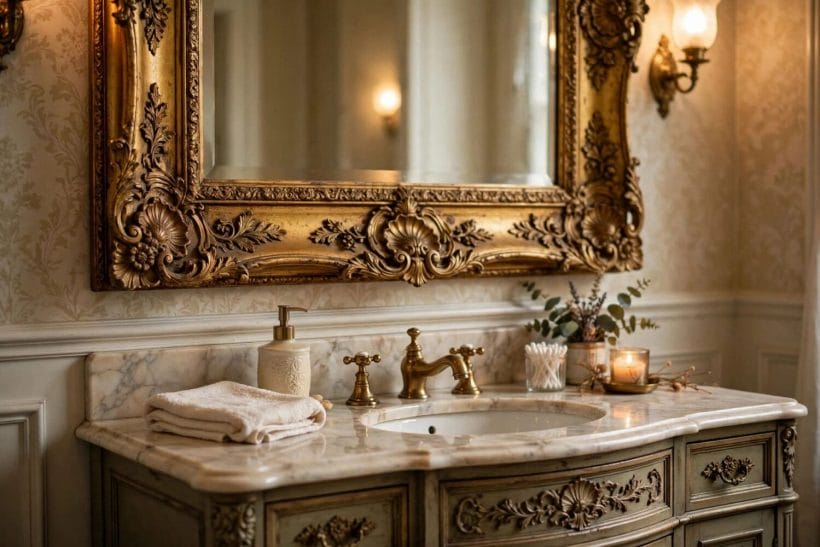
A mirror is only as good as its light. In the calmest rooms the glass and the fittings are planned together, the way the lighting is layered in luxury master bathroom ideas — light on the face, never just on the glass.
34. Flank the mirror with sconces at face height
The classic arrangement, and still the kindest: a light at each side of the glass, level with the face, so both sides of the face are lit evenly and no shadow falls where the razor or the brush needs to work.
35. Run a light bar above the mirror for even wash
A bar over the top of the glass throws a broad, even light downward. It suits wide mirrors and shared vanities, and it keeps the sides of the wall free for tall cabinets or open shelving.
36. Choose a backlit mirror for a soft halo
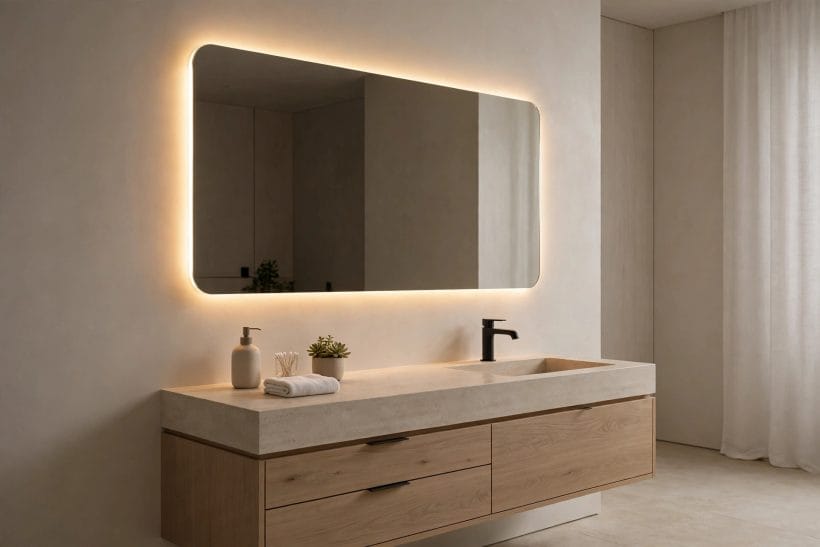
Light hidden behind the glass spills a halo onto the wall and lights the face gently from the mirror itself.
37. Add a lit magnifying mirror for close work
A small articulated magnifying mirror beside the main glass serves shaving, lenses and make-up without forcing the whole room’s mirror to do close work. It folds away to nothing when the wall needs to look calm.
38. Avoid a single downlight over the basin
One ceiling spot above the mirror lights the top of the head and shadows the eye sockets — the least flattering arrangement there is.
39. Put mirror lights on their own switch or dimmer
Morning faces and midnight visits want different light. Mirror lighting on a separate, dimmable circuit lets the room be bright for cleaning, kind for getting ready and barely lit at night, all from the same fittings.
40. Use frosted or opal shades to kill glare
Bare bulbs reflected in a mirror double their glare. Opal glass, fabric shades or frosted globes soften the source so the face is lit by glow rather than by points of light — the difference is felt every morning.
41. Centre a pendant in front of the mirror in a tall room
Where ceilings are high, a low pendant hung just in front of the glass brings the light down to face level with theatre.
42. Light a double vanity as two stations
Two basins want two pools of light. A fitting per mirror — or a bar long enough to cover both faces without a dim middle — keeps the shared vanity from having a good end and a bad end.
43. Choose bulbs that tell the truth about colour
Make-up, shaving and choosing clothes all depend on honest colour. Bulbs with a high colour-rendering rating and a neutral warmth show skin and fabric as daylight will; test one before committing the room to a set.
44. Keep fittings clear of the mirror’s swing and steam
Lights beside a mirror live in splash and steam. Choose fittings rated for bathroom zones, keep them clear of a cabinet mirror’s door swing, and let a qualified electrician place anything near the shower’s reach — local rules govern all of it.
6. Position and Height: Where the Mirror Sits
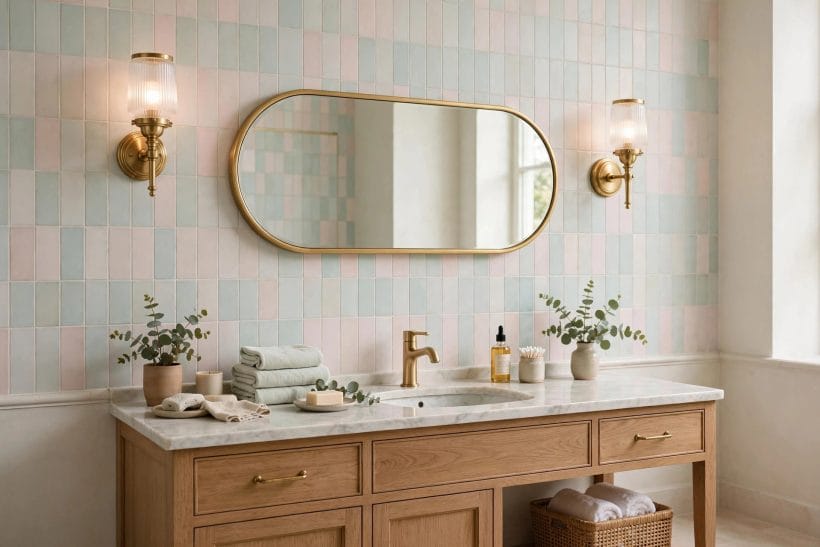
Position is the unglamorous decision that decides whether the mirror is used with pleasure or with a stoop. Tile, stone and glass set the backdrop — the cool surfaces in marble bathroom schemes show how high a mirror can climb when the wall behind it is one calm material.
45. Hang the mirror so its centre meets the average eye
The working rule is simple: the middle of the glass at the eye level of the people who use it most.
46. Keep a hand’s breadth between mirror and splashback
A modest gap above the splashback protects the glass’s lower edge from standing water and gives the wall a breathing line. Mirrors sitting in the splash zone need sealed edges and more cleaning than their owners expect.
47. Align the mirror’s top with a line already in the room
Tops that match the door head, the shower screen or a tile course make the wall look measured.
48. Centre on the basin where the vanity is asymmetric
L-shaped benches, offset basins and one-sided storage all pull the vanity off the wall’s centre. The mirror follows the basin and the user, and the wall’s asymmetry becomes a composition rather than a mistake.
49. Tilt a mirror slightly for a seated user
A dressing-table arrangement or a seated vanity serves its user better with the glass tilted a few degrees down. Pivot brackets exist for exactly this, and the tilt also kills ceiling-light reflections in the glass.
50. Float the mirror off a busy tiled wall
A frameless sheet held a fraction off patterned tiles gives the eye a rest and the tiles a frame. The shadow line behind the glass reads as a deliberate detail, and the wall keeps its pattern without interruption.
51. Run the mirror to the ceiling in a small ensuite
In the smallest rooms, glass from splashback to ceiling is the boldest enlargement there is. It needs the ceiling line to be true and the lighting planned for a tall reflection, but the gain in felt space is unmatched.
52. Leave room for the mirror cabinet’s door to open
A mirrored cabinet beside a wall, a sconce or a tall tap needs its swing checked on paper first.
53. Hang two mirrors at one height across an uneven pair
Where two basins sit at different depths or the users differ in height, two mirrors hung with their tops level keep the wall composed while each glass still centres on its own face.
54. Respect the window: never let the mirror fight it
A mirror beside a window doubles the window’s light if it catches it at an angle, and doubles its glare if it faces it flatly.
55. Fix the mirror for the wall it hangs on
Glass is heavy and bathroom walls vary — stud, masonry, tile over board. The fixing must suit the wall and the mirror’s weight, with fixings rated for humid rooms; where there is any doubt, this is a job for a tradesperson, not a hope.
7. Storage Mirrors: Cabinets, Shelves and Hidden Space
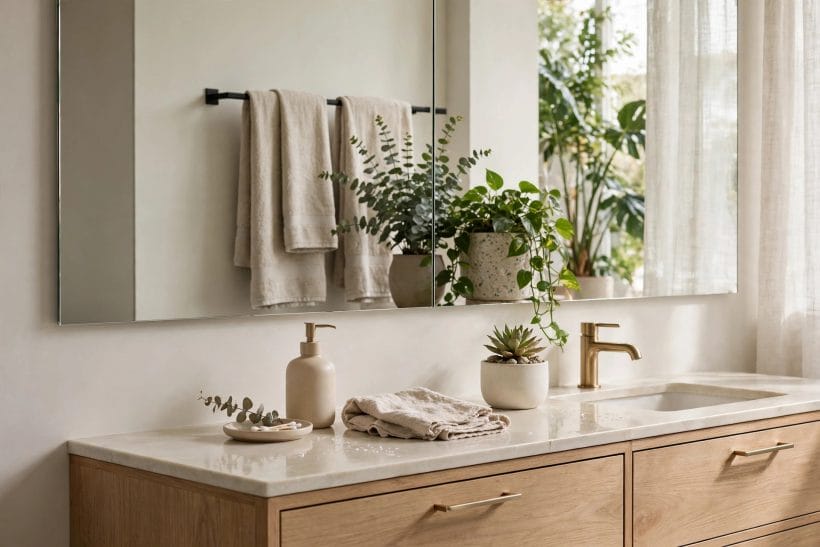
Behind the glass is the bathroom’s most useful hidden volume. The mood of the rooms in spa bathroom ideas depends on clear surfaces — and clear surfaces in a working bathroom usually mean a cabinet doing quiet duty behind the mirror.
56. Choose a mirrored cabinet where surfaces must stay clear
Toothbrushes, medicines and the morning’s small army disappear behind the glass, leaving the bench bare. A mirrored cabinet is the single hardest-working fitting in a small bathroom, earning its wall twice over.
57. Recess the cabinet into the wall for a flush finish
A cabinet sunk between the studs sits nearly flush, its mirror reading as a plain sheet of glass. It takes more building work than a surface box and repays it every day in how calm the wall looks.
58. Pick a surface-mounted cabinet where walls cannot open
Solid walls, rented homes and tight budgets all point to the surface-mounted cabinet. Choose the slimmest profile that holds what it must, and its projection becomes a shelf’s worth of presence rather than a box’s.
59. Split storage: cabinet for daily, drawer for the rest
Not everything belongs behind the mirror. Daily smalls in the cabinet, bulk and spares in a drawer or a tall unit — the division keeps the cabinet shallow, its door light and its contents findable at a glance.
60. Add a shelf under the mirror for the day’s lineup
A narrow shelf beneath the glass holds the morning’s few things at hand height and keeps them off the wet bench. In glass, stone or timber it becomes a deliberate line in the composition.
61. Choose a cabinet with light built in
Cabinets with integrated lighting put the light exactly at the face and hide its wiring in the bargain.
62. Use a tall mirrored cabinet as a second storage tower
A narrow, full-height mirrored cabinet beside the vanity stores towels and tall bottles behind glass that also serves as a dressing mirror. It is storage that pays rent in reflection.
63. Keep medicines high and the cabinet child-aware
A mirrored cabinet at adult eye height is naturally out of small hands’ reach, one more argument for it in a family bathroom. Anything hazardous still belongs locked or higher — the cabinet helps, it does not absolve.
64. Divide the cabinet: one side per person
Over a double vanity, a wide cabinet with two doors gives each user a private half behind a shared plane of glass. Morning peace is a storage decision more often than a character trait.
65. Choose soft-close, demisting glass where steam rules
In a bathroom without a window, a heated demister pad behind the glass keeps the mirror clear through a shower — a small luxury that is used daily.
8. Small Bathrooms, Double Vanities and Finishing Touches
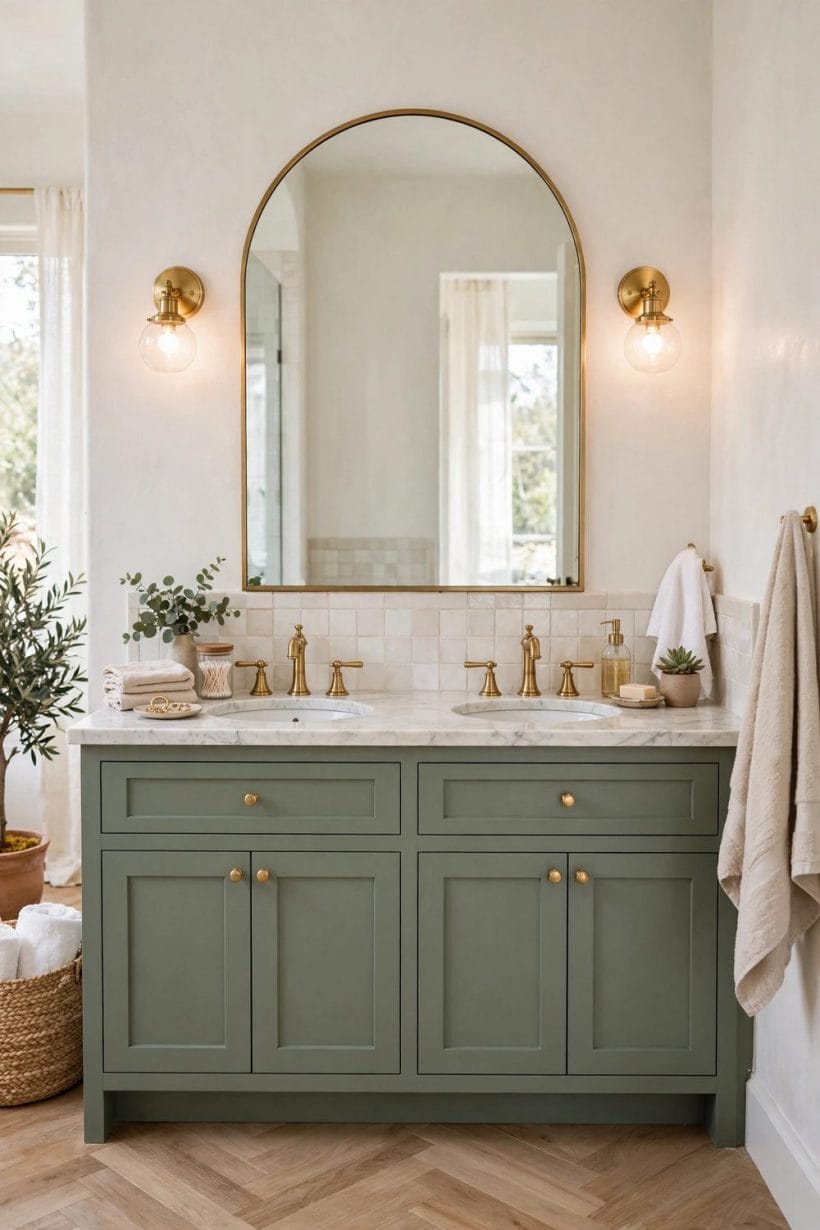
The last decisions are about fit: the mirror in the small room, the pair over the double vanity, and the small finishes that make the glass look chosen rather than hung.
66. Let one big mirror carry a small bathroom
In a compact room, the largest mirror the wall allows is the cheapest space there is. It doubles the light, doubles the room’s depth at a glance, and costs less than any other change of the same effect.
67. Use a corner mirror where two walls meet over the vanity
A vanity tucked into a corner can wear a mirror on each wall, meeting at the corner.
68. Divide a double vanity with a lit gap
Two mirrors with a narrow lit strip or a sconce between them give a double vanity definition without a wall. Each station reads as its own, and the shared bench stays one calm run beneath.
69. Match two mirrors exactly — or not at all
A pair of mirrors must be a true pair: same size, same frame, same height. Near-matches read as accidents. If the basins differ, change the plan to one wide mirror and let unity do the work instead.
70. Finish the edges: polished, bevelled or framed
Raw-cut glass edges announce a shortcut every time the light catches them. Polished or bevelled edges — or a frame that covers them — are the difference between a mirror and a piece of glass on a wall.
71. Keep cleaning honest: glass you can reach is glass that stays clear
A mirror too tall to wipe or hemmed in by fittings will quietly dull. Size and place the glass so its whole face can be reached with a cloth; a clear mirror is a maintained mirror, not a bought one.
72. Add one warm thing beside the glass
A small plant, a timber tray, a folded towel in a warm colour — one soft note beside the mirror keeps the vanity wall from reading as pure equipment.
73. Borrow a vintage mirror for character in a new room
An old mirror with a foxed edge or a shaped frame gives a new bathroom a past.
74. Check the reflection from the doorway
The mirror’s first critic is the person in the doorway. Before fixing, stand there: the glass should reflect something worth seeing — a window, a plant, a calm wall — not the bins or the back of a door.
75. End with the glass level, centred and sealed
The final act is unglamorous: level the mirror, centre it on its basin, seal its edges where steam can creep behind it.
9. Checks and Mistakes: Before the First Purchase or the First Fitting
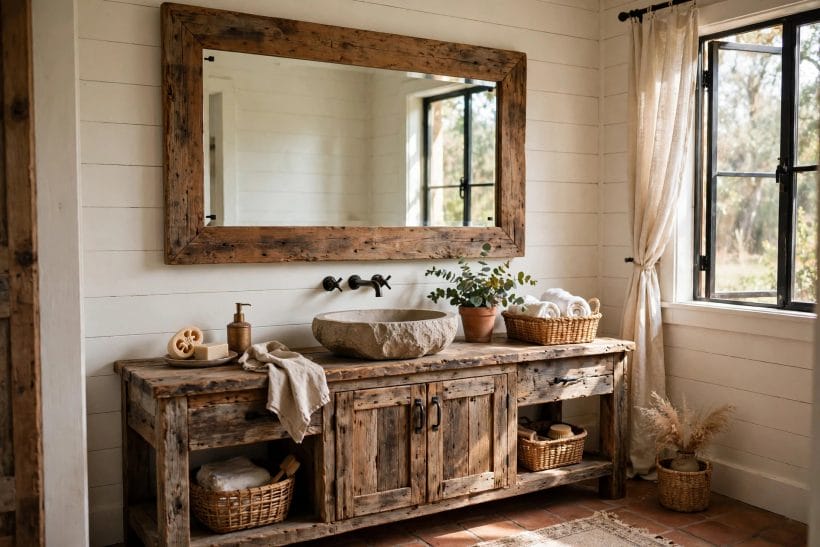
The mirror’s classic mistakes are made before it is hung: a size taped from a catalogue rather than tested on the wall, a height set for the tallest user only, glass ordered before the light was planned.
Plain duties deserve their sentences: bathroom mirrors need edges sealed against steam creeping behind the silvering, fixings suited to the wall and the glass’s weight, and any lighting near water fitted in the correct zones by a qualified electrician.
Finally, judge the mirror by its reflection from the doorway and by a morning’s honest use. A mirror that serves the face, flatters the room and wipes clean without a step-stool has earned its wall; one that fails any of the three will be resented daily, however fine it looked in the shop.
10. Costs and Pulling It Together
Costs follow a kind order: the glass itself is rarely the expensive part — size, shaping and bevelling add modestly, while mirrored cabinets and integrated lighting are the step up.
Pull the vanity wall together by answering the mirror to something already in the room — the basin’s shape, the taps’ metal, the door head’s line.
Final Considerations
The mirror over the vanity succeeds when nobody notices it as an object — when faces are lit, the room feels deeper, and the wall simply looks right.
Tape the outline on the wall tonight, live with it through tomorrow morning, and order the glass the day after — the steadiest sequence in this whole post.


0 Comments