

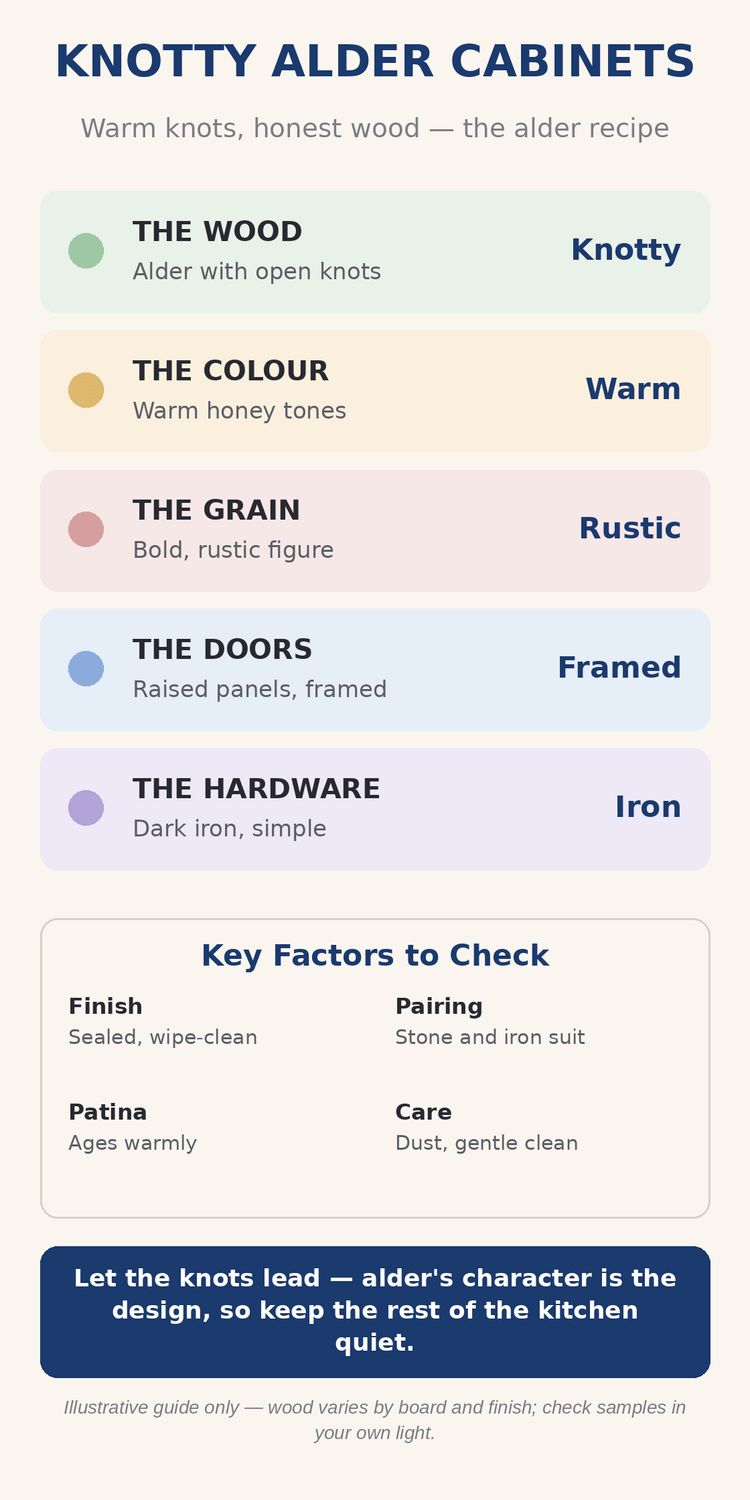
Knotty alder cabinets are the warm heart of a rustic kitchen. The wood carries open knots and bold grain that no stain can fake, and the colour sits in a honey range that makes a kitchen feel welcoming before a single meal is cooked. Photographs of these kitchens tend to share the same qualities: warm light, natural textures, and cabinetry that looks like it belongs to the house rather than to a showroom. This gallery-led guide walks through what makes knotty alder work, room by room and detail by detail.
No maker is named here and no price or performance claim is made, because alder varies by board, finish, and maker. What follows is a visual and practical tour: the wood itself, the colour, the grain, the doors, the hardware, and the kitchens these cabinets suit best. If you are choosing cabinets, use the photographs as a way to learn what to look for, and always judge a real sample in your own kitchen light before deciding.
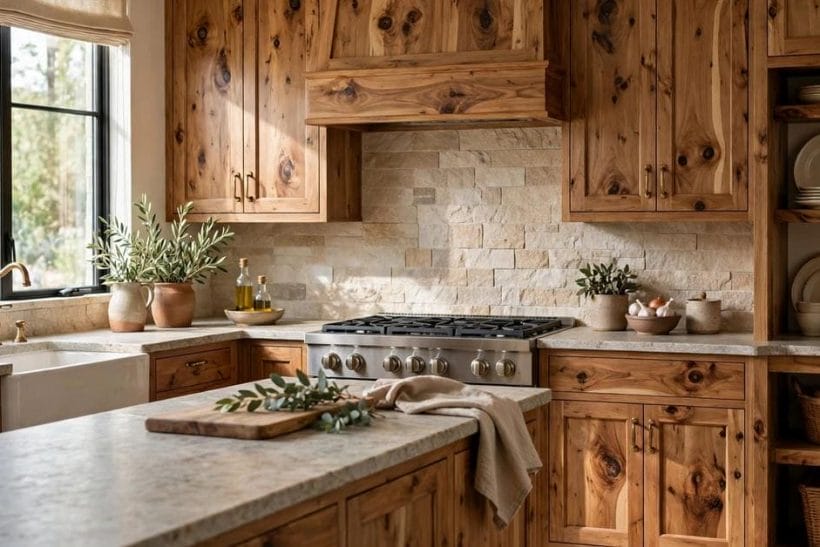
1. The Wood Itself: Alder With Its Knots Showing
Alder is a softer hardwood with a fine, even texture that takes stain well. Knotty alder is the grade that keeps the knots: the dark, round marks where branches once grew, left visible instead of cut away. The result is wood with obvious character. No two doors look alike, and a full kitchen of knotty alder reads as a collection of individual boards rather than a uniform surface.
That character is the point, and it is also the commitment. A kitchen full of knotty alder is visually busy by nature. It pairs best with quiet surroundings: plain counters, simple hardware, and restrained colours elsewhere. When the rest of the kitchen stays calm, the cabinets can carry the room. When everything competes, the room feels crowded.
Kitchen ideas show knotty alder inside full kitchen plans, which helps when the question is not one cabinet door, but how a whole wall of character wood behaves in a real room.
Look at the photograph above and notice how the island anchors the room. The knots give the eye somewhere to rest, and the warm tone sets the colour temperature for everything around it. That is the effect knotty alder is bought for.
2. Colour: The Honey Range
Knotty alder’s natural colour sits in a warm honey range, from pale gold to a deeper amber depending on the finish. A clear finish keeps it light and bright. A medium stain deepens it toward caramel. A dark stain pushes it toward walnut territory, though the knots stay visible throughout. The finish choice changes the room more than any other single decision, so samples matter enormously.
Colour also shifts with light. Alder under warm kitchen bulbs looks richer and redder than the same boards under daylight. A sample viewed in a showroom under bright lights will not look the same in a north-facing kitchen. Take samples home, prop them where the cabinets will go, and look at them morning and evening before committing.
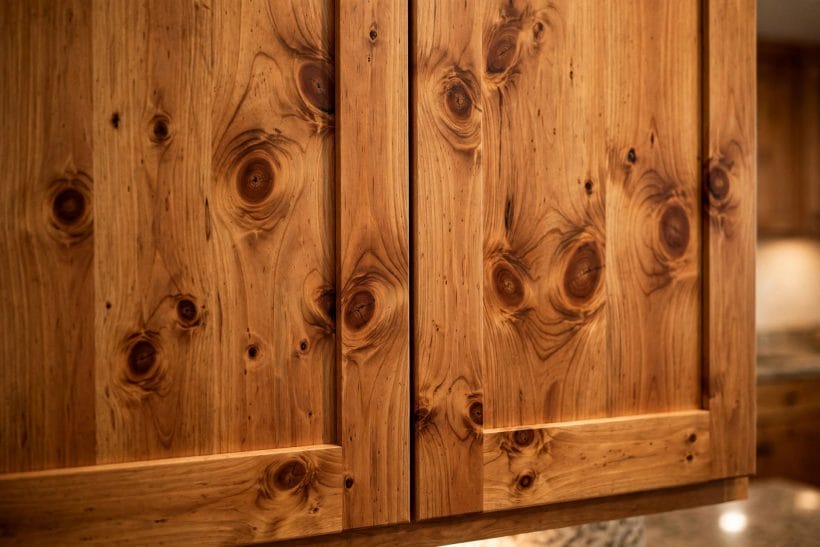
The close-up above shows why sampling matters: the grain and knots change how any stain reads, and no two boards take colour identically. A kitchen of knotty alder has natural variation built in, and that variation is part of its charm.
One more detail worth studying in photographs is how the knots sit within each door’s frame. A knot centred in a panel reads as a deliberate feature. A knot clipped by a frame edge can look like an accident, even when the wood is beautiful. Makers who care about presentation avoid clipped knots on the most visible doors, saving them for end panels and less prominent positions. When you view a kitchen, look at the doors you will see every day, not just the island front that was photographed for display.
3. Grain and Knots Up Close
Alder grain is generally straight with a subtle figure, but knotty grades add drama: cathedral patterns around knots, swirling grain lines, and colour variation from board to board. Up close, a knotty alder door looks almost like a landscape. From across the room, those details merge into a warm, textured surface. Both views matter, because you will live with both.
Knots vary in size and darkness. Small, tight knots read as texture. Large, open knots become focal points. A good cabinet maker distributes knots thoughtfully across a kitchen, so no single door carries all the drama and no stretch of wall looks blank. When viewing a kitchen, notice whether the knots feel balanced or clustered, because that distribution is a sign of care in selection.
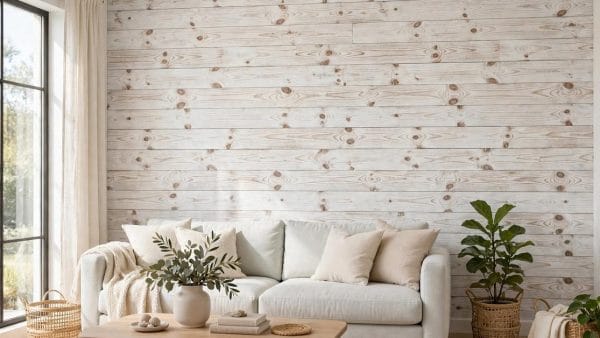
Whitewash knotty pine shows the same knotty character on walls, where the same lesson applies: knots are the feature, and the finish should work with them rather than against them.
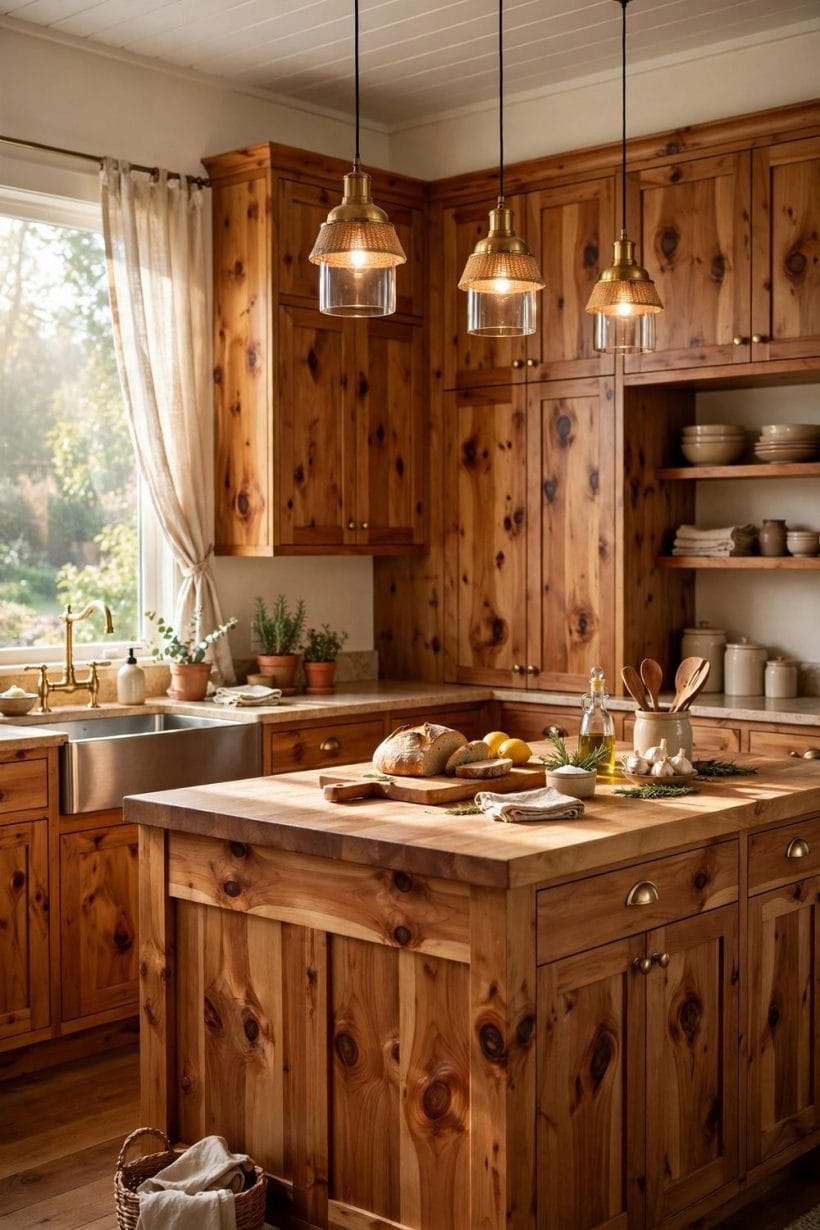
Morning light across a knotty alder kitchen, as in the photograph above, is the most flattering test of the wood. If the cabinets look good in that light, they will look good in most others.
4. Door Styles That Suit Alder
Raised-panel doors are the classic pairing for knotty alder, because their framing echoes traditional woodwork and gives the knots a structured setting. Flat-panel doors suit a more contemporary take, letting the grain itself provide the visual interest without added moulding. Both work. The choice is about the kitchen’s overall style, not about the wood.
Beaded inset doors and simple shaker-style frames sit between those poles, and both are common in the rustic and farmhouse kitchens where alder appears most. Whatever the style, check the construction details: how the panels sit in their frames, how the joints look, and whether the finish is even across panels and frames alike. Alder is soft enough that poor construction shows quickly.
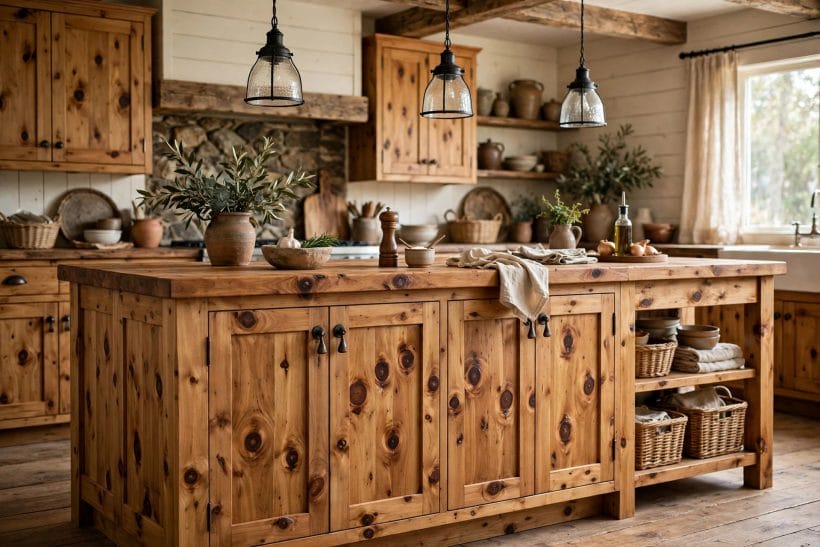
The island above pairs raised-panel alder with simple pendant lights and plain counters. Nothing competes with the wood, and the island becomes the room’s centre without trying.
5. Counters, Backsplashes and Pairings
Stone counters are the natural partner for knotty alder: granite, soapstone, and other natural stones share its organic variation, and their cool tones balance its warmth. Butcher block counters can also work, though a wood-on-wood kitchen needs careful contrast in tone, or the room turns into a single brown mass. A lighter counter against darker alder, or a darker counter against lighter alder, keeps the room defined.
Backsplashes should stay quiet. Plain subway tile, simple stone, or a single slab lets the cabinets lead. A busy patterned backsplash next to knotty alder creates two competing focal points, and the room loses its calm. The rule is simple: let one surface carry the character, and let the others support it.
Interior design ideas show the same pairing discipline across many rooms: strong wood needs quiet neighbours, and restraint elsewhere is what makes the wood sing.
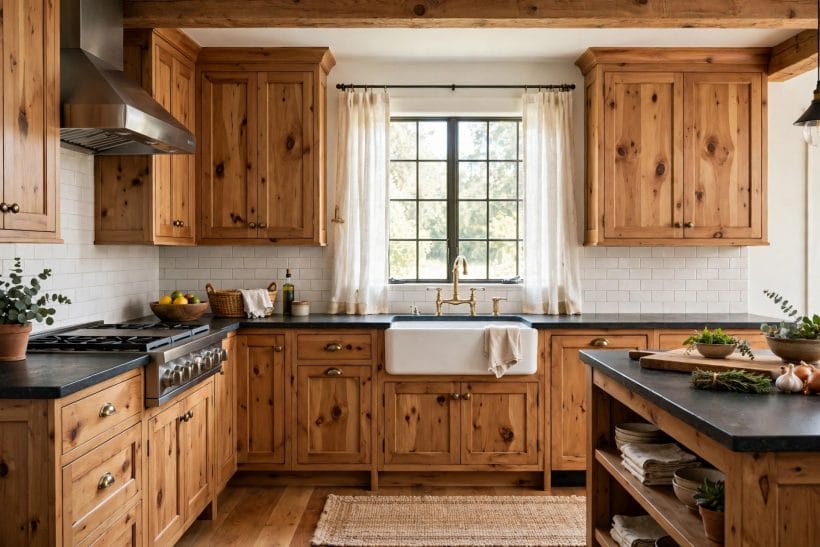
Dark stone against warm alder, as above, is one of the most reliable pairings in rustic kitchens. The contrast defines the cabinets instead of drowning them.
6. Hardware: Dark Iron and Simple Forms
Dark iron hardware is the traditional partner for knotty alder: simple pulls, cup pulls, and knobs in a matte dark finish that echoes the knots without competing with them. The hardware should feel like it belongs to the wood’s world — hand-forged, simple, and honest. Bright chrome or polished nickel can work in a transitional kitchen, but they change the room’s character toward the contemporary.
Hardware size matters too. Small knobs can look lost on large knotty doors, while oversized pulls can dominate them. Proportion the hardware to the door, and keep it consistent across the kitchen. Mixed hardware styles are a common mistake in otherwise beautiful alder kitchens, and consistency costs nothing.
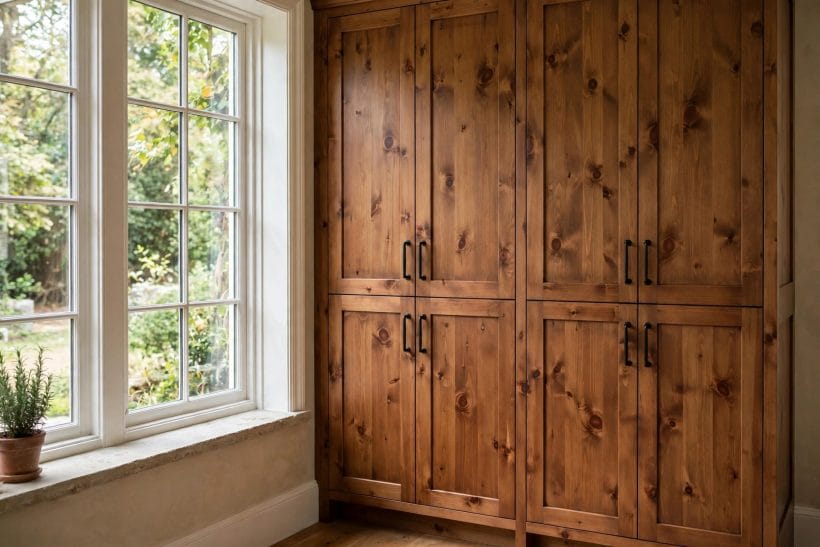
Tall pantry cabinets, as above, show how hardware placement and proportion carry a large expanse of knotty wood. The doors stay calm because the hardware stays consistent.
7. Rustic, Farmhouse and Mountain Kitchens
Knotty alder belongs most naturally in rustic, farmhouse, and mountain kitchens, where its character matches the architecture: exposed beams, stone fireplaces, wide-plank floors, and natural light. In those rooms, alder feels inevitable rather than decorated. The wood and the house speak the same language.
It can also work in transitional kitchens, where a few knotty elements — an island, a hutch, a pantry wall — add warmth to an otherwise clean design. Used as an accent rather than a whole kitchen, alder gives a modern room a handcrafted anchor. The key is intention: alder as a deliberate accent reads as design, while alder as an accident reads as confusion.
Tiny house designs show how warm wood can make a small kitchen feel generous, and the same principle scales up: knotty alder warms a room of any size.
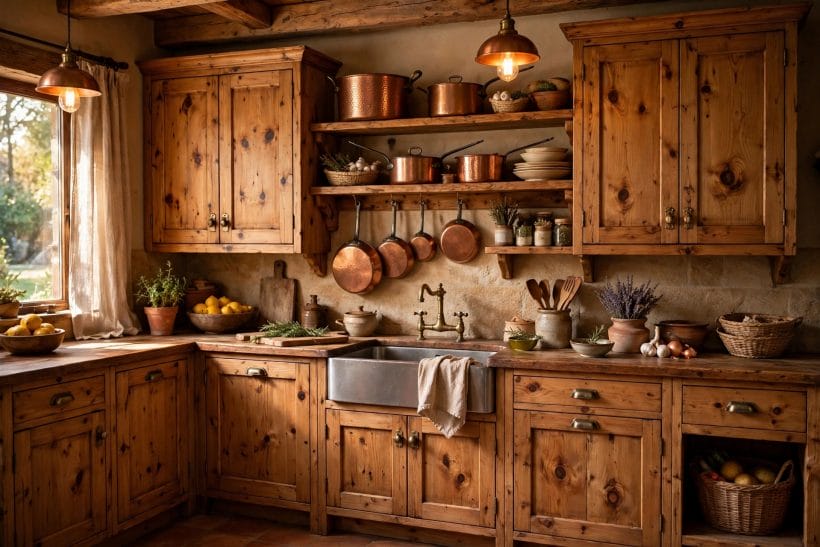
The rustic kitchen above mixes alder cabinets with open shelving and copper, and the combination works because every material is natural and the palette stays warm throughout.
Finish sheen also changes how alder reads in different lights. A matte or satin finish keeps the wood soft and natural, letting grain and knots speak quietly. A high-gloss finish reflects more light and can make a warm kitchen feel brighter, but it also highlights every dent and unevenness in a soft wood. Most knotty alder kitchens suit a satin finish, which balances warmth and practicality. Whatever sheen you choose, test it on a large sample in your own kitchen before committing, because sheen is almost impossible to judge from a small chip.
8. Light, Layout and Making Alder Work
Light transforms knotty alder more than most woods. A kitchen with generous windows lets the grain glow, while a dark kitchen can make alder feel heavy. If your kitchen is short on natural light, lighter alder finishes, pale counters, and good under-cabinet lighting keep the room bright. The wood itself is warm, but the room still needs light to show it.
Layout matters as well. Alder suits kitchens where the cabinets are a feature: islands, pantry walls, and glass-front hutches that display the wood. In a kitchen where cabinets are mostly hidden or purely functional, the character of knotty alder is wasted. Choose alder for kitchens where you will actually see it and enjoy it daily.
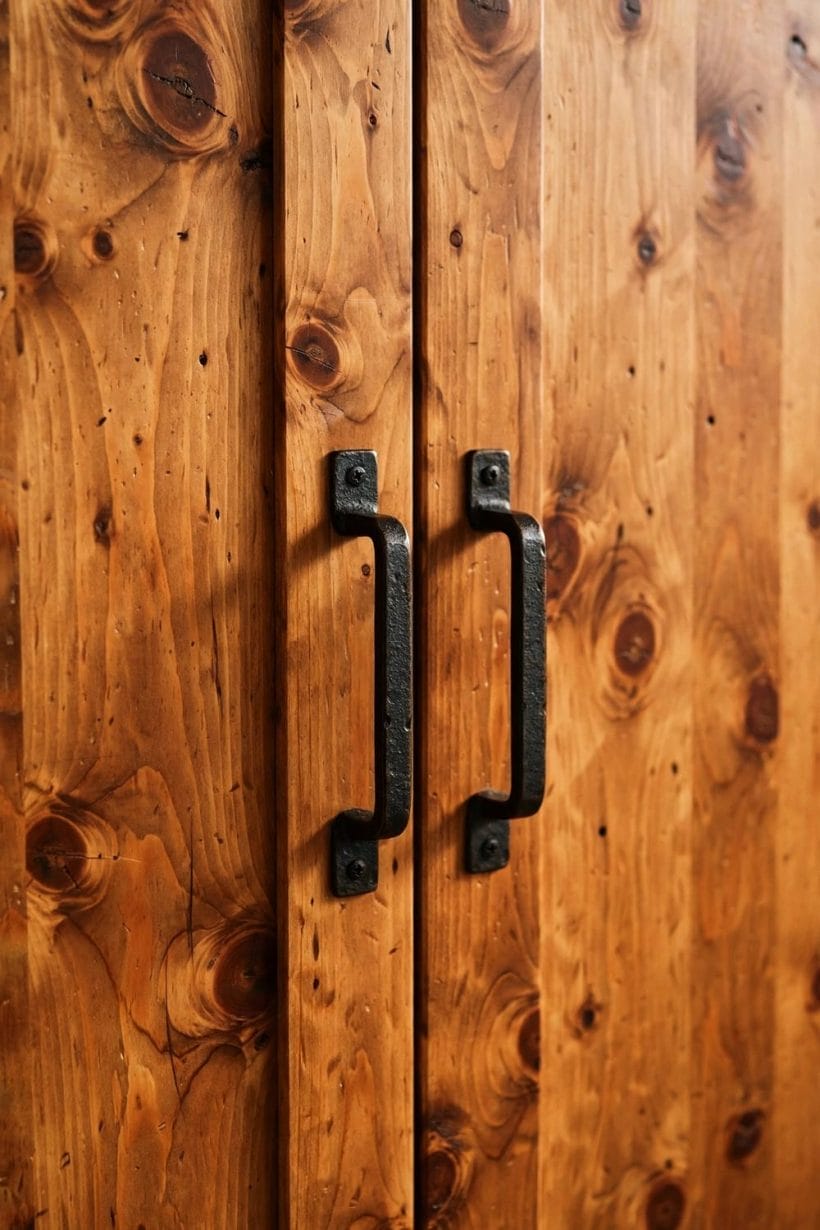
Close-up hardware detail, as above, is worth studying before ordering: the relationship between door, knot, and pull is what you will touch every day.
9. Care, Patina and Living With Alder
Alder is softer than oak or maple, so it dents more easily. That softness is part of its character: a knotty alder kitchen gains small marks over time, and those marks blend into the wood’s already-varied surface rather than standing out. Families who want pristine cabinets should look elsewhere. Families who like a kitchen that ages gracefully will love it.
Care is straightforward: dust regularly, wipe spills promptly with a damp cloth, and avoid harsh cleaners that strip the finish. Touch up worn spots with the finish the maker recommends, and keep the maker’s care guidance with the kitchen’s paperwork. Alder’s patina deepens with age, and a well-kept alder kitchen looks better at ten years than it did at one.
Painted staircase ideas show another wood surface that ages with its house, and the same attitude applies: live with the material, and let it gain character honestly.
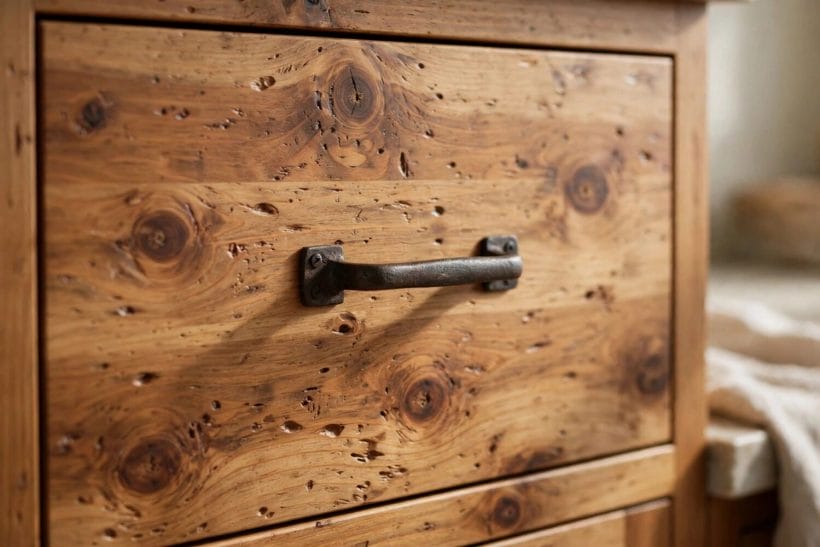
The drawer detail above shows alder at its best: grain, knot, and hardware in quiet agreement, with nothing shouting for attention.
Budget honestly for the whole kitchen, not just the doors. Knotty alder’s character rewards good counters, good hardware, and good lighting, and skimping on those neighbours dulls the wood’s effect. A modest alder kitchen with thoughtful neighbours looks better than an expensive alder kitchen surrounded by compromises, because the room is judged as a whole, not as a collection of parts.
10. Choosing Well: Samples, Makers and Questions
Choosing knotty alder well comes down to three steps. First, get large samples, not small chips, and view them in your kitchen light. Second, ask the maker how knots are selected and distributed across a kitchen, because that selection is the difference between a balanced kitchen and a chaotic one. Third, ask about finish options and care, and get the answers in writing.
Questions worth asking include how the maker handles knot placement on visible doors, what finishes are available and how they age, and what the care routine involves. A maker who answers these clearly is a maker who understands the material. A maker who cannot answer them may be selling alder as a colour rather than as a wood.
Finally, trust your eye. Knotty alder is a character wood, and character is personal. If a particular kitchen’s knots and grain make you happy every time you look at them, that is the right kitchen. If they irritate you, no argument about tradition or value will change that. Choose the wood you want to live with.
Final Considerations
Knotty alder cabinets bring warmth, character, and honesty to a kitchen. Their knots and grain are the feature, not a flaw, and they pair best with quiet counters, simple hardware, and good light. Sample in your own kitchen, ask how knots are distributed, and choose finishes that suit your room’s light. Care is simple, patina is kind, and a well-chosen alder kitchen ages beautifully.
Craftsman living room ideas carry the same warm-wood spirit into the living room, and the two rooms together make a house feel coherent and welcoming.

0 Comments