

A large living room fails in a way a small one never can: not by having too little, but by having its furniture adrift — sofas marooned mid-floor, corners echoing, a room the size of a promise kept by nobody.
This survey is the scale angle only: how a big room is zoned, furnished at its own size and lit across its whole span. Every style the room might wear has its own lane, linked as it appears, and the pillar below gathers them all.
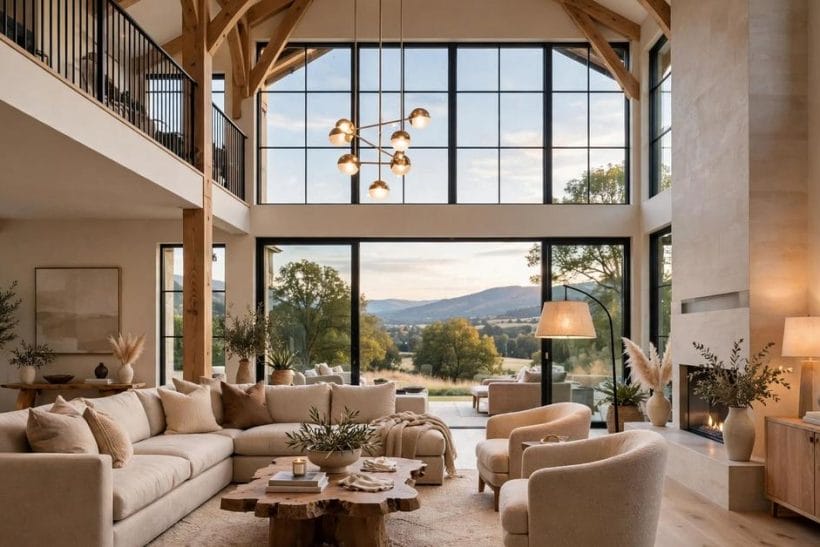
1. Large Living Room Ideas at a Glance
A large living room is the living room entity at generous scale, and its attributes change with size: the floor must be zoned into rooms-within-the-room, the furniture must be scaled up or grouped up to hold the space, the lighting must be layered across distance, and the acoustics, storage and circulation all behave differently than in a compact room. This post owns that scale angle whole — layout mathematics, proportion and the big room’s particular mistakes. The styles are deliberately elsewhere: the pillar survey of the room in all its kinds is the living room ideas collection, and the white, Scandinavian, transitional and French country lanes each have dedicated posts, linked in their sections and never re-taught here.
| Question | Short answer |
|---|---|
| What makes a big room feel empty even when it is furnished? | Distance without structure: furniture pushed to the walls leaves a void in the middle that no single piece can fill. The cure is zoning — pulling seating into grouped islands on rugs, each with its own light and purpose, so the room reads as several loved places rather than one large vacancy. |
| How large is ‘large’ for these purposes? | The moment a single seating group can no longer command the whole floor — when conversation across the room needs a raised voice and one rug looks like a postage stamp — the room is large in the only sense that matters here, and its design must change from furnishing to planning. |
| Should big rooms have big furniture? | Scaled, not merely big: a long room takes a long sofa or two sofas in conversation, and standard pieces grouped with intention hold their own perfectly well. What fails is the small piece alone — one modest sofa against one long wall, reading as an apology. |
| What is the large room’s commonest waste? | Its corners and its middle. Corners go to a lone plant and a dead lamp while the middle goes to nothing at all; this survey spends both — corners as destinations in their own right, the middle as the room’s main seating island — because unused volume is the only true extravagance a big room allows. |
2. Zoning the Floor: Rooms Within the Room
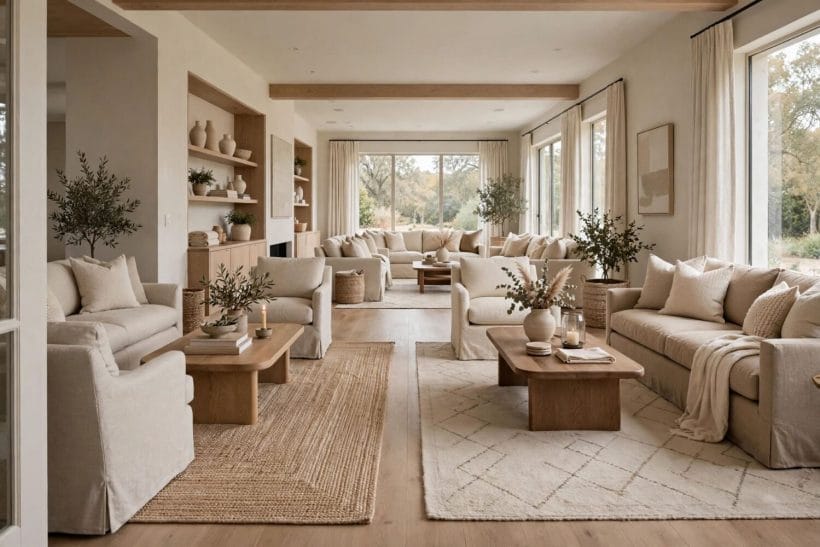
Scale design begins by refusing to treat the floor as one space. The pillar’s room-by-room wisdom in the living room ideas collection applies at any size; this section divides the big floor into governed territories, each legible at a glance.
1. The main seating island
One principal group — sofas and chairs in conversation around a hearth, a view or a table — anchors the room and takes its best position: the light, the outlook, the warmth.
2. A rug big enough to govern
The island’s rug must hold the front legs of every seat around it, and in a large room that means a rug of real consequence.
3. The reading corner as a second room
A deep chair, a floor lamp, a small table and a shelf within reach: the reading corner is a complete small room nested in the large one.
4. A games or music bay
A table for cards and puzzles, or the piano given its own territory with seating turned toward it, gives the big room a second social engine. Large rooms thrive on plural purposes; the single-purpose hall is the one that echoes.
5. The window bay as a destination
Where a big room has a fine window, build the bay into a place: a window seat, a pair of chairs angled to the view, a telescope or a plant collection on the sill.
6. Circulation drawn like streets
Plan the walking routes between zones as deliberately as the zones: clear paths from door to door and door to seating, wide enough for two people and a tray.
7. Backs of sofas as architecture
In a big room, seating islands show their backs, so choose sofas whose backs deserve seeing and dress them: a console behind, a throw, a low bookcase.
8. Symmetrical pairs for formal bones
Pairs — of sofas, chairs, lamps, cabinets — give a large formal room its calm geometry and double every good decision.
9. Asymmetry for the relaxed room
The informal large room zones by weight rather than mirror: a heavy seating island balanced by a light games bay, a tall bookcase answered by a low daybed.
10. The empty centre, kept on purpose
Sometimes the right middle is genuinely open — a dance floor at parties, a play field for toddlers, a rug’s pattern admired whole.
11. Ceiling and floor agreeing
Zones drawn on the floor gain force when the ceiling answers — a beam line, a change of treatment, lights grouped over islands.
3. Furniture at Scale: Sofas, Tables and Proportion
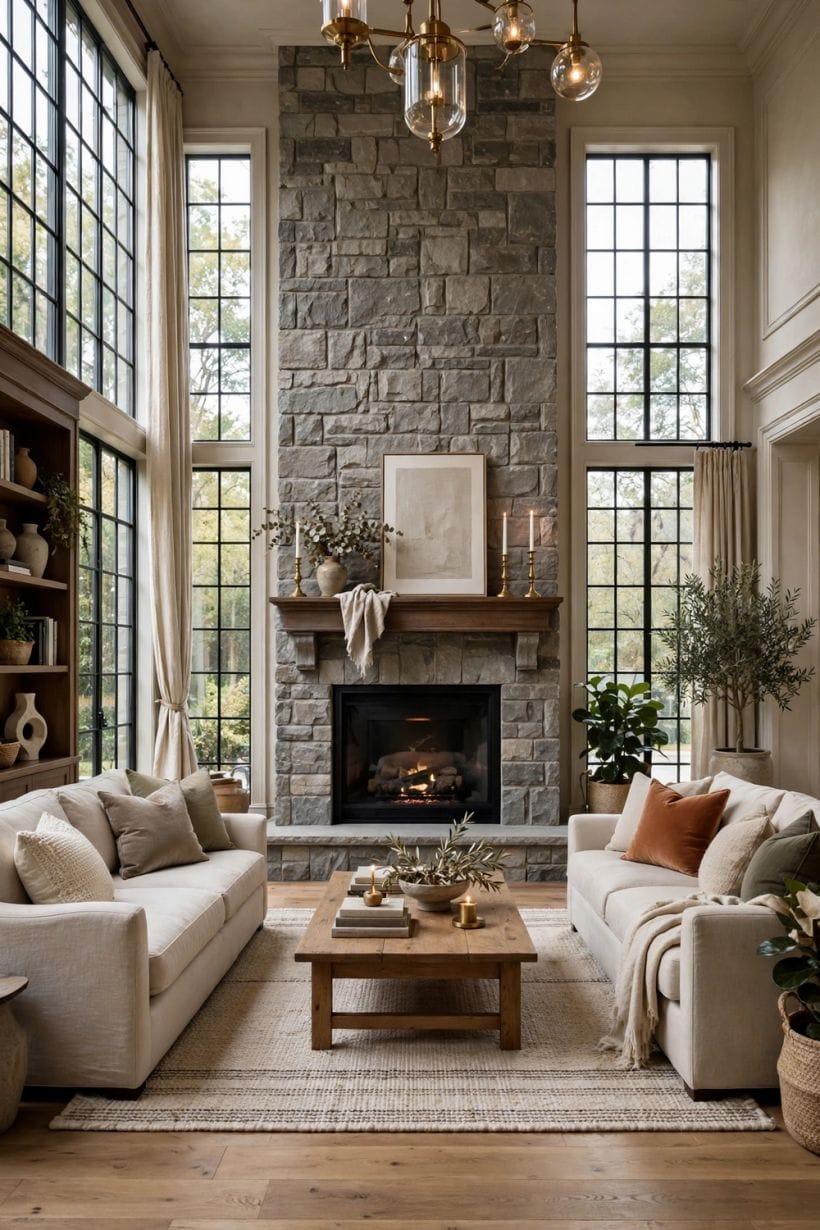
Proportion is the large room’s whole craft: pieces sized to the floor, grouped to the conversation, and numerous enough to furnish the volume without crowding it. The style of the pieces is their own lanes’ business — this section weighs only their scale and company.
12. The long sofa, or two in conversation
A large room’s main seat must hold its wall or its island: either one generous sofa of real length, or two standard sofas facing across a table.
13. Sectionals that earn their footprint
A sectional suits the large room when it turns a corner of the island and defines two edges at once.
14. Chairs in pairs and threes
Single chairs look lost at scale; chairs in conversational pairs, or a pair plus a swivel that turns between zones, furnish with intention. A chair that rotates between the island and the games bay is the large room’s hardest-working seat.
15. A coffee table with presence
The island’s table must reach every seat and hold its ground visually: generous, low, and preferably interesting in material, since it is the room’s centre of gravity seen from every door.
16. Side tables at every seat’s elbow
Distance is the large room’s tax on every drink and book: each seat needs a surface within reach, or the floor becomes the table and the room feels unhosted.
17. A daybed or chaise as the bridge piece
A backless daybed between two zones serves both and blocks neither view nor path: seating that mediates. In the large room’s kit of parts, the bridge piece is what stops zoning from hardening into separation.
18. Tall pieces against tall walls
Big rooms often carry height as well as floor, and they need their tall citizens: bookcases, armoires, tall cabinets and real trees in pots. A room furnished only below waist height looks beheaded; vertical furniture restores its proportions.
19. The console and the low bookcase
Behind sofas and under windows, low storage draws the room’s horizontal lines and swallows its clutter. In a large room, storage must be planned like furniture — because at this scale, it is half the furniture there is.
20. Negative space between groups
Resist filling: the gaps between zones are the room’s breathing, and pieces need air around them to read as chosen. A large room furnished wall-to-wall has merely recreated the small room’s problem at greater expense.
21. Antique scale and modern scale
Older furniture was often built generously and suits big rooms naturally; much modern furniture is scaled for apartments and must be grouped in greater numbers to hold the same ground.
22. Test with tape before the van
At this scale, mistakes arrive by truck. Tape the island’s footprint, walk the streets between zones, sit in the taped chairs at the taped distances and talk.
4. Colour, Pattern and the Wide Wall
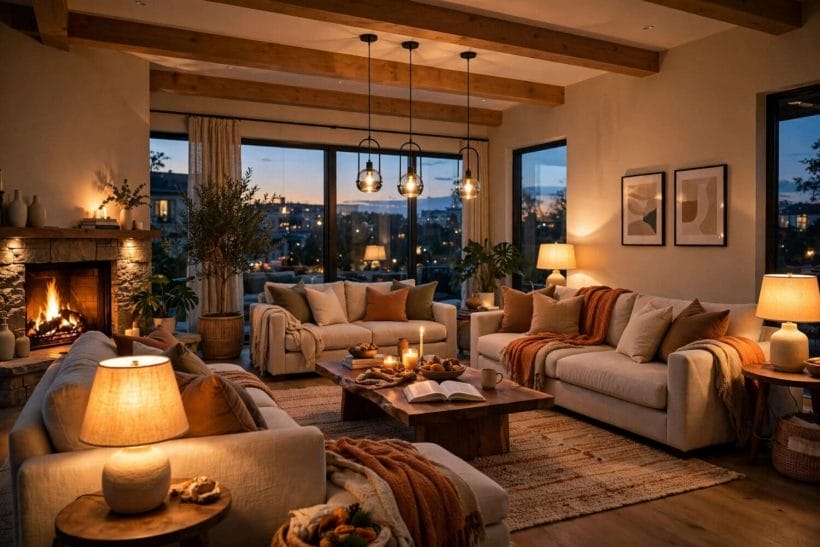
A large room takes colour the way a large canvas takes paint: boldly, in bigger gestures, with more wall to answer for. The colour lanes have their own surveys — the white living room ideas post owns bright serenity at this scale — while this section keeps to how colour behaves when there is simply more of everything.
23. Deep colour without the cave
The fear that dark walls shrink a room reverses at scale: a large room can carry deep, saturated colour on all its walls and feel tailored rather than cave-like, especially with pale ceilings and lit corners.
24. Zoning by colour, gently
A half-step change of tone between zones — the reading corner a breath deeper, the games bay a touch warmer — divides the floor without a single partition.
25. The very long wall and its rhythm
A long unbroken wall defeats single pictures: it wants rhythm — a series of frames, panels, bookcases or a gallery run with breathing spaces.
26. Pattern at the room’s own scale
Small prints vanish at distance; the large room licenses pattern with stature — big geometrics, wide stripes, generous florals — in one or two places, with plains to rest between.
27. Rugs as the room’s paintings
In a large room the rugs carry more colour and pattern than any wall may get, and they are changed more easily: choose them as the zones’ flags.
28. Curtains at full height and width
Short, mean curtains are the large room’s quickest cheapening. Dress windows from ceiling to floor and wider than the glass, so the fabric closes across the wall’s plane; the room’s height is an asset only when its textiles admit it.
29. Wood, stone and the material story
Big rooms hold big materials well: a stone hearth with presence, timber in long runs, plaster with texture.
30. Art sized to be seen across a room
The large room’s art is read at distance and must be composed for it: fewer, larger pieces with strong silhouettes, lit as citizens, not decorations.
31. Accent colour in travelling doses
One accent hue, repeated in small doses across all the zones — a cushion here, a vase there, a book’s spine answering both — stitches the territories into one room.
32. Light colours and the volume tax
Pale schemes in large rooms risk the aircraft-hangar calm: beautiful, echoing, slightly institutional.
33. The ceiling as the sixth surface
At this scale the ceiling is a true surface of the room — wide, visible from every reclined chair — and its treatment, from plain calm to the structured lanes surveyed elsewhere in the ceiling cluster, changes the room’s register entirely.
5. Layered Lighting Across Distance
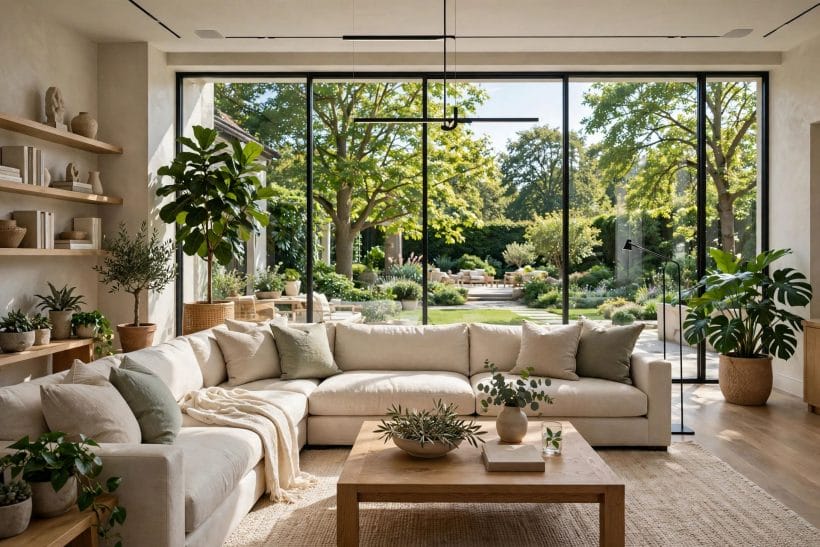
One ceiling light cannot govern a large room; distance defeats it. Lighting here is planned per zone and layered by height — the discipline the room’s lighting discussions always return to, applied at the scale where it matters most.
34. A light plan per zone
Each territory gets its own lighting scheme: the island its pendants or centre light and its table lamps, the reading corner its floor lamp, the games bay its focused light.
35. Table lamps as the room’s citizens
In a large room, table lamps on consoles, side tables and bookcases do the evening’s real work, pooling warm light at seated height. Their number surprises small-room households — a large room may honestly want them in the high single figures.
36. Floor lamps where tables cannot reach
Corners, daybeds and the ends of long sofas take floor lamps: arcs over the island, uprights behind chairs. A floor lamp is furniture and light in one purchase, and the large room’s corners are planned around them, not apologised to them.
37. Wall lights along the long walls
Sconces pace the long walls with rhythm and free every surface beneath them.
38. Dimming as a design material
Large rooms change purpose by the hour, and dimmers let one room be a bright family hall at six and a low, lamplit salon at nine.
39. Lighting the art and the shelves
Picture lights, shelf strips and a lamp inside a bookcase’s run turn the room’s contents into its evening decoration.
40. Daylight managed, not merely admitted
Large rooms often have large glass, and with it glare at one end and gloom at the other.
41. Candles and firelight at scale
A large room swallows candlelight unless it is gathered: groups of candles on the island table, lanterns at the hearth, firelight where a fireplace exists. Clustered flame reads across distance; the single candle is a rumour.
42. The dark corners policy
Decide the corners: lamp them into the room, or dress them deliberately as shadow with a tall plant or a sculptural piece.
43. Switching that matches the zones
Light planned by zone must switch by zone, from the doors the room is entered by.
44. Light at the room’s edges
The perimeter deserves a deliberate whisper of light — a lit bookcase run, a lamp in the far corner, sconces breathing along the long wall — so the room’s full extent stays in the evening’s company.
6. Storage, Display and the Long Walls
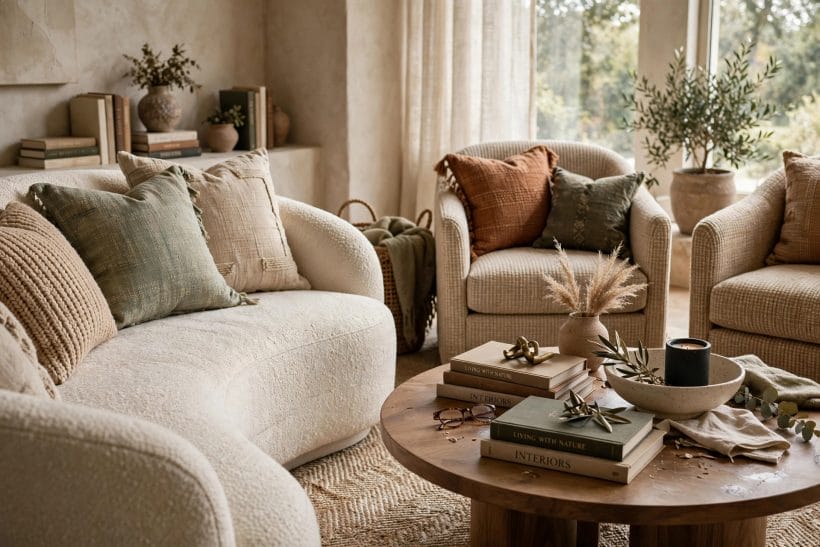
A large room accumulates like a landscape accumulates weather; its storage and display must be designed with the same deliberation as its seating. The transitional living room ideas lane shows one style’s answer; this section keeps to the scale mechanics that every style must solve.
45. Bookcases as walls within walls
A run of bookcases is the large room’s best architecture: storage, display, acoustic softening and a zone’s boundary in one joinery decision.
46. Closed storage for the room’s machinery
Games, blankets, devices, the vacuum’s furniture cousins: the large room’s working clutter needs closed homes at the zones where it is used.
47. Display at the room’s reading distance
Shelves in a big room are seen from afar: group objects in threes and fives with air between, large pieces forward, small collections in trays that read as single objects.
48. The media question, honestly placed
A television in a large room either commands a zone of its own — seating squared to it, the living room with TV survey owns that layout problem — or shares the island as one citizen among several. What fails is the accidental screen: huge, high and governing a room that was planned for conversation.
49. A writing desk in the room’s quiet third
Large rooms can house the household’s desk without colonising a bedroom: a proper table, a lamp, a chair that means business, placed in the zone daylight reaches kindly. The desk zone proves the room’s thesis — largeness is purposes, plural.
50. Plants at architectural scale
One real tree in a pot does what six small plants cannot: it occupies volume, softens echo and marks a zone like a flag.
51. Children’s territory without surrender
A zone for children — low shelves, a play table, storage they can reach — keeps the room’s other territories adult without banning anyone. The large room’s gift to families is exactly this: coexistence by zoning rather than by schedule.
52. The bar or tea station
A drinks cabinet or a kettle’s corner in the room’s social half ends the kitchen pilgrimages and makes the room self-hosting.
53. Rotating display for collectors
Big walls and long shelves tempt permanent clutter; the collector’s discipline is rotation — most of the collection stored, a selection displayed, the display changed with seasons.
54. Empty shelves, deliberately
Leave some shelf space genuinely empty: rest for the eye, room for the future, proof the display was chosen. In large rooms especially, abundance needs editing, and the empty shelf is the editor’s signature.
55. The hearth-side and window-side stores
Logs by the fire, blankets by the window seat, games by the games bay: stores placed at their point of use are the large room’s quiet logistics.
7. Sound, Warmth and the Room’s Climate
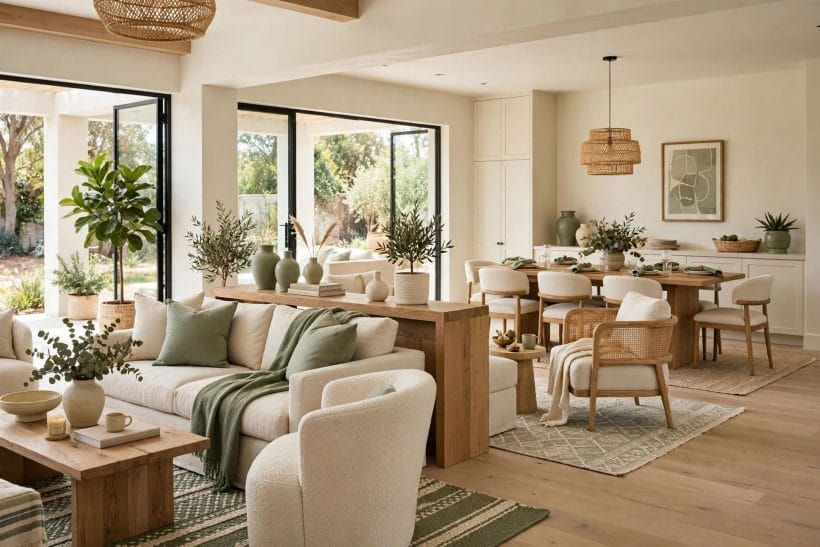
Scale has physics: a large room sounds different, heats different and breathes different, and ignoring that is why so many big rooms feel like halls. This closing section treats the invisible attributes — stated generally, with systems and trades left to their professionals.
56. Softening the echo
Hard volume rings: the cures are the room’s own furnishings — rugs, upholstery, curtains, books, cushions — layered until conversation sits down comfortably. A large room that still echoes is under-furnished in the soft department, whatever its seating count says.
57. Rugs as acoustic treatment
The island rugs are already the room’s main sound absorbers; their underlay and pile deepen the effect. Bare-floored large rooms can be beautiful and are always louder — a trade the household should choose knowingly, zone by zone.
58. Zoned heating for zoned living
Heating a whole large room to warm its one occupied corner wastes the volume’s promise: radiators, stoves or systems arranged by zone let the room’s climate follow its life.
59. The fireplace as a zone’s heart
Where a hearth exists, the main island gathers to it almost by law; the fireplace lanes in this cluster own their elements — stone, corner, standard arrangements — and this survey only notes that in a large room the fire’s warmth is a zoning force, seating within its reach first.
60. Ceiling height and the warm head problem
Tall rooms pool their heat overhead and chill their occupants politely; lower light fittings, fans that move air gently, and seating zones that accept the room’s thermal geography are the household-level answers, with systems work left to its trades.
61. Draughts across the open floor
Big rooms develop weather: draughts travel unimpeded from door to window. Screens, bookcase runs, curtain weight and the seating islands’ own backs break the wind’s journey — zoning again, this time as climate control wearing furniture’s clothes.
62. Summer coolth and cross-breezes
The same openness is summer’s gift: opposed windows and doors aligned with the zones let breezes patrol the room.
63. Music and conversation levels
A large room can hold a party’s noise and a reader’s quiet simultaneously if zones are far enough and soft enough — the household’s own test is a conversation at the island during a gathering at the games bay.
64. The hush of heavy curtains
Full-length, lined curtains are acoustic instruments as much as dressings: they calm the window walls’ hardness and the room’s ring. In the large room’s budget of softness, curtain weight is among the highest-yield lines.
65. Getting the room measured, honestly
Before systems, before furniture: live in the room’s emptiness with a tape, a thermometer’s sense and an ear for its echo, at different hours.
8. The Large Room Lived In: Family, Guests and Seasons
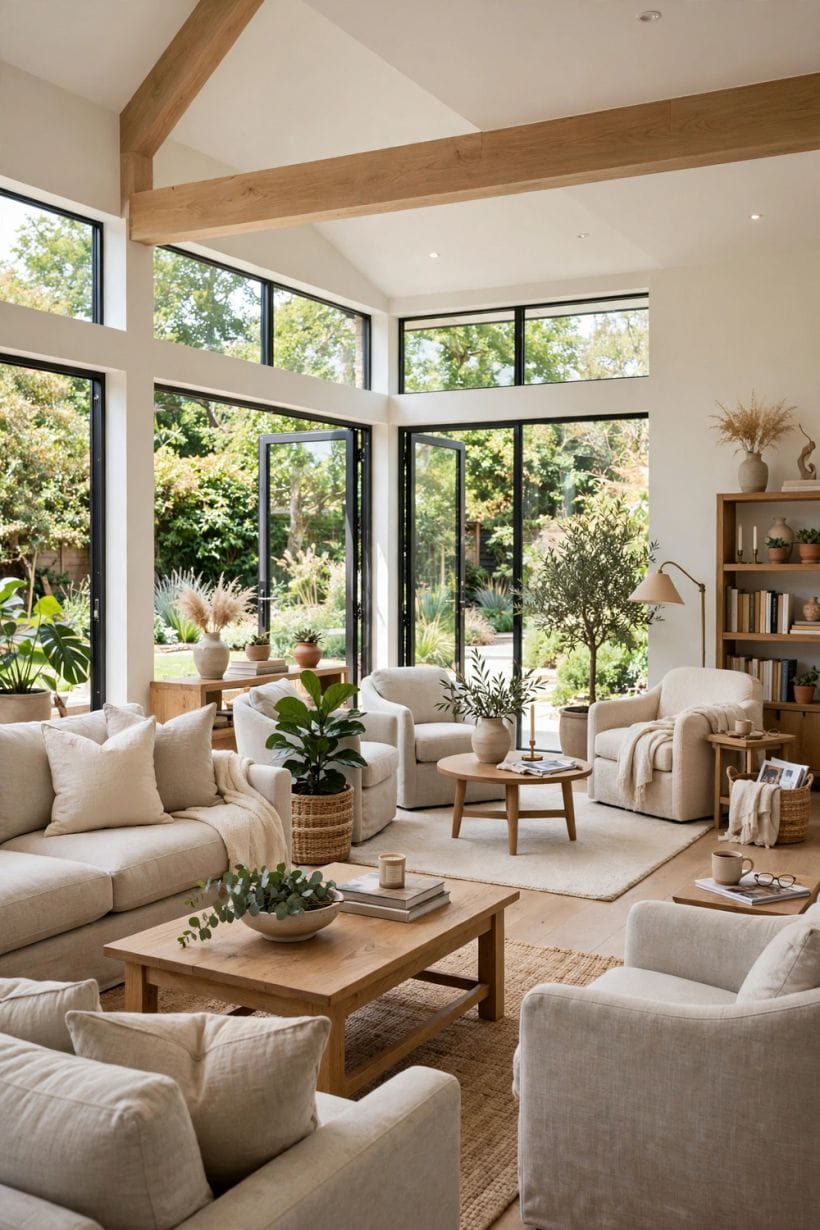
A plan is only a promise until the household’s year has tested it: toddlers, grandparents, parties, fevers, Christmases and the long ordinary Tuesdays. This final section is the scale angle applied to time — how the big room flexes without losing its design.
66. Furniture that migrates
Chairs on castors, light tables, a daybed that serves three zones in a week: the large room rewards pieces that can travel between territories as purposes change. Fixed, monumental arrangements suit showrooms; living rooms are theatres with a repertory company.
67. The party configuration
Know the room’s festival shape before the first invitation: island pushed to a wall or split in two, games bay cleared for drinks, circulation widened.
68. Grandparents and small children at once
The zoned room’s social miracle is simultaneity: children loud in their territory, elders in deep chairs by the fire, conversation between.
69. The quiet weekday shape
Most days, the room lives small: one island lit, one corner used, the rest resting in composed dimness.
70. Seasonal rotation of zones
Summer moves the island toward the garden doors and the breeze’s streets; winter gathers it to the hearth and the lamps.
71. Work, study and the room’s third shift
The desk zone by day, the games bay by evening, the island always: a large room works shifts a small one cannot. Households that discover this stop apologising for the room’s size and start scheduling it like the asset it is.
72. Guest beds and the room that hosts sleep
A daybed zone with a lamp, a screen’s worth of privacy and storage for bedding lets the large room host overnight guests without a spare bedroom.
73. Growing with the household
Zones outlive their first purposes: the play territory becomes the homework bay becomes the music corner. Plan the room’s furniture as a cast that can be re-roled, and the large room ages with the family instead of dating against it.
74. The view from the door, again
Every rearrangement is judged from the doorway: does the room still compose — island anchored, streets clear, far wall lit and dressed? The threshold test, applied at every change, is the large room’s quality control, and it takes thirty seconds.
75. Enough: the finished large room
A large room is finished not when it is full but when every zone is loved, lit and used, and the remaining space reads as air.
9. Checks and Mistakes: Before the First Purchase or the First Stone
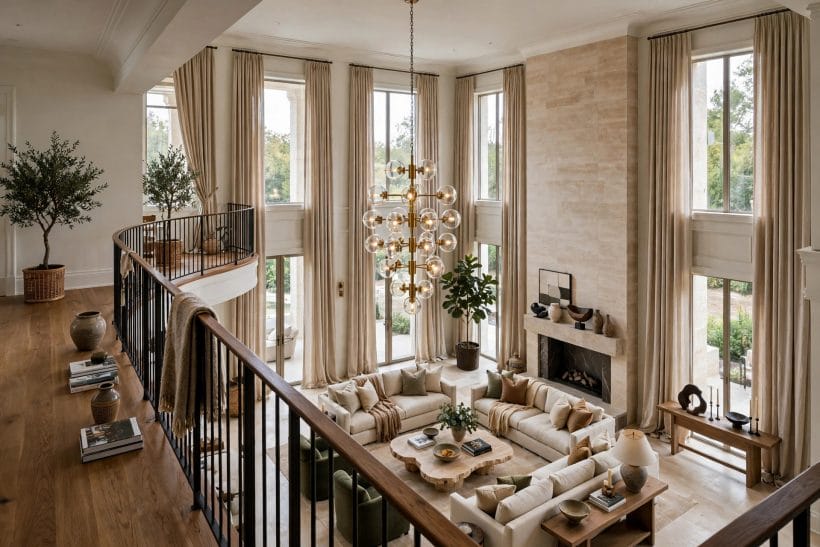
The large room’s cardinal mistake is small-room thinking at large expense: furniture against the walls, a void in the middle, one light in the ceiling and a rug like a postage stamp. Every error in that list is a zoning failure, and every one is cured on paper — tape the zones, walk the streets, rehearse the conversations — before a single piece is bought.
Scale cuts both ways. Pieces bought too small cannot be grouped into significance cheaply, and pieces bought too large cannot be returned gracefully; measuring the room, the doors and the route in is the discipline that scale demands, and it is stated here as it is in every survey in this cluster because large rooms punish its absence longest.
Do not let the style lanes do the scale work, or the scale work excuse the style: this post has deliberately linked the room’s white, transitional, Scandinavian and French country surveys rather than repeating them, because a large room still needs a chosen character — it simply needs that character executed at the room’s own size.
Finally, resist completion. A large room furnished all at once is a showroom; furnished zone by zone, as the household learns its habits, it becomes a biography. Leave a corner deliberately unfinished — the room will tell you what it wants there, in its own time.
10. Costs and Pulling It Together
Costs in a large room obey a simple arithmetic the household should meet early: everything is more — more rug, more curtain, more lamp, more cushion — and the honest budget counts zones, not pieces. Priced qualitatively, the island is the first and largest line; lighting by layer the second, and the one most often under-bought; textiles at full scale the third; and the tall storage and display that give the room its architecture the fourth. Quotes and estimates compared zone by zone show where the money is actually living.
What should never be economised is the rehearsal: tape, time and a measured plan cost almost nothing and govern everything. A large room’s budget spent after its plan is money; spent before it, it is tuition — the distinction this survey exists to teach.
Final Considerations
Largeness is not a style; it is a set of physics — distance, echo, light fall and volume — and the rooms that master it are planned like small villages: neighbourhoods of purpose, streets between them, a civic centre where everyone gathers. Furnish a large living room that way and its size stops being the problem it was bought as and becomes the pleasure it was meant to be.
The style surveys continue the story from here — the relaxed elegance of the french country living room lane among them — and the home design ideas hub gathers the whole house around this room’s generous heart.

0 Comments