

Transitional is the living room’s peace treaty. It takes the traditional room’s manners — symmetry, curves, furniture with presence — and the modern room’s discipline — clean lines, edited surfaces, air — and declines to choose between them. The result is the style most real households actually live in, whether they know its name or not.
This page is the transitional lane of the living-room cluster, linked up to the living room ideas pillar that parents them all. Where the pillar surveys the whole territory, this lane works one temperament in depth: how a room is laid out, sofas chosen, colours balanced and light layered when the brief is tailored comfort — neither period reproduction nor stark minimalism, but the seasoned middle where both feel at home.
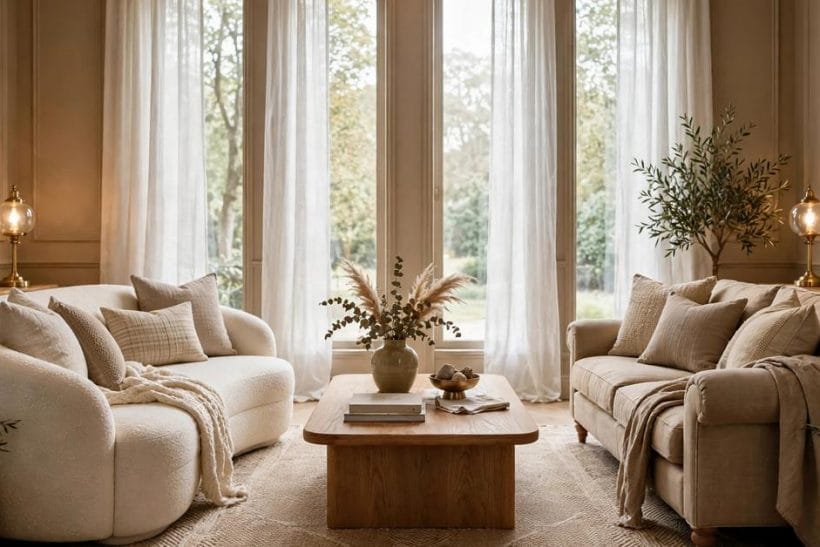
1. Transitional Living Room Ideas at a Glance
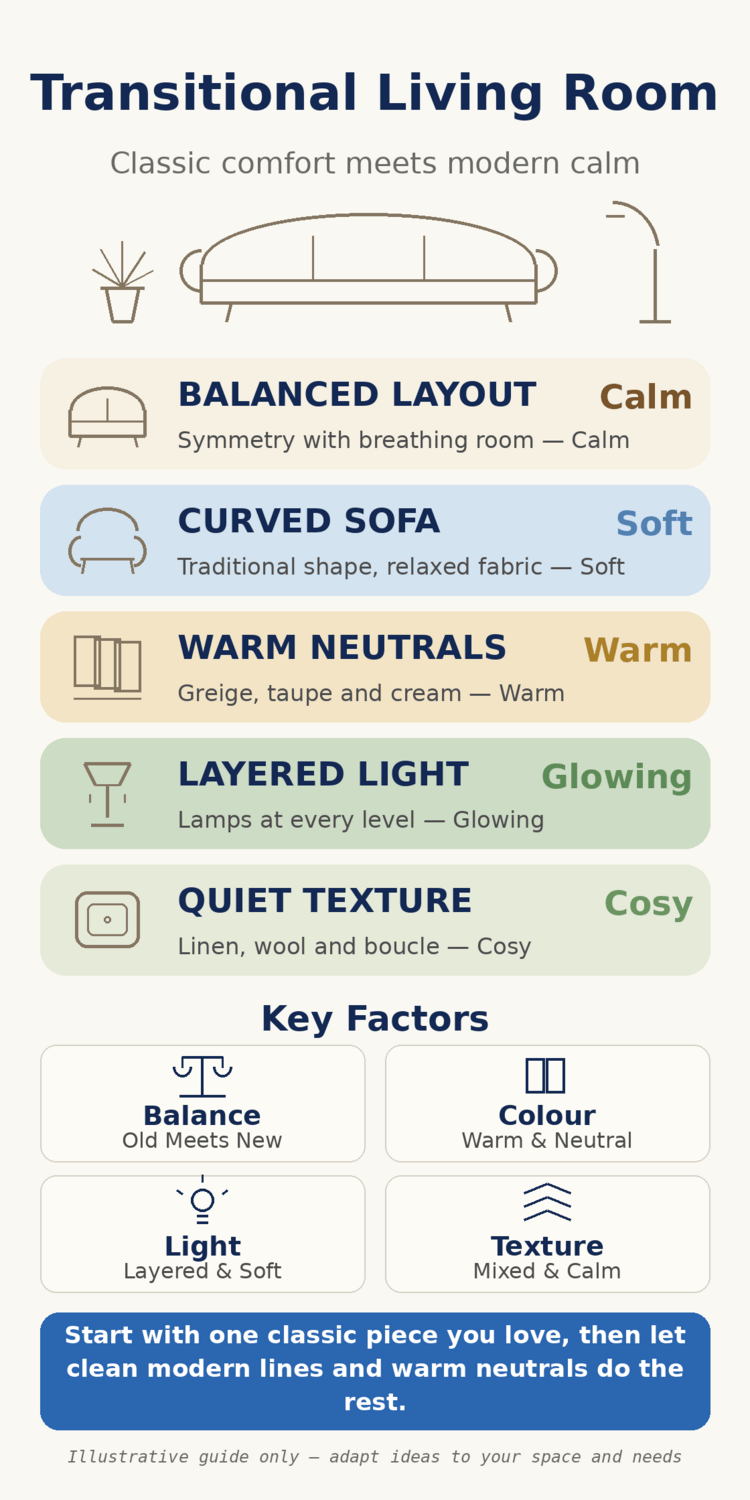
A transitional living room is a sitting room that mixes traditional forms with contemporary restraint: classic silhouettes — the rolled arm, the skirted base, the cabriole curve softened — upholstered in plain, textured fabrics; furniture with traditional presence carried on cleaner lines; a warm neutral palette of cream, taupe and greige with gentle contrast; and lighting that layers updated classics over modern simplicity. Its parts work as a system of balances: curve against line, warm against cool, ornament edited to a garnish. It is the diplomatic cousin of the traditional living room and the modern room alike, and it endures because it asks nobody in the household to surrender.
| Question | Short answer |
|---|---|
| What exactly does transitional mean in a living room? | A deliberate blend: traditional shapes and symmetry, contemporary simplicity and editing. A transitional room might pair a rolled-arm sofa in plain linen with a clean-lined glass coffee table, or set a classic chandelier’s silhouette over an uncluttered, neutral scheme. Neither era dominates; the room reads as comfortable and current at once, which is precisely its design. |
| What colours does the transitional palette use? | Warm neutrals, in layers: cream, ivory and warm white; taupe, greige and soft stone; then gentle contrast from charcoal, deep brown, muted blue or sage in doses. The palette’s signature is that nothing shouts — the interest is carried by texture and tone-on-tone variation rather than by strong colour, so the room feels calm rather than empty. |
| Who does a transitional living room suit? | Households divided against themselves, which is most of them: one partner raised on antiques, one addicted to clean lines; rooms in period houses that must serve modern life; anyone who finds traditional fussy and modern cold. Transitional is the negotiated settlement that both sides can sign without feeling they lost. |
| What is the biggest transitional mistake? | Drifting into blandness — the beige room where blend became blur. Transitional needs its tensions kept alive: a curve needs a straight line to answer it, a soft palette needs one deep note, and edited surfaces need a few objects with real presence. When everything merely agrees, the room stops being transitional and becomes forgettable. |
2. Layouts That Hold Both Eras: Symmetry with Breathing Room
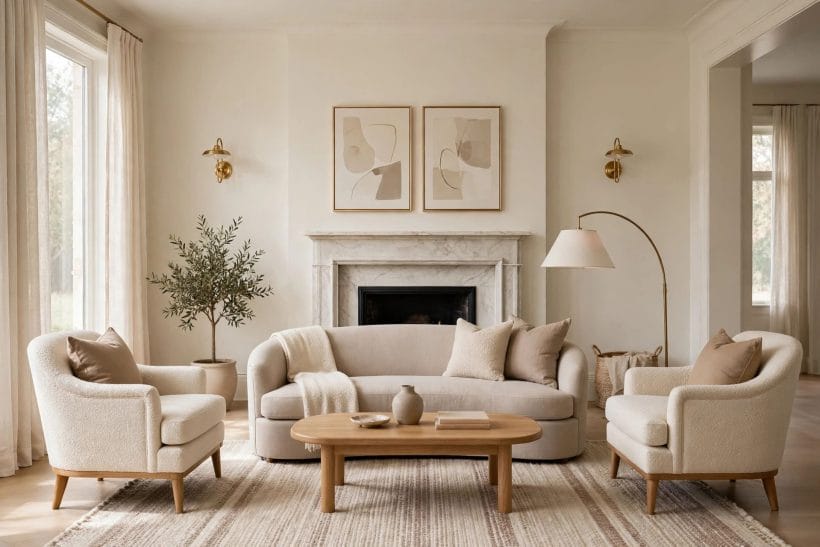
Transitional layout keeps the traditional room’s bones — a clear focal point, balanced arrangements, furniture in conversation — and gives them the modern room’s oxygen. This section sets the plan: symmetry that steadies without stiffening, and space around every piece.
1. Centre the room on one clear focal point
Fireplace, view or a composed media wall: the transitional room keeps the traditional courtesy of a single centre that the seating acknowledges.
2. Use symmetry as the default, then relax it once
Pairs — of chairs, lamps, side tables, pictures — give the room its traditional poise. Then break the pattern in exactly one place: an unmatched chair, an off-centre artwork, a plant where the second lamp should be.
3. Float the sofa off the wall when the room allows
A sofa pulled a hand’s breadth from the wall, with a console or a sliver of shadow behind it, gains the modern room’s ease while keeping a traditional arrangement’s order.
4. Keep the conversation geometry honest
Seats should face each other at a distance where talk needs no raising of voices, with surfaces in reach of every chair.
5. Mix one architectural antique into the plan’s structure
A genuinely old piece used structurally — a farmhouse table as the console, an armoire holding the television, a worn rug anchoring the scheme — gives the room a past the new furniture can converse with.
6. Let the rug define the room within the room
A large rug under the whole seating group draws the transitional room’s boundary more kindly than walls can: traditional in its pattern or border, contemporary in its restraint.
7. Plan the paths through the room as carefully as the seats
Walk lines should pass behind or beside the conversation, never through its middle, and doors should not open onto the back of a sofa if the plan can help it.
8. Give the room one generous gesture
A pair of oversized lamps, a single large artwork, a deep comfortable chair that invites by its silhouette alone — one gesture at a scale above the safe teaches the room its confidence.
9. Use pairs of chairs rather than a second sofa
Two chairs opposite the sofa keep the arrangement light, movable and social — chairs can turn to the fire, to the window, to each other.
10. Leave the corners alive but uncluttered
A corner wants one thing: a reading chair and lamp, a tall plant, a stack of books on a stool. Corners filled with the room’s overflow announce storage failure; corners left entirely bare look unfinished in a style built on comfort.
11. Edit the layout by sitting in every seat
The designer’s final pass is physical: sit everywhere, check the view, the light, the reach to a surface, the distance to the conversation.
3. Sofas and Seating: Traditional Shapes in Relaxed Fabrics
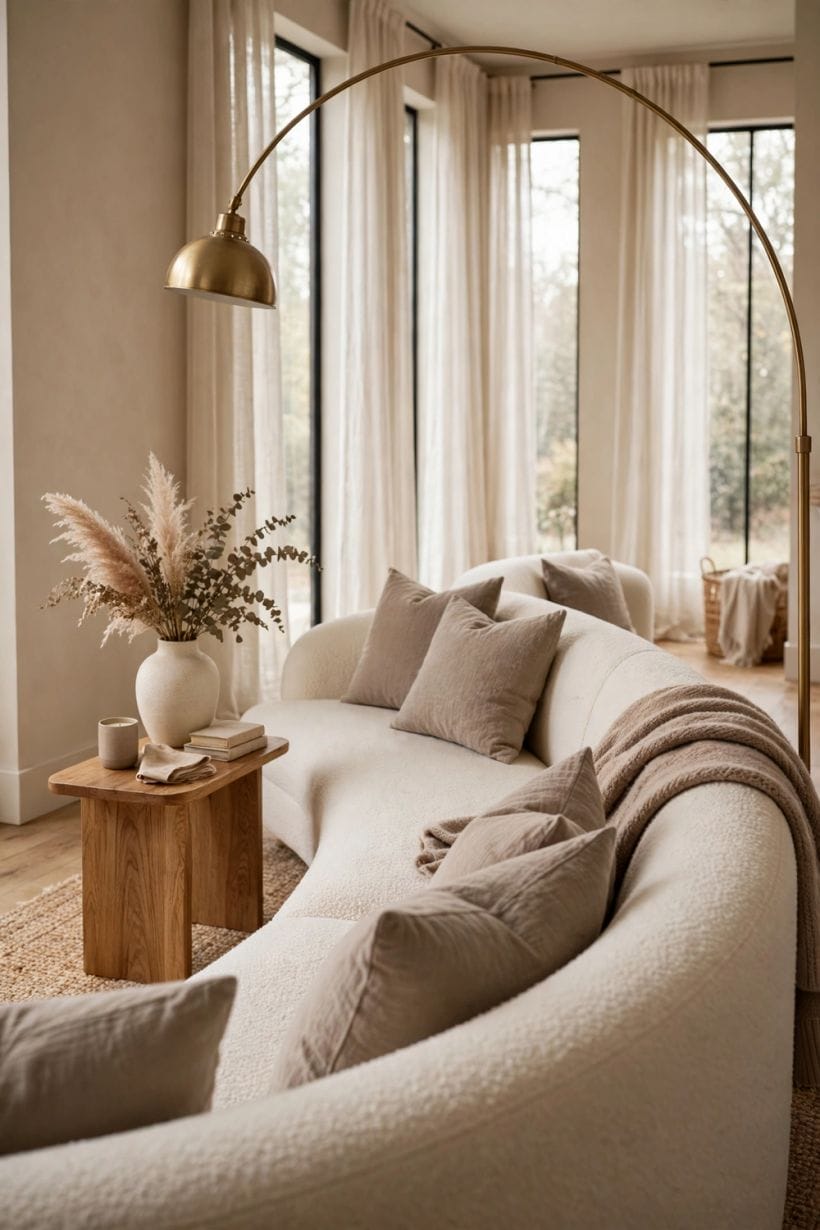
Seating is where the treaty is signed in upholstery: the silhouettes come from the traditional lexicon — rolled arms, deep seats, skirted or turned-leg bases — while the fabrics and colours belong to the modern register of plain, textured and calm. This section works the choices.
12. Choose the rolled or track arm as the room’s dialect
The rolled arm speaks traditional; the slim track arm speaks modern; the transitional sofa often splits the difference with a gentle slope arm or a narrow roll.
13. Upholster in plain fabrics with texture doing the ornament
Linen weaves, bouclé, chenille, brushed cotton: the transitional fabric has a hand, not a print. Texture is how the style gets richness without pattern, and it forgives family life better than silk ever will.
14. Take the seat deep and the back welcoming
Transitional comfort is dimensional: seats deep enough to curl in, backs high enough to lean a head on, cushions that hold their shape without standing to attention.
15. Mix the sofa’s partner pieces rather than matching a suite
The matched three-piece suite is the one purchase transitional style argues against. A sofa, two different chairs and an ottoman that rhymes with one of them compose a room; a suite merely furnishes it.
16. Let one chair carry the curve
A barrel chair, a swivel with a rounded back, or a classic bergère puts the traditional curve into the room in a single gesture, answered by the straighter lines around it.
17. Skirted bases and turned legs as quiet signals
A skirted sofa base reads traditional and hides a multitude of stored sins beneath it; exposed turned or tapered legs read lighter and more modern.
18. Ottomans as the room’s diplomats
The upholstered ottoman is transitional furniture’s hardest worker: footrest, extra seat, coffee table with a tray, the bridge between sofa and chairs.
19. Leather admitted once, in a warm tone
A single leather chair — cognac, saddle, deep brown — gives the neutral scheme a traditional weight and a surface that ages with honour.
20. Cushions as the room’s changing exhibition
With upholstery plain, cushions carry the pattern budget: a classic stripe beside a small geometric, a solid in the scheme’s deep note, textures mixed.
21. Swivel chairs for the room that talks and watches
The swivel chair resolves the modern room’s divided attention with traditional grace: conversation toward the fire, a turn toward the screen, no scraping of legs. A pair of swivels opposite the sofa is fast becoming the transitional layout’s signature move.
22. Buy the frame and springs before the fabric
Whatever its style, a seat is a machine for sitting: hardwood frame, proper springs, cushions that can be re-filled.
4. The Transitional Palette: Warm Neutrals and Gentle Contrast
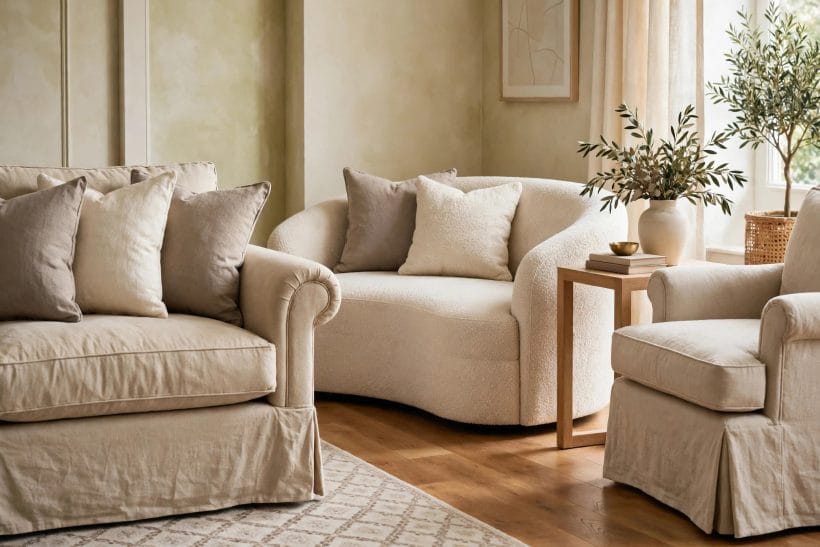
Colour in the transitional room is a study in warm neutrality — the palette that lets traditional presence and modern calm share a wall. This section builds it: the layered neutrals, the one deep note, and the way colour moves through a room that refuses to shout. It is the colour discipline the gray living room lane works in its own register.
23. Build the ground in warm white and cream
The transitional wall is warm — ivory, cream, the white of old linen — chosen to flatter timber, faces and lamplight rather than to make a gallery of the room.
24. Layer taupe and greige as the palette’s working neutrals
Between the cream ground and the deep note live the worker tones: taupe, greige, stone, mushroom — the colours of the sofa, the rug’s field, the curtains.
25. Admit grey, but warm it
Grey belongs in the transitional room only in its warm relations — the greiges and stone greys that sit comfortably beside timber and brass. The gray living room walls treatment works the cooler register as a subject of its own; here grey is a guest who dresses warmly for the house.
26. Spend the deep note once per view
Charcoal, deep espresso, ink blue or the darkest sage: one deep note per sightline — a pair of cushions, the inside of a bookcase, one chair — gives the pale scheme its anchor.
27. Let muted blue be the palette’s traditional accent
Soft, greyed blues — the colour of old porcelain and faded denim — are the transitional accent with the longest pedigree, at home with cream, taupe and timber alike.
28. Use sage and olive where the room faces green
Rooms looking onto gardens take their accent from the view: sage, olive and moss in the textiles let the window’s colour continue into the room at half strength.
29. Keep wood tones in the warm middle register
Timber in the transitional room avoids the extremes: not pale Scandinavian blonde, not dark mahogany gloom, but the warm middle — oak, walnut in its lighter moods, fruitwood.
30. Metals: brushed, aged and unlacquered over polished
The palette’s metals are softened — brushed nickel, aged brass, oil-rubbed bronze, pewter — finishes with the shine taken down to a glow.
31. Carry the palette up and over: ceiling and woodwork
Ceilings in the ground colour’s softest version, woodwork a half-tone deeper than the walls, doors following the woodwork: the transitional envelope is graduated, not contrasted.
32. Test the palette at lamplight before committing
Warm neutrals live or die by evening light, where the wrong undertone turns pink, green or muddy.
33. Let the white living room be the palette’s bright cousin
Where this lane warms its whites to cream, the white living room lane works the cooler, brighter register as its whole subject. The two are cousins, not rivals: a transitional scheme borrows the white room’s freshness in its linens and lampshades, repaying the loan with warmth from timber and taupe.
5. Tables, Storage and Case Pieces: Clean Lines, Warm Materials
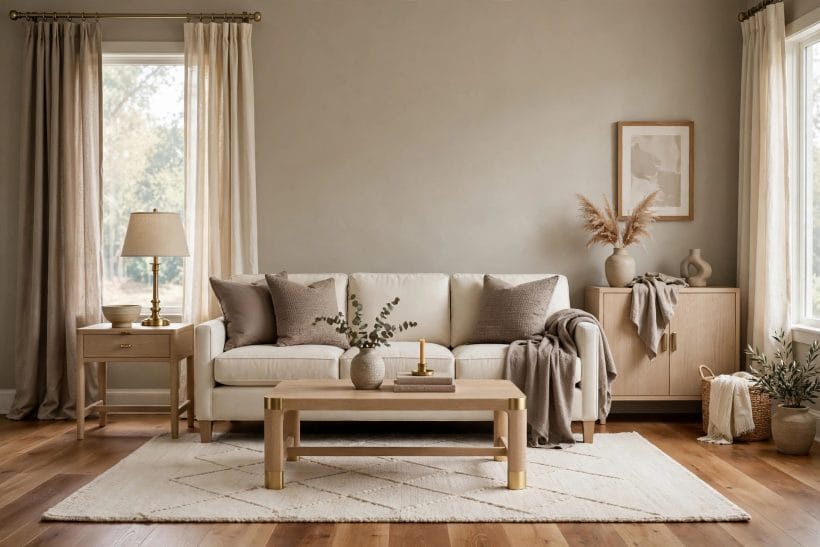
The transitional room’s furniture beyond seating follows the same treaty: traditional materials and presence, contemporary silhouettes. This section works the tables, bookcases and storage that give the room its working skeleton.
34. Choose the coffee table as the room’s hinge piece
The coffee table sits at the composition’s centre and declares the blend: a traditional material on modern lines — a stone top on slim legs, a timber slab with a waterfall edge, glass over a classic base.
35. Side tables in pairs, but not twins
Matched-in-spirit side tables — same height, same material family, different exact design — flank the sofa with transitional logic: the symmetry traditional rooms love, the variety modern rooms insist on.
36. A console behind the sofa or under the art
The console is the style’s favourite case piece: slim, long, useful — lamps and books above, baskets and the household’s beautiful clutter below.
37. Bookcases with breathing room on the shelves
Transitional shelves are edited: books in runs, objects in ones and threes, and empty space left as an exhibit in itself.
38. Paint the inside of one bookcase the deep note
A bookcase’s back painted in the scheme’s dark accent — charcoal, ink, deep sage — turns shelving into display architecture and gives pale objects and book spines a stage.
39. Storage that closes: doors and drawers over open display
The calm surface depends on somewhere for the tide to go: a credenza with doors, drawers in the console, lidded boxes on the shelves.
40. An armoire or tall cabinet as the room’s one antique
If the layout section’s antique is tall storage, it earns twice: presence with a past, and the room’s largest cupboard.
41. Nesting and drinks tables for the working edges
Small movable tables — a nest, a martini table, a stool that moonlights — serve the seats the fixed tables cannot reach.
42. Timber, stone, glass and metal in one composed family
The case pieces should share the palette’s material story: the coffee table’s stone answering the hearth, the console’s oak answering the floor, the lamps’ aged brass answering the hardware.
43. Keep silhouettes clean even when shapes are classic
A camelback profile can still be simply made; a pedestal table can be turned without fussiness. The transitional case piece takes the classic outline and declines the carved garnish — the shape is the ornament.
44. Leave one piece of furniture genuinely imperfect
The worn leather of a reading chair, the water-marked top of an inherited table: a single piece carrying its life openly keeps the composed room human.
6. Textiles, Curves and Pattern: The Soft Layer
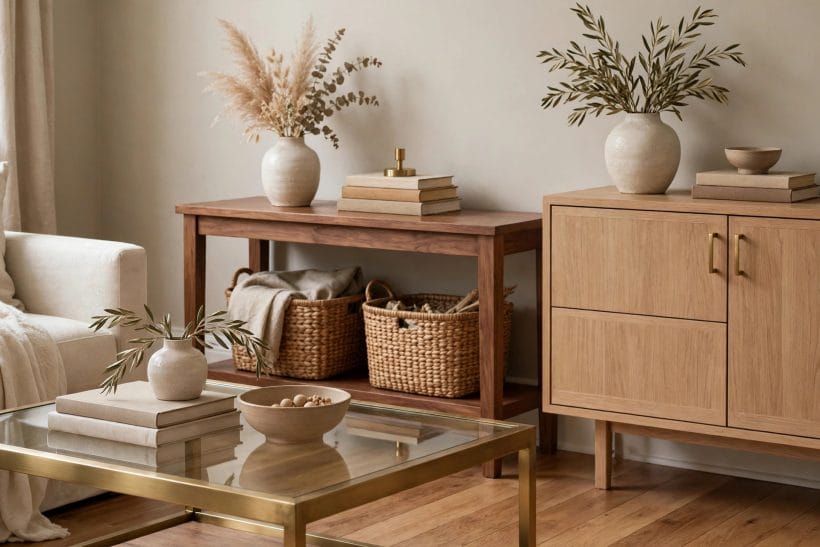
If the furniture is the treaty, the textiles are its tone of voice. This section works the soft layer — curtains, rugs, cushions and throws — where transitional rooms get their warmth, their curves and their small, controlled allowance of pattern, much of it shared with the family room register of comfort.
45. Curtains full-length and simply headed
The transitional curtain hangs from ceiling toward floor in a plain fabric with body — linen, a linen blend, a soft wool — on a simple heading that pleats without frippery.
46. Sheers or a light layer where the sun demands manners
A sheer behind the curtain, or in place of it where privacy allows, keeps the room’s daylight filtered and its evenings unexposed.
47. The rug as the room’s largest textile decision
Choose the rug after the palette and before the cushions: a traditional border or a faded vintage pattern at low contrast, or a contemporary texture in the scheme’s tones.
48. Pattern in small, classic doses
A stripe, a small check, a faded floral, a quiet geometric: the transitional print is classic in motif and modest in scale, admitted in cushions, one chair or the curtains’ leading edge.
49. Curves in the soft layer where furniture is straight
A scalloped cushion edge, a round bolster, the arc of a throw over a chair arm: small curves soften a room whose case pieces run straight.
50. Throws as functional colour
The throw is the transitional room’s accent-with-a-job: the deep note folded over the sofa’s arm, the muted blue across the reading chair.
51. Layer the bed-linen lesson onto the sofa
Sofa dressing borrows the well-made bed’s logic: a base of large plain cushions, a middle layer in texture, one or two small patterned pieces at the front.
52. Upholstery weight matched to the household’s truth
Silk and pale velvet are beautiful liars in a house with dogs and toddlers.
53. Repeat each textile tone at least twice
A tone that appears once is an accident; twice is a scheme.
54. Change the soft layer with the seasons, lightly
Heavier throws and deeper cushion covers in winter; linens lightened and one pattern retired in summer.
55. Keep the window seat and the reading corner dressed
The room’s secondary soft places — a window seat’s cushion and bolsters, the reading chair’s throw and cushion — should be dressed from the same cloth family as the main group.
7. Layered Lighting: Updated Classics and Modern Calm
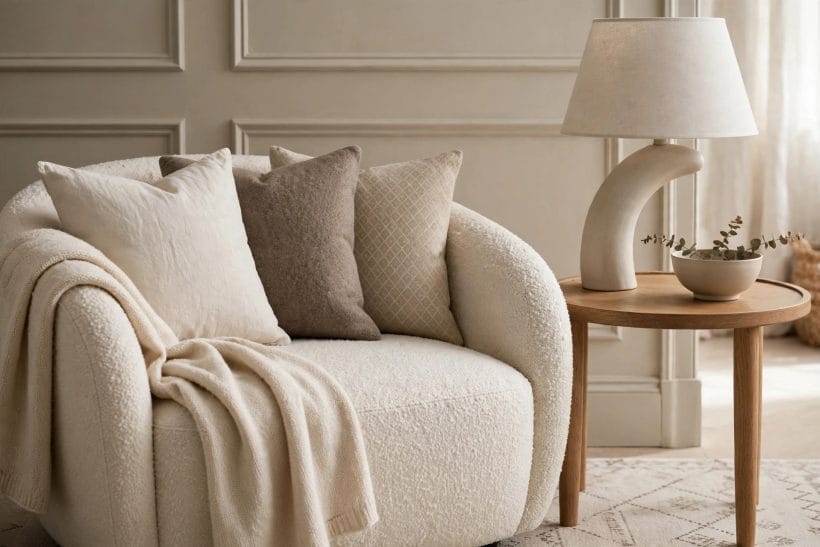
Transitional light layers the traditional room’s chandeliers and lamps over the modern room’s discipline of dimmers and levels. This section lights the room in storeys — the section where the style’s glow is manufactured, kin to the work in the vaulted ceiling living room lane.
56. Begin with the ceiling’s one statement, kept classic in shape
A chandelier or pendant in a traditional silhouette — branches, a lantern, a drum — executed in the palette’s softened metals and stripped of excess crystal theatre.
57. Table lamps in pairs at the conversation’s shoulders
The transitional lamp is a classic shape — urn, column, gourd — in ceramic, aged metal or linen-shaded simplicity, placed in pairs that flank the sofa or face across the room.
58. Shades in the palette’s linens, sized generously
Lampshades in cream linen or soft white, sized with the traditional generosity modern mini-shades forgot, diffuse the layered light the style is named for.
59. A floor lamp for the reading chair, arched or straight
The reading corner gets its own light: a pharmacy lamp’s discipline or an arc’s gesture, in the room’s metal. Task light placed exactly where the book is turns a chair into a destination — and every transitional room needs one destination seat.
60. Dimmers on everything, without exception
The layered scheme only exists if its layers can be tuned: ceiling low, lamps bright for an evening in; the reverse for a gathering. Dimmers are the cheapest luxury in this entire page and the one whose absence is felt nightly.
61. Picture lights and shelf lights as the quiet fourth layer
A picture light over the one good artwork, a strip washing the bookcase’s painted back: small, warm accents that give the room depth after dark.
62. Candlelight admitted as the traditional garnish
Real or good imitation candles on the mantel and the coffee table complete the ancestry: the transitional room remembers that its light descends from flame.
63. Keep bulbs warm and consistent through the room
Mixed colour temperatures undo layering faster than any design error: one warm register for every bulb in the room, so skin, timber and the cream palette all keep their evening promises.
64. Use mirrors to multiply the layers
A mirror over the mantel or opposite the lamps doubles the room’s glow and its sense of space, in the traditional position with a transitional frame — simple, aged, generous.
65. Plan sockets where the lamps actually stand
Layered light fails on logistics: lamps marooned from sockets trail cables across the composition.
8. Walls, Windows and the Finished Layer: Art, Mirrors and Restraint
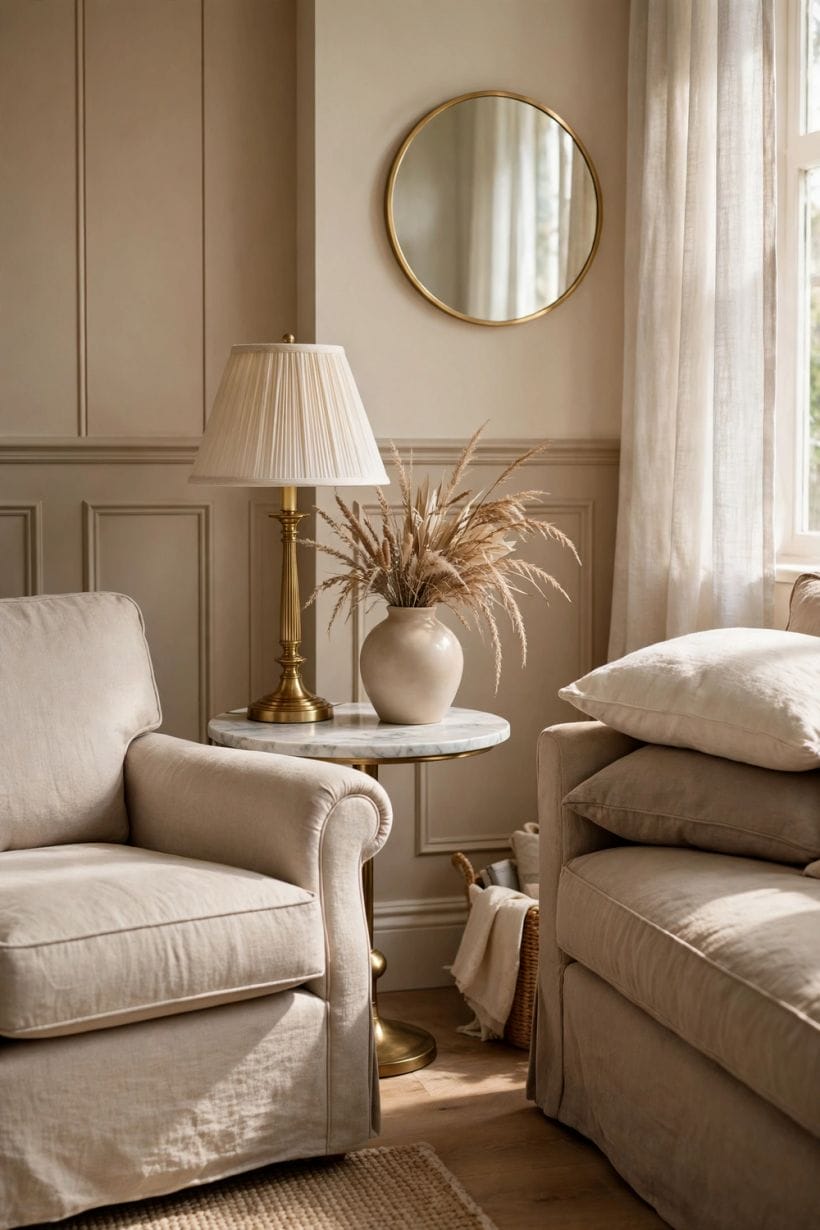
The final section dresses the room’s bones: the wall treatment, the art and the objects that finish a transitional room without tipping it into either ancestor’s excess. Restraint is the skill on show — the room is done not when nothing can be added, but when the adding is governed.
66. Wall treatments with texture over pattern
Grasscloth, limewash, a subtle plaster finish, or simply paint with a beautiful depth: the transitional wall offers the eye a surface, not a story.
67. Panelling and moulding in their simplified forms
A picture-frame moulding or simple wainscot gives a plain room traditional architecture at modern restraint — profiles kept shallow, painted with the wall or a half-tone away.
68. One large artwork over a gallery of small ones
The transitional room prefers a single generous picture — landscape, abstract in the palette’s tones, a serious print — to a wall of fragments. Scale reads as confidence; the gallery wall belongs to the eclectic lane.
69. A mirror where a picture would be expected
Over the mantel especially, a mirror in an aged, simple frame performs the traditional gesture with modern lightness: it finishes the wall, doubles the light and refuses to compete with the room’s conversation the way a loud artwork would.
70. Books as the room’s honest decoration
Real books, the household’s own, in the bookcase and in small stacks on the tables, are the transitional room’s most credible ornament — traditional in substance, unstyled by nature.
71. Plants as the living layer, in classic containers
A fig or olive in a serious pot, a fern on the plant stand, herbs of green on the mantel: plants soften the composed room the way they have softened every interior since rooms began.
72. Objects in ones and threes, with air around them
The mantel and shelves carry few things, chosen ones: a clock, a stack of art books, one ceramic with presence.
73. The television, seated in the treaty
Where the television lives on this room’s wall, it is framed by the composition like everything else: centred, flanked, its black absorbed among the room’s deep notes.
74. Finish with the five-senses audit
The completed room gets audited by senses, not photographs: the seat’s comfort, the lamp’s glow, the curtain’s weight in the hand, the room’s smell of wood and books, its quiet.
75. Keep the room’s evolution open
The treaty’s final clause: nothing here is a period set, so nothing here expires.
9. Checks and Mistakes: Before the First Purchase or the First Stone
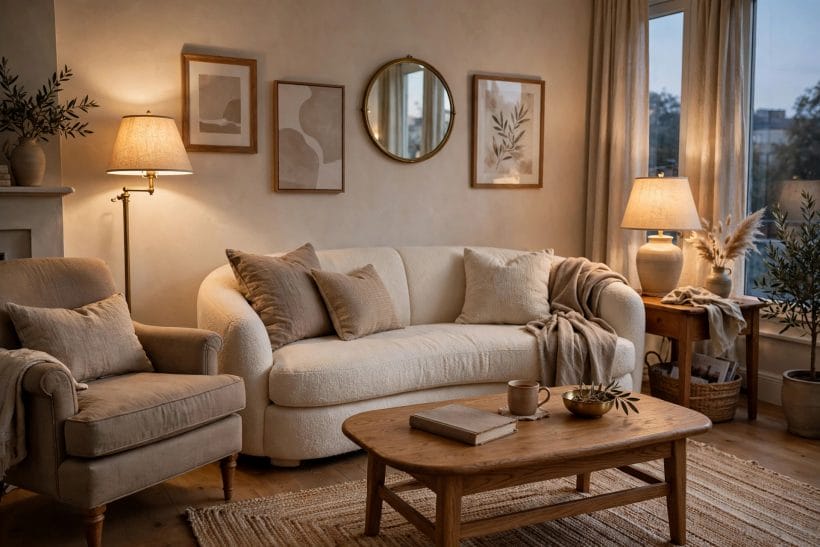
Checks before the large purchases: the floor plan walked in tape on the actual floor, the focal point chosen and the seating tried at conversation distance, the palette’s boards and fabrics viewed in the room at noon and at lamplight. Then the sofa’s frame and springs interrogated in the showroom — sit, sprawl, lie — because the room’s whole comfort is underwritten by that one machine.
One check is about the blend itself: photograph the planned scheme — fabric pile, paint boards, the furniture’s pictures — and look for the argument. A transitional room should show a conversation between eras in the photograph: a curve answering a line, a deep note anchoring the neutrals, one object with age in it. If the photograph shows only agreement, add the tension before the money is spent, not after.
The mistakes are the style’s two cliffs: drifting traditional into a period set where nothing modern may enter, or drifting modern into a beige vacancy where nothing old is welcome. Both are failures of the same nerve — the treaty exists to be kept, one deliberate balance at a time.
10. Costs and Pulling It Together
Costs in a transitional room concentrate where they should: in the sofa’s frame, the rug’s quality and the curtains’ yardage — the big, long-lived textiles and machines of comfort. The style is mercifully cheap in its jewellery: lamps, objects and art can be gathered slowly, inherited, or bought singly over years, because the room is composed to receive additions. Paint and the palette cost little; the discipline of the palette costs nothing but attention.
Pulling it together: lay the symmetrical plan around one focal point; seat it in traditional shapes wearing plain, textured fabrics; build the warm neutral palette with its one deep note; layer the light from updated classics; and finish with restraint — one antique, one gesture, air around everything. The room then takes its place in the wider living room ideas survey as the survey’s most liveable answer: the style that lets a household keep its grandmother’s chair and its clean lines at the same time.
Final Considerations
Transitional is sometimes dismissed as the style of not deciding, and the dismissal is exactly backwards. It is the style of deciding twice — honouring what the traditional room knew about comfort and ceremony, and what the modern room learned about light and air — and holding both decisions in one composed hand.
Begin with the layout and the sofa. A room whose plan is balanced and whose seat is loved has already signed the treaty; everything after is ratification.

0 Comments