

Every living room with a television makes one decision twice: where the screen goes, and whether the room admits it. The rooms that work decide placement honestly, then style around the truth.
This survey collects seventy-five ideas for the living room with TV in the TV-placement angle only — position, furniture, seating, light and the invisible wiring — inside the wider living room ideas pillar. Style-led living rooms keep their own surveys elsewhere in the plan.
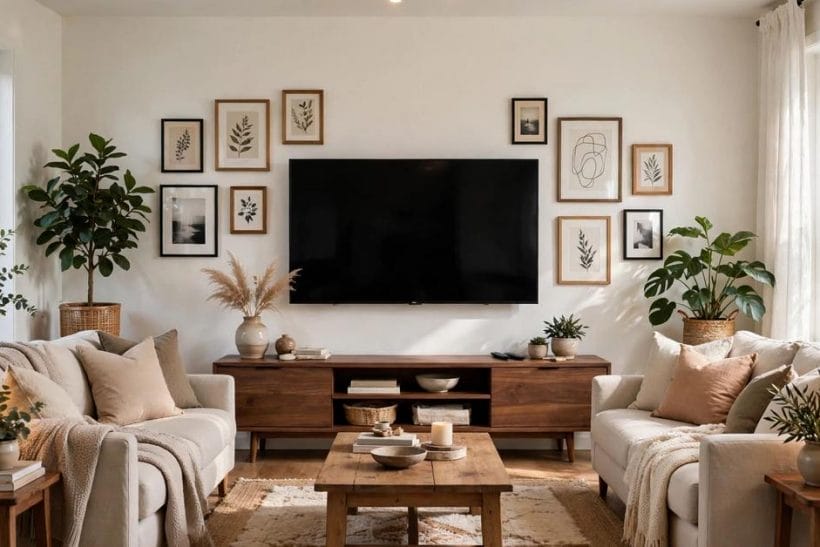
1. Living Room with TV at a Glance
A living room with a TV is a shared sitting room organised — wholly or partly — around a television screen: its placement relative to seating, windows, fireplaces and doors; the furniture that carries or conceals it; the lighting that must serve both viewing and ordinary evenings; and the cabling and sound that make it work without visual mess. Its governing attributes are sightlines (the screen centred on the seats that watch most, at a comfortable height and distance for those seats), competition (the screen is one focal point among several claimants — fireplace, window, art — and the room must rank them), and reversibility (the best TV rooms still read as living rooms when the screen is black). This post owns the placement-and-living angle; the neighbouring fireplace treatments are linked, not absorbed, where they belong below.
| Question | Short answer |
|---|---|
| Where should the TV go first? | Opposite the main sofa, centred on it, at a height comfortable for seated viewers — and chosen before any other furniture is placed. The main seats decide the screen wall; everything else in the room negotiates with that decision, not the other way round. |
| Should a TV go above a fireplace? | It is the most contested placement in the room and it has its own dedicated treatment in this plan, linked below. In general: it can work where the fireplace is low, the seating is laid back, and the heat and height questions are answered honestly — but it is never the default merely because the wall is empty. |
| How do I stop the TV dominating the room? | Rank it. Give the screen a wall and furniture that absorb it — a deep colour, a long low console, bookshelves with breathing room — keep one rival focal point clearly stronger for daytime, and pass the off test: the room should look composed with the screen black. |
| What ruins a TV room most often? | Glare and cables. A screen facing a bright window is unwatchable by day, and a nest of visible wiring undoes every other decision. Both are placement problems solved on paper — sightlines and cable routes drawn before anything is mounted. |
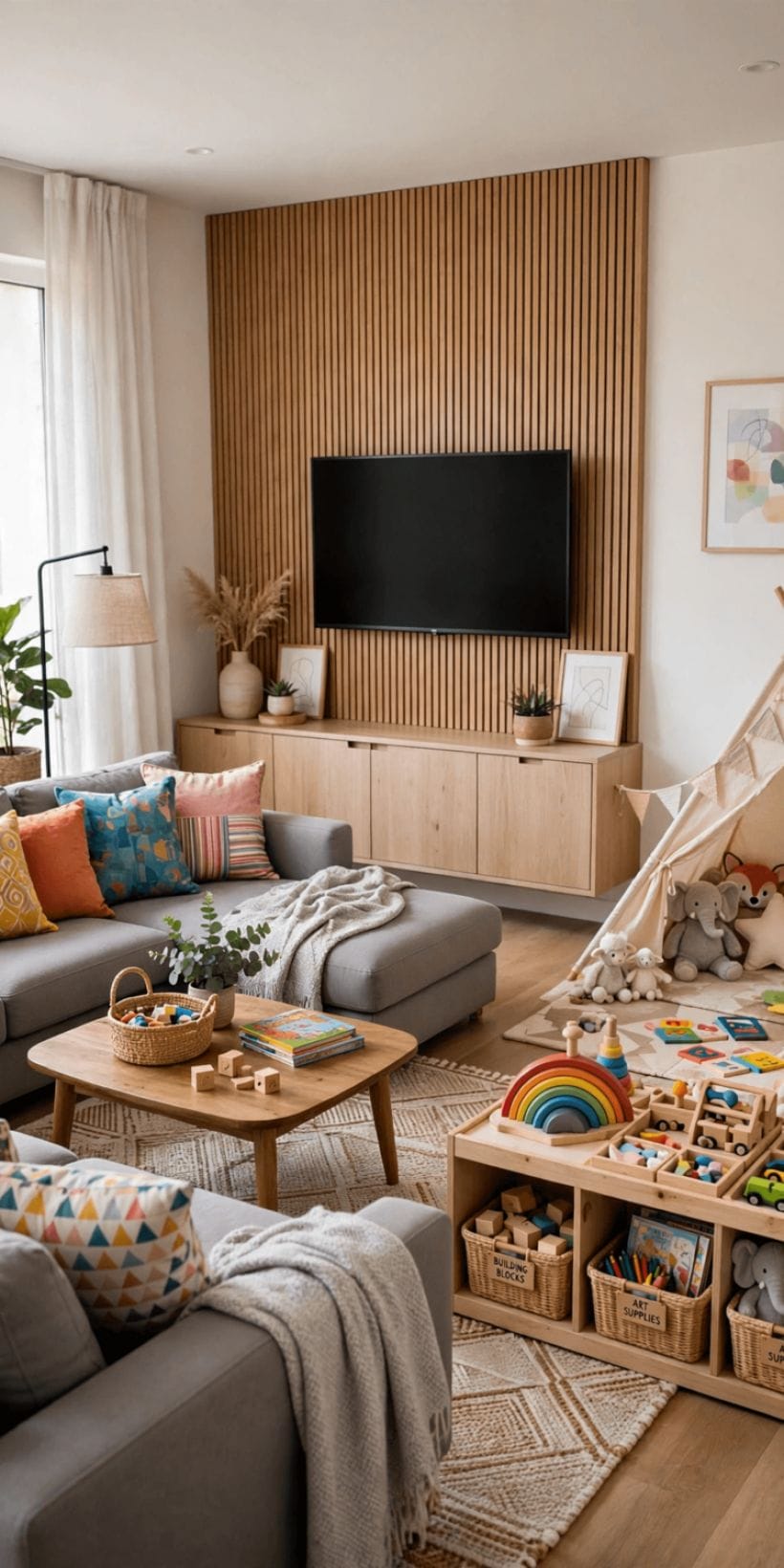
2. Where the TV Goes: Placement Before Everything
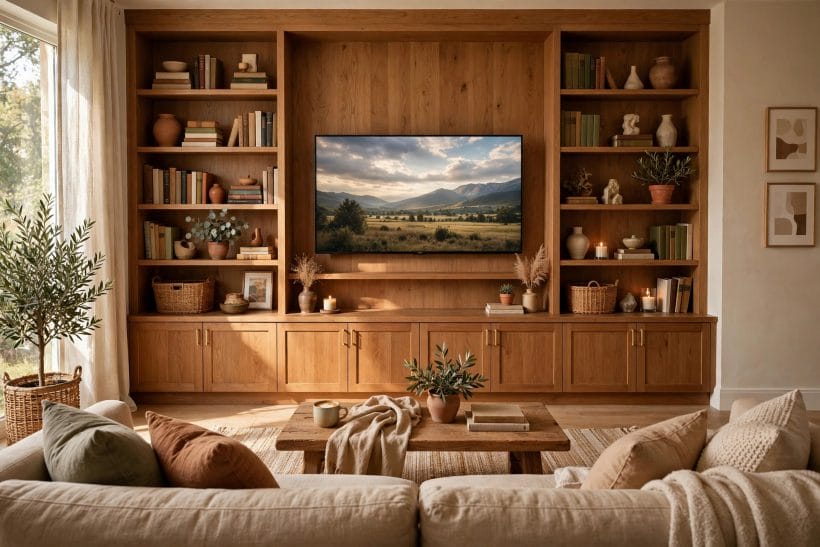
Placement is the decision every other idea in this survey decorates. The pillar survey of living room ideas covers the room whole; here the screen’s address is settled first, with tape, cardboard and honesty.
1. Centre the screen on the seating
The screen belongs centred on the seats that watch it, not centred on the wall, the rug or the room’s architecture. A screen aligned to the wall but off-axis to the sofa taxes every viewing with a turned head.
2. Let the main sofa choose the TV wall
Place the room’s principal sofa where it sits best — light, proportion, relation to the door — and the wall it faces becomes the screen wall in most rooms.
3. Keep seated eye level as the reference
As a general rule, the screen’s centre should sit near the eye level of a person seated on the main sofa — lower than most people first mount it.
4. Use the corner in an awkward room
A corner placement — screen angled across a corner, seating swung to meet it — rescues rooms whose walls are all doors, windows or fireplace.
5. Put the screen on a long room’s short wall
In a rectangular room, the screen on a short wall with the sofa facing it down the length keeps viewing distance comfortable and leaves the long walls for shelves, windows and a secondary seating group.
6. Divide a big room into viewing and talking zones
A large living room can hold two honest arrangements: a viewing group around the screen and a conversation group that ignores it.
7. Swivel seating for an open-plan room
Where the living area shares space with dining or kitchen, a screen on an articulated mount or a pair of swivel chairs lets viewing borrow the room and return it.
8. Never face the screen into the main window
A screen on the wall opposite a large bright window mirrors that window all day. The perpendicular wall is almost always better: viewers get the picture, the window keeps the room, and neither fights the other.
9. Give a small room the wall that frees the floor
In a small living room, mount the screen on the wall that lets the sofa sit back against the opposite one and keeps the floor’s centre clear.
10. Mock it up at full size before drilling
Tape the screen’s outline on the candidate wall, or hold a cardboard cut-out there, and live with it through a day’s light and an evening’s viewing from the real seats.
11. Keep walkways out of the sightline
A route to the kitchen or hall that crosses between sofa and screen will cross every film at its best moment. Place the screen so the room’s natural paths run behind the seating.
3. Mounted, Standing or Hidden: The Screen’s Furniture
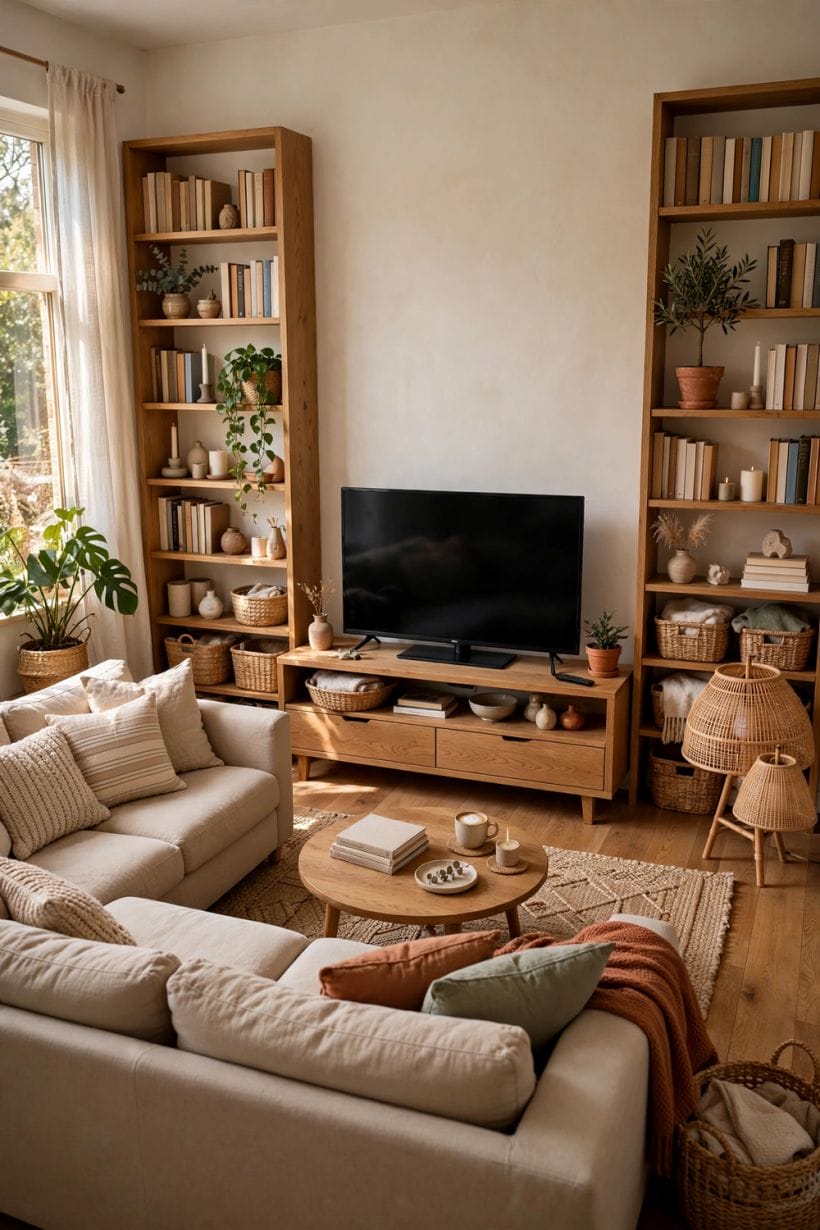
The screen needs a carrier, and the carrier sets the room’s tone: technical and floating, furniture-like and grounded, or invisible until wanted. Choose by how the room lives when the television is off.
12. Wall-mounted, flush and calm
A screen mounted close to the wall, centred on a long low console below, is the calm contemporary default.
13. An articulated arm for angled rooms
Where the best seating cannot face the best wall squarely — corners, L-shaped rooms, open plans — an extending, tilting mount lets the screen come to the viewers.
14. A long, low media console
The traditional stand still earns its place: a console longer than the screen, low enough to keep the screen’s centre near seated eye level, with ventilated room for boxes and a drawer for remotes.
15. The screen on an easel stand
A tripod or easel stand treats the television as a picture on display — movable, rental-friendly, and oddly elegant in rooms with good art.
16. A media wall of shelves around the screen
Building the screen into a wall of bookshelves absorbs its rectangle into a larger, richer composition.
17. Hidden behind doors or a panel
Cabinet doors, a sliding panel or a framed artwork that conceals the screen serves rooms — and households — where television is occasional.
18. Art and photo display when idle
Many screens can show artwork or photographs when not in use, turning the black rectangle into the room’s changing picture.
19. The projector alternative, honestly weighed
A projector and a pull-down or painted screen give the largest picture and the least daytime presence, at the cost of light control and setup fuss.
20. A rolling stand for a flexible life
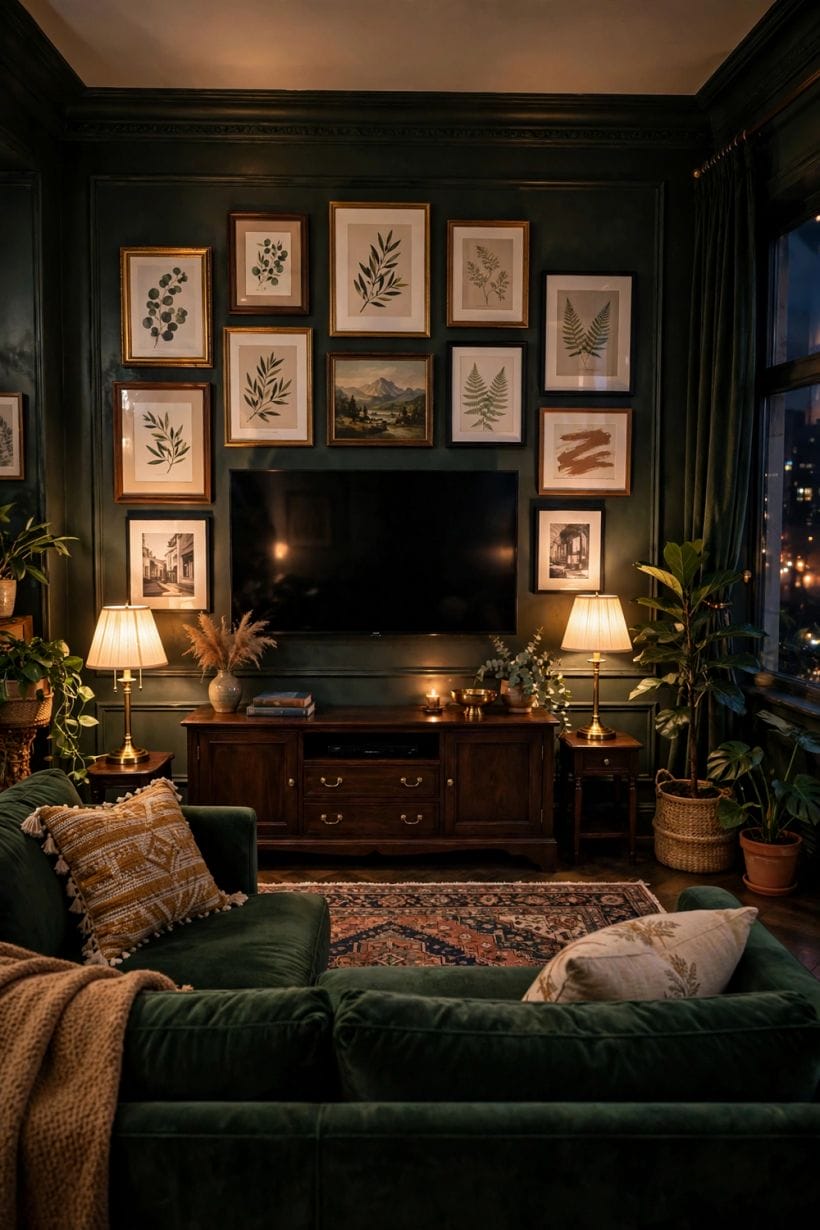
Screens on wheeled stands move between rooms, follow the sun’s opposite, and serve renters who cannot drill.
21. A divider unit in an open plan
A double-sided low unit or open shelving piece can carry the screen and divide living from dining in one move.
22. Corner furniture for the corner screen
Where the screen takes the corner, an angled corner unit or a shaped console keeps the composition tidy and gives boxes a home.
4. Seating Around a Screen: Sofas, Chairs and the Viewing Zone
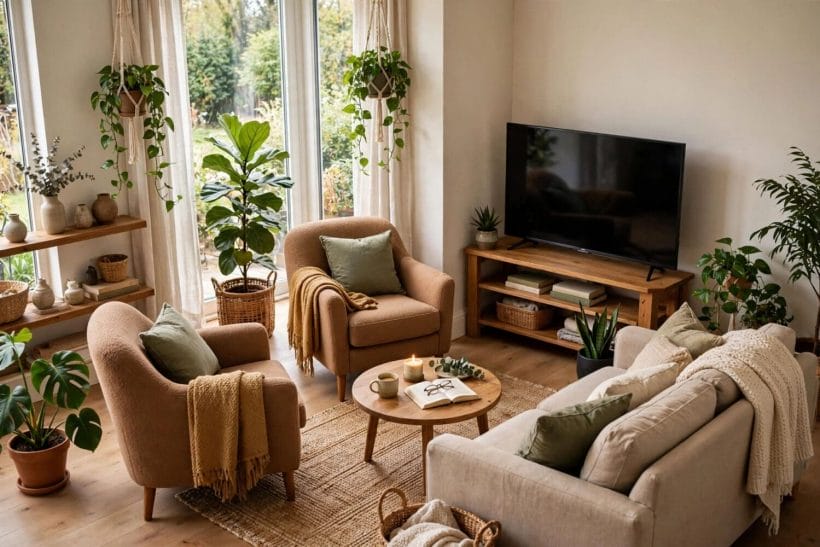
The screen is watched from furniture, and the furniture is lived in all day. These arrangements serve the viewing hours without exiling the others — the same seating-first logic that organises the family room ideas survey, applied here to the room whose family gathers around a screen.
23. One sofa, square-on and centred
The simplest honest arrangement: a single sofa facing the screen squarely, centred on it, at the distance the household finds comfortable. Everything else — chairs, tables, lamps — attends this axis. Most rooms need nothing cleverer; they need this, done exactly.
24. An L-shaped sectional aimed at the corner
A sectional’s chaise end gives sprawling viewers their place while the main run faces the screen. Aim the sectional’s corner at the room’s natural focus and the arrangement suits both corner screens and fireplace-adjacent walls.
25. Two armchairs angled in
A pair of armchairs angled slightly toward the screen — and toward each other — keeps conversation and viewing in one arrangement.
26. A daybed or chaise for the committed sprawler
One genuinely horizontal seat transforms viewing comfort for whoever claims it.
27. Recliners, with their clearance respected
Reclining seats need room behind and in front to work, and they fix the viewing distance once placed. In a dedicated viewing arrangement they are unmatched for comfort; in a small multi-use room they usually cost more flexibility than they return.
28. An ottoman instead of a coffee table
A large upholstered ottoman serves feet during viewing, a tray for drinks, and extra seating for guests — the hardest-working swap in the TV room.
29. Light chairs that move for guests
Keep two genuinely light chairs in the room’s secondary arrangement that can swing round to the screen when guests join. Viewing for six need not mean seating for six fossilised in rows all week.
30. Floor cushions for overflow and children
A basket of floor cushions handles the crowd, the children and the film-night sprawl without a single extra piece of furniture. Children prefer the floor anyway; the cushions merely dignify the preference and keep the main seats for the grown-ups’ backs.
31. A window seat as side seating, honestly labelled
Perpendicular seating — a window seat, a side bench — gives a poor view at an angle and a lovely place to sit with a book while others watch.
32. A rug to draw the viewing zone
A rug under the seating group, sized to hold at least the front legs of every seat, draws the viewing zone on the floor and warms the room’s acoustics in the same move.
33. Side tables within arm’s reach
Every principal seat wants a surface beside it: remotes, a drink, a book, glasses. A viewing arrangement without side tables migrates its clutter onto arms and cushions.
5. Collisions: Fireplaces, Windows and Rival Focal Points
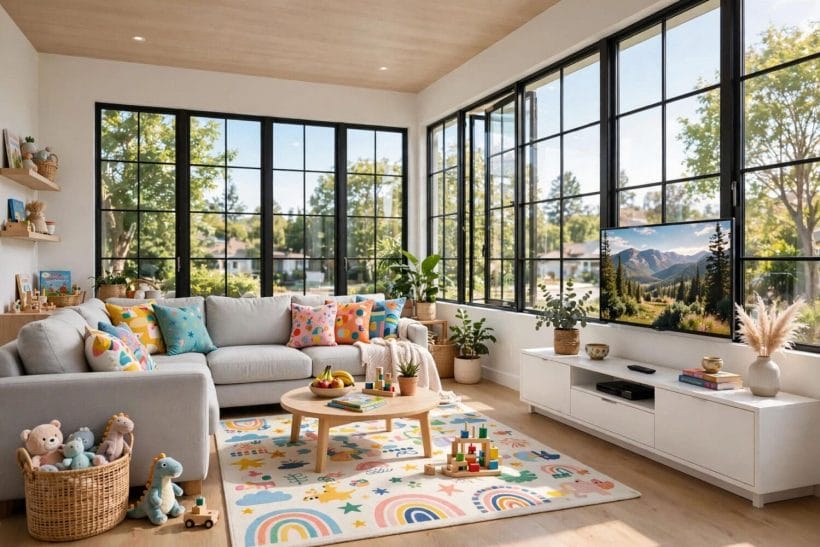
The screen rarely gets a room to itself. It competes with the fireplace, the view and the art — and the dedicated fireplace treatments in this plan, the screen above a standard family-room fireplace at living room with a standard fireplace ideas among them, take those contests one by one. This section ranks the rivals in general.
34. The above-fireplace placement, in its own lane
Mounting the screen above the fireplace is common enough to have its own dedicated survey — TV above fireplace ideas — covering heat, height and mantel depth in detail. Here the general caution only: the combination asks the neck and the hearth questions that the dedicated treatment answers, and it should be chosen, not defaulted into.
35. Screen beside the fireplace instead
Placing the screen on the wall adjacent to the fireplace, with seating angled to serve both, is the traditional peace treaty: two focal points, one conversational arrangement, neither stacked on the other.
36. Fireplace first, screen second and smaller
In a room whose fireplace is genuinely beautiful, rank it first: seating to the fire, and the screen a modest size on a side wall or concealed.
37. The big window outranks the screen by day
A fine view is a focal point that changes hourly. Where the view is the room’s glory, let the daytime arrangement honour it and place the screen for the evening, on a perpendicular wall with blinds for summer nights.
38. Art wall or screen wall: pick one winner per wall
A gallery wall and a television can share a room but not a composition — the screen’s scale and blackness win every contest they enter.
39. Keep the screen off the radiator wall
Screens and their boxes dislike sustained heat, and radiators occupy the low wall space consoles want.
40. Open-plan sightlines from the kitchen
In open plans — the world of the dining room ideas survey, one open space serving several lives — the screen is often watched, or at least glanced at, from the kitchen. A position that serves the sofa and offers the cook a civilised angle is a genuine household peace-maker; one that faces the kitchen with its back of cables is a daily small ugliness. Plan the screen’s back as carefully as its face.
41. Mind the door’s swing and the screen’s safety
A screen on a stand or easel within a door’s swing, or a mounted screen at head height beside a passage, is an accident rehearsing.
42. Separate the play zone from the viewing zone
In family rooms, giving children’s play its own end of the room — behind the sofa, say — keeps toys out of the sightline and viewers out of the game.
43. Back-to-back arrangements in a long room
A long room can hold a viewing arrangement at one end and a fire or reading arrangement at the other, back to back across a shared rug or console.
44. The formal no-TV zone within the same room
Where a household wants a screen-free sitting area as well, define it by its own rug, chairs and light, turned away from the screen without apology. Two clear zones read as generosity; one vague zone reads as indecision.
6. Light and Glare: Serving Two Kinds of Evening
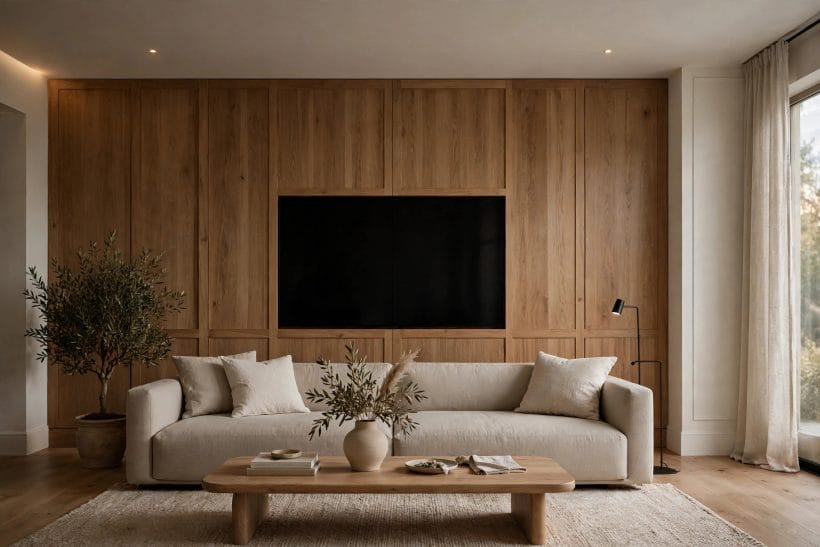
A television emits light and suffers from it. This section arranges the room’s light so the picture survives the day and the room survives the evening.
45. Glare is a placement failure first
Reflections are cured at the planning stage, not with accessories: a screen that does not face a window or a bright doorway needs no anti-glare heroics.
46. Blinds and curtains as viewing equipment
Treat window coverings as part of the viewing setup: a lined curtain or a blind that genuinely darkens the screen’s reflections earns its place on the budget beside the sound.
47. A soft light behind the screen
A gentle light source behind the screen — a bias light or a lamp washing the wall — eases the contrast between a bright picture and a dark room, and most viewers find long evening viewing easier for it.
48. Lamps low and behind the seating
Table and floor lamps placed behind or beside the seating light faces, books and drinks without spilling reflections onto the screen. The viewing room’s lamp rule is simple: light the people, not the picture.
49. Keep downlights off the screen’s mirror angle
Ceiling spots aimed at the screen wall will find the screen and star in it. Keep direct downlight out of the reflection zone, dim what remains, and prefer wall-washing or lamp light for viewing hours.
50. One warm temperature for the evening
Mixed light temperatures — cold light from a hall, warm from a lamp, blue-grey from the screen — make a room feel unsettled.
51. Matte finishes around the screen
Glossy walls, shiny frames and a glass-topped console all throw reflections and visual noise into the picture’s edges. Matte and satin finishes around the screen keep its surround quiet.
52. Soften the screen’s hard edge with planting
A tall plant beside the console or screen — clear of the picture, clear of vents — breaks the rectangle’s geometry and returns some nature to the wall.
53. A deep wall colour behind the screen
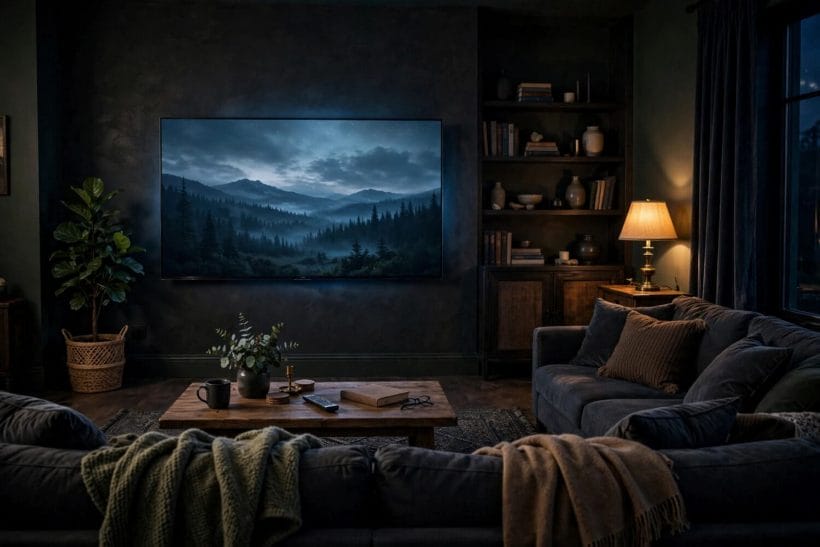
A dark wall behind the screen reduces the contrast between screen and surround, calms the black rectangle by day, and deepens the cinema feel by night.
54. Test the light at the actual viewing hour
Rooms change character between noon and nine. Sit in the viewing seats at the household’s real viewing time, screen on and off, lamps in their evening state, and adjust from evidence.
55. Control the spill from adjacent rooms
A bright kitchen or hall bleeding light across the screen wall undoes the evening’s careful dimming. A door that closes, a dimmer on the hall, or a screen of shelving at the boundary restores the viewing zone’s darkness.
7. Colour and Styling With a Big Black Rectangle
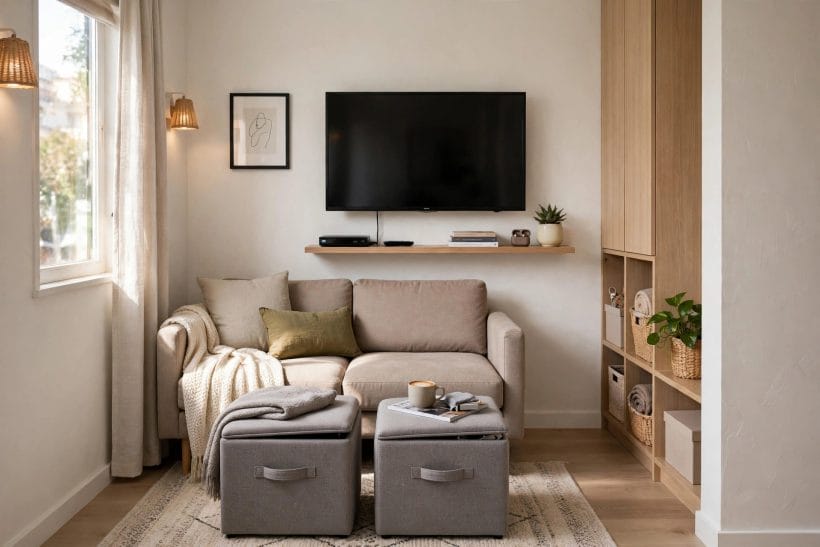
The screen off is a black rectangle of considerable size. These ideas style the room so that rectangle reads as a composed element — using, among others, the calm lessons of the white living room ideas survey, whose rooms must absorb screens without surrendering their lightness.
56. Paint the screen wall deep to absorb it
On a deep-toned wall — ink, forest, charcoal, aubergine — the black screen nearly disappears by day and the picture glows by night. The move suits media walls and consoles alike.
57. Build a gallery that includes the screen
The counter-move: hang art around the screen so its rectangle becomes the largest frame in a gallery. Keep frames’ tones near the screen’s black, hang with real breathing room, and accept that the screen is the senior partner.
58. Style the shelves with breathing room
Bookshelves flanking a screen should be edited, not stuffed: books in runs with gaps, a few objects, some horizontal stacks. A calm surround makes the screen read calmer; a frantic surround makes the whole wall shout.
59. Two objects on the console, not twelve
The console under the screen wants restraint: a plant, a stack of books, perhaps a bowl — and empty surface, which is a styling material in its own right.
60. Repeat the screen’s black in small accents
A black frame across the room, black lamp bases, a dark cushion or two: small repetitions domesticate the screen’s black into the room’s palette.
61. Warm the technology with timber
Timber — the console, side tables, a floor with warmth in it — is technology’s oldest softener. A room of screen, glass and metal can feel like a showroom; one generous timber element returns it to domestic life.
62. Symmetry for a formal room
Formal rooms absorb screens best symmetrically: screen centred, matching lamps or shelves either side, the composition balanced like a chimneypiece. Symmetry tells the eye the arrangement is architecture, and the screen inherits the authority of the fireplace it replaced.
63. Asymmetry for a relaxed one
Relaxed rooms do better offset: screen to one side of the console’s composition, art or a tall plant balancing the other.
64. Textiles to soften the viewing zone
Cushions, a throw over the sofa’s arm, curtains with body: textiles absorb sound, soften the screen’s hard context, and signal that this is a room for bodies, not a showroom for a panel.
65. Give the remotes a designed home
A lidded box, a small tray, a basket on the console: remotes, glasses and chargers corralled in one handsome place.
8. Sound, Cables and the Invisible Layer
The last section is the one visitors never see and always perceive: sound that fills without shouting, cables that exist without appearing, and the room’s life when the screen is off.
66. A soundbar centred under the screen
A single soundbar, centred beneath the screen and clear of the console’s edge, lifts dialogue and film sound far beyond a panel’s own speakers with one cable’s worth of fuss.
67. Flanking speakers for the committed
Where sound matters most, two speakers flanking the screen at roughly the seated listeners’ ear height give true stereo and a sense of scale.
68. Let the rug and upholstery do acoustic work
Bare floors, bare walls and a big screen make a bright, echoing room where dialogue blurs. The rug of the seating section, upholstered furniture and curtains are the TV room’s acoustic treatment wearing domestic clothes. Add softness before adding electronics.
69. Route cables once, properly
Decide every cable’s route on the plan: power, signal, network. In-wall routes belong to qualified installers under local electrical rules; surface channels painted to the wall are the honest alternative.
70. Ventilate the boxes
Streaming boxes, consoles and amplifiers make heat and dislike cupboards without air. Give them open fronts, slatted doors or genuine ventilation, and never stack heat-makers directly on each other.
71. One charging drawer for the household’s devices
A drawer in the console fitted for charging — remotes, controllers, tablets, phones — keeps the viewing zone’s small electronics in one known place.
72. Keep the router reachable, not displayed
Network boxes need air and the occasional restart, so hide them accessibly: a ventilated cupboard section, a shelf behind a door.
73. Label every cable at both ends
Ten minutes with a label maker when the system is installed saves every future rearrangement, fault-find and upgrade.
74. Light the room for its screen-free life
Most living rooms spend most evenings unviewing. Keep a lamp arrangement — a reading light by the best chair, a warm pool over the conversation seats — that makes the room lovely with the screen black and nobody watching.
75. Pass the off test before calling it done
Stand at the door with the screen off and judge the room as a room: composition, calm, a place you’d sit with a book.
9. Checks and Mistakes: Before the First Purchase or the First Stone
Checks before the first fixing: the sightlines from every principal seat, drawn or taped; the light at the real viewing hour, observed with the screen’s outline in place; the cable routes, decided and lawful; and the heat sources, given their distance. Any change involving mains electricity, wall chasing or structural fixings belongs with qualified trades under local rules — mounts in particular must be fixed to what can hold them, verified rather than assumed.
The commonest mistakes are haste’s: mounting before mocking up, centring on the wall instead of the sofa, buying the largest screen the wall admits rather than the right one for the seats, and styling the room around the screen’s picture instead of its black rectangle. Every one of them is prevented by the same habit — test at full size, from the real seats, at the real hour, before anything is drilled.
Finally, measure the room’s life honestly. A household that watches two films a month should not surrender its best wall, its fire and its conversation to a screen it rarely lights; a household that gathers nightly should not apologise for centring its room on the gathering. The placement follows the life. Get that order right and the seventy-five ideas above are merely decoration on a sound decision.
10. Costs and Pulling It Together
Costs in a TV living room spread across four kinds, and this survey invents no figures: the screen and its sound; the furniture that carries them, from an easel stand to a built media wall; the electrical and cable work, which is professional spend wherever walls are opened; and the styling layer of paint, textiles and lamps. Of these, the furniture and the wiring outlast several generations of screen — spend there first, and let the replaceable technology be the line that flexes when budgets tighten.
Pull the survey together and the recipe is one sentence long: place the screen for the seats, house it in furniture with warmth, rank it honestly against fire and window, light the room for people, and hide the machinery. Do that, and the living room with a TV stops being a compromise and becomes what it should be — a living room, in which a television also, excellently, lives. The style-led rooms it neighbours keep their own chapters in the home design ideas collection.
Final Considerations
A television is the most-watched picture most homes own and the least-considered piece of furniture in most rooms. The seventy-five ideas above simply give it the consideration every other major object receives: a decided place, honest furniture, and a room that still belongs to its people.
Begin with the tape measure and the cardboard outline, from the sofa, at viewing time tonight. The right wall announces itself quickly when the test is real — and everything after that is arrangement.



0 Comments