
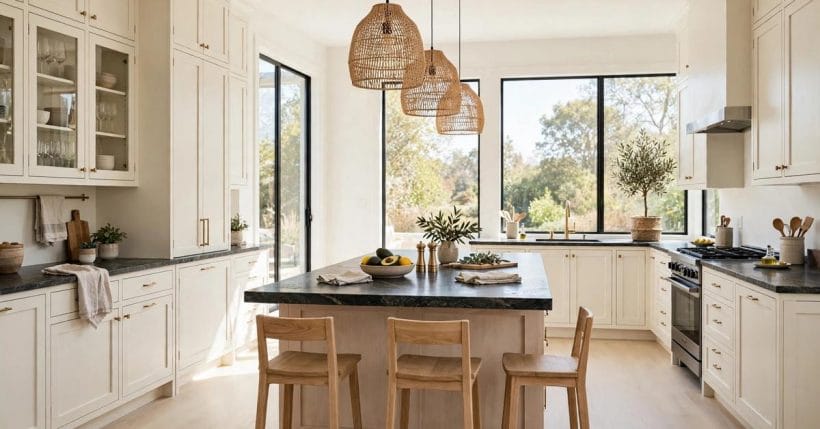
A kitchen with light cabinets and a dark countertop is one of the most forgiving combinations a home can have. The pale cabinets keep the room bright and open, while the dark surface gives the eye a clear place to rest and gives the work areas a sense of purpose. Neither half has to shout. The cabinets do the quiet work of reflecting light, and the countertop does the bolder work of grounding the room, and together they make a kitchen that feels calm in the morning and welcoming in the evening. This guide looks at dark granite countertops with light cabinets as one pairing only: ten ways to shape it, from cream cabinets in a sunny kitchen to pale grey cabinets in a softer, moodier room, with the floors kept pale throughout so the contrast stays where it belongs, between cabinet and countertop.
The pairing works because it is a balance, not a contest. A dark countertop on its own can make a kitchen feel heavy, especially in a small room or one with little daylight. Light cabinets on their own can make a kitchen feel washed out, with nothing to hold the eye. Put the two together and each one fixes the other’s weakness. The cabinets lift the room, the countertop anchors it, and the space between them, the backsplash and the wall above, can stay simple because the main relationship is already settled. The ten ideas below all follow that balance in different rooms, so you can find the version that suits the light and the size of the kitchen you have.
1. Why the Pairing Works
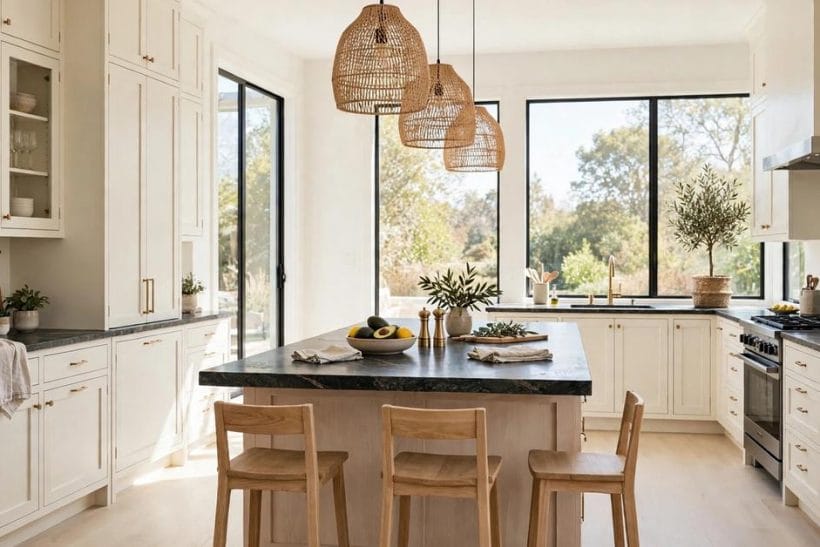
Contrast is the reason this pairing has lasted. A dark countertop against light cabinets reads clearly from across the room: you can see where the work surface begins and ends, where the sink sits, and where the island stands. That clarity is practical as well as visual. In a busy kitchen, a surface that is easy to read is a surface that is easy to use, since plates, boards and bowls all stand out against the dark stone instead of blending into a pale top. The contrast also gives a kitchen a sense of order, because the horizontal dark line of the countertop runs through the room like a thread, tying the separate runs of cabinets together.
Light cabinets do the other half of the job. They reflect daylight and lamplight back into the room, which matters most in kitchens that face away from the sun or have only one window. A pale cabinet door catches whatever light there is and spreads it, so the room feels larger than its floor area and the dark countertop never feels oppressive. This is why the pairing suits small kitchens as well as large ones: the dark surface is limited to a single horizontal band, while the pale cabinets fill the walls above and below it. The dark never dominates, because it never covers more than the worktop itself.
The pairing is also forgiving over time. Cabinet colours come and go, but cream, white and pale grey have stayed in kitchens for decades, and dark stone has done the same. A kitchen built on this pairing does not depend on a single fashionable shade, so a change of wall colour, a new rug, or a different set of bar stools will usually sit happily beside it. That longevity is worth weighing when the work itself, templating, cutting and fitting, is best left to experienced professionals: a combination you will still like in ten years is a combination worth the care it takes to install well.
2. Cream Cabinets With Dark Granite
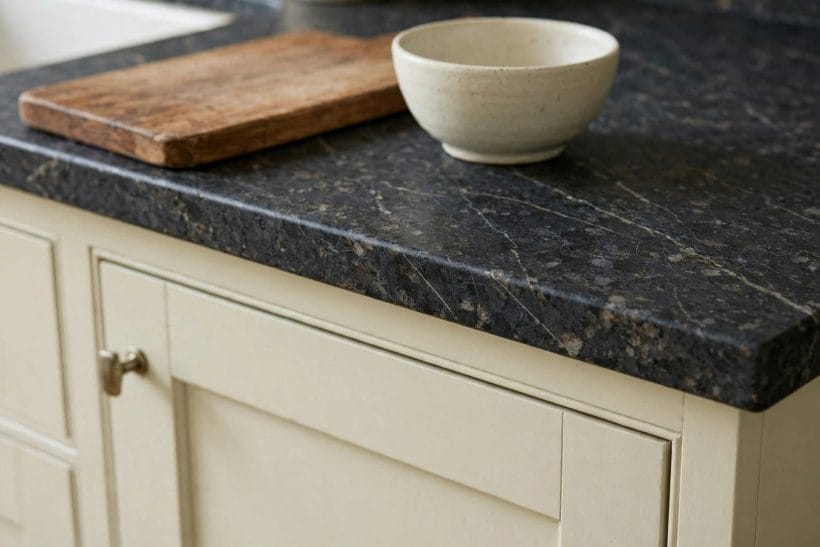
Cream is the warmest of the light cabinet shades, and it softens dark granite more than pure white does. Where white cabinets can make a dark countertop look stark, cream cabinets make the same stone look settled, as if the two have always belonged together. The warmth in the cream picks up the warmth in wooden floors, wooden boards and brass or wooden handles, so the kitchen feels like a room for cooking and gathering rather than a showroom. In a kitchen with warm daylight, cream cabinets and dark granite are often the most comfortable version of the pairing.
Cream also suits kitchens where the rest of the house is warm in tone. If the adjoining rooms have wooden floors, natural rugs and soft furnishings, a cream kitchen connects to them without a jarring change of temperature. The dark countertop then acts as the one cool, solid note in the room, which stops the warmth from becoming sleepy. Keep the backsplash pale and simple here, a plain tile or a pale plaster-look wall, so the cream and the dark stone remain the two voices in the room and nothing else competes with them.
One caution with cream is that not all creams are the same. Some lean yellow, some lean grey, and the difference shows up strongly next to a dark countertop. Look at cabinet samples beside a piece of the stone in your own kitchen light, morning and evening, before deciding, since a cream that looks perfect in a showroom can look quite different at home. The right cream is the one that still pleases you under your own lamps, with the dark stone beside it, and that test is worth more than any description of the shade.
3. White Cabinets and a Dark Island
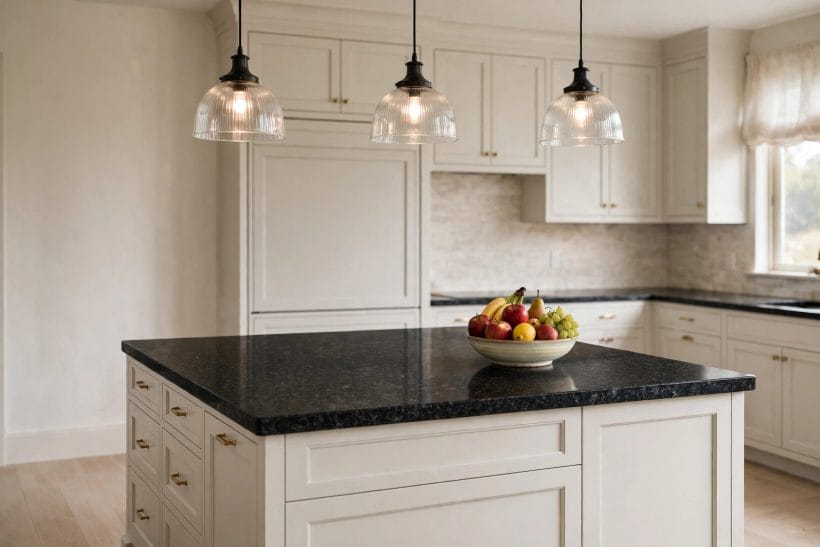
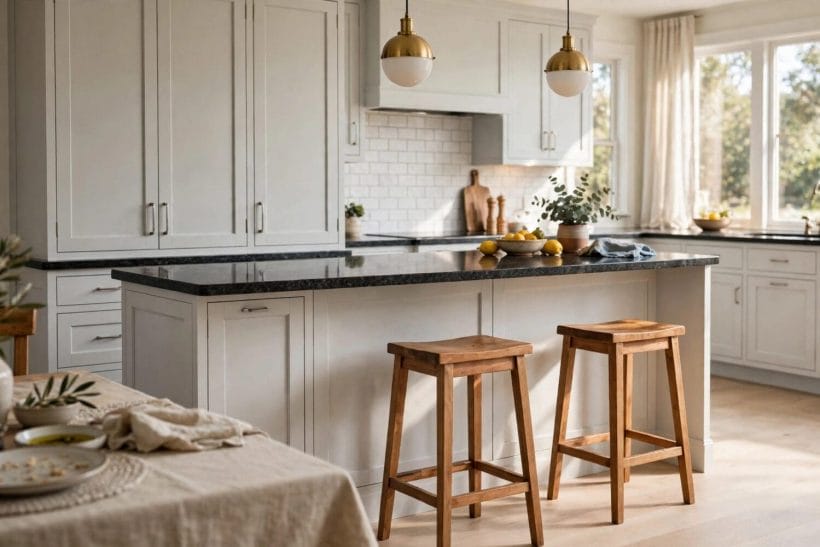
White cabinets give the pairing its crispest form. With white on the walls and a dark island top in the middle of the room, the kitchen reads as bright, clean and deliberate, and the island becomes the natural centre of the room. This version suits kitchens that are used for gathering, since the island is where people stand, talk and eat, and the dark top marks it clearly as the place to gather. White cabinets around the edges keep the room light, while the dark island gives it weight exactly where the weight is wanted.
The island also lets you vary the pairing without breaking it. The perimeter cabinets can stay white, while the island base can be the same white or a slightly deeper pale shade, and the dark top ties both together. Pendant lamps above the island help here: they light the dark surface so it never looks like a hole in the middle of the room, and they mark the island as a separate zone within the kitchen. Two or three pendants, hung at a height that lights the worktop without shining in anyone’s eyes, are usually enough.
White cabinets do show marks more readily than darker ones, so this version asks for a little more wiping down, especially around handles and the sink. That is a small price for the brightness white brings, and it is easily managed if the habit is built in from the start. A soft cloth kept near the sink, used at the end of cooking, keeps white doors looking fresh without any special routine, and the dark countertop, which hides crumbs far better than a pale one, quietly returns the favour.
4. Pale Grey Cabinets for a Softer Contrast
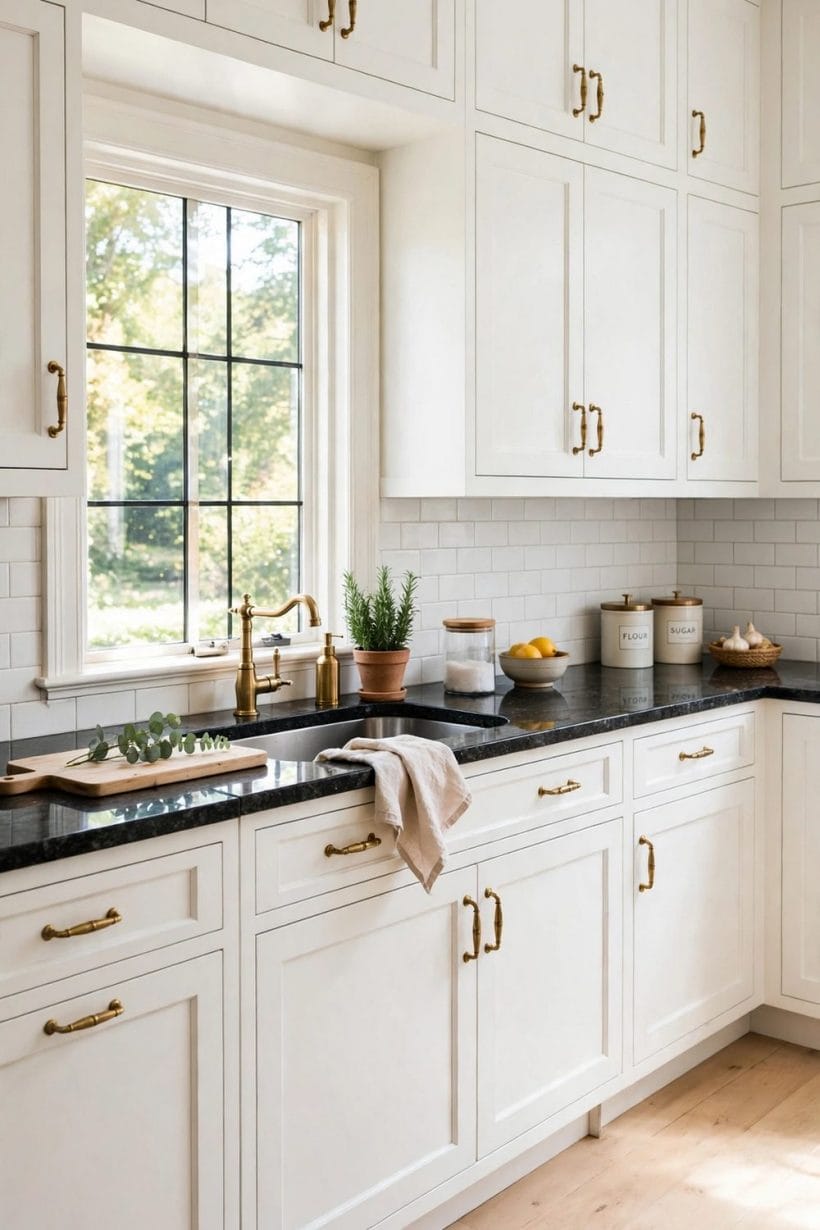
Pale grey cabinets soften the pairing in a different direction from cream. Where cream warms the dark stone, pale grey cools it, and the result is a kitchen that feels calm, modern and a little more grown-up. This version suits kitchens with cool daylight, grey-blue walls in adjoining rooms, or stainless fittings that already bring a cool note into the space. The contrast between pale grey and dark granite is gentler than the contrast with white, so the room feels less graphic and more restful.
Pale grey also pairs well with natural materials. A wooden floor, a wooden board, or a woven blind will warm a pale grey kitchen just enough to stop it feeling cold, while the dark countertop keeps the whole room grounded. The key is to let one warm material do that work, rather than adding warm touches everywhere. A single wooden element, the floor or the stools or a shelf, is enough to give a pale grey kitchen its warmth, and the grey cabinets and dark stone can then stay cool and composed around it.
As with cream, the exact shade of grey matters. A grey that leans blue will feel cooler next to dark stone than a grey that leans warm, and the difference is easy to miss in a small sample. Hold the sample against the stone in your own kitchen, in daylight and in lamplight, and look at the two together rather than at either one alone. The pairing is judged as a pair, and a grey that looks quiet on its own can look either perfect or chilly once the dark countertop sits beside it.
5. The Sink Run: Keeping the Dark Line Unbroken
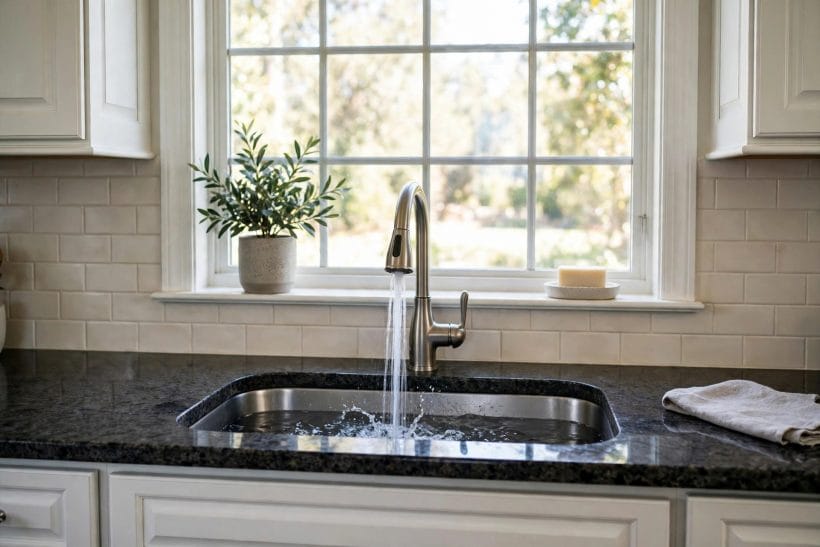
The sink run is where the pairing is tested most honestly, because it is where the kitchen is used hardest. A dark countertop running unbroken past the sink, with light cabinets below and a window above, is one of the most satisfying sights in a kitchen. The dark line draws the eye along the wall, the window light falls on it through the day, and the pale cabinets underneath keep the whole run feeling light despite the dark top. A simple pale backsplash, a plain tile or a light stone upstand, lets the window and the countertop do the talking.
Practical details matter at the sink. A dark top shows water marks and soap splashes more readily than a pale one, so a habit of wiping the area around the tap at the end of washing up keeps it looking its best. That habit is a small one, and it is repaid by the way the dark surface makes everything on it, a plant on the sill, a soap dish, a drying board, stand out clearly. Light cabinets below the sink also help, since they make the space under the window feel open rather than shadowed, even when the worktop above them is dark.
If the sink sits under a window, the light from that window is the sink run’s best decoration. Keep the window dressing simple, a plain blind or a sheer curtain, so daylight reaches the dark countertop without obstruction. The countertop will catch that light and show its veining and depth, which is the reward for choosing real stone rather than a flat, uniform surface. In the evening, a single warm lamp or an under-cabinet light does the same work, and the sink run stays inviting after dark.
6. Small Kitchens: Light Cabinets, One Dark Surface
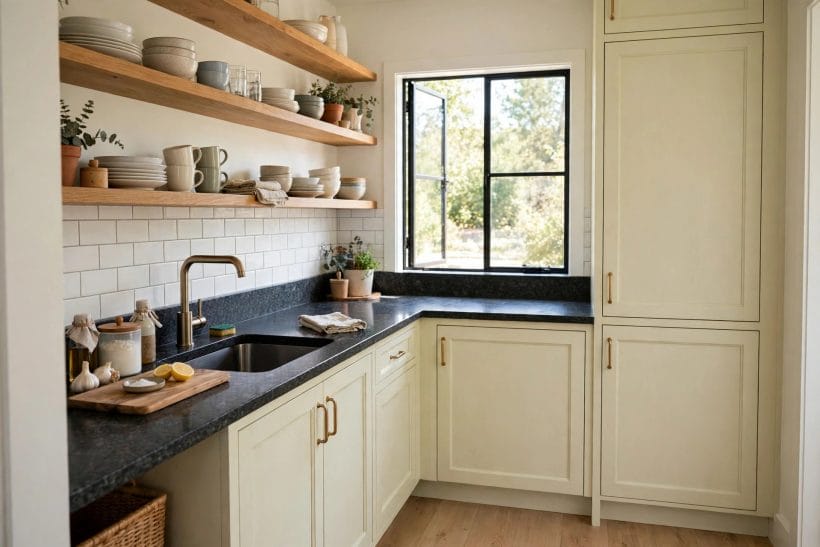
Small kitchens benefit from this pairing more than large ones do, provided the dark surface is kept to one role. In a compact kitchen, light cabinets on every wall keep the room feeling open, and a single dark countertop gives it just enough definition to stop it feeling bland. The mistake to avoid is repeating the dark tone too widely: dark surfaces on every side together with a dark countertop would close a small kitchen in, but light cabinets and pale floors with one dark worktop leave the room bright while still giving it character.
Open shelving can help a small version of the pairing, since it breaks up a long run of pale cabinets without adding a new colour. A shelf or two in light wood, holding everyday dishes and bowls, adds warmth and gives the eye somewhere to rest between the cabinets and the countertop. Keep the shelves few and the objects on them simple, since a small kitchen crowded with display will feel busy no matter how light its cabinets are. The dark countertop below the shelves will anchor the whole arrangement.
Storage discipline matters more than size in a small kitchen with this pairing. Because the countertop is dark, anything left on it is visible, which is both a blessing and a discipline: the surface rewards being kept clear, and a clear dark countertop makes a small kitchen look larger than a cluttered pale one would. A few everyday items, a board, a kettle, a fruit bowl, are enough on display. Everything else earns its place in a cabinet, and the pale doors close over it without fuss.
7. Backsplashes That Stay Quiet
The backsplash is the supporting actor in this pairing, and it should behave like one. With light cabinets above and a dark countertop below, the strip of wall between them is best kept pale and simple, so the contrast that matters, cabinet against countertop, stays the star. A plain pale tile, a light stone slab, or a simple painted wall all do this job well. They protect the wall, they reflect a little light, and they step back from the main event.
Patterned or strongly coloured backsplashes can still work, but they ask the kitchen to carry a third voice, and that voice has to earn its place. If a patterned tile is used, keep it to the backsplash alone, and let the cabinets, the countertop and the floor stay quiet around it. A busy backsplash with busy cabinets and a veined dark stone will tire the eye quickly, while the same tile against plain pale cabinets and a calm dark top can be the one lively note the room needs. The test is simple: if you notice the backsplash before you notice the pairing, it is doing too much.
Height matters as much as pattern. A short backsplash, just a few inches above the countertop, keeps the wall above it free for paint or open space, which suits a light kitchen. A full-height backsplash in a pale material gives a more finished, continuous look and protects more wall, but it should stay pale, since a dark full-height backsplash would double the dark area and upset the balance the pairing depends on. Either height works, provided the material stays light and the dark stone stays confined to the worktop.
8. Handles, Taps and Small Dark Repeats
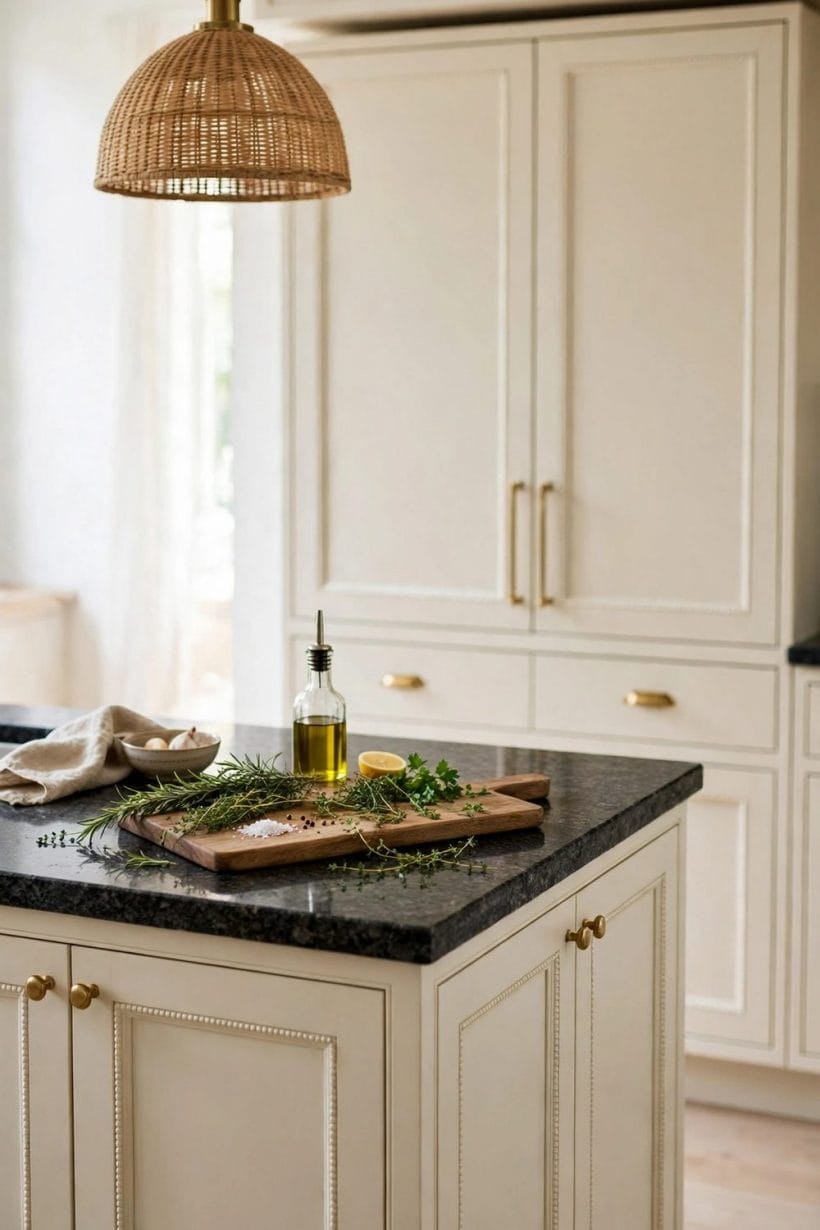
Small dark repeats are what make the pairing feel intentional rather than accidental. A dark countertop on its own can look like a single decision; the same dark tone repeated in small touches, black or dark bronze handles, a dark tap, a dark frame on a picture, ties the room together. These touches should stay small. The countertop is the main dark surface, and everything else dark in the room should be an echo of it, not a rival to it.
Handles are the easiest place to make this echo. Dark handles on light cabinets pick up the countertop without adding any new colour, and they give pale doors a definition they would otherwise lack. Keep the handle style consistent across the kitchen, the same finish on every door and drawer, so the echo reads as a decision rather than a collection of separate choices. A tap in a matching dark finish does the same work at the sink, and a dark pendant cord or a dark stool leg can quietly complete the set.
Restraint is the rule here. Two or three small dark repeats are enough; a kitchen where every fitting is dark will lose the very contrast the pairing is built on. The light cabinets need to stay light, the floors need to stay pale, and the walls need to stay quiet, so that the dark countertop and its few small echoes stand out against a calm background. When the echoes are kept small, the kitchen feels considered, and the pairing feels finished rather than merely installed.
9. Lighting a Dark Countertop Well
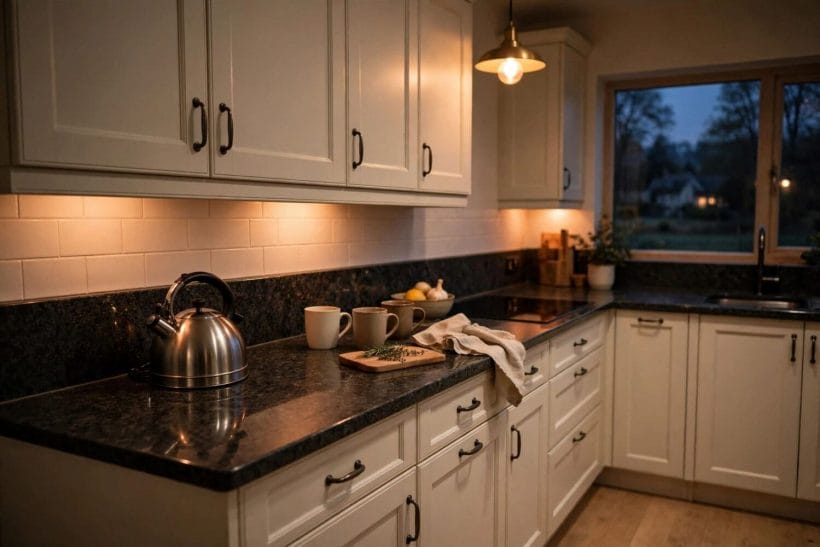
Lighting is what makes a dark countertop look rich instead of gloomy. A dark surface absorbs more light than a pale one, so it needs a little more help from the room’s lighting, and that help is easy to give. Daylight is the first source: a window over the sink or beside the main work run lets the stone show its depth and veining through the day. Where daylight is limited, under-cabinet lights are the next best thing, since they fall directly on the worktop and light exactly the surface that needs it.
Evening lighting needs a warmer approach. A dark countertop under cool, harsh light can look flat, while the same surface under warm lamps looks deep and inviting. Pendant lamps over an island, a warm under-cabinet strip along the main run, and one soft lamp in a corner together give a kitchen a layered evening light that flatters both the pale cabinets and the dark stone. Dimming, where it is available, helps too, since it lets the evening kitchen be as bright or as gentle as the moment asks for.
The light cabinets help the lighting as much as the lights do. Pale doors reflect whatever light the room has, bouncing it back onto the worktop and into the corners, so a kitchen with light cabinets needs fewer lights than the same kitchen with dark ones would. That is one more reason the pairing is practical as well as pretty: the cabinets do part of the lighting work for free, simply by being pale, and the dark countertop gets to enjoy the light they reflect.
10. Living With the Pairing Day to Day
Day to day, this pairing is easy to live with, provided its few habits are kept. Wipe the dark countertop at the end of cooking, since spills and crumbs show more on dark stone than on pale surfaces, and the surface will repay the habit by always looking ready for the next meal. Wipe the pale cabinet fronts when they need it, especially near handles, and keep the sink run clear so the dark line of the worktop stays visible. None of these habits is onerous, and together they keep the kitchen looking the way it did when it was finished.
Sealing and care of the stone itself are best discussed with the professionals who supply and fit it, since different stones and finishes ask for different routines, and a general guide cannot replace advice about the particular stone in your kitchen. What can be said generally is that dark stone rewards prompt attention to spills, gentle cleaning, and the habit of using boards for cutting and trivets for hot pans, which protect any worktop whatever its colour. Treat the stone kindly, and it will hold its depth and character for years.
The pairing also ages gracefully. Pale cabinets can be repainted if tastes change, and a dark stone countertop will sit happily beside a new cabinet shade, since dark stone is neutral in a way that few other surfaces are. That flexibility is a quiet advantage: a kitchen built on light cabinets and a dark countertop is not locked into one look, and a future change of wall colour or cabinet shade will usually work with the stone rather than against it. It is a pairing chosen once and enjoyed for a long time.
Final Considerations
Light cabinets with a dark countertop succeed for a simple reason: each half covers the other’s weakness. The cabinets keep the room bright, the countertop keeps it grounded, and the pale floors and quiet backsplash leave that relationship clear. Cream warms the stone, white sharpens it, and pale grey softens it, so the pairing can be tuned to the light and the mood of the room without ever changing its basic balance. Dark granite countertops with light cabinets remain, in that sense, less a trend than a sound piece of kitchen sense, and a combination worth choosing carefully and installing well.
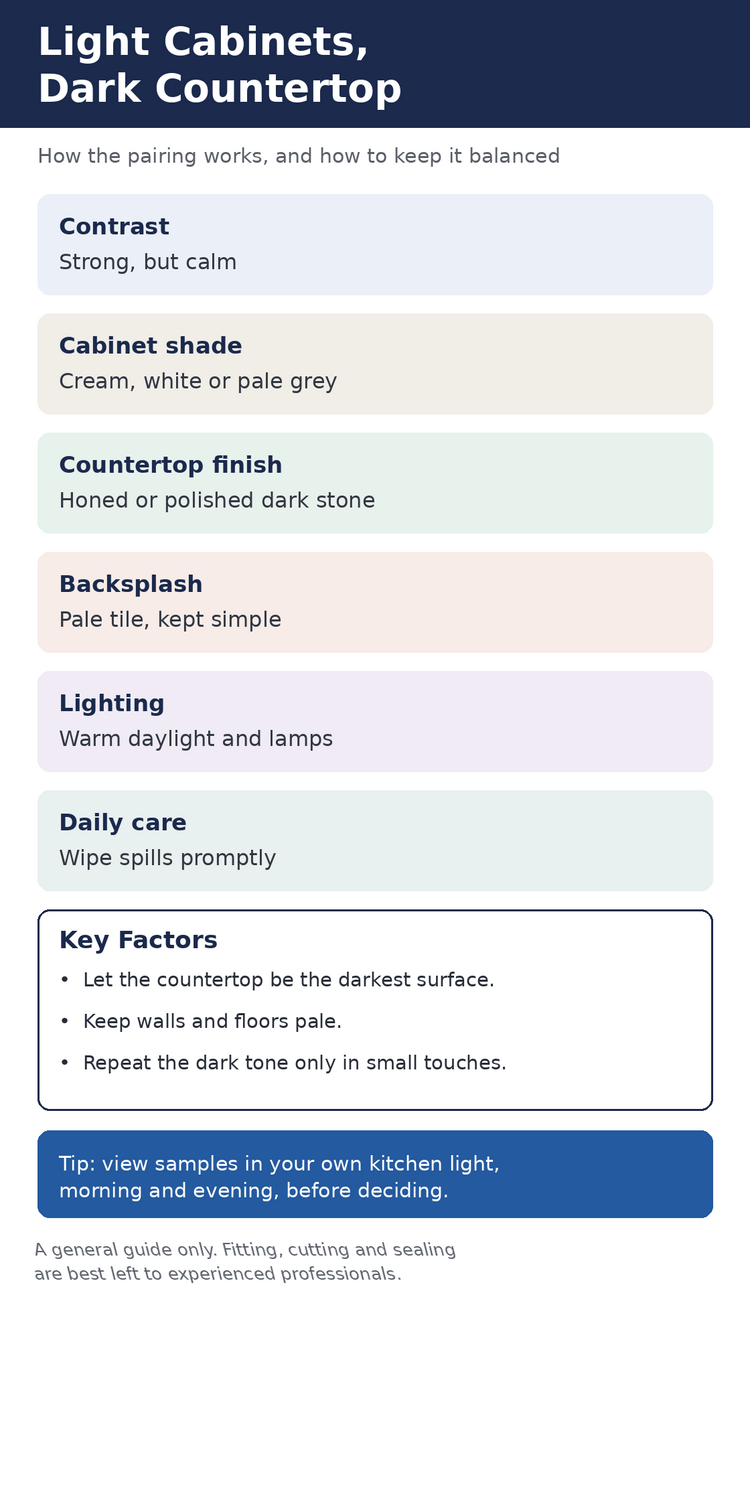
Before deciding, look at cabinet and stone samples together in your own kitchen, morning and evening, since both shades change between daylight and lamplight. Keep the dark tone to the worktop and a few small echoes, keep the cabinets, walls and floors pale, and leave templating, cutting and fitting to experienced professionals. Chosen that way, the pairing will not merely look good on the day it is finished; it will still please you years later, in a kitchen that is bright to work in, calm to gather in, and easy to keep looking its best.
Related reading: kitchen ideas, small kitchen ideas, tiny kitchen ideas, tiny house interior design ideas, tiny house interior paint colours, modern tiny house interior ideas, and soapstone countertops.

0 Comments