

White cabinetry keeps a kitchen feeling bright and generous, while a dark stone worktop gives it weight, depth and a clear place for the eye to rest. These seventy-five pairings explore granite tones, edge profiles and hardware finishes, so you can build the contrast calmly, one decision at a time, instead of hoping three big choices happen to agree with each other.
1. The Pairing at a Glance
| Granite Mood | Best Cabinet Style | Hardware Direction | Watch Out For |
|---|---|---|---|
| Charcoal with fine silver fleck | Flat-front or slim shaker | Brushed steel or matte black | Too many grey tones at once |
| Near-black with soft veining | Classic shaker | Warm brass for balance | Dark floors closing the room in |
| Blue-grey with lively movement | Simple framed doors | Quiet nickel | Busy backsplash choices |
| Brown-black and warm | Traditional raised panel | Bronze or aged brass | Cold lighting fighting the warmth |
The appeal of gray granite countertops with white cabinets is the balance it strikes: the tops ground the room, the cabinets lift it, and neither side shouts. Because both elements are fairly permanent, the order of decisions matters. Choose the stone first if your heart is set on a particular slab, since natural granite varies from piece to piece, then let the cabinet white, the hardware and the backsplash respond to what the stone is actually doing in your light.
Always judge samples together, in the kitchen, at different times of day. A white that looks pure in a showroom can turn creamy beside a cool grey stone, and a granite that reads charcoal at noon can look almost blue by lamplight. If you are planning the whole renovation yourself, the patient, measure-first mindset behind how to build your own tiny house projects serves kitchen planning just as well: drawings, samples and honest lists beat confident guessing every time.
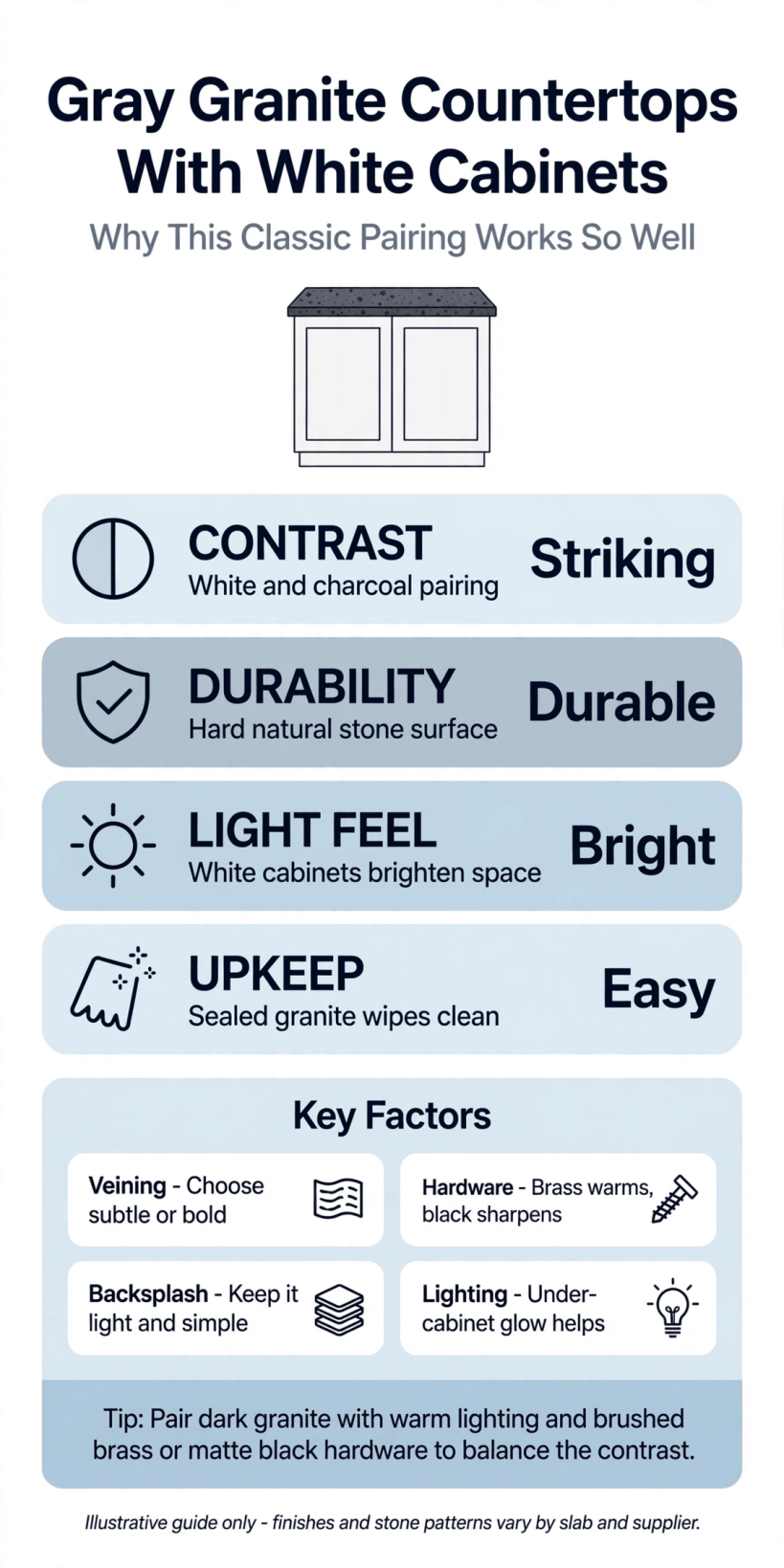
The main pairing decisions in this guide: stone tone, door style, edge profile, hardware and light.
2. Choosing Your Dark Granite: Colour and Fleck
Dark granites sit on a spectrum from soft charcoal to near-black, and the fleck inside the stone is what decides its personality. A fine, even silver fleck reads calm and modern, pairing easily with simple doors and quiet hardware. Bolder stones with larger mineral patterns and gentle veining become the artwork of the kitchen, and they ask everything around them to be simpler, from door style to backsplash, so the room does not argue with itself.
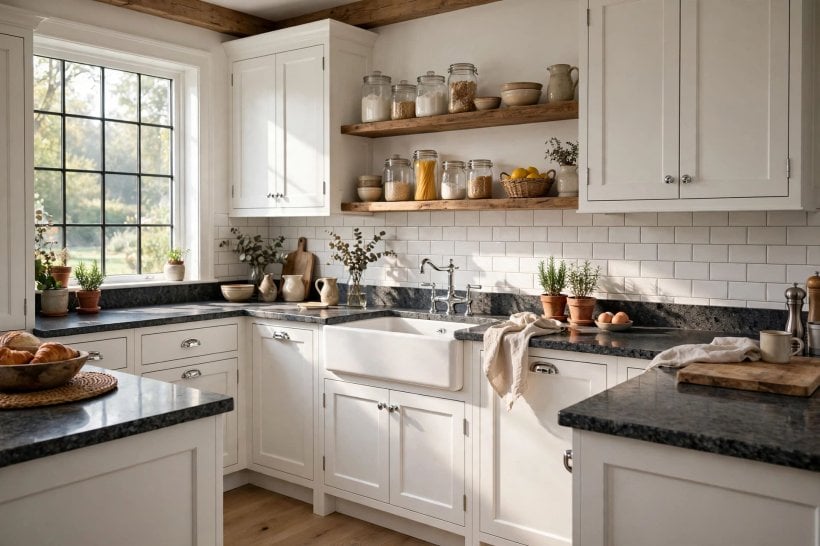
Warmth is the second decision. Some dark granites lean warm, with brown or bronze minerals glinting through, and they love warm whites, timber stools and brass hardware. Others lean cool and blue-grey, suiting crisper whites and steel. If you enjoy confident colour elsewhere in a home, the schemes in colorful tiny house interior features show how a strong accent, used sparingly on stools, blinds or a single wall, can sit happily beside a restrained kitchen palette of white, stone and one warm metal.
3. Cabinet Door Styles That Suit Dark Stone
Shaker doors are the natural partner for dark granite, because their framed shape is traditional enough for a classic stone yet simple enough for a modern one. Keep the frame width moderate: very wide frames in a small kitchen can look heavy under a dark top, while a slim shaker reads tailored and current. Flat-front doors take the same pairing in a sleeker direction, letting the stone carry all the pattern while the cabinetry stays a smooth, bright field.
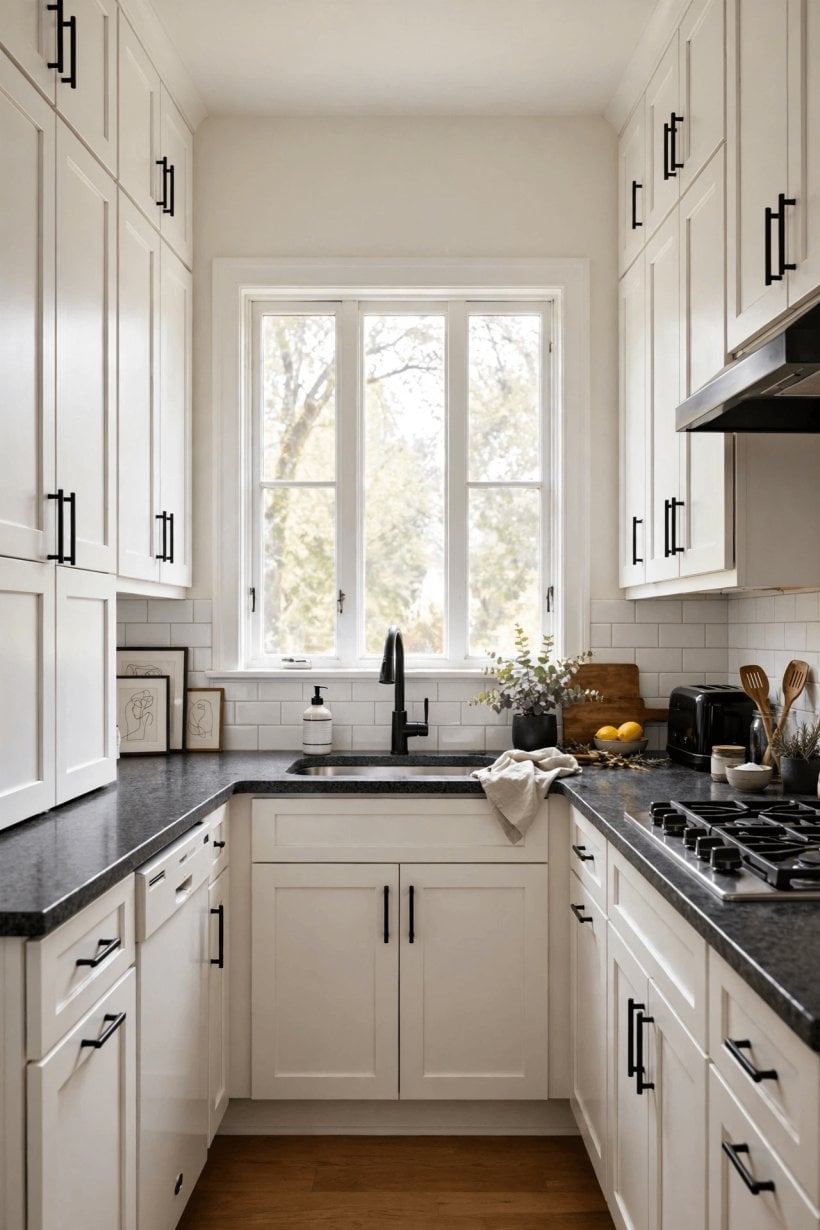
Rustic rooms can push the cabinetry warmer in feel while keeping it white in colour, using beadboard centres, visible wood grain under paint, or simple plank doors. The relaxed mood of tiny barn house interior schemes pairs beautifully with a warm, brown-flecked granite and aged hardware. Whatever the door style, keep the white consistent across every cabinet, including the island, because two slightly different whites beside one dark stone will look like a mistake rather than a design choice.
4. Edges: The Profile That Changes the Feel
The edge profile is the detail most people choose last and notice daily. A simple square or slightly eased edge feels modern and honest, and it suits flat-front and slim shaker doors. A small bevel catches a line of light along the dark stone, which can be lovely in a dim kitchen. Rounded bullnose edges soften the whole run, feel kind to hips and forearms, and belong in family kitchens where people lean, reach and pass closely all day long.
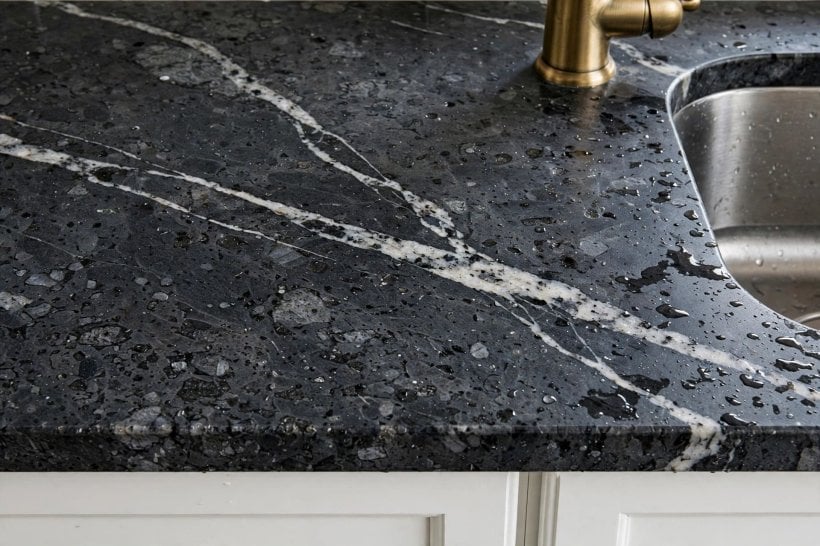
More elaborate ogee edges dress the kitchen up toward the traditional, and they earn their keep in larger rooms with raised-panel doors and other classical details. In a compact kitchen, elaborate edges can fuss against the cabinet frames, so restraint usually wins. Ask your fabricator to make up short sample pieces in two profiles and live with them on the counter for a week. The right edge is the one your hand likes, your eye stops noticing, and your cleaning cloth can travel along without snagging.
5. Hardware: Handles, Knobs and Finishes
Hardware is the jewellery of this pairing, and it has one main job: to warm up, cool down or sharpen the contrast between white doors and dark tops. Brushed brass and aged bronze add warmth and work especially well with warm-leaning stones and traditional doors. Matte black pulls sharpen a modern scheme and echo the depth of the granite, while brushed nickel and steel give a quieter, cooler bridge that suits blue-grey stones and busy households that want hardware to disappear.
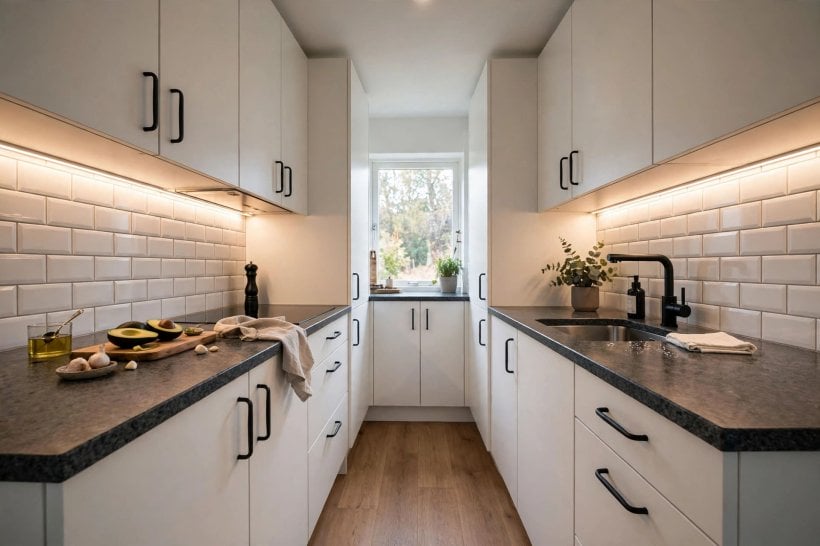
Shape matters as much as finish. Long bar pulls suit drawers and wide doors and feel contemporary; simple knobs keep a classic kitchen gentle; cup pulls on drawers add a farmhouse note that dark granite handles easily. Keep one finish throughout the kitchen, including hinges where they show, and size handles generously enough for real hands, wet hands and hands in a hurry. Handles are touched hundreds of times a week, so this is a place to choose with your fingers, not only your eyes.
6. Backsplash Pairings That Bridge the Gap
The backsplash sits exactly where white meets dark, so it decides whether the contrast feels crisp or jarring. The calmest choice is to run the same granite up the wall as a full-height splash or a simple upstand, which ends the material argument completely and is easy to wipe. The brightest choice is a plain white or off-white tile in a simple stack or brick pattern, which keeps the wall light and lets grout colour do quiet work: white grout for softness, mid-grey grout to echo the stone.
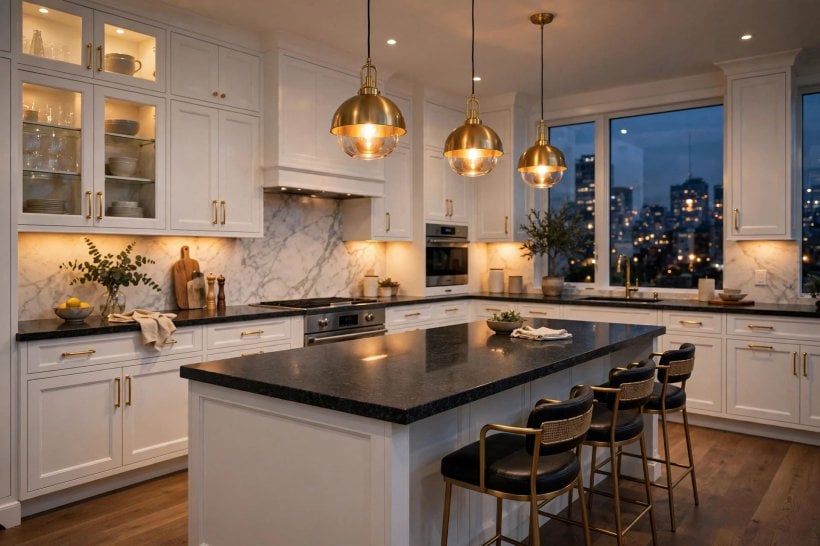
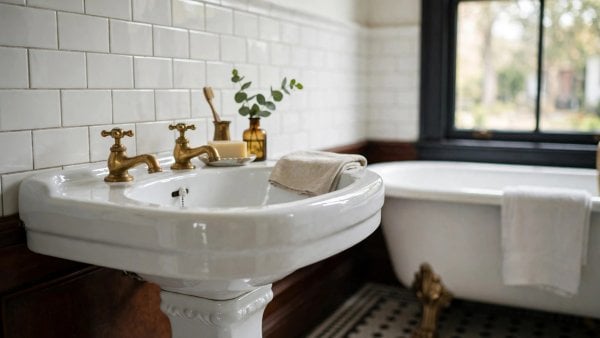
Pattern belongs here only if the granite is quiet. A bold stone plus a bold tile is the most common way this pairing goes wrong, so let one of them lead. The tile discipline used in small bathrooms, choosing one pattern and repeating it calmly, applies here too, and the layouts in tiny house bathroom ideas are a good reminder that small surfaces look best when every material has a clear role. Finish the splash with a thought for the cooker wall, where heat and splashes ask for the most forgiving surface of all.
7. Lighting a High-Contrast Kitchen
Dark stone drinks light, so a white-and-granite kitchen needs more deliberate lighting than an all-pale one. Start with under-cabinet lights washing the worktop, because this is where you chop, read recipes and look for crumbs, and the glow on dark granite is genuinely beautiful in the evening. Add ceiling light that is warm rather than blue, since cool light can make white cabinets feel stark and turn warm stone muddy at exactly the hour the kitchen is busiest.
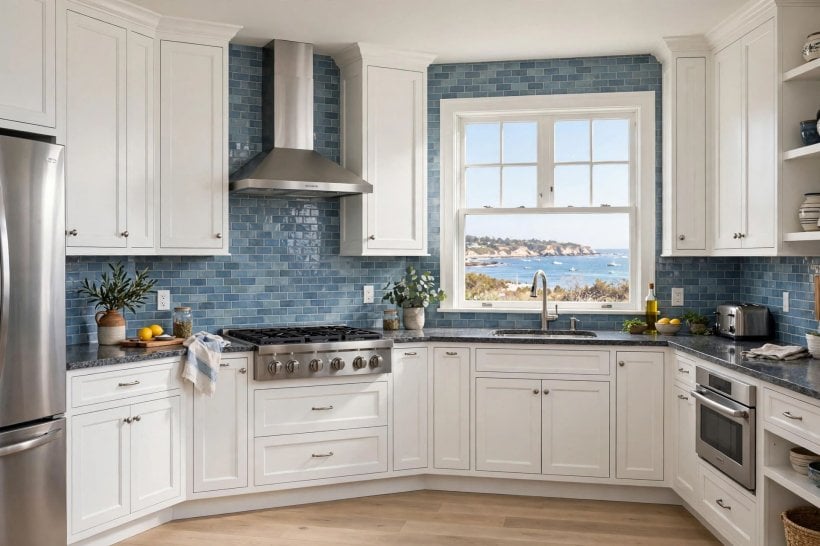
In open-plan rooms the kitchen lighting has to agree with the living area beside it. The layered approach in tiny house living room ideas, a mix of task, background and low evening light rather than one bright source, translates perfectly. Pendants over an island deserve bulbs that flatter both stone and faces, and dimmers earn their small cost every single evening. Finally, polish level plays a part: a polished granite reflects your lighting design back at you, while a honed finish absorbs it into a softer, calmer mood.
8. Sinks, Taps and the Working Zone
The sink area is where this pairing works hardest, so let practicality lead and style follow closely. An undermount sink keeps the dark stone line unbroken and lets crumbs sweep straight in, while a crisp white ceramic sink set into dark granite makes a deliberate, farmhouse-leaning feature of the washing-up zone. Stainless steel suits both stones and most hardware, and it forgives the daily knocks of pots and trays better than almost anything else in the room.
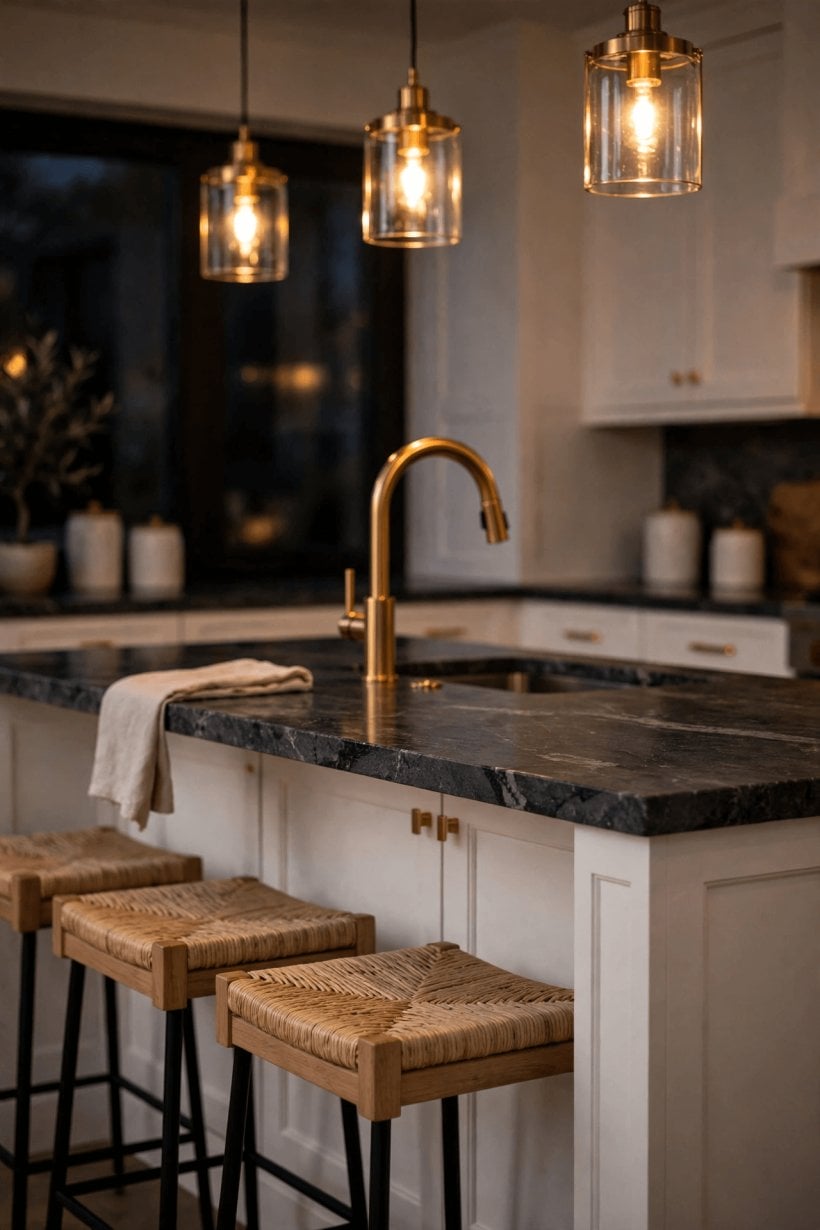
Taps should echo the hardware finish so the room reads as one decision, and a simple, tall arc gives room for big pans under it. Think about the less glamorous details while you are here: where the washing-up liquid lives, whether a rail or a small shelf keeps the sink edge clear, and how the bin relates to the prep zone. A working triangle that suits your cooking, a clear stretch of stone beside the hob, and a home for every board and knife will matter more in five years than any single finish chosen this month.
9. Small Kitchens and Compact Homes
Small kitchens wear this pairing surprisingly well, because the dark top can make white cabinets look even brighter by contrast, and a short run of granite feels generous rather than overwhelming. Keep the stone’s pattern small in scale, the doors simple, and the backsplash plain, and a compact room gains the tailored feel of a much larger one. One continuous worktop surface, rather than several materials in pieces, also calms a small layout and makes it easier to keep clean.
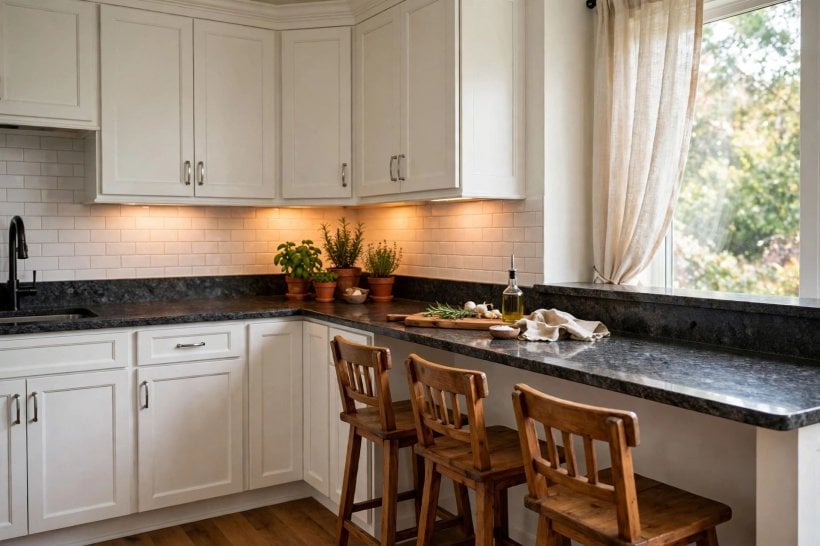
Storage discipline does the rest. In a small kitchen every cabinet is precious, so plan the insides as carefully as the doors: deep drawers for pans, a narrow pull-out for oils near the hob, and nothing stored on the granite that does not earn its place daily. A single plant, a timber board and one good-looking kettle are enough decoration on a dark top. The contrast itself is the ornament here, and it looks best with clear space around it, a lesson every compact home teaches sooner or later.
10. Care, Sealing and Everyday Living
Granite is tough, but it is a natural stone and it appreciates simple habits. Wipe sp
Budget is worth an honest word before you fall for a slab. Natural stone sits in bands rather than at one price, and the band depends on the specific granite, its rarity, the thickness you choose and how many cut-outs and edges your layout needs. An island with a hob and a sink costs more to fabricate than a straight run, whatever stone you pick, so get the templating and fabrication included in any comparison rather than comparing material figures alone. White cabinets vary just as widely, from flat-pack carcasses with painted doors to handmade framed kitchens, and this pairing is kind in one important way: the contrast does the visual work, so modest cabinetry under a beautiful dark stone can look far more expensive than it was, while money saved on door complexity can go toward the slab you touch every day.
Templating day is the moment the design becomes real, and it rewards your presence. The fabricator will measure everything, check that walls and cabinets are level enough for stone, and mark where seams, if any, will fall. Speak up at this stage about seam position, overhangs for stools, and the exact edge you chose, because changes after cutting are costly or impossible. Plan the practicalities too: granite is heavy, access routes matter, and someone will need to be home. While the stone is away being cut, live with your sample against the cabinets and resist last-minute hardware changes made in a shop under different light. Kitchens reward patience at exactly the points where it feels hardest, and the week or two between templating and fitting is one of them.
Finally, think about how the contrast will feel across seasons and years. In summer, bright light bounces off white doors and the dark stone reads as cool shade, which most people love. In winter, warm bulbs, timber boards and a plant or two keep the scheme from feeling austere, and this is where your hardware warmth quietly proves itself every evening. Keep one small habit from the start: a clear worktop rule. Decide what lives on the granite permanently, perhaps a kettle, a board and nothing else, and find homes inside cabinets for everything beyond that. The pairing you chose is strong enough to carry an empty, calm kitchen, and protecting that calm is the difference between a room that still delights you in five years and one that slowly disappeared under clutter.
ills as they happen, especially oils, wine and anything acidic, use boards for chopping and stands for hot pans, and clean day to day with warm water and a soft cloth rather than harsh sprays. Most dark granites hide crumbs and watermarks far better than pale stones, which is one of their honest pleasures, but a quick evening wipe keeps the surface looking deep and even.
Sealing is the one piece of maintenance to take seriously, and your fabricator can advise on the right product and rhythm for your particular stone, since granites vary. Follow that advice rather than general rules, and keep a note of what was used and when. White painted cabinets ask for the same gentle approach: prompt attention to splashes near the hob and sink, and a soft cloth instead of scouring pads. Treated kindly, this pairing ages gracefully, with the stone deepening in character and the cabinetry staying bright for many years of ordinary, happy use.
Final Considerations
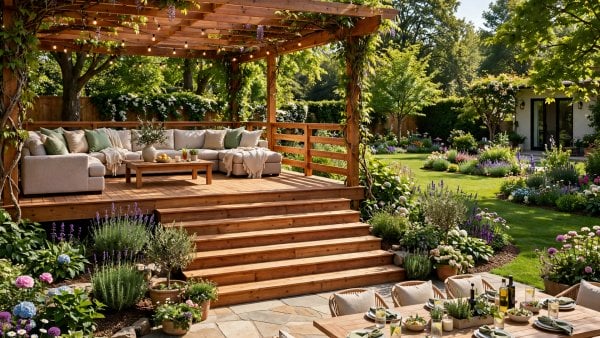
Choose the stone in your own light, let the cabinet white answer it, pick one hardware finish and warm it up or cool it down to suit the granite’s fleck, and keep the backsplash quieter than the worktop. That simple order of decisions is the whole secret behind successful gray granite countertops with white cabinets, in kitchens large and small. If your kitchen looks out to a garden, the greenery-first thinking in tiny house landscaping ideas can soften the view beyond the window too, so the room’s calm contrast between bright cabinetry and deep stone feels settled in its setting rather than imposed on it. Build the pairing patiently, and it will repay you at breakfast every day.

0 Comments