

The officer at the weigh station does not care how beautiful your build is. One number over the limit and the tow is illegal, the insurance is void, and the fine is the least of your problems. Most tiny house owners can name exactly one of the four ratings that govern every tow — and that is how people end up in trouble they never saw coming.
1. Weight Limits of Tiny Houses at a Glance
The weight limits of tiny houses are not a single number but a system of four ratings that interact: GVWR caps the loaded trailer, GAWR caps each axle, tongue weight balances the hitch, and GCWR caps the truck and trailer combined. Exceed any one of them and the tow is illegal, uninsured and dangerous — even if the other three are comfortably in range. This guide decodes each rating in plain language: where to find it, how water and belongings quietly push you over it, and how to match a tow vehicle to the house honestly, with worked examples at 8,000, 12,000 and 14,000–16,000 pounds. Know your numbers before the highway teaches them to you.
| Rating | What It Caps | The Number to Remember |
|---|---|---|
| GVWR | The loaded trailer: trailer + house + water + belongings + everything | Common tiny house trailer GVWRs run 10,000 / 12,000 / 14,000 / 16,000+ lbs |
| GAWR | Each axle individually | Two 7,000-lb axles = 14,000 lbs combined |
| Tongue Weight | The downward force on the hitch | 10–15% of loaded trailer weight |
| GCWR | Truck + trailer + everything, combined | Most states allow up to 26,000 lbs GCWR on a standard license |
| Tow Rating | The maximum trailer weight the truck may pull | Keep the loaded trailer at or under 80% of it |
| Payload | The truck’s own carrying capacity | Tongue weight counts against it, pound for pound |
| The Working Margin | Your safety buffer under GVWR | Keep 5–10% under, weighed loaded with tanks full |
| The Brake Threshold | Where trailer brakes become law | Legally required above 3,000 lbs in most states |
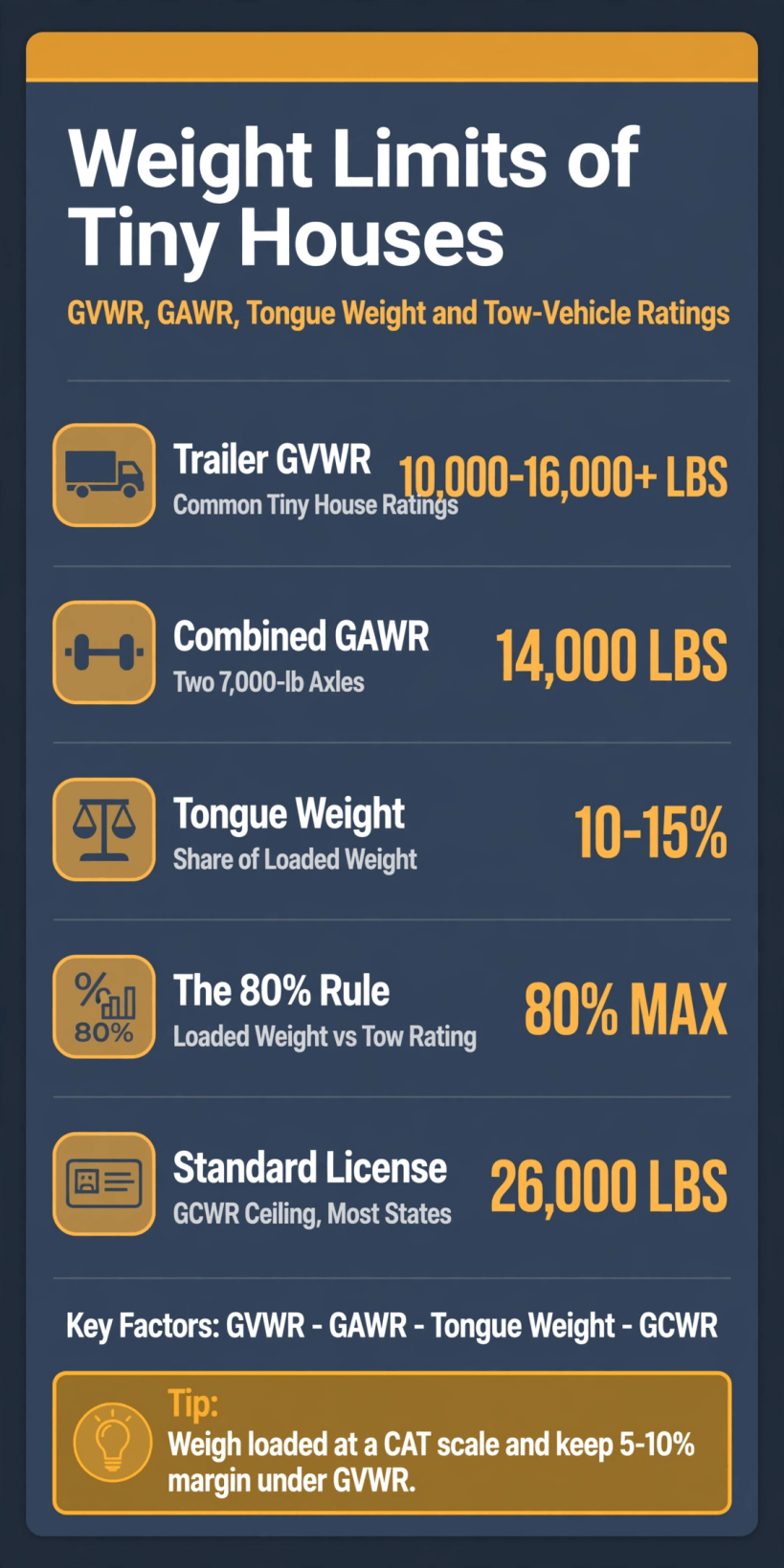
Four ratings, one system: the ceiling on the trailer, the ceiling on each axle, the balance on the hitch, and the ceiling on the whole rig.
None of these numbers is hidden. The trailer’s ratings are stamped on its VIN plate, the truck’s are set by its manufacturer, and your actual loaded weight is one trip to a CAT scale away. The owners who get into trouble are rarely the ones who could not find the numbers — they are the ones who never weighed the rig as it actually travels, tanks full and belongings aboard, and so never learned which side of the ceiling they were on.
2. GVWR: The Master Number
The Gross Vehicle Weight Rating is the maximum the loaded trailer may weigh — trailer, house, water, belongings, everything. It is set by the trailer manufacturer and stamped on the VIN plate, which makes it the first number to read on any trailer and the first number to check before any tow. Common tiny house trailer GVWRs run 10,000, 12,000, 14,000 and 16,000+ pounds, and the rating is chosen when the trailer is — which is why it belongs at the centre of any tiny house trailer buying guide decision, long before the floor plan is drawn.
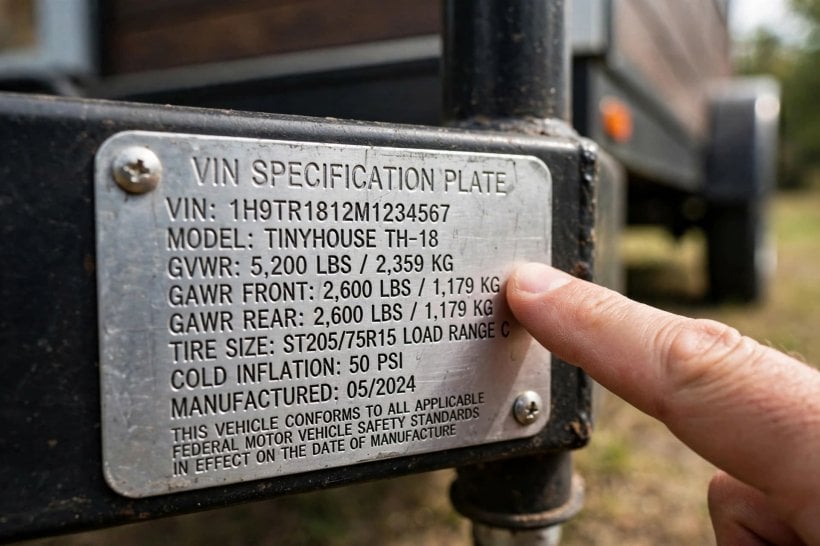
The law treats the ceiling seriously. Exceeding GVWR is a citable offense in most states, carrying fines — and in an accident, the overload can void insurance and establish liability. The trap that catches new owners is definitional: GVWR is not the trailer’s empty weight. It is the ceiling, and your house must live under it with everything aboard. The working practice is to know your loaded weight — weighed on a CAT scale, tanks full — and keep 5–10% margin under the GVWR, so that the last-minute additions every trip attracts do not quietly consume the whole allowance.
Because the rating is fixed by the manufacturer before the house exists, GVWR is also a design constraint, not just a towing one. A trailer bought with too little ceiling leaves the build nowhere to go: every material choice, every tank and every appliance is spent against a number that was settled at purchase. That is why the master number is read first and planned around longest — the house is designed to fit under the ceiling, and the tow is then simply checked against a target the build already respected.
3. GAWR: Per-Axle Limits and the Balance Problem
The Gross Axle Weight Rating is the maximum each axle may carry, and it matters separately from GVWR because a trailer is not one load but a load distributed across axles. Two 7,000-lb axles give 14,000 lbs of combined GAWR — which typically matches the trailer GVWR, minus the tongue weight carried by the truck. The failure mode GAWR guards against is imbalance: a badly distributed load can overload one axle while the total stays under GVWR, and that overloaded axle is the classic cause of bearing failures and blowouts. How the axles sit under the frame in the first place is its own discipline, covered in the axle placement guide for balancing a tiny house trailer.
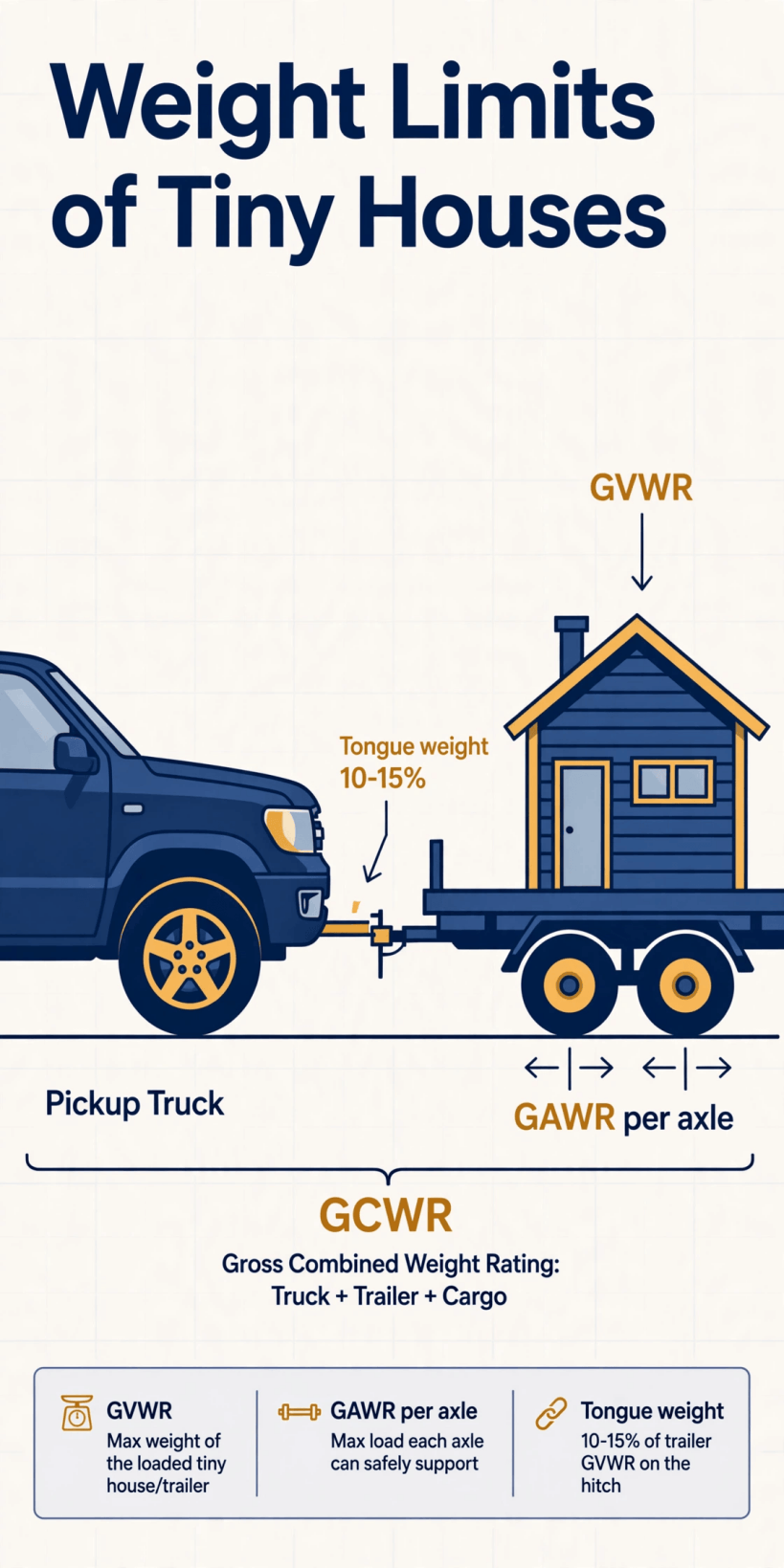
The defence is to weigh per axle — CAT scales give per-axle readings — and to load for balance: heavy items such as batteries and water tanks centered over or slightly ahead of the axles, never all at one end. Axle capacity itself is a buying decision as much as a loading one; the worked sizing in the guide to choosing trailer axles for a 14,000 lbs tiny house shows how the per-axle numbers are picked to match a trailer’s GVWR before the house is built on it. And the plan drawn on top of those axles has to respect the same geometry, which is exactly what the tiny house trailer-specific floor plans are designed around — fenders, axle groups and the rooms fitted over them.
4. Tongue Weight: The 10–15% Rule
Tongue weight is the downward force on the hitch, and it must sit at 10–15% of the loaded trailer weight. The band exists because both directions of error are dangerous. Too little — under 10% — and the trailer sways, and sway is the #1 cause of towing accidents. Too much — over 15% — and the load overloads the truck’s rear axle and ruins its steering. The arithmetic is simple: a 12,000-lb house needs 1,200–1,800 lbs on the tongue. Crosswinds punish a light tongue even harder, which is why the balance question and the aerodynamic design tips for towing on highways belong in the same conversation.
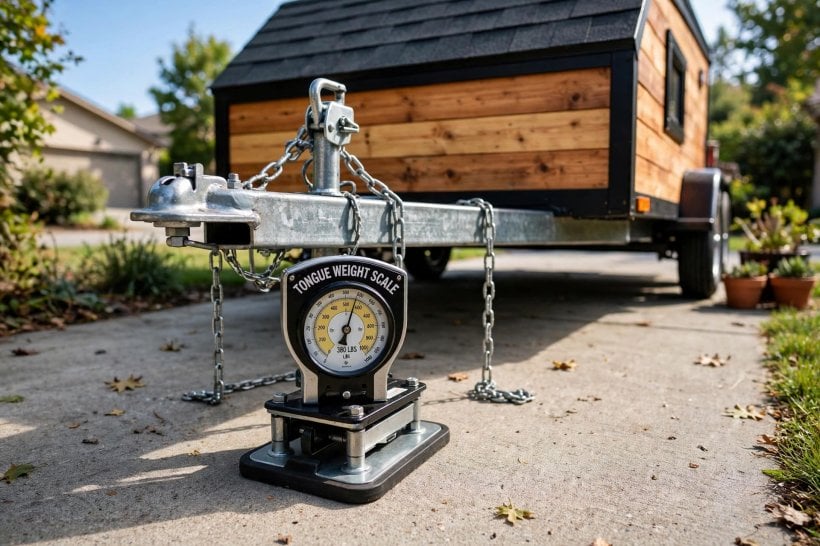
Measure it rather than guessing: a tongue weight scale costs $100–150, and the bathroom-scale-and-lever method works with what you already own. Adjust it by moving heavy items fore and aft — batteries and water tanks are the trim weights, the movable ballast that tunes the percentage. And check tongue weight after every major load change, because the percentage you set in the driveway describes the load you had that day, not the load you are towing now.
5. GCWR and Tow Rating: The Truck Side of the Equation
The truck brings its own set of ceilings. The Gross Combined Weight Rating is the maximum for truck + trailer + everything, set by the truck manufacturer. The tow rating — the maximum trailer weight the truck may pull — is a subset of that GCWR math. And payload, the truck’s own carrying capacity, is where the two vehicles’ numbers collide: tongue weight counts against payload. The original worked example makes it concrete — 1,500 lbs of tongue weight on a truck with 1,800 lbs of payload leaves just 300 lbs for passengers and gear.
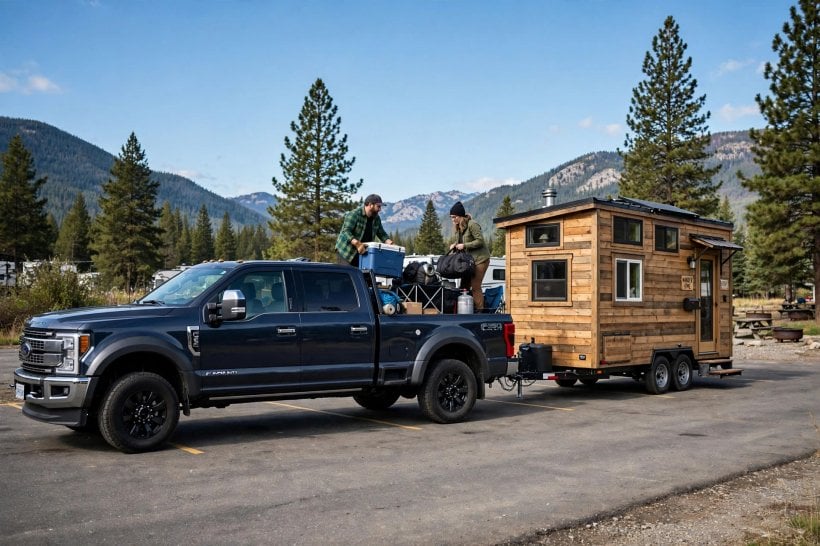
That payload squeeze is the most commonly missed check in the whole system. A truck can pass the tow-rating test and fail the payload test on the same rig, because the rating on the brochure and the capacity on the door are different numbers answering different questions. Run all three truck-side figures — GCWR, tow rating and payload — against your loaded trailer and its tongue weight before you call a rig matched. A fuller walk-through of the truck, hitch and regulation side sits in the guide to towing a tiny house.
6. Matching House to Truck: The 80% Rule in Practice
The matching rule that ties the system together is the 80% rule: loaded trailer weight at or under 80% of the truck’s tow rating — margin for grades, wind and emergencies. A 12,000-lb house therefore wants a truck rated for 15,000+ lbs of towing, which means a 3/4-ton or 1-ton truck: F-250 or F-350, Silverado 2500 or 3500, Ram 2500 or 3500. The worked examples scale the rule across the range of houses people actually tow:

- An 8,000-lb tiny house: a half-ton truck (F-150, Silverado 1500) with the max-tow package (11,000–13,000 lb rating) — comfortable at 80%.
- A 12,000-lb tiny house: a 3/4-ton truck (F-250 — 15,000–20,000 lb rating) — the sweet spot.
- A 14,000–16,000-lb tiny house: a 1-ton truck (F-350 dually for the heaviest — 20,000–30,000+ lb rating) — dual rear wheels add stability that matters at this weight.
- Never: tow a 12,000-lb house with a truck rated for 12,000 lbs (zero margin), or with a half-ton at its absolute limit — the rating assumes ideal conditions, and you will not have them.
The pattern inside the examples is the point. Each step up in house weight is a step up in truck class, and the margin is not timidity — it is the capacity that grades, headwinds and emergency manoeuvres spend. A rig matched at 100% of its rating is a rig that is overloaded the first time the road stops being flat, straight and calm.
7. The Weight That Creeps: Water, Belongings and the Vanishing Margin
GVWR counts everything: trailer, house, water, belongings. That “everything” is where compliance quietly dies, because a house is rarely weighed in the state it actually travels. Water goes aboard, tanks fill, and the belongings accumulate — tools, batteries, food, gear — each addition small, the total anything but. The original warning bears repeating in full: water and belongings quietly push you over. The house that left the builder under its ceiling can cross it one ordinary loading day at a time, without a single dramatic change to point at.
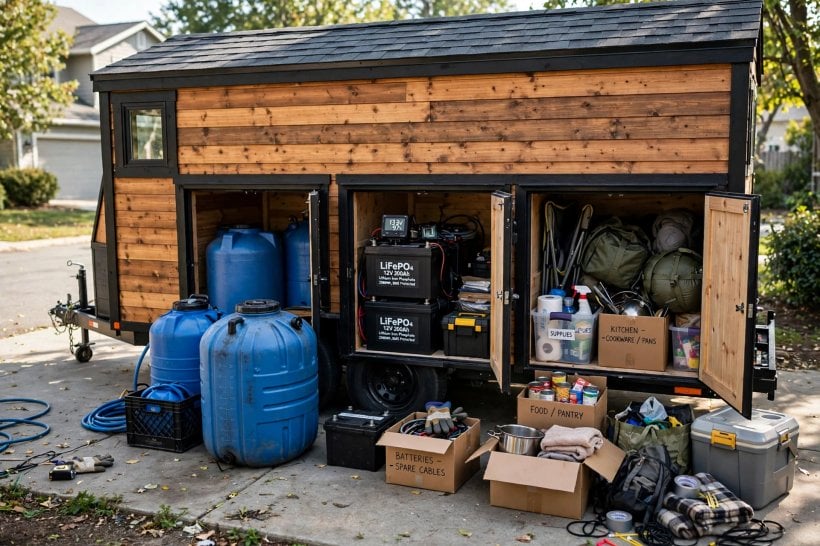
The countermeasures are habits, not hardware. Weigh the rig loaded, tanks full, in travelling trim — not empty and optimistic. Hold the 5–10% margin under GVWR as untouchable reserve rather than usable capacity. Use the heavy, movable items — batteries and water tanks — as the trim weights that keep both the total and the tongue percentage where they belong. And re-check after every major load change, the same discipline tongue weight demands, because the load is a moving target and the ceiling is not.
Creep also moves weight, not just adds it. Belongings loaded at the rear shift the balance the GAWR and tongue-weight checks depend on: the same total can pass the GVWR test while failing per-axle or pushing the tongue under its 10% floor. That is why the re-weigh after a load change is a full check — total, per-axle and tongue — and not just a glance at the biggest number. The load you tow is the load you last arranged, and the ratings grade the arrangement as much as the amount.
8. Brakes, Hitches and Mirrors: The System Behind the Ratings
The ratings are the start; the hardware completes them. Trailer brakes come first: electric brakes on all axles plus a breakaway kit — legally required above 3,000 lbs in most states. The brake controller should be proportional, not time-delayed, so truck and trailer brake as one. A weight-distribution hitch is the call for bumper-pull trailers over ~8,000 lbs, restoring steering weight to the truck’s front axle, and sway control — friction or dual-cam — is cheap insurance against the sway that kills.
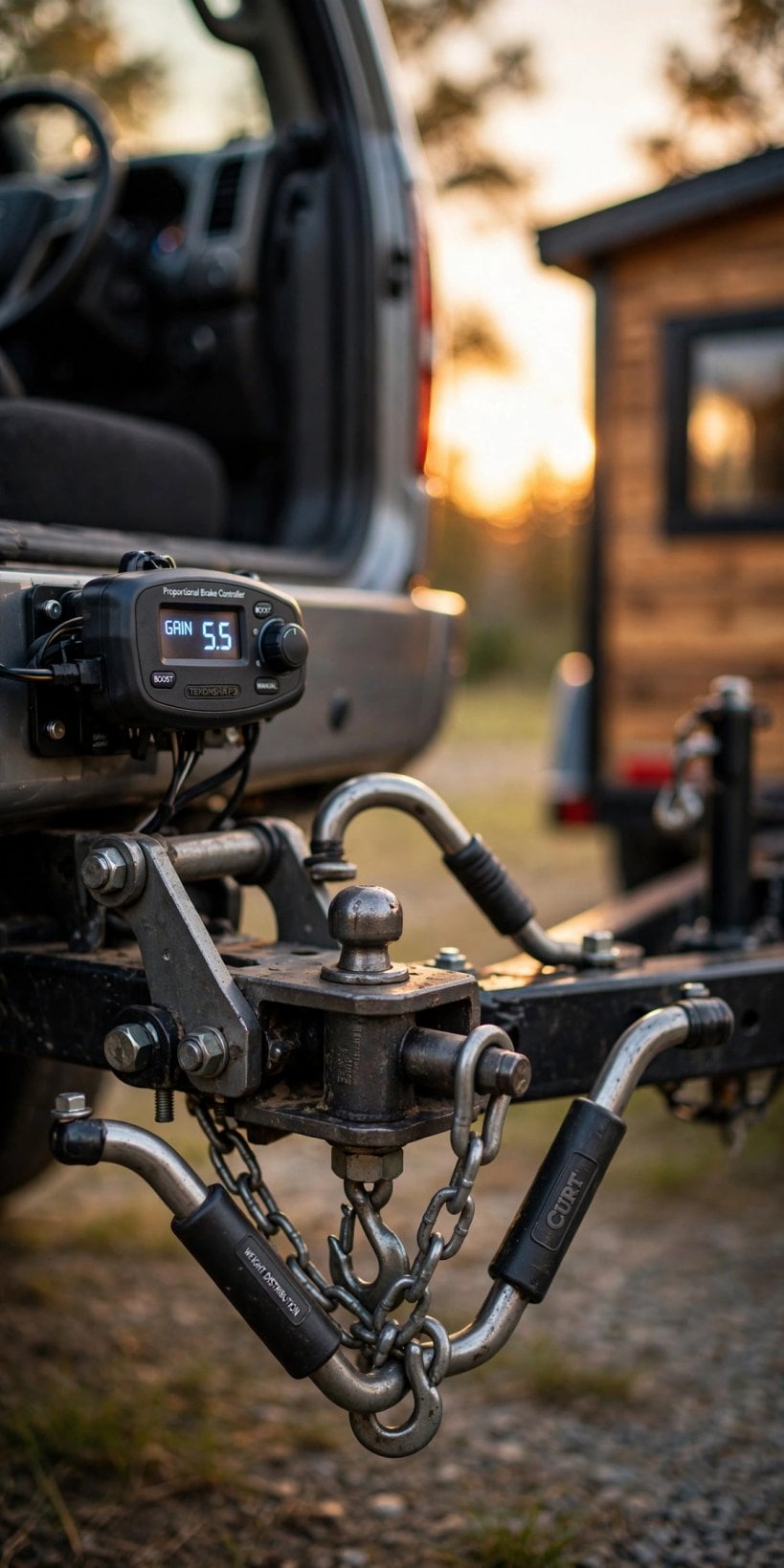
Vision and contact finish the system. Extended tow mirrors are not optional: you must see past the 8’6″-wide house. And truck tires run at max sidewall pressure when towing — the placard pressure is for empty trucks. None of this hardware changes a single rating; all of it is what makes the ratings achievable in practice, because a rig can be legal on paper and still be braked, hitched and shod like an accident waiting for a hill.
9. Legal and Insurance Realities: Licenses, Speed Caps and Weigh Stations
The legal frame around the ratings has its own thresholds. On licensing, most states allow towing up to 26,000 lbs GCWR on a standard license — but verify yours, because some states have lower thresholds or non-commercial Class A requirements. On insurance, disclose the actual trailer GVWR and loaded weight to the insurer: an undisclosed overload can void a claim, which is the financial version of the weigh-station problem. On speed, many states cap trailer towing at 55–65 mph regardless of the posted limit, so know each state’s rule on your route.
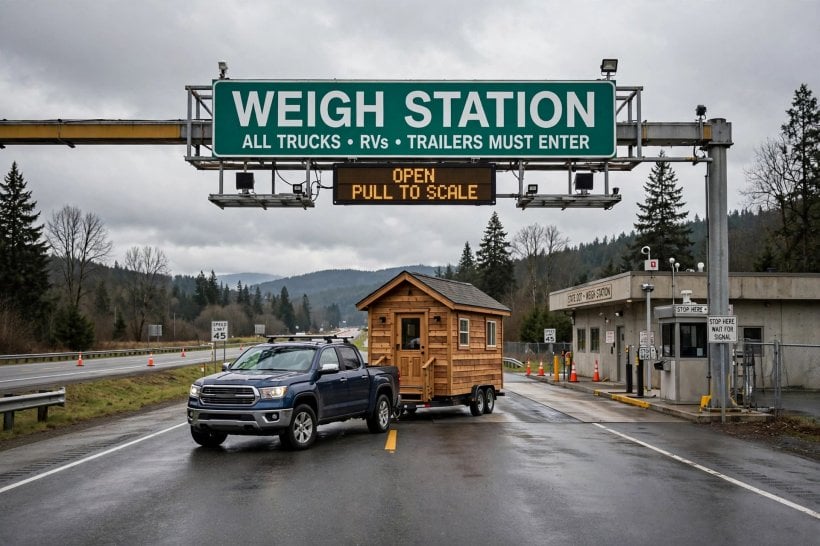
Weigh stations close the loop. Private non-commercial trailers are generally exempt, but commercial-appearing rigs get waved in — so the exemption is no reason to be unable to prove your numbers. The bottom line of the legal side is the same as the mechanical side: the ratings are legal facts, not suggestions. When moving day itself arrives, the logistics of routes, permits and professional transport are covered in the guide to how to transport a tiny house.
10. Weighing the Rig: CAT Scales and the Paper Trail
Everything in this guide converges on one unglamorous practice: weigh the rig, and keep the proof. A CAT scale gives the readings the system runs on — total loaded weight for the GVWR check, per-axle readings for the GAWR balance check — taken in travelling trim, tanks full. The tongue scale settles the 10–15% question in the driveway. Between them, there is no rating in the system you have to take on faith.
The paper trail is the other half of the discipline: build the file — scale tickets, spec sheets — that proves compliance. It is what you hand an insurer when you disclose the actual GVWR and loaded weight, what you show when a commercial-appearing rig gets waved in, and what turns a dispute about an overload from your word against an officer’s into a document check you have already passed. Weigh after every major load change, file the ticket each time, and the four ratings stop being trivia and become the maintained state of the rig.
Final Considerations
GVWR caps the house, GAWR balances it, tongue weight stabilizes it, and the truck’s ratings must swallow all of it with 20% margin. Learn the four numbers, weigh the rig, match the truck honestly, and maintain the brake and hitch systems that make the numbers real. Towing a tiny house is serious motoring — the ratings exist because the physics is unforgiving, and the owners who respect them are the ones whose houses arrive.




3 Comments