

A metal fence gives a garden a crisp, finished edge that timber struggles to match. It stays straight, shrugs off weather and suits everything from a compact townhouse plot to a long rural boundary.
This guide compares layouts, metals, colours and gates, explains what drives the price, and walks through installation and care, so you can plan a fence that looks sharp on day one and still looks sharp years later.
1. Metal Fences at a Glance
If you only read one section, make it this one. The table below collects the decisions that shape every metal fencing project, from the style of panel to the finish that protects it. Most disappointment with a new fence comes from skipping one of these early choices, such as picking a height before checking how much light a garden needs, or choosing a colour before seeing it against the house brickwork.
| Question | Quick Answer |
|---|---|
| Best for | Long-lasting boundaries, front gardens, side returns and secure rear gardens |
| Main layouts | Solid panels, horizontal or vertical slats, pickets, railings and welded mesh |
| Common metals | Galvanised steel, powder-coated aluminium and traditional iron |
| Privacy level | Full privacy from solid or close-slat panels; open views from railings and mesh |
| Typical finish | Powder coating over galvanised metal in black, anthracite, green or custom colours |
| Cost drivers | Metal type, panel style, fence height and length, gates, ground conditions and labour |
| Maintenance | Wash down occasionally, touch up chips promptly, check fixings and gate hinges yearly |
| Before you start | Confirm the boundary line, talk to neighbours, and check local rules on fence heights |
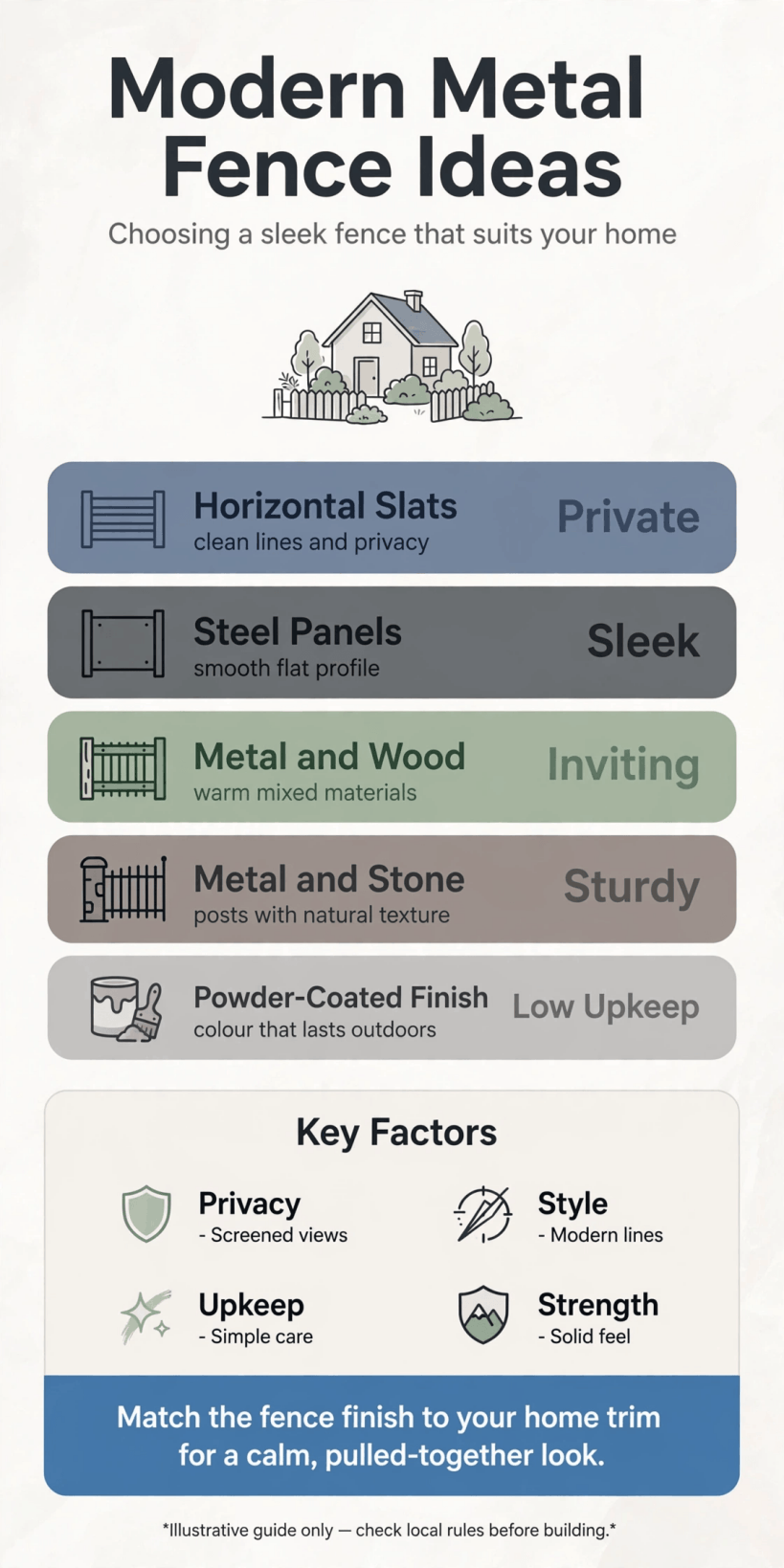
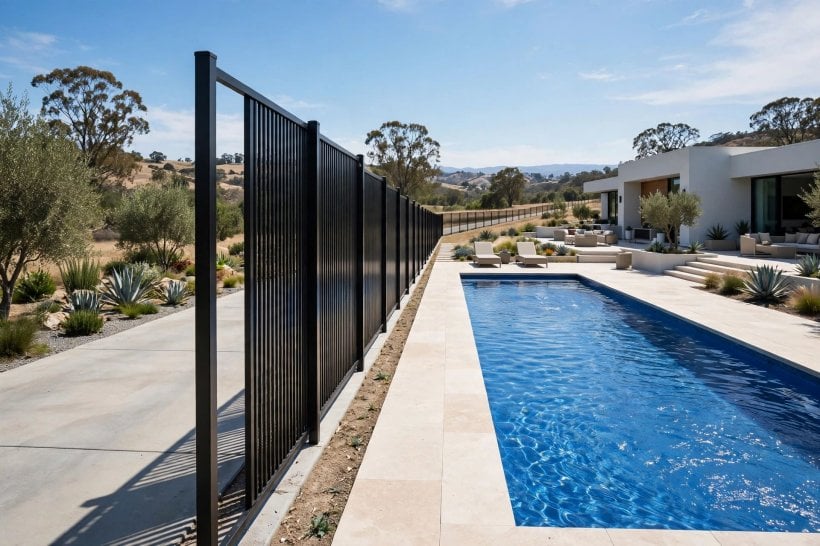
A visual summary of metal fence layouts, materials and finishes to help you compare options quickly.
A fence rarely stands alone in a garden design. It frames planting, lawns and paths, so it helps to think of it alongside the wider plot, much as the projects in our tiny house landscaping ideas treat boundaries as part of the whole outdoor picture rather than an afterthought.
2. Why Choose Metal for a Garden Boundary
Metal’s first advantage is lifespan. A well-made steel or aluminium fence, properly coated, resists the rot, warping and insect damage that shorten the life of timber panels. It also stays true: long runs look straight and tidy because panels are manufactured to consistent sizes and posts hold them rigidly, which is exactly what a contemporary garden scheme needs.
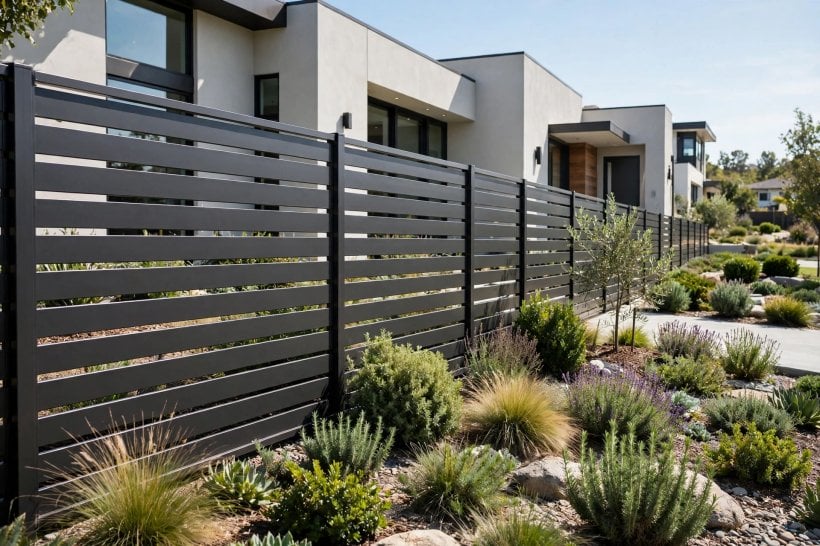
Security is the second advantage. A metal fence is harder to climb than a low timber panel, difficult to cut through quietly, and can be built to heights and strengths that suit everything from keeping a dog in to keeping intruders out. Third comes appearance: slim profiles let more light reach planting, and crisp lines flatter both modern homes and period houses when the style is chosen with care. Finally, metal is recyclable and widely recycled, and because it lasts, it avoids the replacement cycle of cheaper materials. Against that, weigh the honest drawbacks: metal costs more upfront than basic timber, solid panels can feel stark without planting to soften them, and a poor-quality coating will eventually show rust at chips and fixings, so buy the best-protected system your budget allows.
3. Panel, Picket, Slat and Mesh Layouts
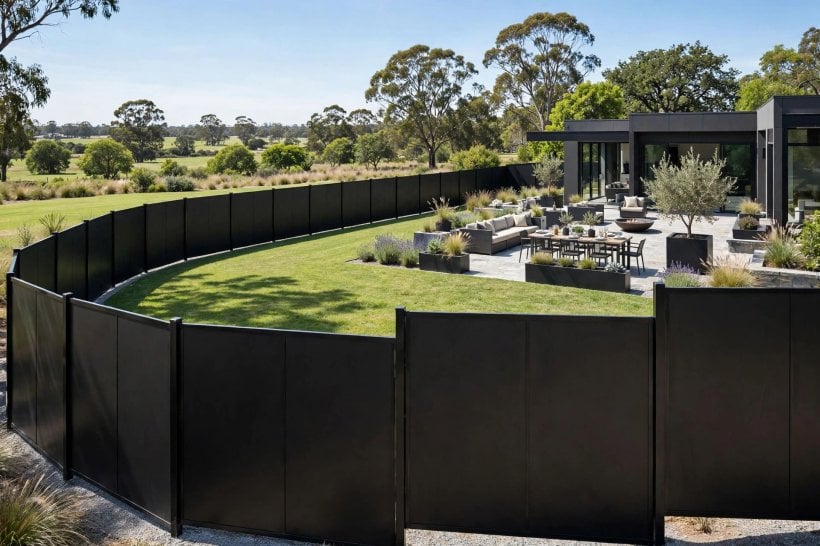
Layout decides how your fence looks, how private it feels and how much wind it catches. Solid panels give complete screening and a calm, plain backdrop for planting, and they are the go-to choice for rear gardens overlooked by neighbours. Their weakness is wind load: a long solid run acts like a sail, so posts and fixings must be up to the job, especially in exposed spots.
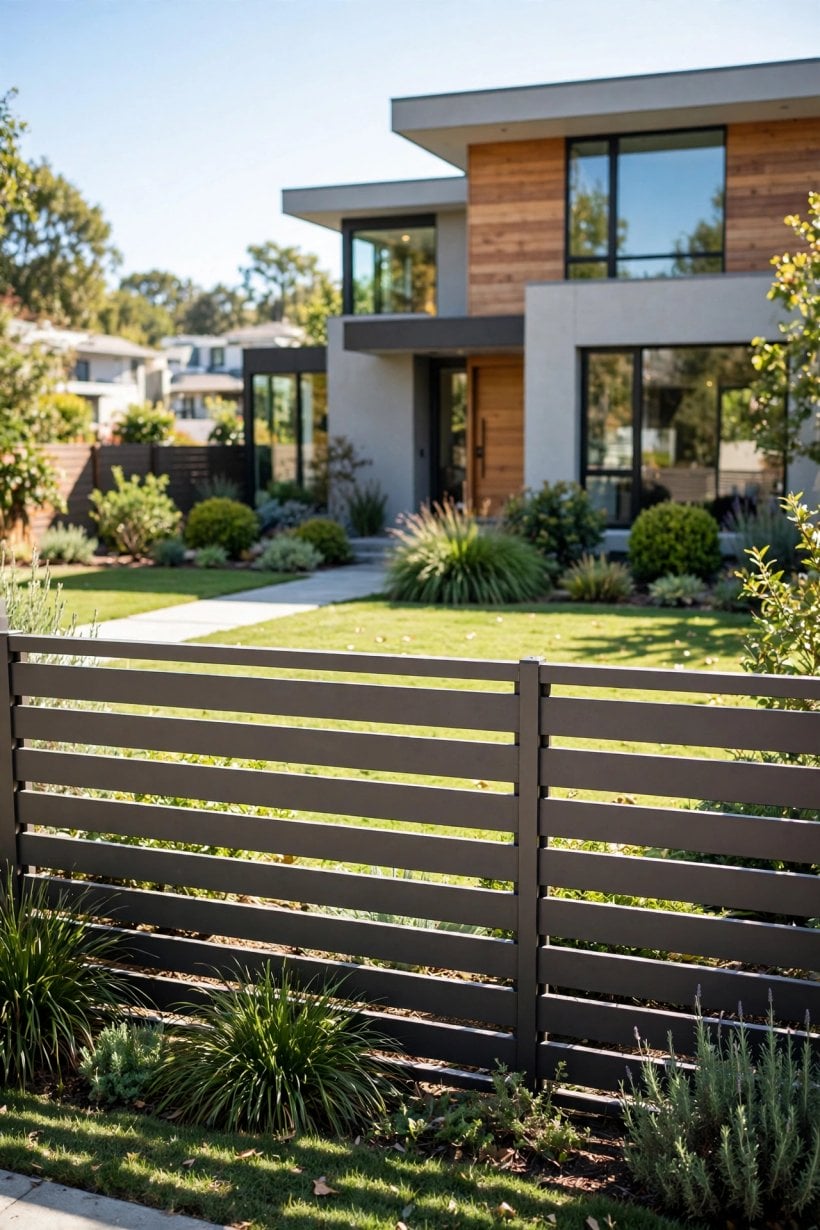
Slatted layouts, horizontal or vertical, are the signature look of a modern metal fence: narrow gaps between slats filter light, soften the barrier and let some air through, which eases wind pressure while keeping privacy high. Picket and railing styles suit front gardens, where a lower, more open fence keeps sightlines friendly and shows off planting, and they pair naturally with a matching gate. Welded mesh is the utility player, strong, discreet and ideal where you want security without visual bulk, such as around a vegetable plot or along a boundary hidden by hedging. Mix layouts along one plot if it helps: solid panels beside the patio, slats along the side return and railings at the front often give the best balance of privacy, light and cost.
4. Steel, Aluminium and Iron Compared
Steel is the workhorse. Galvanised steel panels and posts are strong, widely available and keenly priced for the strength they offer, and powder coating over the galvanised layer gives colour plus a second line of defence against rust. Steel suits long runs, tall privacy fences and matching gates, though it is heavy, so posts and foundations must be sized properly.
Aluminium is the lightweight alternative. It never rusts, which makes it a favourite in coastal gardens where salt air attacks lesser metals, and its lighter panels are easier to handle on a DIY install. It usually costs more than steel for a similar look and feels less rigid in very tall panels, so check the panel construction. Traditional iron, whether genuine wrought iron or steel made to look like it, brings heritage character to period homes, with spear-top railings that timber cannot imitate; it is the heaviest and often the priciest route, and it needs its paint maintained. Whichever metal you choose, ask how edges, welds and fixings are protected, because fences usually corrode at cuts and joints first, not in the middle of a panel. The material-first thinking here echoes the approach in our guide to building your own tiny house.
5. Colours and Powder-Coated Finishes
Powder coating transformed metal fencing. A dry powder is applied to the prepared metal and baked into a smooth, even skin that resists fading and chipping far better than a coat of paint brushed on at home. It also opens up colour: alongside the classics of black, anthracite grey and deep green, many systems offer browns, creams and custom shades matched to window frames or render.
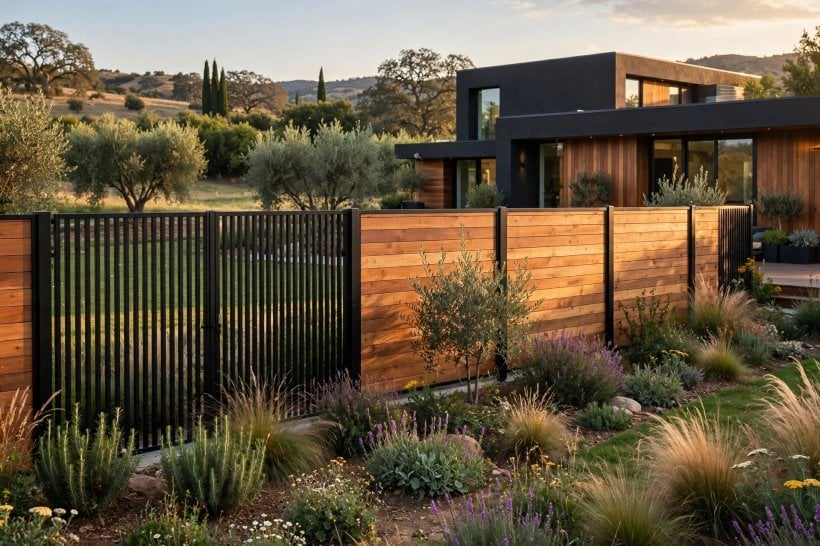
Choosing well is about context. Black disappears against planting and makes foliage look greener, which is why it dominates contemporary schemes. Anthracite is softer than black and flatters pale paving and grey stone. Green blends into rural and leafy settings, while a colour matched to the house, such as the exact grey of the window frames, makes a fence feel architect-designed rather than added on. Order a sample panel or swatch and look at it outdoors at different times of day, against brick, render and leaves, before ordering a whole run. Remember that dark colours show dust and pollen more in spring, and that a satin finish hides marks better than a high gloss. If your wider scheme leans bold, the palettes in our colourful tiny house interior ideas show how confident colour works when it is repeated with intent.
6. Heights, Privacy and Light
Height is a balancing act between privacy, light and neighbourliness. A tall fence around a rear garden gives real seclusion for a patio or hot tub corner, but the same fence on a south-facing boundary can shade planting and make a small garden feel enclosed. Start by standing where you actually sit outside and judging what you need to screen: often a slightly lower fence plus a pergola, a tree or tall planting over the seating area gives privacy with a lighter feel.
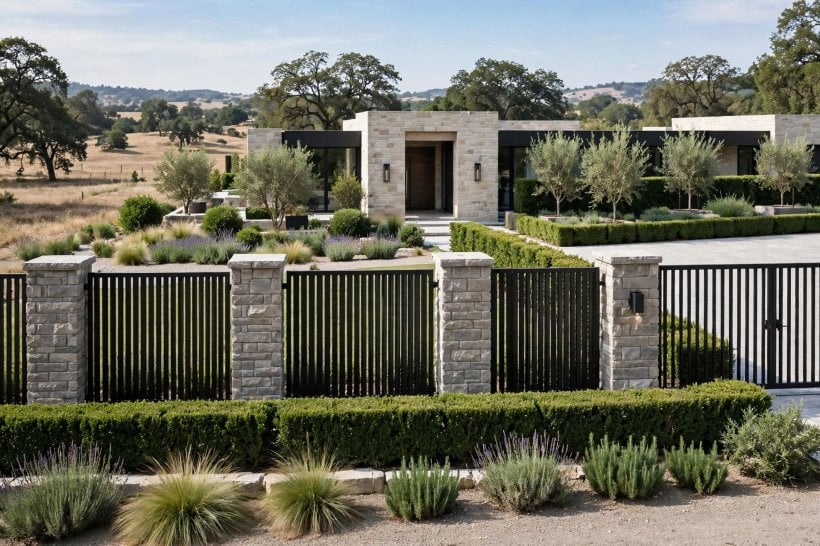
Front gardens usually call for lower fences that preserve the open, friendly character of a street and keep sightlines clear where drives meet the pavement. Rules about fence heights, especially beside a road or footpath, vary by place, so check your local authority’s guidance before ordering tall panels, and talk to neighbours early; a fence both households are happy with causes no friction later. Also think about the view from inside the house, in the way you would with the rooms in our tiny house living room ideas: a slatted top section above solid panels is a neat compromise, adding screening at seated eye level while letting low sun filter through in the evening.
7. Posts, Fixings and Gates
A fence is only as good as its posts. Metal posts set in concrete are the standard for strength, spaced to suit the panel width, with the depth and footing size matched to the fence height and how exposed the site is. On solid ground such as a patio or a wall top, bolt-down posts on base plates can work, but only where the surface and fixings are genuinely strong enough for the wind load the fence will catch.
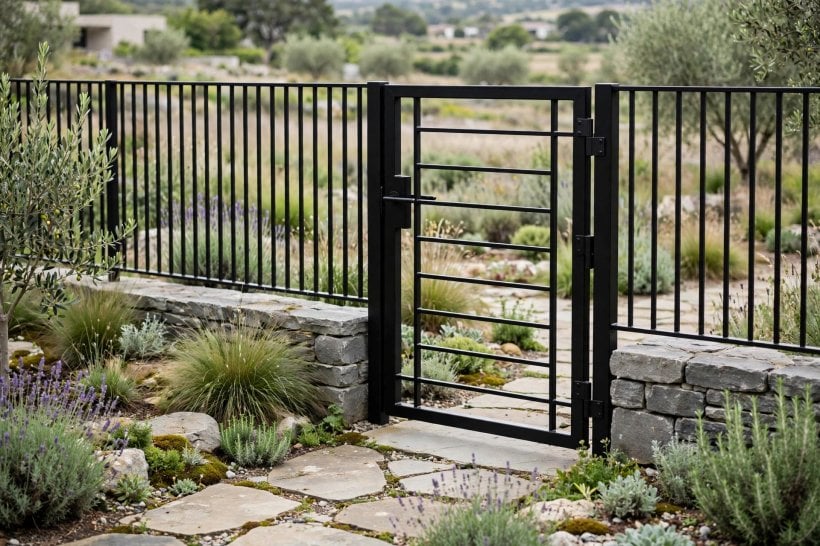
Gates deserve the same care as the fence itself. A matching metal gate keeps the design coherent and the security consistent, and it needs a frame and hinges rated for its weight, a latch that suits who uses it, and a lock if the gate guards a side return or rear access. Allow for how the gate swings, keep the swing clear of bins and bikes, and consider a self-closing hinge where children or dogs pass through. Small details finish the job: post caps keep water out of hollow posts, cover strips hide panel fixings for a cleaner line, and gravel boards or a low plinth at the base stop soil and mulch piling against the metal. These are the unglamorous parts that decide whether a fence still feels solid in ten years, much like the joinery details in our tiny barn house interior ideas.
8. Costs and What Drives the Price
Metal fencing prices vary widely, and understanding the drivers helps you compare quotes fairly. The first driver is the system itself: basic mesh and simple railing panels sit at the affordable end, slatted and solid privacy panels cost more, and bespoke sizes, decorative details and matching gates add further cost. Aluminium generally costs more than a comparable steel system, and heritage-style ironwork more again.
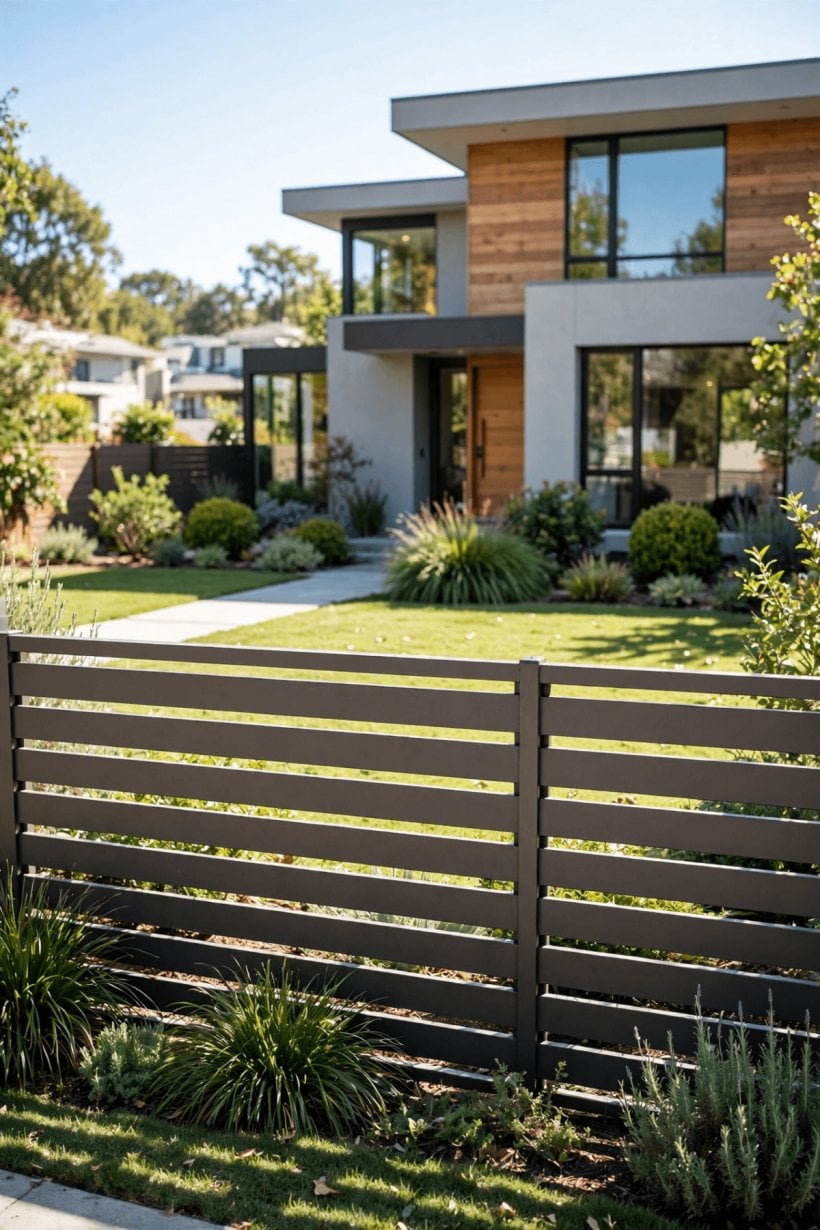
Scale is the second driver: cost rises with length, obviously, but also with height, because taller fences need more material and stronger posts and footings. Gates are a third driver, since a well-made gate with quality hinges and a lock can cost as much as several plain panels. Ground conditions and access make the fourth: sloping plots need stepped or raked panels, old fences need removing and disposing of, and restricted access slows labour. Finally, installation itself: a straightforward run on level ground is the cheapest to fit, while complex layouts with corners, steps and multiple gates take longer. Ask for itemised quotes that separate materials, gates, groundwork and labour, and check what protection the coating carries and what the supplier’s guarantee actually covers, rather than choosing on the headline figure alone.
9. Installing a Metal Fence Step by Step
Good installation starts before a single hole is dug. Confirm exactly where the boundary runs and that the fence will sit on your side of it, mark underground services if you know of any, and agree the plan with neighbours whose gardens you will overlook while working. Then set out the line with string, mark post positions to match the panel sizes in your system, and check levels across the run so you can plan steps on sloping ground.
Dig post holes to the depth your system specifies, set the first post plumb in concrete, and work panel by panel, checking each post for plumb and each panel for level as you go rather than hoping to adjust at the end. On a slope, step panels in even increments so the fence top looks deliberate. Fit gates last, once the adjoining posts have fully set, and adjust hinges so the gate swings freely and latches without lifting. Common mistakes include posts set too shallow for the fence height, panels forced to fit mis-measured bays, and gates hung before the concrete has cured. None of this is beyond a careful DIYer for a modest run, but tall, long or sloping fences repay professional fitting, in the same spirit as the measured planning behind our tiny house bedroom ideas.
10. Care, Rust Prevention and Repairs
Metal fencing is low maintenance, not no maintenance. A wash down with soapy water once or twice a year removes the grime and salt that sit on coatings, and a rinse keeps dark colours looking deep rather than dusty. Pay attention to the base of panels and posts, where soil, mulch and leaf litter trap moisture against the metal, and keep that zone clear.
Chips and scratches are the one thing to act on quickly. Where a coating is broken, clean the spot, and touch it in with the paint or touch-up product your supplier recommends, so corrosion cannot get a foothold under the surrounding coating. Check hinges, latches and fixings yearly, tighten anything that has worked loose, and add a drop of suitable lubricant to gate hinges that squeak. If a panel is damaged by an accident, most modular systems let you replace a single bay without disturbing the rest of the run, which is a quiet advantage over one-piece fencing. With that light routine, a quality metal fence should protect its looks for many years, much like the simple upkeep that keeps the hardworking spaces in our tiny house bathroom ideas at their best.
Final Considerations
Choose the layout for how you live, the metal for your site, and the colour for your house and planting, then spend what is needed on posts, footings and a matching gate, because those are the parts that make a fence feel permanent. Check the boundary and the local height guidance before you order, get itemised quotes, and plan a small yearly care routine from the start. Do that, and a metal fence stops being a mere boundary and becomes the crisp, calm frame that makes the whole garden look intentional.

0 Comments