

The modern wooden fence is where the garden’s oldest job — marking the boundary — learned the house’s newest language: long horizontal lines, honest timber, gaps measured in millimetres of intention. It does everything a fence has ever done, privacy, shelter, a back wall for the garden’s rooms, and it does it looking like architecture rather than apology.
This page keeps to the modern wooden fence itself: its slatted and boarded faces, its timbers and finishes, its posts and gates. The gate’s own wider family is gathered on the gate ideas page and the drive’s arrival is treated elsewhere; here the subject is the boundary line itself, drawn in wood and drawn clean.
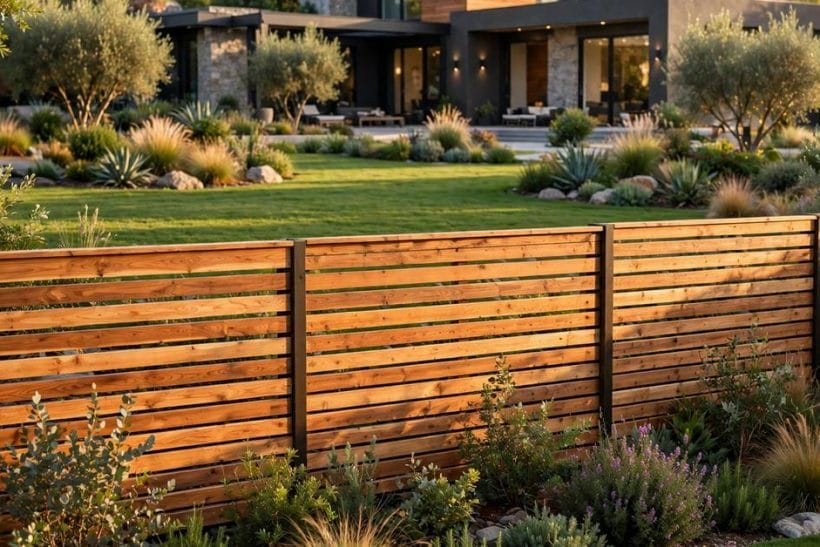
1. Modern Fence Ideas at a Glance
A modern wooden fence is a boundary fence built in the contemporary manner: horizontal or vertical boards and slats with deliberate spacing, minimal visible fixings, durable timber or timber-look boards, and finishes that run from natural silvered wood to deep architectural stains. Its working parts are the posts, the rails they carry, the boards that make the face, and the gate that punctures it. It is the garden’s enclosing member, related to the driveway‘s edging and the patio’s screens, and it sets the backdrop against which the whole garden is read.
| Question | Short answer |
|---|---|
| What makes a fence ‘modern’ rather than traditional? | Line and restraint. Horizontal slats or flat boards with even, deliberate gaps; square posts; fixings hidden or disciplined; a finish chosen as architecture. The traditional fence laps and weaves; the modern fence draws straight lines and lets the timber’s grain supply the pattern. |
| How private is a slatted modern fence? | As private as its gaps decide. Shadow-gap slats with narrow spacing read as solid from most angles while passing air and a little light; wider spacing trades privacy for openness deliberately. The angle of view matters — slats that are private from the street may be open from a neighbour’s upper window, which is a planning question, not a surprise. |
| What timber suits a modern fence best? | Durable, stable boards that stay straight: the classic fencing timbers, thermally treated boards and quality composites all serve. Straightness is the modern fence’s whole aesthetic — a warped board in a lapped fence is character; in a slatted fence it is a headline. |
| Who owns the boundary, and whose fence is it? | It varies by deed, by custom and by place, and it is the first thing to establish — with the deeds and a neighbourly conversation — before any fence is designed. Heights, too, are commonly governed by local rules; the modern fence’s clean top line makes its height very visible, so the conversation happens first. |
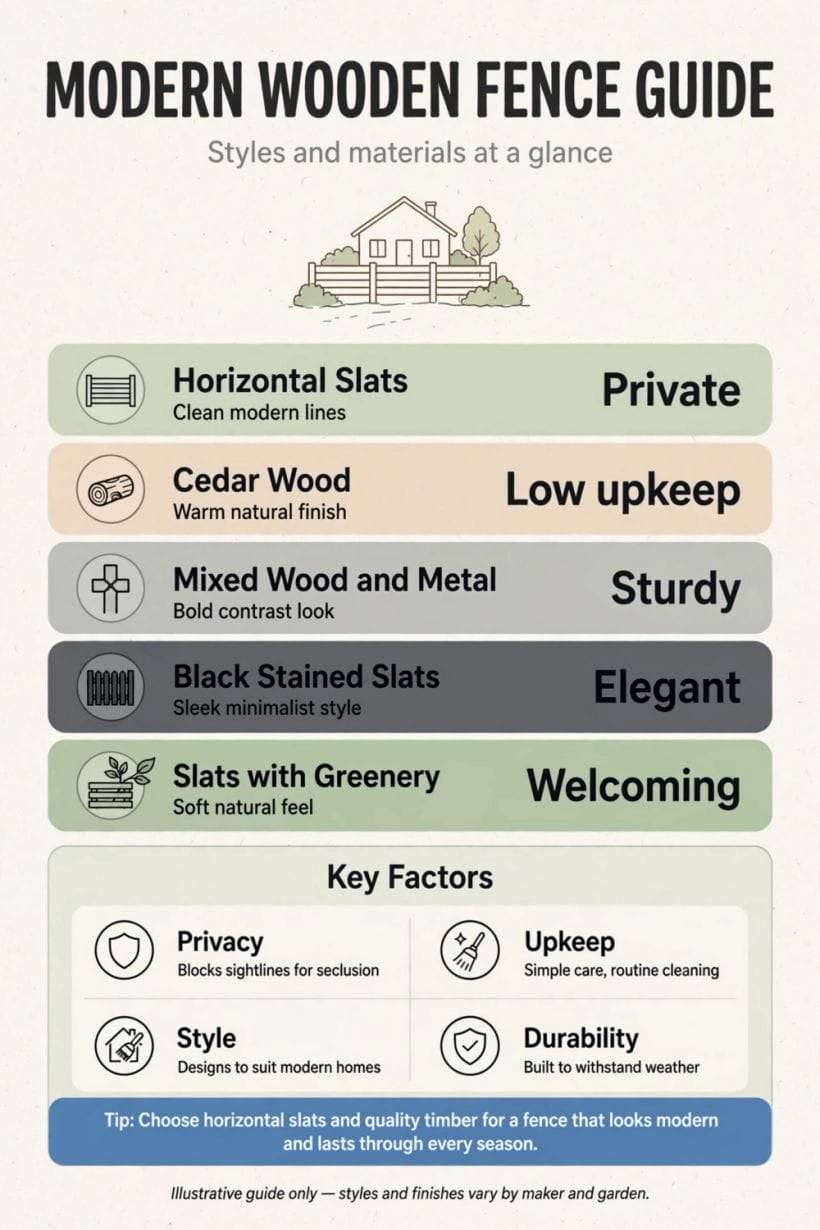
2. Reading the Boundary: What the Modern Fence Must Do
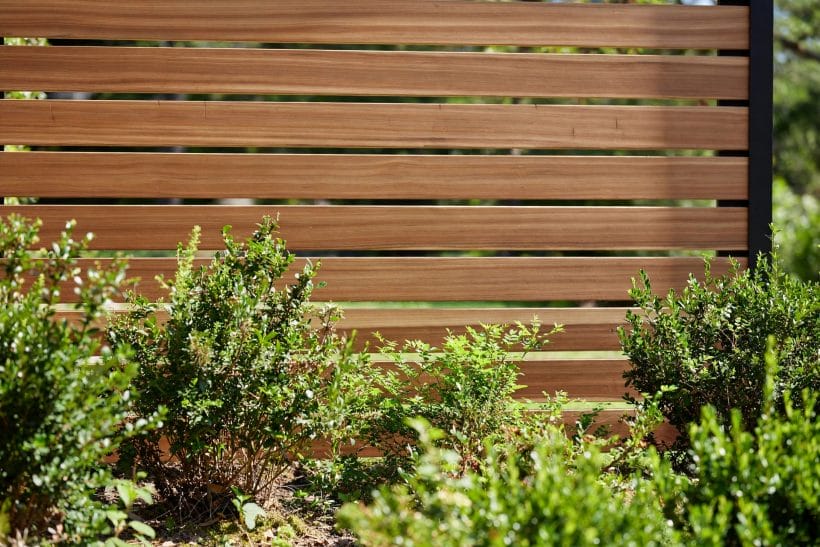
Before a single board is chosen, the boundary itself is read like a brief. Height for privacy, gaps for light, a face for the street and a kinder face for the garden: the modern fence is designed from its duties outward, and this section takes the duties in order.
1. Walk the boundary and list its four jobs
Privacy from the street, shelter from the wind, a backdrop for planting, a keeper of children and dogs: most boundaries are hired for two or three of these and blamed for all four.
2. Decide which face is the public one
A fence has two faces and they need not match. The street side carries the house’s manners — even, finished, maintained; the garden side carries the planting and the furniture.
3. Set the height by the sightline it must break
Privacy is geometry: the seated eye in the garden, the standing eye on the pavement, the neighbour’s upper window.
4. Choose the gap policy: solid, shadow or screen
Solid boarding for the exposed corner, shadow-gap slats for the long run, an open screen where the garden borrows a view: a single fence can change its policy along its length, and the modern manner — disciplined lines throughout — is exactly what lets it do so without looking indecisive.
5. Respect the rules before respecting the design
Boundary heights and front-garden enclosures are governed in many places, and front fences most of all.
6. Talk to the neighbours before the posts go in
A fence announced is a fence forgiven; a fence surprised is a feud with a top rail.
7. Plan the fence with the garden’s rooms, not against them
The fence is the garden’s outer wall, and its sections serve the rooms inside: solid behind the seating, slatted where the border wants light, open where the view is borrowed.
8. Let the front fence make its promise lower
The front boundary sells the house to the street: lower, more open, more finished than the back, in dialogue with the front yard landscaping it frames. A modern front fence in fine timber at a courteous height is the neighbourhood’s favourite kind of showing off.
9. Decide the fence’s relationship with the house’s architecture
Echo the house’s horizontal siding, its window rhythm, its stain colour, and the fence reads as the building’s own extension. Ignore the house entirely and the fence reads as a billboard that wandered in.
10. Give the boundary a gate policy as well as a fence policy
Where people, bins, bikes and mowers pass decides the gates, and the gates decide the posts’ strength and the fence’s breaks.
11. Survey the ground: slopes, roots and buried services
Boundaries run over tree roots, across slopes and above pipes and cables more often than any other garden line.
3. Horizontal Slats: The Modern Fence’s Signature
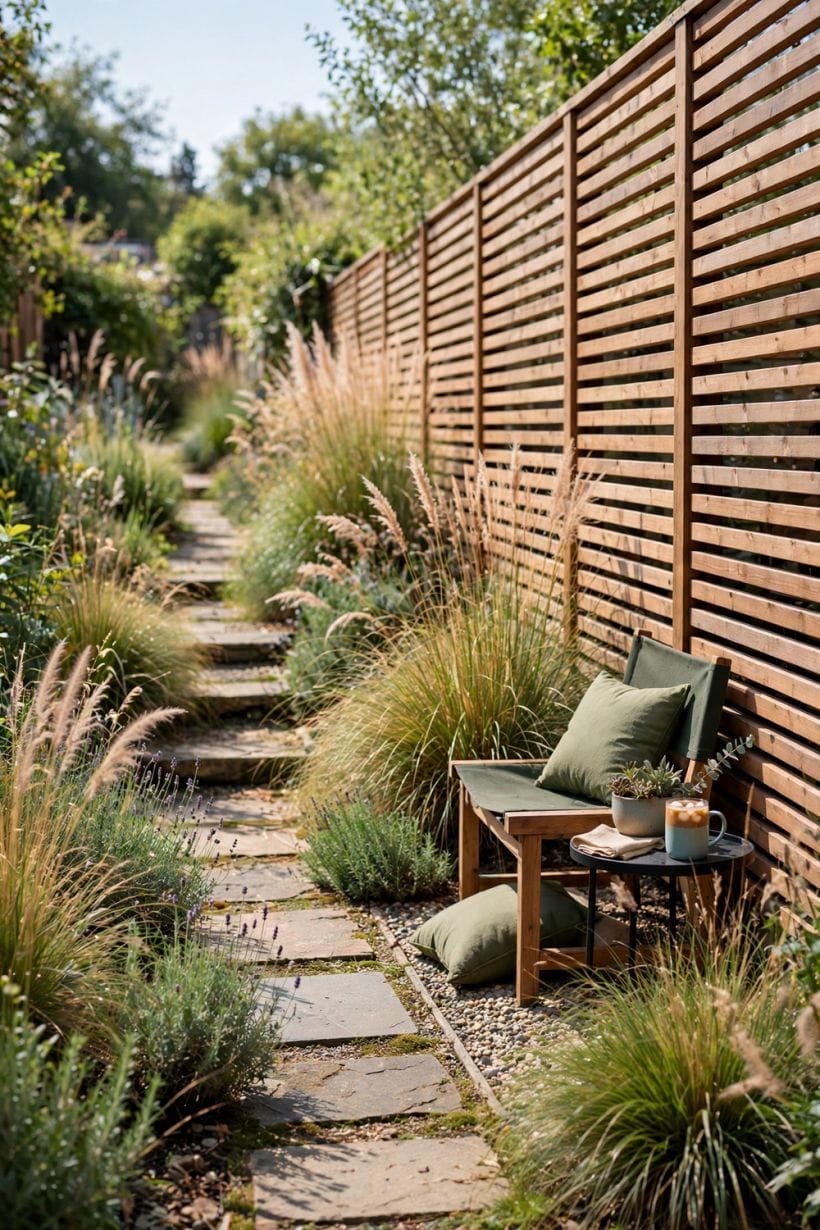
The horizontal slat is the modern fence’s handwriting: long boards running level, with even shadow gaps that draw lines of light along the boundary. It is the most demanding face to build — every unevenness is announced — and the most rewarding, because it makes the smallest garden read as designed space.
12. Run the slats level and let the eye travel
The horizontal line’s whole gift is calm: the eye follows it the length of the garden and the space feels longer, lower, more composed.
13. Keep the shadow gaps even and deliberate
The narrow gap between slats is the style’s punctuation: even, shadowed, breathing. Set with spacers and kept identical the whole run, it reads as intention; wandering gaps read as haste.
14. Choose slat width for the fence’s proportion
Wide slats read calm and architectural; narrow slats read fine and busy.
15. Break long runs with a post rhythm
Even a continuous slatted fence is read in bays.
16. Step the slats on a slope rather than raking them
Two honest answers serve a slope: the top stepping down in level bays like a staircase, or the whole run raked to follow the ground.
17. Let corner details carry the craft
Corners are where slatted fences are judged: mitred, butted with a cover batten, or turned around a corner post with the gaps unbroken.
18. Use double-sided slats where both faces are loved
Where the boundary is admired from both sides — the shared garden, the corner plot — slats fixed alternately or on a central rail give both faces the finished pattern.
19. Pair slats with a solid lower section where life is lived hard
Dogs, footballs and mower wheels all argue with the bottom of a fence.
20. Hide the fixings or make them a pattern
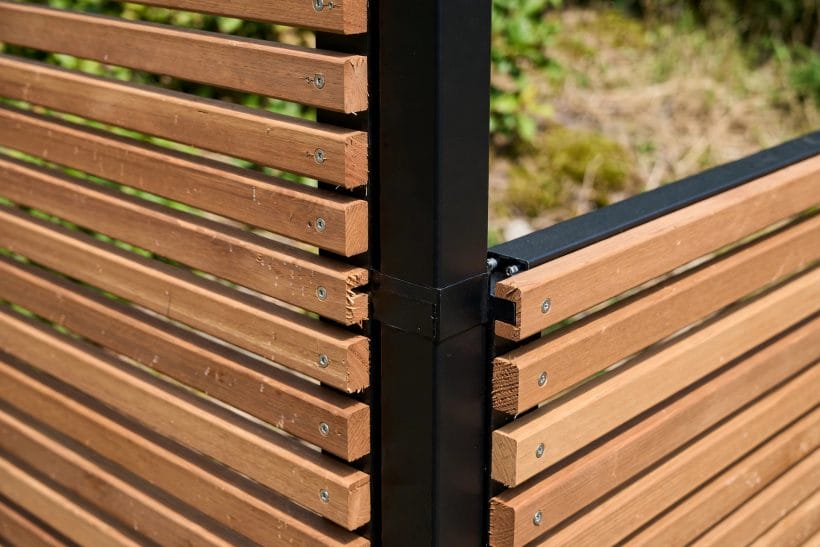
Screws marching along every slat end the modern spell; fixings from behind, or shadow-fixed rails, keep the face clean. Where screws must show, they are stainless, aligned and counted like rivets on a bridge — a pattern, not an apology.
21. Finish the slats’ ends like furniture
End grain drinks weather.
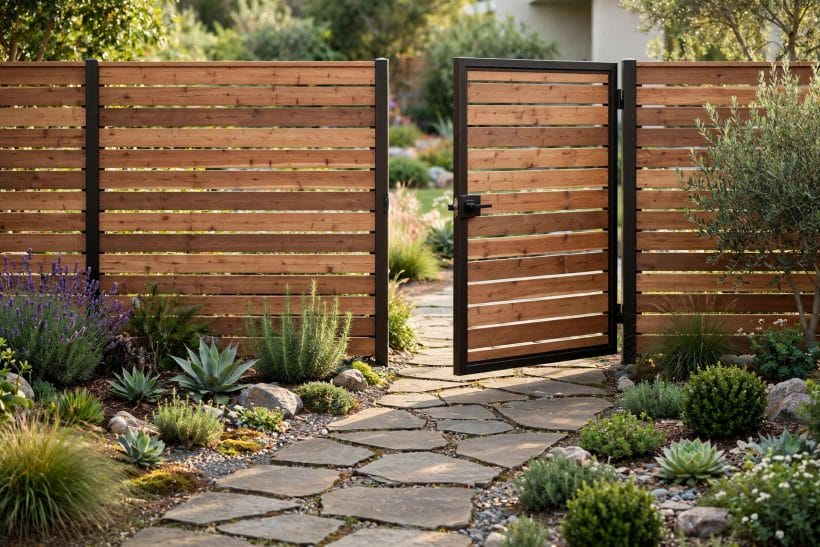
22. Let one slatted section be the garden’s feature wall
Behind the seating, at the end of the view from the kitchen window, one run of perfect slats in the garden’s best timber does the work of art.
4. Boards, Battens and Vertical Variations
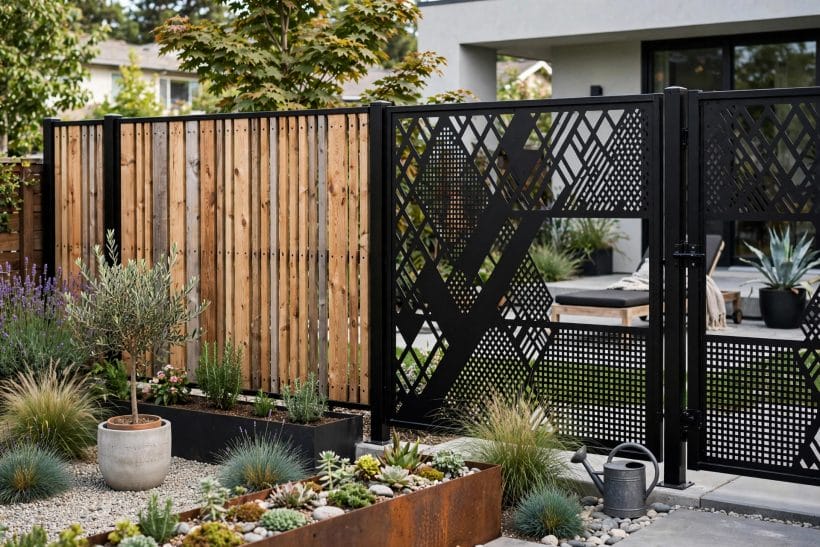
Not every modern fence runs horizontal. Vertical boards — flat, board-and-batten, or in feathered rhythms of width — give the boundary height and formality, suit narrow plots, and answer slopes with less ceremony. This section covers the upright variations and where each earns its place.
23. Run vertical boards for height in a narrow garden
Vertical lines lift the eye and make a short boundary feel tall and a narrow garden feel composed. In the small urban plot, vertical boarding is often the truer modern: denser, quieter, and kinder to the planting that leans against it.
24. Use board-and-batten for texture with discipline
Wide boards covered at their joins by slim battens give the modern fence its crafted texture: shadow lines in a steady rhythm, movement in the timber hidden by the battens’ overlap.
25. Alternate board widths for a composed rhythm
Boards in a repeating pattern of widths — wide, narrow, wide — give a plain fence the order of music without a single ornament. The rhythm must repeat exactly; the modern eye forgives plainness instantly and irregularity never.
26. Feather the boards’ tops or keep the line dead level
A level top line is the modern signature; a softened, undulating top is a cottage in modern dress.
27. Mix a boarded lower run with an open upper screen
Solid to seated-eye height, open above: the combination serves privacy where the garden sits and openness where the sky begins.
28. Let verticals meet the slope by stepping the bays
Vertical boards step down a slope in level bays more gracefully than any other face, each bay a clean rectangle.
29. Use reeded and grooved boards for a fine, quiet face
Boards milled with fine vertical grooves catch light in stripes and make a plain fence feel woven. The texture is subtle from the street and rich from the garden chair — the modern fence’s way of being interesting without being loud.
30. Pair timber boarding with black metal posts for the hybrid line
Steel posts, timber boards: the hybrid fence borrows the metal’s slenderness and the wood’s warmth, and its bays read as framed panels. It is the boundary for houses whose architecture already mixes the two materials, from the pool fence to the front screen.
31. Board the bins and the meters into the fence’s own architecture
The modern fence earns its keep by hiding the garden’s machinery: bin stores, meter boxes and bike shelters built in the same boards, with the same gaps and finish, disappear into the boundary.
32. Give a boarded fence one deliberate opening: the borrowed view
A single framed gap, a slatted window at seated height, a section lowered to a hedge: the deliberate opening turns a wall into a composition and borrows the landscape beyond.
33. Cap the top with a rail that sheds water and finishes the line
A top cap — a slightly proud rail, a metal flashing, a bevelled board — throws the rain off the boards’ end grain and draws the fence’s final line in one stroke.
5. Timber, Finishes and the Weather’s Share
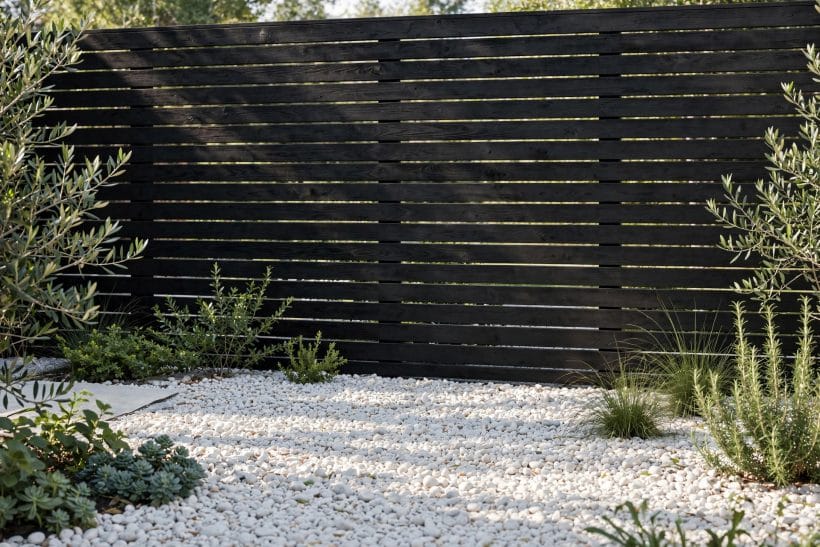
A wooden fence is a promise made to the weather, and the finish is how the promise is kept. This section covers the timbers that stay straight, the stains that hold their colour, the silvering that needs nothing at all, and the honest maintenance rhythm that keeps a modern fence modern.
34. Choose timber that stays straight above all virtues
The modern face is a straightness contest. Slow-grown, well-seasoned boards, the durable softwoods treated for ground-line duty, the naturally oily hardwoods for feature runs: whichever the budget chooses, its boards are sighted down their length before purchase like rifle barrels.
35. Let cedar and its cousins silver gracefully if the house agrees
Left alone, the durable fencing timbers weather to a silver-grey that sits beautifully against green planting and grey stone.
36. Stain deep for the architectural fence
Charcoal, near-black and deep brown stains turn the fence into the garden’s dark backdrop, against which green planting photographs itself.
37. Use warm mid-tones where the garden is the colour
Where borders blaze and lawns glow, the fence’s best service is a warm, quiet mid-tone that recedes.
38. Protect the end grain and the ground line first
Fences die at the bottom and the ends: end grain drinking at every cut, the ground line rotting in the damp.
39. Treat the cut ends on the day, not in the memoir
Every board cut on site exposes untreated heartwood. The preservative pot travels with the saw, and ends are dipped before they are fixed — a discipline measured in seconds per board and in decades per fence.
40. Expect the first year’s movement and design for it
New timber shrinks, settles and shows its gaps’ true widths by the second season.
41. Refresh finishes on a rhythm the calendar owns
Stains and oils want their season: a wash, a check of fixings, a coat where the sun has argued hardest.
42. Match the fence’s finish to the deck, gate and furniture family
One timber language across the garden — fence, gate, deck boards and the bench — makes modest materials read as a scheme. The finishes need not be identical twins; cousins are enough, and the garden’s whole carpentry budget looks doubled by the kinship.
43. Test the finish on the offcut, in the garden’s own light
Stain colours lie in the tin and confess on the wood. The offcut test — brushed, dried, stood against the planting at noon and dusk — is the five minutes that prevents five years of the wrong brown.
44. Plan a sacrificial board or two into the design
The run beside the gate, the bay behind the football goal: somewhere the fence will be kicked, scuffed and ridden into. Boards there fixed for easy single replacement turn damage into a half-hour’s errand instead of a craftsman’s visit.
6. Posts, Rails and the Hidden Structure
The modern fence’s face gets the photographs; its skeleton gets the decades. Posts that stand plumb in proper footings, rails that do not sag, fixings that do not stain — this section builds the part of the fence nobody sees, which is precisely why it decides everything.
45. Set the posts like the fence depends on them, because it does
Posts carry the whole composition: their depth, their footing and their plumb line are the fence.
46. Choose post material for the ground it stands in
Timber posts treated for ground contact, steel posts in the wet corner, concrete where the soil is kind to nothing: the choice is made per boundary’s conditions, and mixing honestly where the ground changes is engineering, not indecision.
47. Cap every post against the weather’s favourite entry
A post top is a flat cup offered to the rain. Caps — timber, metal, or the post’s own bevel — shed it, and they give the fence’s skyline its punctuation.
48. Keep the rails level and the bays honest
Rails carry the boards, and a rail that sags telegraphs through every slat.
49. Use concealed rails for the cleanest modern faces
Rails tucked behind the boards, or the boards fixed to a frame the garden side never sees, give the street face its unbroken lines.
50. Space fixings like a pattern and use stainless where it shows
Visible screws are jewellery or litter, decided by their alignment. Stainless fixings near the coast and in the durable hardwoods prevent the black tear-stains that bleed down pale boards — a five-pound decision that saves the fence’s whole face.
51. Mind the gate posts twice: they work for a living
The gate’s posts take the swing, the slam and the leaning child. They are set deeper, braced harder and chosen stouter than the run’s — and the fence’s design leaves their extra substance looking deliberate rather than apologetic.
52. Let expansion live in the fixings, not the face
Timber moves across its width with the seasons.
53. Build one bay to be removable for the garden’s great days
Sofas, hot tubs, the occasional piano: gardens receive large guests rarely but surely.
54. Anchor the fence against the wind it will actually meet
A solid modern face is a sail, and exposed boundaries take the storm’s whole argument through their posts.
55. Straighten the line with a string and forgive nothing
The string line is the fence builder’s conscience: posts set to it, tops checked against it, the whole run read from its far end before the boards go on.
7. Gates, Corners and Meeting the House
A fence is interrupted by life at its gates and terminated by architecture at its ends. The gate in a modern fence is a moving piece of the same composition; the corners and house junctions are where fences are either tailored or abandoned. This section fits the interruptions.
56. Build the gate as the fence’s moving bay
Same boards, same gaps, same finish, on a frame that keeps it true: the modern gate disappears into the run when closed, which is its party trick.
57. Frame the gate for the slam it will actually receive
Gates are closed by children, weather and hurry. A braced frame, honest hinges and a latch that catches at a push are the gate’s whole engineering; elegance is what remains when the slam has been survived ten thousand times.
58. Give the everyday gate the everyday position
The gate used twenty times a day — to the bins, the car, the street — belongs on that route exactly, even where a grander position tempts.
59. Let the wide gate be two leaves in one composition
Vehicle and mower access wants width: a pair of leaves in the fence’s own boards, meeting on a centre post that removes for the great occasions.
60. Finish corners with the mitre, the batten or the post — chosen once
The corner treatment chosen in the slats section is executed here without improvisation: the mitred wrap for the tailored garden, the cover batten for the crafted one, the honest corner post for the architectural.
61. Meet the house wall with a flashed, deliberate junction
Where the fence lands on the house, a wall plate, a flashing and a board that finishes clean against the masonry make the junction read as building, not collision.
62. Meet a hedge or a wall with a designed handshake
Fences rarely run the whole boundary: they hand over to hedges, walls and older fences.
63. Light the gate’s latch side for the night arrival
One small light at the working gate — on the house’s path light circuit or a solar fitting — serves the key, the latch and the visitor’s confidence.
64. Keep the numbers, bell and post box in the composition
The front fence carries the house’s administration: numbers, letter box, the occasional bell.
65. Plant the gate’s swing before planting the gate’s garden
The gate’s arc is a no-planting zone drawn on the plan, however seductive the empty corner looks in spring.
8. Planting Against the Fence, Privacy and the Long Term
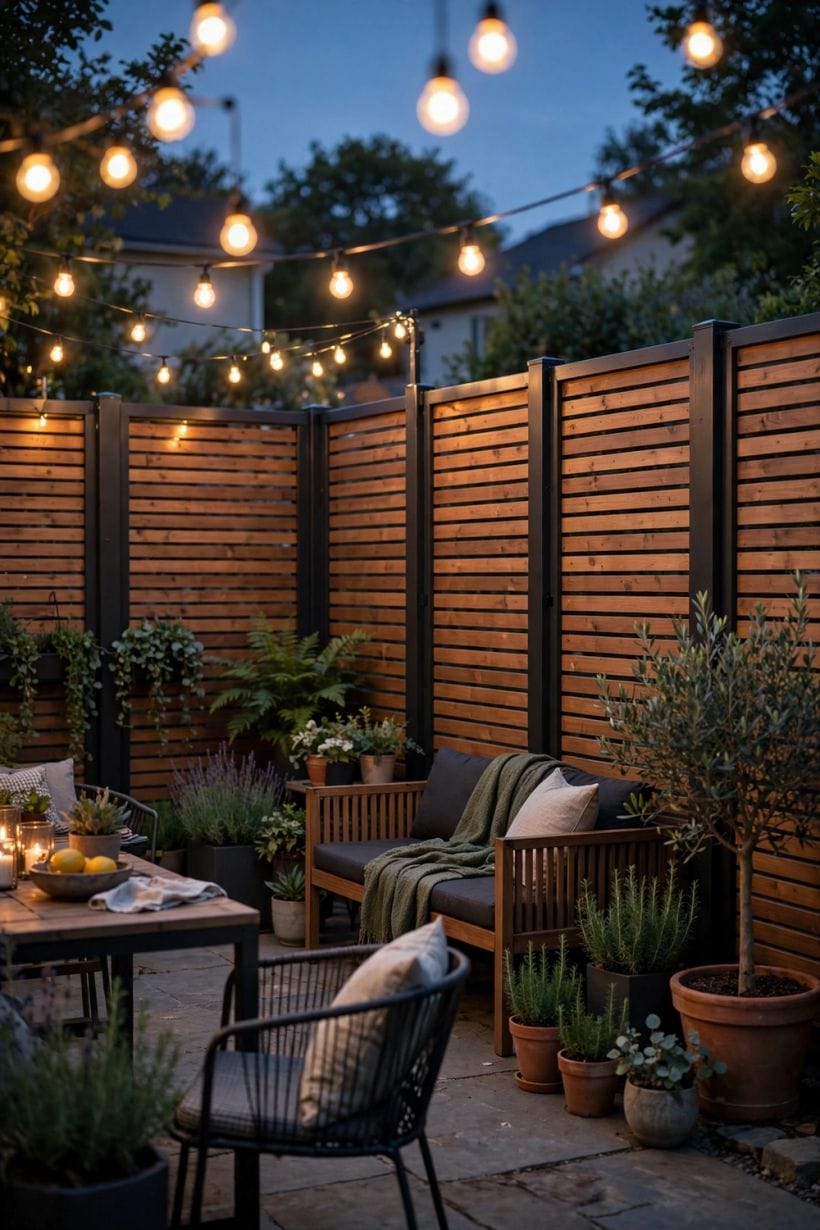
The finished fence is a backdrop, a shelter and a neighbourly promise. This last section plants against it, checks its privacy honestly from the seats it protects, and sets the small maintenance state that keeps a modern wooden fence the garden’s best-looking wall for decades.
66. Plant against the fence as against a wall of a room
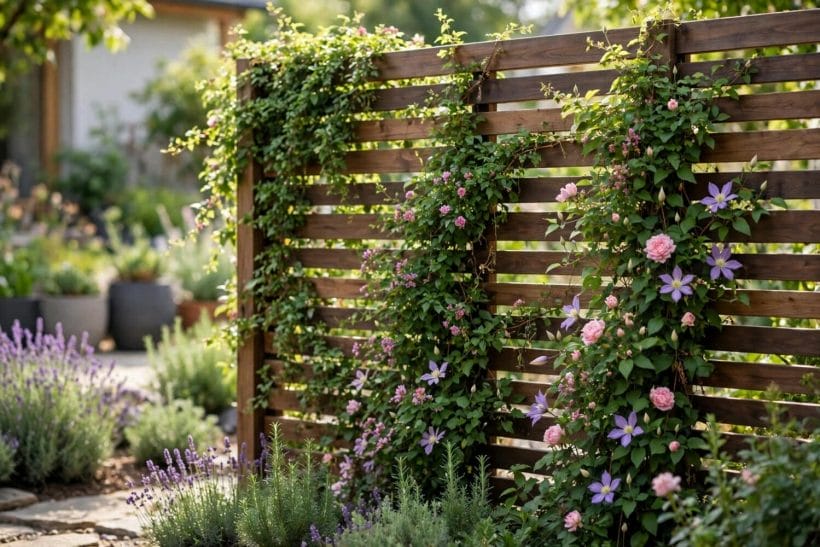
The fence face is the garden room’s fourth wall: climbers on wires, shrubs in front, the border’s layers against it. Planted so, the boundary disappears into the garden’s composition and only its shelter and backdrop remain — the fence’s final promotion.
67. Use the fence’s shelter to grow what the open garden cannot
A warm fence face in sun is a microclimate: figs, tender climbers, the herbs that sulk in the open all thrive against it.
68. Train climbers on wires and battens, not on the slats themselves
Plants that grip the boards stain, lift and rot them; plants on a wire stand-off frame get the fence’s shelter without its substance.
69. Check privacy from the actual seats, at the actual hours
The garden’s privacy is tested where life happens: the terrace chairs at breakfast, the lounger at four.
70. Layer a hedge inside the fence where sound or sight still leaks
Fences stop eyes; hedges soften sound and finish what slats begin. A low hedge inside the boundary, or a planted screen at the one exposed corner, layers the garden’s defences kindly — two systems each doing the half they are best at.
71. Keep the fence’s foot clear for air and the mower
Planting hard against the ground line traps damp against the boards and guarantees a strimmer’s war. A hand’s width of clear gravel at the fence’s foot dries the boards, feeds the mower’s edge and reads as the design’s crisp plinth.
72. Refresh the planting, not the fence, when the garden tires
A modern fence in good order is a decade’s backdrop; gardens tire of planting schemes in five years.
73. Agree the shared sections’ care like the neighbours you will remain
Where the fence is shared, its washing, staining and repair are a standing arrangement, not an annual negotiation.
74. Wash the fence yearly and oil or stain by the calendar
A yearly wash with a soft brush, a check of caps and fixings, the finish renewed on its rhythm: the modern fence kept like the garden shed‘s better sibling stays crisp for decades. Neglect is the only unaffordable finish, and it is charged in full, later.
75. Let the fence grow old in the design, not despite it
Silvering timber, softening planting, a gate whose latch is polished by hands: the modern fence designed to age becomes the garden’s patina.
9. Checks and Mistakes: Before the First Purchase or the First Stone
Before building, walk the checks in order: the deeds and the boundary’s ownership established; the neighbours consulted while the design is still pencil; heights and front-garden rules checked against the local requirements, which vary by place and are confirmed with the authority or a professional rather than assumed; the sightlines for privacy walked with a pole and a helper; the ground surveyed for slopes, roots and buried services; and the gate positions fixed by the household’s real daily routes.
The faithful mistakes: the fence designed from the catalogue’s photograph with no reading of the boundary’s actual duties; slats set by eye until the gaps wander like a smile; untreated cut ends buried in the build; posts skimped while boards were splurged on; the gate hung on run-posts and sagging by Christmas; and the whole composition finished in a stain chosen from the tin’s label in a fluorescent aisle. Every one is a planning error wearing a fence’s clothes.
One check is about the long term: stand in the garden and ask who maintains this fence, on what rhythm, at whose cost, for the next twenty years — and whether the neighbours have been told. A modern fence with its maintenance agreed is a boundary in both senses: it marks the land, and it keeps the peace.
10. Costs and Pulling It Together
Costs follow the fence’s own honesty: the skeleton — posts, footings, rails, fixings — is where the decades are bought, and it is invisible; the boards are where the beauty is bought, and they can be upgraded, re-stained or replaced bay by bay over the years. A modest timber impeccably structured will out-serve and out-last a precious timber on wandering posts, every time the two are compared in year ten.
Pulling it together: read the boundary’s duties; draw the line in level slats or composed boards; build the skeleton like a building; finish the timber for the weather it will actually meet; fit the gates as moving parts of the same design; and plant against the result as against a garden wall. The fence then takes its place among the working home design ideas that earn their keep daily — a wall the garden is proud of from both sides.
Final Considerations
A modern wooden fence is proof that the plainest job in the garden — keeping the world out and the garden in — can be done with the manners of architecture. Built straight, finished honestly and planted against kindly, it stops being the garden’s edge and becomes its frame.
Begin with the posts and the conversation. The boards, the stain and the compliments all follow from a boundary that stands true and a neighbour who was told first.


0 Comments