

The small home theater is the big screen’s revenge on the big house. A spare bedroom, a den, the far end of a basement — rooms too small for almost anything grand turn out to be exactly the size a cinema wants: short throws, close seats, sound that wraps instead of wandering off. Film has always preferred intimacy to acreage.
This page keeps strictly to the small room: choosing it, darkening it, seating it and making it sound far larger than it is. The household’s louder play lives on the game room ideas page, and the general living room’s screen questions belong with the everyday set; here the lights go all the way down and the film is the whole event.
1. Small Home Theater Ideas at a Glance
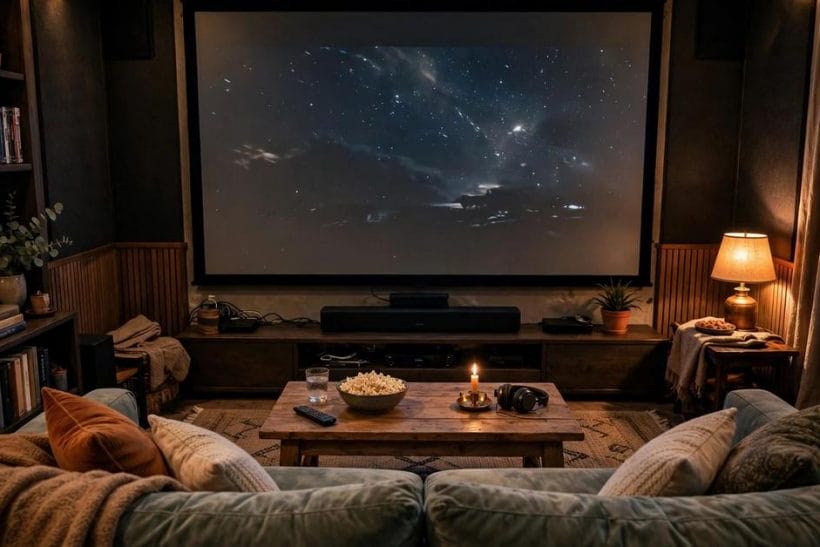
A small home theater is a compact room — a spare bedroom, den or basement corner — arranged for film first: a screen sized to a short viewing distance, seating placed at that distance and no further, controlled darkness, and sound scaled to the room rather than to a showroom. Its working parts are the room’s proportions, the screen wall, the seats, the speakers and the blackout. It is the intimate member of the house’s entertainment family, descended from the home theater in a tiny house tradition, where every inch of the cinema was argued for.
| Question | Short answer |
|---|---|
| How small can a home theater be? | As small as a box room that holds a screen wall, two or three seats at an honest distance, and darkness. Small is an advantage: the picture fills more of the view, the sound needs less power, and the room can be finished to a standard a barn-sized theater could never afford. |
| Television or projector in a small room? | Both honest answers. A large television is simpler, brighter and kinder to daylight, and in a short room it is already enormous. A projector gives the true cinema scale and a screen that can vanish, but asks for darkness and a throw distance the room must genuinely have. |
| What matters most in a small theater? | The seating distance and the darkness, in that order. A screen matched to where the seats actually are beats a bigger screen watched too close, and a room that can go truly dark makes every picture — television or projected — look twice as expensive. |
| Can a small theater double as another room? | Gracefully, if the second life is quiet: a guest bed that folds, a reading chair, a desk at the back. The theaters that fail are the ones asked to be offices, gyms and cinemas in the same hour. Choose the room’s first loyalty and let the rest visit. |
2. The Small Room Itself: Choosing and Preparing the Space
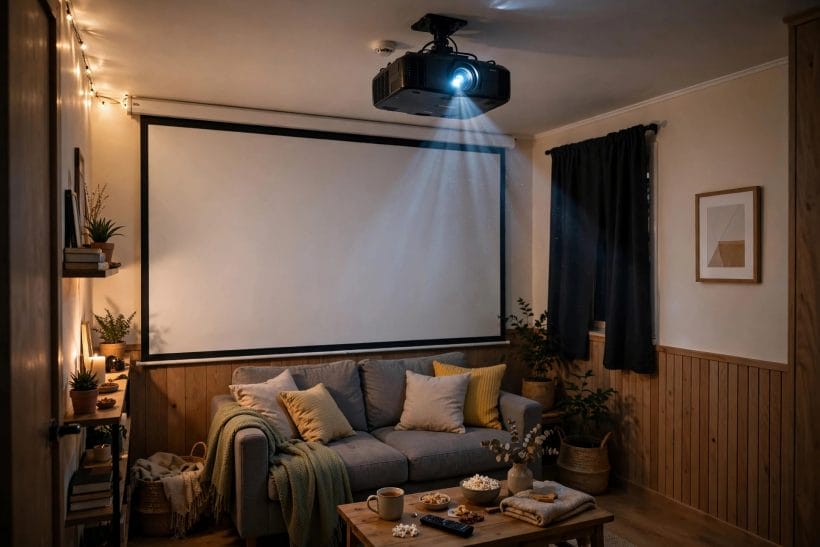
Every good small theater starts as a room audit. The best candidate is the room with the fewest windows, the squarest walls and the least through-traffic — the box room, the den, the basement’s far end. This section chooses the room and settles its bones before any equipment is allowed through the door.
1. Choose the room with the fewest windows, not the most floor
Darkness is the small theater’s foundation, and every window is a negotiation.
2. Prefer a room off the household’s traffic routes
A cinema that the family crosses to reach the kitchen is a cinema interrupted.
3. Measure the viewing distance before dreaming of screen sizes
Seat position first, screen second: pace out where heads will actually rest, then let that distance choose the picture.
4. Claim the squarest wall for the screen
The screen wall wants to be flat, unbroken and free of doors: the room’s one plain rectangle.
5. Give the basement’s end its honest chance
The far end of a basement is the small theater’s classic site: cool, dark, acoustically padded by the earth itself. Its checks are damp, headroom and the escape route, all settled with the house’s professionals before the first seat is carried down.
6. Plan the door’s light seal like a darkroom’s
The theater door is the room’s one permitted leak, and it is treated as such: a solid door, a seal at its foot, a curtain inside if the hall is bright.
7. Run the cables before the furniture arrives
Screen, speakers, seats and the little rack of equipment all want power and signal where they stand. An afternoon with an electrician while the room is empty buys a decade without cables crossing the carpet like tripwires in the dark.
8. Keep one wall free for the seats to breathe against
Seats pushed hard against the back wall rob the sound and crowd the sitters.
9. Decide the room’s second life now, and subordinate it
Guest bed, reading room, the household’s quiet office: each is a fine second life if it is furnished as a guest in the cinema’s house.
10. Test the room with one film before furnishing it
A borrowed screen, two chairs and a Friday night in the empty room will teach more than a month of catalogues: where the light leaks, where the sound blooms, where the seats want to be.
11. Let the small room stay small on purpose
Resist the annexation of the next room, the borrowed corridor, the growing screen. The small theater’s whole magic is concentration — of picture, of sound, of money, of attention.
3. The Screen: Size, Position and the Honest Picture
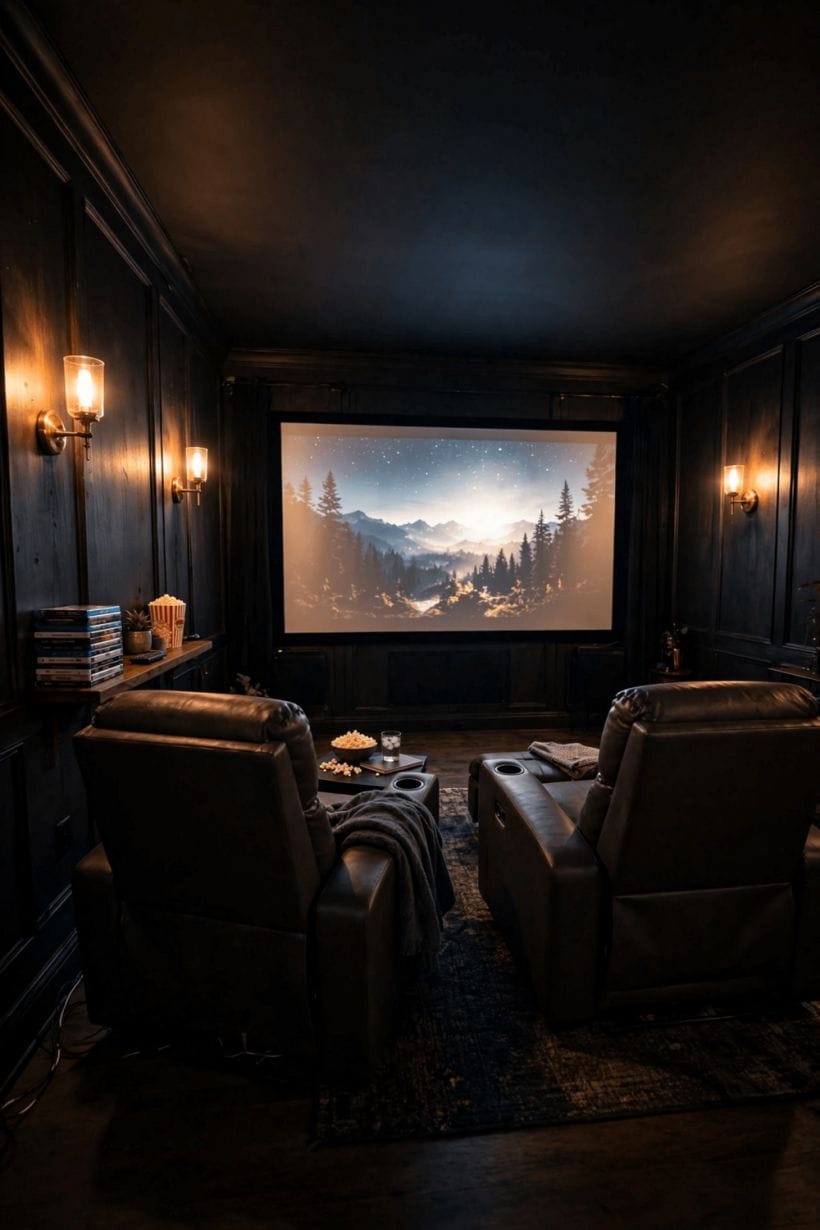
In a small room the screen’s question is never how big it can be, but how big it should be — and where its centre falls against the seated eye. This section sizes the picture to the seats, chooses between television and projection with the room’s light as witness, and hangs the result at the height comfort dictates.
12. Size the screen to the seats, not to the wall
The wall will always accept a bigger screen than the eye will. From the room’s real viewing distance, a screen that fills the comfortable field of view — no head-turning, no tennis-match eyes — is the largest honest picture.
13. Set the screen’s centre at the seated eye’s level
Heads rest back; eyes settle slightly below the horizontal. A screen centred where the seated gaze naturally lands ends the cricked-neck cinema, and it usually means lower than the television’s showroom perch.
14. Choose a television where daylight shares the room
If the room must also live by day — the den, the guest room — a good television forgives the light a projector cannot.
15. Choose projection where the room can go truly dark
The projector’s picture has the cinema’s own texture — light thrown, not emitted — and in a blacked-out small room it is unbeatable theatre.
16. Prepare a wall as a screen before buying a screen
A flat wall, filled, sanded and painted in a proper screen paint, serves small rooms beautifully and costs a fraction of a framed screen.
17. Frame the picture with a dark surround
Whatever plays the film, a matte dark border around it — painted, panelled or curtained — deepens every black in the picture and tells the eye where the world ends.
18. Keep the screen wall free of competing light and clutter
No lamps beside the screen, no bright shelves flanking it, no blinking equipment under it. In the dark, whatever glows competes with the film. The screen wall is a stage, and stages are lit for one performer at a time.
19. Mount equipment where its lights can be hidden
The little rack of boxes belongs in a cupboard, behind a door or under a cloth — anywhere its standby eyes do not stare into the dark.
20. Give the picture a sound-first partner: the centre of the room’s attention
Screen position and seating position are one decision seen from two ends. The seats face the screen squarely — not angled from a corner sofa’s compromise — because the small theater exists precisely to end the household’s crooked-neck viewing arrangement.
21. Leave the upgrade path open in the wall, not the wallet
Run the spare cable, leave the conduit, site the mount where a larger screen could one day hang.
22. Judge the picture from the worst seat, in the dark, with a real film
Not the demo loop, not the middle seat at noon.
4. Seating: Sofas, Recliners and Rows That Fit
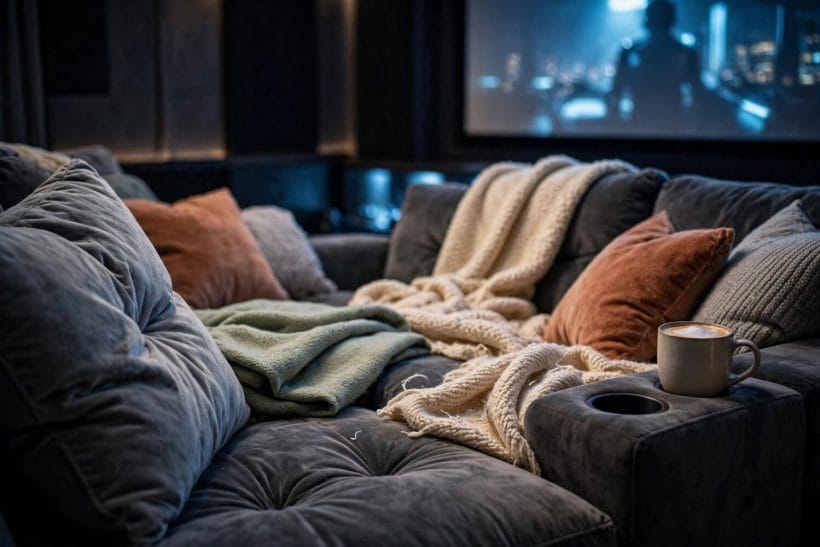
The small theater’s seats are its true furniture — the screen is only watched, but the seats are inhabited for two hours at a stretch. This section arranges seating for sightlines, comfort and the room’s small mercy: nobody sits far from the picture, so nobody needs to sit in an airline’s idea of luxury.
23. Let one excellent sofa beat a row of mean recliners
In a small room, a deep, well-made sofa for three serves better than a squeezed row of cinema chairs with cupholders and compromise.
24. Raise the back row on a simple platform where two rows are honest
If the room truly holds two rows, a low platform under the rear seats — carpeted, solid, with a step light — restores the sightline the front row’s heads would steal.
25. Keep every head below the screen’s sightline from behind
Sightlines are drawn, not assumed: from each seat, over the heads in front, to the screen’s bottom edge.
26. Choose seats for the two-hour test, not the two-minute sit
Showroom comfort is a sprinter; film comfort is a stayer.
27. Give each seat its own small territory
A side table, a shared ledge, a cushion-defined border: each sitter wants a place for a drink, the remote and their own elbow.
28. Let a loveseat-and-chair mix fit the room’s shape
Not every small room is a rectangle begging for a row.
29. Face the seats squarely and skip the corner-sofa swivel
The L-shaped sofa facing two ways serves neither. In the theater, seats face the screen as pews face the altar; the household’s lounging angles live in the living room, whose whole constitution is compromise. Here, the film wins.
30. Add footstools before adding seats
Feet up is half of cinema comfort, and a shared ottoman or two stools buy it for every sitter at once.
31. Keep a throw and cushions as part of the rig
Small rooms run cool when darkened and still. Throws live on the seats permanently, cushions tune each sitter’s posture, and the theater feels furnished for people rather than for equipment — the photograph’s version of the room is the lived one.
32. Leave walking room at one side, however tight
Aisle space feels wasted until the film’s middle, when it is the most loved foot of floor in the house. One side’s passage, kept clear of tables and cables, lets the audience move like guests rather than mountaineers.
33. Let the best seat be a known and shared honour
Every small theater has one perfect seat — centre, at the distance, in the sound’s sweet heart.
5. Sound in a Small Room: Speakers, Soundbars and Neighbours
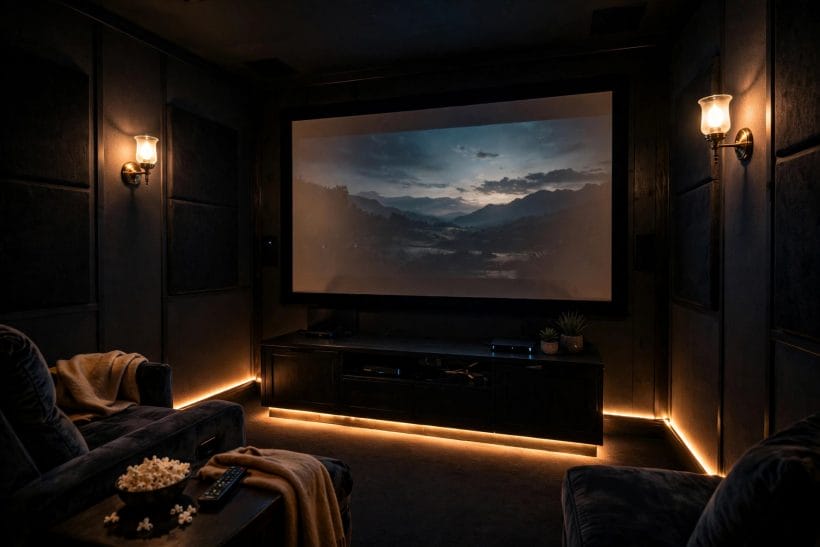
Small rooms are kind to sound: the walls are close, the distances short, and modest equipment fills the space without strain. The enemies are boom, echo and the neighbour’s ceiling. This section builds sound that wraps the seats, keeps the dialogue clear, and lets the household sleep through the explosions upstairs.
34. Start with a good soundbar and be honest about enough
In the smallest rooms a quality soundbar — with its speech-clearing modes and a modest subwoofer — is not the compromise; it is the correct instrument.
35. Graduate to separate speakers where the room invites them
Where the room is dedicated, a pair of front speakers, a centre for dialogue and small surrounds behind the seats build the true cinema wrap.
36. Put the dialogue speaker at the screen’s heart, aimed at the ears
Most of a film is people talking, and the centre speaker is its voice. It sits at the screen’s centre height, tilted to the seats, never buried in a cabinet’s cave.
37. Tame the subwoofer for the room and the neighbours
Bass is the sound that travels — through floors, walls and good relations.
38. Soften the room’s hard echoes with its own furnishings
Bare walls slap sound back; a furnished room absorbs it. The sofa, the rug, curtains, cushions and a bookshelf are the small theater’s acoustic treatment, already paid for.
39. Hang the heaviest curtains the room owns on the window wall
Curtains in a theater do triple duty: blackout for the picture, softness for the sound, insulation for the neighbours. The window wall dressed floor-to-ceiling in lined curtains is the small theater’s hardest-working surface, and it looks like luxury while doing it.
40. Keep surrounds small, high and behind the listeners
Rear speakers in a small room are whisperers, not shouters: small cabinets or in-wall units just behind and above the seats, set low in the mix. Their job is weather and footsteps, not a second concert competing with the screen.
41. Use the receiver’s night modes without embarrassment
Dynamic-range and night settings exist for apartment cinemas and sleeping households: dialogue stays clear, explosions stay home. A theater that can be enjoyed at family volume at 11 p.m.
42. Carpet or rug the floor between screen and seats
The floor is the room’s largest hard mirror for sound.
43. Test sound with dialogue, rain and one explosion
The audit scene list: a whispered conversation, a rainstorm, a single action peak.
44. Let headphones be the midnight matinee’s best friend
A pair of good wireless headphones at the rack extends the theater’s hours to any the household keeps. Many small theaters end up loved most at midnight, by one viewer, in perfect private sound — a feature, not a fallback.
6. Light Control: Blackout, Bias Light and the Dark Palette
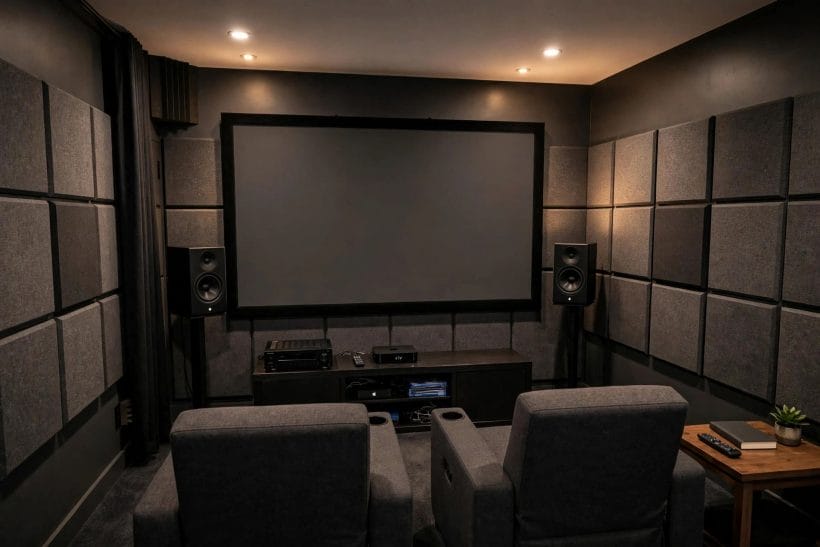
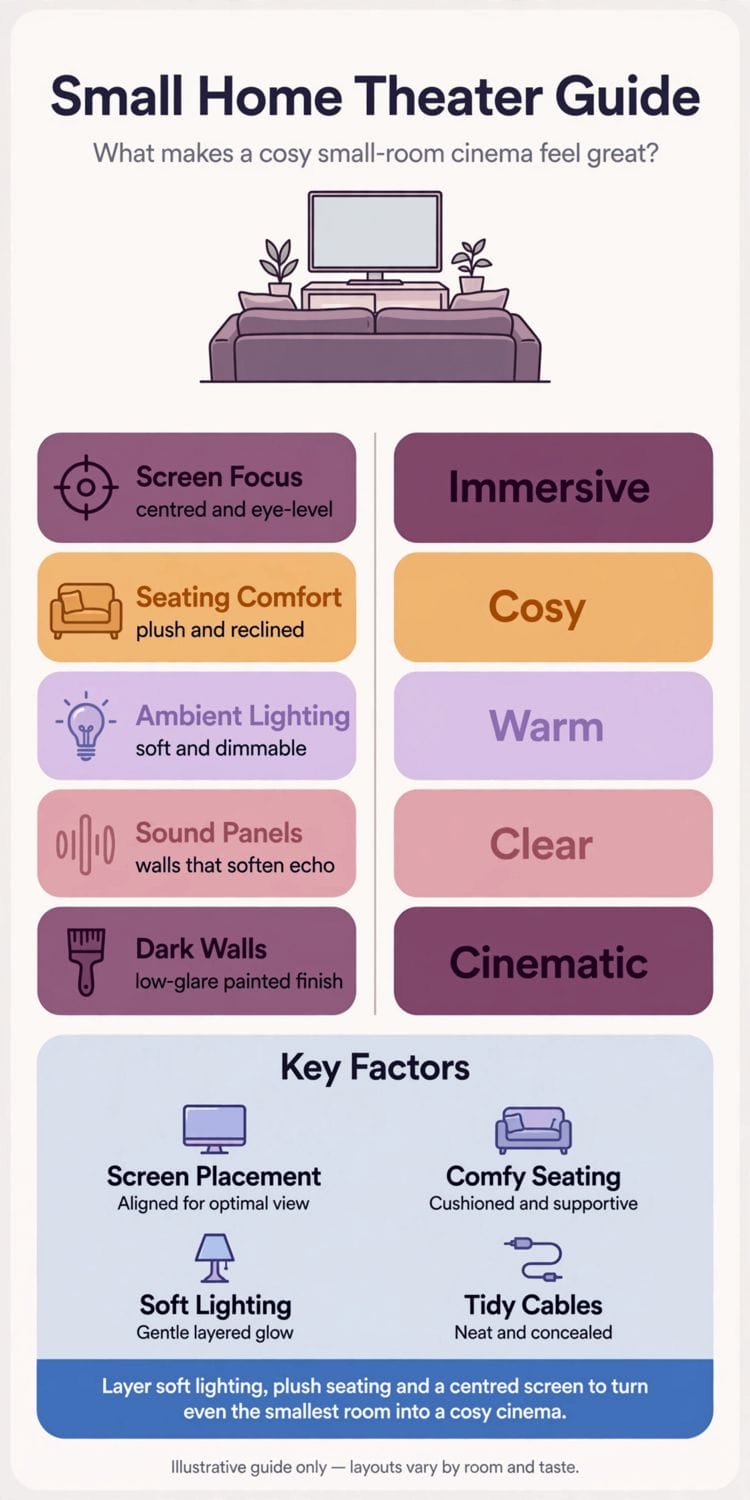
Darkness is the small theater’s special effect, and it is built, not bought: sealed windows, a palette that swallows stray light, and exactly two kinds of electric light — the glow that saves the picture’s blacks, and the low lamp that saves the audience’s shins. This section makes the dark.
45. Black out the window completely, then check at noon
Blackout lining, a blind inside the frame, or both: the test is a summer noon with the lights off, when every leak draws a blade on the screen wall.
46. Paint the screen wall and ceiling in deep, matte tones
Dark matte paint around the screen deepens the picture’s blacks more honestly than any setting in a menu. The ceiling especially — the surface nobody paints and everybody’s picture reflects off — goes dark first, and the room’s cinema temper follows.
47. Let the rest of the palette go warm and low
Behind the seats, deep warm colours — oxblood, forest, ink, chocolate — hold the room’s cosiness without throwing light back at the screen.
48. Add a soft bias light behind the screen
A gentle glow behind a television’s edges rests the eyes and deepens the perceived blacks — the one light that improves the picture by existing.
49. Keep one low, warm light for arrivals and intervals
The audience must find seats, drinks and the door without a searchlight.
50. Banish every standby light from the audience’s view
In a black room, one red dot is a lighthouse. Equipment faces, chargers and glowing switches are turned, taped or cupboarded until the dark is total.
51. Choose curtains and blinds you can operate in the dark
The blackout ritual happens nightly, by touch: cords where hands expect them, curtains that draw in one pull, no ladder-and-velcro ceremonies. A room that takes five minutes to darken will be watched in daylight grey instead, whatever its owner intended.
52. Give the door a curtain inside for the latecomer
Films acquire latecomers; doors admit light. A heavy curtain just inside the theater door lets people slip in and out through a light-lock, like a darkroom’s — a small, theatrical kindness that saves every film’s middle act from the landing’s glare.
53. Light the snack shelf, not the room
Popcorn and drinks are fetched by their own tiny light — a shaded shelf lamp, a low strip under the rack — so the resupply mission never needs the ceiling’s betrayal.
54. Dim everything from the seat, never from the wall
The walk of shame in every bad theater is the host crossing the room to kill the lights after the film has started.
55. Test the darkness with the household’s brightest habit
Someone will check a phone; someone will open the door for the cat.
7. Storage, Snacks and the Cinema Ritual
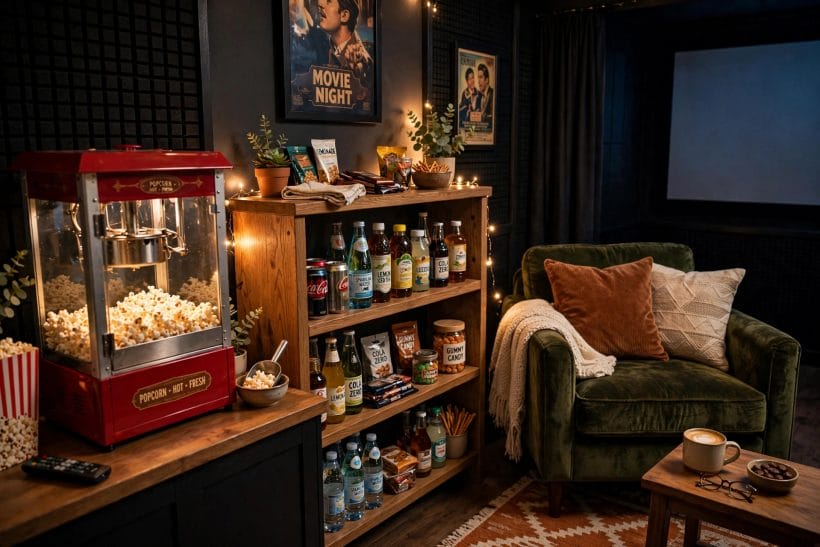
A theater is a ritual with furniture. The small room sanctifies its Friday nights with kept things: the blanket that lives on the sofa, the snack shelf stocked like a tiny lobby, the films shelved where hands fall on them. This section furnishes the ceremony — the part of the theater no equipment catalogue sells.
56. Give the films and the kit one home by the door
Discs, remotes, chargers, the streaming sticks and the spare batteries: one cupboard or shelf unit by the door holds the theater’s whole administration.
57. Build a snack shelf with a lobby’s small ambitions
Popcorn, glasses, the bottle opener, napkins that match the room’s dignity: a shelf or trolley stocked between films turns the interval into an intermission.
58. Keep a drinks ledge at the seats’ elbows
Cupholders built into chairs are fine; a ledge behind or beside the seats is finer, because it holds mugs, bowls and the occasional supper tray too.
59. Let the blankets and cushions live in the room
A basket by the sofa holding the theater’s own throws ends the nightly migration of bedding through the house.
60. Shelve the disc collection where choosing is browsing
If the household keeps discs, they deserve spines-out shelving at browsing height near the seats — the video-shop pleasure of choosing by hand. The collection in a cupboard across the house might as well be in another family’s name.
61. Give the projector or screen its dust discipline
Lenses, screens and vents in a small dark room gather dust invisibly and announce it on the brightest scene.
62. Program the household’s film night like an institution
A standing night, a choosing rota, a rule about phones: the small theater becomes the week’s anchor when it is run as a tiny institution rather than an appliance. The ritual is the real luxury the room was built to hold.
63. Keep a guest kit: spare cushion, spare throw, the good seat’s loan
Guests in a small theater are close company; the spare cushion and throw in the basket make them comfortable company. The room that receives well is used oftener, and a theater’s value is measured in evenings, not in specifications.
64. Keep a small library corner for the interval browsings
A shelf of film books, the household’s magazines, the programme notes of past enthusiasms: the interval in a small theater is a salon moment, and a browsable shelf gives it somewhere civilised to happen.
65. Store the room’s second life tidily out of sight
If the guest bed folds, it folds away; if the desk visits, its papers live in a box with a lid.
8. Small Budgets, Big Evenings: Where the Money Shows
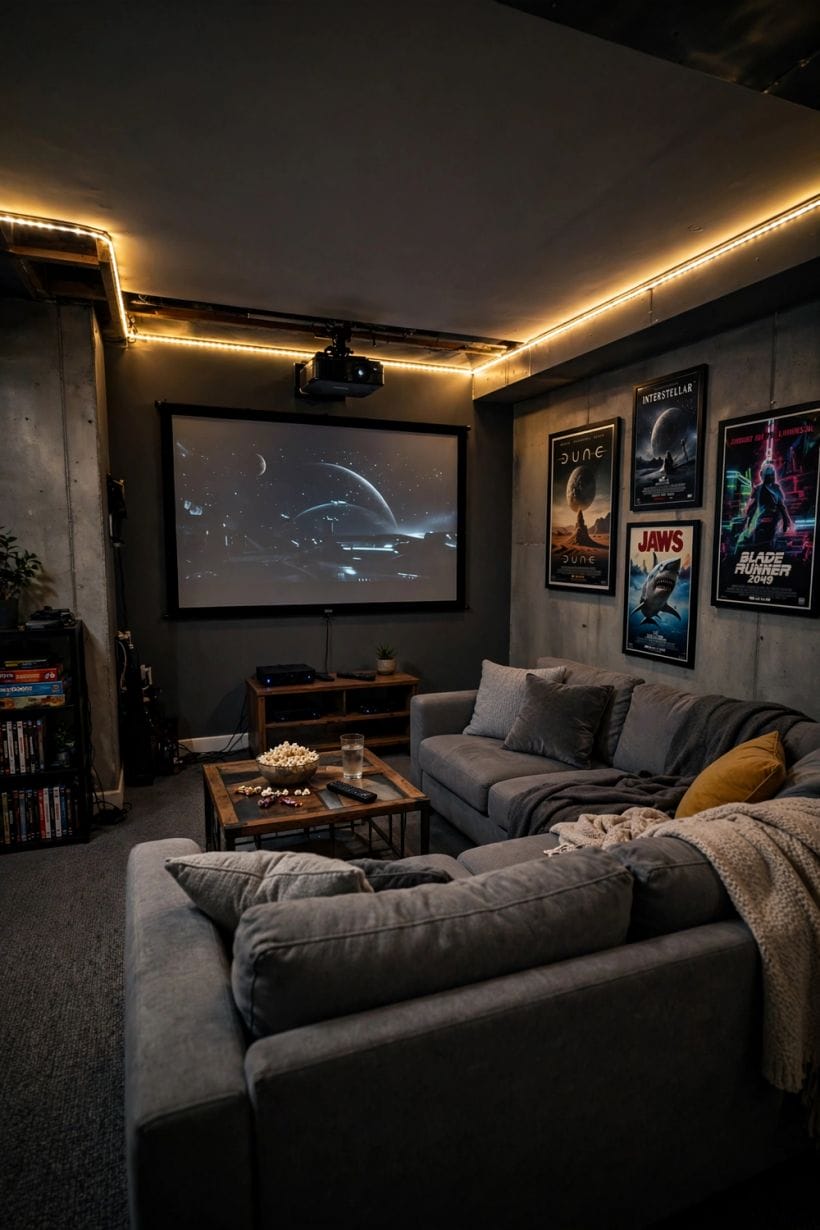
The small theater is the one room where a modest budget outperforms a grand one spent carelessly, because the room’s size forgives the equipment and exposes the comforts. This section spends in the order the audience feels it: darkness first, seats second, sound third, and the picture — astonishingly — wherever the room leaves off.
66. Spend first on darkness, which costs the least
Blackout, seals and dark paint: the foundation of the whole theater is also its cheapest layer.
67. Spend second on the seats, which are touched all evening
The audience forgets the screen’s specifications and remembers the sofa’s mercy.
68. Let the picture be the size the room asked for
The correct screen for the measured distance is usually the mid-priced one, and the savings against the showroom’s temptation fund the sound and the seats. A picture exactly right is invisible; a picture too big is a headache with a warranty.
69. Buy sound in the order the ear notices: voices, wrap, thunder
Dialogue clarity first, surround wrap second, bass last — because films are mostly voices, sometimes weather, and rarely earthquakes. The household that buys in the ear’s order never owns a theater that shouts its action scenes and mumbles its stories.
70. Reuse the house’s own furniture and electronics honestly
The spare room’s armchair, the retired hi-fi’s speakers, the previous television demoted with honour: small theaters are famously built from the house’s own best hand-me-downs.
71. Phase the build: dark, seats, picture, sound, ceremony
A theater can open in stages and be loved at every one: this month the blackout and the old screen, next season the seats, then the sound.
72. Keep a small, permanent kit budget for the room
Bulbs and projector lamps, batteries, the cloth for the lens, the snack shelf’s stock: a theater runs on small consumables whose absence cancels evenings. A household that funds the kit quietly never loses a film night to a dead remote.
73. Borrow the tiny house theater discipline of one-in-one-out
In the smallest cinemas — the converted closets and under-stair screens of the tiny-house world — every new box evicts an old one.
74. Count the cost in evenings, not in specifications
The honest ledger of a small theater is evenings used per year.
75. Leave one upgrade unworn in the plan
The final wisdom of the phased theater: always know the next improvement, and let it wait.
9. Checks and Mistakes: Before the First Purchase or the First Stone
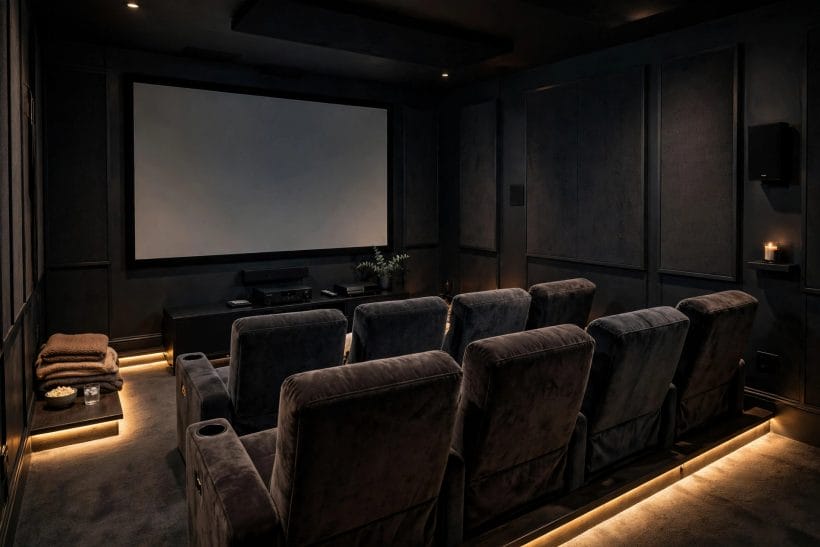
Before the first film night, walk the checks in order: the room dark at noon with the door shut; every seat’s sightline to the screen’s bottom edge tested with real sitters; dialogue followed at low volume from the worst seat; the subwoofer set by the quiet scene, not the loud one; cables nowhere a foot can find them in the dark; and the neighbours’ side of the wall considered while there is still time to add the heavy curtain.
The faithful mistakes: the screen bought for the wall instead of the seats; seats against the back wall with the sound’s breathing room spent on a bigger picture; speakers imprisoned in cabinets; a room that cannot go dark asked to behave like a cinema; and the theater colonised by the household’s gym kit and office overflow until the film has to book its own room. Every one is a constitution error, not an equipment error.
One check is about the household, not the room: agree the film night’s terms while everyone still likes the plan — whose turn chooses, when phones sleep, who may book the room and for what. Small theaters run on ritual, and ritual is just an agreement everyone has decided to keep.
10. Costs and Pulling It Together
Costs follow the room’s own logic: darkness is cheap, seats are the serious furniture money, sound is modest because the walls are near, and the picture is whatever size the measured distance honestly asks for. The small theater is the rare room where spending less, in the right order, visibly outperforms spending more in the showroom’s order.
Pulling it together: choose the darkest spare room; measure from the seats; darken it completely; seat it like you mean to stay; give it clear voices and kind thunder; stock the snack shelf; and let the ritual begin. The room then takes its place in the wider world of home design ideas as the smallest proof that luxury is not a size but a standard of attention.
Final Considerations
A small home theater asks the least of a house and gives back the most ceremony: a door that closes on the day, a dark that falls completely, a story that fills the whole of the senses for two hours. Rooms twice its size envy it by the second winter, because what it owns cannot be bought by the square foot.
Begin with the dark and the seats. The picture and the sound, sized honestly to a small room, will astonish you soon enough — but it is the darkness and the comfort that the audience will still be thanking in ten years’ time.



0 Comments