

A swimming pool is the only room in the house that is mostly weather — a piece of managed sky lying on the ground, reflecting clouds, collecting leaves, and reorganising every summer plan around itself. Houses change around a pool; gardens are redesigned by it; childhoods are measured in it.
These 75 pool ideas treat the pool as a design decision long before it is a hole: shape, shell, edge, deck, shade and planting, in that order. The dry land around the water gets its own surveys at patio ideas and deck ideas; this post stays in the water and at its edge.
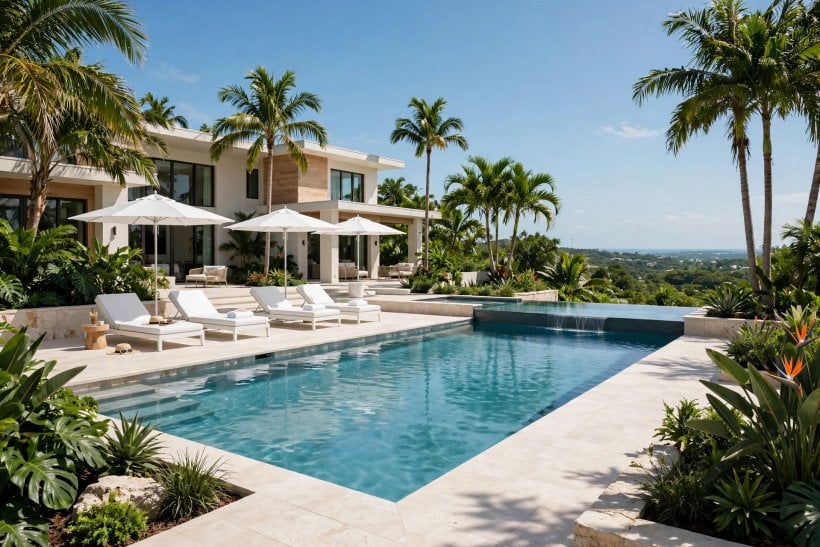
1. Pool Ideas at a Glance
The central entity is the swimming pool: a waterproofed basin of treated water set in the garden, together with the systems that keep it swimmable — circulation, filtration, sanitation — and the architecture that makes it a place rather than a tank: coping, deck, shade and planting. Its attributes divide by construction (inground, above-ground, semi-inground, plunge), by plan (shape, entries) and by setting (the apron and garden around it). The first attribute governs the rest: a pool is a machine for holding summer, and its design succeeds when the machine disappears into the pleasure.
| What is the best pool shape? | The one that matches how the household swims: lengths for laps, freeform for lounging families, a rectangle for both and for the garden’s geometry. |
| Inground or above-ground? | Inground is architecture and permanence; above-ground is speed, price and reversibility. Semi-inground splits the difference and suits sloping ground. |
| How small can a pool be and still be a pool? | A plunge pool or spool — spa-sized, deep enough to submerge — delivers the cooling ritual without the swimming. The test is immersion, not distance. |
| What do owners underestimate? | The surround. The deck, shade and planting are used every visit; the water only when swimming. Budget the pool’s room, not just its basin. |
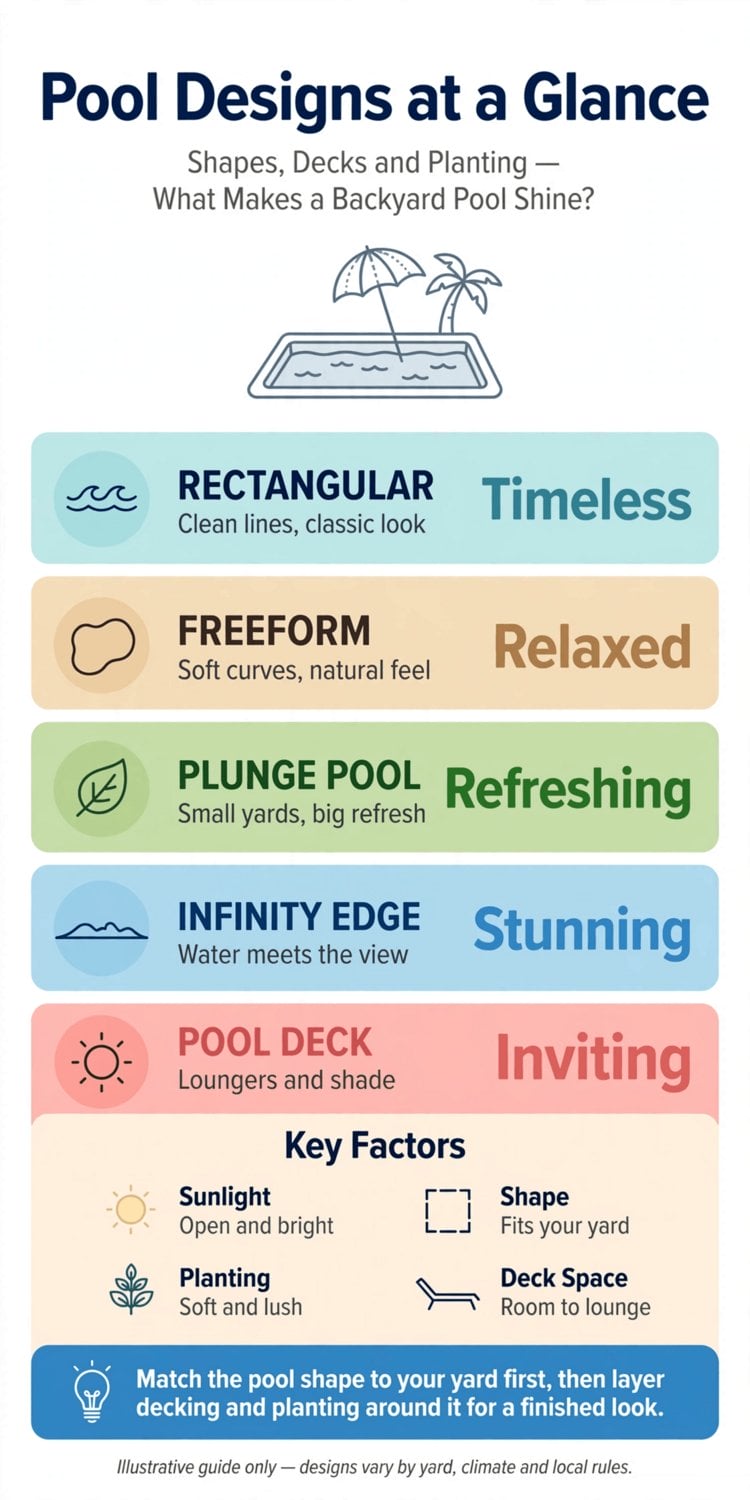
2. Shapes and Layouts: The Pool as a Plan
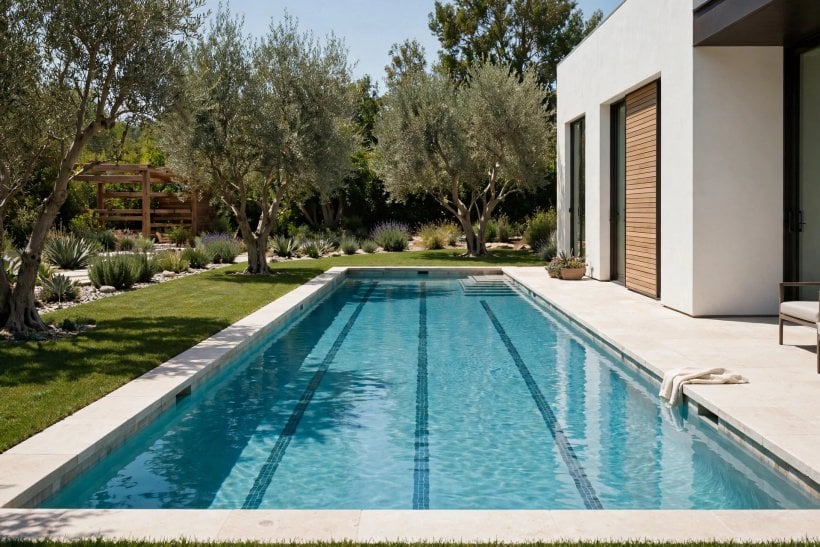
Shape is the pool’s first and most permanent decision — shells can be re-finished, but the plan is forever. This section works through the geometries and the entries, steps and shelves that turn a shape into a place people use all day.
1. Draw the Pool From the House, Not the Fence
The pool will be looked at from the house ten times for every swim. Align its geometry with the house’s axes and terraces and it reads as architecture; dropped at a surveyor’s angle, it reads as an incident.
2. Give Laps a Rectangle and Mean It
Serious swimming wants straight sides, a constant depth conversation and no beach entry in the lane. A lap pool is a piece of sports equipment — narrow, honest and unapologetic.
3. Let Freeform Shapes Serve Lounging Households
Curved, kidney and lagoon plans suit gardens that are themselves informal, and households whose swimming is mostly floating. Freeform fails in formal gardens and delights in loose ones; match the plan to the planting.
4. Build a Baja Shelf for the Shallow Life
A wide, ankle-to-knee-deep sun shelf is where toddlers paddle, chairs stand in the water and adults cool their feet with a book. In family pools the shelf is used more hours than the deep end.
5. Enter by Steps You Can Sit On
Wide corner or full-width steps double as seating, teaching water and the shallow end’s social centre. Steps are furniture that happens to be underwater; design them with the generosity of a terrace stair.
6. Keep a Beach Entry Where Wheels and Toddlers Rule
A zero-entry slope admits pushchairs, wheelchairs, cautious dogs and the very young without a threshold event. It spends length to buy access — a fair trade in the households that need it.
7. Put the Deep End Away From the House Terrace
Diving, jumping and teenage physics belong at the garden’s far end; the shallow social water belongs near the house. Zoning depth by distance keeps the terrace calm and the noise where the garden can absorb it.
8. Plan the Sun’s Path Before the Excavator’s
A pool in permanent shade is a beautiful refrigerator. Trace the sun across the site in high summer and place the water where the day’s warmth lands — the cheapest heating system is geography.
9. Leave a Straight Side for Covers and Cleaners
Covers unroll along straight edges, and automatic cleaners patrol predictable geometry. One honest straight side in an otherwise freeform plan repays its discipline every week of the season.
10. Orient the Long View Down the Water
From the main room and the terrace, the eye should travel along the pool, not across it. Length is the pool’s grandeur; arrange the plan so the house gets to look down all of it.
11. Sketch the Fence Line in the Same Drawing
Safety barriers decide gates, sight lines and the deck’s usable shape. A pool drawn without its fence is a fiction that the fence will later vandalise; draw both, once, together.
3. Inground Pools: Shells, Finishes and Edges
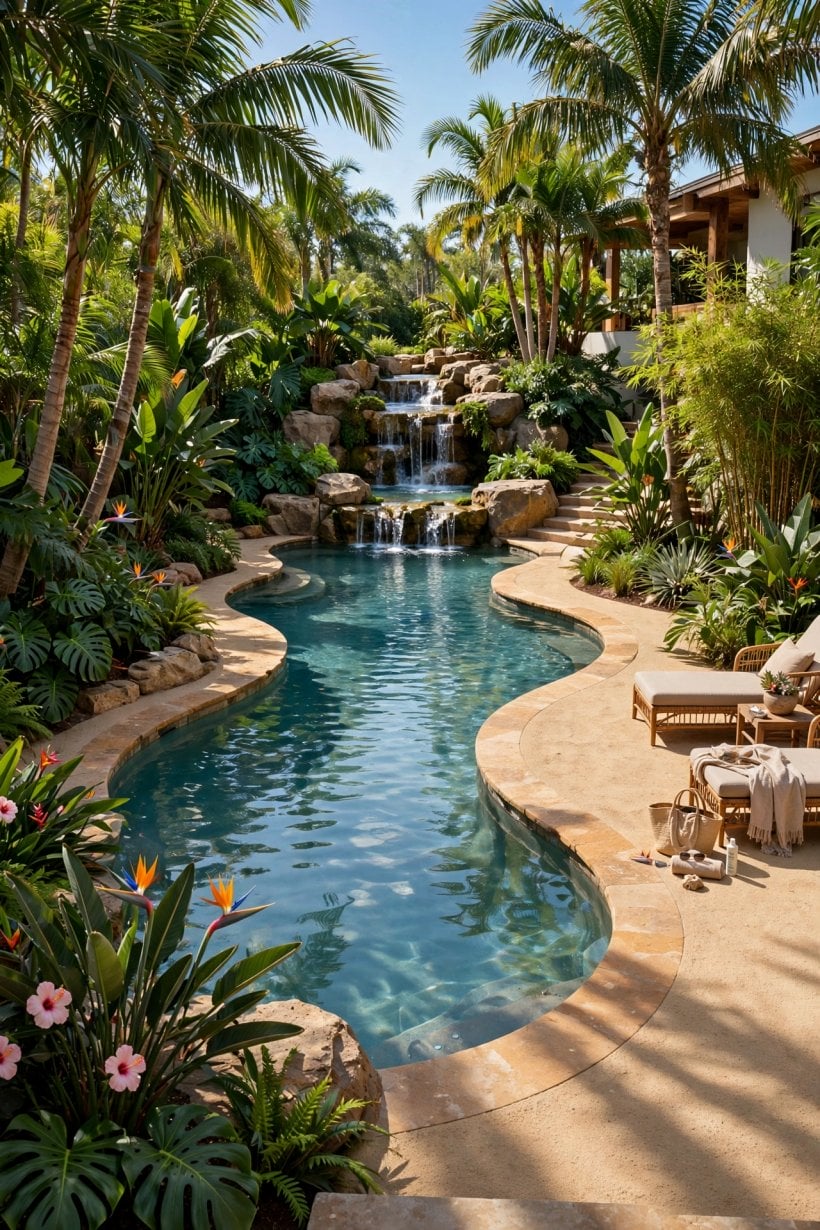
The inground pool is the permanent form: a shell built or set into the earth, finished inside, edged with coping. This section covers the three shell families and the finishes that decide how the water looks and feels.
12. Choose Concrete for Shape Freedom
Sprayed or shuttered concrete takes any plan, any depth profile, any shelf the designer draws. It is the slowest and dearest shell and the only one that begins as a blank page.
13. Choose Fibreglass for Speed and Surface
A factory shell arrives finished: smooth, algae-shy and installed in days rather than months. The price is the catalogue — sizes and shapes are what the moulds say they are.
14. Choose a Liner for Price and Renewability
Vinyl-lined pools cost least and the liner is a renewable skin, replaced when it fades or tears. The feel is smooth, the patterns are endless, and the structure beneath can be modest.
15. Finish Concrete in Plaster, Aggregate or Tile
Plaster is classic and bright; exposed aggregate is tougher and sparkles; full tile is the luxury surface, cool and exact. The finish is the water’s colour as much as its texture — choose it by the blue you want.
16. Remember the Water’s Colour Is the Finish’s Colour
Pools are painted by their interiors: white reads pale aqua, sand reads lagoon green, deep grey-blue reads oceanic. The water itself is clear; every photograph that inspired the build was a finish doing its work.
17. Edge With Coping That Hands Can Trust
The coping is the pool’s rim — sat on, gripped, hauled out by. Rounded, grippy and cool under sun: bullnose stone or textured concrete beats any sharp fashionable edge the first time a wet hand trusts it.
18. Run a Skimmer and Returns Like a System, Not a Kit
Circulation is the invisible architecture: skimmers placed against the prevailing breeze, returns aimed to sweep the floor toward them. A well-plumbed pool nearly cleans itself; a badly plumbed one is a weekly argument.
19. Light the Water From Within
Underwater lights turn the evening pool into the garden’s lantern and make night swimming safe. Place them to light the steps and the deep end’s floor, on the sides the house does not stare into.
20. Build the Plant Enclosure Out of the Picture
Pumps and filters hum, drip and demand access. House them in a ventilated enclosure at the garden’s working edge — near enough for maintenance, far enough that the pool’s theatre is unbroken.
21. Design the Overflow Before the Rain Does
Storms fill pools to the brim and beyond. An overflow to drainage keeps the surplus from touring the terrace, and the water level where the skimmers can work.
22. Leave Access for the Shell’s Whole Life
Liners get replaced, shells get resurfaced, pipes eventually confess. Routes for machinery and materials, and pipe runs that can be reached, are the inground pool’s letter to its own future.
4. Above-Ground and Semi-Inground Pools
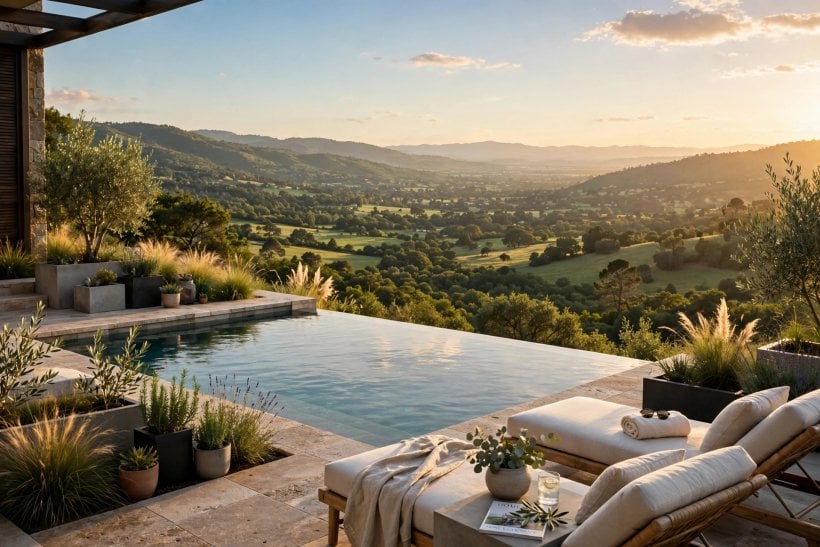
The above-ground pool is the honest democrat of this survey: a season of swimming for a fraction of the inground price, removable when life changes. Dressed well — decked, screened, planted — it stops reading as a compromise and starts reading as a decision.
23. Deck One Side to the Pool’s Rim
A deck brought level with the coping turns an above-ground pool into a place: entry, seating and sunbathing in one structure. The transformation is out of all proportion to the timber it costs.
24. Sink It Partway for the Best of Both
Semi-inground builds bury a portion of the wall, gaining the inground profile and easier entry while keeping above-ground bones and price. Sloping sites take to it naturally.
25. Screen the Skirt With Planting or Panelling
The pool’s wall is its least lovely face. A skirt of decking boards, woven panels or dense planting at its foot hides the engineering and roots the pool in the garden.
26. Choose the Ladder or Steps as Seriously as the Pool
Above-ground entry is a climb, and its quality decides daily pleasure — wide steps with a handrail beat a flexing ladder for children, elders and anyone carrying a drink.
27. Level the Ground Like a Foundation, Because It Is One
An above-ground pool presses tonnes of water onto its pad. A level, compacted, honest base is the whole structure’s life expectancy; a sloped pad writes its failure in the waterline within a season.
28. Site It Beyond the Trees’ Confetti
Leaves, blossom and bird business fall straight down and blow predictably. The cheapest filtration upgrade is distance from the garden’s shedding trees — site the pool in the clear and skim a quarter as often.
29. Keep the Round Shape for Even Loads and Easy Covers
Round above-ground pools carry their water pressure evenly and cover easily; ovals need buttressing and cost more to dress. Where the garden allows the circle, the circle repays.
30. Plan the Winter Story at Purchase
Drained or winterised, covered or left — the above-ground pool’s off-season is a design decision. Storage for the ladder, the cover’s home and the frame’s protection belong in the first plan, not the first frost.
31. Fence It With the Same Seriousness as Any Pool
Removable ladders, gated decks, self-closing barriers: an above-ground pool is water at depth and the law and the conscience treat it so. Design the protection as part of the dressing, not as a later fence of regrets.
32. Use It as the Trial Pool Before Building In
A season or two above ground teaches a household its true swimming habits — where the sun matters, how deep the use runs. Many inground masterpieces are second drafts of an above-ground experiment.
33. Let the Deck Carry the Pool’s Social Life
Loungers, a shade sail’s posts, the towel hooks, the drinks ledge: the deck around an above-ground pool is its living room. Size the deck for the household’s evenings, not just its entries.
5. Plunge Pools, Spools and Small-Water Designs
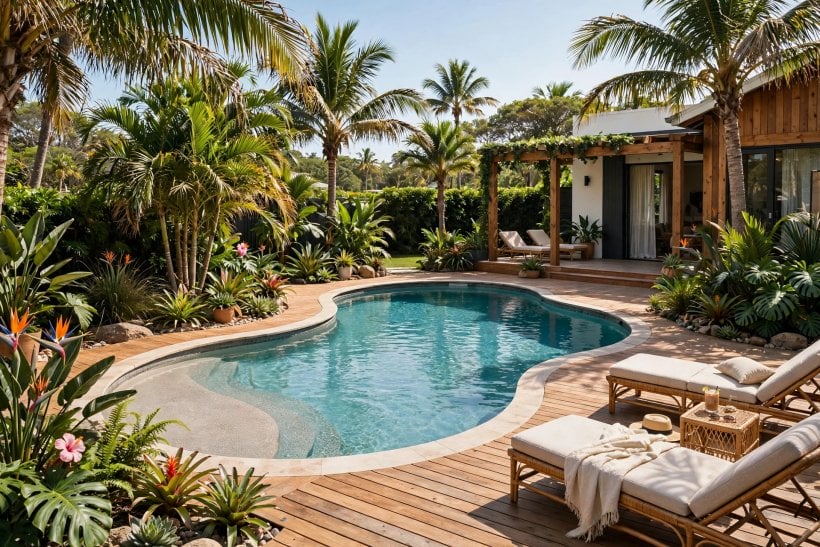
Small water is the survey’s growth stock: courtyard plunge pools, spools, and cocktail pools built for cooling rather than crossing. They bring the ritual to gardens the full-sized pool would evict — and pair naturally with the small-garden thinking at small backyard rockscaping.
34. Plunge Deep Rather Than Long
A plunge pool trades distance for depth: enough water to submerge to the shoulders, cool the core and float. Depth is cheap in excavation and priceless in August.
35. Add Jets and Call It a Spool, Proudly
Spa jets, heating and a bench turn the small pool into a year-round instrument — cool plunge in summer, hot soak in winter. The spool is two appliances in one hole, and gardens are richer for it.
36. Heat Small Water Without Guilt
Heating costs scale with volume, and small volumes are merciful. A plunge pool can be kept at bath kindness or plunge coldness on a budget that would not move a full pool a single degree.
37. Give the Plunge Pool a Seat All Round
An underwater bench around the walls turns the small pool into a conversation pit with water in it. Most plunge-pool hours are spent sitting in it, talking — furnish for the actual sport.
38. Fit a Current Machine for the Serious Swimmer
A swim-current unit lets a short pool train a long swimmer. In tiny gardens it is the difference between a dip and a workout, and it folds the lap pool into a courtyard.
39. Dress It as a Fountain When Idle
A scupper, a spout, a sheet of falling water: small pools earn their garden place by being beautiful when unused, which is most of the year. Design the idle view as carefully as the swim.
40. Tile It Dark for a Mirror, Pale for a Jewel
Small water is looked down into more than across. Dark interiors mirror the sky and read as depth; pale interiors glow like a jewel box. Both are right; the garden’s palette decides.
41. Borrow the Courtyard’s Walls as the Design
In a walled garden the plunge pool is a floor of water among architecture. Run it wall to wall, keep the coping minimal, and let the building do the decorating it has been waiting to do.
42. Keep the Plant Small, Tough and Reachable
Circulation for a plunge pool hides in a bench-sized enclosure or beneath the deck’s hatch. Small water still needs real plumbing — it just needs it within arm’s reach.
43. Cover It in One Motion
A small pool’s cover is a single panel, a hinged deck section, a roller the width of a door. When covering is effortless, it happens; when it happens, heat stays and leaves stay out.
44. Light It Like a Lantern for the Evening Garden
One underwater light in a small pool glows the whole vessel. In small gardens the plunge pool at night is the garden’s fireplace — a lit, moving centre everything arranges around.
6. Decking, Coping and the Apron Around
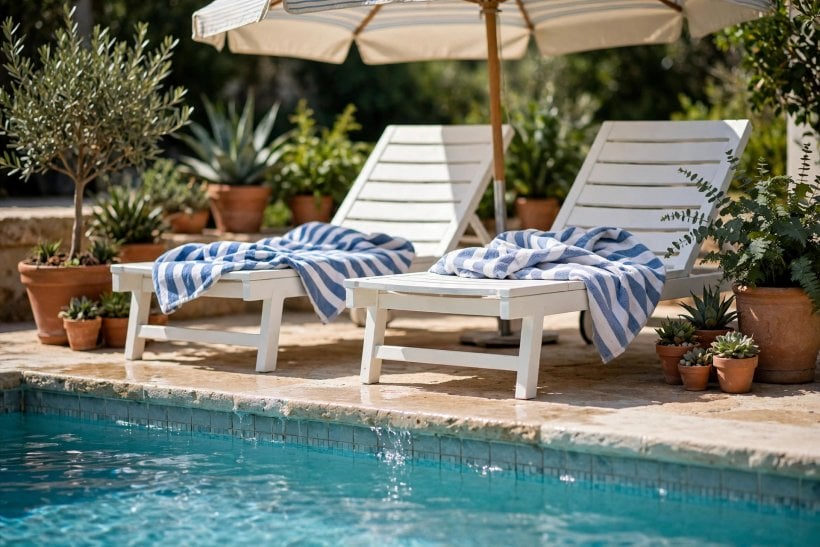
More pool hours are spent on the apron than in the water. This section builds the pool’s room — surfaces that forgive wet feet, edges that welcome hands, falls that keep the terrace dry. The wider terrace discipline is the porch ideas survey’s dry-land cousin.
45. Choose Deck Material by Barefoot Honesty
Wet grip, heat under noon sun, splinter and stain behaviour: judge decking as a bare foot judges it. Pale stone and textured concrete stay kind; dark timber and some composites cook by lunchtime in hot climates.
46. Fall the Apron Away From the Water
The deck’s slope is invisible and absolute: every splash and storm must drain away from the pool, never into it carrying the terrace’s dust. Falls are the apron’s plumbing; get them in the base, not the grout.
47. Drain the Apron’s Low Edge With a Channel
A linear drain where deck meets lawn or terrace catches the apron’s runoff and the pool’s surge. Without it, the garden’s lowest corner becomes the pool’s accidental second basin.
48. Run Coping and Deck as One Composed Edge
Where coping stone, deck boards and lawn meet in a muddle of levels, the pool looks assembled. One deliberate edge detail — materials meeting at considered lines — makes modest pools look designed.
49. Leave a Dry Route Round the Whole Pool
Maintenance, rescue, retrieving the ball: the apron must walk all the way round at a dry foot’s width minimum. Pools pushed to fences are cleaned from in the water and regretted from out of it.
50. Build the Lounger’s Territory Generously
The sunbathing strip wants depth for a lounger, a side table and a passing waiter with drinks. Aprons sized for walking produce gardens where everyone stands; size for lying down.
51. Keep Grass Out of the Splash Zone
Lawn against coping means clippings in the skimmer forever and mud at the pool’s edge. A paved margin of honest width between water and grass saves the filter and the water’s clarity alike.
52. Set the Diving and Jumping Zone’s Floor for Impact
Where bodies land outside the water — and they do — the surface should forgive. Keep the active end’s apron in grippy, slightly forgiving material and the furniture out of the landing pattern.
53. Anchor Shade Into the Apron’s Structure
Umbrella sleeves cast into the deck, pergola posts on real footings: shade fixed into the apron survives the storm that takes the parasol into the neighbour’s hedge. The shade section below builds on these bones.
54. Hose Points and Power Belong at the Apron’s Edge
Cleaning, inflating, lighting the evening: a tap and a weatherproof socket at the deck’s working edge serve the pool’s whole life. Services designed in are invisible; services improvised are cables.
55. Let the Apron Age as Gracefully as the Pool
Materials that silver, patinate or simply endure keep the setting dignified as seasons pass. Finishes that peel, fade in patches or demand annual theatre will make a good pool look neglected by year three.
7. Shade, Planting and the Poolside Room
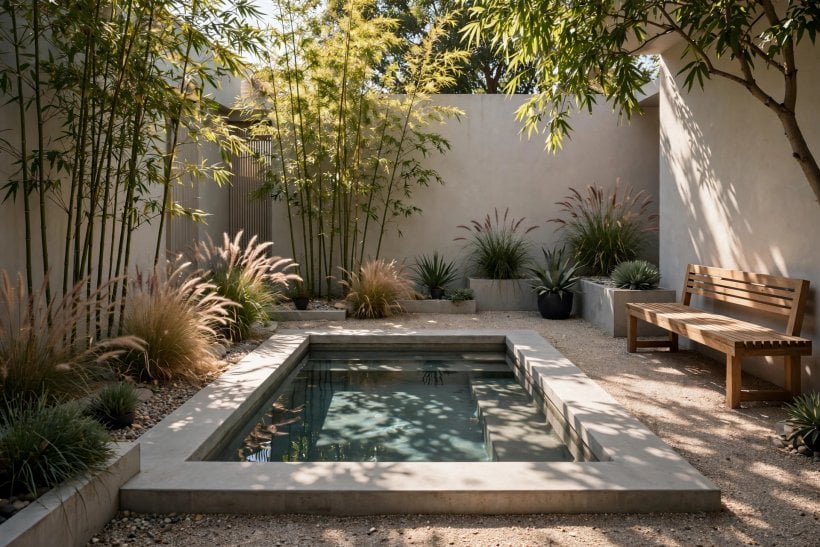
A pool without shade is a dare, and a pool without planting is a car park with water. This section furnishes the poolside room — shade, planting that behaves near water, and the small architecture of towels, drinks and evenings. The planting logic extends the backyard landscaping ideas programme to the water’s edge.
56. Shade the Shallow End’s Social Water
The shelf and steps are where people linger longest, half in and half out. Shade that reaches the social water — a pergola’s edge, a sail’s corner — extends every session and saves every shoulder.
57. Sail It When the Sun Moves Too Much for a Roof
Shade sails angle to the season and come down for winter, giving pools in mixed climates a negotiable sky. Their posts want real footings; a sail is a wing, and wings pull.
58. Plant for Litter Manners First, Beauty Second
Poolside planting must hold its leaves, drop nothing sticky, and keep its roots polite. Evergreen structure, tough grasses and clean habits near the water; the floriferous mess-makers belong across the garden.
59. Keep Thorns, Bees and Berries at a Distance
Bare feet and wet children negotiate the planting at ankle height. Roses, berrying shrubs and bee banquets in flower are glorious one bed away and a hazard at the coping’s edge.
60. Use Planting as the Fence’s Soft Face
Where the safety barrier is unavoidably stark, a green screen inside it restores the garden feeling without touching the barrier’s duty. The fence keeps its law; the planting keeps the view.
61. Build a Towel and Robe Station Into the Setting
Hooks on the pergola post, a bench with a dry box, a rail in the sun: the pool’s textiles need architecture or they colonise the loungers. A designed towel station is used a dozen times a day.
62. Give the Evening a Fire or a Light Source
Poolside evenings gather around a point: a fire bowl at the apron’s edge, the lit water itself, a lantern tree. Plan the point and the seating follows it as naturally as moths.
63. Screen the Neighbours With Height in the Right Place
Privacy planting belongs where sight lines actually run — from their windows and terraces to the water. A tall screen in the wrong place shades the pool and spares nobody; map the views before planting the hedge.
64. Keep a Grass or Green Corner for Wet Feet and Games
Not every poolside hour is on stone. A small lawn panel — real or good artificial — takes the picnics, the toddlers’ headquarters and the dog’s supervisory post, at a managed distance from the waterline.
65. Store the Pool’s Clutter in a Poolside Box or Shed
Inflatables, noodles, covers, chemicals and the robot cleaner need a home at the pool, or the apron becomes a depot. A bench-box or slim shed built into the setting swallows the whole colourful inventory.
8. Pools for Small Gardens and Tiny Properties
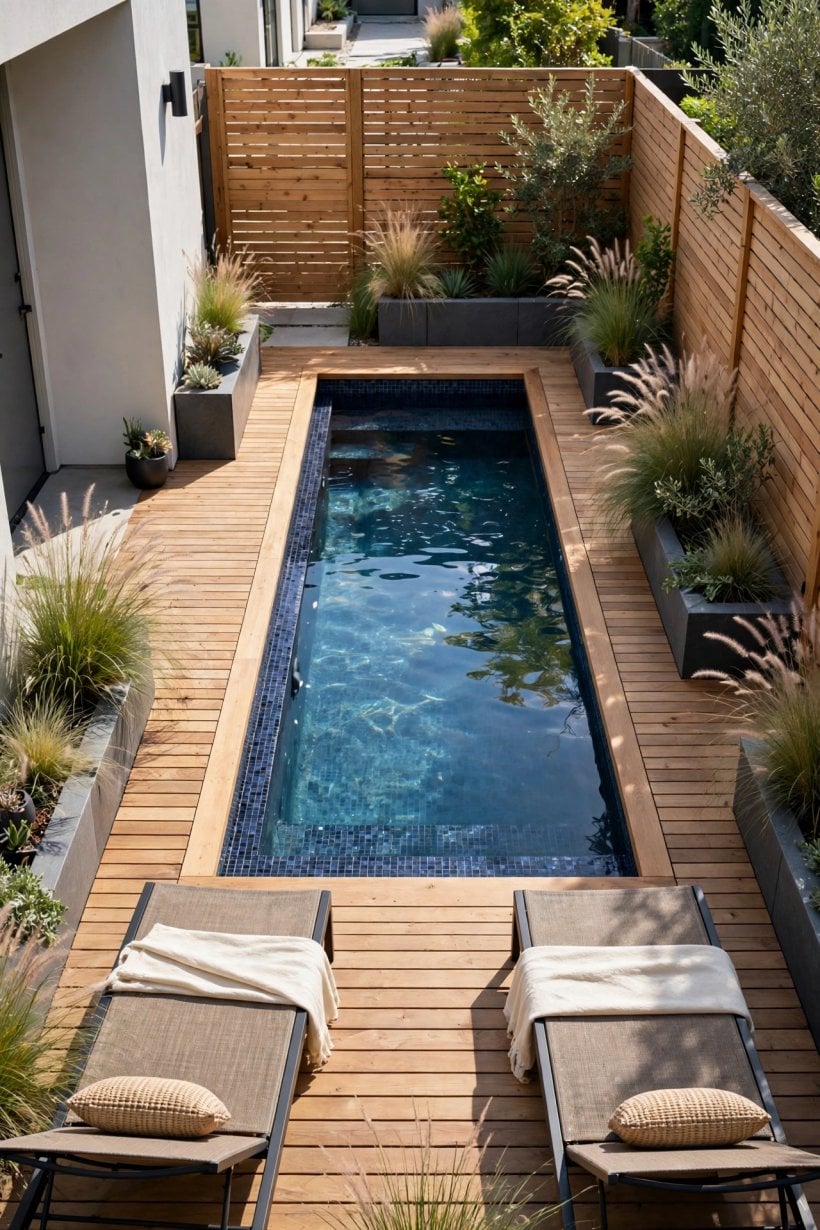
Small gardens were long told to forget swimming; the small-water revolution disagrees. These ideas fit water into tight plots — the same spirit that asks can I put a tiny house in my backyard — where the pool must earn its ground against every other use.
66. Take the Garden’s Awkward Corner and Make It the Point
Every small plot has a corner too shady, sloped or odd for the lawn’s ambitions. A plunge pool turns the liability into the destination, and the good garden keeps its shape around it.
67. Run a Narrow Lap Tank Along the Boundary
A lane-width pool against the fence uses the garden’s least useful strip and leaves the centre free. Boundary tanks are the small plot’s lap pool, and their length often surprises.
68. Let the Pool Double as the Garden’s Water Feature
In a small garden, everything must work twice. A pool designed to be beautiful idle — still, reflective, edged like a rill — is the garden’s ornament for the 300 days it is not swum in.
69. Share the Deck With the Dining Terrace
One paved room serving table and water beats two cramped ones. The apron that hosts dinner at seven hosts towels at noon, and the small garden keeps a single generous surface.
70. Keep Depths Family-Shallow for Safety and Warmth
Small pools warm faster and supervise easier at a friendly, fairly even depth. The deep end is a luxury of size; in a small vessel, a swimmable shelf-and-slope profile serves everyone better.
71. Choose the Cover as the Design’s Security and Blanket
On a small plot the cover is safety barrier, heat blanket and leaf shield in one — specify the best the budget allows, because it will be seen and used daily, unlike a big garden’s hidden roller.
72. Build Plant and Filter Into a Garden Structure
The pergola’s post cluster, the bench’s belly, a shed shared with tools: small gardens hide pool machinery inside furniture that was coming anyway. Every dedicated box is floor the garden has lost.
73. Light the Small Pool as the Garden’s Evening Centre
One vessel of lit water organises a small garden’s whole night. Neighbours’ windows, the terrace, the path home — all borrow its glow, and the plot feels twice its size after dark.
74. Respect the Rules Early: Fences, Setbacks, Consents
Small plots sit close to boundaries, and pool rules — barriers, distances, drainage, consents — bite hardest there. Establish what the plot legally allows before falling for a design; the survey of permissions is unglamorous and decisive.
75. Accept the Dip as the Destination
The small garden’s pool succeeds when nobody apologises for it. A cool, clear, beautiful plunge ten steps from the kitchen door beats the memory of a big pool in a garden that exists in a brochure.
9. Checks and Mistakes: Before the Ground Is Broken
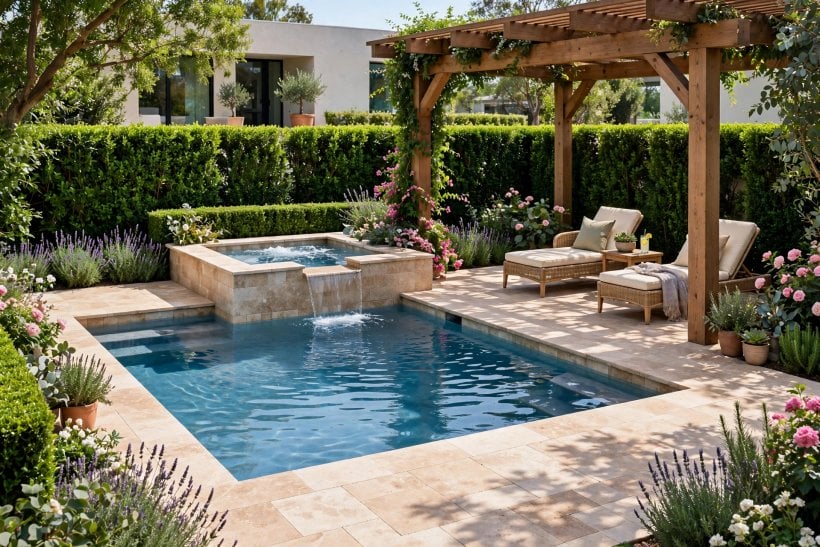
The classic pool mistakes are all made before the water arrives: a site chosen for the view that ignores the sun, a budget that builds the basin and strands the surround, safety treated as a later errand. Each is cheapest on paper, which is when this section should be read.
Apply the checks in site order. First, the sun check: the water’s position traced against a high-summer day, shade accounted. Second, the services check: water, power, drainage and plant space all reach the site without heroics. Third, the rules check: barriers, setbacks, consents and the neighbours’ sight lines settled in writing. Fourth, the whole-cost check: basin, apron, shade, planting, fence and the first season’s running, in one honest number. A pool that passes all four will be forgiven almost any shape.
10. Costs and Pulling It Together
Pool costs sort brutally by type. Above-ground builds are the modest end — a kit, a level pad, a season. Inground shells are a construction project priced like one, with concrete at the top and liners at the kinder end; plunge pools sit between, their volume savings spent back on finish. In every class the surround rivals the basin: decking, coping, fencing, shade and planting routinely cost what the hole and shell did.
The running costs are the second purchase: heating, chemicals, cleaning, water and the eventual liner or resurfacing, paid annually for the pool’s whole life. Spend the capital where it reduces the rent — sound circulation, a good cover, honest falls on the apron — and let the visible luxuries queue behind the machine. A pool is a decade-long commitment wearing a summer’s costume; fund it as the decade.
Final Considerations
A pool is the garden’s boldest sentence, and like all bold sentences it should be true: true to how the household swims, true to the sun the site actually gets, true to the budget’s whole length. Built true, it stops being an amenity and becomes the place the family’s summers are archived — first swims, last swims of the year, the evening the water was warmer than the air.
Choose the type by the life it will serve, build the surround as seriously as the shell, and keep the machine quiet and the water honest. The garden will organise itself around the result for as long as the house is loved — and in the off-season, the sunroom ideas survey keeps the water in view from the warm side of the glass.

0 Comments