

A tropical garden is not made of tropical plants. It is made of shade, layers and water, arranged until the fence disappears and the air itself feels borrowed from somewhere warmer.
These tropical landscaping ideas build that borrowed climate honestly: canopy first, big leaves in drifts, paths that vanish, water with a voice, colour in relay, and a version scaled down to the smallest courtyard.
1. Tropical Landscape at a Glance
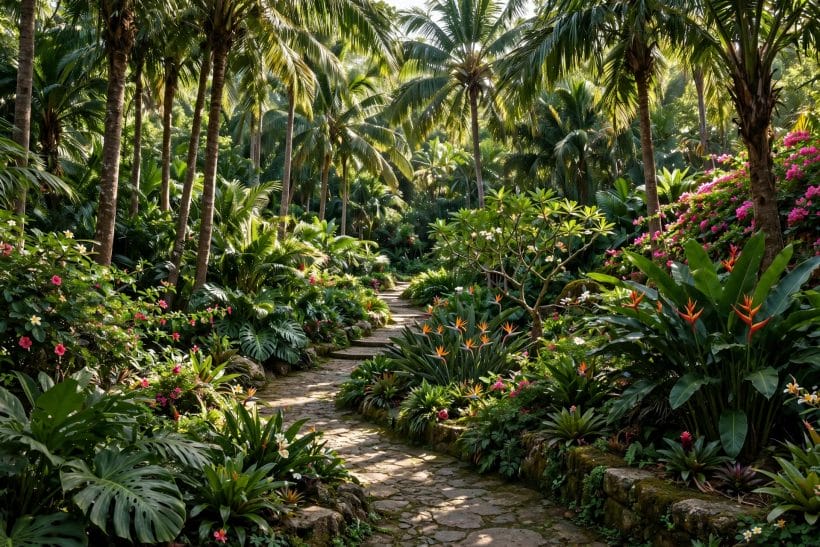
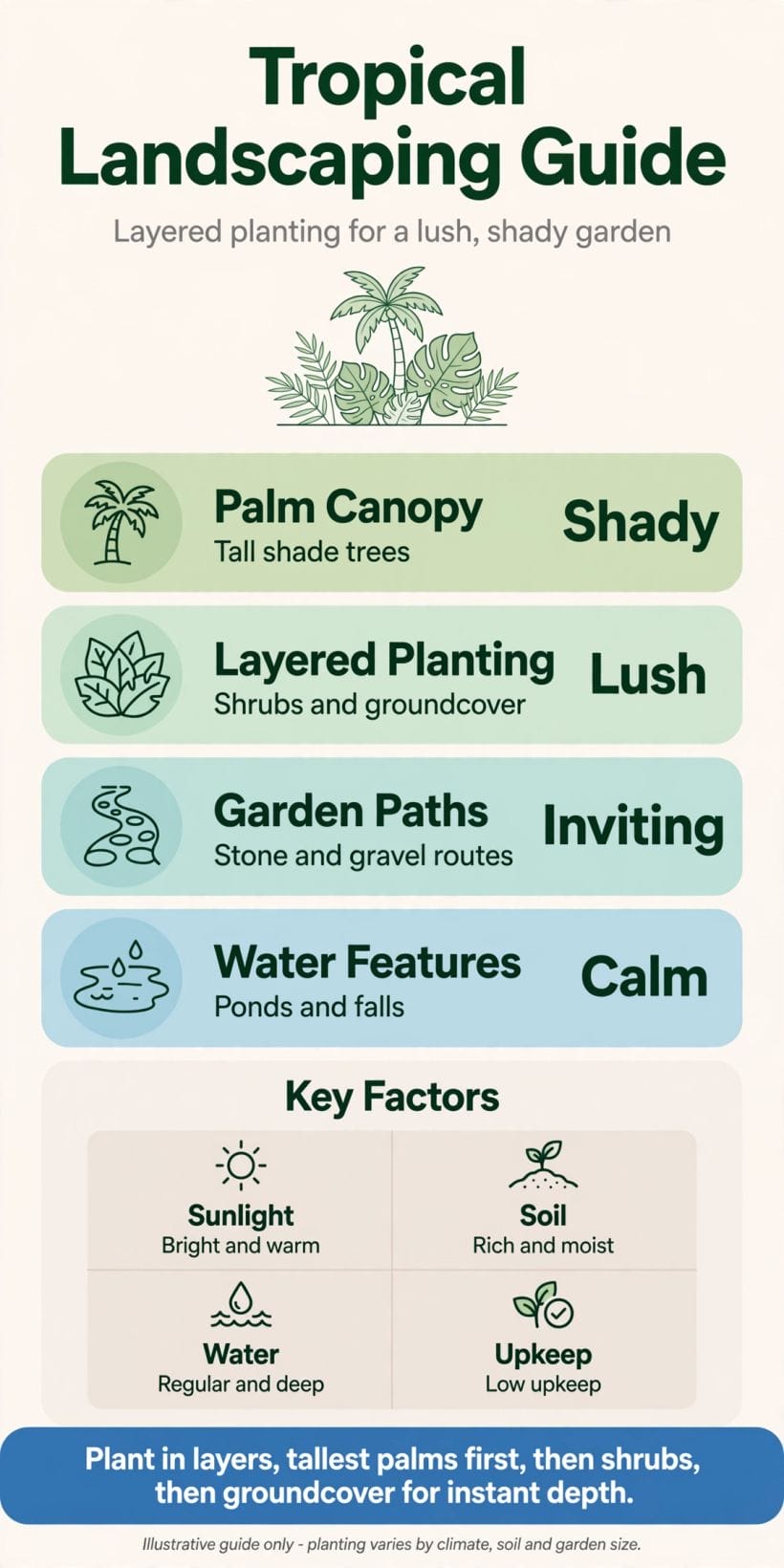
The central entity is the tropical landscape: a garden composed in three planted storeys, canopy, understorey and ground layer, around shade, water and enclosure. Its attributes are the structure plants and their repetition, the paths and thresholds that sequence the visitor’s journey, water and stone as its furniture, a flowering relay set against dominant green, and the keeping regime, watering, feeding, pruning and winter protection, that a fast-growing garden demands. Its rule is abundance with composition: dense, layered and enclosed, yet every plant placed by the storey it belongs to and the view it was planted to make.
| Question | Short answer |
|---|---|
| What makes a garden tropical? | Layers and shade: canopy over big-leafed understorey over ground cover, with the boundaries planted invisible. |
| Which plants lead? | Palms for the skyline, bananas and tree ferns for architecture, clumping bamboo for screens. |
| Where does the colour live? | In the leaves first, coloured and variegated foliage, with flowers arriving in a planned relay. |
| What does water do? | Everything: a still pond reflects, a small fall gives the garden its sound and masks the world. |
| What is the main upkeep? | Water and editing: tropical growth is fast, thirsty and in constant need of an honest prune. |
2. The Tropical Garden Itself: Canopy, Understorey and Ground
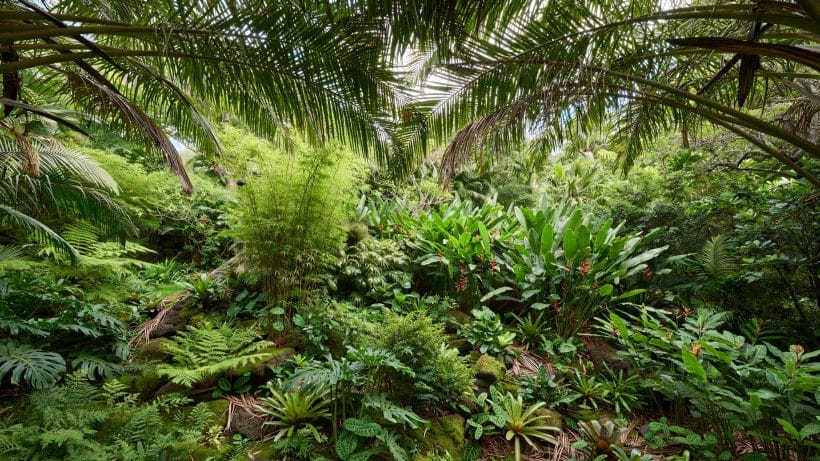
A tropical landscape is built in storeys, like the forests it imitates. It joins the wider family of garden surveys that includes the backyard landscaping ideas post; this post stays inside the tropical lane, where the air is warm in the planting if not always in the climate, and every idea serves the layered, shaded, abundant effect.
1. Plant in three storeys, always
Canopy above for shade and silhouette, understorey at eye level for the big leaves, ground layer below for coverage and flower.
2. Shade is the first crop
Decide where the shade falls before choosing a single flowering plant.
3. Curve every line the eye travels
Paths, bed edges and lawn shapes should bend out of sight rather than run straight to a fence.
4. Make the boundary disappear
Plant the boundaries denser than the centre, in layered screens of palm, bamboo-like clumps and broad shrubs.
5. Water in the plan from the start
Tropical planting drinks, so the water plan, where it comes from, how it reaches the beds, where it drains, is structure, not afterthought.
6. Give the garden a destination
A seat, a pond, a statue half-seen through leaves: every tropical garden needs something the paths are for. Abundance without destination is a thicket; abundance arranged around a goal, glimpsed and approached slowly, is a landscape.
7. Work with the site’s own warmth
South walls, sheltered corners and sun-trap terraces extend what can grow, and cold pockets must be planted with the hardier company.
8. Soil rich, deep and mulched
Build the soil with organic matter before planting and keep it covered always.
9. Density is the aesthetic
Plant closer than temperate instinct suggests, letting canopies knit and ground layers merge.
10. Plan for growth at tropical speed
Leave each plant the room its mature size demands, or accept a regime of moving and dividing.
11. One garden, one climate story
Choose the planting family that suits the site’s real winters, lush hardy exotics in cooler places, true tenders where frost is a rumour.
3. The Big Leaves: Structure Plants and Their Company
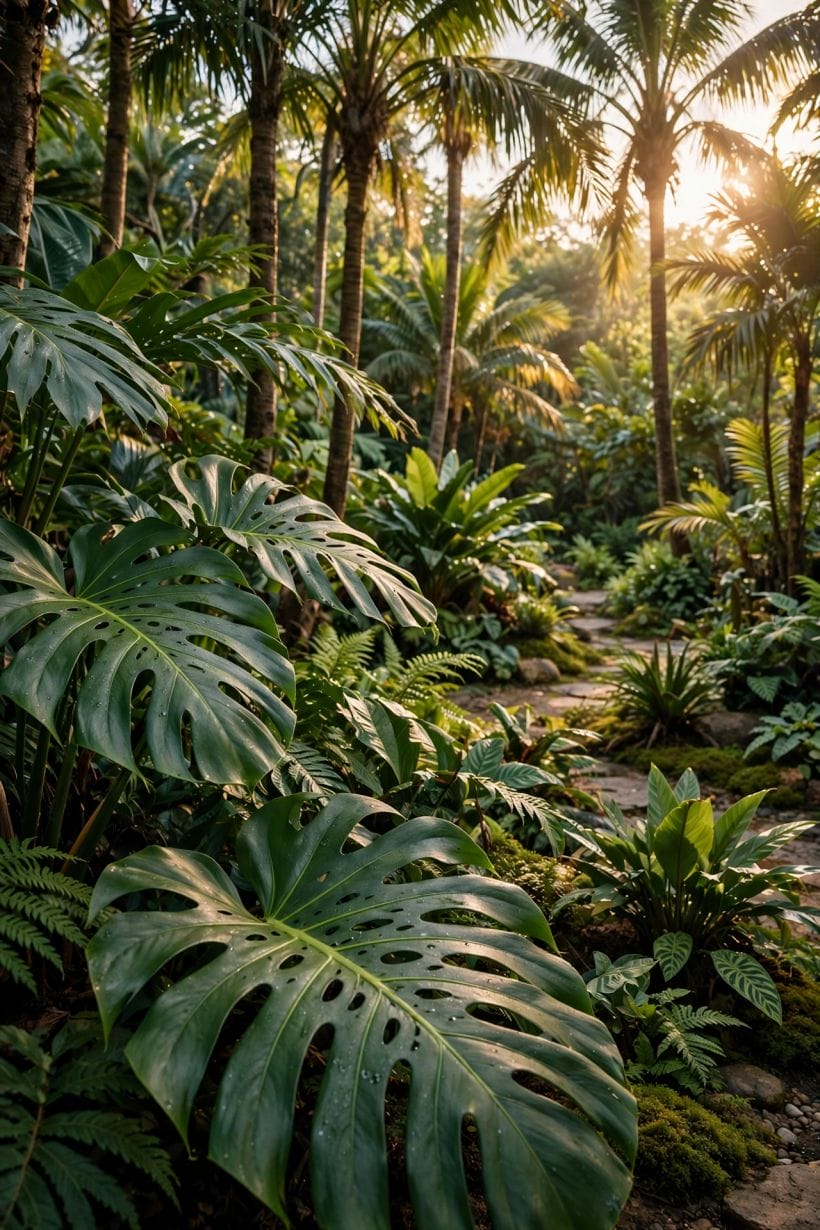
Leaves, not flowers, are the tropical garden’s architecture. The front of the house runs the same layered logic at kerb scale in the front yard landscaping ideas post; this section plants the interior of the garden, where leaf size, silhouette and movement do the work that walls do indoors.
12. Palms for the ceiling and the silhouette
Palms, hardy or tender as the climate dictates, give the garden its unmistakable skyline and its moving shade. Even a single well-placed palm changes every photograph of a garden; a loose grove changes the garden’s whole climate of feeling.
13. Bananas and their kin for instant architecture
Banana plants and their broad-leafed relatives produce enormous leaves at a speed no shrub can match. They are the tropical gardener’s scaffolding, filling a new garden in one season while the slower structure plants establish beneath their shelter.
14. Tree ferns for the shaded heart
Where shade and moisture meet, tree ferns plant the garden’s prehistoric centre. Their fronds are the finest texture the style owns, and a grove of them around a seat or a pond makes the garden’s most photographed and most loved corner.
15. Bamboos, clumped and contained
Clumping bamboos give height, movement and a rustling screen faster than any hedge. Choose clumping forms for gardens, keep any running kind in serious containers, and the bamboo is a servant; reverse those decisions and it becomes the landlord.
16. Hostas and bold perennials in the understorey
The great foliage perennials, hostas, ligularias, rodgersias and their kin, carpet the understorey with leaf variety in shade. Planted in drifts rather than singles, they give the middle layer its depth without asking for sun the canopy has already spent.
17. Cannas and gingers for height with flower
Cannas and hardy gingers carry the understorey’s flowers on foliage that earns its place even unflowered. In a tropical scheme a plant should be worth growing for its leaves alone, with its flowers as a bonus season rather than its whole excuse.
18. Climbers to green the verticals
Walls, fences and pergolas take climbers, flowering where sun reaches, foliage where it does not, until no vertical surface reads as man-made. The tropical garden’s enclosure is complete only when its boundaries are as planted as its beds.
19. Evergreen backbone for the off-season
Give the garden an evergreen skeleton, palms, bamboos, bold evergreen shrubs, that holds the composition when the herbaceous layers rest. A tropical garden that vanishes entirely in winter leaves its owner a season of apology; a skeleton keeps the promise standing.
20. Containers for the true tenders
The genuinely tender treasures, citrus, the tender palms, the great flowering shrubs of warmer worlds, live in pots that move under cover when the season turns.
21. Repeat a short cast widely
Choose a small company of structure plants and repeat them through the garden rather than collecting one of everything. Repetition is what turns planting into landscape; the collector’s one-of-each reads as a nursery that forgot to stop.
22. Young plants, planted close, win
Buy structure plants young and plant them at final spacing with ground layer between.
4. Paths, Edges and Moving Through Green
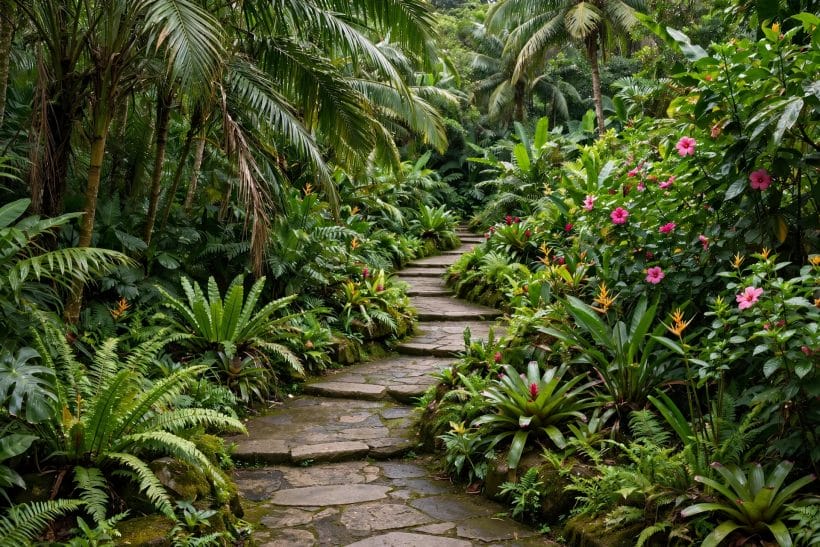
A tropical garden is experienced at walking pace, in shade, with leaves brushing the shoulder. Sloped sites run a version of this movement problem in the hillside landscaping ideas post; on level ground the paths below do the same work, deciding what the visitor sees, in what order, and what stays hidden for the return journey.
23. Paths that vanish and return
Run paths in loops and curves that disappear behind planting and re-emerge changed.
24. Stepping stones through the lush parts
Where the planting is thickest, step the visitor through on stones set in ground cover rather than a built path.
25. Edges softened by spill
Let ground layer plants spill over every path edge until the boundary between path and bed is a negotiation, not a line. Hard edges belong to formal gardens; the tropical path should feel discovered through foliage, not drawn on it.
26. One paved terrace as the base camp
Keep one properly paved terrace by the house for furniture, pots and daily use, from which the green paths depart. The terrace is the garden’s harbour, dry-shod and level, and its contrast with the wild paths beyond makes both read better.
27. Thresholds between garden rooms
Mark the passage from one part of the garden to another with a step, a gate of foliage, a narrowing between bamboos.
28. Decking where the ground stays wet
In damp low ground, a boardwalk section carries the path dry over the wettest, lushest planting.
29. Gravel that crunches quietly
Where paths are surfaced, a fine gravel over a firm base gives dry footing with a soft voice. The path’s sound matters in a garden built on atmosphere; a quiet crunch underfoot belongs, where a hard echo would wake the illusion.
30. Seating hidden until reached
Place benches and seats where paths reveal them late, around a bend or behind a palm.
31. Light the path, not the garden
Low path lights at ankle height guide evening walks without flattening the night garden. Uplight one great palm or tree fern as the night’s single portrait, and leave the rest in shadow, where the tropical garden’s mystery lives.
32. Maintenance access kept honest
Keep one workable route, wide enough for a barrow, to every bed and the compost corner. Gardens whose maintenance needs a commando course get maintained rarely; the lush style, of all styles, cannot survive rare maintenance.
33. Bridges over water, however small
Where a stream or pond crosses the path, cross it on a simple bridge or broad stepping slabs. The crossing becomes the garden’s ceremony, the moment every visitor remembers, out of all proportion to the water’s size.
5. Water, Stone and the Garden’s Furniture

Water is the tropical garden’s voice, and stone its accent. The hard outdoor room these elements serve is planned in the patio ideas pillar; this section keeps both elements inside the planting, where a pond’s edge or a boulder’s shoulder should always be half-swallowed by leaves.
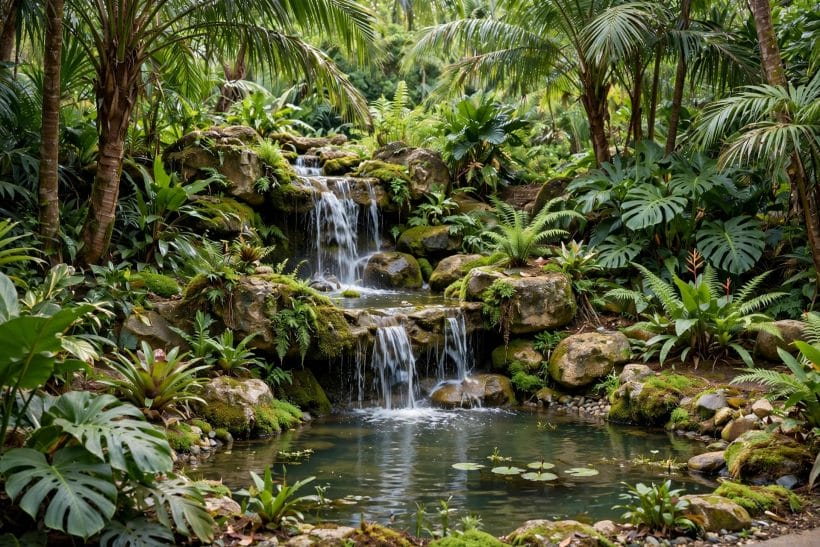
34. A still pond for reflection
A dark, still pond doubles the garden’s foliage in reflection and cools the air at its edge. Edged with boulders and overhung with ferns, it becomes the tropical garden’s mirror and its most restful seat-side destination.
35. Moving water for the sound
A small fall, a spout into a basin, a rill along a path gives the garden its soundtrack and masks the world’s noise beyond the fence.
36. Boulders as half-buried furniture
Set the largest stones the budget allows, buried deep so they read as geology, not ornaments placed yesterday.
37. A rain chain and water jars
Where roofs shed water near the garden, a rain chain into a stone jar turns drainage into display. Tropical gardens celebrate water rather than hiding it, and every downpour becomes a small performance the house can watch from its windows.
38. Seating in stone and heavy timber
Benches and tables in stone or massive timber survive the damp shade that rots lighter furniture. Their weight suits the planting’s scale, and a stone seat warmed by a gap of sun is the tropical garden’s most civilised invention.
39. Statuary glimpsed, never centred
Place figures and ornaments where paths discover them, half-screened, at a turn or across water. The tropical garden’s ornaments work like its wildlife should: encountered, not exhibited, and remembered all the more for the screening leaves.
40. A dipping pool or plunge where space allows
Where a swimming or plunge pool joins the garden, plant its edges as the pond’s are, with palms overhanging and leaves at the coping. The leisure water of the pool ideas post and the wild water of this one meet at the edge, and the planting is what marries them into one garden.
41. Bird baths and drinking stones
Shallow water at ground and table height brings birds into the garden’s daily life. A tropical garden without birdsong is a stage set; a drinking stone by the path fills it with the movement and sound the planting was imitating all along.
42. Torches and fire where evenings gather
Flame torches or a fire bowl at the main seat give the night garden its hearth. Firelight on big leaves is the tropical evening’s whole theatre, and the seat around it becomes the garden’s most used room after dark.
43. Pots as the garden’s jewellery
Great pots, glazed in deep greens and blues or left as honest terracotta, carry the tender collection and mark the terrace’s edge. A pot group lets the gardener compose and recompose the scene seasonally without touching a single planted thing.
44. Keep fish and plants in balance in ponds
Where fish live in the pond, plant for shade and shelter and let the water’s ecology settle before stocking ambitions grow.
6. Keeping the Jungle: Water, Food and the Honest Prune
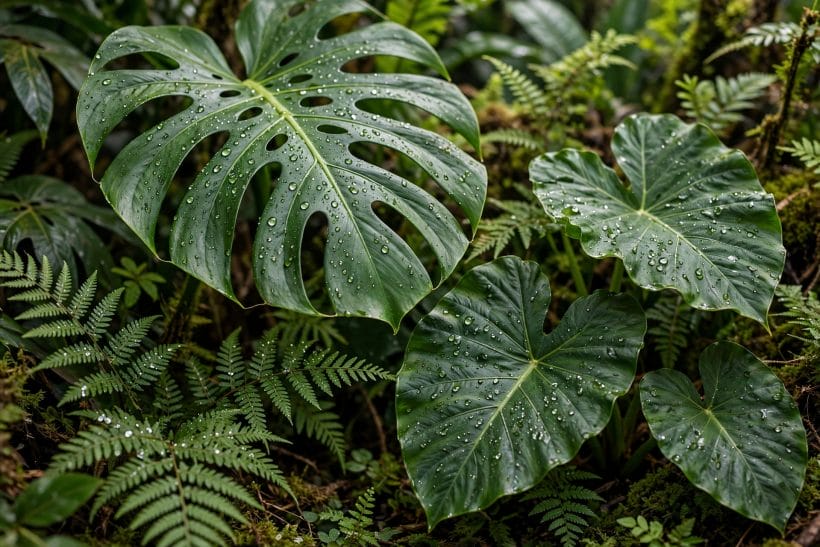
A tropical garden is the fastest-growing room a household owns, and its keeping is a rhythm, not a rescue. This section is the maintenance spine the whole style stands on: water delivered as designed, food given at tropical rates, growth edited before it edits itself, and winter met with a plan rather than a prayer.
45. Water little and often, deep at the roots
Tropical planting prefers frequent, thorough watering that wets the root zone and then lets the surface breathe. Timers and soaker lines serve better than heroic hosepipe sessions, because the garden’s thirst is daily and its owner’s memory is not.
46. Mulch renewed as it vanishes
Keep every bed under a living or laid mulch, renewed as the garden’s warmth consumes it. Mulch in a tropical garden is not tidiness; it is the moisture bank, the weed truce and the soil’s slow dinner, all in one layer.
47. Feed at tropical rates, in season
Growth this fast eats, and structure plants in full career need feeding through their growing season to hold their size and colour.
48. Prune for air as much as size
Thin the understorey regularly so air moves through the layers and leaves dry after rain. Tropical density invites every mildew and rot that still air offers; the honest prune keeps the jungle lush by keeping it ventilated.
49. Divide and move the overgrown, bravely
When a clump outgrows its station, divide it, move it or give it away while it is still an asset. Gardeners who edit early garden with surplus; gardeners who edit late garden with a saw, a skip and a feeling of loss.
50. The container fleet’s winter quarters
Before the cold season, the tender pots move to their planned shelter, cleaned, checked and grouped by their needs. A winter move rehearsed in autumn daylight takes an afternoon; the same move improvised on the first frost night takes casualties.
51. Watch the water features weekly
Pumps, filters and pond balances need a weekly glance in the growing season, when growth and warmth conspire to clog and cloud. Ten minutes weekly keeps water clear and machinery alive; a neglected month makes both a project.
52. Compost the garden’s own abundance
A tropical garden produces green waste at a rate that becomes its finest resource when composted hot and returned as mulch. The jungle feeding itself is the style’s closed loop, and the compost corner deserves the same design respect as the pond.
53. Pests met early and specifically
Check the great leaves’ undersides and the new growth weekly, and meet problems while they are colonies, not plagues. Lush gardens feed pests as generously as plants, and the gardener’s eye, applied early, is worth more than any later remedy.
54. Renovate one bed a year
Take one bed or corner back to structure each year, dividing, replanting and remulching it completely. Rotation renovation keeps the whole garden young in turns, and no single year carries the impossible task of renewing a jungle all at once.
55. Rest in the garden’s slow season
Where the climate gives the garden a quiet season, let the gardener rest with it, planning rather than planting.
7. Colour and Flower in a Green-Dominant Garden
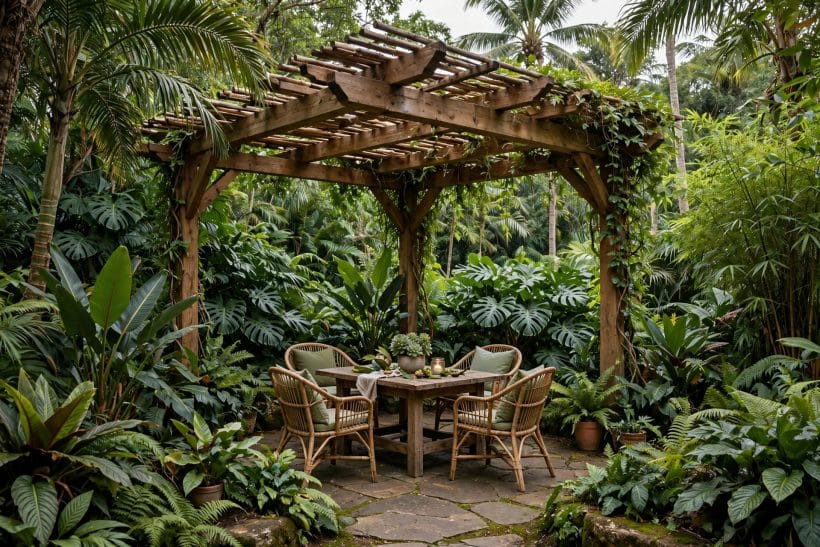
In a tropical landscape, green is not the background; it is the subject, and flower colour arrives as event rather than upholstery. The protected version of this growing is worked under glass in the greenhouse ideas post; out in the open garden, the colour below is timed to the foliage, so the garden performs in sequence instead of all at once.
56. Hibiscus and its kin for the great flowers
Where the climate carries them, hibiscus and their relatives give the tropical garden its poster flowers, huge and unembarrassed. Planted against deep green, a single flowering shrub reads across the whole garden; the green is what makes the colour loud.
57. Cordyline and croton for coloured leaves
Coloured foliage, the burgundy cordylines, the painted crotons and their kin, gives colour that no flowering season can take away. In a style where leaves rule, coloured leaves are the permanent collection, and flowers are only its visiting exhibitions.
58. Orchids and bromeliads in the trees
Where winters allow, mount epiphytes on trunks and branches so the canopy itself flowers at eye height.
59. Gingers and heliconia kin for the exotics
The ginger family’s flowers, torch-like and architectural, suit the foliage around them because they share its scale. Small, fussy flowers disappear in a tropical border; the flowers that belong are as boldly built as the leaves they stand among.
60. A flowering season planned in relay
Choose flowering plants so something performs in every warm month, the relay passed from shrub to climber to perennial. A tropical garden that flowers all at once and then rests is a firework; a relay garden is a theatre with a season.
61. White and cream for the evening garden
Pale flowers and silver-variegated leaves glow at dusk when the saturated colours go dark. Plant the evening seat’s surroundings pale, and the garden’s last hour gains a second, quieter flowering that day visitors never see.
62. Fruit as ornament and harvest
Bananas in fruit, citrus in pots, a fig against the warm wall: productive plants in a tropical garden are ornaments that occasionally feed people. Their inclusion deepens the style’s honesty, since the forests it imitates were always somebody’s larder too.
63. Scent planted at the seats
Jasmine at the terrace, scented gingers by the evening bench, herbs along the path’s edge where legs brush them.
64. Variegation to light the shade
Cream and yellow variegated leaves carry light into the garden’s shaded storeys where flowers refuse to perform. Used in drifts at the understorey’s dark corners, variegation is the tropical gardener’s lamp, burning all season without a bill.
65. Restraint in the colour count
Hold the hot colours to a family, reds and oranges together, or pinks with whites, rather than the whole paintbox at war.
8. Small Gardens, Patios and Tropical Rooms Outdoors
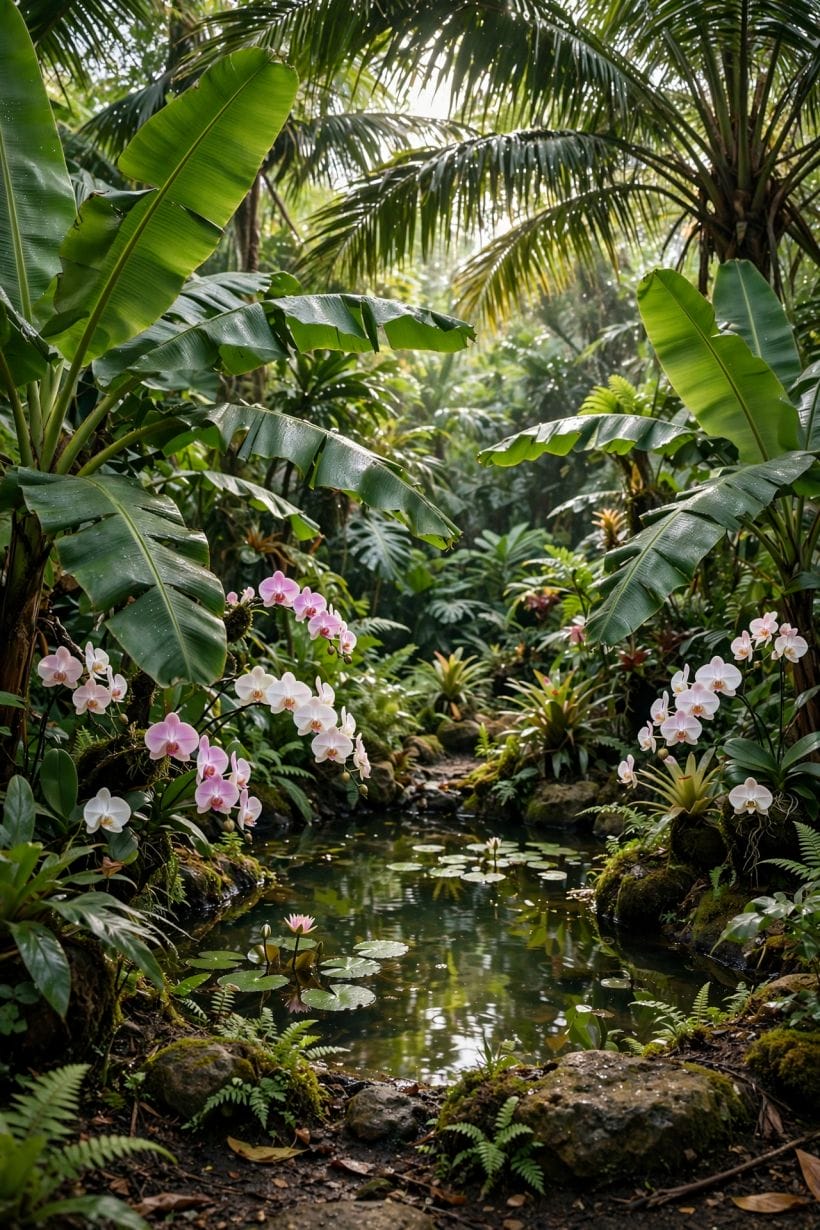
The tropical effect does not require acreage; it requires enclosure, layers and nerve, all of which fit a courtyard. The same small-plot discipline drives the tiny-house gardens in the tiny house landscaping ideas post; this section applies it to the patio and the small town plot, where the style’s enclosure is an advantage rather than a compromise.
66. One palm, planted like a decision
In a small garden, a single palm in the right corner reclassifies every other plant as tropical company.
67. Walls green on every side
Cover a small plot’s walls and fences completely, with climbers, mounted pots and tall planting hard against them. The tropical courtyard is all interior: when no boundary material shows anywhere, the garden’s size stops being its first fact.
68. The pot jungle on paving
Where no soil exists at all, a jungle of great pots at varied heights, canopy pot, leaf pot, ground pot, builds the storeys in containers. Grouped tightly and watered faithfully, a pot jungle on a terrace convinces every sense except the worm’s.
69. A shade sail or pergola as instant canopy
Where no tree canopy exists yet, a sail or a climber-covered pergola manufactures the shade the understorey needs. Artificial canopy is honest scaffolding: it serves until the palms grow into the job, and then retires or stays as the terrace’s roof.
70. Mirrors and dark paint deepen small plots
A garden mirror behind planting and boundaries painted near-black make foliage advance and fences recede. Dark boundaries are the small tropical garden’s cheapest depth, because green against black reads as forest shadow rather than as a fence with plants on it.
71. Water in miniature still counts
A stone basin with a spout, a half-barrel pond with a lily, a wall fountain into a trough: small water gives the courtyard its sound and its reflections at pot scale.
72. Seating wrapped, not placed
Set the small garden’s seat inside the planting, with leaves at its back and shoulders, not on an open lawn facing it.
73. Night lighting makes the small garden huge
Uplight the palm, wash the green wall, light the path’s edge, and a courtyard at night becomes boundless. Small gardens gain more from lighting than large ones, because darkness removes exactly the boundaries that daylight insists on.
74. Balconies and roof terraces in pots
The pot jungle climbs: balconies and roof terraces take the same three storeys in containers, weighted for wind and watered with discipline. Height gives these gardens their drainage and their sun; their tropical problem is only ever thirst and gusts.
75. Keep the small garden edited ruthlessly
Small tropical plots fail by accumulation, every gift plant and bargain exotic admitted until the layers merge into congestion. Edit yearly, remove bravely, and remember that in a courtyard each plant must earn a place that a larger garden grants by charity.
9. Checks and Mistakes: Before the First Purchase or the First Stone
Check local rules and neighbours before planting anything with ambitions: running bamboo, large palms near boundaries and water features all carry obligations that vary by place, and the makers’ and growers’ guidance for each plant’s hardiness should be checked against the site’s real winters before money is spent. Check also drainage, since a tropical garden’s generous watering must have somewhere lawful and harmless to go.
The commonest tropical mistake is planting tenders as if the climate were warmer than it is, and mourning them annually. The second is planting singly, one of each exotic, so the garden reads as a collection rather than a place. Choose the cast the site’s winters allow, repeat it in drifts, protect the borderline treasures in pots, and the garden will look inevitable rather than optimistic.
Test the water plan through one dry spell before expanding the planting further. A tropical garden’s appetite is its defining cost, and the gardens that thrive are those whose water was solved first and celebrated second.
10. Costs and Pulling It Together
Costs in a tropical landscape follow the structure: canopy trees and palms, water works and stone first, then the understorey in drifts, then the ground layer that finishes it. Money is saved by buying young, since tropical growth repays patience faster than any other style, and by the pot strategy for tender plants, whose winter quarters cost less than annual replacement. It is wasted on mature tender specimens planted into winters they cannot survive, and on hard landscaping that the planting was always going to swallow.
Pull the garden together in the order it grows: shade, soil and water, structure in drifts, paths and thresholds, colour in relay, and the small spaces composed last. A tropical landscape finished in that order reaches its enclosed, abundant maturity as one composition, and every season after is editing, the pleasantest work a gardener is ever given.
Final Considerations
A tropical landscape is a climate built by hand: shade laid over richness, water given a voice, and green allowed to be the main event rather than the frame. Build it in storeys, plant its cast in drifts, keep its water honest and its boundaries invisible, and a garden of almost any size or zone can hold a piece of somewhere warmer.
Start with the canopy and the pond, repeat a short cast of great leaves until the fence disappears, and let the flowers arrive in their relay. The jungle, properly composed, is not the opposite of order; it is order at its most generous.

0 Comments