

A flat garden is arranged; a hillside garden is negotiated — with gravity, with rain, and with a view that pays rent for every difficult step.
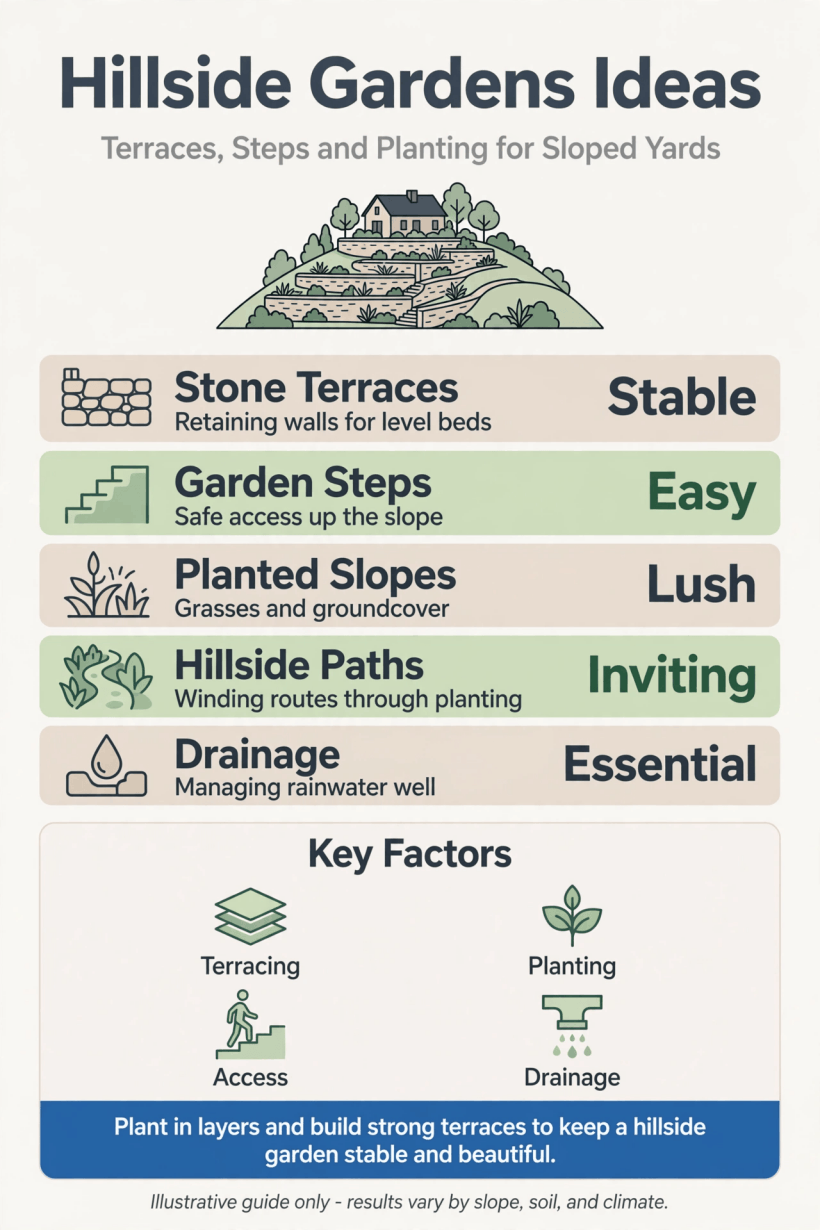
This survey of hillside gardens ideas works the slope in order: reading it, terracing it, climbing it, planting it, watering it wisely, resting on it, and keeping it true year after year.
1. Hillside Landscaping Ideas at a Glance
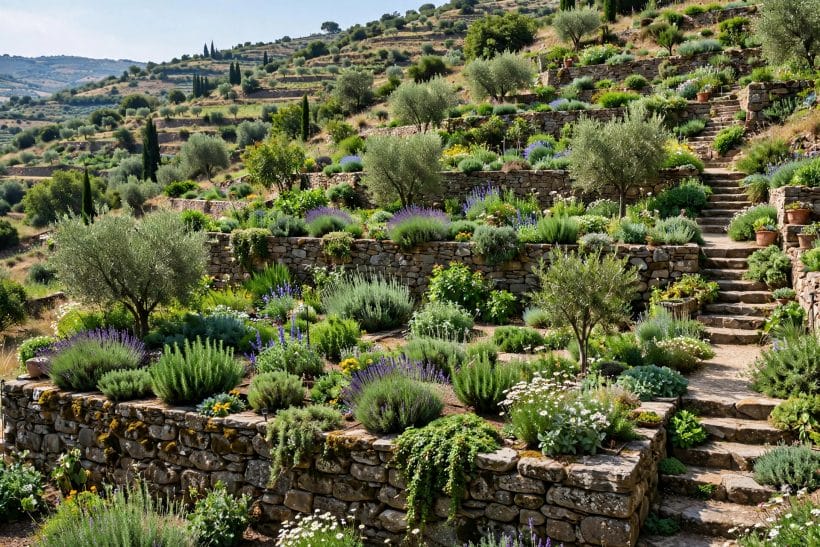
The central entity is the hillside garden: ground that falls, shaped into level terraces and planted banks, climbed by steps and landings, and held together by roots, retaining edges and managed water. Its attributes are the slope itself (gradient, aspect and access), the terraces that level it, the route that climbs it, the layered planting that binds it, the drainage that protects it, and the flat moments — lawn, seat and table — carved from it. These hillside gardens ideas link to the landscaping family around them and stay strictly on falling ground throughout: flat-garden planting is linked, never re-taught.
| Question | Short answer |
|---|---|
| What is the first job on any slope? | Reading it: gradient, aspect, access and — above all — where its water goes in a storm, before any terrace is drawn. |
| Should the whole slope be terraced? | No. Terrace the ground the garden will truly use, and plant the rest as a bound, layered bank — cheaper, kinder and usually more beautiful. |
| What holds a hillside garden together? | Roots, low stepped retaining, and water that is slowed and spread rather than gathered and hurried downhill. |
| What is the hillside’s reward? | The view: borrowed landscape from every terrace and landing, which no amount of flat-garden skill can manufacture. |
2. Reading the Slope: Gradient, Aspect and Access
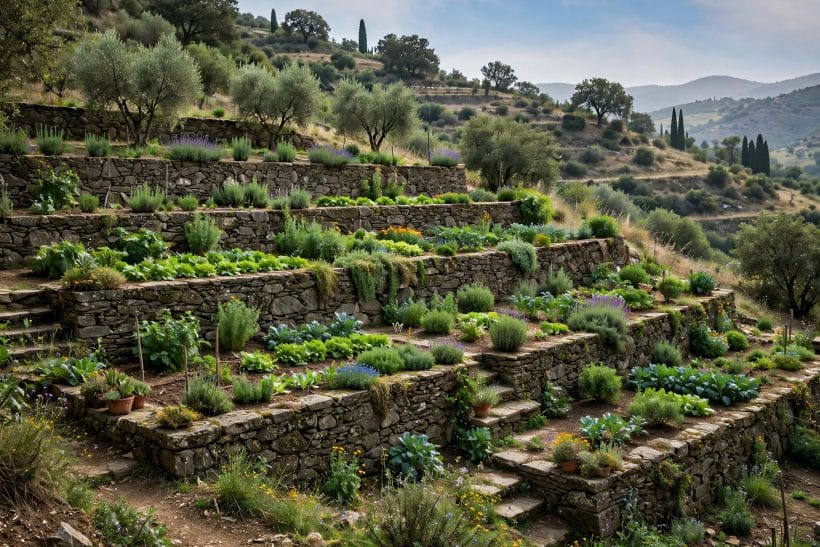
Every hillside garden begins as a reading exercise: how steep, facing which way, shedding water where, and reachable by which route. The same reading at the front of the house is worked through in the front yard landscaping ideas post; this section reads the slope itself, before a single terrace is drawn.
1. Walk the Slope in Rain Before Designing Anything
A slope in a downpour confesses everything: where water gathers, where it runs, where it cuts. Mark the wet map on paper — the terraces, drains and paths in this post all answer to it.
2. Face the Aspect Honestly
A sun-baked south slope and a shaded north bank are different gardens wearing the same gradient. Planting, seating and even step materials follow the aspect, so name it first and design for the slope you have.
3. Divide the Slope Into Its Natural Benches
Most hillsides already suggest their terraces in small level shelves and changes of steepness. Designing with those benches means less digging, lower walls and a garden that looks grown rather than imposed.
4. Find the Honest Access Route First
Barrows, materials and gardeners all need a way up that is not a scramble. The access route fixed early becomes the garden’s working path, and later its most-used steps.
5. Keep the House’s Own Ground Sacred
Near the house, the slope’s water and soil movement matter to walls and foundations, not just to planting. Keep this zone simple, drained and inspectable, and save the adventures for further down the hill.
6. Decide What the Slope Is For
A view to sit in, vegetables to grow, children to play, or simply a beautiful bank to look at: each purpose terraces differently. One clear purpose, named early, prevents the compromise slope that serves nothing well.
7. Measure the Steepness With Your Legs
Walk the slope carrying something, in wet shoes, and note where you lean, slow or grab for support. The body’s report locates the steps, handholds and landings more honestly than any drawing.
8. Note Where Frost and Wind Settle
Cold air pools at a slope’s foot and wind worries its crest, and planting feels both. A season of watching — or a neighbour’s candour — places tender plants and seats in the slope’s kind pockets.
9. Photograph the Slope in Every Season You Can
A bank that charms in spring can glare in summer and slump in winter. Seasonal photographs keep the design honest about structure, because on a slope the bones show for half the year.
10. Respect the Trees Already Holding the Hill
Established trees are the slope’s engineers, their roots binding the ground the garden stands on. Design around them, keep excavation away from their roots, and let their shade plan the seating.
11. Sketch Three Schemes, Not One
Terraced fully, terraced partly, or planted as one flowing bank: three honest schemes compared on paper cost an evening. The middle scheme usually wins, and it wins by argument, not by default.
3. Terraces, Retaining and Level Ground
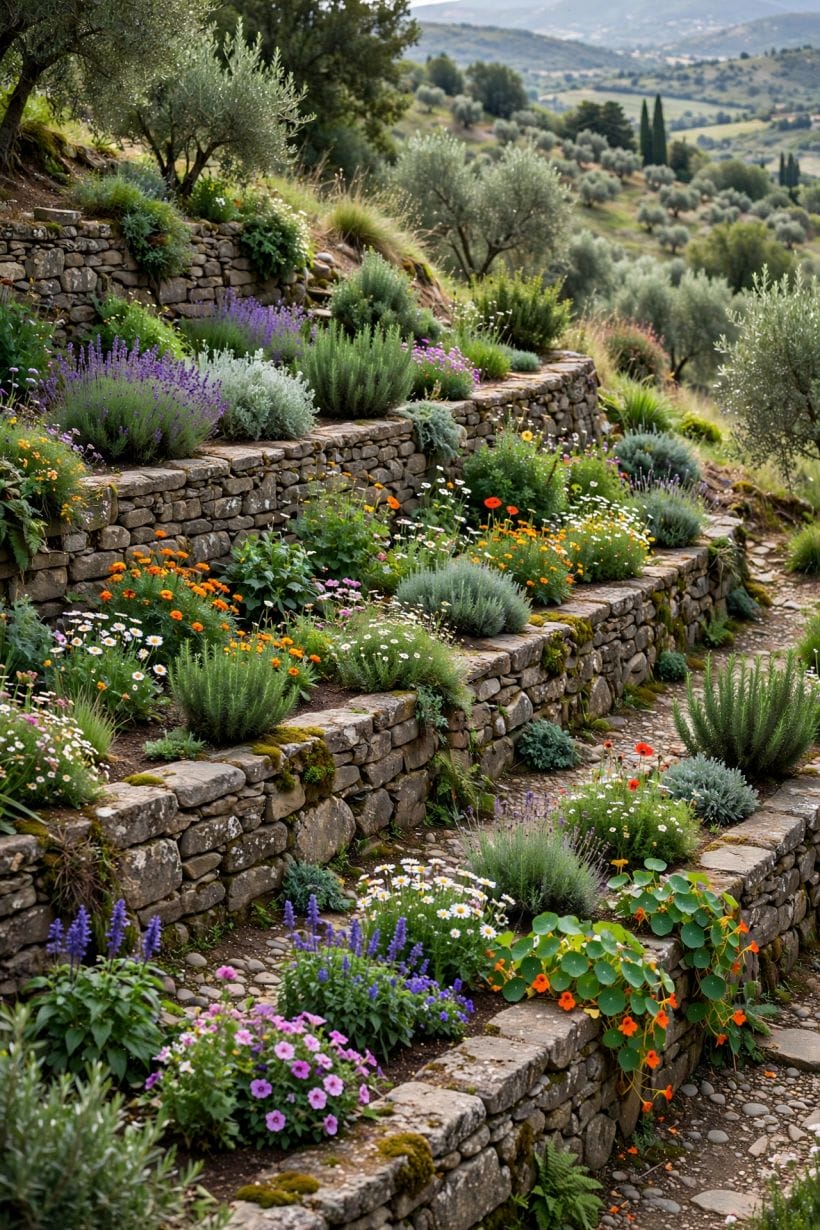
Terracing is the hillside’s central craft: cutting the slope into level rooms held by retaining edges. The materials those edges are built from are compared in the rock landscaping ideas post; this section keeps to the terracing decisions themselves, with all structural questions left — as they must be — to local rules and professional judgement for anything beyond garden scale.
12. Terrace Only as Much as the Purpose Needs
Every terrace is digging, retaining and drainage bought together. Level the ground the garden will truly use — beds, seats, a lawn — and let the rest stay a planted bank, beautifully and cheaply.
13. Keep Garden Retaining Low and Stepped
Several low retaining edges stepping down a slope are kinder to build, plant and repair than one tall wall.
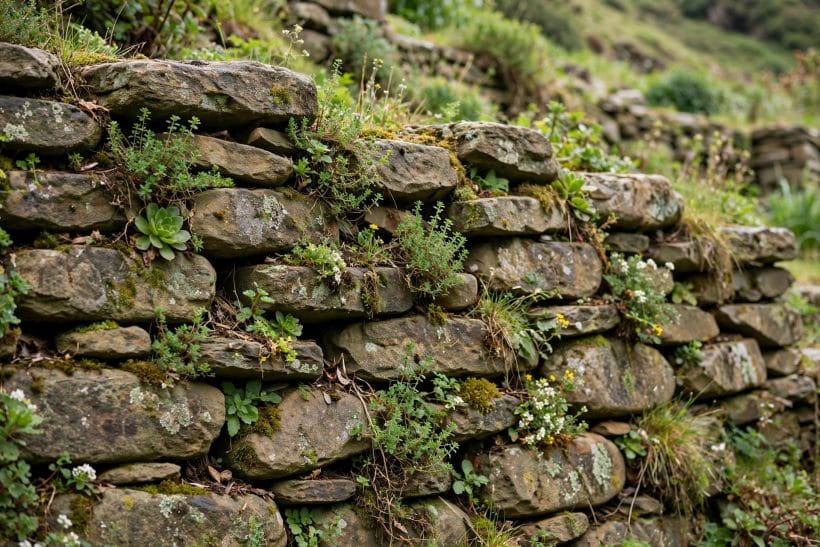
14. Let Dry-Stone Manners Suit Planted Banks
Stone laid with a slight backward lean and soil settled behind it makes a retaining edge plants can colonise. Its informal face suits the planted slope, and small movements can be re-laid by hand.
15. Use Timber Retaining Where the Garden Is Informal
Stout timber edges terrace a cottage or woodland slope quickly and warmly, accepting a shorter life than stone. Plan their replacement from the day they are built, and they will never fail by surprise.
16. Give Every Terrace Its Own Drainage
A terrace that holds water against its retaining edge is a pond learning to be a landslide.
17. Make the Terrace Wide Enough to Work From
A bed terrace too narrow to stand on while gardening will be gardened from below, badly, or not at all. Width for feet first, width for plants second: the order decides whether the terrace is used or admired.
18. Plant the Retaining Face as You Build It
Crevice plants tucked in as a stone edge rises establish while the soil is open and the gardener is present. Retrofitting planting into a finished wall is slower, drier work with poorer results.
19. Keep One Terrace Wild on Purpose
A level left to meadow or loose shrubs among the worked terraces gives the slope its contrast and its wildlife. Wildness placed deliberately reads as design; wildness everywhere reads as surrender.
20. Build From the Bottom Terrace Up
Work that starts at the foot gives every higher terrace a finished edge to build against and a route to carry materials along. Top-down building strands materials and gardeners alike.
21. Cap the Retaining Edge for Feet and Eyes
A flat cap or a planted lip finishes a retaining edge as a seat, a shelf for pots and a clear signal of the level change. Unfinished edges trip the eye first and the feet later.
22. Check Retaining After the First Winter
New terraces settle, drain and shift through their first cold season. A spring inspection — bulges noted, drainage cleared, small movements corrected — is the cheapest structural care in this whole post.
4. Steps, Paths and Landings: Moving on the Hill
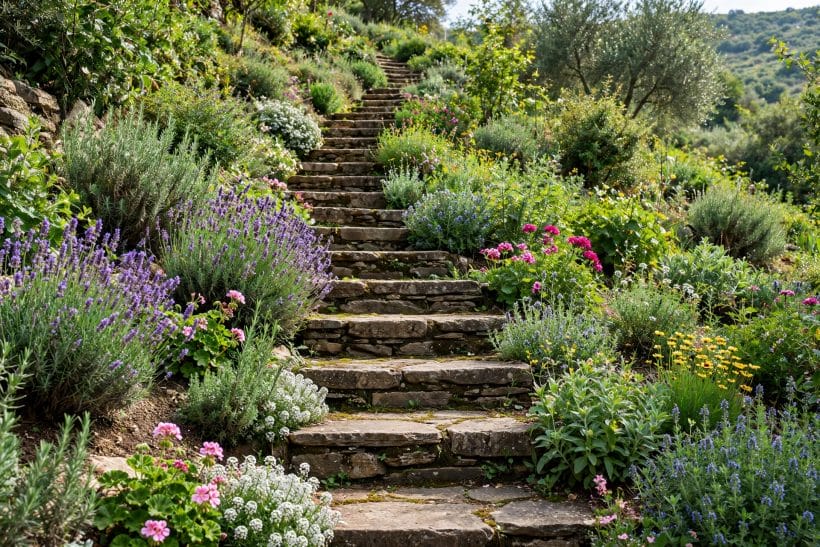
On a slope, movement is the design: the route decides what is visited, planted and loved. The level-ground version of that route is drawn in the walkway ideas post; this section climbs — steps, switchbacks and landings that make a hillside garden a place walked daily rather than viewed from the house.
23. Let the Path Confess the Desire Line
Watch where feet naturally cross the slope for a season, then build the steps there. Paths imposed against the desire line are shortcut within a year, and the shortcuts erode.
24. Make Garden Steps Broad, Shallow and Uniform
Outdoor steps forgive when their treads are generous, their rises gentle and every step the same as the last. Uniformity is safety: the body climbs a remembered rhythm, even carrying a watering can.
25. Use Landings as the Slope’s Sitting Rooms
A landing widened into a small terrace — a bench, a pot, a view — turns the climb into a sequence of rests. Hillside gardens are enjoyed landing by landing, not from the top alone.
26. Switchback Only Where the Slope Demands It
Zigzag paths tame steep ground at the price of length and retaining. Where the gradient allows a direct stepped route, take it; switchbacks earn their keep on the truly steep banks.
27. Edge Steps With Planting, Not Walls Alone
Low planting spilling at a step’s edge softens the engineering and signals the route in every season. Keep the tread itself clear — the softness belongs at the margins, never underfoot.
28. Light the Route Before Decorating It
A slope at dusk is a beautiful ankle hazard. Low lights at steps and landings — the working lights of this post — come before any decorative glow, and they make the evening garden possible.
29. Give the Working Route Its Own Plain Steps
Compost, bins and barrows deserve a direct, sturdy, unglamorous route that spares the pretty steps. Gardens with one precious route do their heavy work resentfully, or not at all.
30. Build Steps From the Bottom, Like the Terraces
Each finished step is the platform for building the next, and the route stays usable throughout the work. Top-down step building is a mountaineering exercise disguised as gardening.
31. Keep a Handhold Where the Slope Is Steep
A rail, a wall top at hand height or a run of sturdy posts where the climb is steepest is kindness, not weakness. Hillside gardens are kept by ageing gardeners too; design for them early.
32. Surface Steps for Grip in the Wet
Smooth stone and polished timber turn treacherous on a damp slope. Choose step materials with texture, clear algae promptly, and let the winter test judge every surface honestly.
33. Rest the Route at the Best View, Once
One landing placed exactly where the garden and the valley compose themselves is worth three placed by arithmetic. The whole climb is remembered by that single pause.
5. Planting the Slope: Roots, Layers and Groundcover
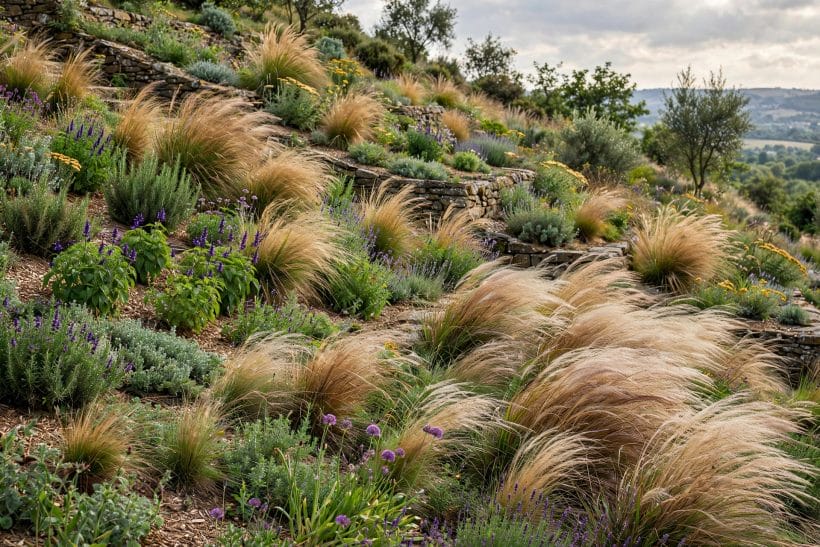
Planting is the hillside’s structure as much as its beauty: roots bind the ground that terraces and steps stand on. The flat-garden planting logic behind these choices is gathered in the backyard landscaping ideas post; this section plants the slope itself — in layers, in drifts, and always with the soil’s holding in mind.
34. Plant in Layers, as a Woodland Does
Trees above, shrubs in the middle, groundcover at the soil’s face: the layered slope sheds rain gently, shades its own roots and holds together as one system. Single-layer planting on a bank is a promise erosion collects.
35. Let Groundcover Be the Slope’s Skin
Spreading plants that root as they run stitch the surface against rain’s washing. Choose them for the aspect — sun-lovers for the baked bank, shade kinds for the north slope — and plant them closer than feels necessary.
36. Use Shrubs as the Middle Engineers
A shrub’s root plate holds a disc of hillside for decades while its branches clothe the bank. Stagger shrubs across the slope rather than lining them, so their held discs overlap into one bound surface.
37. Keep Thirsty Planting Away From Retaining
Roots seeking water work into joints and drains behind retaining edges. Give vigorous, thirsty plants the open bank, and keep the wall’s backland to shallow, gentle rooters.
38. Plant Drifts That Follow the Contours
Planting laid along the contour lines slows rain’s run and reads as the slope’s natural striping. Drifts that run straight downhill become channels, in looks and in fact.
39. Mulch the Bank, and Keep Mulch in Place
Mulch protects new planting and bare soil, but a steep bank sheds loose mulch in the first storm. Use it under established cover, in pockets and terraces, where gravity cannot take it to the bottom in one night.
40. Choose Plants That Want the Slope’s Own Water
A bank drains as fast as it is watered, so its planting should be chosen for the moisture the slope actually keeps.
41. Leave the Crest Planted Against the Wind
The slope’s top edge takes the weather for the whole garden. A loose hedge or a band of tough shrubs there shelters everything below and gives the hill its skyline.
42. Grow One Spectacle Slope, and Keep the Rest Quiet
A bank of spring bulbs, a drift of summer colour, one season’s theatre: a single spectacle slope concentrates the work and the wonder. Quiet green elsewhere makes the spectacle read louder.
43. Replace Bare Soil Everywhere, Always
Bare soil on a slope is erosion waiting for rain. Temporary cover, a fast groundcover or even a nurse crop of annuals — anything rooted — holds the bank while the permanent planting establishes.
44. Edit the Slope From Below
A hillside is mostly seen from its foot and from the house. Edit planting standing there, where the layers compose, rather than up close, where every plant looks equally important.
6. Water on a Slope: Rain, Drainage and Dry Banks
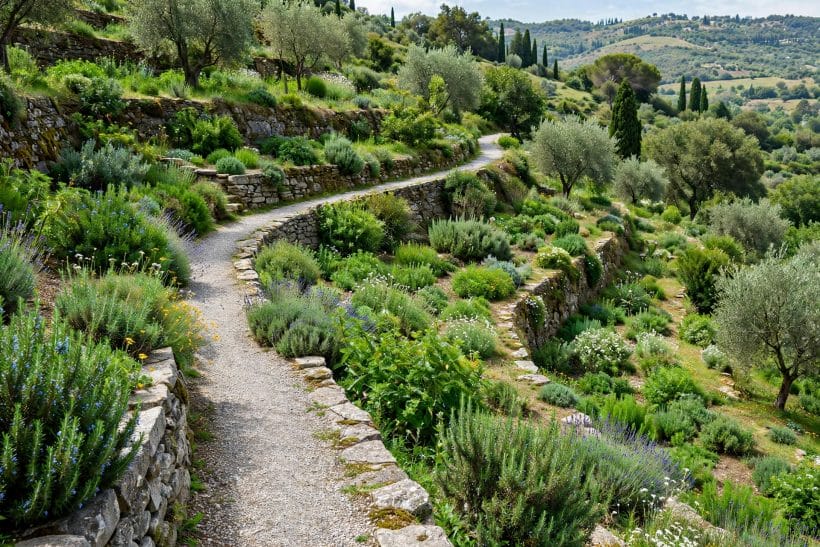
Water is the hillside gardener’s true client: it arrives uninvited, moves fast, and grades all the work. How paved ground at the garden’s edges handles the same rain is finished in the front yard rock landscaping curb appeal post; this section keeps the water on the slope — slowed, spread and led away before it can cut.
45. Slow Water Before You Shed It
Rain that is slowed soaks in; rain that is hurried erodes. Contours, terraces, planting and gravel margins all exist in this post to buy water time before any drain is asked to carry it away.
46. Spread Runoff, Never Concentrate It
A slope’s worst wounds start where water is gathered into one fast stream. Spread flows across planted ground in shallow, vegetated swales, and no single line of water gains the speed to cut.
47. Give the House Its Own Dry Defences
Ground beside the house must fall away, gutters must not discharge onto the bank, and drains there must be inspectable. The garden’s water games stop, without exception, at the house’s walls.
48. Expect the Path to Become a Stream
In a storm, steps and paths are the slope’s rivers. Build them expecting it — channels at their edges, surfaces that grip wet, and no fine mulch or loose gravel where the water will certainly run.
49. Catch Water High, Use It Low
Rain caught near the crest — in a tank, a pond shelf or a boggy terrace — can serve the dry lower bank in summer. Hillside water stored is hillside drought answered, at gravity’s free delivery.
50. Plant the Wet Lines, Armour the Wettest
The slope’s natural drainage lines want moisture-loving planting that holds their banks, and stone only where the flow is strongest. A drainage line planted and watched stays a stream; ignored, it becomes a gully.
51. Keep Drains and Culverts Clear by Habit
A blocked drain on a slope fails uphill, into terraces and retaining. Clear leaves and silt after storms as a standing habit — five minutes that have saved more hillside gardens than any redesign.
52. Let Dry Banks Be Dry, Beautifully
Some slopes will never hold summer water, and fighting them is waste. Plant them as dry gardens — gravel, silver leaves, deep roots — and their honesty becomes the garden’s most admired corner.
53. Watch for the Slope’s New Springs
Changes uphill — a neighbour’s building, a felled tree — can send new water through an old garden. Sudden damp patches are messages; trace them early, while the answer is still a spade’s work.
54. Never Send Your Water Onto a Neighbour
A slope’s drainage ends at a boundary as a responsibility, not a discharge. Lead water to soakaways and planted ground within your own plot, as local rules expect, and keep the hill’s friendships intact.
55. Walk the Slope After the Year’s Worst Storm
The storm is the examiner and its marks are the report: fresh cuts, silt fans, moved mulch. Repairing storm marks within weeks is hillside keeping at its most valuable.
7. Lawns, Seating and Flat Moments: Resting on the Hill
A hillside garden still owes its household the flat pleasures: a patch of lawn, a seat in the sun, a table that does not slide. The paved version of that level room is built in the patio ideas pillar; this section levels the green version — terraces given to grass, rest and the long view.
56. Make One True Lawn Terrace, No More
A single level lawn, honestly terraced, serves picnics, children and rest better than grass attempted across the whole slope. Mowing, watering and keeping all concentrate where they can succeed.
57. Seat the View, Not Just the Garden
A hillside’s gift is borrowed landscape: the valley, the town, the weather arriving. Place the principal seat where that gift composes, even if it is halfway down the working slope.
58. Build the Seat Into the Retaining
A bench formed in a terrace’s retaining edge — capped wide, backed by planting — costs no extra ground and seats the garden’s best pause. Built-in seats on slopes outlast every chair carried up them.
59. Keep a Morning Seat and an Evening Seat
Slopes face one way, so their sun arrives on a schedule. A small seat for morning coffee in the early light and one for the evening’s last sun doubles the garden’s daily use for two benches’ cost.
60. Flatten a Children’s Corner Deliberately
Children need one level, enclosed moment on a hillside — for a tent, a game, a paddling pool in summer. Terrace it once, near the house’s eye, and the rest of the slope can stay adventure.
61. Let a Table Claim the Best Terrace
Eating outdoors on a slope belongs on the widest, flattest terrace, nearest the kitchen’s route. A table placed for the view but against the carry will host two dinners a year; placed for both, it hosts weekly.
62. Screen One Flat Moment From the Wind
A level seat in a wind lane is a seat unused. One hedge shoulder or a fence panel at the terrace’s weather edge turns the garden’s best view into its most sat-in place.
63. Keep Grass Off the Steepest Ground Forever
Sloping lawn is hard to mow, quick to wear and first to erode at its edges. Give steep ground to planting without apology, and keep grass where feet and mower can both stand level.
64. Give the Slope a Destination at Its Foot
A pond shelf, a grove seat, a small orchard terrace at the bottom gives the descent its purpose. Gardens climbed only to be climbed are visited half as often as gardens with somewhere to arrive.
65. Rest the Eye With One Unplanted Prospect
From the principal seat, one stretch of the view should be simple — lawn falling to a hedge, the valley beyond. A hillside composed entirely of incident tires the eye it was planted to please.
8. Keeping, Erosion Watch and the Hillside Year

A hillside garden is kept, not finished: its enemy is slow movement, and its defence is attention. The raised alternative that shares this keeping burden is compared in the deck ideas post; this closing set stays on the slope — the inspections, repairs and seasonal habits that keep terraces true and soil at home.
66. Inspect After Storms, Without Exception
The hillside’s health check is the post-storm walk: drains clear, edges sound, new cuts noted. Ten minutes then is worth a week of repair later, and it cannot be delegated to a dry day.
67. Repair Small Erosion the Week It Appears
A rill filled, replanted and mulched in its first week disappears; left a season, it organises the slope’s water around itself. Erosion is a habit water learns — break it early.
68. Top Up Settled Terraces a Little at a Time
New and old terraces alike settle toward their drains and edges. Small, regular top-ups of soil where levels dip keep the terrace’s falls true and its retaining unstressed.
69. Keep the Steps Swept and the Treads Sound
Leaf litter and algae make slope steps treacherous in days. A swept step is a safe step, and loose treads re-laid promptly never get the chance to start a collapse.
70. Prune for the Slope’s Balance, Not Just Its Looks
Top-heavy shrubs on a bank catch wind and lever their root plates in storms. Pruning that keeps the slope’s planting low-shouldered and balanced is structural care wearing a gardener’s hat.
71. Watch Retaining Faces for the First Lean
A retaining edge that begins to lean or bulge is speaking early, while its repair is still gardening. Note it, drain behind it, and take advice before the lean becomes a fall.
72. Feed the Soil Where the Slope Cannot
Rain washes a bank’s goodness downhill, so the crest and terraces hunger first. Compost carried up and mulched in pockets repays the slope’s tax and feeds the roots that hold it.
73. Keep Records of the Slope’s Behaviour
A dated note — which drain blocked, which edge moved, which bank slipped — turns anecdotes into a map of the hill’s habits. Five years of notes make the sixth year’s keeping almost entirely foresight.
74. Accept One Untamable Corner, and Plant It Wild
Most hillsides keep one patch that defeats terracing, mowing and neatness together. Plant it densely wild, call it the rough, and let it hold its ground and its wildlife without further argument.
75. Remember the Hillside’s Wage: The View
Every chore in this section is paid for daily in borrowed landscape no flat garden can buy. Keep the slope with that wage in mind, and its work reads as rent on the finest seat in the neighbourhood.
9. Checks and Mistakes: Before the First Purchase or the First Stone
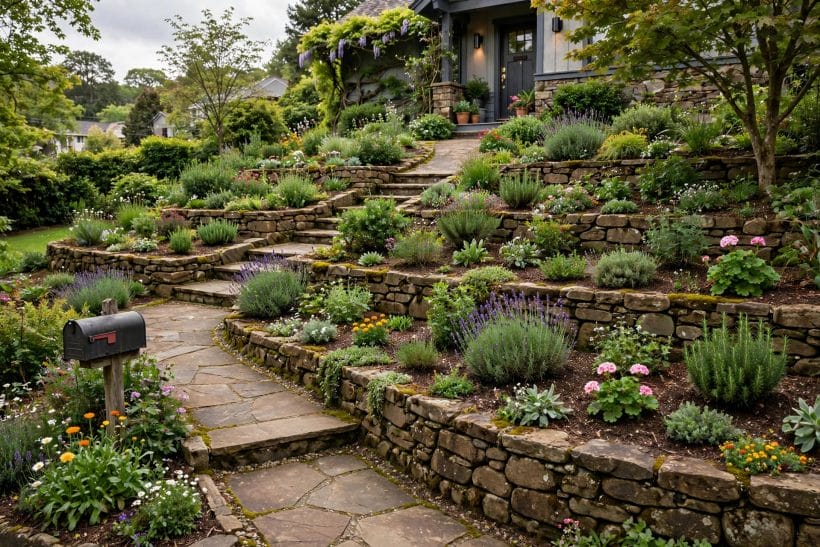
Check a hillside scheme the way this post checked its subjects: walk the slope in rain, carry something up it in wet shoes, photograph its bones in winter, and price the retaining and drainage before pricing a single plant. Most hillside failures are decided at the reading stage — a terrace drawn against the water, a path built against the desire line, a wall asked to do an engineer’s work as a gardener’s weekend.
The common mistakes are all impatience with gravity: bare soil left over winter, drains left unchecked, erosion admired for a season before it is repaired. Each is avoided by this post’s order — read, terrace, climb, plant, water, rest, keep — and by treating every storm as an inspection the garden has booked for you.
10. Costs and Pulling It Together
Costs stay qualitative, as honest advice about other people’s hillsides must: the economical end of hillside work is planting — roots, groundcover and patience on a well-read slope; the expensive end is excavation, retaining and drainage on a steep one, where professional hands and local rules rightly govern the larger structures. Money spent in this post’s order is rarely wasted, because the reading that directs it costs nothing but time.
Pull it together in the sequence kept here: read the slope, terrace only what the purpose needs, build the route the body wants, plant in binding layers, slow the water, carve the flat moments, and keep the whole by storm and season. Followed in that order, these seventy-five ideas stop being a list and become a hillside that holds — soil, water and gardener alike.
Final Considerations
A hillside garden is never finished, only kept — and kept gladly, because its wage is paid every single day in view. Read the slope honestly, hold it with roots and low stone, slow its water, and climb it by steps you built where your own feet asked to go, and the difficult plot becomes the one every visitor remembers.



0 Comments