

A bedroom painted in deep navy can feel like a retreat from the rest of the house, a room that quiets the eye the moment the door closes. The colour is rich without being loud, and it gives bedding, wood and lamplight something calm to sit against. Done well, a dark blue bedroom feels restful rather than gloomy, generous rather than closed in, and easy to live with through every season. The ideas below work through the room in the order that makes decisions easiest, from the walls themselves to the bedding, the storage, the light and the small habits that keep the room feeling settled.
The most common mistake with navy is enthusiasm. Painting every wall in the deepest shade, then adding navy bedding, navy curtains and navy cushions, leaves nowhere for the eye to rest, and the room can feel heavy even in bright daylight. Restraint is what makes the colour work. Let navy lead in one clear place, then let paler surfaces, warm wood and soft textures do the rest of the work. A room built this way keeps its depth without losing its daylight, and it stays flexible, because changing a throw or a set of pillowcases is far easier than repainting a wall.
Nothing in this guide calls for structural change or specialist skill. Most of the ideas are about arrangement, colour balance and storage, and anything involving fixed wiring or changes to the structure of the home belongs with a qualified professional. As with kitchen ideas elsewhere in the home, the best bedroom plans start from how the room is actually used each day, not from a picture of a room nobody sleeps in. Begin with the bed, the light and the storage you already have, and let the navy earn its place around them.

| Item | What it is |
|---|---|
| Start With One Navy Wall, Not Four | The wall behind the bed is the natural home for navy. |
| Lay Out the Bed for Light and Easy Movement | Bed placement decides whether a navy bedroom feels generous or cramped, whatever its size. |
| Layer Bedding in White, Grey and Navy | Bedding is where navy bedrooms most often go wrong, because it is tempting to match everything to the wall. |
| Choose Storage That Keeps the Room Calm | Storage is what separates a restful navy bedroom from a cluttered one, because dark walls show disorder more plainly than pale ones do. |
| Balance Navy With Pale Wood and Soft Neutrals | Navy needs warm, pale companions to stay restful. |
| Layer Light for Mornings and Evenings | Light is the difference between a navy bedroom that feels cosy and one that feels cave-like. |
| Add Texture Without Adding Clutter | Texture is what keeps a navy bedroom from feeling flat, because a narrow palette needs variety somewhere. |
| Style the Walls With Restraint | Wall decoration in a navy bedroom should be chosen slowly, because the wall colour is already doing a great deal of work. |
| Make a Small Navy Bedroom Feel Generous | Small bedrooms often suit navy better than expected, because a deep colour can make the walls feel further away rather than closer, provided the rest of the room stays pale and uncluttered. |
| Keep the Room Restful Night After Night | A navy bedroom is only a success if it stays restful after the novelty fades. |
1. Start With One Navy Wall, Not Four
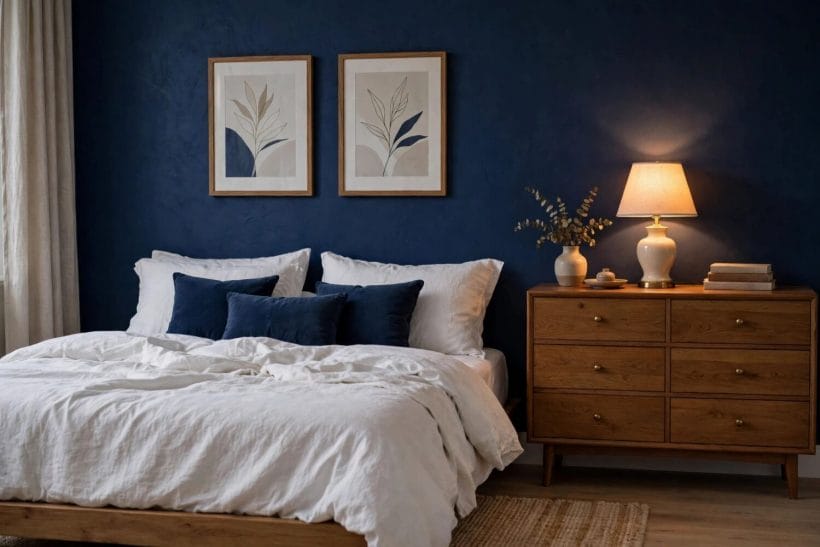
The wall behind the bed is the natural home for navy. It frames the bed, gives the headboard a backdrop, and is the wall you see least while lying down, so its depth never feels overbearing at night. A single navy wall also makes the rest of the room easier to furnish, because pale walls elsewhere keep the daylight moving and stop the room from feeling like a box. When guests walk in, the navy wall reads as a deliberate choice rather than a colour that simply took over.
Choosing which wall to paint matters as much as choosing the colour. The bed wall is usually the strongest candidate, but a wall with a window can work too, provided the window frame and curtains stay pale so the daylight is not swallowed. A wall broken up by doors or fitted wardrobes is a weaker choice, because the navy gets chopped into fragments and loses its calm, continuous effect. Stand in the doorway, look at each wall in turn, and choose the one that reads as a single, unbroken surface.
Finish matters in a way that colour charts rarely explain. A flat, soft finish keeps navy looking like a colour rather than a shine, and it forgives the small marks that bedrooms collect over time. A very glossy finish, by contrast, throws light around in hard patches and can make a dark wall feel restless. Test the shade on a generous patch of the chosen wall and live with it through a day and an evening before committing, because navy changes dramatically between morning light and lamplight.
If painting feels like too much of a commitment, the same effect can be approached gradually. A navy headboard, a set of navy curtains or a deep blue upholstered bench can introduce the colour while the walls stay pale, and the room can be lived with for a while before any paint is bought. The principle stays the same either way: navy leads in one place, and everything else stays calm around it.
2. Lay Out the Bed for Light and Easy Movement
Bed placement decides whether a navy bedroom feels generous or cramped, whatever its size. The bed usually belongs against the navy wall, centred where possible, with a clear path on each side so making the bed and getting in and out never becomes a shuffle. When the bed sits hard against a side wall, one sleeper climbs over the other and the room feels improvised, however beautiful the colour. A little breathing room on both sides is worth more than any decorative flourish.
Light should be planned from the bed outward. Morning light falling across the bed makes waking easier, while harsh light striking directly into the eyes first thing does the opposite, so the angle of the bed to the window deserves a moment of thought. If the window sits on the navy wall itself, pale curtains and a light window frame keep the daylight generous. Planning a smaller room follows the same logic: the largest piece of furniture goes first, and everything else fits around it rather than competing with it.
Walkways deserve the same care as the bed itself. A path from the door to the bed, and from the bed to the wardrobe, should be clear of boxes, laundry and stray furniture, because a bedroom that is awkward to move through never feels restful, however calm its colours. Bedside tables should be reachable without stretching, and anything used every night, from a glass of water to a book, should have an obvious home within arm’s reach of the bed.
Finally, consider what the bed faces. A view of a tidy wardrobe or a calm stretch of wall helps the room feel settled, while a view of cluttered open storage or a pile of laundry pulls the eye every time the door opens. If the view from the bed cannot be changed, a simple curtain or a closed wardrobe door can hide it, and the room immediately feels more restful for it.
3. Layer Bedding in White, Grey and Navy
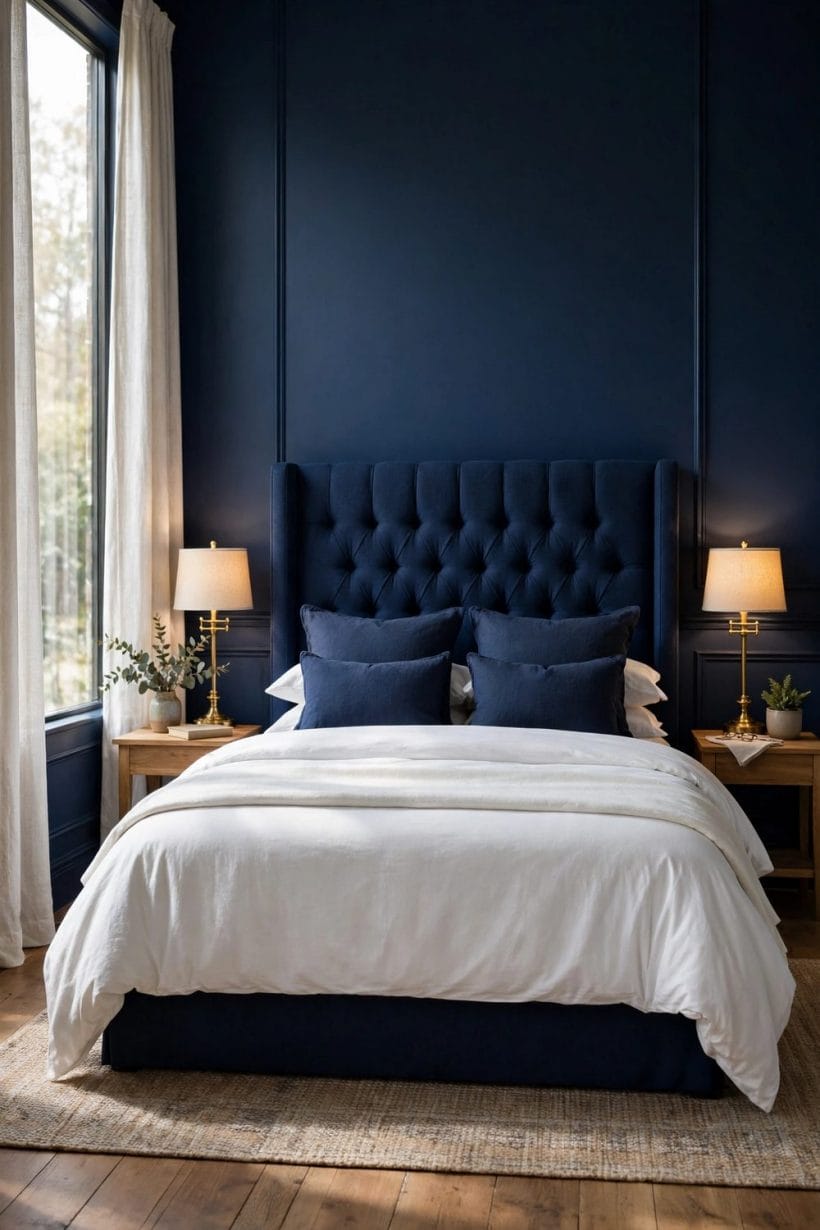
Bedding is where navy bedrooms most often go wrong, because it is tempting to match everything to the wall. A bed dressed entirely in navy can look striking in a photograph and feel heavy in real life, especially under lamplight. The calmer approach layers the colours: white or pale grey sheets and a duvet cover as the base, a navy throw or blanket folded across the foot, and cushions that mix navy with pale tones. The bed then echoes the wall without repeating it flatly.
Texture does as much work as colour here. A crisp cotton duvet cover, a soft knitted throw and a linen cushion cover each catch the light differently, so the bed looks layered rather than flat, even when the palette stays narrow. Smooth, shiny fabrics all over can make navy feel cold, while too many heavy textures can make the bed feel bulky. Mixing a smooth base with one or two softer, more tactile layers usually finds the balance, and the bed stays inviting rather than staged.
Seasonal change is easier when the layers are separate. In warmer months, a lighter cover with a single navy throw is often enough, while colder months welcome an extra blanket and a heavier throw without any change to the walls. Keeping the navy elements as the removable layers, rather than the fixed ones, means the room can shift its mood through the year while the walls stay exactly as they are.
Pillow arrangement deserves restraint too. A small group of pillows, some for sleeping and a couple for leaning against while reading, looks calm and stays practical. A tall stack of decorative cushions that must be removed every night and piled somewhere each morning soon becomes a chore, and the pile itself becomes the clutter the room was trying to avoid. Choose the pillows the room actually uses, and let the rest live in a cupboard.
4. Choose Storage That Keeps the Room Calm
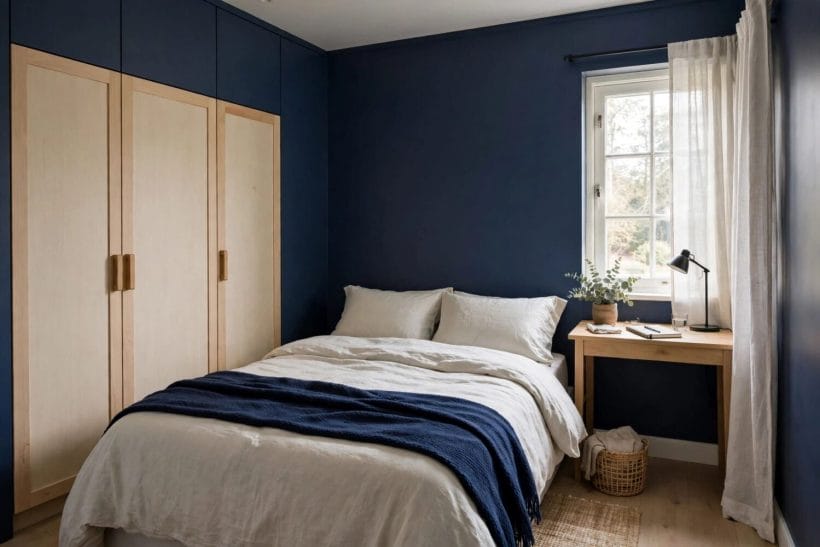
Storage is what separates a restful navy bedroom from a cluttered one, because dark walls show disorder more plainly than pale ones do. Open piles and overflowing surfaces catch the eye against navy, while closed storage lets the colour stay calm. Fitted wardrobes, a chest of drawers with everything inside, and a bedside table with a drawer all help, because what is out of sight stops competing with the wall colour.
Not everything needs to be hidden, but what stays visible should be chosen. A few folded blankets in a basket, a row of books on a shelf, or a single tray for nightly essentials can look intentional, while a surface covered in unrelated objects looks like storage that ran out. Storage ideas for compact homes apply here too: give every regular item a named home, and anything without a home is a candidate for another room or for letting go.
Under-bed storage earns its place in a navy bedroom, because it hides bulky, rarely used things without adding furniture to the room. Boxes for out-of-season bedding or spare blankets keep the wardrobe free for everyday clothes, and the room keeps its calm surfaces. The boxes themselves should be plain and lidded, so nothing spills out when they are pulled forward, and labelling them simply saves the nightly hunt for a missing blanket.
Laundry deserves a plan of its own, since a chair piled with clothes is the fastest way to undo a calm navy room. A lidded basket in a corner, or a basket inside the wardrobe, keeps worn clothes out of sight until wash day without adding a chore. The same thinking applies to shoes by the door and bags by the bed: a hook, a basket or a single shelf each, and the floor stays clear for walking rather than stepping around.
5. Balance Navy With Pale Wood and Soft Neutrals
Navy needs warm, pale companions to stay restful. Pale wood does this beautifully: bedside tables, a dresser or a bench in a light timber soften the depth of the wall without competing with it, and the grain gives the eye something gentle to follow. Very dark wood beside navy can merge into a single dark mass, while very pale wood keeps each piece distinct, so the room reads as layered rather than heavy.
Soft neutrals on the remaining walls and the floor complete the balance. Warm white, pale grey and gentle cream all sit comfortably beside navy, and the choice between them depends on the light the room receives. A north-facing room often welcomes a warmer neutral, while a bright, sunny room can carry a cooler grey without feeling cold. Interiors across the home use the same balance: one strong colour, then quiet neutrals that let it breathe.
Rugs play a larger role in a navy bedroom than they do in a pale one, because they break up dark floors and anchor the bed. A rug in a pale, natural tone under the bed, extending far enough to step onto in the morning, warms the room underfoot and visually. A very dark rug on a dark floor, by contrast, disappears into the shadows and adds nothing, so the rug is a place to go deliberately pale.
Metal finishes should be chosen with the same restraint. Warm brass or brushed gold lamps and handles glow gently against navy, while cool chrome can feel sharp beside it. Either can work, but mixing many different metals across lamps, handles and frames soon looks busy. Choosing one metal and repeating it quietly through the room keeps the navy as the star and everything else as support.
6. Layer Light for Mornings and Evenings
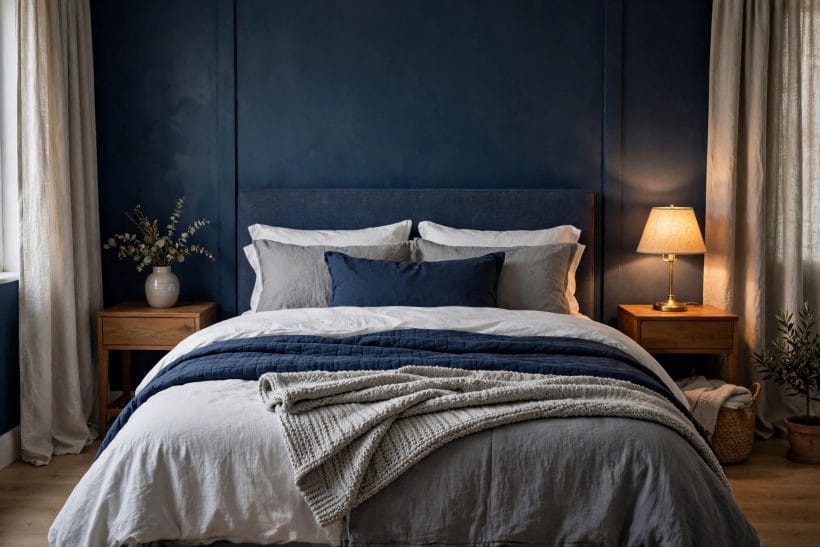
Light is the difference between a navy bedroom that feels cosy and one that feels cave-like. A single bright ceiling light flattens navy walls and throws hard shadows, while layers of softer light let the colour glow. The usual layers are daylight through the window, a pair of bedside lamps for reading, and, where the room allows, a soft floor lamp or a small lamp on the dresser for evenings. Each layer has its own job, and together they keep the room usable at every hour.
Bedside lamps deserve particular care in a navy room, because they are the light closest to the wall colour. A warm-toned bulb in a lamp with a pale or linen shade throws a gentle pool of light that softens the navy beside the bed, while a harsh white bulb can make the same wall look cold and flat. A lamp that can be dimmed, or a choice between a brighter reading setting and a softer night setting, gives the room flexibility without any rewiring beyond a simple lamp choice.
Daylight should be protected, not blocked. Heavy, dark curtains over a navy wall can swallow the very light the room needs, while sheer curtains or pale drapes let daylight through and keep the window as a bright point in the room. If privacy is a concern, a sheer layer for daytime and a pale heavier curtain for night gives both, and the window stays a source of lightness rather than another dark surface.
Mirrors can help a navy bedroom, used sparingly. A mirror opposite or beside a window bounces daylight deeper into the room, and a mirror on a pale wall adds brightness without adding colour. A mirror on the navy wall itself, however, can chop the colour into fragments and create glare under lamplight, so placement matters more than size. One well-placed mirror usually does more than several scattered ones.

7. Add Texture Without Adding Clutter
Texture is what keeps a navy bedroom from feeling flat, because a narrow palette needs variety somewhere. Knitted throws, woven baskets, linen curtains, a wooden bench and a soft rug each add a different surface for the eye and the hand, and together they make the room feel considered without adding a single extra object of clutter. The trick is to let the textures come from things the room already needs, rather than from decoration bought for its own sake.
Curtains are one of the strongest textures in the room, because they cover a large area and frame the daylight. Linen or a soft cotton weave in a pale neutral lets light filter gently and moves slightly in a breeze, which stops the room feeling stiff. Heavy velvet curtains in a matching navy, while tempting, can double the darkness of the wall and make the window disappear, so curtains are usually a place to stay pale and let the wall keep the navy.
Bedding textures, wall textures and floor textures should be balanced rather than matched. If the bedding is heavily knitted, the curtains can stay smooth; if the rug is deeply woven, the throw can stay light. Design ideas for the whole home follow the same rule: contrast between surfaces creates interest, while every surface competing at once creates noise. A room with two or three distinct textures feels rich, while a room with many feels restless.
Wall texture itself can be used gently. Panelled woodwork painted navy, a subtle woven wallpaper in a deep blue, or a simple fabric headboard all give the navy wall depth without changing its colour. The key is subtlety: a strong pattern on a navy wall can fight with the bedding and the curtains, while a quiet texture adds depth that only reveals itself slowly. When in doubt, the plainer texture is usually the calmer choice.
8. Style the Walls With Restraint
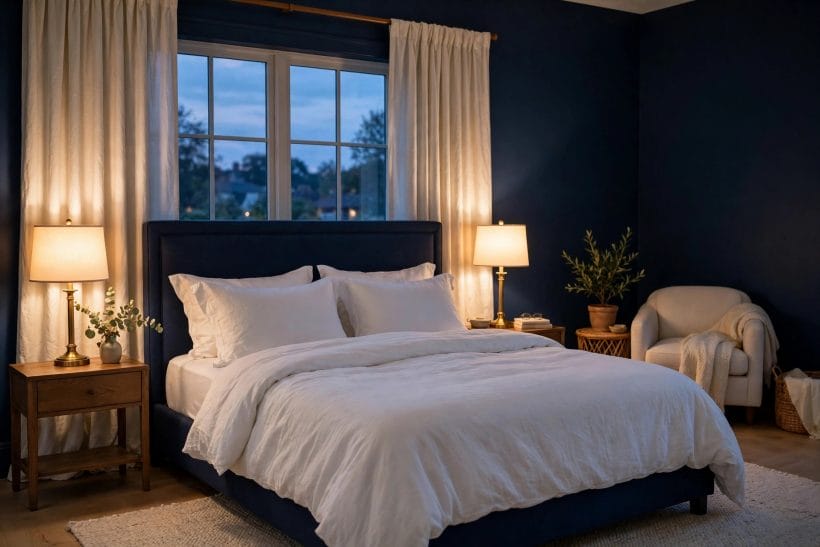
Wall decoration in a navy bedroom should be chosen slowly, because the wall colour is already doing a great deal of work. A small group of framed prints above the bed, a single larger piece on a pale wall, or a simple shelf with a couple of well-loved objects usually suits the room better than a wall covered edge to edge. Empty wall space is not a problem to be solved; against navy, it is part of the calm.
Frames matter as much as the pictures inside them. Pale wood or light metal frames stand out gently against navy and keep the artwork readable, while very dark frames can vanish into the wall and leave the picture floating oddly. A consistent frame style across the room, rather than a mix of every frame ever owned, keeps the wall feeling intentional, even when the pictures themselves are varied.
Personal objects deserve the same restraint. A photograph, a small keepsake or a piece of art with a story behind it earns its place on a navy wall far more than a set of decorations chosen only to fill space. Limiting the wall to pieces that genuinely mean something to the people who sleep in the room keeps the decoration honest, and the room feels personal rather than staged.
Anything hung on the navy wall should be fixed securely and checked from the doorway, because a crooked frame is far more visible against a dark, plain background than against a busy pale one. Stepping back after hanging, and adjusting while the room is lit as it will be in the evening, saves the slow irritation of a frame that always looks slightly off. Small care here pays off every day.
9. Make a Small Navy Bedroom Feel Generous
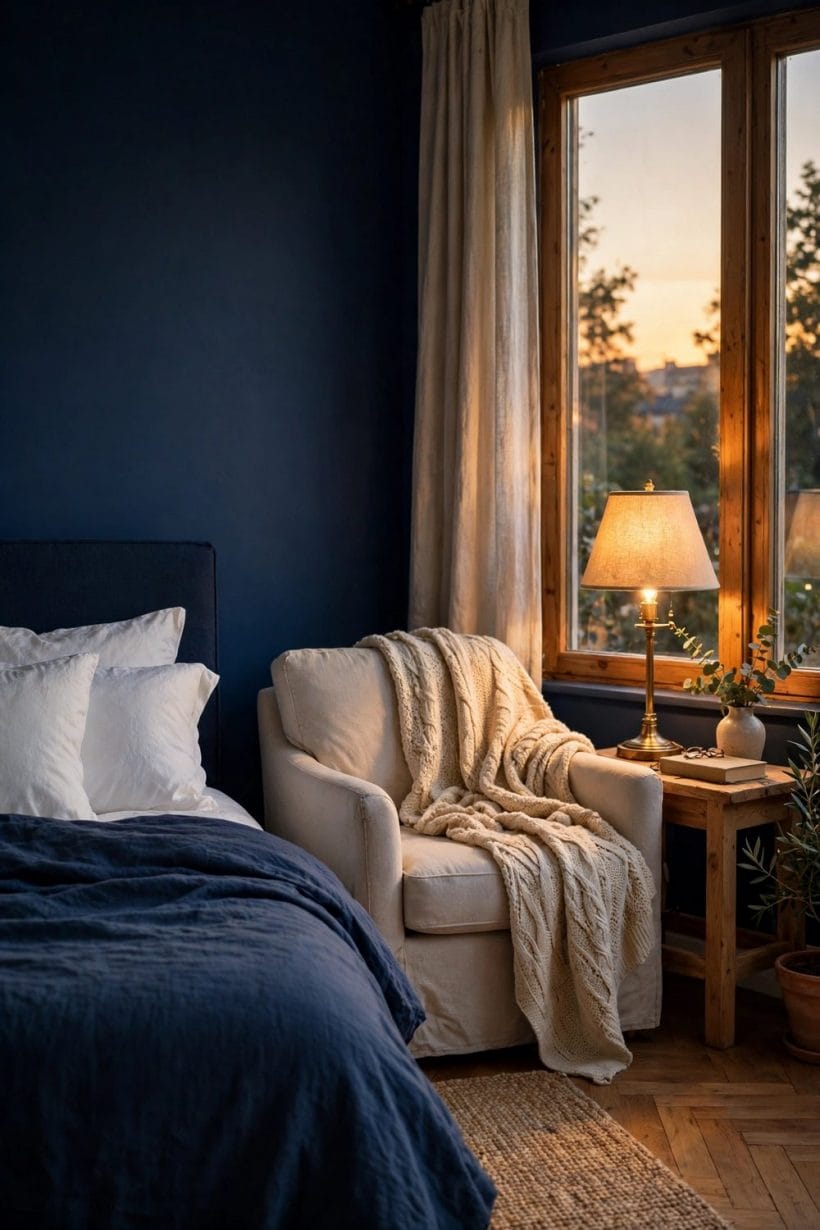
Small bedrooms often suit navy better than expected, because a deep colour can make the walls feel further away rather than closer, provided the rest of the room stays pale and uncluttered. The fear that navy will shrink a small room usually comes true only when the room is also crowded, dark and full of competing patterns. A small navy bedroom with a clear floor, pale bedding and good light can feel surprisingly generous.
Furniture scale is the deciding factor. A bed that fills the room wall to wall leaves no room to move and makes the navy feel oppressive, while a bed that leaves clear paths on both sides keeps the room usable. Choosing a headboard that is tall enough to read against the wall, but not so tall that it dominates the room, helps too. In a small room, every piece should earn its floor space, and anything that does not should live elsewhere.
Vertical space can be used without adding clutter. A high shelf for books, a tall but narrow wardrobe, or artwork hung a little higher than usual draws the eye upward and makes the ceiling feel higher. The danger is turning high shelves into dusty storage for things never used, so anything placed up high should still be reachable and genuinely wanted. Height used well makes a small navy room feel taller, not just fuller.
Keeping the floor visible is the simplest trick of all. A bed on legs, a clear stretch of floor beside the wardrobe, and a rug that does not cover every inch of floorboards all help the room feel larger. When the floor disappears under boxes and bags, even the palest room feels cramped, and a navy room feels it first. Clear floor, pale bedding and one navy wall together make a small room feel like a retreat rather than a cupboard.
10. Keep the Room Restful Night After Night
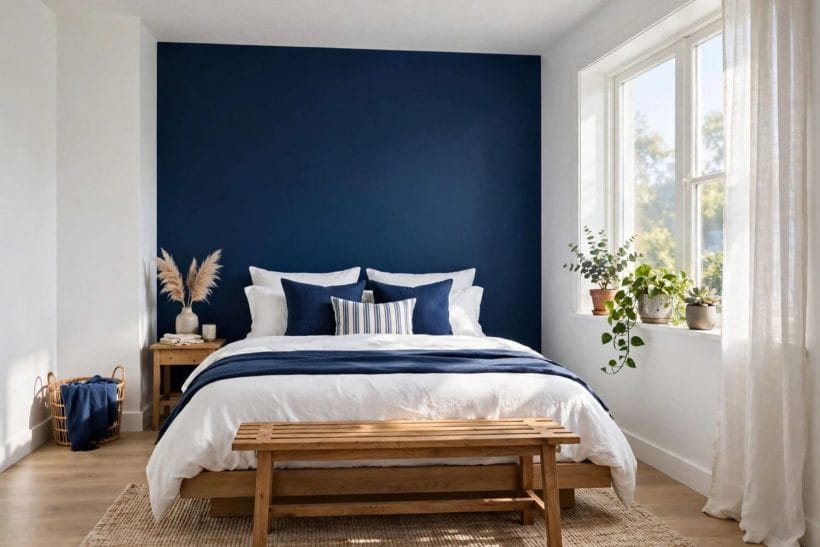
A navy bedroom is only a success if it stays restful after the novelty fades. The habits that keep it so are small and unglamorous: making the bed each morning, returning books and glasses to their places, and keeping the floor clear. These habits matter more in a navy room than in a pale one, because dark walls make disorder visible, but they also reward the effort, because a tidy navy room looks calm in a way a tidy pale room rarely matches.
Evening routine shapes how restful the room feels at night. Dimming the main light and switching to bedside lamps an hour before sleep lets the navy deepen gently, rather than snapping from bright to dark. A chair kept clear for tomorrow’s clothes, rather than a pile on the floor, means the morning starts calmly too. The room works best when its evening state is planned, not left to chance.
Refreshing the room need not mean redecorating. Changing a throw, swapping cushion covers, or bringing in fresh flowers or greenery can shift the mood of a navy bedroom through the seasons without touching the walls. Because the navy is constant, these small changes read clearly, and the room can feel new without any upheaval. The navy wall becomes a backdrop that welcomes change rather than resisting it.
Finally, listen to the room over time. If the navy starts to feel heavy in winter, a paler throw or a brighter lamp may be all that is needed. If it feels washed out in summer, a deeper cushion or a darker throw can restore its depth. A bedroom that is adjusted gently, in response to light and season, stays a place of rest for years, and the navy that first attracted attention becomes simply the colour of home.
Final Considerations
A successful dark blue bedroom is built on restraint: one navy wall, pale companions, layered bedding, closed storage and light that changes through the day. Each decision supports the next, and none of them requires a large budget or a major project. Start with the wall behind the bed, dress the bed in layers, give everything a home, and let the lamps do their quiet work in the evening.
Before committing to paint, live with the colour for a while through a headboard, curtains or bedding, and test a generous patch on the wall in both daylight and lamplight. If the room still feels calm after that trial, the navy has earned its place. For a wider home project, a planning checklist for a home project can help order the steps, but the bedroom itself needs only the ideas above, applied patiently, to become a restful room that welcomes sleep night after night.



0 Comments