
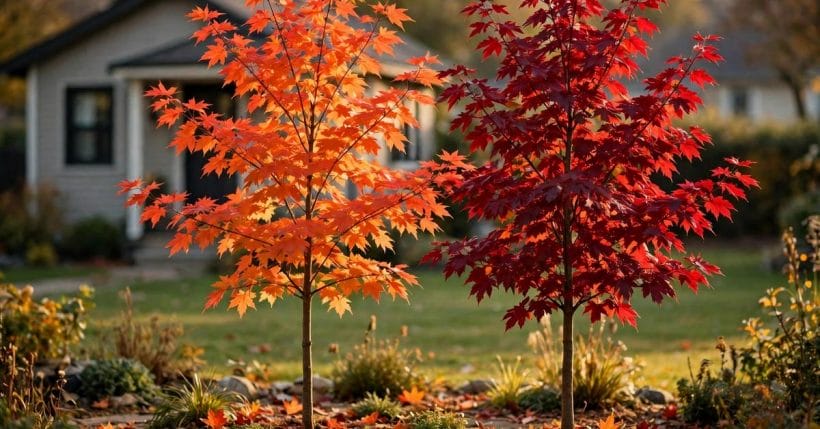
Two young maple trees can stand side by side in a small front garden and still tell quite different autumn stories. One flames up in bright orange-red, the other deepens into a rich crimson, and from the street the two can look like different seasons altogether. That contrast is the whole point of this comparison: october glory vs red sunset is a choice between two red maples that share a family resemblance but part company in autumn colour, in the mood they give a garden, and in the kind of setting where each one looks most at home.
Both trees are grown for the same reason, a strong autumn show in an ordinary garden, and both ask for the same broad conditions: open sky, room to spread, and steady care while they settle in. Neither one is a guaranteed performer in every garden, because autumn colour, leaf health and growth all vary with soil, climate, water and care, and a tree that glows in one garden may colour more quietly in another. This guide compares the two in general terms only, looking at colour, leaves, shape, shade, planting and the long view, so you can weigh which autumn character suits your garden, your house and the way you use the space outside it.
| Item | What it is |
|---|---|
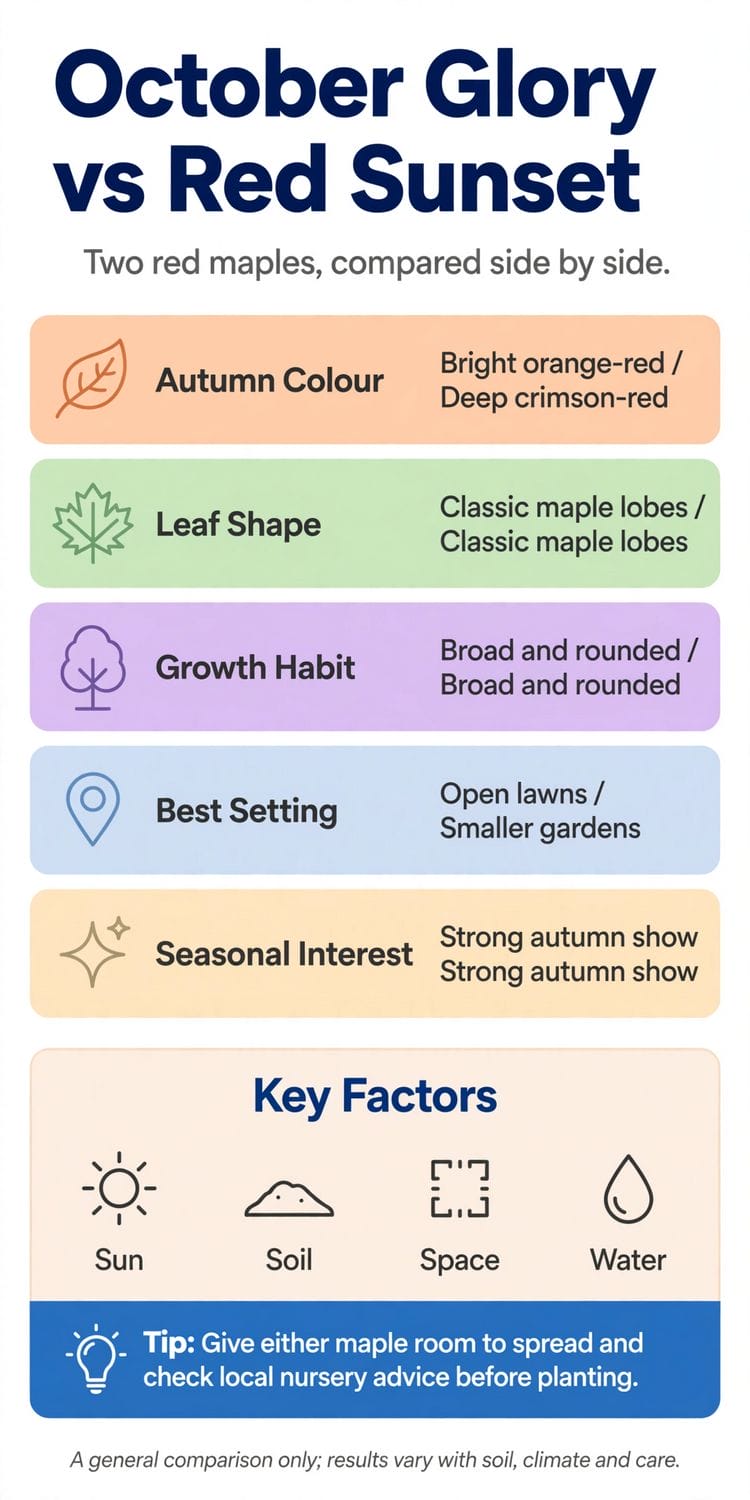
| Two Maples, One Autumn Question | October Glory and Red Sunset are both red maples, which means they share the classic maple leaf shape, a broad spreading habit as they mature, and a reputation for autumn colour that draws the eye. |
| Autumn Colour: The Bright Flame | October Glory earns its name in autumn, when its canopy turns to shades of orange-red that seem lit from within. |
| Red Sunset and the Deeper Crimson | Red Sunset takes a different path through autumn, turning to a deeper crimson that feels richer and more restrained than the bright flame of its companion. |
| Looking Closer: Leaves and Light | Up close, the two trees have much in common. |
| The Garden Floor in Autumn | When the leaves begin to fall, the garden beneath a red maple becomes a carpet of colour, and the two trees paint that carpet differently. |
| Planting and the First Seasons | Planting either maple is a job for a careful gardener, and the first seasons matter more than any later ones. |
| Shade, Shelter and Sitting Beneath | As the trees mature, their broad canopies give shade, and that shade changes how a garden is used. |
| The Canopy From Below | Standing beneath a red maple in autumn and looking up is one of the small pleasures of the season, and the two trees offer different versions of it. |
| Late Autumn and the Bare Branches | Late autumn brings the end of the show, as the last leaves fall and the branches stand bare. |
1. Two Maples, One Autumn Question
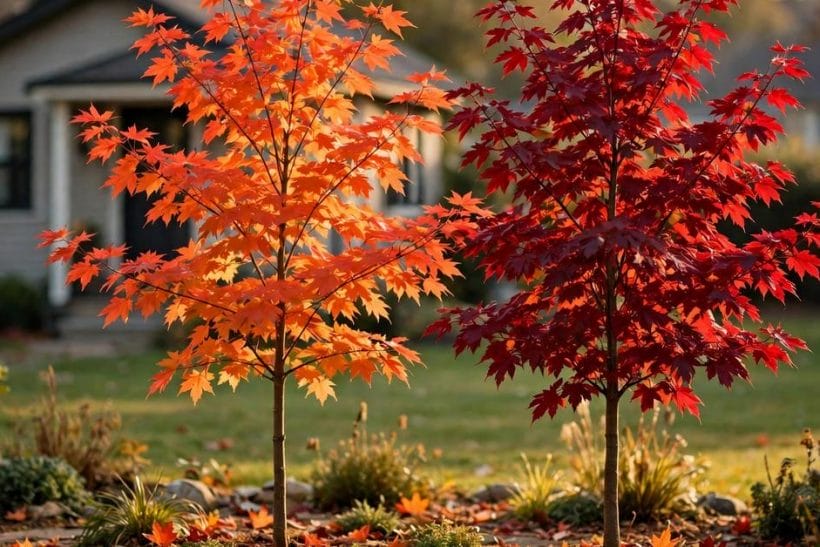
October Glory and Red Sunset are both red maples, which means they share the classic maple leaf shape, a broad spreading habit as they mature, and a reputation for autumn colour that draws the eye. Standing beside each other in autumn, the difference is mainly one of tone: October Glory tends toward a brighter, warmer flame, with orange and red mixed through the canopy, while Red Sunset tends toward a deeper, cooler crimson that can read almost wine-dark in soft light. The two are close enough that a visitor might call them the same tree, yet different enough that the choice changes the whole feeling of a front garden.
The question behind the comparison is therefore less about which tree is better in some absolute sense, and more about which autumn colour you want to live with. A bright orange-red canopy lifts a garden and catches the light, making a small house look warm and welcoming from the street. A deep crimson canopy gives a quieter, richer effect, a pool of dark red that holds the eye without shouting. Both effects are beautiful, and both depend on the light of the day, the colour of the house behind them, and the planting around their feet.
It helps to think of the two as characters rather than rivals. October Glory is the extrovert of the pair, the tree that announces autumn loudly and early in the eye, even if the exact timing varies from garden to garden. Red Sunset is the quieter presence, the tree whose colour rewards a second look and sits well against pale walls, grey stone and green lawns. The sections below take each part of the comparison in turn, so the choice can be made on the whole tree, not on a single afternoon of colour alone.
2. Autumn Colour: The Bright Flame
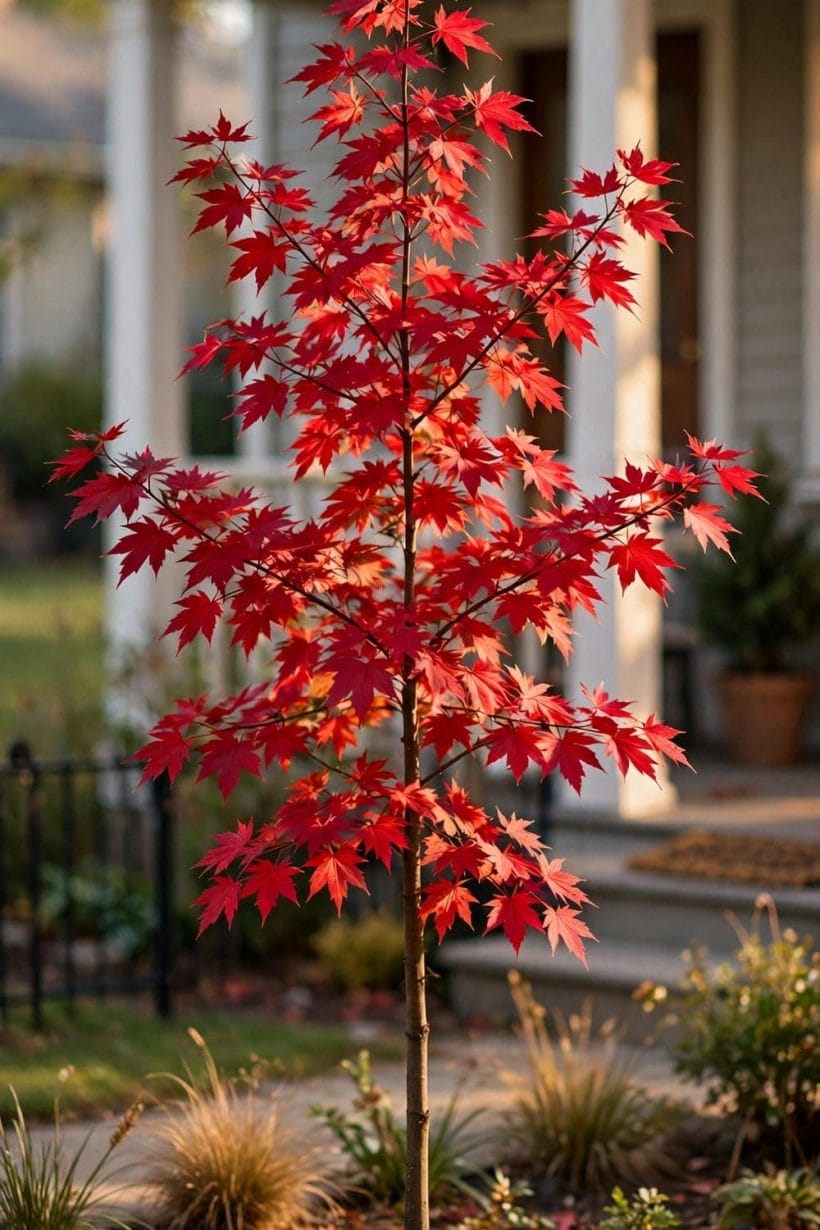
October Glory earns its name in autumn, when its canopy turns to shades of orange-red that seem lit from within. In good light the leaves glow, with brighter orange at the edges of the canopy and deeper red toward the centre, so the whole tree looks like a small fire that never quite settles. That brightness is the tree’s signature, and it is the reason many gardeners choose it for a front garden, where autumn colour is on public view and where a warm canopy can make an ordinary house look inviting.
The brightness also means October Glory shows up well against many backgrounds. Against a pale house, a grey fence or a green lawn, the orange-red canopy stands out clearly, and even on a dull day it holds more warmth than most autumn trees. In a garden with warm-toned brick or timber, the effect is harmonious rather than clashing, since the tree picks up the warmth already present in the house. Against very dark backgrounds the colour can look even more vivid, which is worth considering if the tree will stand near dark fencing or deep green hedging.
Colour, however, is never a promise. The depth and brightness of any maple’s autumn show vary with the season, the soil, the water it receives and the light it grows in, and the same tree can colour more strongly in one year than in another. October Glory’s tendency is toward the bright end of the red maple range, but a sheltered spot, a dry spell or a dull autumn can all soften the display. Judge the tree on its general character, bright and warm, rather than on any single photograph of a perfect autumn.
3. Red Sunset and the Deeper Crimson
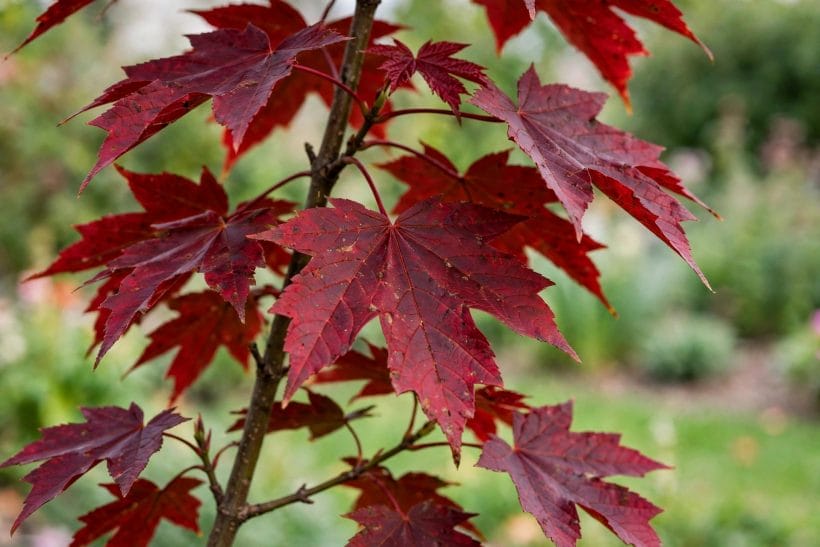
Red Sunset takes a different path through autumn, turning to a deeper crimson that feels richer and more restrained than the bright flame of its companion. Where October Glory seems to catch fire, Red Sunset seems to deepen, and the canopy can hold a dark red tone that looks almost velvety in low light. That depth gives the tree a particular elegance, especially in gardens where the planting is calm and the house colours are pale or muted, since the dark red acts as a single strong note rather than a blaze.
The deeper tone also changes how the tree sits in a garden through the day. In morning light the crimson can look fresh and clear, while in evening light it darkens and recedes, giving the garden a quieter mood as the day ends. Gardeners who prefer a restful garden, or who want autumn colour without a loud display, often find this character more to their taste. It pairs well with soft green lawns, pale gravel paths and light-coloured walls, all of which let the dark red read as a deliberate accent.
As with its companion, the exact shade varies. Red Sunset’s tendency is toward the deep crimson end of the range, but soil, climate and the season itself all shape the result, and no two autumns colour quite alike. The honest way to describe the difference is one of tendency, not of certainty: October Glory leans bright and warm, Red Sunset leans deep and cool, and both can surprise you in a good year. Choosing between them is largely a matter of which tendency you would rather live with.
4. Looking Closer: Leaves and Light
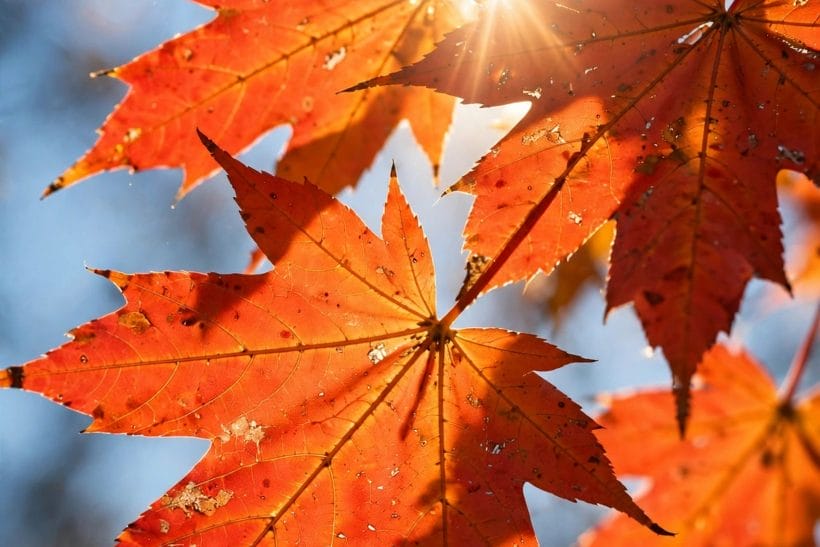
Up close, the two trees have much in common. Both carry the familiar maple leaf, lobed and pointed, that turns colour leaf by leaf rather than all at once, so the canopy often shows a mixture of shades at any one moment. That mixture is part of the charm: a single branch can hold leaves at different stages, from green through gold and orange to full red, and the canopy as a whole looks layered rather than flat. The difference between the two is less in the shape of the leaf than in the colour the leaf reaches at its peak.
Light changes everything about how the leaves read. Sunlight through the canopy makes both trees glow, and the bright leaves of October Glory can look almost translucent in strong sun, while the deeper leaves of Red Sunset hold their colour more solidly and show their veining more clearly. In shade, the bright tree keeps more of its warmth, while the deep tree can look darker and more sombre, which may suit a quiet corner but may feel heavy in a garden that already gets little sun. Where the tree will stand, and how much sun its canopy will catch, is therefore part of the colour decision.
Leaf fall is another shared habit worth noting. Both trees drop their leaves in autumn, and the ground beneath them becomes part of the display for a few weeks, scattered with red and orange. That litter is easy to manage with regular raking, and many gardeners enjoy it as the last stage of the show before winter. A tree chosen for autumn colour should be judged with its fallen leaves in mind too, since the garden floor is where the colour lands in the end.
5. The Garden Floor in Autumn
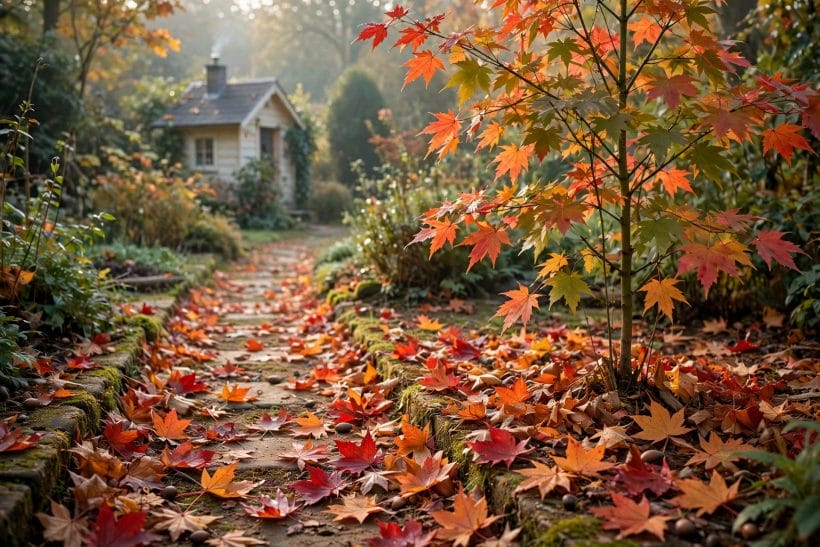
When the leaves begin to fall, the garden beneath a red maple becomes a carpet of colour, and the two trees paint that carpet differently. Beneath October Glory the fallen leaves tend toward bright orange and red, keeping the garden lively even as the canopy thins. Beneath Red Sunset the fallen leaves tend toward deeper crimson, giving paths and lawns a richer, quieter covering. Either way, the fallen leaves are a pleasure for a while, and a small job afterwards, since a thick layer left on a lawn can smother the grass beneath it.
Paths deserve a thought here too. A garden path that runs beneath a maple will be scattered with leaves through autumn, and a bright scattering can make a plain path look festive, while a deep scattering can make it look formal and composed. The choice matters most in a small garden, where the path is a large part of what you see from the house. A pale path shows fallen leaves clearly, which is a delight when the leaves are fresh and a chore when they are wet, so regular clearing is part of living with either tree.
The practical point is simple: autumn colour does not end when the leaves leave the branches. It continues on the ground, on the path and on the lawn, and the character of that second display follows the character of the first. Gardeners who love the bright flame will enjoy the bright carpet, and gardeners who prefer the deep crimson will enjoy the deeper one. Neither is tidier than the other in any reliable way, since leaf fall depends on wind, rain and the season as much as on the tree itself.
6. Planting and the First Seasons
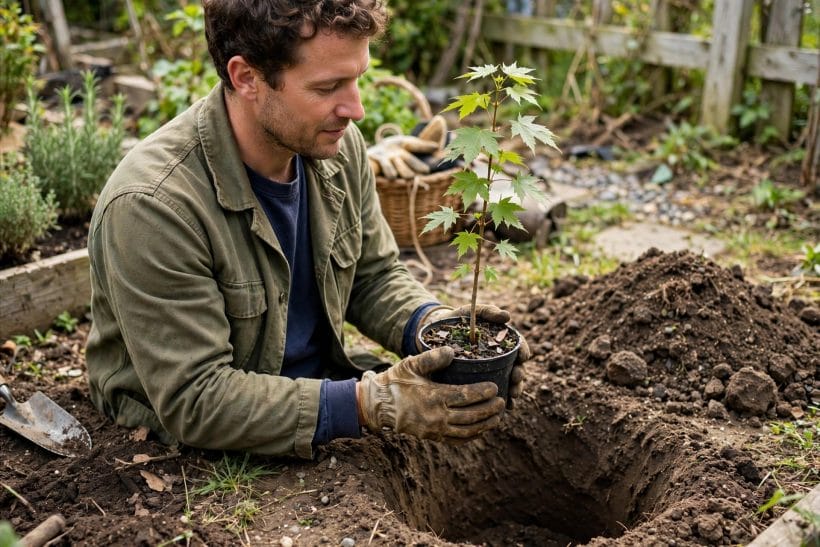
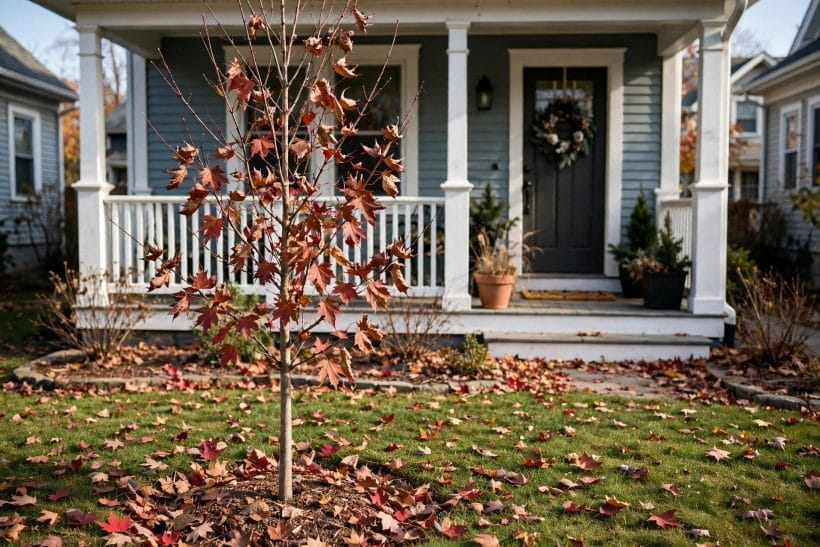
Planting either maple is a job for a careful gardener, and the first seasons matter more than any later ones. A young tree needs a planting hole that gives its roots room, soil that drains without drying out, and steady watering while it settles, especially through dry spells in its first years. Staking may help a young tree stand straight in a windy spot, but ties should be checked as the trunk thickens so they never bite into the bark. These are general points of good planting practice, and they apply equally to both trees.
Position matters as much as planting technique. Both trees grow into broad, spreading canopies, so each one needs space around it, clear of buildings, walls, paths and overhead wires, with room for the canopy to spread without constant pruning. A tree planted too close to a house will always be a compromise, pruned back just as it begins to look its best. It is better to give either maple generous room from the start, even if the young tree looks small and lonely in a large space for its first seasons, since the space is an investment in the mature tree.
Local advice is worth seeking before planting, since soil, climate and local conditions vary widely, and a nursery or local garden adviser can speak to what grows well in your area. That advice matters more than any general guide, because it is grounded in the conditions your tree will actually face. A tree chosen with local knowledge, planted with care and watered steadily while it settles, has the best chance of giving the autumn show you planted it for, whichever of the two you choose.
7. Shade, Shelter and Sitting Beneath
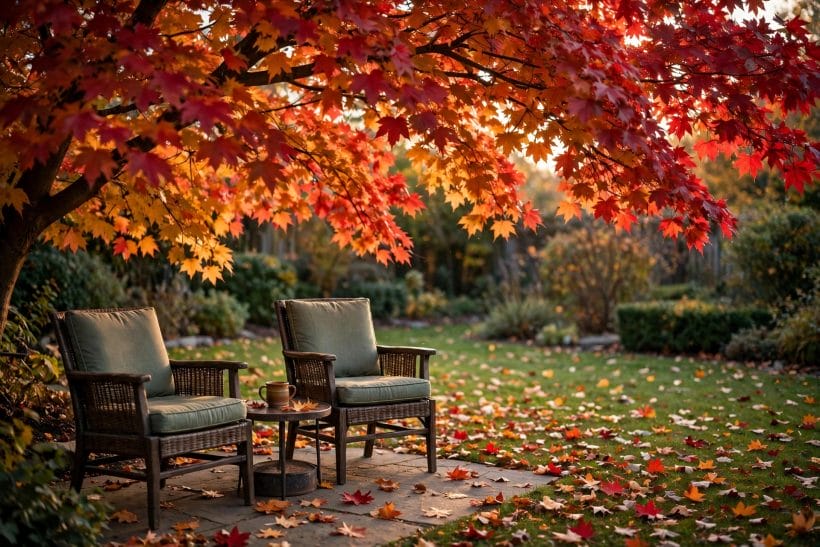
As the trees mature, their broad canopies give shade, and that shade changes how a garden is used. A maple canopy over a patio or a seating area softens strong sun, cools the ground beneath it, and makes an outdoor seat pleasant through the warmer months. The shade is dappled rather than dense, since light filters through the lobed leaves, so the ground beneath a maple is rarely gloomy, and grass and planting beneath the canopy can still thrive in the filtered light.
The two trees give broadly similar shade, since their canopies are similar in form, but the colour of the light beneath them differs in autumn, when the canopy itself becomes the view. Sitting beneath October Glory in autumn means sitting beneath a bright, warm ceiling of orange-red, which lifts the mood of a patio. Sitting beneath Red Sunset means sitting beneath a deeper, richer ceiling, which feels more enclosed and calm. Through the rest of the year, when both canopies are green, the difference largely disappears, and the shade is simply pleasant.
Shelter is a quieter benefit. A broad canopy breaks wind and softens rain, making a seating area more comfortable, and a tree near a house can shade a sunny wall and cool the rooms behind it. These benefits grow with the tree, so they should be weighed alongside autumn colour when choosing a position. A tree planted where its shade will fall on a patio or a sunny wall gives back more than colour alone, and either maple can do that work well if it has room to grow.
8. The Canopy From Below
Standing beneath a red maple in autumn and looking up is one of the small pleasures of the season, and the two trees offer different versions of it. Beneath October Glory, the canopy overhead is a bright mosaic of orange and red, with sunlight breaking through the leaves and scattering warm light on the ground. Beneath Red Sunset, the canopy overhead is a deeper field of crimson, with the light filtered to a richer, redder glow. Both views reward a pause, and both change through the day as the sun moves.
The view from below also shows the structure of the tree, the way the branches spread and divide, and how the canopy holds together as a single shape. A well-grown maple has a balanced branch structure, with no single limb dominating, and that balance is what makes the canopy look generous rather than ragged. Young trees may look uneven for a while, and light formative pruning by a knowledgeable gardener can help, but the broad shape of either tree is generally pleasing without heavy intervention.
Looking up also reminds you that autumn is only one season of the tree’s year. Through spring and summer the canopy is green and fresh, through winter it is bare branches against the sky, and autumn is the brief, bright climax. Choosing a maple for autumn colour alone would miss most of its life, so it is worth liking the tree in its other seasons too: the fresh green of spring, the full shade of summer, and the clean branch pattern of winter all belong to the same tree you plant for October.
9. Late Autumn and the Bare Branches
Late autumn brings the end of the show, as the last leaves fall and the branches stand bare. The two trees end the season in much the same way, with a brief period when only a few leaves cling to the outer twigs, and then the clean lines of the branch structure take over. A maple in winter is a quieter beauty, a pattern of branches against the sky, and a garden that has enjoyed a bright autumn often feels larger and lighter once the canopy has gone, since the sky opens up again.
Winter is also the season for looking at the tree honestly. Bare branches show the shape clearly, and any crossing or damaged limbs are easy to see, which makes winter a sensible time for a knowledgeable gardener to carry out light pruning. Heavy structural work, and anything involving large limbs or a tree near buildings or wires, is best left to experienced professionals, since a wrong cut can harm the tree and a falling limb can cause real damage. The general rule is to keep winter work light and leave the rest to those who do it every day.
The bare season is worth weighing when choosing between the two, mainly because it removes the difference between them. In winter, October Glory and Red Sunset look very much alike, two maples with similar branch patterns and similar silhouettes. The choice between them is therefore a choice about autumn and about the growing seasons, not about winter, and a gardener who loves the winter shape of one will generally love the winter shape of the other just as well.
10. Choosing Between Them
Choosing between October Glory and Red Sunset comes down, in the end, to the autumn mood you want and the garden you have. If your garden is small and you want autumn colour that announces itself, that brightens a pale house and lifts the street view, the brighter, warmer tendency of October Glory is the natural lean. If your garden is calm and you want autumn colour that deepens rather than shouts, that sits richly against pale walls and green lawns, the deeper crimson tendency of Red Sunset is the natural lean. Neither lean is a verdict, and both trees can delight in the right setting.
Setting should weigh as heavily as colour. A larger, open garden gives either tree the room its broad canopy needs, and the bright tree can fill that space with warmth without overwhelming it. A smaller garden asks for more care in positioning, since a broad canopy will dominate a small space whatever its colour, and the deeper tree may sit more quietly in a compact garden. Think about the house behind the tree, the paths beneath it, the neighbours it will shade, and the view from the windows that look onto it, since all of those shape how the autumn colour is actually experienced.
Finally, let local knowledge have the last word. A nursery or local adviser who knows your soil and climate can tell you which of the two tends to colour more reliably in your area, and that local tendency matters more than any general description. Visit trees in autumn if you can, in gardens near your own, and look at them in the light of your own street rather than in photographs alone. The tree you choose will be with you for many autumns, so a little looking now is time well spent.
Final Considerations
October Glory and Red Sunset are two versions of the same good idea: a red maple that gives a strong autumn show in an ordinary garden. The first leans bright and warm, the second leans deep and cool, and the rest of the tree, its leaves, its broad shape, its shade and its winter branches, is broadly shared between them. That shared character is reassuring, because it means the choice is not a gamble between a good tree and a poor one, but a choice between two good trees with different autumn moods.
Before planting, give the chosen tree room to spread, clear of buildings and wires, plant it with care, water it steadily while it settles, and seek local nursery advice for your soil and climate. Judge the autumn colour as a tendency that varies with season and care, not as a guaranteed display, and enjoy the tree through its whole year, from spring green through summer shade to the brief, bright climax of autumn. Seen that way, october glory vs red sunset is less a contest than a pleasant decision, and either answer, made with room and care, can give a garden an autumn worth waiting for.
Related reading: tiny house garden ideas, container garden ideas, backyard landscaping ideas, tiny backyard ideas, tiny house patio ideas, rock landscaping ideas, and tiny house exterior ideas.



0 Comments