
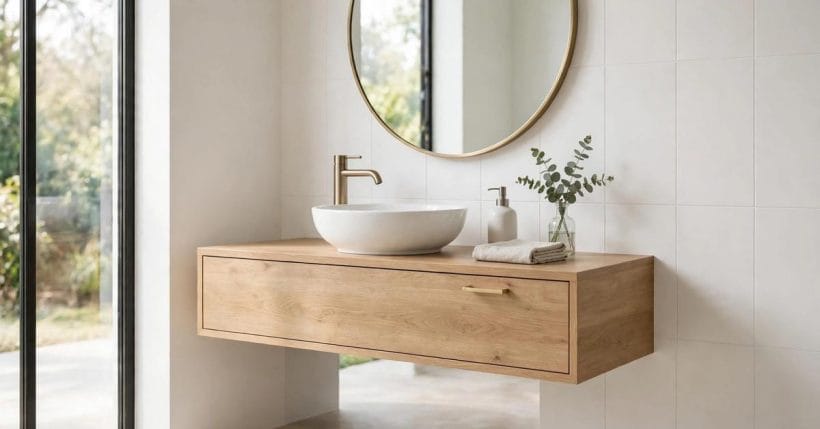
A bathroom with a floating vanity feels different from the moment you walk in. The unit hangs on the wall, the floor runs clear beneath it, and the room looks larger than its measurements suggest. These seventy-five floating vanity bathroom ideas explore that single form in all its variety: small rooms and shared bathrooms, timber warmth and painted colour, stone tops and vessel basins, mirrors and lights, storage that works, and tiles that let the floating form shine.
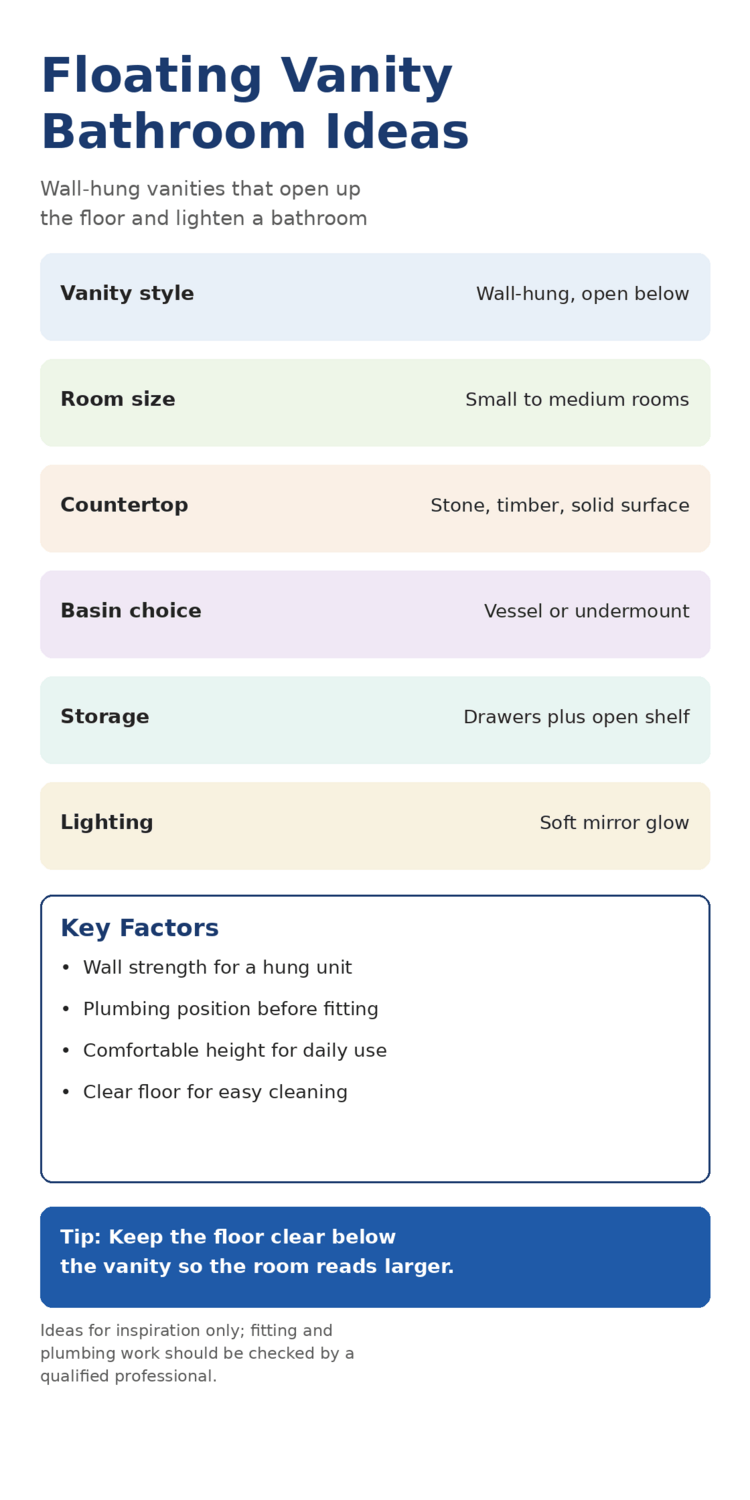
Before choosing, it helps to think about the wall itself. A floating unit hangs entirely from its fixings, so the wall must be suitable and the fitting should be left to a qualified professional, with plumbing checked at the same time. The ideas below stay with design, finishes and everyday use, so you can choose a look with confidence and leave the structural and plumbing work to the right hands. For small-room context, see our tiny bathroom ideas and tiny house bathroom designs, and for the wider room around the vanity, see our tiny house interior design ideas.
1. Small Bathrooms and Clear Floors
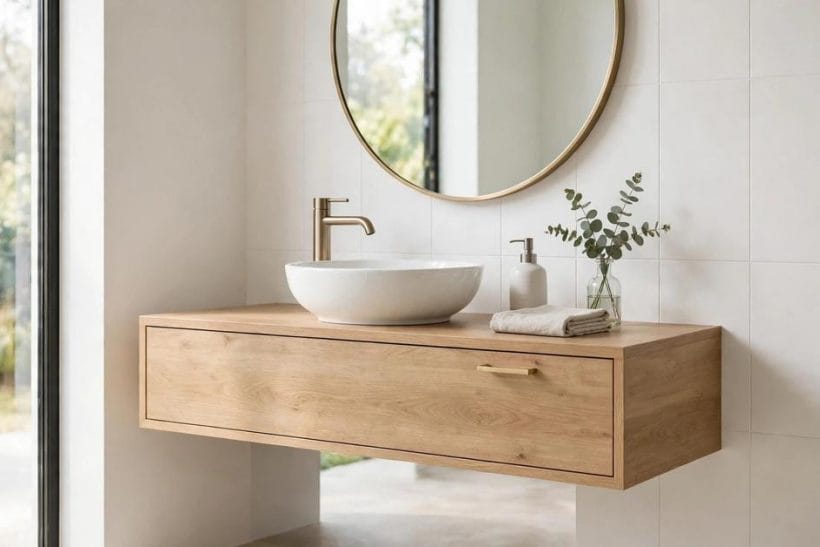
A floating vanity earns its place in a small bathroom by leaving the floor visible beneath it. That open strip of floor makes the room feel wider, lets light travel further, and makes cleaning simpler, because there is no plinth to work around. The ideas in this section keep the unit compact and the floor clear.
| Item | What it is |
|---|---|
| A Single Drawer in a Narrow Room | A single deep drawer under a wall-hung top keeps daily items close without filling the room. |
| Open Floor Beneath the Basin | Leaving the space under the vanity completely open is the simplest way to make a small bathroom feel larger. |
| A Corner-Hung Unit | A vanity hung into a corner uses a stretch of wall that often sits empty, freeing the main wall for a mirror or a towel rail. |
| Wall-Hung Beside a Compact Bath | When a bath shares a small room with a vanity, hanging the vanity clears the floor between the two fixtures. |
| A Slim Depth for Tight Doorways | A shallow-depth floating unit suits bathrooms where the door swing or a passage leaves little room to spare. |
| Floating Vanity in a Tiny House Bathroom | In a tiny house bathroom, every centimetre of visible floor matters, and a wall-hung vanity helps the room breathe. |
| A Clear Run to the Shower | Hanging the vanity on the wall opposite the shower keeps the route between fixtures open and dry. |
| Mirror Above, Nothing Below | Pairing a generous mirror with a completely clear space below the vanity doubles the sense of light in a small room. |
| One Long Drawer, Nothing Else | A single long drawer gives a clean front and one generous space for bottles, cloths and spare towels. |
| A Slab Shelf with a Vessel Basin | A thick timber or stone shelf hung on the wall, topped with a vessel basin, is the lightest floating form of all. |
| A Framed Unit with an Open Shelf | A framed floating unit with one open shelf below the drawer gives a place for rolled towels or a basket, while still showing floor at the sides. |
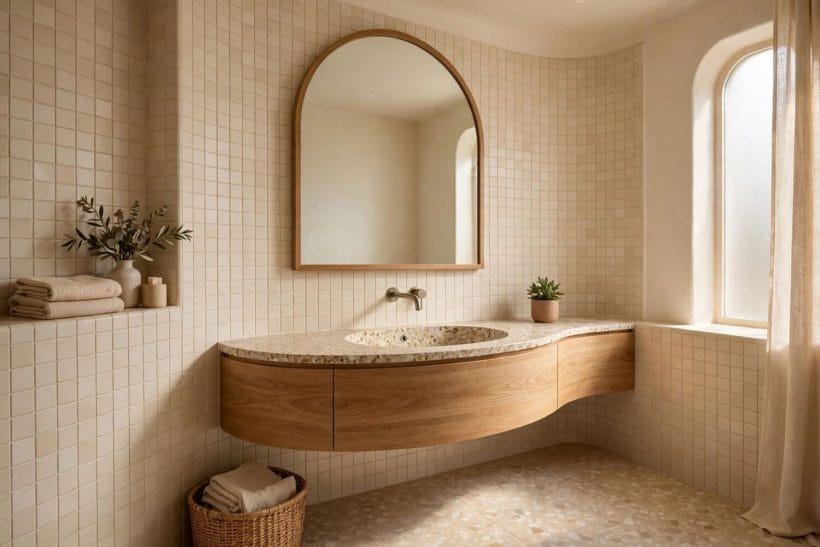
| A Rounded Front for Soft Lines | A vanity with a gently curved front softens a bathroom full of straight tiles and square mirrors. |
| A Handle-Free Front in Pale Timber | A handle-free drawer front in pale timber gives a single vanity a quiet, furniture-like quality. |
| A Narrow Unit for a Cloakroom | A cloakroom needs only a small basin and a place for soap, and a narrow floating unit provides both without crowding the room. |
| A Vanity That Matches the Door | Matching the vanity front to the bathroom door finish ties a small room together with very little effort. |
| A Single Unit with a Side Return | A floating unit with a short side return gives a little extra counter space beside the basin, useful for a soap dish or a small tray. |
| A Long Double Drawer Unit | A long floating unit with two basins and a shared drawer run gives a shared bathroom a single calm line. |
| Two Separate Hung Units | Hanging two separate floating units with a gap between them gives each person a truly personal station. |
| A Double Vanity with a Central Shelf | A double floating vanity with an open central shelf gives shared storage a visible home, with towels or baskets in the middle and drawers at each end. |
| His and Hers Finishes, One Form | Two basins on one floating unit can carry slightly different finishes, such as a timber front on one side and a painted front on the other, while sharing the same countertop. |
| A Double Unit in a Family Bathroom | A family bathroom benefits from a long floating unit with durable fronts and generous drawer space for each child and adult. |
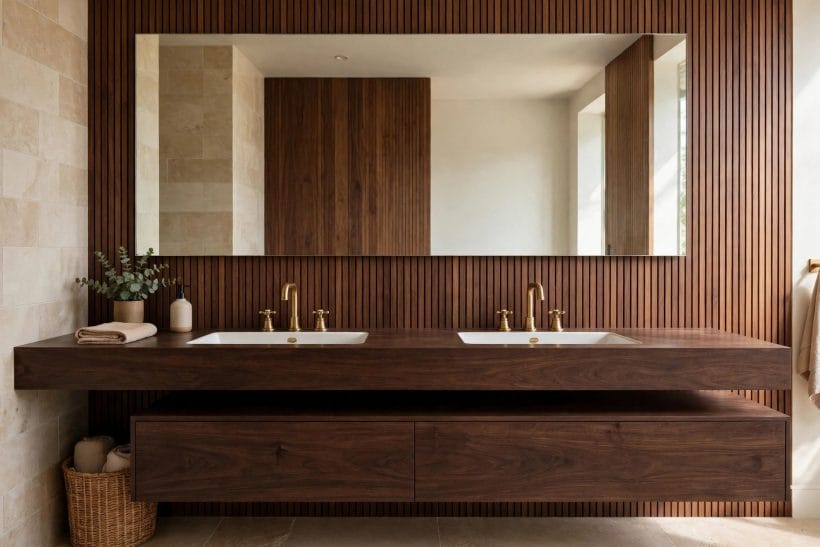
| Twin Basins, One Long Mirror | A single long mirror above a double floating vanity reflects the whole room and makes a shared bathroom feel wider. |
| A Double Vanity with a Make-Up Station | One end of a double floating unit can drop to a lower counter height to serve as a seated dressing area, with a mirror and a small stool below. |
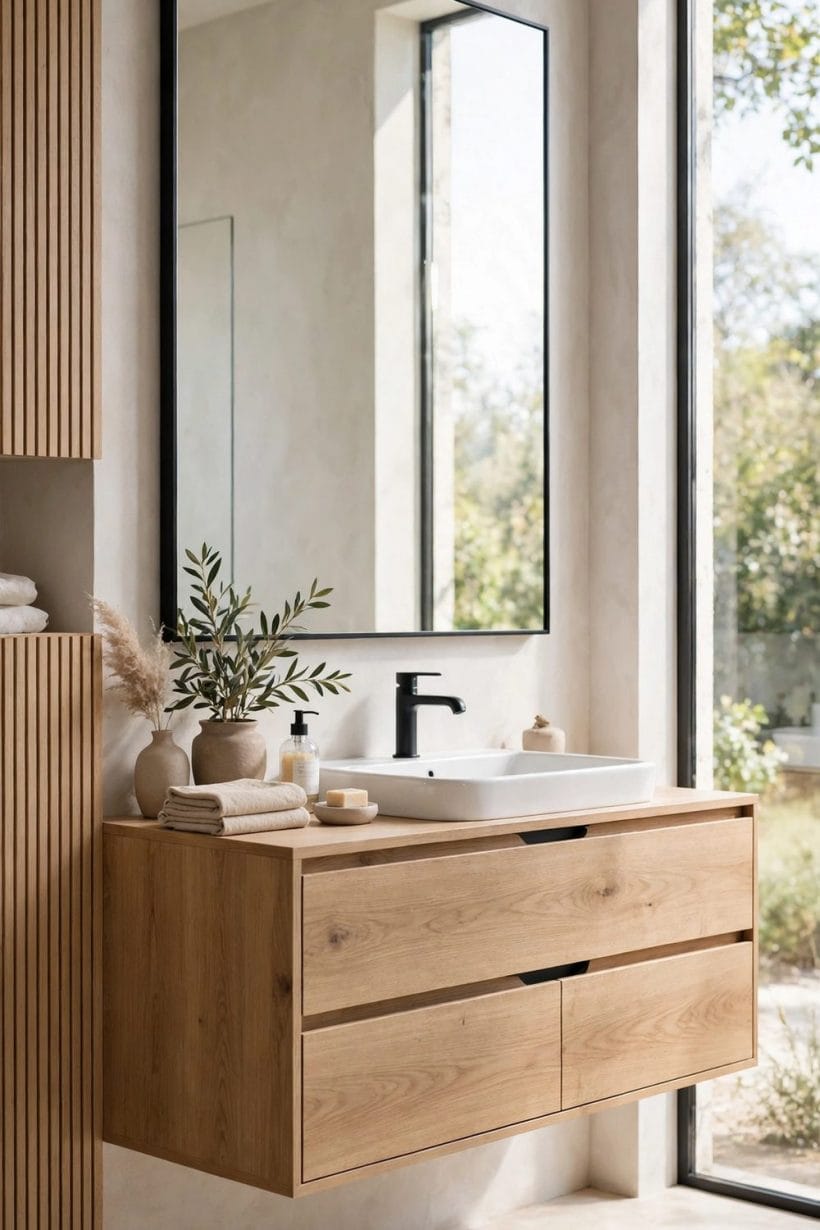
| Pale Oak with White Tiles | Pale oak and white tiles are a classic pairing for a floating vanity, because the timber warms the cool tiles without darkening the room. |
| Warm Walnut for a Richer Room | Warm walnut gives a floating vanity the presence of a piece of furniture, and it suits a larger bathroom where a darker unit will not overwhelm. |
| Reclaimed-Look Timber for Character | A timber front with a weathered, reclaimed look brings character to a plain bathroom, as if the vanity has a history. |
| Teak Tones with Green Accents | Teak-toned timber and green accents, such as a plant or a sage towel, give a floating vanity a natural, spa-like feel. |
| Ash Timber in a Bright Bathroom | Ash timber, pale with a visible grain, keeps a bright bathroom feeling light while adding warmth that white units lack. |
| Smoked Timber for a Moody Scheme | Smoked timber, darker and cooler than walnut, suits a moody bathroom with deep wall colour and soft lighting. |
| Timber and Black Details | Timber fronts with black taps and a black-framed mirror give a floating vanity a contemporary edge. |
| A Timber Shelf with Woven Baskets | A floating timber shelf below the basin, holding woven baskets, gives a vanity a relaxed, open feel. |
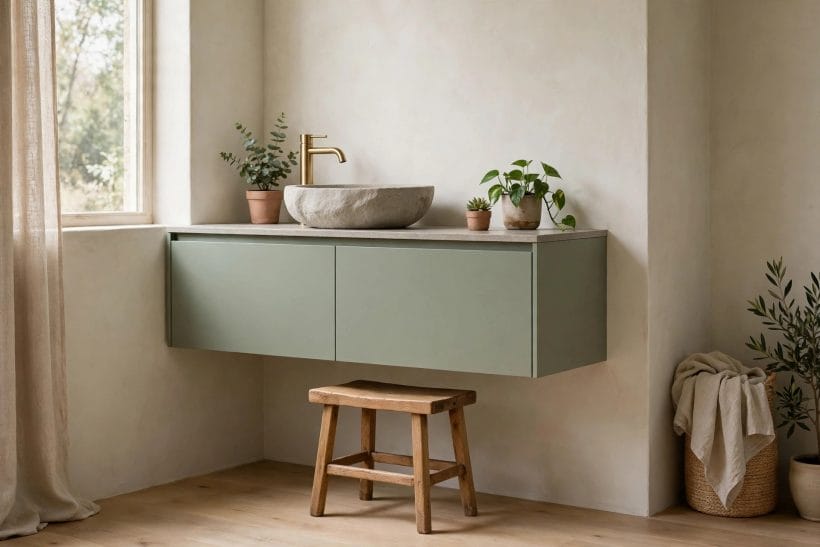
| Soft Sage on a Floating Unit | Soft sage paint on a floating vanity brings a gentle green into the bathroom without overwhelming it. |
| Dusty Blue for a Coastal Feel | Dusty blue paint gives a floating vanity a coastal feel, especially with white walls and a pale timber mirror frame. |
| Warm Cream for a Classic Room | Warm cream paint on a floating vanity suits a classic bathroom, where the unit should blend rather than stand out. |
| Blush Pink for a Gentle Touch | Blush pink paint on a floating vanity gives a bathroom a gentle, warm touch, especially with brass-look details and a round mirror. |
| Charcoal for a Bold Anchor | Charcoal paint on a floating unit anchors a pale bathroom, giving the eye a dark point to rest on. |
| Pale Grey for a Quiet Scheme | Pale grey paint is the quietest choice for a floating vanity, sitting comfortably with white, timber and stone. |
| Terracotta Warmth in a Sunny Room | Terracotta paint on a floating vanity brings warmth to a sunny bathroom, pairing well with cream tiles and woven textures. |
| A Stone Top with an Undermount Basin | A stone countertop with an undermount basin gives a floating vanity a clean, uninterrupted surface, since the basin sits below the top. |
| A Vessel Basin as the Feature | A vessel basin sitting on top of a floating vanity becomes the feature of the bathroom, especially in stone or ceramic with a distinctive shape. |
| An Integrated Basin for Easy Cleaning | An integrated basin, formed as part of the countertop, gives a floating vanity the easiest surface to clean, with no joins to trap water. |
| A Timber Top with a Ceramic Basin | A timber countertop with a white ceramic basin gives a floating vanity warmth on top and brightness in the middle. |
| A Double-Thickness Top for Presence | A double-thickness countertop gives a floating vanity a more substantial presence, as if the top were a slab rather than a board. |
| A Dark Stone Top on a Pale Unit | A dark stone countertop on a pale floating unit gives the bathroom a clear contrast, grounding the light unit against the wall. |
| A Basin Offset to One Side | Placing the basin to one side of a floating vanity leaves a generous stretch of counter beside it for a tray, a plant or folded towels. |
| A Semi-Recessed Basin for a Shallow Unit | A semi-recessed basin, jutting slightly beyond the front of a shallow floating unit, gives hand-washing room without a deep cabinet. |
| A Round Mirror Above a Single Unit | A round mirror above a single floating vanity softens the straight lines of the unit and the tiles. |
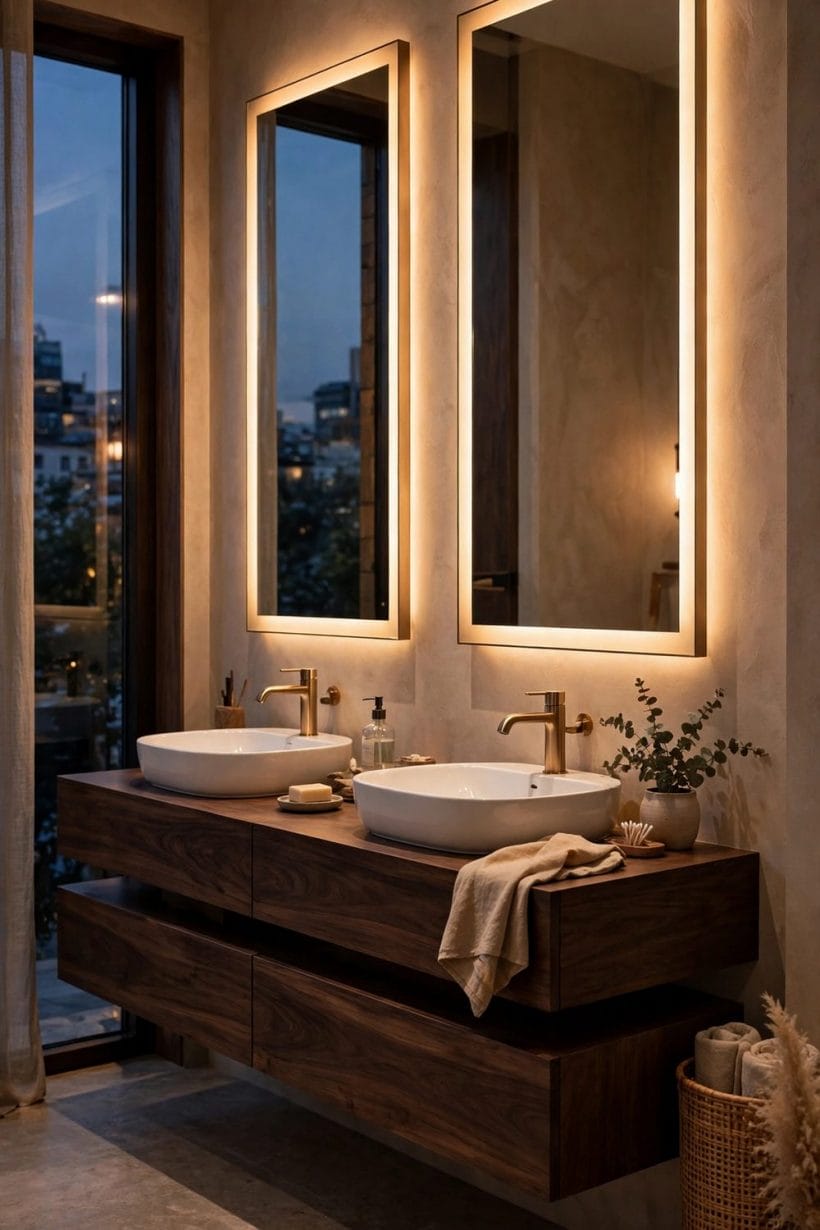
| A Backlit Mirror for Evening Light | A backlit mirror above a floating vanity gives soft evening light without harsh shadows, and the glow suits the floating form. |
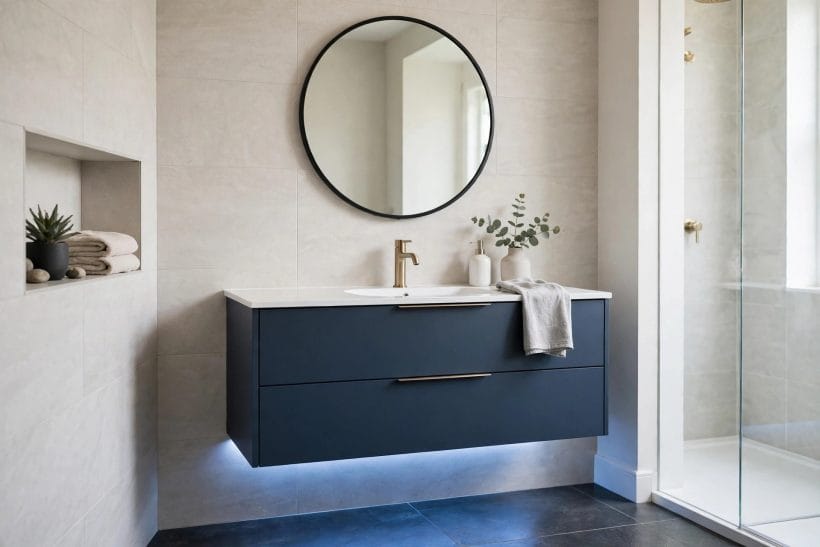
| Under-Vanity Glow on the Floor | A soft light strip beneath a floating vanity washes the floor with a gentle glow, emphasising the open space below and making night-time visits easier. |
| Twin Mirrors for a Double Unit | Twin mirrors above a double floating vanity give each station its own reflection, while the gap between them keeps the wall from feeling covered. |
| A Mirrored Cabinet That Still Floats | A mirrored cabinet above a floating vanity can provide storage without a floor-standing unit, if the cabinet itself is slim and wall-hung. |
| Pendant Lights Beside the Mirror | Pendant lights hanging beside a mirror give a floating vanity a dressed, intentional look, with light falling from both sides of the face. |
| A Tall Mirror for a Small Room | A tall mirror above a floating vanity draws the eye upward and makes a small bathroom feel taller. |
| Deep Drawers for Bottles and Towels | Deep drawers in a floating vanity hold tall bottles and folded towels without the need for a separate cabinet. |
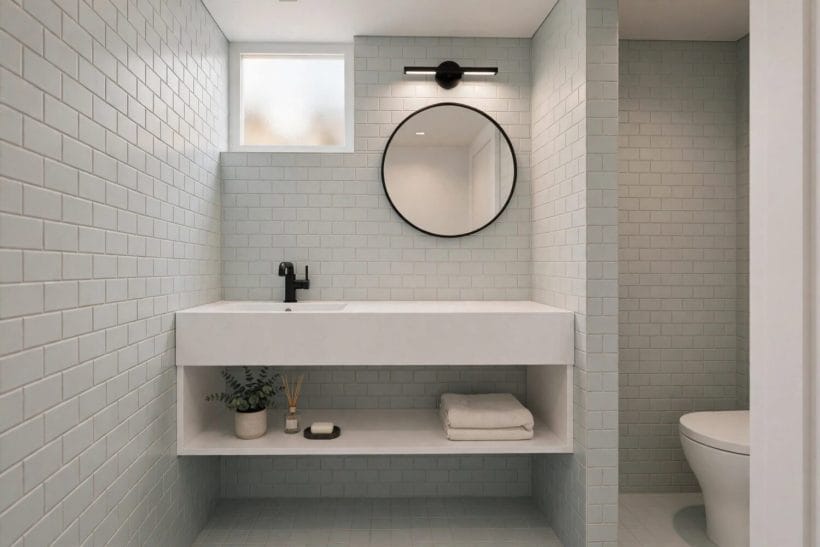
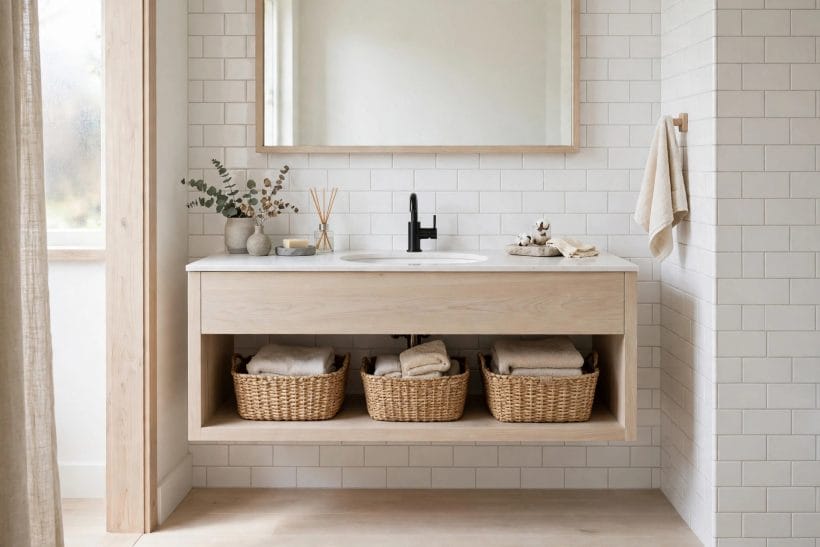
| An Open Shelf for Rolled Towels | An open shelf below a floating drawer gives rolled towels a visible, hotel-like home, and the shelf itself stays light because it is open. |
| A Side Tower for Tall Storage | A tall, narrow tower beside a floating vanity gives a home for tall bottles and spare towels without widening the vanity itself. |
| Baskets Below for a Relaxed Look | Woven baskets placed below a floating vanity give a relaxed, natural storage option for towels or laundry. |
| A Drawer Divider for Small Items | A drawer divider inside a floating vanity keeps small items, such as brushes, creams and spare parts, from sliding into a jumble. |
| Hidden Storage Behind the Mirror | Storage behind the mirror above a floating vanity keeps medicines and small items out of sight without adding furniture to the room. |
| A Pull-Out Step for Children | A pull-out step stored inside a floating vanity gives children a safe boost to the basin, then slides away so the floor stays clear. |
| Labelled Jars on the Counter | Labelled jars on a floating vanity counter keep cotton pads, salts and small items visible and tidy, without needing a drawer for each. |
| Large Tiles Behind the Vanity | Large wall tiles behind a floating vanity give a calm backdrop with few grout lines, so the unit stands out cleanly against the wall. |
| A Tiled Feature Strip Above the Unit | A narrow strip of patterned or coloured tiles above a floating vanity adds a decorative band without covering the whole wall. |
| Floor Tiles Running Under the Unit | Floor tiles that run uninterrupted beneath a floating vanity make the open space below feel intentional, not leftover. |
| Vertical Tiles for Height | Vertical wall tiles behind a floating vanity draw the eye upward and make a low room feel taller. |
| A Painted Wall with a Tiled Splashback | A painted wall with a tiled splashback behind a floating vanity gives colour above and protection where splashes land. |
| Patterned Floor Tiles Below | Patterned floor tiles visible beneath a floating vanity turn the open floor into a feature, since the pattern is not hidden by a cabinet plinth. |
| Timber-Look Floor with a Pale Unit | Timber-look floor tiles with a pale floating vanity give a bathroom warmth underfoot and lightness at eye level. |
| Wall-Hung Taps for a Clear Counter | Wall-hung taps above a floating vanity free the countertop completely, leaving room for soap and a small tray. |
| Handles That Match the Mirror Frame | Handles on a floating vanity that match the mirror frame tie the two pieces together with a single repeated finish. |
| A Soap Tray That Drains | A soap tray that drains on a floating vanity counter keeps water from pooling around the basin. |
| Sealing Timber for Bathroom Air | Timber on a floating vanity should be sealed for bathroom air, since steam and splashes reach the front daily. |
| Checking the Wall Fixings | A floating vanity hangs entirely from its wall fixings, so those fixings should be checked from time to time for any movement or loosening. |
| Painted Finishes and Touch-Ups | A painted floating vanity can be touched up if a drawer edge chips, which is one advantage of a painted front over a foil-wrapped one. |
| Keeping the Open Floor Clear | The open floor below a floating vanity only works if it stays open, so resist the urge to fill it with boxes or a laundry basket. |
1. A Single Drawer in a Narrow Room
A single deep drawer under a wall-hung top keeps daily items close without filling the room. Choose a unit only as wide as the basin needs, and leave the floor beneath it empty so the eye travels straight to the far wall. A plain front and a quiet handle keep the small space calm.
2. Open Floor Beneath the Basin
Leaving the space under the vanity completely open is the simplest way to make a small bathroom feel larger. The continuous floor finish runs wall to wall, and a mop or cloth can pass straight underneath. Keep only one low basket there, if anything, so the openness stays.
3. A Corner-Hung Unit
A vanity hung into a corner uses a stretch of wall that often sits empty, freeing the main wall for a mirror or a towel rail. The basin sits close to the corner, and the open floor below keeps the corner from feeling boxed in. A triangular or short unit suits the tightest corners best.
4. Wall-Hung Beside a Compact Bath
When a bath shares a small room with a vanity, hanging the vanity clears the floor between the two fixtures. The gap reads as walking space rather than furniture, and the room feels less crowded at bath time. Match the vanity finish to the bath panel for a settled look.
5. A Slim Depth for Tight Doorways
A shallow-depth floating unit suits bathrooms where the door swing or a passage leaves little room to spare. The basin still works for washing, while the reduced depth keeps the walkway comfortable. Pair it with a flat mirror rather than a deep cabinet to protect the sense of space.
6. Floating Vanity in a Tiny House Bathroom
In a tiny house bathroom, every centimetre of visible floor matters, and a wall-hung vanity helps the room breathe. A light timber front and a small basin keep the unit from dominating, while the open space below can hold a single low stool. It suits compact homes well, where a wall-hung vanity gives a small room a lighter, more open feel.
7. A Clear Run to the Shower
Hanging the vanity on the wall opposite the shower keeps the route between fixtures open and dry. Water from the shower has a clear floor to run across, and towels stay within easy reach of both areas. A wall-hung unit also avoids the damp corners that floor-standing cabinets can trap.
8. Mirror Above, Nothing Below
Pairing a generous mirror with a completely clear space below the vanity doubles the sense of light in a small room. The mirror reflects the open floor and the opposite wall, so the bathroom feels twice its size. Keep the countertop nearly bare, with only soap and a small plant, to hold the effect.
2. Single Vanities and Compact Forms
A single floating vanity suits most bathrooms, from a guest cloakroom to a generous main bathroom. The form can be a simple drawer box, a slab shelf with a basin, or a framed unit with open storage, and each version hangs the same way: fixed to the wall, with the floor free below. The ideas here explore those single-unit forms.
9. One Long Drawer, Nothing Else
A single long drawer gives a clean front and one generous space for bottles, cloths and spare towels. The simplicity suits a calm bathroom, where the vanity is a quiet piece of furniture rather than a feature. A push-to-open front removes the need for handles altogether.
10. A Slab Shelf with a Vessel Basin
A thick timber or stone shelf hung on the wall, topped with a vessel basin, is the lightest floating form of all. The shelf reads almost as a ledge, and the basin becomes the visual focus. Keep plumbing neat and boxed in a slim channel so the lightness is not lost.
11. A Framed Unit with an Open Shelf
A framed floating unit with one open shelf below the drawer gives a place for rolled towels or a basket, while still showing floor at the sides. The frame adds structure to a plain wall, and the open shelf stops the unit from feeling like a closed box. Choose a frame finish that matches the mirror frame.
12. A Rounded Front for Soft Lines
A vanity with a gently curved front softens a bathroom full of straight tiles and square mirrors. The curve catches light differently across the day and makes the unit feel made for the room. Pair it with a round basin and a round mirror for a coherent, gentle scheme.
13. A Handle-Free Front in Pale Timber
A handle-free drawer front in pale timber gives a single vanity a quiet, furniture-like quality. The grain becomes the decoration, so keep the countertop plain and the basin simple. A small shadow gap between drawer and wall adds definition without hardware.
14. A Narrow Unit for a Cloakroom
A cloakroom needs only a small basin and a place for soap, and a narrow floating unit provides both without crowding the room. The open floor below keeps the tiny room usable, and a wall-hung tap frees counter space. A dark front can ground the small room, if the walls stay pale.
15. A Vanity That Matches the Door
Matching the vanity front to the bathroom door finish ties a small room together with very little effort. The same timber tone or painted shade on both pieces makes the room feel planned rather than assembled. Keep the basin and taps neutral so the matched finishes do the talking.
16. A Single Unit with a Side Return
A floating unit with a short side return gives a little extra counter space beside the basin, useful for a soap dish or a small tray. The return should stay shallow so it does not block the walkway. This form suits a bathroom where the vanity wall is longer than the basin needs.
3. Double Vanities and Shared Bathrooms
Two people sharing a bathroom need two basins, two mirrors and, ideally, two sets of storage, and a floating double vanity can provide all three while still showing floor below. The long, wall-hung form suits a wide wall, and the open space beneath keeps a large unit from feeling heavy. The ideas here keep shared mornings workable.
17. A Long Double Drawer Unit
A long floating unit with two basins and a shared drawer run gives a shared bathroom a single calm line. Each person gets a basin and a mirror, while the shared storage below holds towels for both. Keep the fronts identical so the unit reads as one piece, not two stuck together.
18. Two Separate Hung Units
Hanging two separate floating units with a gap between them gives each person a truly personal station. The gap can hold a small stool or a plant, and the floor shows through between the units. This arrangement suits a wide wall where a single long unit would feel too dominant.
19. A Double Vanity with a Central Shelf
A double floating vanity with an open central shelf gives shared storage a visible home, with towels or baskets in the middle and drawers at each end. The central opening breaks up the long front and stops it from feeling like a sideboard. Keep the central shelf tidy, since it is always on show.
20. His and Hers Finishes, One Form
Two basins on one floating unit can carry slightly different finishes, such as a timber front on one side and a painted front on the other, while sharing the same countertop. The shared top holds the scheme together, and the differing fronts give each side its own character. Keep taps and mirrors matched to avoid a busy look.
21. A Double Unit in a Family Bathroom
A family bathroom benefits from a long floating unit with durable fronts and generous drawer space for each child and adult. The open floor below makes sweeping up after bath time quicker, and the wall-hung form keeps the unit clear of splashes. Choose fronts that wipe clean easily.
22. Twin Basins, One Long Mirror
A single long mirror above a double floating vanity reflects the whole room and makes a shared bathroom feel wider. The mirror unifies the two stations, while separate basins keep mornings separate. Add a light strip along the mirror so both stations are lit evenly.
23. A Double Vanity with a Make-Up Station
One end of a double floating unit can drop to a lower counter height to serve as a seated dressing area, with a mirror and a small stool below. The lower section still floats, so the floor stays clear, and the change in height marks the dressing zone. Keep the stool light so it can be moved for cleaning.
4. Timber, Warmth and Natural Finishes
Timber is the warmest finish for a floating vanity, and it pairs naturally with white tiles, stone basins and soft textiles. Light timbers keep a room bright, while darker timbers add depth and a furniture-like richness. The ideas in this section use timber in its many shades, always as a descriptive finish rather than a specification.
24. Pale Oak with White Tiles
Pale oak and white tiles are a classic pairing for a floating vanity, because the timber warms the cool tiles without darkening the room. The grain gives the unit texture, and the white tiles reflect light back into the space. A white basin and a simple tap complete the calm scheme.
25. Warm Walnut for a Richer Room
Warm walnut gives a floating vanity the presence of a piece of furniture, and it suits a larger bathroom where a darker unit will not overwhelm. The deep tone pairs well with cream walls and brass-look taps. Keep the countertop pale so the walnut stays the focus.
26. Reclaimed-Look Timber for Character
A timber front with a weathered, reclaimed look brings character to a plain bathroom, as if the vanity has a history. The texture suits a rustic or farmhouse-style room, and it pairs well with simple white sanitary ware. Keep the rest of the room plain so the timber texture is not competing.
27. Teak Tones with Green Accents
Teak-toned timber and green accents, such as a plant or a sage towel, give a floating vanity a natural, spa-like feel. The warm timber and the green sit comfortably together, and the scheme suits a bathroom with good daylight. A stone basin strengthens the natural palette.
28. Ash Timber in a Bright Bathroom
Ash timber, pale with a visible grain, keeps a bright bathroom feeling light while adding warmth that white units lack. It works well with pale grey tiles and a white basin. The subtle grain means the unit stays quiet, which suits a minimalist room.
29. Smoked Timber for a Moody Scheme
Smoked timber, darker and cooler than walnut, suits a moody bathroom with deep wall colour and soft lighting. The floating form stops the dark unit from feeling heavy, because the floor still shows below. Pair it with a pale basin so the unit does not disappear into the wall.
30. Timber and Black Details
Timber fronts with black taps and a black-framed mirror give a floating vanity a contemporary edge. The black details outline the unit against a pale wall, and the timber keeps the scheme warm. Keep black to the details only, so the room stays inviting rather than stark.
31. A Timber Shelf with Woven Baskets
A floating timber shelf below the basin, holding woven baskets, gives a vanity a relaxed, open feel. The baskets hide clutter while showing texture, and the shelf itself is easy to wipe. This arrangement suits a bathroom where closed drawers would feel too formal.
5. Painted Colour and Soft Shades
A painted floating vanity can carry colour in a bathroom without repainting the walls, and because the unit floats, the colour never touches the floor. Soft shades keep the room calm, while a deeper shade can anchor a pale scheme. The shades below are described in words only, as colour should be chosen by eye from samples in the room itself.
32. Soft Sage on a Floating Unit
Soft sage paint on a floating vanity brings a gentle green into the bathroom without overwhelming it. The shade pairs well with white tiles and timber accents, and it suits a room with natural light. A white basin keeps the sage fresh rather than heavy.
33. Dusty Blue for a Coastal Feel
Dusty blue paint gives a floating vanity a coastal feel, especially with white walls and a pale timber mirror frame. The shade is calm rather than bright, so it works in a small room as well as a large one. Add a woven basket below for a beach-house touch.
34. Warm Cream for a Classic Room
Warm cream paint on a floating vanity suits a classic bathroom, where the unit should blend rather than stand out. The cream softens white tiles and pairs well with traditional taps. A marble-look countertop adds a touch of formality to the gentle shade.
35. Blush Pink for a Gentle Touch
Blush pink paint on a floating vanity gives a bathroom a gentle, warm touch, especially with brass-look details and a round mirror. The shade should stay pale so the room feels soft rather than sweet. White towels and a plain basin keep the scheme balanced.
36. Charcoal for a Bold Anchor
Charcoal paint on a floating unit anchors a pale bathroom, giving the eye a dark point to rest on. Because the unit floats, the dark colour does not weigh the floor down, and the room stays light overall. Pair it with a pale countertop and a large mirror.
37. Pale Grey for a Quiet Scheme
Pale grey paint is the quietest choice for a floating vanity, sitting comfortably with white, timber and stone. It suits a bathroom where the tiles or the mirror are the feature, and the vanity should simply support them. A white basin and chrome-look taps complete the understated look.
38. Terracotta Warmth in a Sunny Room
Terracotta paint on a floating vanity brings warmth to a sunny bathroom, pairing well with cream tiles and woven textures. The earthy shade feels welcoming rather than bold, and it suits a room with warm daylight. Keep the walls pale so the terracotta stays the warm note, not the whole song.
6. Stone, Basins and Countertops
The countertop and basin define how a floating vanity feels to use, because they are the surfaces touched every day. Stone gives weight and coolness, timber gives warmth, and a solid surface gives a seamless, easy-to-clean top. The ideas here pair tops and basins with the floating form.
39. A Stone Top with an Undermount Basin
A stone countertop with an undermount basin gives a floating vanity a clean, uninterrupted surface, since the basin sits below the top. Wiping the counter is simple, and the stone adds a cool, solid feel. The floating form keeps the heavy-looking stone from feeling bulky.
40. A Vessel Basin as the Feature
A vessel basin sitting on top of a floating vanity becomes the feature of the bathroom, especially in stone or ceramic with a distinctive shape. The vanity below should stay simple so the basin can take the attention. A wall-hung tap frees the counter around the vessel.
41. An Integrated Basin for Easy Cleaning
An integrated basin, formed as part of the countertop, gives a floating vanity the easiest surface to clean, with no joins to trap water. The seamless top suits a minimalist bathroom, where the vanity should look like one quiet piece. Choose a plain front so the top is the star.
42. A Timber Top with a Ceramic Basin
A timber countertop with a white ceramic basin gives a floating vanity warmth on top and brightness in the middle. The timber should be sealed for bathroom use, and the ceramic basin is easy to wipe. This pairing suits a room where timber already appears in a mirror frame or a stool.
43. A Double-Thickness Top for Presence
A double-thickness countertop gives a floating vanity a more substantial presence, as if the top were a slab rather than a board. The thicker edge catches light and shadow, adding detail without decoration. Keep the front plain so the thick top is the single strong detail.
44. A Dark Stone Top on a Pale Unit
A dark stone countertop on a pale floating unit gives the bathroom a clear contrast, grounding the light unit against the wall. The dark top also hides water marks better than a pale top in daily use. Pair it with a white basin so the contrast stays between top and unit, not basin and top.
45. A Basin Offset to One Side
Placing the basin to one side of a floating vanity leaves a generous stretch of counter beside it for a tray, a plant or folded towels. The offset arrangement suits a longer wall, where the vanity can be wider than the basin needs. Keep the plumbing tidy, since an offset basin can expose more pipework.
46. A Semi-Recessed Basin for a Shallow Unit
A semi-recessed basin, jutting slightly beyond the front of a shallow floating unit, gives hand-washing room without a deep cabinet. The basin edge becomes a design detail, and the shallow unit keeps a tight bathroom walkable. This form suits a cloakroom or a narrow bathroom well.
7. Mirrors, Lighting and Reflection
A floating vanity looks its best with a mirror and lighting that respect its lightness. A mirror that floats in the same way, or a light that glows beneath the unit, reinforces the sense that the furniture is hovering. The ideas here pair mirrors and lights with the wall-hung form.
47. A Round Mirror Above a Single Unit
A round mirror above a single floating vanity softens the straight lines of the unit and the tiles. The circle becomes a focal point, and its reflection makes the room feel taller. Hang it so its centre sits at a comfortable height for daily use.
48. A Backlit Mirror for Evening Light
A backlit mirror above a floating vanity gives soft evening light without harsh shadows, and the glow suits the floating form. The light reflects off the wall behind the mirror, creating a halo that makes the vanity area feel calm. Pair it with a dimmer, if the room allows, for a gentler night-time light.
49. Under-Vanity Glow on the Floor
A soft light strip beneath a floating vanity washes the floor with a gentle glow, emphasising the open space below and making night-time visits easier. The glow should be warm and low, so it feels like a night light rather than a spotlight. This detail also makes the floating effect visible after dark.
50. Twin Mirrors for a Double Unit
Twin mirrors above a double floating vanity give each station its own reflection, while the gap between them keeps the wall from feeling covered. Matching frames tie the pair together, and separate mirrors allow each person to adjust their own view. Keep the frames slim so the mirrors do not dominate.
51. A Mirrored Cabinet That Still Floats
A mirrored cabinet above a floating vanity can provide storage without a floor-standing unit, if the cabinet itself is slim and wall-hung. The mirrored front reflects the room, so the cabinet almost disappears. Keep the cabinet depth shallow so it does not crowd the basin.
52. Pendant Lights Beside the Mirror
Pendant lights hanging beside a mirror give a floating vanity a dressed, intentional look, with light falling from both sides of the face. The pendants should hang clear of splashes and at a height that lights without dazzling. This arrangement suits a larger bathroom with a generous mirror.
53. A Tall Mirror for a Small Room
A tall mirror above a floating vanity draws the eye upward and makes a small bathroom feel taller. The vertical line contrasts with the horizontal vanity, and the reflection adds depth. Keep the mirror frame minimal so the height, not the frame, does the work.
8. Storage Below and Beside the Vanity
Storage is where a floating vanity must work hardest, because the unit cannot rely on a floor-standing carcass. Drawers, open shelves, side towers and baskets all have a role, and the best schemes mix closed storage for clutter with open storage for towels. The ideas here keep storage useful without filling the open floor.
54. Deep Drawers for Bottles and Towels
Deep drawers in a floating vanity hold tall bottles and folded towels without the need for a separate cabinet. The drawer should run smoothly and close softly, since it is used daily. Divide the drawer with small trays so bottles do not slide when it opens.
55. An Open Shelf for Rolled Towels
An open shelf below a floating drawer gives rolled towels a visible, hotel-like home, and the shelf itself stays light because it is open. The towels add colour and texture, and they are easy to reach after a shower. Keep the shelf to one row of towels so it stays tidy.
56. A Side Tower for Tall Storage
A tall, narrow tower beside a floating vanity gives a home for tall bottles and spare towels without widening the vanity itself. The tower should be wall-hung or slim, so it does not undo the floating effect. For more on tower storage, see the vanity tower ideas in our vanity towers bathroom storage post, which explores tall storage beside a vanity in detail.
57. Baskets Below for a Relaxed Look
Woven baskets placed below a floating vanity give a relaxed, natural storage option for towels or laundry. The baskets should be shallow enough to leave floor visible around them, so the floating effect remains. Choose baskets that can be wiped or washed, since bathroom air is humid.
58. A Drawer Divider for Small Items
A drawer divider inside a floating vanity keeps small items, such as brushes, creams and spare parts, from sliding into a jumble. The divider turns one deep drawer into several useful compartments. This small addition makes a floating unit feel as practical as a larger cabinet.
59. Hidden Storage Behind the Mirror
Storage behind the mirror above a floating vanity keeps medicines and small items out of sight without adding furniture to the room. The mirrored cabinet should be slim, so it does not crowd the basin. This hidden storage pairs well with a floating unit, because both keep the room visually clear.
60. A Pull-Out Step for Children
A pull-out step stored inside a floating vanity gives children a safe boost to the basin, then slides away so the floor stays clear. The step should be sturdy and easy for a child to pull out with a small handle. This idea suits a family bathroom where the vanity height is set for adults.
61. Labelled Jars on the Counter
Labelled jars on a floating vanity counter keep cotton pads, salts and small items visible and tidy, without needing a drawer for each. The jars should be small and matching, so the counter stays calm. Keep only the jars used daily on show, and store the rest out of sight.
9. Tiles, Walls and Floor Pairings
Tiles and wall finishes around a floating vanity decide whether the unit blends in or stands out, and the floor finish below it is always visible, so it matters more than with a floor-standing cabinet. The pairings below keep the wall calm and the floor continuous, so the floating form can do its work.
62. Large Tiles Behind the Vanity
Large wall tiles behind a floating vanity give a calm backdrop with few grout lines, so the unit stands out cleanly against the wall. The large format suits a modern bathroom, and the smooth wall makes the floating form easy to see. Keep the tile colour pale so the vanity front is the contrast.
63. A Tiled Feature Strip Above the Unit
A narrow strip of patterned or coloured tiles above a floating vanity adds a decorative band without covering the whole wall. The strip draws the eye to the mirror area and gives the vanity a finished backdrop. Keep the strip at mirror height, so it frames rather than competes with the mirror.
64. Floor Tiles Running Under the Unit
Floor tiles that run uninterrupted beneath a floating vanity make the open space below feel intentional, not leftover. The continuous floor is the whole point of the floating form, so choose a floor tile that looks good on its own. For a dark-floor scheme, see our black floor bathroom ideas, which pairs dark floors with pale units.
65. Vertical Tiles for Height
Vertical wall tiles behind a floating vanity draw the eye upward and make a low room feel taller. The vertical lines contrast with the horizontal unit, and the effect is strongest with slim tiles. Keep the grout colour close to the tile colour so the lines stay subtle.
66. A Painted Wall with a Tiled Splashback
A painted wall with a tiled splashback behind a floating vanity gives colour above and protection where splashes land. The paint can carry a soft shade, while the tiles protect the basin area. This pairing suits a bathroom where full tiling would feel cold.
67. Patterned Floor Tiles Below
Patterned floor tiles visible beneath a floating vanity turn the open floor into a feature, since the pattern is not hidden by a cabinet plinth. The pattern should be calm enough to live with daily, such as a simple geometric repeat. Keep the vanity front plain so the floor pattern is the decoration.
68. Timber-Look Floor with a Pale Unit
Timber-look floor tiles with a pale floating vanity give a bathroom warmth underfoot and lightness at eye level. The timber tone on the floor and the pale unit balance each other, and the combination suits a room with natural light. A white basin ties the two finishes together.
10. Finishing Details and Everyday Care
The last details of a floating vanity are the ones lived with daily: the tap, the handles, the cleaning routine and the small checks that keep a wall-hung unit secure. These finishing ideas keep the vanity looking good and working well long after it is fitted, with fitting and structural work left to qualified professionals.
69. Wall-Hung Taps for a Clear Counter
Wall-hung taps above a floating vanity free the countertop completely, leaving room for soap and a small tray. The taps should be fitted by a qualified professional, since the pipework sits inside the wall. The clear counter is the reward, and it suits a minimalist scheme well.
70. Handles That Match the Mirror Frame
Handles on a floating vanity that match the mirror frame tie the two pieces together with a single repeated finish. The repetition is subtle, but it makes the bathroom feel planned. Keep the handles small, so they do not interrupt the clean front.
71. A Soap Tray That Drains
A soap tray that drains on a floating vanity counter keeps water from pooling around the basin. The tray should be easy to lift and clean, and its material should suit the countertop. This small detail protects both the counter and the vanity front from water marks.
72. Sealing Timber for Bathroom Air
Timber on a floating vanity should be sealed for bathroom air, since steam and splashes reach the front daily. The seal keeps the timber looking good and prevents water marks. Re-check the seal from time to time, especially on the drawer edges nearest the basin.
73. Checking the Wall Fixings
A floating vanity hangs entirely from its wall fixings, so those fixings should be checked from time to time for any movement or loosening. Any sign of movement should be looked at by a qualified professional, since the unit carries the basin and its contents. This check is part of living with a wall-hung unit, not a flaw in it.
74. Painted Finishes and Touch-Ups
A painted floating vanity can be touched up if a drawer edge chips, which is one advantage of a painted front over a foil-wrapped one. Keep a small amount of the same paint for touch-ups, and apply it sparingly to the chip only. For painted cabinet ideas more generally, see our painted bathroom cabinets post.
75. Keeping the Open Floor Clear
The open floor below a floating vanity only works if it stays open, so resist the urge to fill it with boxes or a laundry basket. One low stool or a single basket is enough, and the rest of the floor should stay visible. This discipline is what keeps the floating effect alive year after year.
Final Considerations
A floating vanity is a simple idea done well: a basin unit hung on the wall, with the floor clear below. Choose the size for the room, not for the catalogue, and let the finish suit the tiles and the light you already have. Timber warms a pale room, painted colour adds personality without repainting walls, and a stone top gives a cool, durable surface for daily use.
Plan storage honestly, because a floating unit cannot hide clutter behind a plinth. Deep drawers for bottles, an open shelf for towels, and a tower or mirrored cabinet beside the unit will cover most needs, and our tiny house interior storage ideas post has more small-room storage thinking. Check the wall fixings from time to time, keep the open floor clear, and have any fitting or plumbing work done by a qualified professional. Done that way, a floating vanity keeps a bathroom feeling open, calm and easy to live with for years.


0 Comments