

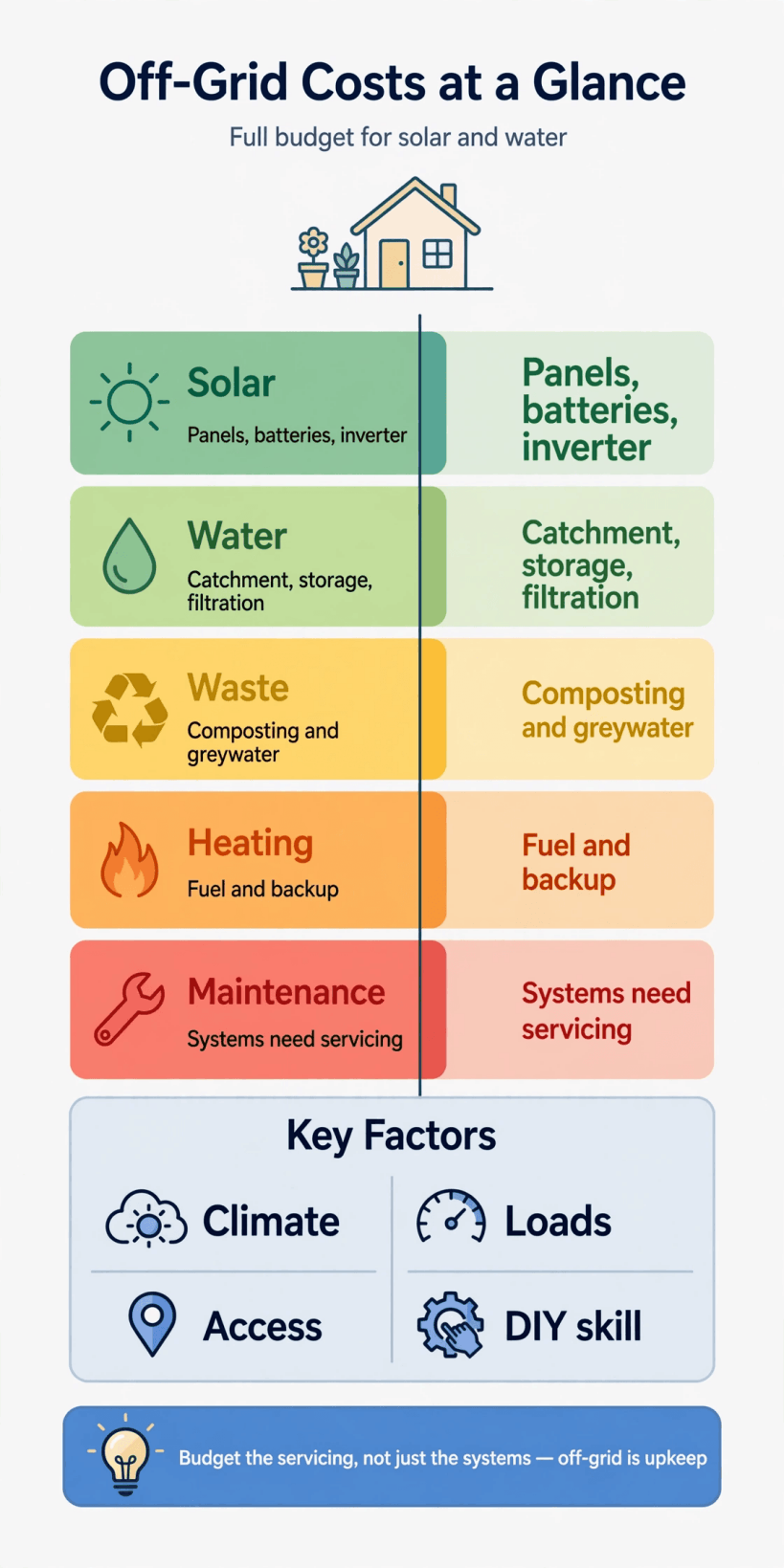
An off-grid tiny house budget is really two budgets wearing one coat: the price of generating and storing your own power, and the price of supplying and handling your own water. Neither behaves like a utility bill. Both are bought up front, as hardware, in sizes you must choose before you have lived a single winter in the house — which is why the honest way to budget an off grid tiny house cost breakdown is component by component, asking of each part not just what it costs, but what drives its cost up or down, and what undersizing it would cost you later.
So this guide names no prices as facts, because there are none that would survive your postcode, your climate and your appetite for hot showers. Instead it maps every major component — solar array, batteries, inverter and controls, water catchment, storage, filtration, waste systems, heating and backup — explains the drivers that move its price band, and shows where money is well spent, where it is wasted, and where it is quietly saved by using less in the first place. All ranges mentioned are qualitative and ILLUSTRATIVE: shapes of a budget, offered so you can replace them with local quotes for your exact system.
At a Glance: The Budget at a Glance
| Component | Typical Share of the Systems Budget (Illustrative) | Biggest Cost Driver |
|---|---|---|
| Battery storage | Often the largest single share | How many cloudy days of autonomy you demand |
| Solar array | A major share | Daily energy use and winter sun at your site |
| Inverter and controls | A moderate share | Peak loads: what must run at the same time |
| Water storage and delivery | A modest-to-moderate share | Tank size, burial and freeze protection |
| Filtration and treatment | A modest share, plus ongoing consumables | Source quality and how safe you must make it |
| Waste systems | A modest share | Composting vs septic-style routes and local rules |
| Heating and backup generation | A moderate share | Climate severity and fuel strategy |
| Installation, cabling and safety gear | The share everyone forgets | Distance, complexity and professional labour |
1. Start With the Load: The Budget Behind the Budget
Every component in this guide is sized by one number — how much energy and water the household actually uses each day — so the cheapest budget decision happens before any hardware: measure or honestly estimate the load. List the appliances, their draw and their daily hours; do the same for water, fixture by fixture. A tiny house helps enormously here — fewer lights, shorter pipe runs, one of everything — provided the occupants resist importing big-house habits: the electric oven, the tumble dryer and the hour-long shower are not appliances in an off-grid budget, they are system upgrades in disguise.
Designing the service package as one system, as in our overview of tiny house utilities: power, water and off-grid sewage, prevents the classic budgeting error of pricing components from different assumptions. Get the load list agreed and written down; every quote that follows should be priced against the same list, or the cheapest quote will simply be the one that quietly assumed less house.
2. Solar Array: Paying for Winter Sun
The array’s cost is driven, first, by how much energy it must harvest in the worst month, not the best — a system sized on summer sunshine is a summer system with a winter hobby of disappointing you. Latitude, shading, roof or ground mounting, panel efficiency and the tilt you can achieve all move the required array size, and therefore the price band, more than the badge on the panel does. Ground mounts cost more in structure and cabling but allow cleaning, snow clearing and future expansion; roof mounts save the structure and complicate everything else.
Hardware beyond the panels rides along: mounting rails, cabling runs, combiner and safety disconnects, and the charge control that matches array to batteries. Illustratively, the array is usually one of the two largest shares of the power budget. The same sizing logic that governs a small charging setup in how to charge an electric bike with off-grid solar power — daily need, worst-month sun, storage to bridge the gaps — governs the whole house; only the arithmetic grows.
3. Batteries: The Largest Share, Bought by the Day
Storage is where off-grid budgets are truly decided, because batteries are bought by the day of autonomy: how many sunless days the house should shrug off before anyone changes behaviour. Each added day of full autonomy adds a substantial block of cost, which is why honest load-cutting in section 1 is worth more here than any discount. Chemistry drives the rest of the band — modern lithium-based storage costs more up front and typically offers deeper usable capacity and longer service life; traditional lead-based banks cost less to buy and more to house, maintain and replace sooner. The price per usable, warranted year is the comparison that matters, not the ticket price.
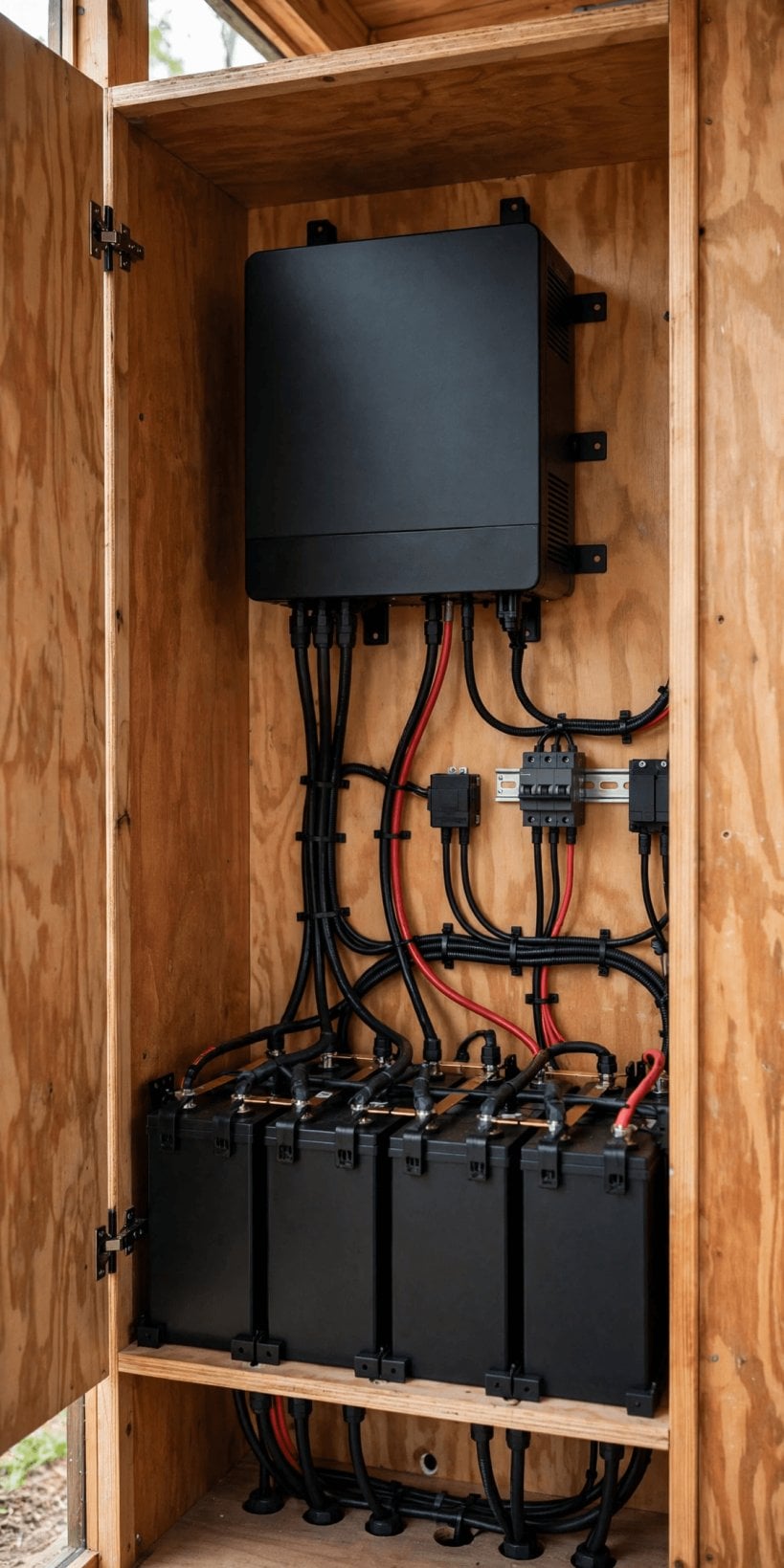
Budget also for the battery’s living conditions: a protected, temperature-sensible space, proper cabling and fusing, and monitoring so problems are seen in data before they are smelled in the air. Batteries are consumables on a long fuse — every off-grid budget should carry a replacement line from year one, in a reserve, so the biggest component in the system never becomes a surprise bill.
4. Inverter and Controls: Paying for Peaks
The inverter is priced by peaks, not averages: it must start and run the worst simultaneous combination the household will honestly demand — pump, kettle, tools, chargers — and motor loads ask brief multiples of their running draw. A unit sized to the average day fails the household at the exact moment everyone is home and busy. Quality also differentiates here in ways that matter: clean output for electronics, efficiency at the low loads where inverters spend most of their lives, and the control and monitoring layer that ties array, batteries and any backup source into one supervised system.
Illustratively this cluster sits in the moderate band of the power budget — smaller than storage, larger than everything except the array — and it is a poor place to economise blindly, because every other component’s work passes through it. Budget for the unphotogenic companions too: switchgear, breakers, surge protection and an electrician’s time where regulations or warranties ask for professional installation.
5. Water Catchment: The Roof Is the First Component
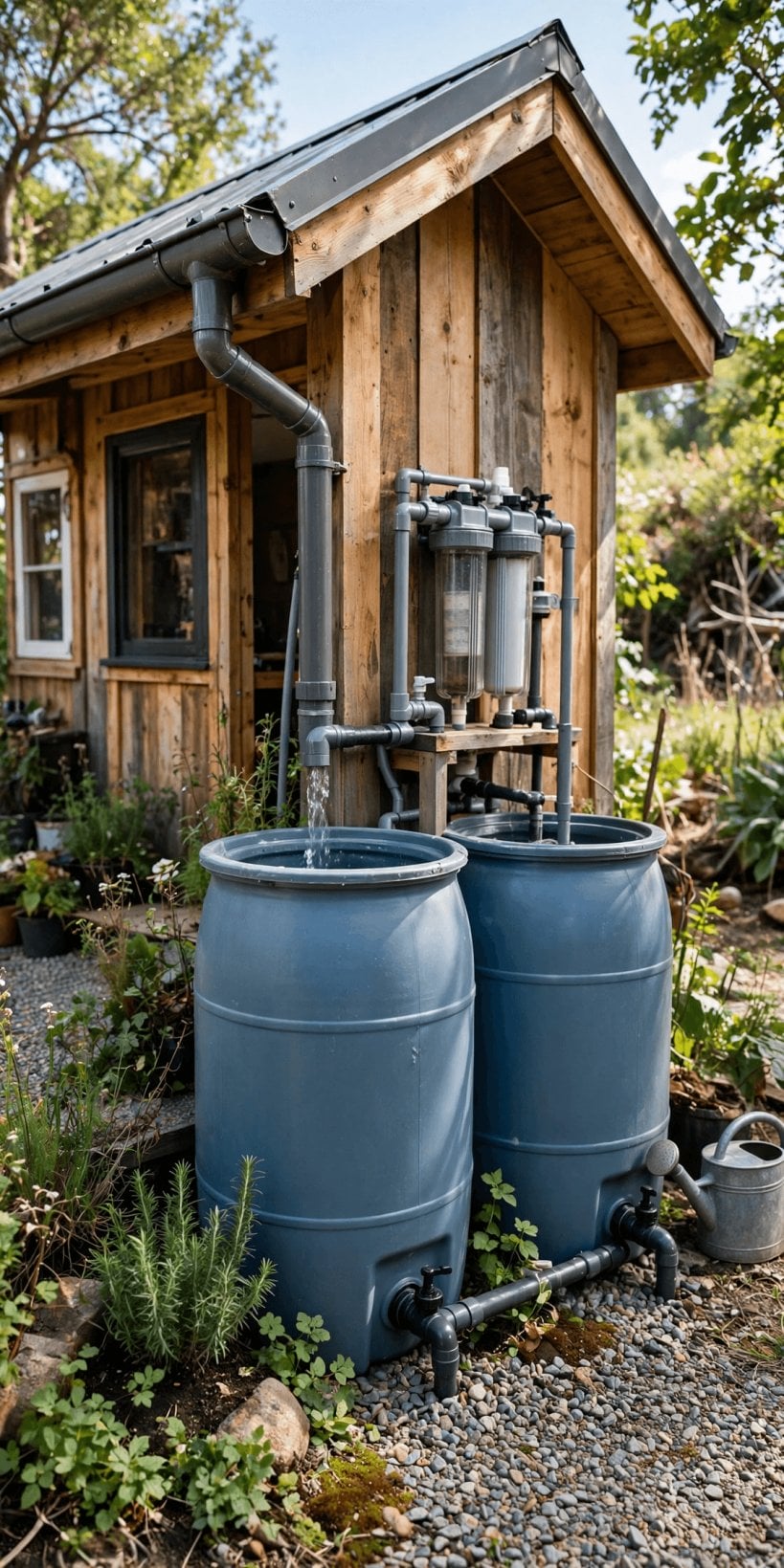
On the water side, catchment begins with the roof you already have: its area sets the harvest ceiling in your rainfall pattern, its material and condition set the cleaning and first-flush arrangements the system needs, and gutters, screens and diverters — individually modest parts — decide how much of what falls actually reaches the tank in usable condition. Costs here are driven by roof complexity, the distance from downpipe to storage, and how much debris and bird traffic the site provides.
The sizing logic of catchment and tanks is covered properly in rainwater harvesting systems: roof catchment and tank sizing, and the budgeting lesson matches the solar one: design for the dry spell, not the wet month. Where rainwater is a supplement rather than the whole supply — topped up by delivery or a well — the whole water budget steps down a band, which is why the supply strategy should be decided before any tank is priced.
6. Water Storage and Delivery: Tanks, Pumps and Freeze
Storage cost scales with volume and with ambition: an above-ground tank is the budget route; burying it, insulating it or splitting storage across vessels all raise the band in exchange for freeze protection, tidiness or resilience. Delivery adds its own stack — a pressure pump, an accumulator, pipework rated and routed for your winters, and taps and fittings that can be serviced without draining the house’s whole supply. In cold climates, freeze strategy is not an accessory line: heat trace, insulated housings and drain-down options are the difference between a system and a springtime repair project.
Illustratively, storage and delivery together form a modest-to-moderate share of the whole systems budget — smaller than the power side for most tiny builds, but with the same shape: the vessel is the visible cost, and the making-it-work hardware quietly doubles the line. Access for tank cleaning and pump replacement belongs in the plan and the budget both; sealed-in equipment is a future wall opening.
7. Filtration and Treatment: Safety Has Consumables
Making stored rainwater safe to drink is a chain, not a gadget: sediment filtration, finer filtration, and a disinfection stage, commonly ultraviolet, each with parts that wear out on a schedule. The capital cost is driven by flow rate and the quality of the incoming water; the running cost — cartridges, lamps, occasional testing — is driven by how much water the household pushes through the chain. Budget both, or the treatment line will be quietly paid later in neglected filter changes, which is payment in risk instead.
Local rules may have views on rainwater use indoors, and any system design should be checked against them before purchase, not after installation. Keep the treatment point sensibly placed — whole-house treatment costs more to buy and feed than treating the drinking and cooking line to the highest standard and the rest to a sound one, and that tiering decision is one of the few genuine savings in this entire guide.
8. Waste Systems: Blackwater and Greywater Choices
Waste is the budget line most shaped by rules and by philosophy. The routes range from composting toilets with managed greywater, through holding and pump-out arrangements, to septic-style systems where land and regulations allow — each with its own capital band, servicing pattern and approval story. The comparison in tiny house composting toilets: commercial vs DIY shows how wide the spread runs even within one route: a manufactured composting unit is a real appliance purchase; a well-built DIY system trades money for knowledge and upkeep.
Greywater handling — from the laundry, shower and sinks — needs its own honest line: filtration or settlement, distribution or disposal that local rules accept, and freeze-proof routing. Underestimate waste in the budget and the whole project’s approval, comfort and resale story suffers; it is the least glamorous system in the house and the one neighbours and inspectors care about most.
9. Heating and Backup: The Winter Insurance Layer
Heat is the load that can break a small power system, so off-grid tiny houses usually heat with fuel, not electricity — and the budget follows the fuel strategy. A small wood stove costs its appliance price plus flue, hearth and clearances done properly; bottled-gas or diesel heating trades appliance cost for fuel logistics; either way the comparison thinking in how to heat a tiny house: heating options compared should set the choice before the system is priced around it. Insulation is the silent partner in this line — the better the shell performs, as explored in how to insulate a tiny house: spray foam, rockwool and sheep’s wool, the smaller every winter system downstream can be.
Backup generation is the final layer: a modest generator, its fuel store, safe exhaust and transfer arrangements, bought as insurance for the worst week rather than as a second power station. Connectivity can ride this layer too — the communications options in off-grid internet: staying connected in the wilderness draw little power but should be on the load list from section 1, not discovered in winter.
10. Installation, Servicing and the Reserve: The Honest Total
The last budget layer is the one spreadsheets forget: delivery of heavy components to real sites, mounting and trenching, cabling and plumbing runs between components, professional installation where required, permits or inspections where they apply, and commissioning — the unglamorous hours that turn a pile of hardware into a system. Illustratively this layer regularly surprises first-time budgeters more than any component does, because it scales with distance, access and complexity rather than with catalogue prices.
Then the running budget: filter and lamp changes, battery monitoring and eventual replacement, pump seals, stove servicing, generator fuel and maintenance, tank cleaning and water testing. Set a servicing line and a replacement reserve from the first month — modest, regular, non-negotiable — and the off-grid systems stay what they were bought to be: independence with a maintenance schedule, rather than independence until the first big failure.
Final Considerations
A full off-grid budget is a chain of driven costs: the load drives the array, the array and your appetite for autonomy drive the batteries, the peaks drive the inverter, the dry spell drives the tank, and winter drives the heating and backup layer. Money spent shrinking the load — efficient appliances, honest habits, a well-insulated shell — is the only spending that reduces every other line at once, which is why it belongs at the top of the budget rather than the bottom.
Build your own total the way this guide is built: one component at a time, priced from local quotes against one written load list, with installation and servicing lines included and a reserve started from day one. The result will not match any generic figure — it will be better than that. It will be your number, for your house, on your land, in your climate: the only kind of budget an off-grid life can safely be planned on.




0 Comments