

Ask what a tiny house earns and you will usually be shown a gross number: a nightly rate multiplied by a hopeful number of nights, presented as if cleaning, platform fees, empty weekdays, insurance and repairs were rounding errors. Real tiny house rental income is smaller, lumpier and far more interesting than that — because once you subtract the honest cost stack and respect the seasons, what remains is a number you can actually plan a life or a loan around, even when it is less flattering than the headline.
One promise before any figures: this article does not present surveyed owner data, because we have not surveyed owners. Every range below is clearly labelled ILLUSTRATIVE — plausible example bands built from the drivers that move real results: location, season, occupancy, unit quality and costs. Your tiny house will land somewhere inside, above or below these bands for reasons this guide names one by one, and the most valuable skill it teaches is not believing a range — it is knowing how to build your own number from your own bookings, bills and calendar.
At a Glance: The Illustrative Numbers at a Glance
| Figure (Illustrative) | Example Range | What Moves It Most |
|---|---|---|
| Nightly rate — quiet rural setting | Lower band of local short-stay pricing | Distance to a draw: town, trail, water, events |
| Nightly rate — high-demand location | Upper band of local short-stay pricing | Scarcity, views, design quality, reviews |
| Occupancy — peak season | Roughly half to most nights booked | Season length, weekends, minimum stays |
| Occupancy — off season | A small fraction of nights booked | Weather, local demand, pricing discipline |
| Cost stack per booked night | Cleaning, platform fees, utilities, consumables | Turnover frequency and who cleans |
| Annual fixed costs | Insurance, land or pad costs, licences, upkeep | Ownership structure and jurisdiction |
| Net income | What survives after every line above | Occupancy minus costs — never rate alone |
1. How to Read These Numbers: Illustrative, Not Surveyed
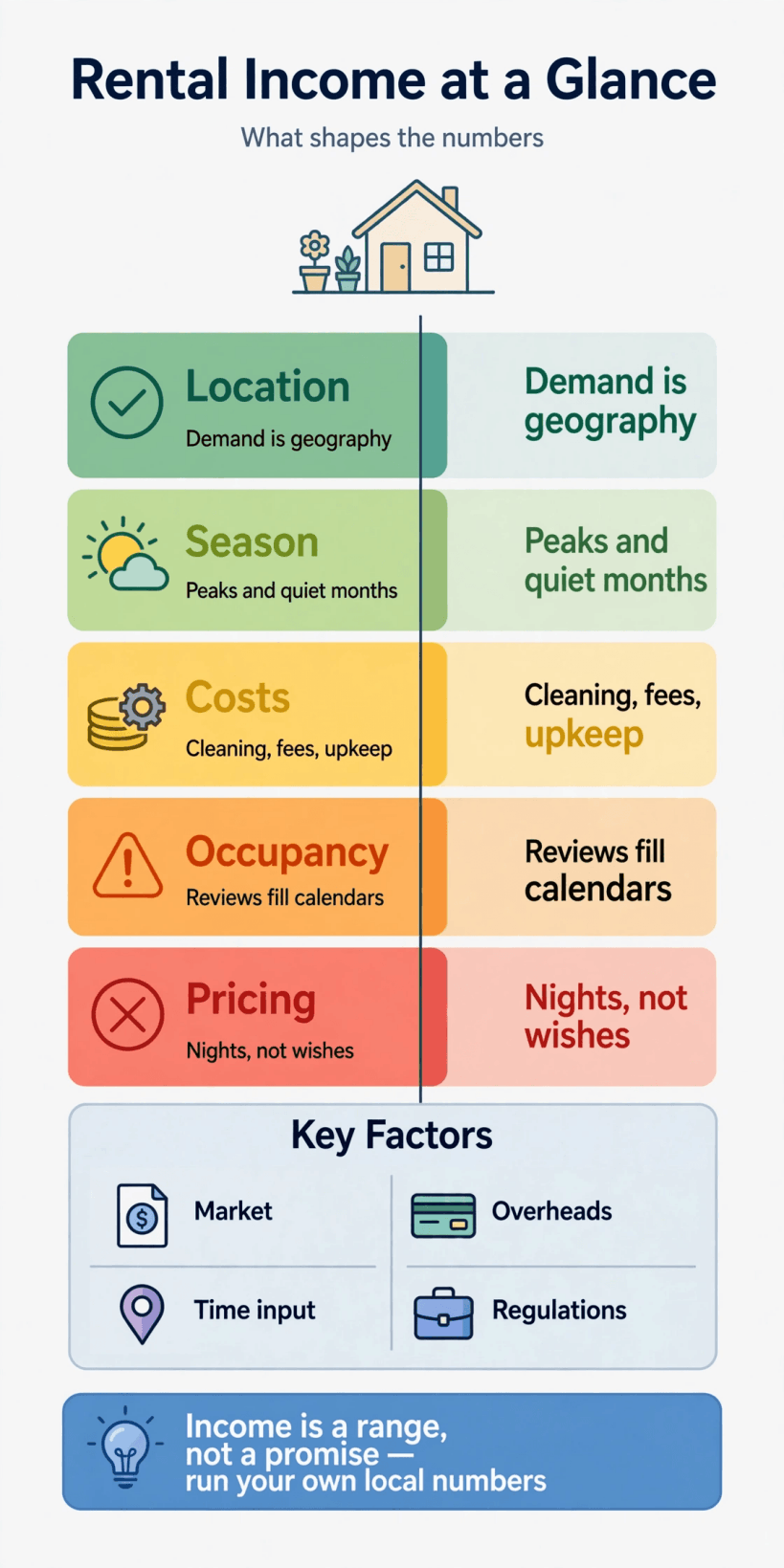
Start with the honesty rule that governs everything after this heading: an illustrative range is a thinking tool, not a promise and not a statistic. It shows the shape of the business — which lines are big, which are seasonal, which the owner controls — so a reader can replace every band with local quotes and real diary data. Anyone offering exact average earnings for tiny houses everywhere is selling something, because the spread between a lakeside unit an hour from a city and an identical unit in a quiet agricultural county is not a detail; it is most of the story.
The method used throughout is driver-first: name the factor, show which way it pushes the figure, and only then sketch the band it produces. That is also how careful owners talk about their own results — as outcomes of place, season and effort rather than as a property of the house itself. The hosting groundwork in how to rent a tiny house on Airbnb covers the operational side; this guide stays on the money, line by line.
2. Nightly Rate: What Actually Sets the Price of a Night
A nightly rate is set by the local market, not by the owner’s costs or hopes. The drivers, in rough order of force: the strength of the location’s draw (a recognised destination, a trailhead, a lake, a festival town), the scarcity of comparable stays nearby, the quality signals in the listing (design, photographs, reviews, amenities like a bath or a hot tub where permitted), and the calendar — the same house commands its highest band on peak weekends and must discount or accept emptiness midweek in the off season. Illustratively, owners in quiet rural areas often price in the lower band of their local short-stay market, while distinctive houses in high-demand locations price in the upper band; the honest way to find your band is to map ten comparable local listings and place your house among them by quality, not by optimism.
Two rate traps recur. Pricing to cover your costs produces a number the market never agreed to; and copying a famous listing’s rate imports its location, reviews and years of ranking into a house that has none of those yet. Rate is a hypothesis each season tests — adjust it in small steps, watch booking pace rather than raw views, and remember a slightly lower rate at strong occupancy usually out-earns a proud rate at weak occupancy, before costs are even counted.
3. Occupancy by Season: The Calendar Is the Business
Occupancy — the share of available nights actually booked — moves income more than any other single factor, and it is ruthlessly seasonal in most locations. Illustratively, a well-run unit in a seasonal destination might book roughly half to most of its peak-season nights, a moderate share in the shoulder months, and only a small fraction in the depths of the off season; annualised, that pattern often lands somewhere in the broad middle band between a quarter and a half of the year booked. Treat those bands as a sketch of the shape — a steep peak, soft shoulders, a quiet valley — and replace them with your area’s reality: local event calendars, school holidays, weather and the booking pace of comparable listings.
Owners influence occupancy at the margins that matter: minimum-stay settings that protect weekends without blocking longer stays, pricing that steps down for week-long bookings, a listing that sells the off season honestly (storm-watching, quiet desks, wood stoves) instead of pretending it is summer. The structural levers — land, siting, access — were decided earlier, which is why the land thinking in how to prepare land for a tiny house belongs in an income conversation: a house guests can reach, park at and enjoy in February earns in February.
4. Gross Income: Doing the Simple Sum Honestly
Gross income is nights booked multiplied by the average rate actually achieved — not the headline rate on the listing’s best weekend. Build it month by month, because annual averages hide the truth: twelve monthly lines, each with its own realistic rate and occupancy, summed. Illustratively, a house achieving a mid-band rate across a broad-middle occupancy year produces a gross that looks encouraging on a listing screenshot — and this is precisely the number that misleads, because not one cost has yet left the account. Gross is a starting point for arithmetic, never a description of earnings, and any projection that stops here is marketing.
Keep the two levers separate in your own tracking. Rate problems and occupancy problems have different cures — photography, amenities and positioning move rate; availability settings, minimum stays and seasonal offers move occupancy — and a single blended gross figure cannot tell you which lever is failing. Owners who keep a simple monthly record learn their own pattern within a year; that private data, not any article’s bands, becomes the real numbers from then on.
5. The Cost Stack, Part One: Cleaning, Fees and Consumables
Now the subtraction begins, with the costs that attach to every booking. Cleaning is usually the largest per-stay line: either a professional cleaner’s fee per turnover or the owner’s own hours, which are a cost whether or not money changes hands. Short stays multiply this line mercilessly — a one-night booking carries the same full clean as a five-night one — which is why cleaning fees and minimum stays exist. Platform fees take their percentage of every reservation, payment processing rides along, and consumables quietly accumulate: laundry, toiletries, coffee, firewood, replacement linen and the small breakages that hospitality provides free of charge.
Illustratively, per booked night, these turnover-linked costs commonly consume a noticeable slice of the rate — small on long stays, heavy on one-nighters — and owners who track them per stay rather than per month see the pattern clearly enough to set minimum stays with confidence. The design choices in the house itself can shrink this stack: the cleaning-ease thinking in our design coverage exists precisely because turnover minutes are money, repeated hundreds of times.
6. The Cost Stack, Part Two: Utilities, Upkeep and the Fixed Layer
Beneath the per-stay costs sits the fixed and semi-fixed layer, payable in empty months too: utilities standing charges and usage (heating a tiny house for a February guest costs more than the listing photo suggests), water and waste arrangements, insurance, any land lease or pad fee, property taxes where they apply, licences or local charges, accounting, and the upkeep fund — appliances, exterior finishes, decking, mattresses and the roof all age on a schedule indifferent to occupancy. The utility arrangements compared in tiny house utilities: power, water and off-grid sewage each carry their own cost profile, and off-grid systems trade bills for servicing and eventual component replacement.
The honest habit is a reserve: a fixed share of every booking moved aside for repairs and replacements, so a failed water heater is an inconvenience rather than a crisis. Illustratively, owners who reserve nothing report wonderful income until the year everything wears out at once. Fixed costs also explain why two houses with identical gross can net very differently — the one on leased land with premium insurance and a long utility run keeps less of every night it sells.
7. Insurance, Tax and the Costs of Being Legitimate
Short-stay renting changes a tiny house’s risk and legal profile, and the legitimate costs follow. Standard cover may not fit a house that hosts paying guests, sits on wheels, or stands on someone else’s land; the distinctions in tiny house insurance: wheels vs foundation decide which policies are even available, and proper cover priced for actual rental use is a real line in the budget, not an optional extra. Platform protection schemes are not a substitute for your own policy — they have scopes, exclusions and processes an owner should read before the first guest, not after the first claim.
Tax treatment likewise varies by jurisdiction and by how the rental is structured — income tax on the earnings, possible local occupancy or tourist taxes to collect and remit, and records to keep for all of it. This is accountant territory, and the fee for an hour of local advice is reliably cheaper than the cost of reconstructing a year of bookings later. Legitimacy costs money; illegitimacy costs more, later, with interest of several kinds.
8. Regulation Checks: Permission Is an Income Line Too
Every figure in this guide assumes the rental is allowed to exist. Short-stay rules are local: some jurisdictions welcome tiny house stays, some restrict short lets, some regulate them through permits, caps, registration or parking and servicing standards, and some prohibit the use outright on certain land. The zoning groundwork in zoning laws for tiny houses: how to talk to officials is therefore an income skill: an owner who confirms the position with the county or city before investing avoids the worst line in any budget — income that must stop.

Check, in writing where possible: whether short-stay rental of a tiny house is permitted on your land, whether a permit or registration is required, any night caps or occupancy rules, parking, waste and signage conditions, and what your insurance and any land lease say about paying guests. Rules also change; a yearly diary note to re-check them is part of running the business, and neighbours who were consulted early are a form of regulatory insurance no policy sells.
9. Net vs Gross: The Only Honest Headline
Net income is what remains after the full stack: turnover costs, platform and payment fees, utilities, the fixed layer, insurance, tax provisions and the repair reserve. Illustratively, across a typical year it is common for the honest net to land at a modest share of the gross — the exact fraction swung hard by stay length, occupancy and whether the owner self-cleans — and that is not a failure of the model; it is the model, shared by every small hospitality business on earth. The owner who quotes gross is describing revenue; the owner who plans on net is running a business.
Judge the net against the right yardsticks: the capital actually tied up in the house and site, the hours actually worked, and what the same money and time would earn elsewhere — the comparison discipline in how to finance a tiny house: loans and options applies to owning-for-rent as much as to buying. Some owners rationally accept a slim net because the house also serves as their own holiday place or a future home; that is a legitimate choice, provided it is chosen with open eyes rather than discovered.
10. Improving Your Own Numbers: The Levers That Work
Improvement, in order of usual return: protect occupancy first (availability, minimum-stay tuning, honest off-season offers, fast replies), then defend rate with quality signals (the design and sleep standards guests reward, professional-looking photographs, reviews answered graciously), then trim the stack (longer average stays to dilute cleaning, durable finishes to shrink the reserve’s workload, self-cleaning only while your hours are genuinely cheaper than a cleaner’s). Each lever is small; compounded across a season, they are the difference between the bottom and the middle of every illustrative band in this guide.
Track monthly, review seasonally, and change one thing at a time so you can see what worked. Within a year, your own record — your rates achieved, your occupancy by month, your true cost per stay — replaces every illustrative figure here, and your projections stop being guesses. That private dataset, built booking by booking, is what real numbers from owners actually are: not a headline to borrow, but a habit to copy.
Final Considerations
Tiny house rental income is real, and it is earned the unglamorous way: a market-set rate, a seasonal calendar respected rather than denied, a cost stack subtracted in full, permission confirmed, and a reserve that turns repairs into routine. The illustrative bands in this guide exist to show that shape honestly — use them to build your own monthly model from local comparables and quotes, then let your first year of bookings replace them entirely.
The owners who do well are rarely the ones with the most beautiful houses; they are the ones who know their numbers monthly, price and set stays by evidence, and treat net — never gross — as the headline. Build that habit before the first guest arrives, and the income question stops being a hope and becomes a report you can read.


0 Comments