
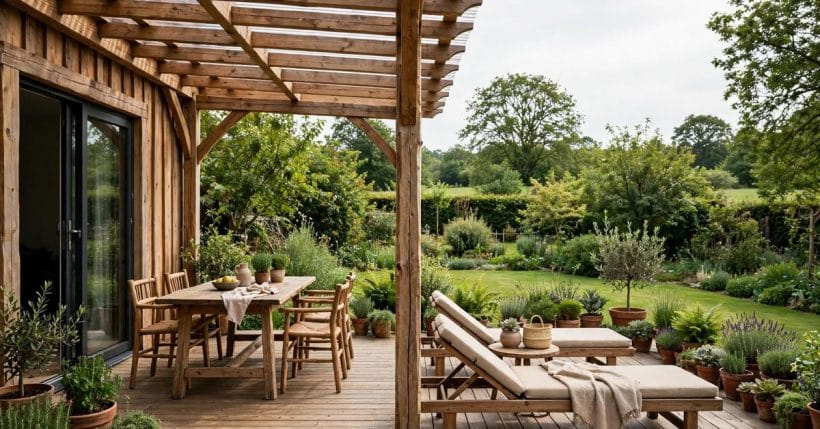
A partially covered deck is a small outdoor room with a deliberate split in it. Part of the deck sits beneath a cover, shaded and sheltered, while the rest stays open to the sky, sunny and breezy. That split is the whole idea. It lets one small deck serve two moods at once: a cool corner for eating and sitting through the heat of the day, and an open stretch for sunbathing, stargazing and drying off after a swim. Nothing about the arrangement is complicated, but getting the split right takes thought, because the cover, the open side and the furniture all have to work together.
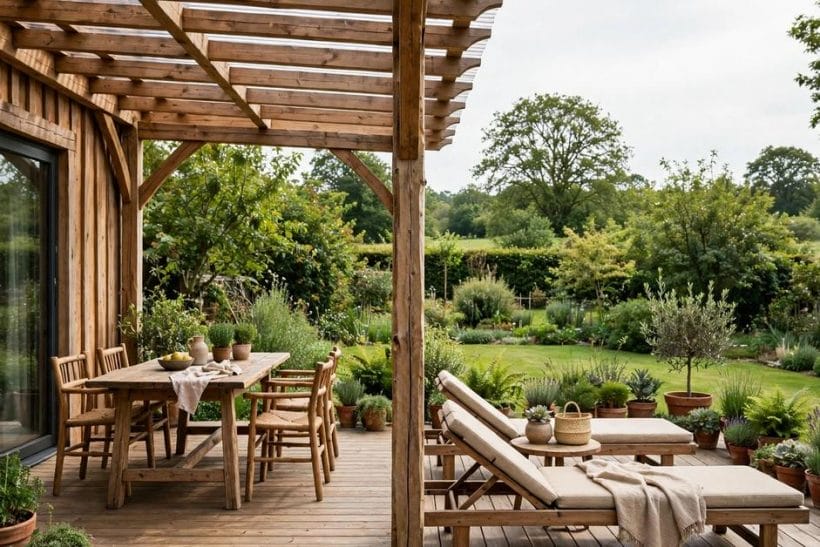
This gallery gathers small deck ideas with partial cover, looking at the partially covered deck on its own terms: how much of the deck to cover, where to put the cover, which materials suit the shaded side and the open side, how railings and planting frame the space, and how furniture can be arranged so both halves get used. It stays with the partial-cover form throughout. A deck that is lifted well above the ground is a different subject, covered in the raised deck ideas gallery, and a roof that reaches out over a patio belongs to the patio roof extension ideas gallery. Here, the deck itself stays close to the ground and the cover shades only part of it.
| Item | What it is |
|---|---|
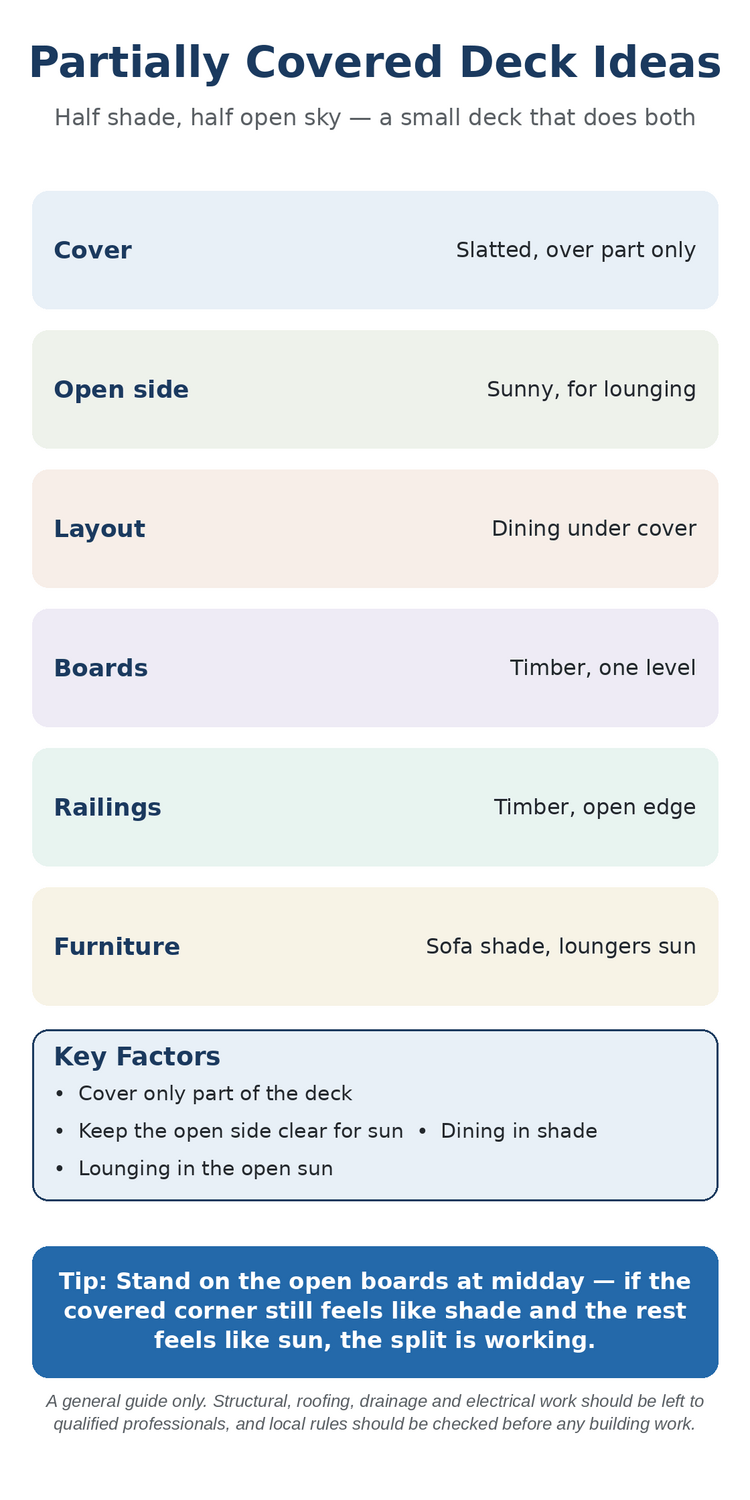
| Decide How Much of the Deck the Cover Should Shade | The first decision on a partially covered deck is also the most important one: how much shade is enough, and how much open sky is worth keeping. |
| Choose a Cover Shape That Suits a Small Deck | On a small deck, the cover should feel light. |
| Plan the Layout Around the Split | Layout on a partially covered deck starts with the line between shade and sun. |
| Pick Boards That Suit Shade and Sun Together | Deck boards on a partially covered deck live two lives at once. |
| Set the Cover Posts and Frame With Care | The posts and frame of a partial cover do more than hold the cover up: they shape how the deck feels. |
| Use Railings to Frame the Open Edge | Railings on a partially covered deck have a particular job: they frame the open side without closing it in. |
| Arrange Furniture for Shade and Sun | Furniture is where the partial-cover idea becomes daily life. |
| Work With Light, Shade and Breeze | Light is the living material of a partially covered deck. |
| Plant Around the Split | Planting is the soft edge of a partially covered deck, and it can do a great deal of work. |
| Keep Both Halves in Use Through the Seasons | A partially covered deck earns its keep across the seasons precisely because it offers two climates. |
1. Decide How Much of the Deck the Cover Should Shade
The first decision on a partially covered deck is also the most important one: how much shade is enough, and how much open sky is worth keeping. Cover too little and the shaded corner feels like an afterthought, too cramped for a table and chairs. Cover too much and the deck loses the sunny half that makes the split worthwhile, turning into a covered deck with a strip of sun at the edge. A useful way to think about it is by use rather than by area. Put the cover where people sit longest and need shade most, which is usually the dining spot and the main seating corner, and leave the lounging and sunbathing area open.
Watch how the sun moves across the deck before settling the split. Morning light, midday glare and late afternoon sun all fall on different parts of the deck, and the shaded corner should be shaded when it is actually in use. A dining corner that is lovely at breakfast can be unbearable at lunch if the cover sits on the wrong side. Spend time on the deck at different hours, notice where shade already falls from the house or a tree, and let the cover fill the gap rather than duplicating shade that is already there. The open side, meanwhile, should catch sun at the time of day when loungers are most likely to be used.
It also helps to think about rain, not just sun. A partial cover will not keep the whole deck dry, and it should not be expected to. The point of the split is choice, not total shelter. The covered corner stays usable in a light shower and keeps cushions and table settings drier, while the open side is accepted as a fair-weather space. Planning for that honestly, with furniture that can cope with a wetting and cushions that can be brought under cover, keeps the deck pleasant rather than disappointing. For background on deck layouts in general, the tiny house deck ideas gallery surveys small deck arrangements of many kinds.
2. Choose a Cover Shape That Suits a Small Deck
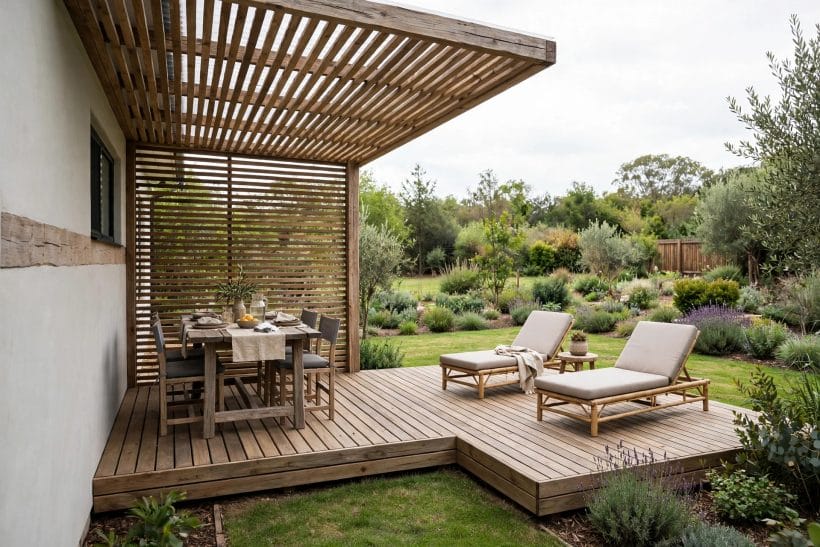
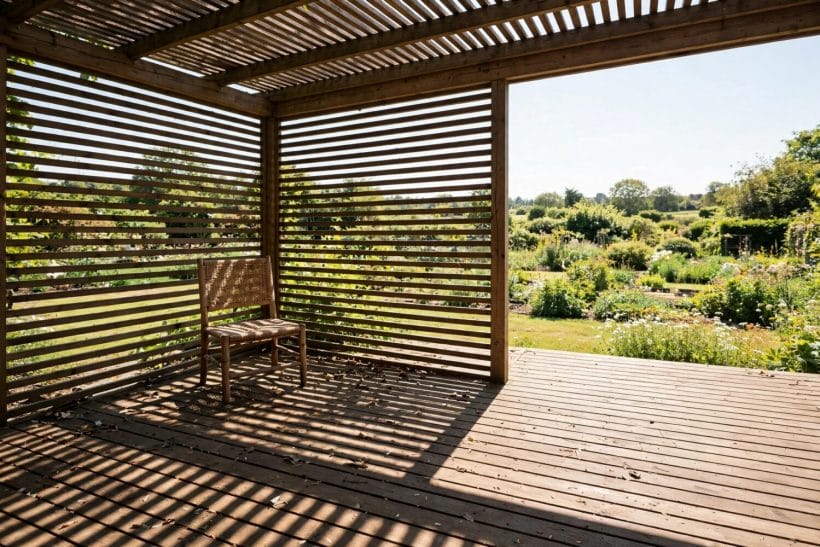
On a small deck, the cover should feel light. A heavy, solid roof over part of a compact deck can dominate the whole space, making the open side feel like a leftover rather than a partner. Slatted covers, open pergola frames and light lattice panels suit the partial-cover form well, because they give shade without shutting out the sky entirely. Sunlight filters through the slats in stripes, the air keeps moving, and the covered corner still feels outdoors. The cover reads as a frame for the seating beneath it rather than as a ceiling over the deck.
Shape matters as much as material. A cover that runs along the house wall suits a dining corner tucked against the house, while a cover that reaches out over a corner of the deck can shelter a seating nook at the far end. A straight run of cover is simplest and easiest to keep in proportion on a small deck, while an L-shaped arrangement can follow a corner layout. Whatever the shape, the cover should end cleanly, with its edge aligned to something sensible: the edge of the dining area, a change in the deck boards, or a post that also marks the start of the open side. A cover that stops halfway across a seating group, shading half a table, will irritate every time it is used.
Fixing a cover to a house wall or setting posts into a deck are structural jobs, and they should be left to qualified professionals, along with any roofing, drainage or electrical work the cover involves. A homeowner can choose the shape and the look, but the fixing, the load and the weathering details are professional work. Getting that division right keeps the project safe and keeps the finished deck looking settled rather than improvised.
3. Plan the Layout Around the Split
Layout on a partially covered deck starts with the line between shade and sun. That line is the organising feature of the whole deck, so furniture should respect it rather than straddle it. The dining table belongs fully under the cover, with room to pull chairs out without stepping into the sun. The lounge chairs belong fully in the open, with room to stretch out and catch the sun. A rug, a planter or a low bench can mark the boundary between the two zones, giving the eye a resting point where shade gives way to sky.
Movement matters on a small deck, where every step counts. Keep a clear path from the house door to the open side, so nobody has to squeeze past the dining table to reach a lounger. Keep the route to the garden clear too, since the open side usually leads towards the lawn or the planting. If the deck has steps down to the garden, the open side is the natural place for them, where the deck already feels connected to the outdoors. A layout that forces people to cross the dining corner to get anywhere will feel cramped, however generous the deck itself may be.
Small decks reward furniture that earns its place. A dining set that seats the household comfortably, a lounge chair or two, and a small side table for drinks will usually fill a compact deck quite happily. Adding more pieces for the sake of it only clutters the split and blurs the line between shade and sun. Choose fewer pieces, place them decisively on one side of the line or the other, and leave enough open boards to walk on comfortably. The deck will feel larger for the restraint.
4. Pick Boards That Suit Shade and Sun Together
Deck boards on a partially covered deck live two lives at once. Boards under the cover stay drier and more shaded, while boards in the open take the full sun, the rain and the weather. That difference shows over time in colour and wear, so it is worth choosing boards with the change in mind. Timber boards weather gracefully and can be kept looking settled with regular care, while low-maintenance boards hold their colour more evenly across the split. Either choice can work well, provided the difference between the shaded boards and the sunny boards is expected rather than a surprise.
Running the boards in one direction across the whole deck helps the split feel like one deck rather than two separate surfaces. A change of board direction at the cover line can look deliberate and smart, but it can also chop a small deck into fragments. A single direction, with the cover line marked by a post or a planter rather than a joint, usually keeps a compact deck calm. Board colour should be chosen in daylight on the open side, since that is where the colour will be seen most starkly, and checked again under the cover, where the same boards will read darker.
Care differs between the two halves as well. The shaded boards may stay damp longer after rain and gather leaves under the cover, while the open boards dry quickly but take more sun. A simple routine of sweeping, clearing leaves from beneath the cover, and washing the boards keeps both halves looking alike. Any sealing, staining or weatherproofing work is best discussed with a professional, who can advise on products suited to boards that live partly in shade and partly in sun.
5. Set the Cover Posts and Frame With Care
The posts and frame of a partial cover do more than hold the cover up: they shape how the deck feels. Slim posts keep a small deck feeling open, while chunky posts can make the covered corner feel like a separate room. Posts placed at the corners of the dining area frame the seating neatly, and posts aligned with the house wall keep the structure looking intentional. Where a post lands in the middle of a walking route, it will be bumped into and cursed, so post positions deserve as much thought as the cover itself.
Colour and finish help the frame sit quietly. Timber posts that match the deck boards tie the cover to the deck, while painted posts that match the house trim tie it to the house. Either approach works, but mixing too many finishes on a small deck can look restless. Keep the palette tight: deck boards, cover frame and railings in a small family of tones, with plants and cushions providing the colour. The cover should feel like part of the deck, not an addition bolted on afterwards.
As with any structure attached to a house or standing on a deck, the posts, footings and fixings are professional work. The frame must stand up to wind and weather, and its fixings must suit the deck and the ground beneath it. A professional can also advise on drainage around the posts, so water does not collect where the cover meets the deck. Homeowners can enjoy choosing the look, while the structure itself is left in qualified hands.
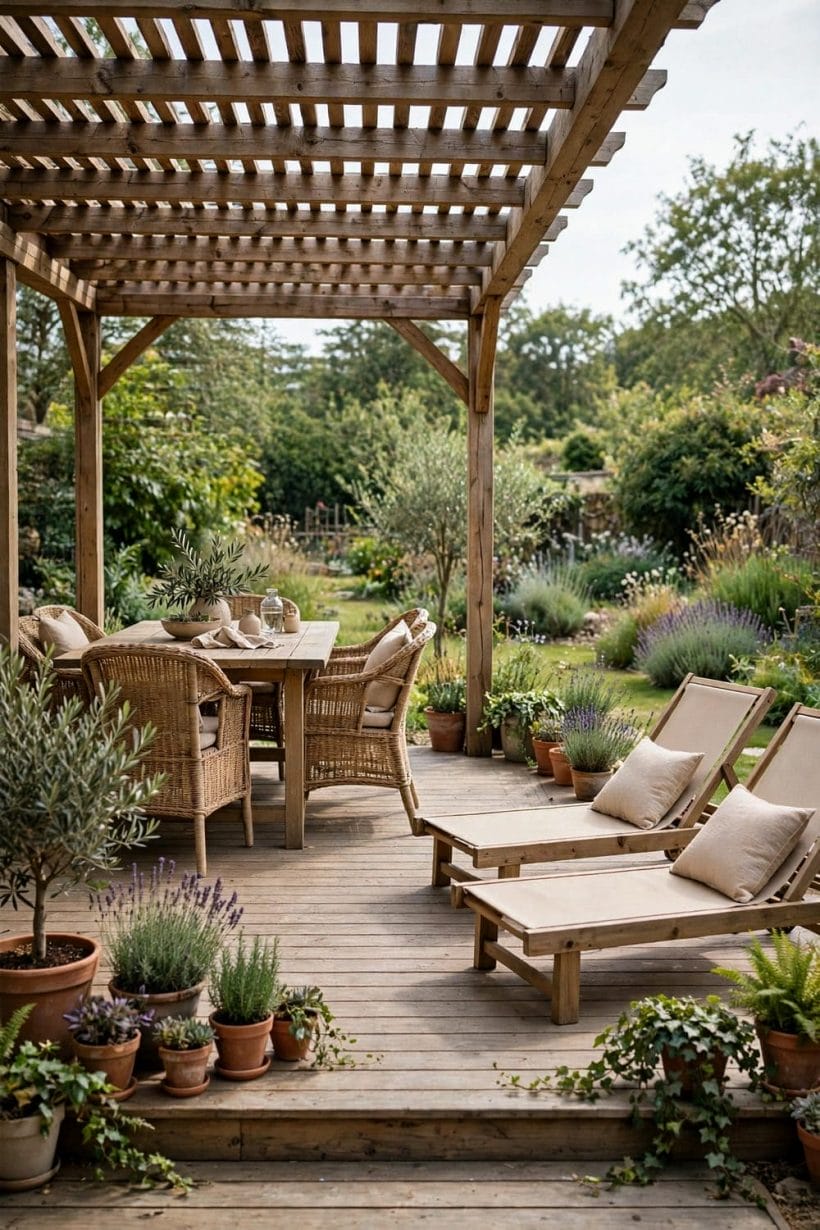
6. Use Railings to Frame the Open Edge
Railings on a partially covered deck have a particular job: they frame the open side without closing it in. The open half of the deck is valuable precisely because it feels open, so a railing that blocks the view or shuts out the breeze defeats its purpose. Slim balusters, a simple timber handrail, or a low rail that keeps the sightline clear all suit the form. The railing should say where the deck ends and the garden begins, while still letting the garden feel close.
The railing can also help mark the split between shade and sun. A run of railing along the open edge, stopping where the cover begins, gives the covered corner a sense of enclosure on one side and leaves the sunny side open on the other. Planters set along the railing soften the edge and give the open side a garden feel, while a gate or a gap in the railing marks the way down to the lawn. On a small deck, the railing is one of the most visible elements from the garden, so it is worth choosing a style that looks good from outside as well as from the deck itself.
Railing height, strength and fixing are safety matters, and local rules may set requirements for them. A professional should be consulted on the railing design, especially where the deck sits above the ground at all, and on the fixing of posts and balusters. A railing that looks right but is not properly fixed is not a finished job. With the structure sound, the homeowner can focus on the look: timber tones, slim profiles, and planting that makes the edge feel generous.
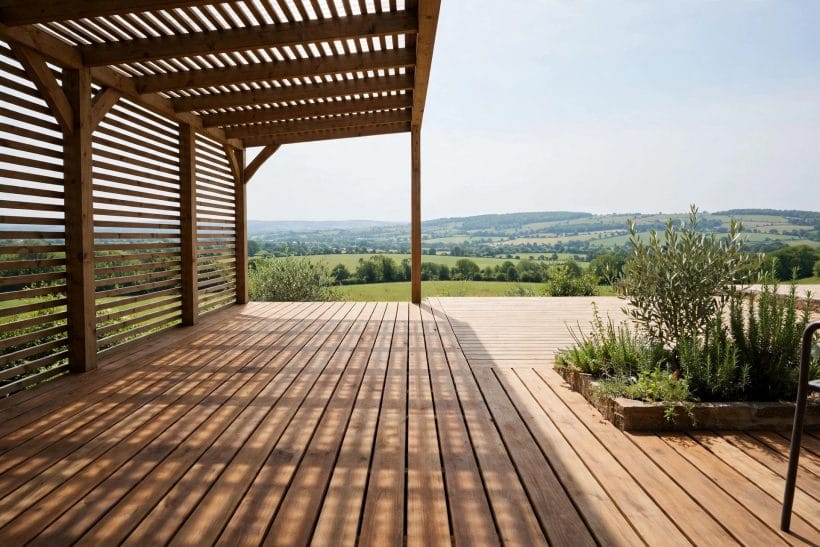
7. Arrange Furniture for Shade and Sun
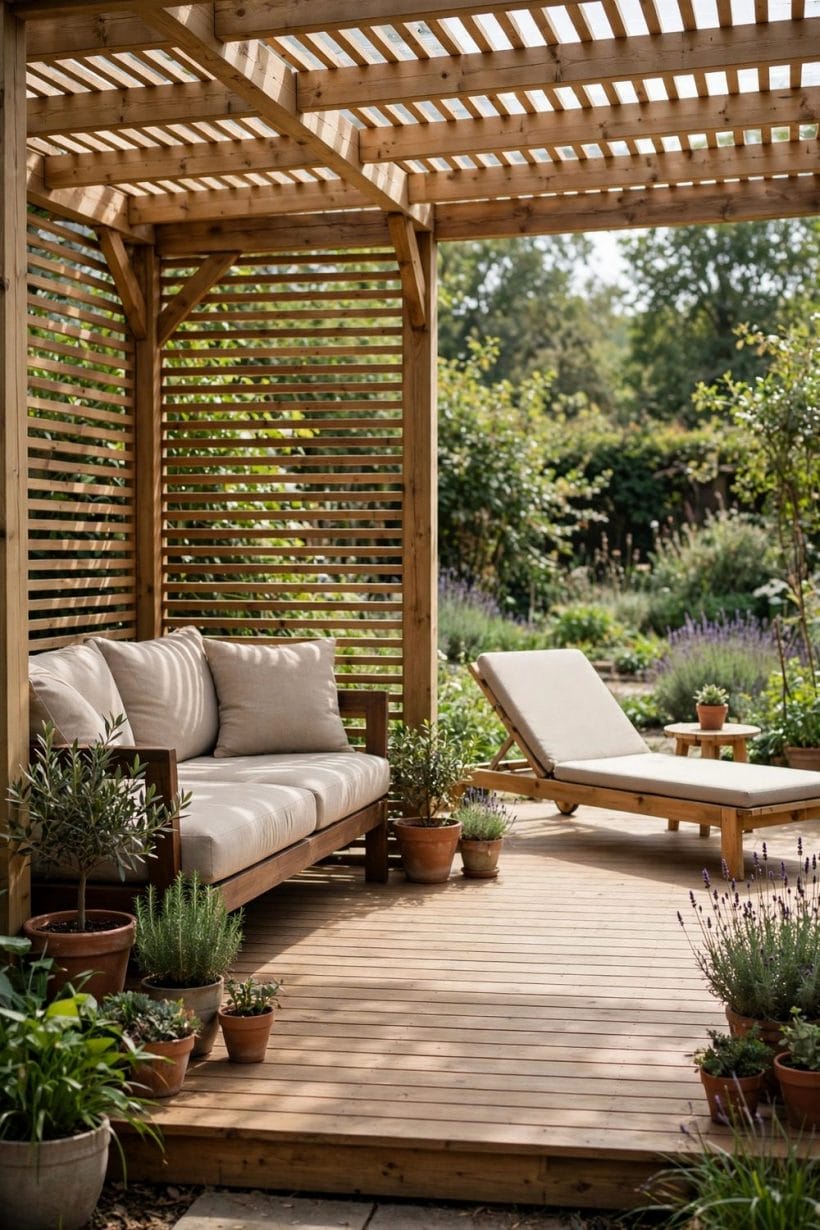
Furniture is where the partial-cover idea becomes daily life. The shaded corner is the natural home for the dining table, where meals can stretch out without glare, and for a sofa or deep chairs where people sit and talk. The open side belongs to loungers, sun chairs and the odd side table for a book and a drink. Arranging furniture this way means both halves are used for what they do best, rather than one half sitting empty while everyone crowds into the other.
Cushions and fabrics deserve thought, since they live in two climates on one deck. Cushions under the cover stay drier and keep their colour longer, while cushions left in the open will fade and wet through. Keeping the soft furnishings under cover, or bringing them in when the deck is not in use, preserves them and keeps the deck looking cared for. Loungers, which are built for sun and weather, can stay out, while the sofa cushions earn a sheltered spot. A storage bench under the cover can hold the cushions neatly and double as extra seating.
Scale is everything on a small deck. A sofa that fits the covered corner with room to walk around it will feel generous, while one that fills the corner wall to wall will feel like a squeeze. Measure the covered area honestly, allow room to pull chairs out and walk past, and choose furniture that fits the space rather than the wish. The tiny house patio ideas gallery offers useful comparisons for furnishing small outdoor spaces, and the tiny house exterior ideas gallery shows how decks sit within the wider look of a small home.
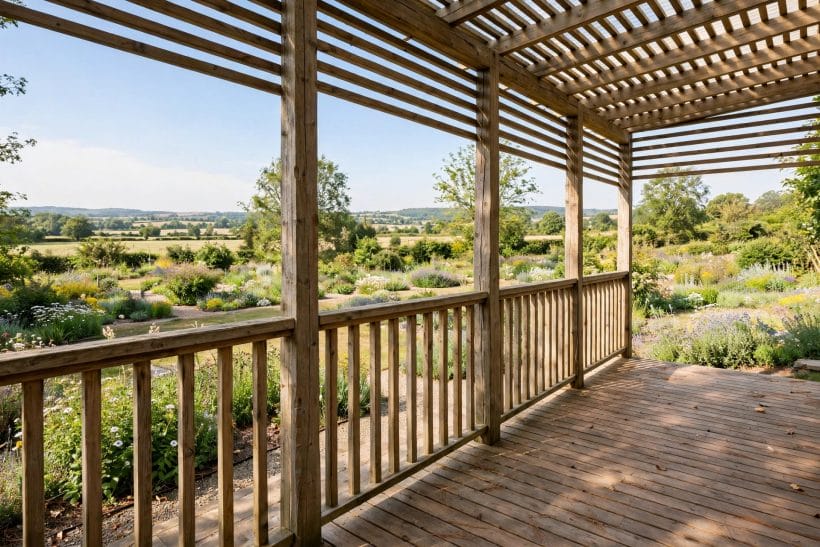
8. Work With Light, Shade and Breeze
Light is the living material of a partially covered deck. Under a slatted cover, sunlight arrives in stripes that move across the boards through the day, giving the shaded corner a dappled, changing character. In the open, the light is full and direct. That contrast is the pleasure of the form, and it can be enjoyed deliberately: breakfast in the striped shade, an afternoon lounger in full sun, an evening meal as the stripes lengthen and soften. Noticing how light moves across the deck is part of learning to use it well.
Breeze matters as much as light. A partial cover that blocks the prevailing breeze can make the shaded corner feel stuffy, while an open side that catches the wind can feel exposed. Slatted covers and open sides both let air move, which is one reason they suit the form so well. Planting can help too: a hedge or a screen of tall pots on the windy side takes the edge off the breeze without shutting the deck in, and climbers on the cover frame give shade and shelter while keeping the air flowing. The aim is a deck that feels comfortable in a range of weather, not just on a still, sunny day.
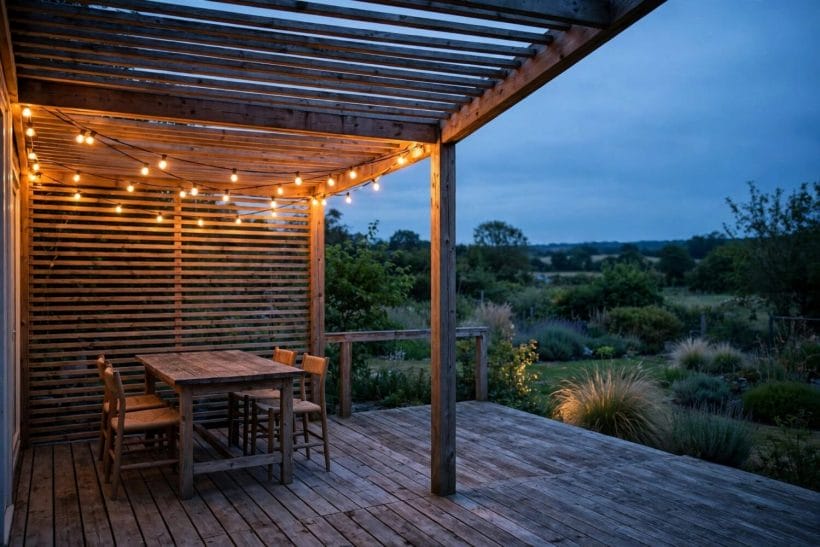
Evening light transforms the deck again. String lights under the cover give the dining corner a warm glow, while the open side darkens into a place for watching the sky. Lighting under a cover is electrical work and should be installed by a qualified professional, with fittings suited to outdoor use. With the lighting settled, the deck gains an evening life that a fully open deck or a fully covered deck would not offer in quite the same way.
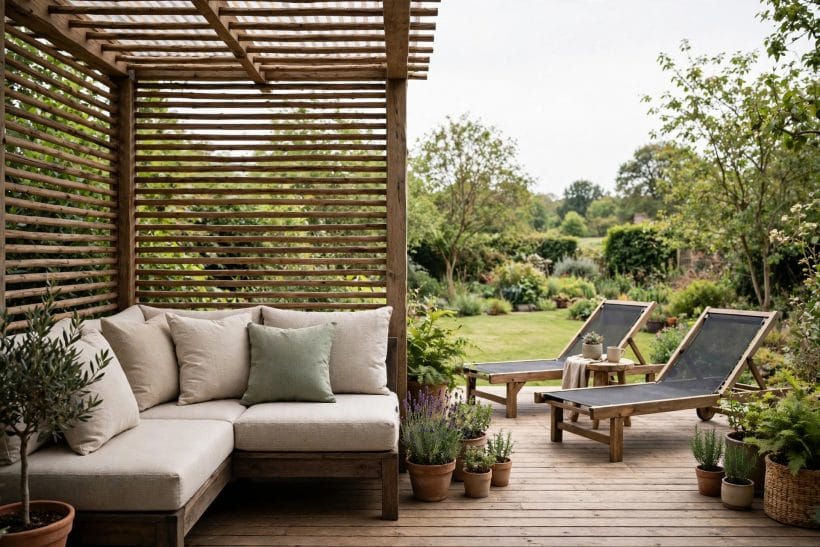
9. Plant Around the Split
Planting is the soft edge of a partially covered deck, and it can do a great deal of work. Pots along the cover posts soften the structure and tie it to the garden. A planter at the end of the cover marks where shade gives way to sun. Trailing plants from pots on the cover frame give the shaded corner a green ceiling without the weight of a solid roof. On the open side, pots and low planting keep the sunny deck feeling like a garden room rather than a bare platform.
Choose plants for the two climates the deck creates. Shade-tolerant plants suit the covered corner, where direct sun is limited, while sun-loving plants thrive on the open side. Pots make this easy, since they can be moved as the seasons change and as the gardener learns which spots suit which plants. Herbs near the dining corner are a practical pleasure, within reach of the cook, while scented plants near the loungers make the sunny side a nicer place to lie. The tiny house garden ideas gallery has planting arrangements that suit small outdoor spaces, and the backyard landscaping ideas gallery shows how a deck can sit within a wider garden design.
Watering and care should be planned with the split in mind. Pots under the cover will need watering by hand, since rain may not reach them, while pots on the open side will catch rain but dry out faster in sun. A watering can kept by the door and a routine that covers both halves keeps the planting even. Over time, the planting will grow into the structure, softening the posts and the railing until the deck feels less built and more grown, which is exactly the character a small garden deck should have.
10. Keep Both Halves in Use Through the Seasons
A partially covered deck earns its keep across the seasons precisely because it offers two climates. In warm weather, the shaded corner is the refuge and the open side is the sun trap. In cooler weather, the open side catches whatever sun there is, while the covered corner shelters a morning coffee from dew and light rain. In autumn, the cover keeps falling leaves off the dining area, and the open side stays a place to stand and look at the garden. A deck with only one climate cannot offer that range.
Seasonal care keeps both halves ready. Sweeping leaves from under the cover, clearing the open boards after storms, and checking that water drains freely from both halves will keep the deck sound. Cushions come under cover in wet spells, loungers stay out while the sun lasts, and the cover frame gets a look-over for wear where it meets the deck and the house. Small, regular attention beats a yearly overhaul, and it keeps the deck inviting rather than a chore to rescue each spring.
Finally, use the deck as it was planned. Eat under the cover, lounge in the open, and move between the two as the day changes. A partially covered deck is at its best when both halves are lived in, not when one half is treated as the real deck and the other as an afterthought. The split is not a compromise between a covered deck and an open one: it is a form in its own right, and a small deck shaped around it can feel larger, livelier and more useful than a deck twice its size with only one climate to offer.
Final Considerations
Before building or altering a partially covered deck, it is worth standing on the deck at different times of day and picturing the split in place. That is the heart of small deck ideas with partial cover: shade and sun on one small deck, planned together. Where will the shade fall when meals are eaten, and where will the sun fall when loungers are out? Which corner feels sheltered, and which feels open? Those observations, more than any catalogue image, will settle where the cover should sit and how much of the deck it should shade. A cover placed with that knowledge will feel inevitable once built.
Structural, roofing, drainage and electrical work should always be left to qualified professionals, and local rules should be checked before any building work begins. Railing safety, cover fixings and drainage around posts are not details to improvise. With the structure in professional hands, the homeowner can enjoy the choices that make the deck personal: the boards, the furniture, the planting, and the daily habit of moving between shade and sun.
A partially covered deck is a modest idea with a generous payoff. It gives a small outdoor space two characters, two climates and two ways of spending time outside, without the weight of a full roof or the exposure of a fully open deck. Planned around its split, furnished for shade and sun alike, and planted to soften its edges, it becomes the part of the home that gets used most, from the first coffee of the day to the last evening light.


0 Comments