

The patio gazebo is the garden’s compromise between the open terrace and the summer house: a roof for the shower, shade for the noon, walls implied rather than built, and a room’s worth of life held between a handful of posts. Done well, it becomes the most-used seat in the property. Done carelessly, it becomes an expensive place to store the barbecue.
This collection works the patio version specifically: choosing the structure, placing it on the hard ground it shares with the terrace, defending it against weather, furnishing its wall-less room, planting it into the garden and keeping it standing. It sits inside the wider outdoor cluster gathered at the patio ideas pillar, to which it links as that collection’s roofed member.
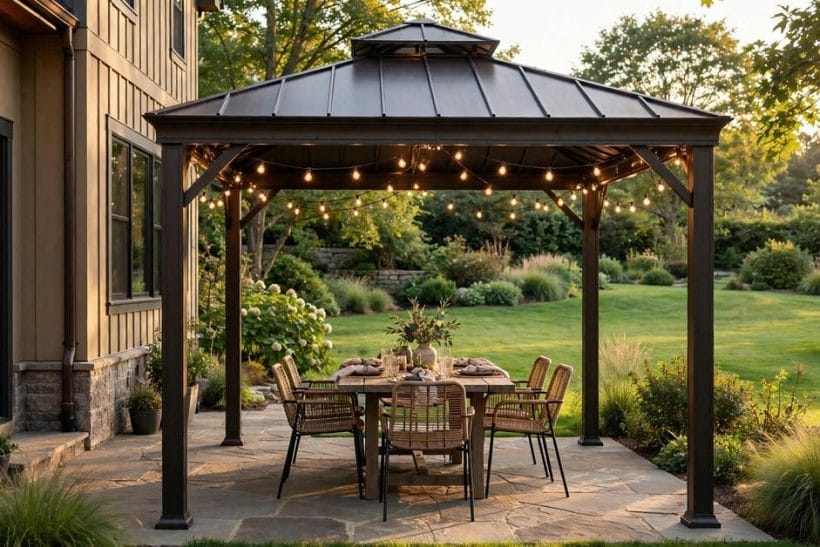
1. Patio with a Gazebo Ideas at a Glance
The patio gazebo is a roofed garden structure standing on a patio — round, hexagonal or square — whose attributes are structure (posts, roof, fixings), placement (sun, shelter, route from the house), weather defence (pitch, curtains, panels, heat) and furnishing (a primary life, held between the posts). It is kin to, and distinct from, the open pergola: the gazebo’s roof is its whole point. Settle those four attributes and the seventy-five choices below fall into place.
| Question | Short answer |
|---|---|
| Gazebo or pergola — what’s the difference? | A gazebo has a full roof; a pergola has open rafters for climbers. Shelter versus dapple. |
| What size should it be? | The smallest that holds your furniture group with walking room at the edges. |
| Where on the patio should it stand? | Evening sun, wind shelter, view faced, and a short lit route from the kitchen door. |
| Timber or metal? | Timber for presence and paintability; metal for slim lines and low upkeep. |
| Does it need permission? | Rules vary by place, size and boundary distance — check locally before building. |
| Can a small patio hold one? | Yes — corner placement, honest sizing, and the terrace’s other life kept clear. |
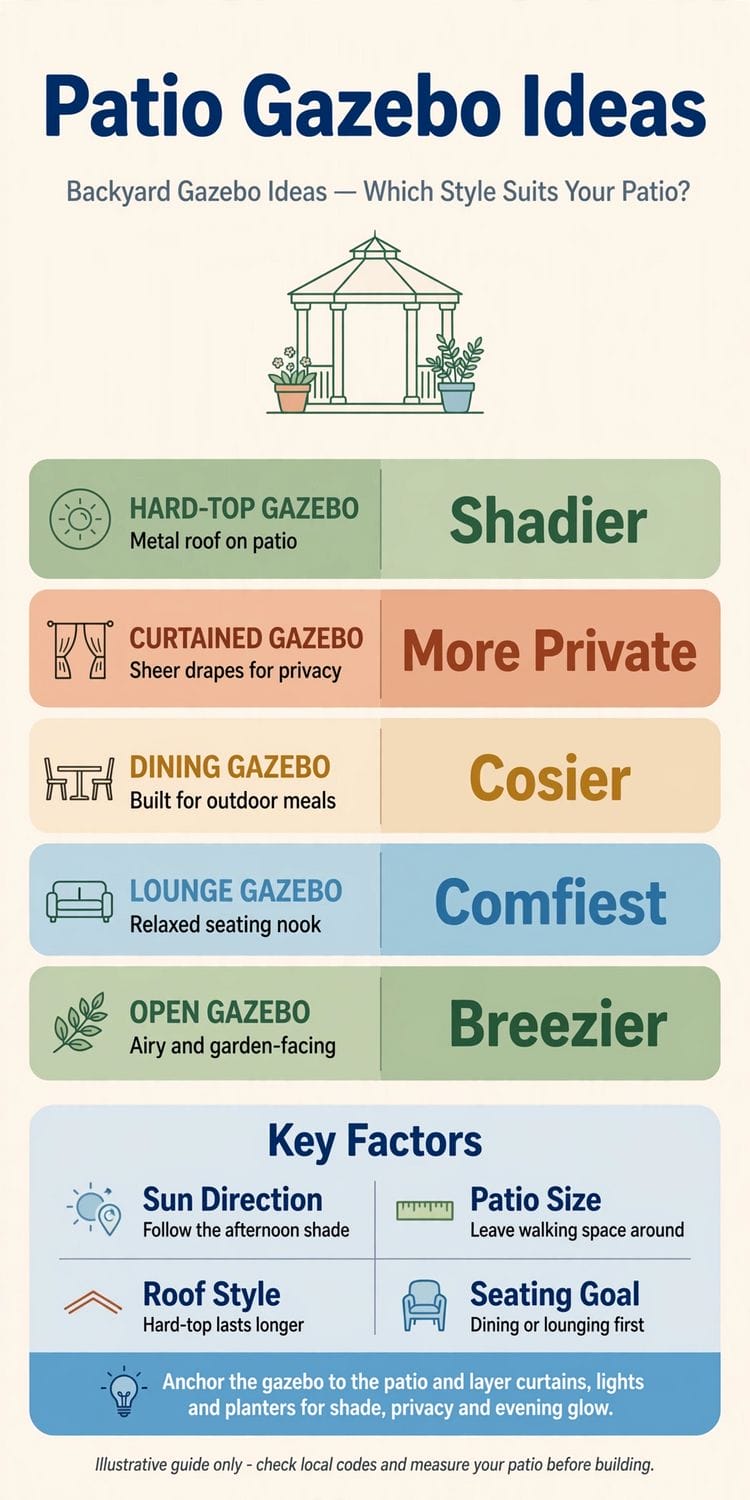
2. Choosing the Gazebo: Size, Shape and Structure
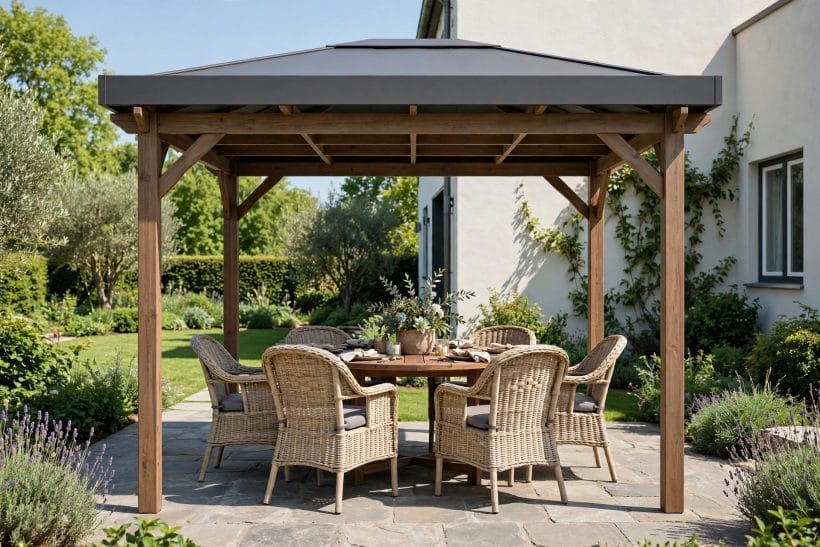
A gazebo is a small building pretending to be garden furniture, and it should be chosen with a building’s seriousness: size for the life it will hold, a shape that suits the patio, and a structure honest about the weather it will meet. This section is the choosing.
1. Size it for the furniture, not the catalogue
Decide the furniture group first — dining for six, a sofa set, two loungers and a table — then choose the smallest gazebo that holds it with walking room at the edges.
2. Round, hexagonal or square: match the patio’s geometry
Round and many-sided gazebos suit informal gardens and corner placements, where their geometry softens the patio’s edges. Square and rectangular structures suit terraces against a house wall and hold rectangular dining tables honestly.
3. Timber for warmth, metal for slimness
Timber posts give a gazebo its garden-room presence and take paint or stain in any direction the scheme moves; powder-coated metal gives slimmer lines, less upkeep and a more contemporary read.
4. Open sides, half walls or full shelter
The classic gazebo is open on all sides beneath its roof; half-height rails or panels add definition and a place to lean furniture; full side panels make a garden room that sheds weather.
5. A hard roof or a soft canopy
Shingles, metal sheets and polycarbonate make permanent roofs that shed rain audibly and shade completely; fabric canopies are lighter, cheaper and removable for winter, but they flap, fade and age fastest.
6. Kit, bespoke or self-built
Kits arrive with the joinery solved and the instructions written; bespoke structures fit odd patios and strong opinions; self-builds suit confident hands and simple shapes. All three routes are respectable.
7. The floor question: on the patio or of the patio
A gazebo standing on the existing patio is the simplest build and the easiest to remove; a raised deck floor under it defines the space and keeps furniture feet dry, at the price of a step.
8. Count the posts before you fall in love
Every post is a view interrupted and a furniture route blocked. Structures that span further between posts keep the inside open for tables and loungers; more, slimmer posts suit benches built around the perimeter.
9. Style: garden classic, modern pavilion or rustic shelter
Name the style before buying: the white-painted classic with a cupola, the flat-roofed modern pavilion, the rough-timber rustic shelter.
10. Buy the structure for your worst weather
Wind lift, snow load and driving rain are the gazebo’s real examiners, and they vary by garden, not by brochure. Anchoring, bracing and roof fixing should be specified for the site’s honest worst, with local advice where the weather is serious.
11. Decide its permanence honestly
A gazebo can be a fixture for decades or a stage of the garden’s life. Permanent structures earn foundations, services and the good roof; temporary ones earn lighter fixings and an exit plan.
3. Placing It on the Patio: Position and Ground
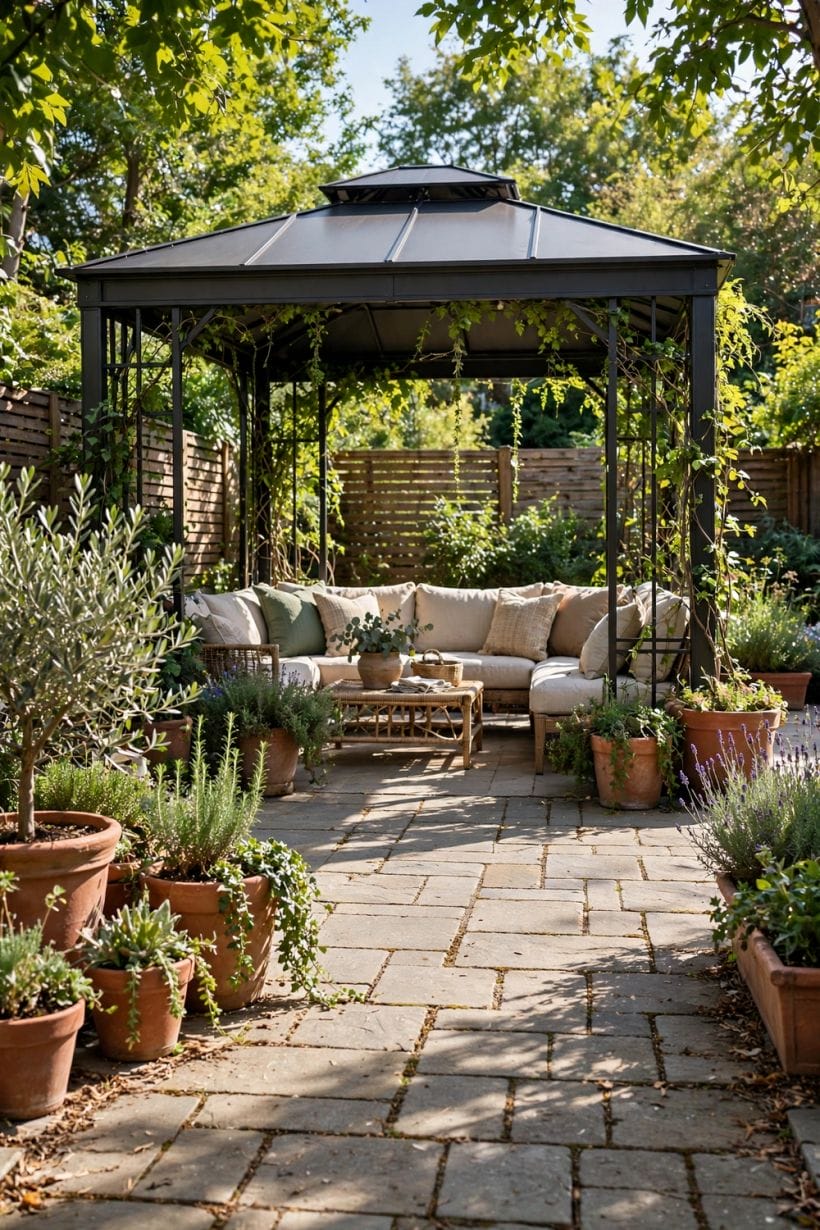
Where the gazebo stands decides how much it is used: ten steps too far, in the wrong wind or facing a fence, and the finest structure becomes garden sculpture. Placement is about sun path, shelter, views and the journey from the kitchen door.
12. Chase the evening sun, dodge the noon glare
Most patio life happens in the evening, so place the gazebo where the day’s last light lands — or, in hot gardens, where it pointedly doesn’t.
13. Shelter from the prevailing wind
A gazebo in the wind’s path loses its candles, its napkins and eventually its guests.
14. Face the view, not the boundary
Turn the gazebo’s open face toward the garden’s best view — the longest lawn, the border at its peak, the borrowed trees beyond the fence. Structures placed by leftover space rather than by view get used for storage.
15. The kitchen-door test
Food, drinks and cushions travel from the house, so the route matters: a short, level, lit path from the kitchen or living door to the gazebo is used daily; a long trek across wet grass is used for photographs.
16. A corner placement for small patios
Tucking the gazebo into the patio’s corner keeps the main terrace open for everything else and gives the structure two boundaries as shelter and backdrop.
17. Centre stage for the grand terrace
A large patio can carry the gazebo at its centre or its far end as the composition’s destination: paths lead to it, planting frames it, and the terrace reads as a journey with a roofed reward.
18. Level ground or an honest platform
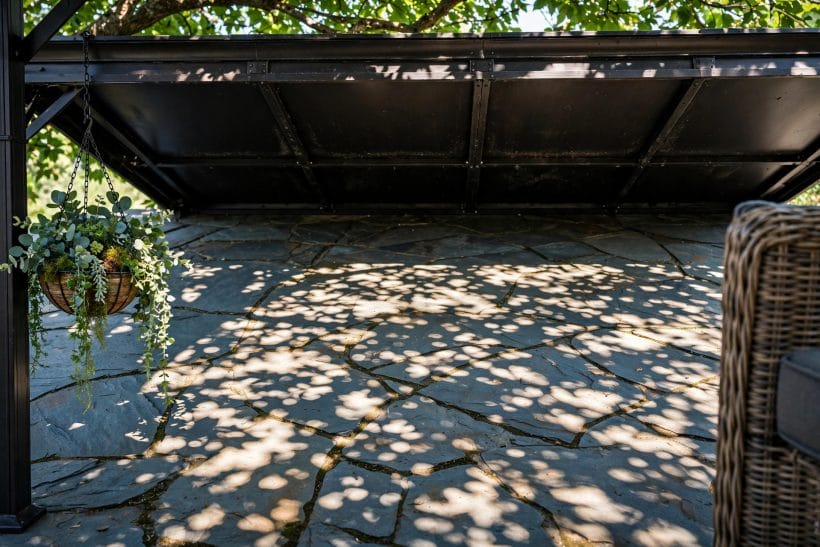
Gazebos forgive many things but not a rocking leg. The standing ground must be level and firm — the patio itself, a compacted and slabbed pad, or a framed deck.
19. Drainage: keep the floor out of the puddle
Patios shed water somewhere, and a gazebo placed in the shed’s path gets a moat. Check where rain runs and pools before fixing the position; a slight regrade, a channel or a raised floor solves it.
20. Near the house or deep in the garden
A gazebo near the house shares the house’s services — light, power, the loo, the fridge — and gets used on whim. One deep in the garden is a destination: quieter, more private, more deliberate.
21. Power and water decided at placement time
If the gazebo will ever want lighting, a heater, music or a water feature, the time to trench a cable or a pipe is before the base is laid and the path is finished.
22. Neighbours, boundaries and good manners
A roofed structure near a boundary raises questions of overlooking, shade thrown on a neighbour’s garden and simple courtesy. Set it in from the fence, keep its height neighbourly, and — where the garden is small — let a conversation precede the concrete.
4. Roofs, Sides and Weather Protection
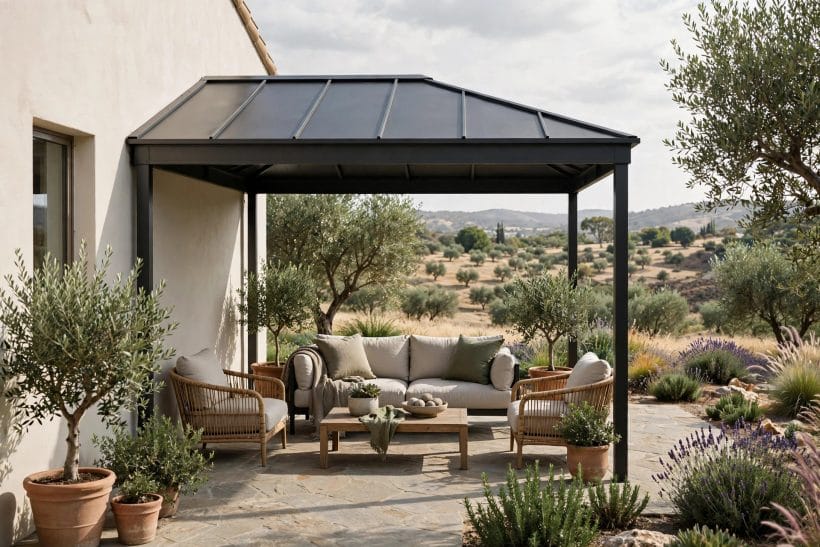
A gazebo earns its keep in imperfect weather: the shower that would end the barbecue, the breeze that would end the evening, the noon sun that would end lunch. Its roof and sides are therefore working parts, not decoration, and they should be specified like it.
23. The roof pitch decides the rain behaviour
A pitched roof sheds water to its edges and away from the sitters; too shallow a pitch drips at the seams and ponds on fabric. Gutters or a drip edge at the low side keep the cascade off the entrance.
24. Cupolas and vents let the heat out
Warm air gathers at a gazebo’s crown, and the classic cupola or a simple vented ridge lets it escape, which is why traditional gazebos wear their little hats.
25. Curtains: the flexible wall
Outdoor curtains on rails or rods give a gazebo adjustable sides — open for the view, drawn for the wind, the low sun or the neighbours.
26. Roll-down blinds for the exposed side
Where one side takes the weather, a clear or woven roll-down blind defends it without walling the structure in. Blinds also extend the season at both ends, holding a little warmth on spring and autumn evenings.
27. Half-panels where the wind lives
Solid or slatted half-panels on the prevailing-weather side stop the draught at sitting height while keeping the open feel above. Slats ventilate better and look lighter; solid panels double as a back for benches and a mount for shelves and hooks.
28. Mosquito and midge netting, honestly fitted
Where biting insects own the evening, fine netting panels or curtains turn the gazebo from beautiful to usable. The netting must seal at the edges and the floor line, or it merely slows the invasion.
29. A heater extends the shoulders of the year
A radiant heater mounted high and central — used with the manufacturer’s clearances respected — stretches the gazebo’s season by weeks at both ends. It heats people, not air, so it works even in an open structure.
30. Rain noise: the roof’s soundtrack
Metal roofs drum, fabric whispers, shingles hush. Under a summer downpour the gazebo becomes a listening room, and households divide by whether they find the drumming delightful or maddening.
31. Snow and the winter posture
In snow country the roof’s load rating and the structure’s winter posture matter: fabric canopies come off and store dry; hard roofs stay and carry. Decide in autumn, not at the first snowfall, and clear heavy accumulations rather than testing the brochure’s optimism.
32. Shade cloth for the hottest gardens
Where the sun is the main enemy, a shade-cloth layer under or over the roof cuts glare and heat while keeping the air moving — often more comfortable than a sealed roof at noon.
33. Gutter the drip away from the door
Every gazebo has a door side, and the roof will try to water it. A gutter, a drip chain or a simple regrade of the pitch keeps the entrance dry underfoot.
5. Furnishing Inside: Seating, Tables and Dining
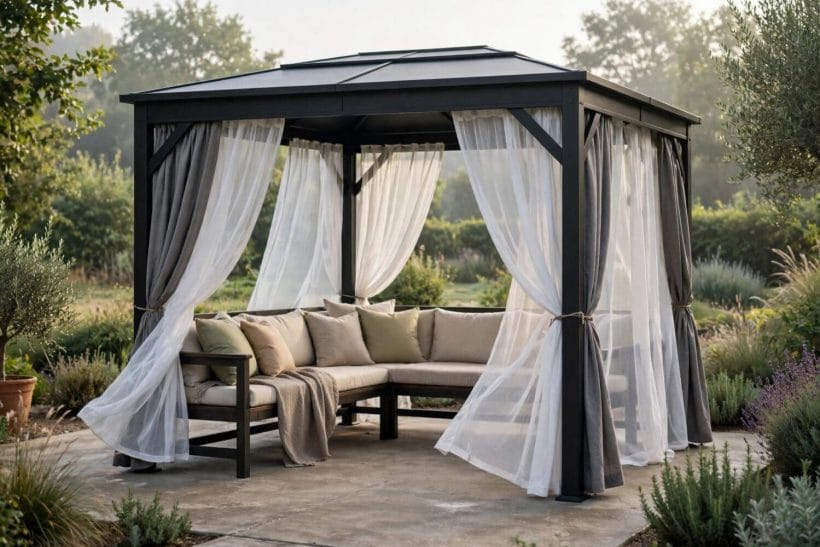
Inside its posts, a gazebo is a room with no walls to help it, so the furniture must make the arrangement by itself: a centre, a perimeter, and routes between. These are the furnishing decisions that turn a roof on posts into the garden’s favourite room.
34. Choose the room’s primary life first
Dining room, sitting room or daybed retreat — a gazebo can be any, and can swap with work, but it furnishes best when one life leads.
35. Dining under the roof: the table decides
A dining gazebo is its table: sized for the household’s real guest count, not its fantasies, with chairs that pull out within the posts and a route for serving that does not squeeze past knees.
36. Sofas and low chairs for the sitting version
Outdoor sofas and deep chairs around a low table make the gazebo a second living room, best facing the garden’s view or each other across a rug.
37. Built-in perimeter benches use every post
Benches fixed between the posts claim the edges and free the centre, seat crowds without chair Tetris, and give the structure its shipshape, built feel.
38. A daybed or swing seat as the indulgence
One piece of pure pleasure — a hanging swing seat, a daybed with a mattress, a hammock chair — gives the gazebo its personality and its queue of volunteers.
39. The outdoor rug defines the floor
A woven outdoor rug under the furniture group turns boards or slabs into a room’s floor: it sets the centre, warms the feet and catches the eye’s idea of where the room is.
40. Storage inside: a bench that swallows
Cushions, throws, games and the candle jars all need a dry home within the structure or beside it.
41. A drinks station changes the hosting
A narrow side table or trolley for drinks, glasses and the water jug removes the evening’s endless kitchen trips and gives the gazebo its self-sufficiency.
42. Furniture weight: movable by one person
Gazebo furniture gets rearranged by season, by party and by the sun’s movement, so every piece should be movable by one person without heroics.
43. Textiles soften the structure’s geometry
Cushions, throws and a table runner take the engineering out of a gazebo’s look and put the garden party in.
44. Leave one corner uncommitted
Resist furnishing every post-to-post span. One open corner — for the plant of the moment, the child’s chair, the dog’s bed, the telescope — keeps the room adaptable and stops it feeling like a furniture showroom under a roof.
6. Shade, Planting and the Garden Connection
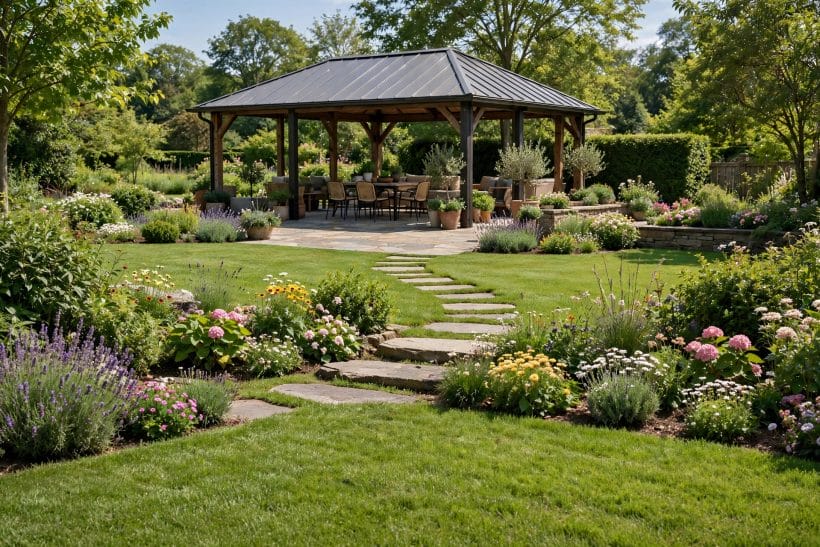
A gazebo that ignores its garden is a shed with good PR. Planting ties the structure to the ground it stands on — softening its posts, scenting its air, extending its shade — and the patio beneath it gathers the whole composition. The dedicated gazebo collection is linked here, where the two posts divide their territory.
45. Climbers for the posts: the living walls
A rose, a jasmine or a clematis trained up one or two posts gives the gazebo its perfume and its dappled second roof in a few seasons.
46. This post’s place beside the gazebo collection
The wider gazebo ideas collection treats the structure on its own — siting it across lawns, poolsides and garden rooms. This post’s subject is narrower and more specific: the gazebo married to a patio, where the hard surface, the house’s doors and the terrace’s other furniture all share the plan. Read together, the two divide the topic without repeating it.
47. Pots at the posts soften the engineering
A large pot at each post’s foot — olive, bay, a grass, a seasonal bedding show — breaks the line where structure meets slab and makes the gazebo feel planted rather than parked.
48. Shade planting for the hot side
A small tree or a tall shrub planted on the sun’s side of the gazebo extends its shade beyond the roofline and cools the approach.
49. Scent at sitting height
Plant for the nose at the height of a seated guest: jasmine at a post, lavender at the entrance path, a potted lemon verbena or scented geranium on the side table.
50. The pergola distinction, kept clear
A gazebo is a roofed, usually round or many-sided structure; a pergola is an open-raftered frame for climbers. The neighbours in this cluster keep the distinction: the patio with a pergola ideas collection covers the open-frame version, and choosing between the two is a real decision — full shade and rain shelter here, dappled shade and sky there. Mixed up, the two words produce the wrong structure.
51. Borders around the base hide the workings
A planted border lapping the patio’s edge where the gazebo stands hides fixings, softens the slab’s end and gives the structure a garden to rise from.
52. Grass and meadow moods for informal gardens
In relaxed gardens, let planting lean in: grasses brushing the posts, self-seeders in the slab joints, a mown path rather than a paved one to the door.
53. Container citrus and herbs for the cook’s gazebo
Where the gazebo hosts dining, pots of herbs and a container citrus at its edge put the garnish within arm’s reach and scent the table.
54. Keep the view’s frame planted, not blocked
The planting around a view-facing gazebo should frame the prospect like a picture’s mount: low in the sightline, taller at the edges. The commonest planting mistake is a shrub planted small at the view’s centre that becomes, in five years, the view.
55. Seasonal colour rotated in pots
Because the structure is permanent, its colour story can be seasonal: spring bulbs in the post pots, summer bedding, autumn grasses and seedheads, winter evergreen structure with lights.
7. Light, Evenings and the Seasons
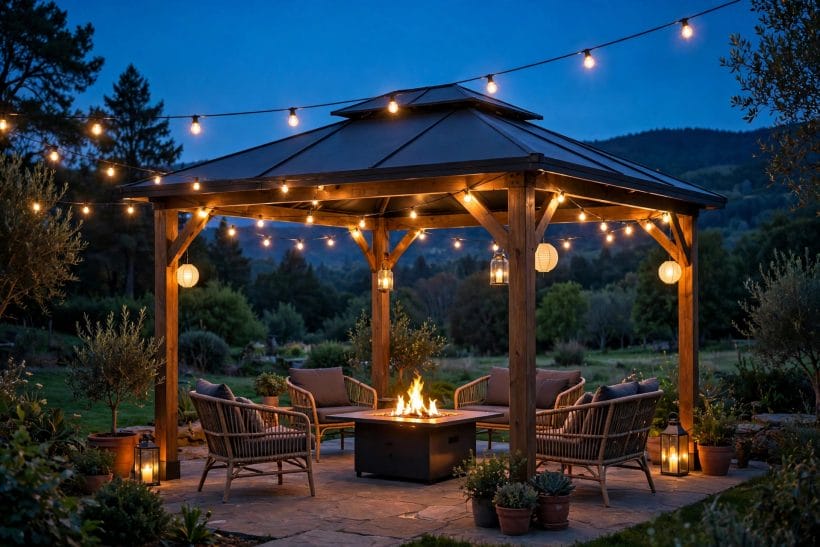
A gazebo’s best hours are the day’s edges — the long evening, the early coffee — and its best seasons are the shoulders. Lighting and small comforts decide whether the structure is used for the summer’s whole length or only its postcard afternoons.
56. String lights: the instant ceiling of light
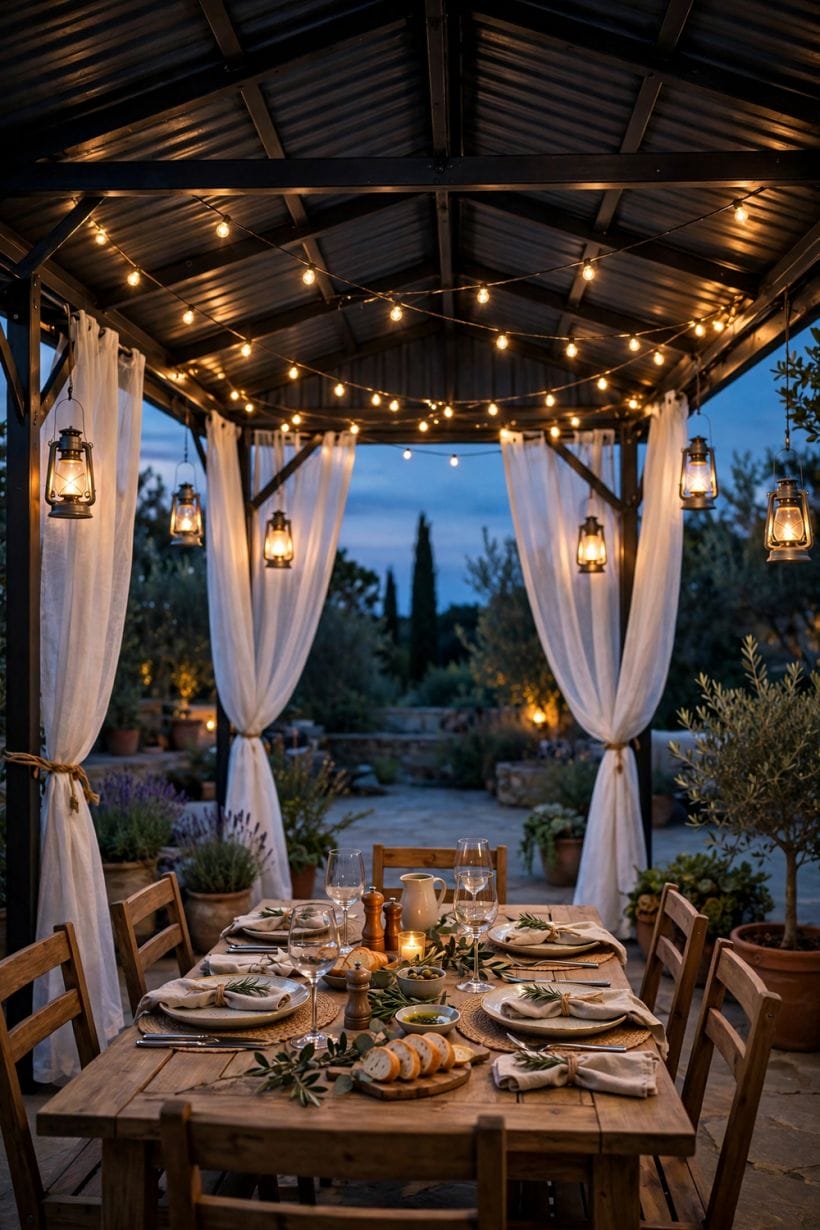
Festoon or string lights swagged between posts give the gazebo its evening ceiling and its unmistakable party silhouette.
57. Lanterns and candles for the table
Real candlelight in storm lanterns is the gazebo’s native light: sheltered from the breeze by glass, warm on faces, kind to food.
58. A fixed light for the working evenings
Where the gazebo hosts reading, games or late dining, one fixed warm light — a pendant under the crown or wall lights on the posts — does the honest work the fairy lights decorate around.
59. Solar lights: where they earn their place
Solar stake and string lights suit the far-from-house gazebo with no cable run, provided expectations stay modest about brightness and winter performance. They mark paths and edges better than they light tables.
60. Heating the shoulder seasons
Spring and autumn evenings are the gazebo’s bonus months, claimed by a heater, a throw over every chair and cushions stored warm-side.
61. The morning gazebo is a different room
Furnish one corner for the day’s first hour — a chair turned to the sunrise, a hook for the robe, a side table that holds a coffee pot — and the structure doubles its service.
62. Music and the neighbours
A small speaker at low volume inside a roofed structure carries further than its owner expects, especially across water and lawns at night.
63. Winter dress: lights and evergreen
Undressed for winter, a gazebo can look like an abandoned bandstand; dressed with its canopy stored, climbers’ skeletons lit by a string of lights and the evergreen pots in place, it stays the garden’s focal point through the dark months.
64. Wet-weather evenings are the test
The gazebo justifies its roof on the showery evening when the barbecue survives, the cushions stay dry under the crown and the party moves ten steps rather than indoors.
65. Photograph it at dusk for the household record
The dusk photograph — lights on, table set, garden darkening — is how the household will remember the structure, and taking it each year is a pleasant audit: what grew, what faded, what to fix.
8. Care, Permissions and Keeping It Standing
A gazebo is a building, and buildings are kept by small regular acts rather than by rescues. This closing section covers the maintenance rhythm, the checks that precede building — stated generally, because rules vary by place — and the repairs that keep the structure the garden’s pride rather than its apology.
66. Annual once-over, top to bottom
Once a year, walk the structure with a ladder and a screwdriver: roof fixings, flashing and gutters; post feet for rot or rust where they meet the ground; bracing and bolts for tightness; fabric for tears at the stress points.
67. Post feet are the structure’s weak point
Timber rots and metal rusts where they meet wet ground, so post feet deserve the design’s best detail: shoes or standoffs that hold the post clear of standing water, gravel or a slab that drains away.
68. Timber care: stain, oil or paint on a rhythm
Timber gazebos ask for their finish renewed on the manufacturer’s rhythm — paint and stain protect by film, oils by feeding the wood — and the work is easiest before the finish fails, not after.
69. Fabric winters indoors
Canopies, curtains and cushions winter best dry, clean and indoors or in the store box, checked for mildew before they are packed. Fabric left up through the storm season ages in months what careful storage spreads over years.
70. Permissions and rules, stated generally
Whether a gazebo needs formal permission depends on where you live, its size and height, and its distance from boundaries — the rules genuinely vary, and some places ask nothing of a small open structure while others are strict.
71. Foundations matched to ambition
A light kit gazebo on a sound patio needs fixings, not foundations; a heavy bespoke structure on soft ground needs proper footings designed for its loads and the local soil. The middle path — guessing — is how structures lean.
72. Insurance and the honest inventory
A permanent garden structure is part of the property; notifying the household insurer of a substantial build is a dull five minutes that matters exactly once — after the storm.
73. Repairs: like for like keeps it handsome
Replace failed boards, rails and roof pieces in the structure’s own material and profile where possible; a gazebo patched in whatever was handy ages into a scarecrow.
74. Small patios: the gazebo still fits the rules
Everything above scales down: the small patio ideas collection shows compact terraces holding a corner gazebo or a small pavilion without surrendering the whole patio, provided the placement rules — corner first, route kept clear, structure sized to furniture — are followed at miniature scale. Small is a discipline, not an exemption.
75. Know when to let it evolve
Gardens change around structures: trees grow, neighbours build, the household’s life moves on.
9. Checks and Mistakes: Before the First Purchase or the First Fitting
Audit the finished structure from the house door on a showery evening: is the route short and lit, the entrance dry, the inside furnished for one clear primary life with the corners not all committed? Is the roof’s water going somewhere that is not the doorway? A gazebo passes its real examination in imperfect weather, not in the brochure’s sunshine.
Before building, walk the placement through a full day — sun at noon, glare at four, the evening’s last light, the wind’s usual direction — and check the local rules for structures of its size near boundaries. An afternoon of watching prevents the two irreversible mistakes: the wrong spot and the wrong paperwork.
Check the structure’s own weak points while they are still choices: post feet lifted from standing water, roof fixings rated for the site’s honest worst weather, fabric that stores indoors for winter. Gazebos fail at their details, and every detail on that list is cheap at build time and dear later.
10. Costs and Pulling It Together
The gazebo’s economics are the garden’s best: one structure buys shade, shelter, a dining room, a sitting room and the garden’s focal point in a single footprint, and repays the cost in evenings that would otherwise have been spent indoors. Spend first on the structure and the roof — the parts that cannot be upgraded casually — and let furniture arrive as the seasons teach the household how it actually uses the room.
The outdoor field as a whole is gathered through the home design ideas hub, and the structure’s own family continues at the porch ideas collection — the house’s other roofed threshold — whose lessons about posts, roofs and evening light translate directly to the patio’s freestanding version.
Final Considerations
A patio gazebo succeeds when it disappears into the household’s habits: coffee appears there in the morning, lunch migrates there at noon, and the evening ends there because nobody suggested moving. Build for that life — placed by sun and route, defended against the weather, furnished for one clear purpose — and the structure stops being a garden feature and becomes the address of the summer.
Start with placement and structure, the two decisions that cannot be unmade cheaply, and let everything else — planting, lights, curtains, the swing seat — arrive in the seasons that follow. Gardens reward patience, and a gazebo planted into a growing garden gets more itself every year.


0 Comments