

The Victorian living room is modern decorating’s repressed ancestor: the deep colours, the pattern on pattern, the buttoned velvet and the mantel dressed like an altar — everything the pale decades swept away, returning now room by room as households rediscover what firelight and confidence can do. This is the style for people who find minimalism cold and are no longer embarrassed to say so.
This collection builds the room properly: the palette with its period logic, the architecture that carries it, the fireplace enthroned, the furniture weighted, the textiles layered and the light kept low and warm — then edits the whole for houses that must also hold televisions, children and dogs. It is the style-led sibling of the living room ideas pillar, to which it belongs.
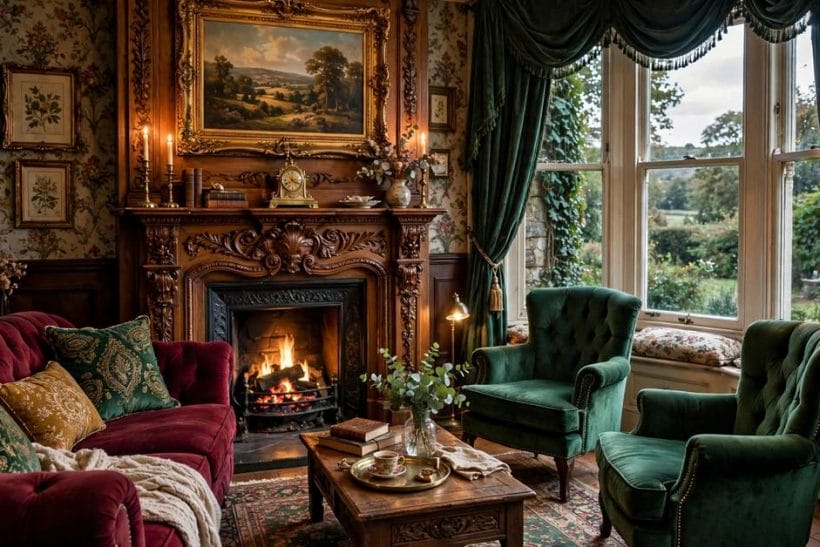
1. Victorian Living Room Ideas at a Glance
The Victorian living room is the period-style member of this collection’s living-room cluster: a room whose central entity is depth — of colour, of pattern, of upholstery and of shadow — organised around the fireplace and dressed in ranked layers. Its attributes are palette (deep greens, reds, blues with ochre and gilt), architecture (rails, cornices, bay, mantel), furniture weight (buttoned, carved, dark-timbered) and light (low, warm, multiplied). Hold those four and the style survives any amount of modern editing.
| Question | Short answer |
|---|---|
| What colours define the style? | Deep green, oxblood, ink blue and plum — with ochre, brass and black as the punctuation. |
| Must I buy antiques? | No — weight is the requirement. Antique, reproduction or honest modern all work if built heavily. |
| What if my room has no fireplace? | Enthrone a substitute: a mantel-style surround, a great mirror or picture, seating arranged to it. |
| Can it work in a small room? | Yes — deep colour plus edited quantity; cut the object count, never the depth. |
| How is it lit? | Many small warm lights at face height; the ceiling light is jewellery, not a floodlight. |
| Will it survive family life? | Better than pale schemes — deep colours and patterns are camouflage by design. |
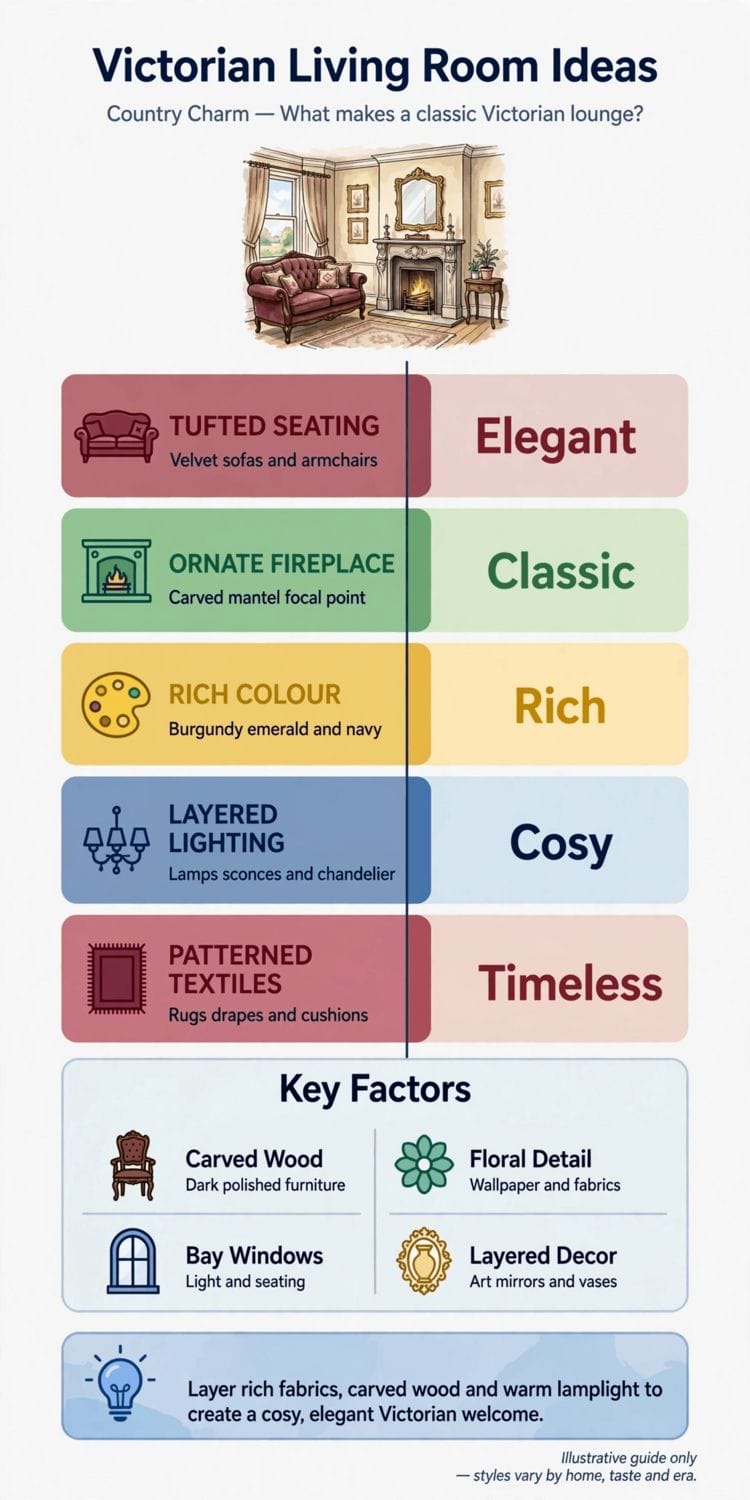
2. The Victorian Palette: Colour and Pattern
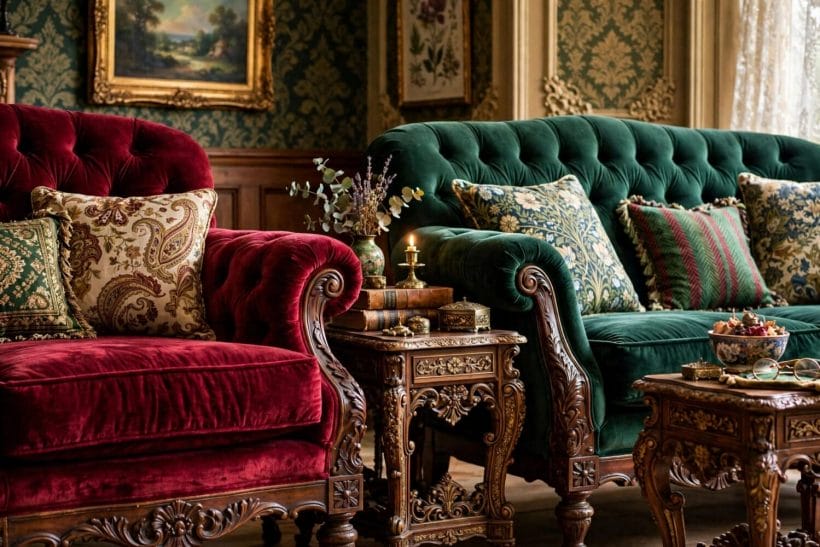
Victorian colour is the opposite of timid: deep greens, oxblood reds, ink blues, ochres and plums, laid on generously and patterned without apology. But it was never random — the palette obeys a period logic of depth below, richness above, and gilding at the points of light. This section sets the scheme.
1. Deep green: the drawing room’s first colour
Bottle and emerald greens were the Victorian parlour’s signature, flattering to faces by lamplight and forgiving of soot and city air.
2. Oxblood, claret and the red room
Red in the Victorian register is never scarlet; it is oxblood, claret and burgundy — reds with brown and black in them, made for firelight.
3. Ink blue and teal for the cooler house
Midnight and peacock blues give the Victorian room its cooler register — nearly as deep as green, friendlier to north light, and the natural ground for silver, pewter and pale marble.
4. Ochre, mustard and the gold thread
Every deep Victorian scheme carries a thread of ochre — in a cushion, a picture frame’s gilt, a curtain’s lining, the brass of the fender. It is the palette’s candlelight, warmed metal made into colour.
5. Pattern in the period manner: more than one, ranked
Victorian rooms layered patterns deliberately — a large motif in the paper, a smaller in the carpet, a stripe in the upholstery — and the method still works when the patterns are ranked by scale and share a palette.
6. The dado logic: depth below, richness above
Period walls were zoned: the deepest colour low, where furniture and wear lived; a richer patterned paper in the main field; the palest tone at the ceiling, lifting the room’s crown.
7. Wallpaper: the room’s main event
A Victorian living room is the one modern room where a bold wallpaper is not a risk but the assignment: large-scale botanical, damask or William Morris-style repeats in the period palette.
8. Carpet and rug: the patterned foundation
The period floor was a patterned carpet wall to wall; the modern translation is one large, deep-toned patterned rug over boards, anchoring the seating.
9. Gilding and brass at the points of light
Gold in a Victorian room lives where light strikes: picture frames, mirror frames, the fender, lamp fittings, a screen’s hinges. It should be warm, aged and slightly imperfect — bright new gold reads as hotel.
10. Black as the palette’s punctuation
Ebonised furniture, a black marble mantel, japanned trays and picture frames give the deep colours their outline. Victorian schemes are never pastel because black keeps them honest.
11. Restraint is not the same as fear
The style tolerates editing — fewer, larger pieces; pattern in two layers rather than four — provided the edit keeps the depth. What it cannot survive is dilution: pale imitations of its colours, its patterns shrunk to politeness.
3. Walls, Ceilings and Architectural Detail
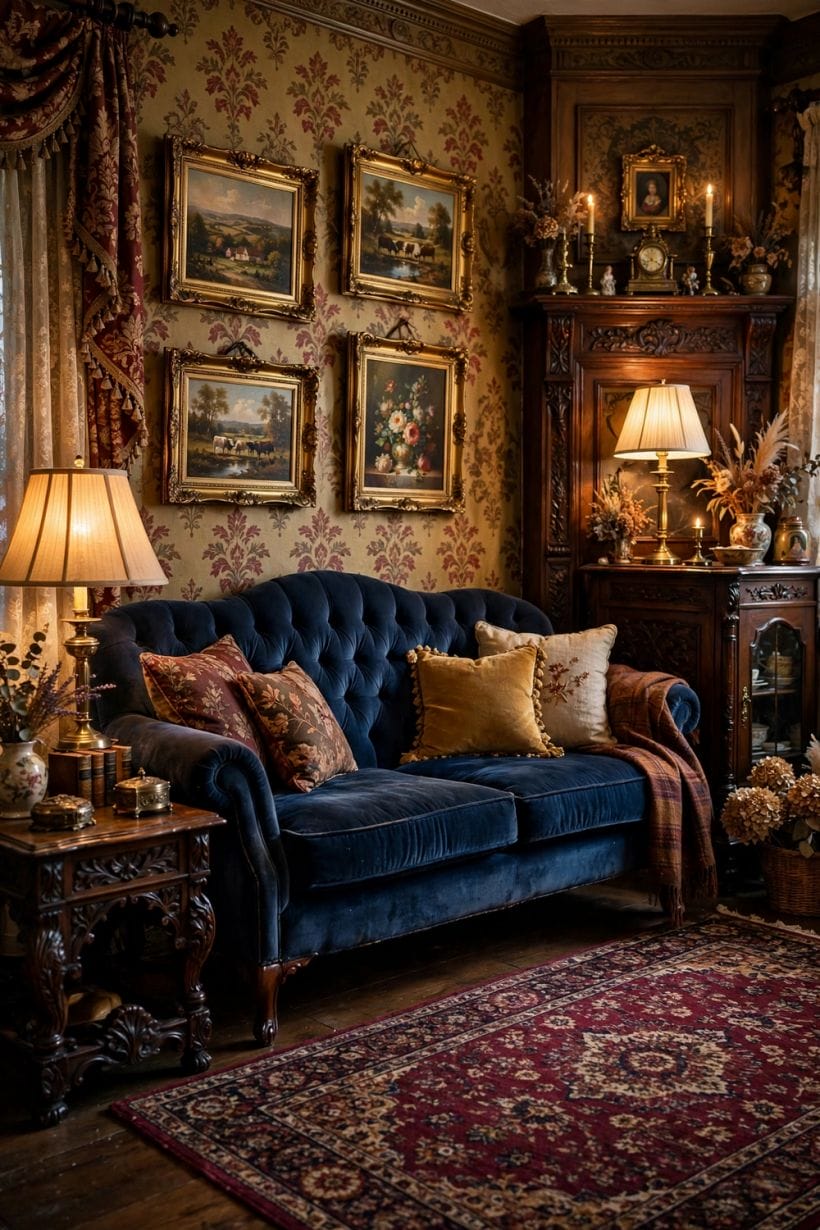
Victorian style is carried as much by a room’s bones as by its furniture: high ceilings, deep cornices, picture rails, panelled doors, a bay window if fortune provides. Where the bones exist, honour them; where they don’t, a few well-chosen additions install the architecture the furniture expects.
12. Cornice and ceiling rose: restore the crown
The deep cornice and the ceiling rose are the period ceiling’s jewellery, and many houses still own them under paint and neglect. Cleaned, repaired and painted in the ceiling’s pale tone, they give the room its finished height.
13. Picture rails and dado rails earn their keep
Rails are not decoration; they are the room’s working lines. Pictures hang from the picture rail without drilling the plaster, and the dado rail marks the wall’s colour change and takes the chair-back knocks.
14. Panelling and the panelled wall
Victorian rooms loved a panelled wall — full-height in the grand houses, dado-height in the rest — painted deep or in polished timber.
15. Bay windows are the style’s throne room
The bay is the Victorian living room’s glory: light from three sides, a window seat’s invitation, the natural home of a chaise, a plant stand or the Christmas tree.
16. Deep skirting and architraves
Period joinery was tall and proud: deep skirtings, wide architraves, panelled doors with furniture-weight knobs. Where a house has been modernised flat, reinstating deeper skirting on the main walls alone restores the room’s base note.
17. The ceiling keeps its pale register
For all their love of depth, Victorian schemes kept ceilings pale — cream, off-white, the faintest blush — because lamplight and firelight travelled upward. A dark ceiling crushes the style’s height.
18. Fireplace surrounds belong to this section too
The mantel is architecture before it is furniture, and its treatment belongs with the walls: marble, slate or carved timber, sized to the room’s ambition.
19. Stained glass and the coloured transom
A fanlight or transom of coloured glass above the door, or a stained panel in the bay, gives the Victorian room its jewel-light — the coloured wash across the floor at certain hours that no lamp can imitate.
20. Shutters and the tall window dressings
Victorian windows were dressed in layers — shutters or blinds at the glass, lace or sheer for privacy, heavy curtains over all — and the layered window is taken up with textiles below.
21. This room’s parent: the Victorian house whole
The living room is one chamber of a whole-house style, and the Victorian house collection treats the architecture entire — halls, stairs, bedrooms and the exterior’s brick and bay. Rooms borrowed from it piecemeal work best when this living room keeps faith with the house’s own period bones rather than importing a second history.
22. Modern bones, Victorian manners
A plain modern box of a room can still host the style: give it the dado-line in paint, one architectural addition with conviction — a proper mantel, a ceiling rose, reinstated rails — and let colour and furniture do the rest.
4. The Fireplace as the Room’s Throne
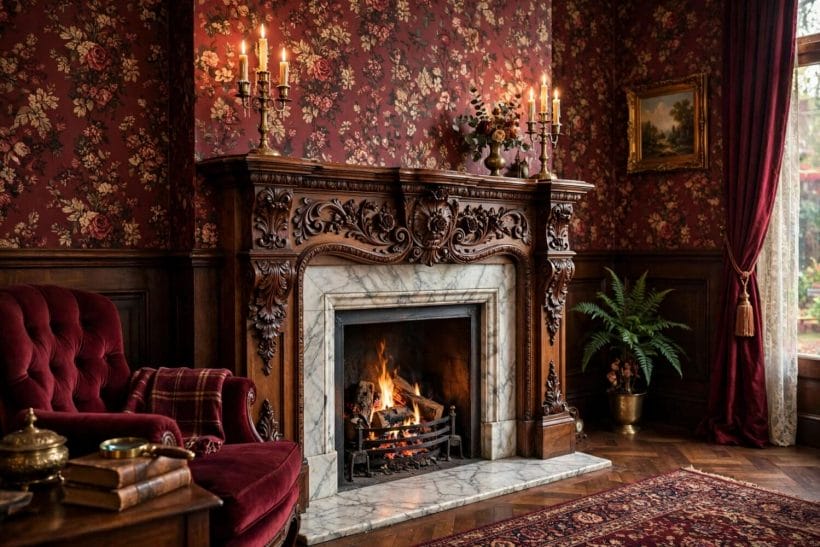
In the Victorian living room every seat once faced the fire, and the mantel was the room’s altar: clock at the centre, ornaments in pairs, the best picture above. Modern heating has dethroned the fire practically, but the style still organises itself around the chimney breast — and the room fails when it pretends otherwise.
23. Arrange the seating to the fire first
Sofas and chairs angled to the fireplace, the best armchairs flanking it, the rug centred on the hearth — this is the style’s native layout, and it still makes the most sociable room.
24. The mantelpiece as the room’s stage
Dress the mantel in the period manner: a clock or a central object at the middle, pairs falling away to each side, a picture or mirror above large enough to matter.
25. Marble, slate and carved timber surrounds
Choose the surround as the room’s best material: veined marble for the grand register, honed slate or black marble for the sharper one, carved timber for warmth.
26. The overmantel mirror multiplies firelight
A large gilt mirror above the mantel was the period’s light engine, doubling fire and lamplight into the room. It remains the most beautiful and useful object a Victorian living room can own.
27. Fender, tools and the working hearth
A brass or steel fender, a proper set of fire tools and a log basket furnish the hearth as a workplace, not a stage set — even where the fire is now gas or decorative.
28. Tiles at the hearth: colour at floor level
Victorian hearth tiles — deep greens, burgundies, picture tiles in the grate cheeks — carry the palette to the floor at the room’s focus.
29. Chimney-breast walls take the deepest colour
If one wall earns the scheme’s deepest shade or its boldest paper, it is the chimney breast: the room’s architecture has already voted it the feature.
30. Alcove cupboards and shelves
Built-in cupboards below and shelves above in the alcoves are the Victorian living room’s storage signature — books, china, the decanter, all housed in the architecture.
31. Candles and lamps on the mantel line
Before electricity, the mantel carried the room’s candles; the arrangement still flatters — a pair of lamps or candle sticks at the mantel’s ends gives the evening room its twin points of warmth.
32. A fire screen with a purpose
The embroidered or stained-glass fire screen hid the empty grate in summer and shielded faces in winter; today it is the chimney breast’s seasonal dress — in place when the fire is unlit, giving the hearth a finished face.
33. When there is no fireplace at all
Houses without a chimney breast can still enthrone a focal point: a substantial mantel-style surround with an electric fire honestly presented, or a great picture, mirror or cabinet as the wall’s centre, with seating arranged to it.
5. Furniture: Sofas, Chairs and Dark Timber
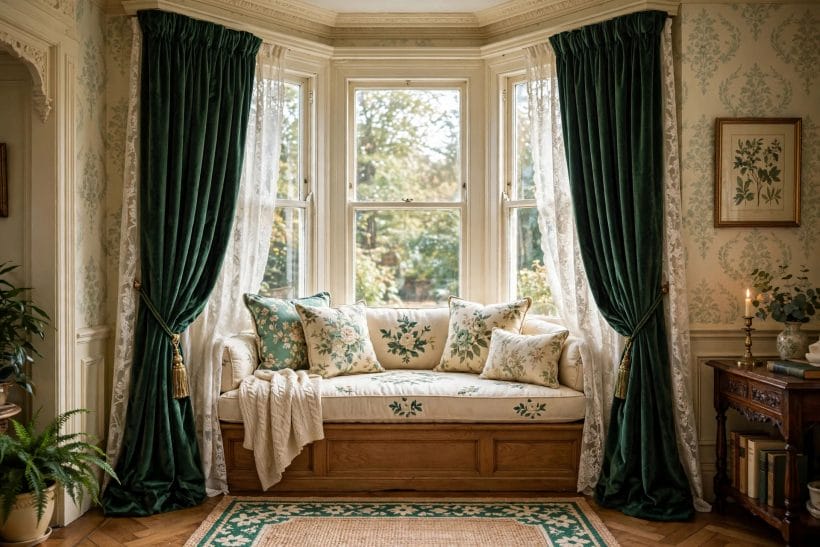
Victorian furniture was built to be inherited: deep-buttoned upholstery, carved mahogany and walnut, chairs for every posture from the nursing chair to the grandfather’s wing. The modern room need not buy antiques — but it must buy weight, because light, slight furniture is the one thing this style cannot absorb.
34. The buttoned sofa: chesterfield and its cousins
A deep-buttoned sofa in leather or velvet is the Victorian living room’s anchor piece — low-backed, rolled-armed, unapologetic. The chesterfield is the famous pattern, but any generously upholstered, skirted or turned-leg sofa in a deep fabric carries the register.
35. Wing chairs at the fire
The wingback chair was designed for the hearth — wings against the draught, a high back for the doze — and a pair flanking the fireplace is the style’s most recognisable grouping.
36. Mahogany and walnut set the timber tone
Dark, polished, figured timber is the style’s wood: mahogany’s red depth, walnut’s brown swirl, ebonised accents between. Modern pieces in dark stains join the family honestly.
37. Small tables everywhere: the occasional-table habit
Victorian rooms were forests of small tables — beside every chair, at the sofa’s elbows, a tripod table for the tea, a pedestal for the plant.
38. The chaise longue and the daybed corner
A chaise in the bay or by the window is the style’s indulgence — for reading, fainting in novels and actual afternoon rest in real life. It gives the room its diagonal and its romance, and it is the piece guests remember.
39. Display cabinets and the whatnot
Glass-fronted cabinets and tiered whatnot stands housed the period’s treasures — china, shells, photographs, curiosities from every voyage.
40. A writing desk or bureau in the corner
The Victorian parlour worked as well as rested: a bureau or small writing desk in the corner, with its chair and lamp, claims the room’s quiet function.
41. Stools, ottomans and the footstool culture
Footstools and upholstered ottomans in the scheme’s fabrics give the seating its finishing layer and the room its flexibility — spare seats, footrests, tea-tray stands.
42. Antique, reproduction or honest modern
The style accepts all three, ranked by conviction rather than price: a worn genuine piece first, a well-made reproduction second, a modern piece in the period’s weight and fabric third. What it rejects is the flimsy — furniture whose construction apologises.
43. The traditional sibling in this cluster
Victorian’s nearest relative here is the traditional living room collection — the broader, calmer church to which this style is a denominated chapel. Households torn between the two should steal the traditional room’s restraint in quantity and keep the Victorian commitment in colour and weight.
44. Furniture arrangement: conversation, not corridor
Group the furniture for talk: seats facing each other across the rug at conversational distance, chairs angled in at the corners, nothing marooned against the walls.
6. Textiles, Curtains and Layered Softness
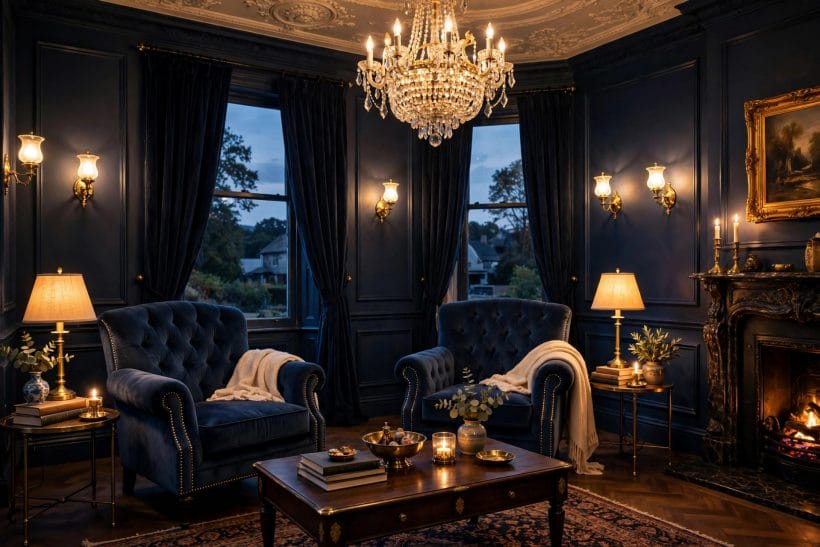
If colour is the Victorian room’s voice, textiles are its accent: velvet, damask, lace, fringe and tassel, layer upon layer at the windows, the furniture and the floor. The modern hand should layer with the same generosity and the same ranking — one textile leads at each surface, the rest support.
45. Velvet is the style’s signature fabric
Cotton velvet on the sofa, the chaise or one great chair gives the Victorian room its depth of colour and its invitation to touch. Velvet also dyes the period palette best — greens, reds and blues at their richest.
46. Curtains in the grand manner
Full-length, lined, interlined if the budget reaches — Victorian curtains were architecture in cloth, hung high, pooling a breath on the floor, tied back with rosettes or cords by day.
47. Lace and sheers: the period’s daylight filter
Nottingham lace was the Victorian window’s glory, and its modern descendants — fine voiles, embroidered sheers — still give the style its daytime face: privacy kept, light admitted, pattern at the glass.
48. Damask, brocade and woven pattern
Self-patterned weaves — damask and brocade in the scheme’s own colours — give upholstery and curtains their richness without adding a competing print.
49. Fringe, tassels and trimmings
Bullion fringe on a lampshade, tassels at the curtain’s tie-back, braid edging a cushion — the trimmings are the style’s punctuation, and a little of them restores what plain modern sewing removed.
50. Throws and shawls over chair backs
A folded shawl or throw over the wing chair’s back is documentary Victorian — the parlour’s shawl was furniture as much as garment — and it remains the fastest softening a chair can receive.
51. Cushions: many, ranked and plump
Victorian sofas carried cushions in numbers modern taste finds startling, and the revival should keep at least the spirit: three to five on a sofa, in the scheme’s fabrics ranked by pattern scale, plumped and karate-chopped by nobody — the style prefers them inviting, not tortured.
52. Table linen and the dressed side table
A cloth or runner on the sideboard and the occasional tables — lace, linen or damask — gives the room its dressed, occasion-ready layer and protects the polished timber beneath.
53. The French cousin’s lessons in layering
The french country living room ideas in this cluster layer textiles with a lighter hand — linen where Victorian uses velvet, toile where it uses damask — and the comparison is instructive: both styles layer by ranking, and households can borrow the French ranking while keeping the Victorian depth.
54. Rug on rug in the coldest rooms
The period layered its floor coverings — carpet over boards, a finer rug over the carpet at the seating — and the arrangement still serves cold, large rooms: a big flatweave underfoot and a deep-piled rug at the chairs.
55. Textile care is part of the style
Velvet wants brushing, curtains want their annual clean, and moths want the woolens more than you do. Build the care into the choice: washable where children rule, the precious fabrics at adult height and adult furniture.
7. Light: From Gaslight Manners to Modern Wiring
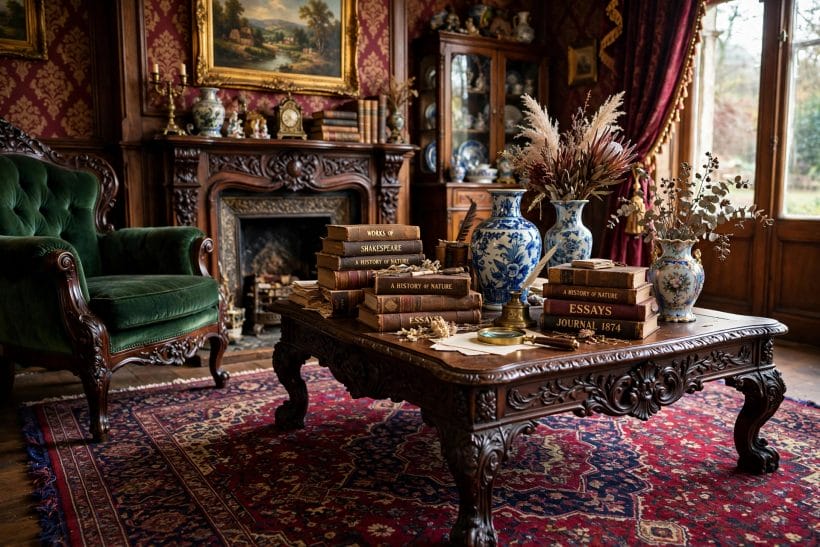
Victorian light was warm, low and multiplied — candles, oil and gas at face height, never a single source overhead. Modern wiring can reproduce the manners exactly, and must, because a deep-coloured room lit like an office is the style’s commonest modern failure.
56. Many small lights, no big one
The rule is absolute: table lamps, wall lights, the fire and candlelight between them, and the ceiling pendant dimmed or off. Aim for pools of warm light at sitting height around the room.
57. The chandelier or pendant as jewellery, not floodlight
The central pendant’s job is ceremony — crystal, brass or glass catching the room’s other lights — rather than illumination.
58. Wall sconces at the chimney breast
A pair of sconces flanking the overmantel mirror or picture is the style’s classic wall lighting: face-height, symmetrical, bouncing off the gilt. They give the room its evening architecture — the lit focal wall — while the rest settles into companionable gloom.
59. Table lamps with fabric shades
Lamps belong on the side tables the furniture section insisted on, with fabric shades that throw light down onto the book and up onto the ceiling, warming both.
60. Firelight is a light source — design for it
Where the fire is real, it is the room’s primary evening light and the other sources should defer — dimmer, warmer, fewer.
61. Candles for the final layer
Real candles on the mantel and the dining-adjacent surfaces — in holders, away from curtains and textiles, never left burning unwatched — give the Victorian room the light it was designed in.
62. Warm bulb temperature throughout
Every bulb in the room should share the warm register; one cool bulb in a lamp poisons the scheme at its seat.
63. Picture lights for the room’s art
A picture light over the principal painting or print gives the wall its jewel and the evening room its gallery note.
64. Daylight through lace: the bright scheme survives
Deep rooms are accused of gloom, but the style was built for bright days too: lace at the glass, pale ceilings, the mirror’s work.
65. Dimmers are the style’s best modern friend
Fit dimmers at the main circuits and the room gains its full range — bright for the morning’s cleaning, low for the evening’s company, candle-level for the fire’s hour.
8. Victorian in a Modern House: Editing the Look
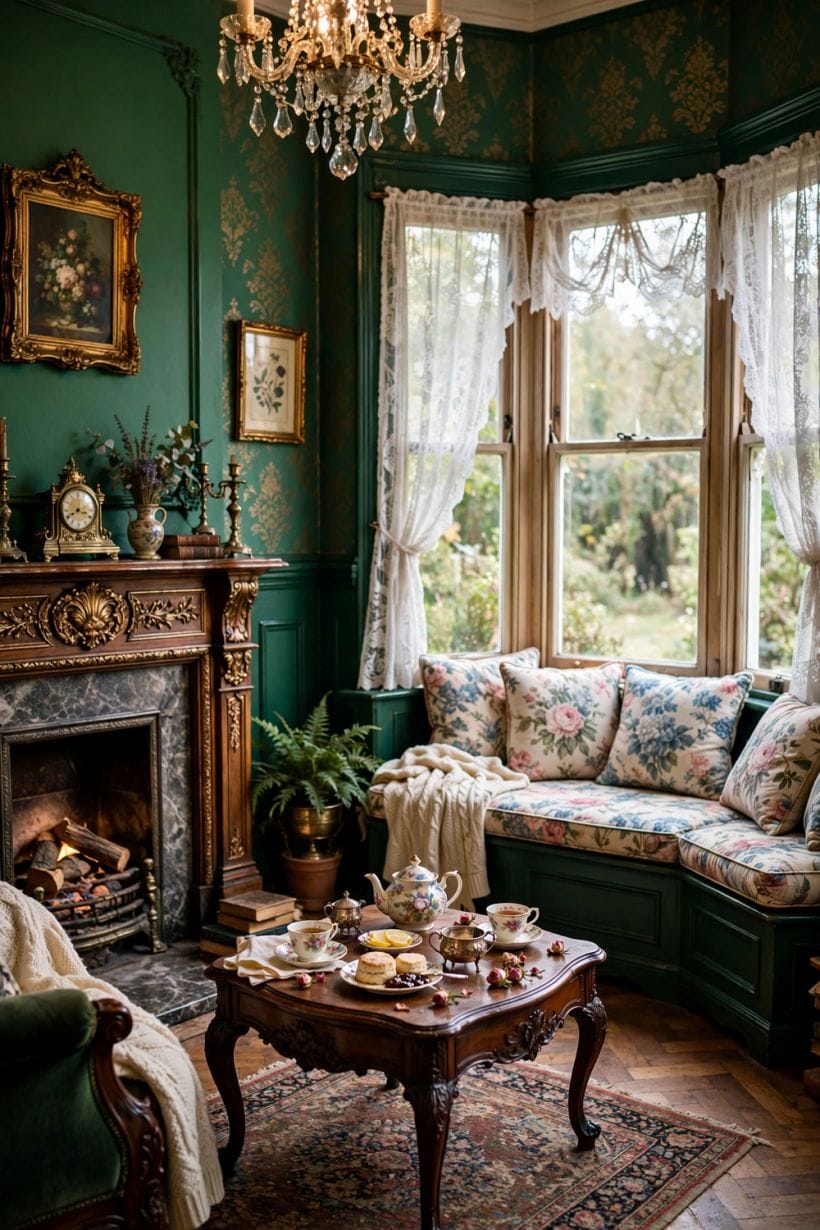
Few households want the full museum — and the style, honestly examined, never asked for it: real Victorian parlours mixed the new with the inherited and the fashionable with the merely kept. This closing section edits the look for modern life, including the family’s everyday room and the cluster’s shared hub.
66. Keep the depth, cut the count
The single most useful edit: halve the number of objects, keep every colour and fabric at full strength.
67. The television, accommodated honestly
Hide it in a cabinet, frame it as a picture, or let it stand modern among the period pieces — all three work if done with conviction. What fails is the television apologising in the corner at an angle.
68. Everyday family life in a formal style
The parlour was the best room, kept for company; the modern living room works daily, and the style survives the demotion if the precious is placed high and the practical is built sturdily.
69. The family’s other room takes the overflow
Households with a second sitting room can let it carry the toys, the games console and the laundry airer, leaving the Victorian room to its manners — the arrangement the family room ideas in this cluster describe from the other side. Two rooms, two registers, and neither apologising for the other.
70. Start with colour and one great piece
The beginner’s sequence: the deep walls first, then one anchor — the buttoned sofa or the proper mantel — then textiles, then detail as the seasons and budget allow.
71. Rental and low-commitment routes
Where paint is forbidden, the style travels in its furniture and textiles: the deep sofa, the patterned rug, the layered curtains on a tension system, the gilt mirror hung from the picture rail that rentals often still own.
72. Resale realism
A Victorian living room sells a period house beautifully and a modern box bravely.
73. Mixing eras at the edges
One modern piece per room — a good contemporary lamp, a plain coffee table in black — keeps the Victorian scheme from fancy dress, the way one antique keeps a modern room from a showroom.
74. Children, dogs and dark colours
Deep colours are the family’s secret allies: plum velvet hides what cream linen advertises, and patterned rugs are camouflage by design.
75. The hub where the cluster gathers
This style is one voice in the living-room cluster gathered under the home design ideas hub, beside traditional, French country, modern and the colour-led rooms. Houses read whole when their rooms share a discipline — here, depth and weight downstairs, whatever the bedrooms choose above — and the hub is where the household can plan the whole conversation.
9. Checks and Mistakes: Before the First Purchase or the First Fitting
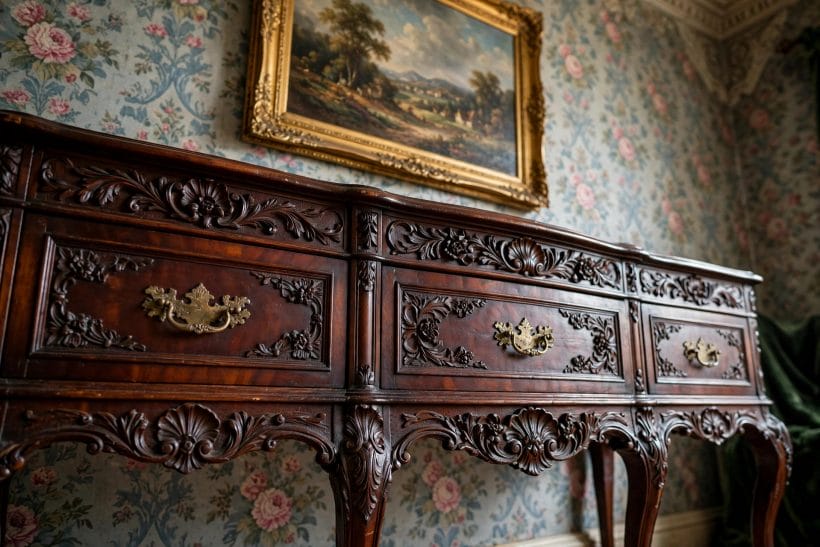
Audit the room by lamplight, seated where a guest sits: is the fire — or its substitute throne — clearly the room’s centre, with the seating arranged to it? Is one pattern clearly the largest, the others ranked beneath? Does every seat own a surface and a light? The Victorian room is a machine for company, and these are its gauges.
Test the depth before the detail: paint and paper samples judged at night, the sofa fabric against the wall colour in the room’s own light, the rug’s pattern at the room’s real viewing distance. This style is bought in daylight and lived in by lamplight, and the second judging is the one that counts.
Check the practical machinery: dimmers fitted, the fire’s equipment sound, curtains that clear the radiators and the hearth’s sparks, washable layers where the family actually sits. Period manners were always practical underneath; a revival that forgets the practicality has kept the costume and lost the character.
10. Costs and Pulling It Together
The budget of the Victorian room concentrates where the period concentrated: the sofa, the mantel, the wallpaper and the rug — the four purchases that carry the style — with the rest assembled patiently from auctions, inheritances and high-street pieces chosen for weight. Spread thinly over twenty ornaments, the same money buys a theme; spent on the four anchors, it buys a room.
Above all, do not dilute. Every compromise in this style should be a compromise of quantity — fewer pieces, fewer patterns, less clutter — and never of intensity. A small, deep, confident Victorian living room is a triumph; a large, pale, apologetic one is merely a room with old-fashioned furniture in it.
Final Considerations
The Victorian living room asks for courage in exactly two places — colour and weight — and repays it with the warmest, most sociable room a house can hold. Build the depth honestly, enthrone the fire, light it low and warm, and the style that modern taste buried turns out to have been waiting, patiently, with the best seat in the house.
Begin with the walls and one great piece, and let the layers arrive as they can be afforded and found. These rooms were never bought in a weekend, even by the Victorians — they accumulated, like the families in them, and the accumulation is the authenticity.

0 Comments