

Heating is the system a tiny house lives or dies by, and the propane vs electric heat tiny house decision shapes far more than the fuel bill. It decides whether your home can sit happily beyond the power lines, how much moisture your walls drink all winter, what you check on dark evenings, and whether a power cut means a chilly night or no change at all. Both fuels heat a small space easily — the interesting differences begin after the room is warm.
This comparison weighs the two across off-grid fit, running cost, moisture, installation and safety, with honest notes on control, outages and daily feel. Costs stay qualitative on purpose: tariffs and propane prices vary so much by region and supplier that anyone quoting you an exact winner, sight unseen, is selling something. What does transfer everywhere is how each fuel behaves — and by the final verdict you should know which behaviour your home, your land and your winters actually need.
Propane vs Electric Heat Tiny House at a Glance
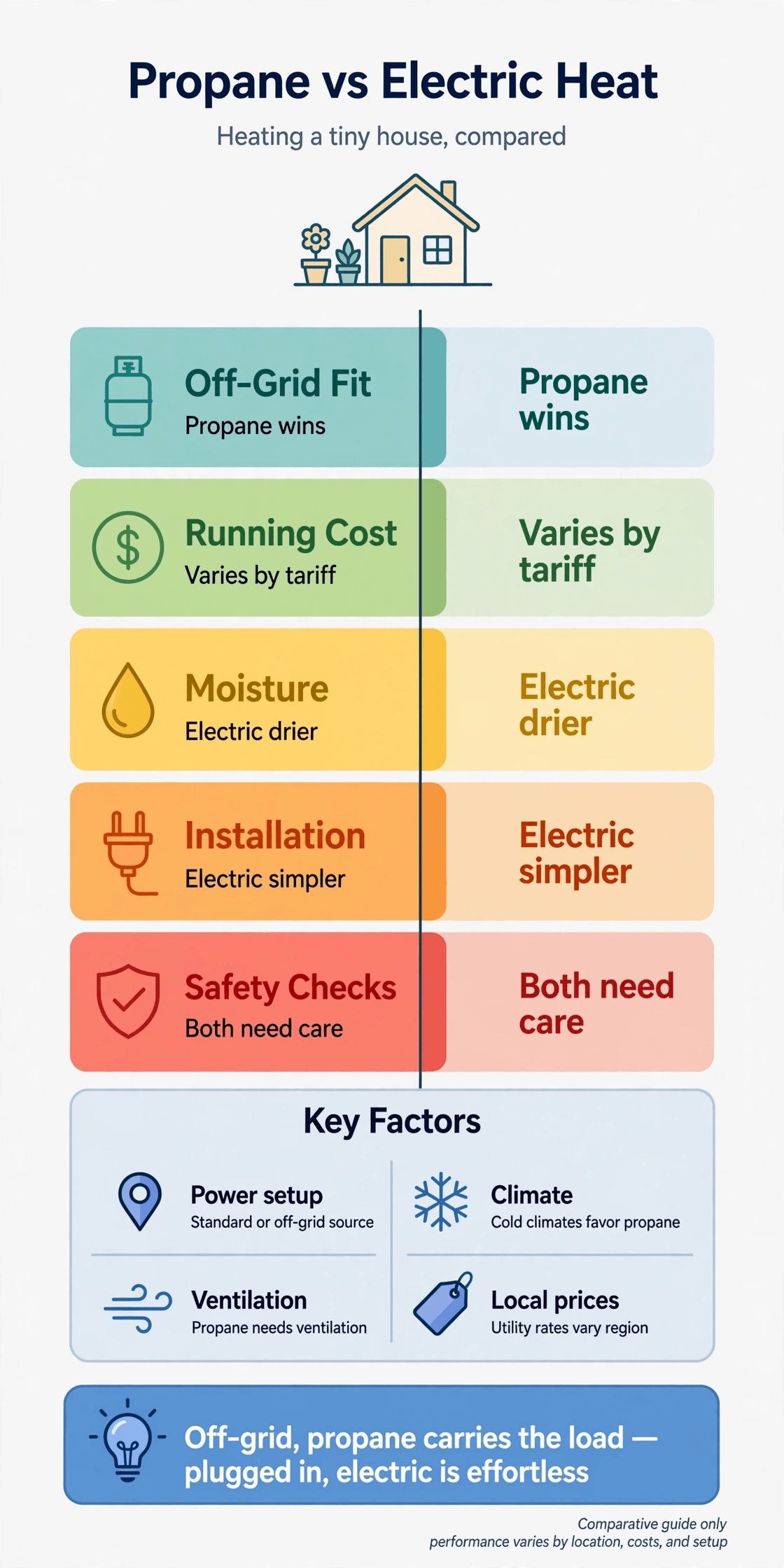
The short version first. Propane carries its energy with it and answers to no grid; electric heat is effortless wherever the supply is strong. Every row below is a consequence of those two facts.
| Criterion | Propane Heat | Electric Heat |
|---|---|---|
| Off-grid fit | Works anywhere a cylinder can be delivered | Needs grid, generator or a serious solar-and-battery setup |
| Running cost | Follows propane prices and delivery access | Follows your electricity tariff; easy to meter exactly |
| Moisture | Unvented models add water vapour to indoor air | Adds no moisture; gently dries the air it warms |
| Installation | Tank, regulator, flue and ventilation to fit properly | Trivial for plug-in units; fixed heaters need a circuit |
| Safety checks | Leak tests, CO alarm, flue and hose inspections | Electrical checks; keep clear of fabrics and dust |
| Outages | Keeps heating through most power cuts | Stops with the grid unless you have backup power |
| Control | Fast, strong heat; thermostatic models common | Precise thermostats; some types respond slowly |
| Best for | Off-grid and cold-climate stationary homes | Hooked-up homes with fair, reliable electricity |
1. How Each System Heats: Combustion Warmth vs the Electric Family
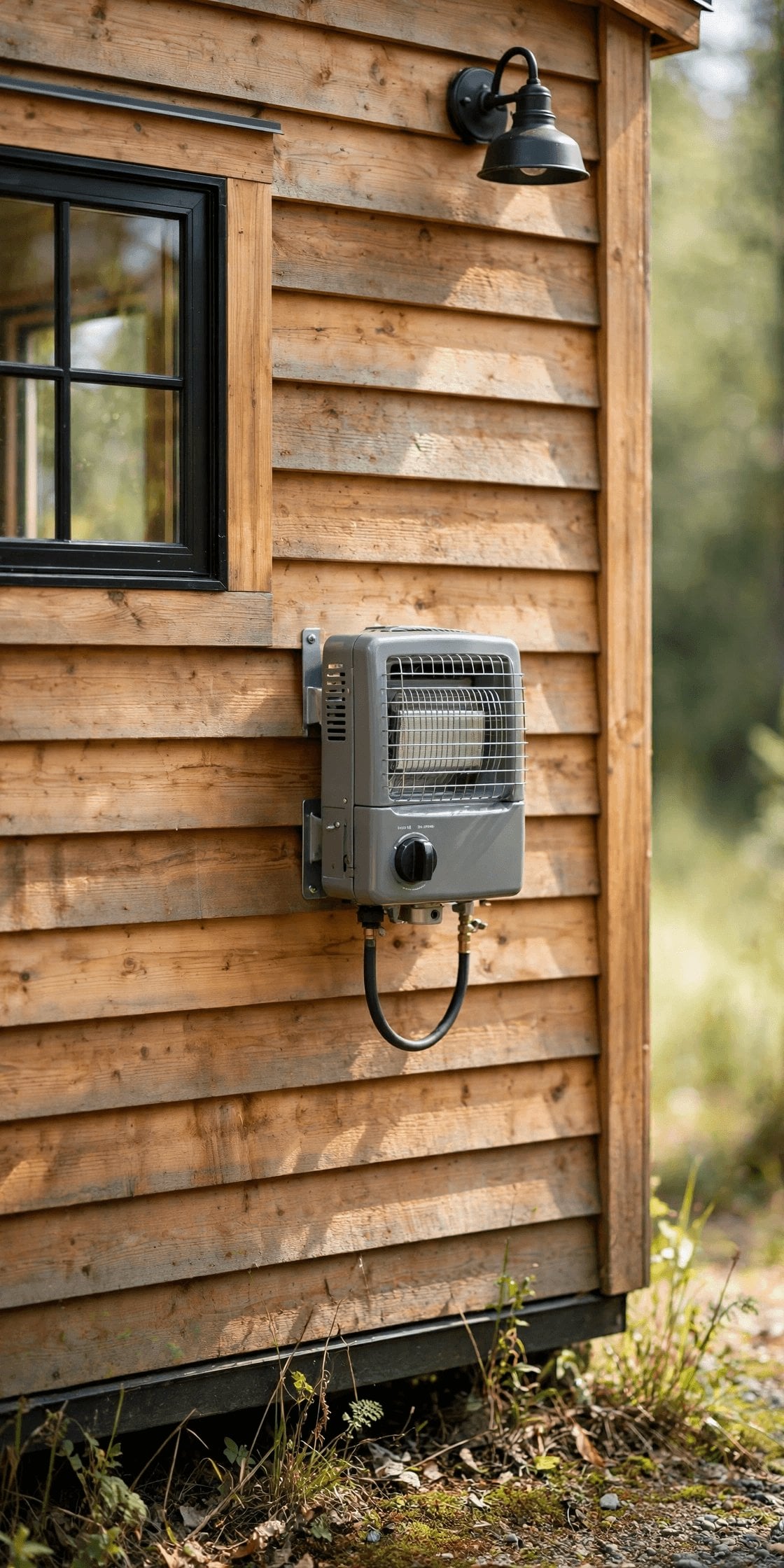
Propane heat is combustion on demand: a burner, a heat exchanger and, in most modern units, a fan to move the warmth around the room. It produces strong, fast heat that does not care how cold the night is, which is why it is the default in caravans, boats and off-grid cabins. Vented models draw combustion air from outside and send exhaust back out again; unvented models burn room air and return everything — heat, exhaust gases and water vapour — into the home, a distinction that matters greatly in section four.
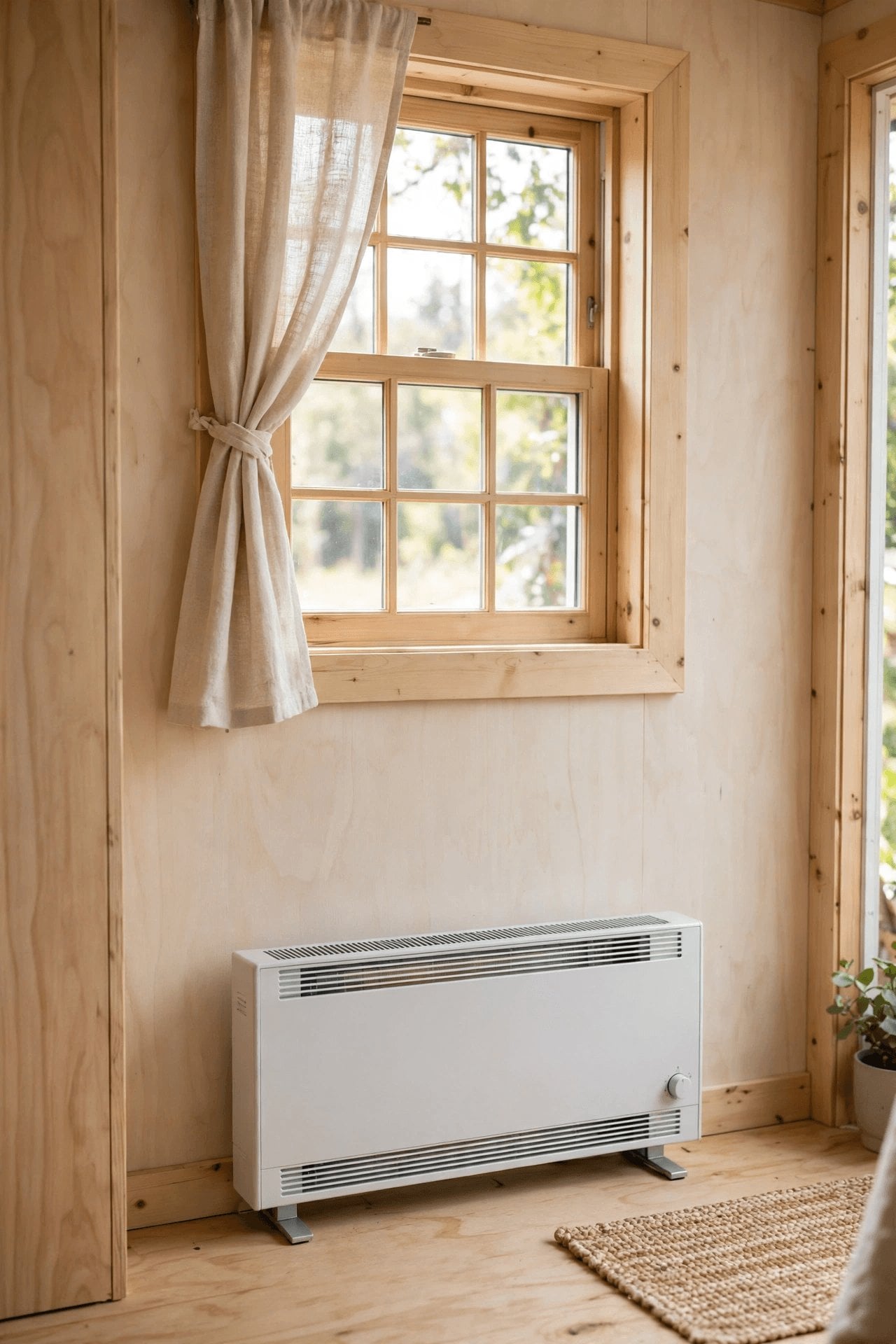
Electric heat is a family rather than a single appliance: fan heaters and oil-filled radiators that plug in anywhere, fixed panel and baseboard heaters, radiant floors, and heat pumps such as mini-splits that move heat instead of making it. Our overview of how to heat a tiny house tours the whole family. What unites them is the supply question — every electric option is only as strong as the electricity behind it, whether that is a hookup post, a generator or a battery bank — while propane carries its energy with it in a cylinder. Hold that thought; it decides the next section.
2. Off-Grid Fit: Living Beyond the Power Line
Away from the grid, propane is the natural citizen. Its energy sits in a tank outside your door, spends nothing while it waits, and asks only for a delivery route or a trip to swap a cylinder. Sizing that storage is a craft of its own — our guide to propane vs electric in tiny houses: tank sizing and energy demand works through it properly. A winter of heating becomes a logistics plan rather than an engineering project, and the heater keeps working through every outage the neighbourhood endures.
Electric heat off-grid is possible, but it has to be earned. Resistance heating is one of the hungriest loads a small solar system can be asked to meet, in the very season with the least sun — the arithmetic in sizing a solar panel kit and battery bank for a tiny home shows why most off-gridders treat electric heat as a supplement rather than the main act. Heat pumps soften this, using far less energy per unit of warmth within their working range, and a generator can always be fired up — at the cost of noise, fuel and fuss. On a hookup, of course, the verdict flips entirely: electric becomes the effortless option and propane the one you have to fetch.
3. Running Cost: Reading Your Tariff and Your Propane Receipts
Running cost is where honest comparisons go to be humble, because both fuels are priced locally and both prices move. Propane arrives by the cylinder, the litre or the delivery, with rural routes and small-cylinder exchanges quietly raising the real price of each unit of heat. Electricity arrives by the unit on a tariff you can read — which at least makes electric running costs exactly measurable; the meter never guesses. The only advice that transfers everywhere is method: price both fuels per unit of energy where you actually live, in the month you use the most heat.
Efficiency writes the second half of the bill. A modern vented propane heater turns most of its fuel into room heat; an unvented one turns nearly all of it in, but pays you back in moisture, as section four explains. Resistance electric heaters convert essentially all their electricity into heat at the point of use, while a heat pump can deliver several units of warmth per unit of electricity in suitable weather — which is how electric sometimes wins the cost contest on a mild-climate hookup and loses it badly in a deep freeze on a small battery bank. Run your own tariff against your own cylinder price; that arithmetic, done honestly, is the whole answer.
4. Moisture and Indoor Air: Combustion’s Hidden By-Product
Here is the difference the brochures bury: burning propane produces water. In a vented heater that moisture leaves with the exhaust. In an unvented heater it enters your room air, hour by hour across a cold week, and a tiny house has very little air to dilute it. The symptoms are familiar to winter tiny dwellers — streaming windows, damp corners of bedding, mould deciding to live in the wardrobe — and they are often blamed on the home when the heater is the author. If you choose unvented propane, ventilation is not a preference; it is the other half of the appliance.
Electric heat adds no moisture at all, and gently dries the air it warms, which is one reason hooked-up owners report fewer condensation battles. The tiny house still makes its own moisture from cooking, showers and breathing, so the disciplines in tiny house living in cold climates apply to both fuels — and balanced systems like HRV and ERV ventilation in tiny houses solve it properly for either. Judge this row by heater type, not fuel alone: vented propane and electric finish roughly level, while unvented propane starts with a handicap you must ventilate away.
5. Installation Simplicity: Tanks, Flues, Circuits and Hookups
Propane asks for a small infrastructure: a secured cylinder or tank outside, a regulator, sound pipework, the heater’s flue where one is fitted, and ventilation openings that must never be ‘tidied’ shut, plus alarms. None of it is exotic — it is the standard kit of caravans and cabins everywhere — but it is regulated work in many regions, and it deserves to be: gas rewards respect and punishes improvisation. Storage is part of the installation too; cylinders live upright, outside and secured.
Electric spans the simplest and the fiddliest installations in this entire comparison. A plug-in radiator installs in the time it takes to unbox it. Fixed heaters, radiant floors and heat pumps ask for proper circuits and breakers, and mini-splits add refrigerant work that belongs to professionals. The hidden constraint is capacity: a small hookup or inverter may not feed every electric heater you fancy at once, alongside cooking and hot water. Scored honestly: propane is one competent, certified job with checks afterwards; electric is trivial for portable units and a real electrical project for the fixed, efficient ones.
6. Heat Quality and Control: Thermostats, Placement and Cold Floors
Warmth has a texture. Propane fan heaters deliver the classic tiny-house experience: quick, strong heat with a gentle fan note, warming the air first and the furniture eventually. Electric options spread wider — fan heaters feel similar; oil-filled radiators and panels give a slower, steadier, silent warmth; radiant floors make cold mornings barefoot-friendly, a small luxury the underfloor heating comparison of hydronic and electric radiant systems explores in depth.
Control differs by appliance more than by fuel. Both sides offer honest thermostats, and both sides suffer when a cheap heater’s thermostat sits inside its own warm plume and short-cycles the room. Heat pumps add the finest control, plus a cooling bonus for summer, at the price of complexity. In a space this small, placement beats power: a modest heater in the right spot, with air free to circulate to the loft and the bathroom, outperforms a bigger one boxed into a corner. Whichever fuel you choose, spend your care on position and control before burner size or wattage.
7. Reliability and Outages: What Works When the Grid Doesn’t
Ask each system what it does at the worst moment. Propane’s answer is its quiet superpower: the fuel is already at your home, and many heaters — especially simple vented and radiant types — keep working through a power cut untouched. Fan-assisted models need only a small amount of electricity, easily covered by the house battery for a good while. In storm country and outage-prone rural spots, that independence is not a feature on a list. It is the whole argument.
Electric heat stops when its supply stops, full stop — unless the supply is yours. Hooked-up homes ride out short cuts with blankets and patience; off-grid homes lean on the battery bank and the gear surveyed in our off-grid power stations comparison, which is sized for lights and laptops rather than heaters. A generator bridges the gap, noisily. Score this section by your address: a reliable urban hookup makes outage behaviour a footnote, while a rural plot at the end of a long line makes it a headline — and it headlines for propane.
8. Safety Checks: The Routines Each Fuel Demands
Each fuel has its own safety liturgy, and both deserve observance. Propane’s list: an in-date carbon monoxide alarm within hearing of where you sleep, because faulty combustion is silent; leak checks on the joints whenever cylinders change; hoses, regulators and flues inspected on a schedule rather than on a suspicion; and ventilation openings kept open, always. None of this is burdensome — it is minutes per month — and none of it is optional, because the failures it prevents do not announce themselves.
Electric’s list is shorter but not empty: heaters kept clear of bedding, curtains and the laundry that somehow migrates towards warmth; cables and plugs checked for heat damage; circuits never asked to carry more than they were built for; portable units switched off when you sleep or go out, unless they are designed and rated for unattended use. The honest summary is that propane demands more checks and repays them with total reliability, while electric asks fewer checks and offers fewer ways to get things wrong. Choose the liturgy you will actually perform — the safest system is the one whose routine survives your real life.
9. Noise, Smell and Daily Living Feel
Live with each fuel for a week and the differences turn sensory. Propane weeks have a rhythm of logistics — watching the gauge, swapping cylinders, the quiet satisfaction of a full tank ahead of a cold snap — and, with fan models, a low working hum when the burner fires. Storage becomes part of the home’s design: a ventilated, secure home for cylinders, like the DIY tongue boxes built for safe propane and power storage, keeps it tidy and compliant.
Electric weeks feel like nothing at all, which is precisely their luxury: silent panels, no deliveries, no smells, warmth that arrives the way the lights do. The sensations turn up at the meter instead — a hooked-up owner thinks about the tariff the way a propane owner thinks about the gauge. Neither daily life is better in the abstract. One suits people who like self-reliant systems they can see and touch; the other suits people who want heat to be invisible. You already know which of those people you are.
10. Hybrid Heating: Using Both Fuels Where Each Is Strongest
Plenty of tiny houses refuse to choose, and they are often the warmest. The classic hybrid pairs a vented propane heater as the backbone — off-grid capable, outage-proof, strong in deep cold — with electric as the precision instrument: a small panel heater by the bed on hookup nights, or a heat pump carrying the mild months at high efficiency and leaving propane the hard winter shifts. Each fuel covers the other’s weakest row in the table above.
A hybrid costs more to install than either system alone and asks you to maintain two safety routines, so it earns its place only where both halves genuinely work: a home that splits its year between hookups and off-grid stays, or a cold-climate home that wants outage insurance plus inexpensive shoulder-season heat. If your life is single-mode — always hooked up, or always off-grid — the hybrid is complexity shopping for a problem you do not have. Simplicity is a heating feature too.
Final Considerations
So, who should pick which? Choose propane if your tiny house will live off-grid or at the end of an unreliable line, if your winters are seriously cold, and if you will keep its safety routine faithfully: tank secured, flue and hoses checked, alarm tested, ventilation open. You get heat that answers to you alone, works through every outage, and asks only for a cylinder supply chain you can actually sustain.
Choose electric if your home lives on a dependable hookup with a tariff that treats you kindly — especially if a heat pump can carry your climate — and if you value silent, moisture-free, check-light warmth. And if your year genuinely mixes both worlds, build the hybrid deliberately rather than drifting into it. The wrong answer is not a fuel; it is a fuel chosen for a different home, on a different plot, than the one you actually have.


0 Comments