

A small bedroom gives nothing away free — every centimetre must earn its place, and yet the best of them feel like the calmest rooms in the house.
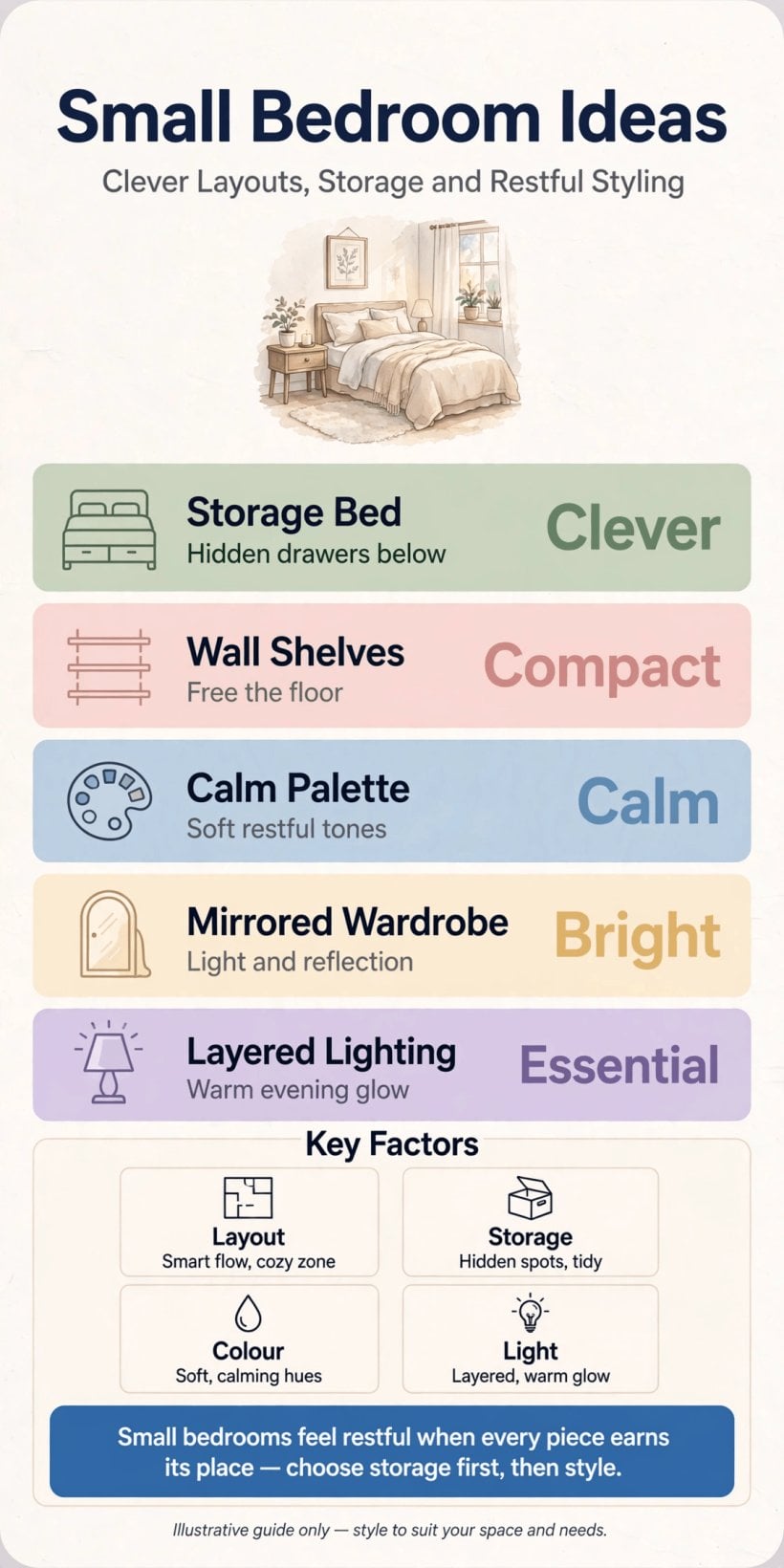
These small bedroom ideas work the problem in order: layout, the bed, storage, colour and light, furniture, the room’s real occupants, and the daily keeping that holds it all together.
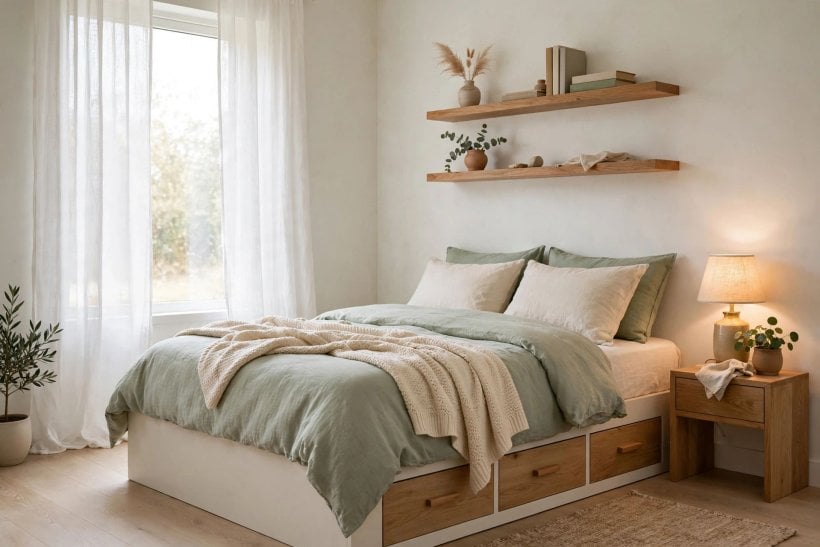
1. Small Bedroom Ideas at a Glance
The central entity is the small bedroom, defined by its attributes: a layout that protects the walkway and the window’s light, a bed specified as a system of frame, storage and cloth, storage fitted to the walls rather than scattered through the room, pale continuous colour, furniture that justifies its footprint twice, and a nightly reset that keeps the whole composition true. It links up to the bedroom pillar and stays strictly inside the small-space lane — master, modern and farmhouse bedrooms have their own posts.
| Question | Short answer |
|---|---|
| What is the first move in a small bedroom? | Layout: place the bed on the long wall, clear the door’s swing and keep the window wall low, before anything is bought. |
| Where does the storage go? | Into one fitted wall, under the bed in real drawers, and into alcoves — never scattered as boxes across the floor. |
| Which colours make it feel bigger? | One pale colour over walls and trim, pattern at a single scale, and texture — linen, wool, timber — doing the rich work. |
| How does it stay tidy? | A rule of three on every surface, everything given a parish, and a five-minute reset every night without exception. |
2. Layout First: Where the Bed, Door and Window Agree
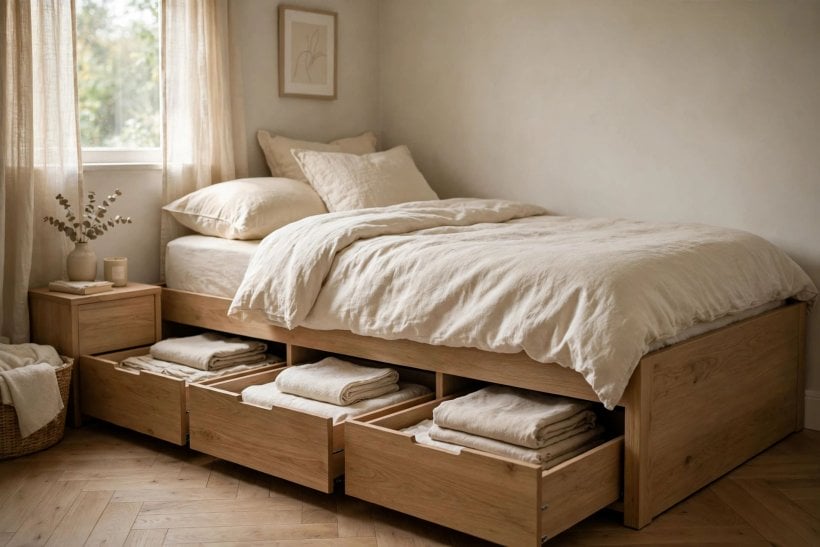
A small room rewards planning before shopping: measure the walls, the door’s swing and the window’s light, then place the bed where the room’s traffic can flow past it. The full survey this post belongs to is the bedroom ideas pillar; this section keeps strictly to the small-space layout decisions that pillar leaves to specialists like this one.
1. Centre the Bed on the Long Wall, Not in the Corner
A bed pushed into a corner reads as an apology and makes bed-making a climb.
2. Float the Bed Only When the Walkway Survives
Pulling the bed a hand’s width off the wall can ease making it and soften the room’s geometry.
3. Keep the Door’s Swing Clear of Furniture
A door that strikes a wardrobe or a chair announces a layout that was never drawn. Mark the swing on the floor before anything is bought, and let that honest arc evict whatever it condemns.
4. Put the Tallest Piece on the Shortest Wall
Wardrobes and shelves read as architecture when they fill the short wall completely, and as clutter when they scatter. One tall, complete wall frees the other three to stay low, pale and calm.
5. Let the Window Wall Stay Low and Open
Nothing tall under or beside the window: the light is the small room’s largest possession. Keep the sill line clear, the curtains wide of the glass, and the view doing the decorating it does for free.
6. Choose the Bed Size the Room Can Honestly Carry
The largest bed that leaves real passage on both sides beats the grander bed that turns the room into its own obstacle course. Sleep quality lives in the mattress; room quality lives in the space around it.
7. Use the Foot of the Bed, Never Block It
A slim bench, a low chest or a basket row at the foot earns its place by holding blankets and sitting shoes.
8. Give One Wall the Mirror, Opposite the Light
A generous mirror facing the window doubles the room’s daylight and its apparent depth at once. One large mirror composes; several small ones merely glitter — choose the single calm reflection.
9. Plan the Night Route Before the Day Look
From bed to door in the dark, barefoot, half asleep: that journey is the layout’s real examination. Keep its path clear, its corners padded by nothing sharper than cloth, and its light reachable from the pillow.
10. Draw the Room to Scale Once, on Paper
Ten minutes with a tape and a squared page prevents every expensive mistake in this section. Furniture that fits on paper fits in the room; furniture bought on hope fits in neither.
11. Leave One Empty Corner on Purpose
A small room with every corner filled reads as storage.
3. The Bed Itself: Frames, Headboards and Bedding That Save Space
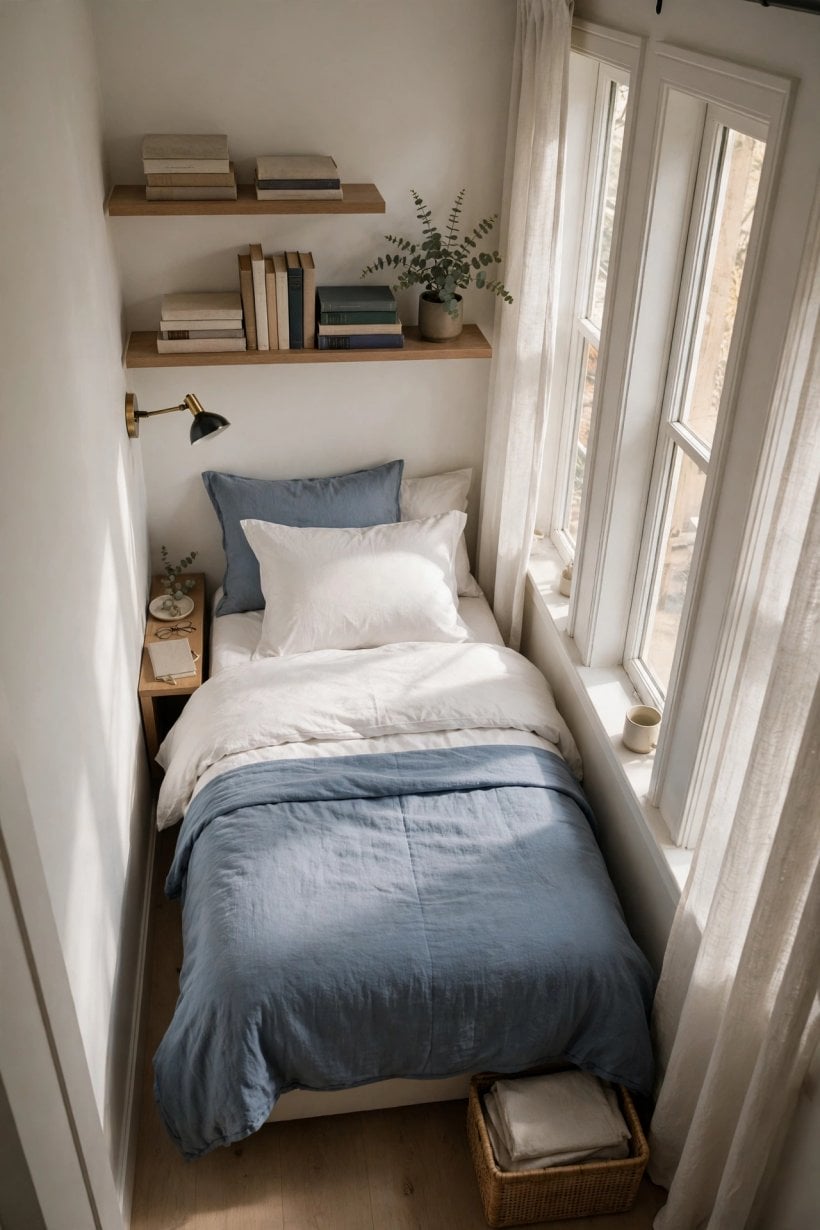
The bed is the small room’s largest object and its hardest worker, so it is specified like a system: frame, storage, headboard and cloth in one decision. Readers fitting out genuinely tiny sleeping quarters will find the same discipline at smaller scale in the small bedroom interior design ideas for tiny houses post; here the bed is tuned for ordinary small rooms.
12. Choose a Low Frame to Buy Headroom
A low platform frame makes ceilings feel higher and windows larger, and keeps the bed’s bulk below the room’s sight lines.
13. Let the Headboard Be Slim, Upholstered or Painted
A padded panel, a timber board or a painted arch behind the pillows gives the bed its ceremony without the deep carved headboard’s footprint. Wall-mounted and cushion-slim designs keep every centimetre for sleep.
14. Take Storage Drawers Under the Bed, or None at All
Drawers that roll fully out turn the bed’s footprint into the room’s best cupboard. The halfway alternative — loose boxes shoved underneath — collects dust and loses socks; commit to drawers or keep the under-bed honestly empty.
15. Dress the Bed in Layers, Not Bulk
Two light layers beat one heavy duvet in a small room, visually and practically: the bed looks composed, and warmth adjusts by folding. Keep the palette quiet and let one folded throw carry the room’s single pattern.
16. Keep Pillows to the Number That Sleep
Two sleeping pillows and one cushion is the small bed’s honest ration.
17. Use White or Pale Bedding as the Default Light
Pale linen reflects the window’s gift back into the room and makes the largest object in it read as air.
18. Tuck, Fold and Corner Like a Hotel Once a Week
A made bed is the small room’s tidiness engine: when the biggest surface is crisp, the whole room reads as ordered. The daily thirty-second version — smooth, fold, square — keeps the effect without the ceremony.
19. Fit a Slim Shelf Where a Nightstand Cannot Go
A wall ledge at pillow height holds the book, the glass and the phone where a bedside table would block the passage.
20. Let Curtains, Not the Bed, Carry the Drama
In a small room the dressed window is the safer theatre: full curtains and a good blind give the colour and pattern, leaving the bed calm.
21. Choose a Mattress for the Sleeper, Not the Showroom
Comfort is the bed’s one non-negotiable attribute, and it is invisible in photographs. Spend on the mattress, save on the frame’s ornament, and the small room will be forgiven everything else.
22. Keep the Bed’s Footprint Honest in a Shared Room
Where two people sleep small, circulation is a relationship issue disguised as furniture. Equal passage, equal light and equal storage end more arguments than any throw cushion ever has.
4. Storage That Earns Its Place: Walls, Drawers and Doors
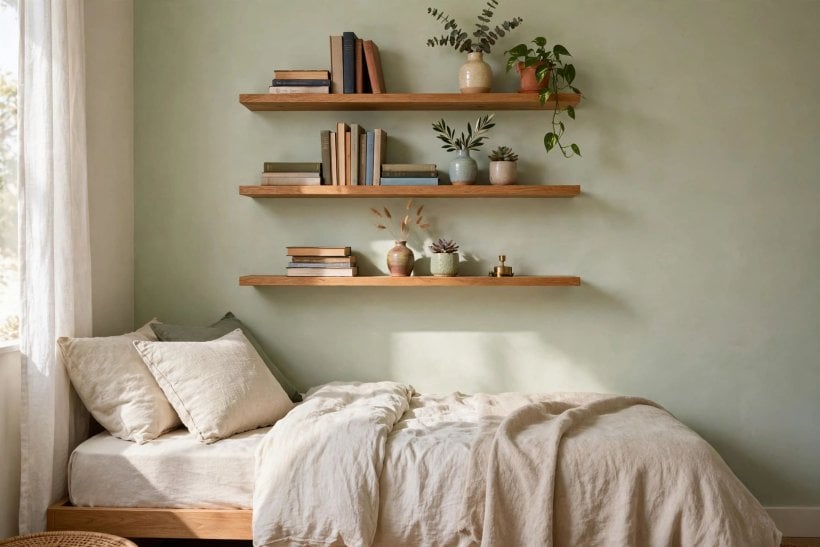
Small-room storage succeeds when it is architectural — fitted, vertical and complete — and fails when it is a fleet of small boxes. The wider philosophy of sleeping small is gathered in the tiny house bedroom ideas post; this section stays with the storage moves that ordinary small bedrooms can adopt whole.
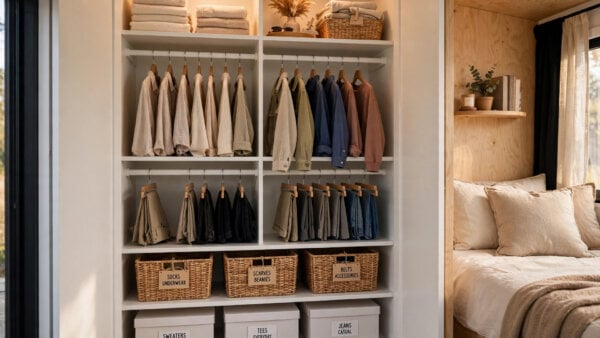
23. Fit One Wall of Storage, Floor to Ceiling
A single fitted wall of cupboards and drawers holds more, and looks calmer, than furniture scattered on three walls. Build it once, paint it with the room, and let every other wall stay free for light and air.
24. Hang Shelves High, Where the Room Is Empty Anyway
The band of wall above door height is the small room’s free warehouse. A single high shelf run for books and boxes uses space the eye rarely visits, leaving the living band of the room uncluttered.
25. Use the Back of the Door, Fully and Neatly
Hooks, a shoe rack or a mirror on the door’s back converts a swinging slab into storage. Keep it flat, light and silent — a door that rattles its cargo announces itself at every closing.
26. Choose Drawers Over Hanging Where Space Is Tight
Folded clothes in drawers use a wardrobe’s volume far more completely than hanging rails do. Keep hanging only for what truly creases, and let drawers — labelled by habit, not by hope — carry the rest.
27. Let Baskets Corral the Small Chaos
Chargers, creams, hair ties and the night’s small wreckage belong in one or two handsome baskets, not across every surface. A corralled mess reads as a system; a spread one reads as a spill.
28. Store by Season, Out of the Room Entirely
The small bedroom cannot house the whole year’s wardrobe and remain a bedroom. Off-season clothes belong in the loft, the hall cupboard or the suitcase under another bed — the room keeps only what the season wears.
29. Fit Drawers Into the Stair and Alcove Dead Zones
Alcoves, chimney breasts and the wedge beside the door are the small room’s found spaces. A drawer or shelf fitted exactly into each one converts architecture’s leftovers into the room’s hardest-working storage.
30. Keep Surfaces to a Rule of Three
Bedside, dresser and shelf: three objects maximum on any surface, chosen and dustable. The rule is arbitrary and absolute, which is why it works — a small room’s calm is mostly the discipline of its horizontal planes.
31. Use Under-Shelf and Rail Hooks Inside the Wardrobe
The wardrobe’s interior is a second room hiding inside the first. Hooks, a second short rail and shelf dividers double its honest capacity without touching the bedroom’s footprint at all.
32. Give Everything a Parish, and Evict the Homeless
An object without a home in a small room becomes a permanent traveller across its surfaces. Assign every category its place once; what cannot be homed is the room’s honest signal that it must leave.
33. Close the Storage: Doors and Lids Beat Open Display
Open shelves of clothes and boxes photograph bravely and live dustily.
5. Colour, Light and Cloth: Making Small Feel Generous
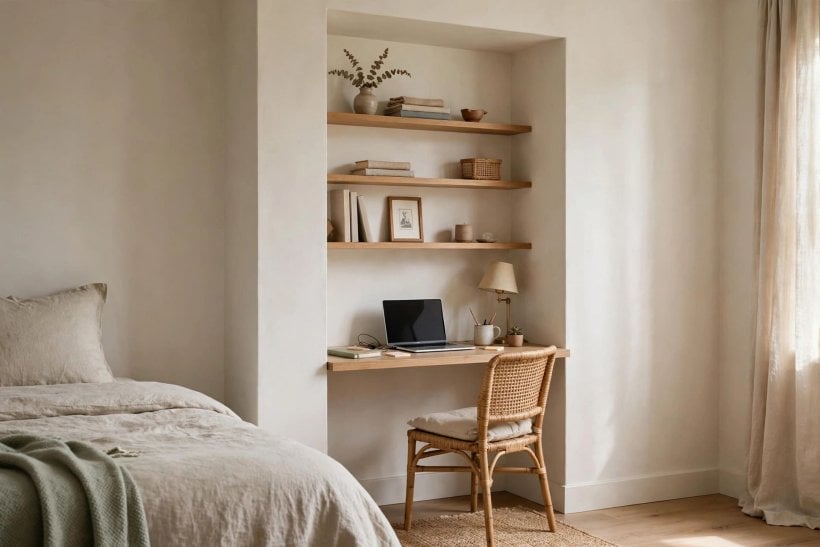
Colour cannot add a metre, but it can remove the feeling of the missing one. The temperature and undertone decisions behind these schemes are worked through in the tiny house interior paint colors post; here the palette is applied to the small bedroom’s walls, cloth and light.
34. Paint Walls and Trim One Pale Colour, Throughout
A single soft colour carried over walls, skirting and door removes the visual joints where a small room announces its edges. The eye travels uninterrupted, and uninterrupted travel is what spaciousness actually feels like.
35. Let One Wall Carry the Deep Colour, Behind the Bed
If depth is wanted, spend it on the headboard wall, where it reads as a backdrop rather than a boundary. The sleeper faces the pale room; the photograph gets its drama; both win.
36. Match Curtain Colour Closely to the Walls
Curtains that blend with the wall extend it; curtains that contrast cut it into slices. In the small room, cloth the colour of the walls, hung high and wide, makes the window wall read as one generous plane.
37. Layer Light at Three Heights: Ceiling, Lamp and Low Glow
A ceiling light for dressing, a lamp for reading and a low warm source for the evening wind-down: three modest lights compose a room that one bright fitting flattens.
38. Choose Warm Light for Sleep’s Sake
Warm-toned bulbs flatter skin, timber and pale paint, and tell the body the day is ending. Keep the small bedroom’s light warm and dimmable where possible; the room’s last hour should feel like dusk, not a clinic.
39. Keep the Floor Pale, Continuous and Mostly Visible
A light floor or a single generous rug under the bed extends the room’s apparent footprint.
40. Use Pattern at One Scale Only
A small room can carry pattern handsomely — on the cushion, the curtain or the paper of one wall — but competing scales quarrel in close quarters.
41. Let Texture Do What Colour Cannot
Linen, wool, cane, timber and one woven throw give a pale room its richness without a single loud colour. In small spaces, the hand reads luxury before the eye does; dress the room for touch.
42. Keep the Ceiling Painted Bright and Forgotten
The palest surface in the room should be overhead, matte and unconsidered. A ceiling that draws the eye has stolen attention from the room’s life; a bright quiet one quietly raises the roof.
43. Borrow Light From the Landing With a Glazed Door or Fanlight
Where rules and privacy allow, a glazed top panel or borrowed-light window feeds the small room the hall’s daylight. It is an old terrace-house trick, and it still outperforms any bulb.
44. Test Colour at the Room’s Darkest Hour
Paint reads twice as deep in a small north-facing room as on the shop’s card. Sample on the wall, live with it through an evening, and let the room’s own light have the final vote.
6. Furniture at Small Scale: Slim, Legged and Multi-Tasking
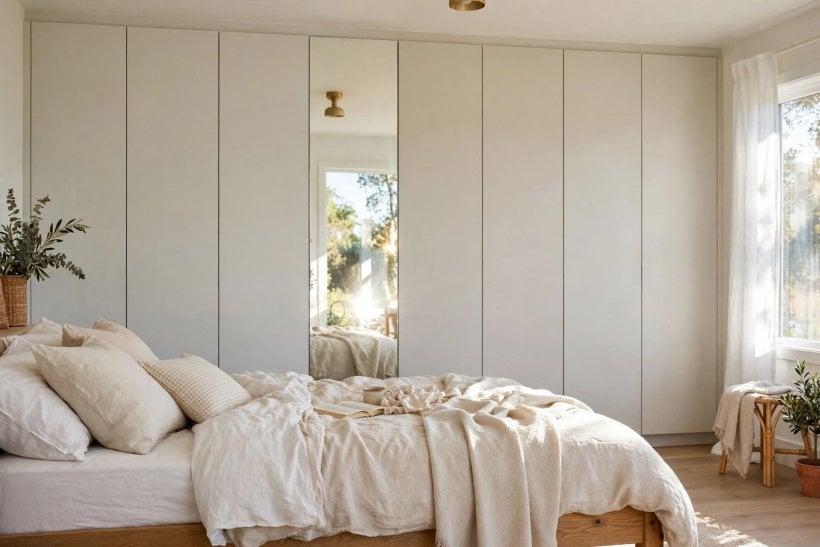
Every piece in a small bedroom must justify its footprint twice. The modern end of this discipline — pared forms and fitted pieces — is surveyed in the modern bedroom ideas post; this section applies the same tests piece by piece.
45. Choose Legged Furniture So the Floor Shows Through
Beds, chairs and dressers raised on legs let light and the eye pass underneath, and the room reads larger for every visible patch of floor. Plinth bases belong to big rooms with floor to spare.
46. Take the Wardrobe Shallow Where Hanging Allows
A wardrobe no deeper than its hangers need be reclaims a strip of room along its whole width. Fitted shallow, doors flat and handles recessed, it becomes wall rather than furniture.
47. Let One Chair Be the Room’s Only Guest
A single slim chair — for clothes in transit, for shoes, for sitting with a book — serves a small bedroom better than any suite. Choose it light enough to move one-handed; it will travel daily.
48. Use a Desk That Folds, Slides or Doubles as a Dressing Table
Work and dressing rarely need the room at the same hour. A fold-down desk or a dressing table that takes a laptop shares one footprint between two lives, and closes its work away at night.
49. Pick Nightstands as Drawers, Not Tables
A small chest of two drawers beside the bed stores the night’s needs; an open table merely displays them. In the small room, every surface should hide something, or it is charging rent for nothing.
50. Hang the Television, or Leave It Out Entirely
A screen on a wall arm costs no floor and folds flat; a screen on a stand costs a dresser’s worth of room.
51. Choose Round Corners Where the Route Is Tight
A round-edged bedside or a curved chair back forgives the hip-level collisions that small rooms schedule nightly. Where the walkway narrows, soften every corner the body will ever meet in the dark.
52. Keep One Piece of Real Timber for Warmth
In a pale, fitted, efficient room, one honest timber piece — a stool, a tray, the chair — keeps the space from feeling like a cabin on a ship. Efficiency needs a heartbeat; wood is the cheapest one.
53. Measure Furniture by Its Delivered Size, Not Its Photograph
Online dimensions lie by omission: doors, stairs and the room’s own swing decide what can actually arrive. Measure the whole route before ordering, or the perfect dresser becomes a landing ornament.
54. Let the Laundry Basket Be Furniture-Grade
It will be seen every day of its life. A lidded, handsome basket earns its permanent corner; a plastic sack in the doorway taxes the room’s calm at every glance.
55. Buy the Second Piece Only When the First Has Failed Honestly
Small rooms punish speculative furniture. Live with the layout a month, name the genuine lack, then buy exactly that — the room’s discipline is protected by shopping last, not first.
7. Small Rooms for Children, Guests and Teenagers
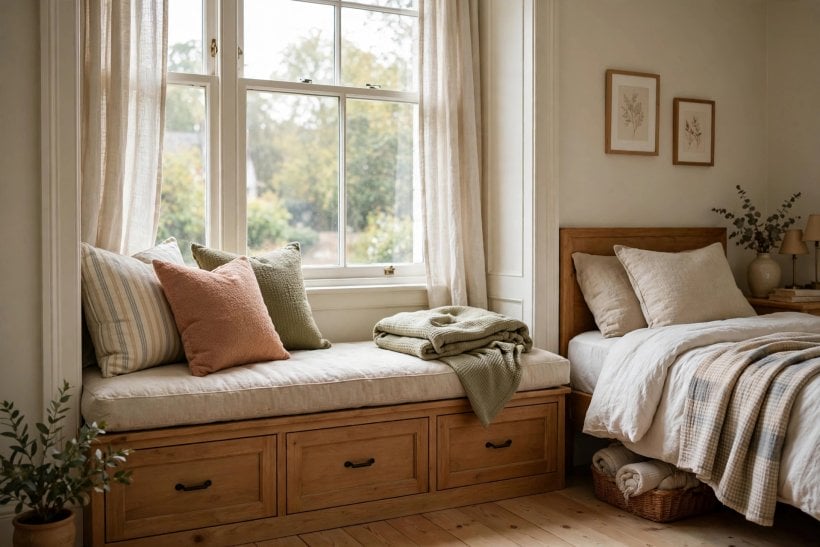
One small room, three different lives: the child’s, the guest’s and the teenager’s. The farmhouse answer to family sleeping is told in the farmhouse bedroom ideas post; this section fits the small room to its actual occupant.
56. Give a Child’s Small Room Zones, Not Just Furniture
Sleep, play and clothes in three small parishes the child can name. Zones a six-year-old can maintain beat storage a parent must police, and the room stays resettable in five minutes.
57. Take Children’s Beds With Storage or a Trundle
A drawer bed swallows the toy tide; a trundle swallows the sleepover. In a child’s small room, the bed is the largest storage opportunity in the house — spend it deliberately.
58. Keep a Guest Room Honest: Bed, Hook, Luggage Place
Guests need a good bed, somewhere to hang a shirt, a surface for a bag and a light to read by.
59. Let the Guest Bed Double as the Room’s Day Use
A daybed or a good sofa bed lets the small spare room work as a study or snug between visits. The room earns its keep weekly, not twice a year, and guests still sleep properly.
60. Give a Teenager a Door That Closes and Storage That Shuts
Privacy and concealment are the teenage room’s twin needs. A small room with a real door, lidded storage and one wall the teenager owns outright will be kept better than any room designed at them.
61. Fit Study Into the Small Room Without Colonising Sleep
A slim desk under the window, a shelf above it, and a chair that tucks fully away. Keep the desk’s parish at the room’s bright edge, and the bed’s parish calm at its quiet one.
62. Use Bunks or a High Sleeper Only Where the Ceiling Earns It
Stacked sleep frees a whole wall’s worth of floor, but a bunk under a low ceiling is a cave with a ladder. Where height allows, the high sleeper with desk beneath is the small room’s single biggest win.
63. Keep Children’s Colour in the Replaceable Layers
Walls pale and lasting; the beloved colour in bedding, cushions and the rug, replaced as tastes revolve. A small room repainted at every phase teaches the wrong lesson — layers change, bones stay.
64. Let Siblings Sharing Small Have Equal, Marked Territory
Two drawers each, two shelves each, a line — literal or agreed — down the room’s middle. Fairness drawn on the plan prevents the nightly negotiations that shared small rooms are famous for.
65. Plan the Room’s Next Life at the Start
The nursery becomes the child’s room becomes the teenager’s: choose the bed, storage and colours that can be re-dressed rather than replaced. Small rooms reward furniture bought for the decade, not the season.
8. Rest, Air and the Daily Keeping of a Small Room
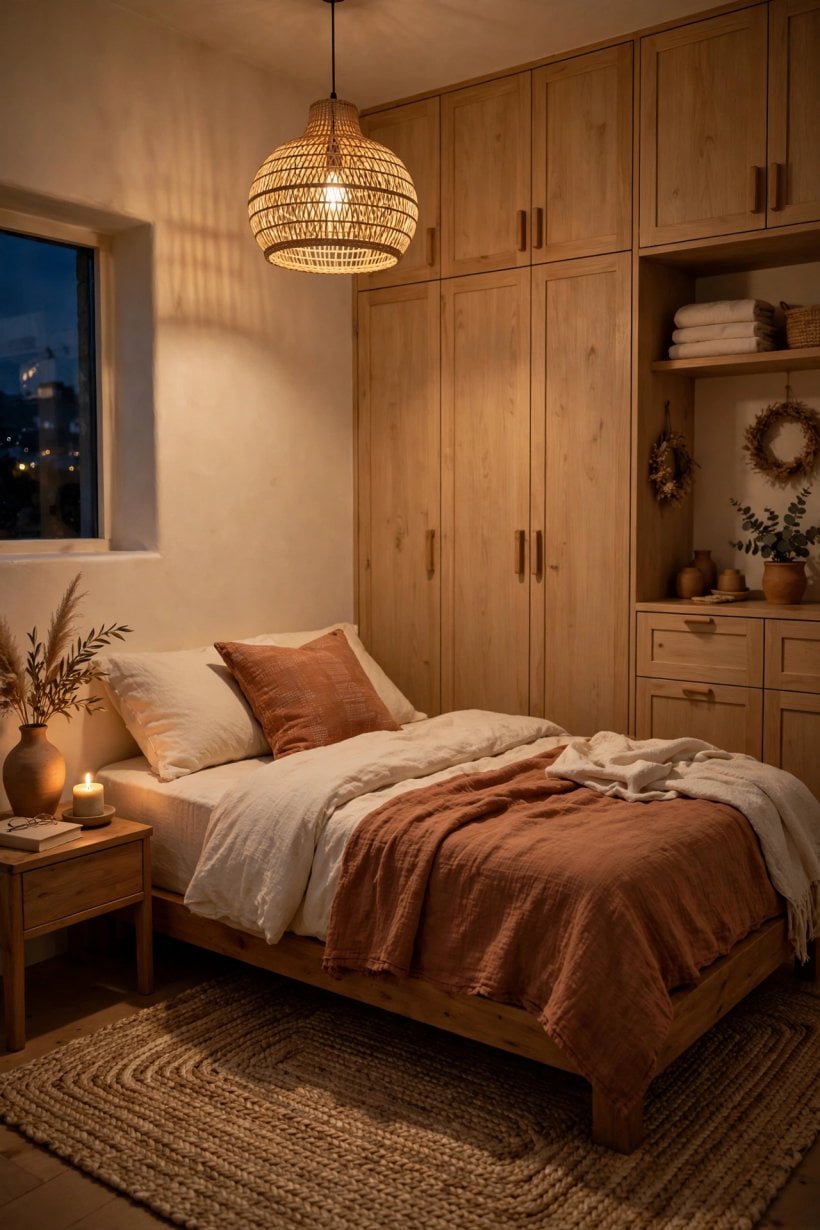
A small bedroom stays lovely by routine more than by renovation. The calm, colour-led version of this closing discipline is explored in the gray bedroom ideas post; here the keeping is practical: air, quiet and the five-minute reset.
66. Air the Room Daily, Even in Winter
Ten minutes of open window clears the night’s closeness from a small room faster than any scent. Bedding folded back while the room airs is the oldest housekeeping in this post, and still the most effective.
67. Keep Scent to Clean Cloth and Open Air
A small room amplifies fragrance as it amplifies clutter. Washed linen, aired blankets and one plant outperform every diffuser; where scent is used, let it whisper from the wardrobe, not shout from the pillow.
68. Silence the Small Room’s Small Noises
Felt pads on drawers, a rug where feet land, curtains that swallow the street: quiet is a material in a small bedroom. Audit the room at midnight, when its squeaks and rattles present themselves for fixing.
69. Reset the Room in Five Minutes, Nightly
Bed squared, clothes homed, surfaces back to three, baskets shut: the nightly five-minute reset is why small rooms in this post look composed in the morning. Disorder compounds overnight if it is allowed to sleep in.
70. Wash and Rotate Bedding Before It Asks
In a small room the bed is the view; tired linen is a tired room. A weekly wash and a spare set in the drawer keep the largest surface in the room permanently at its best.
71. Keep One Plant That Thrives on Neglect
A single forgiving plant on the sill softens the small room’s geometry and reports on its air. Choose the plant for the light the room actually has, not the light the photograph wishes it had.
72. Store Suitcases and Boxes Anywhere Else
The small bedroom is prime land; archives and luggage are its worst tenants. Every bulky non-sleeping object evicted returns its footprint in calm, which is the room’s true currency.
73. Let the Door Close on a Finished Room
The habit that holds all the others: never leave the small bedroom mid-task. Finish the fold, home the basket, close the wardrobe — a room always left complete is a room always ready to rest in.
74. Review the Room Each Season With Fresh Eyes
Stand in the doorway as a guest would. What has crept, sagged or multiplied since spring announces itself at once to the doorway view — the small room’s honest mirror, consulted four times a year.
75. Remember the Small Room’s Advantage: It Forgives Fast
One hour of work transforms a small bedroom completely — a mercy no large room offers. The small room is not the compromise; kept with this discipline, it is the easiest beautiful room in the house.
9. Checks and Mistakes: Before the First Pour or Purchase
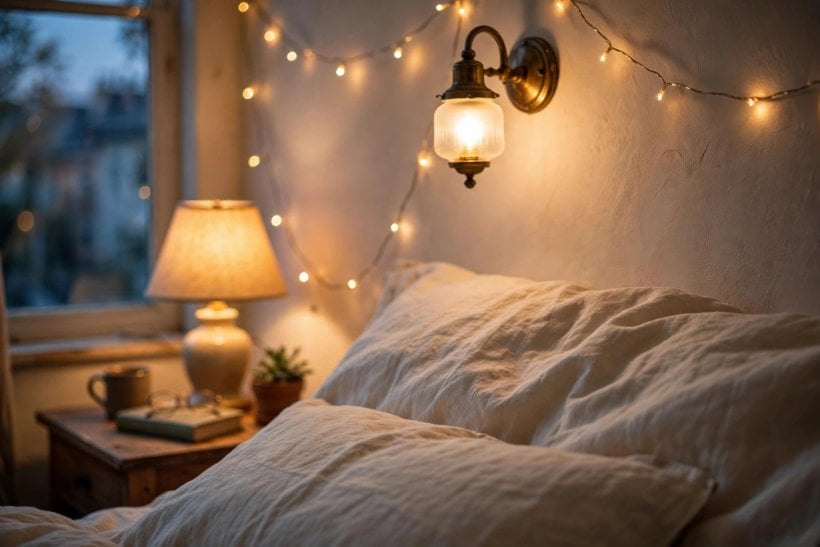
Check a small bedroom the way this post checked its subjects: measure the room, mark the door’s swing and the walkway on the floor, photograph it from the doorway, and live with the layout a week before buying anything. Most small-room failures are purchases made before the plan existed.
Check every idea against the room’s real light and its real occupant: a scheme that flatters a bright guest room can gloomy a north-facing child’s room. The transferable part of every idea here is the decision underneath — proportion, storage and calm — never the photograph on top.
The common mistakes are all impatience: the too-large bed, the scattered boxes, the second speculative chair. Each is avoided by this post’s order — plan, bed, storage, colour, furniture — and by finishing one stage before funding the next.
10. Costs and Pulling It Together
Costs stay qualitative, as honest decorating must: the economical end of the small bedroom is labour and discipline — measuring, painting one colour, homing every object — and the expensive end is fitted storage and a good mattress, both bought once and amortised over a decade of mornings. Money spent in this post’s order is rarely wasted, because the free steps come first.
Pull it together in the sequence kept here: layout, bed, storage, colour and light, furniture, the occupant’s real life, then the keeping. Followed in that order, these seventy-five ideas stop being a list and become the smallest, calmest room in the house — finished, and easy to keep finished.
Final Considerations
The small bedroom is not the house’s leftover; planned honestly, it is its refuge perfected. Measure once, fit the storage to the walls, keep the palette calm and the reset nightly — and the little room at the end of the landing becomes the one everyone quietly envies.

0 Comments