
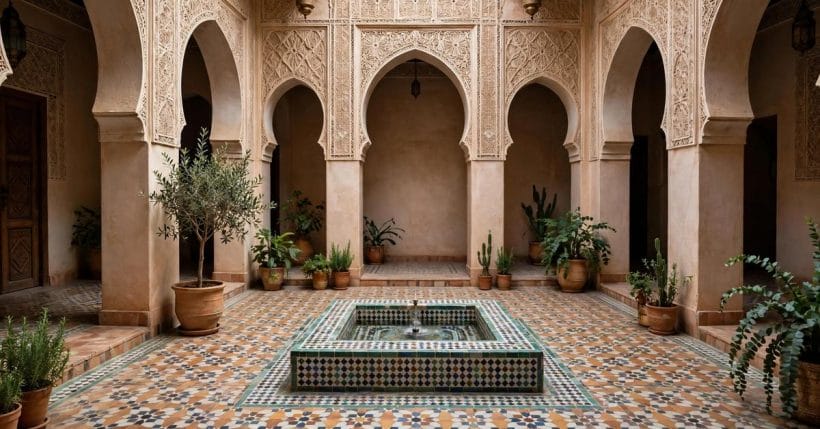
Moroccan style is the opposite of the all-white room. It layers jewel colour over earthy plaster, geometry over geometry, and warm metal light over deep shade — and somehow, handled well, the result is not noise but calm. It is a look built over centuries in the courtyards, workshops and markets of North Africa, and its raw materials are humble: lime plaster, glazed clay, carved wood, pierced brass and wool.
This explainer covers the style in general terms — its colour, pattern, tile, arches, metalwork and textiles — and how to borrow its warmth for an ordinary room without turning the room into a stage set.
1. Moroccan Style at a Glance
Scope first. This post owns the style as a whole: its elements, its logic and its use at home. Neighbouring world-style reading lives elsewhere on the site — small Japanese garden ideas for the quiet opposite pole outdoors, and courtyard landscaping ideas for the enclosed outdoor room this style is built around. Here, everything is Morocco — colour, pattern and craft.
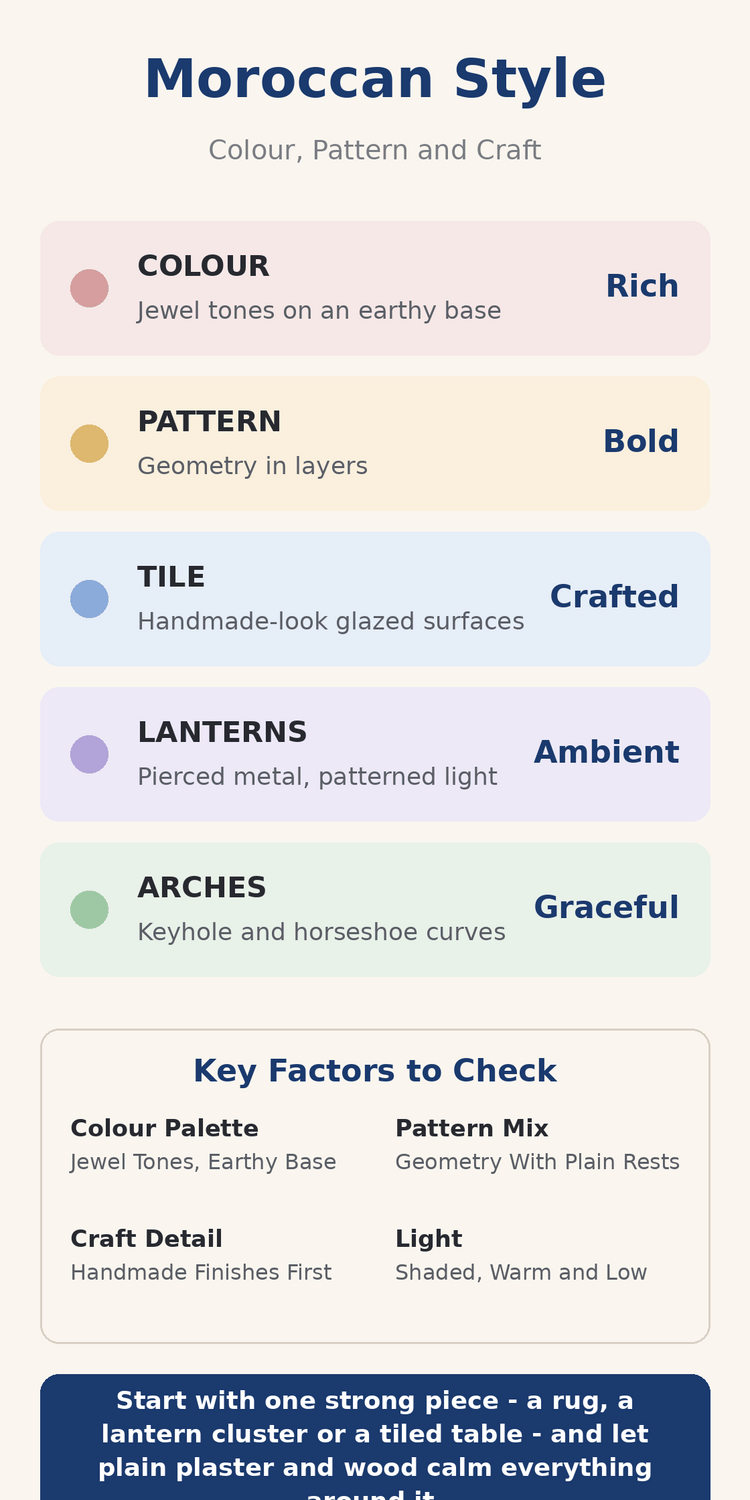
The five elements in the table are the whole look in miniature. Each one is strong; the style works because plain plaster, shade and wood give them room to breathe.
A word on approach before the tour: Moroccan style is a living tradition, not a museum period, and it is still being made daily by working craftspeople. The honest way to borrow from it is the way this explainer tries to teach — understand the materials and the rules first, then let objects follow. Rooms assembled from the rules outward age well; rooms assembled from a shopping list of “Moroccan pieces” rarely do.
| Element | Character | What it means |
|---|---|---|
| Colour | Rich | Jewel tones and spice colours over an earthy base |
| Pattern | Bold | Geometry layered in tile, plaster, wood and weave |
| Tile | Crafted | Handmade-look glazed tile with living variation |
| Lanterns | Ambient | Pierced metal throwing patterned, low light |
| Arches | Graceful | Keyhole and horseshoe curves softening doorways |
2. Where the Look Comes From: Courtyards and Craft
1. The inward-looking house
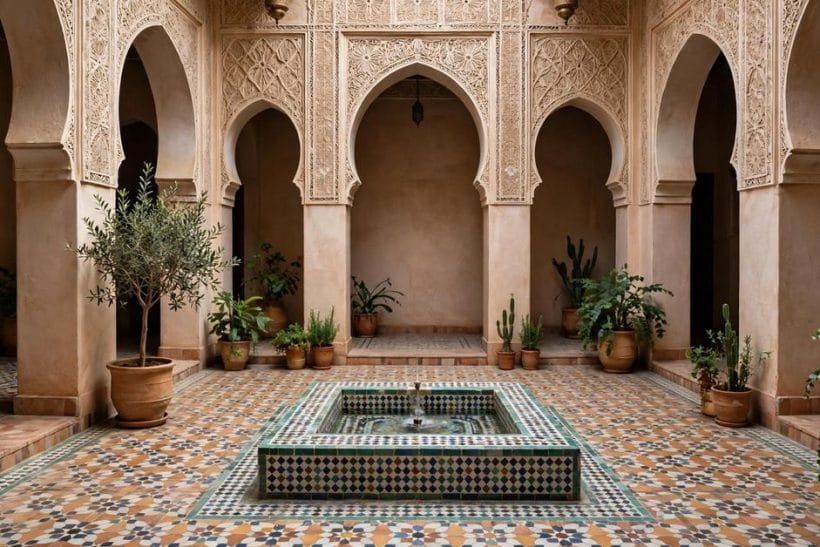
Traditional Moroccan houses turn inward: plain walls to the street, life arranged around a shaded courtyard or riad garden where air, water and tile keep the heat at bay. The style’s love of enclosed, layered, low-lit rooms comes straight from that plan — decoration lavished on the inside, where the family actually lives.
2. Craft traditions, not a theme
Almost everything in the look is a craft before it is a decoration: tiles cut and glazed by hand, plaster carved while wet, cedar carved and painted, brass pierced with a punch, wool knotted into rugs. The slight irregularity in each piece is not a flaw to forgive; it is the signature that makes the whole feel human.
3. A crossroads palette
Morocco sits where Africa, Arabia and the Mediterranean meet, and the style carries all three: desert earths and spice-market reds, deep Mediterranean blues and greens, and an old love of gilding and silvered metal. The palette feels exotic to northern eyes mainly because it refuses to be pale.
3. Colour: Jewel Tones on an Earthy Base
4. The earthy ground
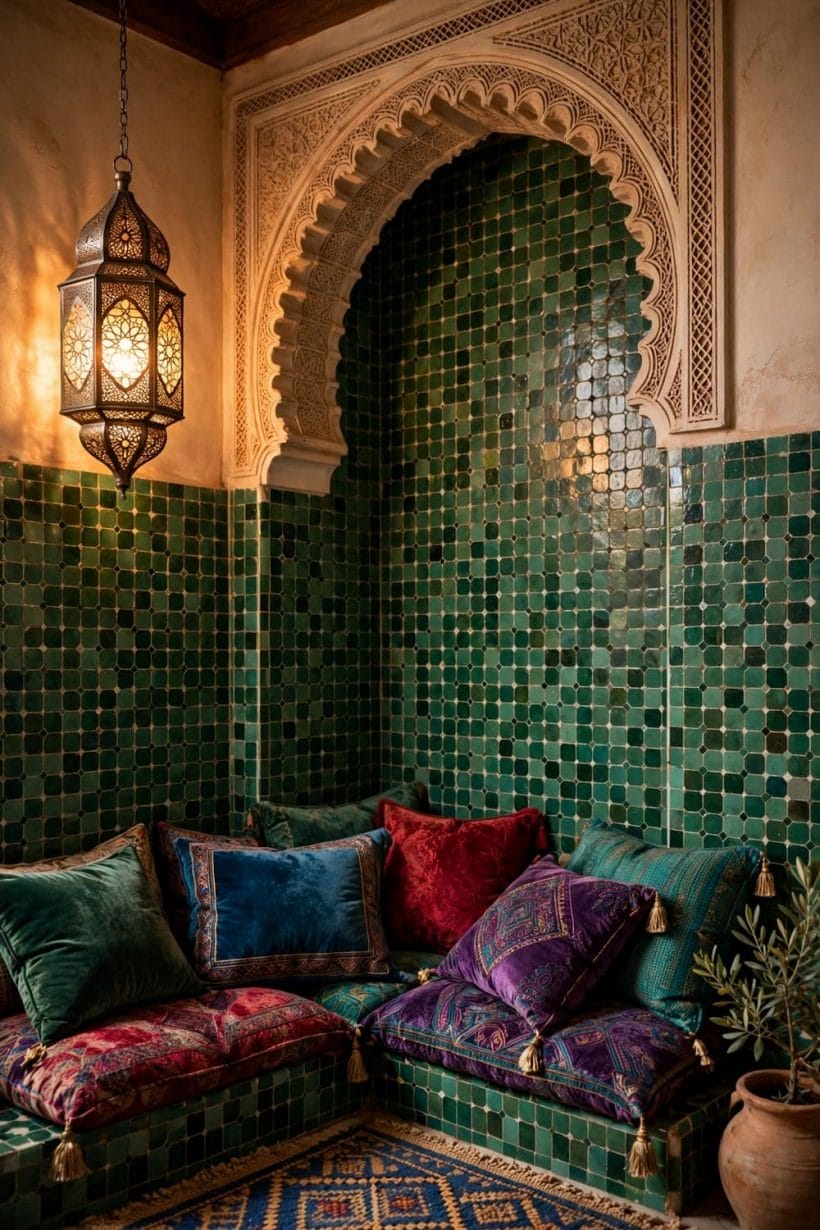
Under everything sits earth: tadelakt-style plaster in sand, clay and warm stone tones, unglazed terracotta underfoot, natural cedar and walnut. This ground matters more than the famous colours — it is what stops saffron, indigo and pomegranate from shouting, by giving them something warm and matte to sit on.
5. The jewel layer
Against the ground, the jewels: deep blue, emerald and teal; saffron and amber; pomegranate red and plum. They appear in tile, glass, textile and painted wood rather than on every wall, and they are almost always slightly smoky rather than bright — colours aged by sun and limewash, not mixed yesterday.
6. How much colour is enough
The traditional answer is: one strong colour per surface family, repeated until it becomes the room’s rhythm. A blue that appears in the tile, the door and the cushions reads as design; six competing jewels read as a market stall. Choose your lead colour the way the courtyard houses do and let the rest be earth and metal.
Light is a colour in these rooms too. Interiors built for bright sun use colour the way northern rooms use wallpaper: the strong tones are calibrated for shade, filtered through screens, shutters and courtyard shadow. When the same palette travels north into weak grey daylight, it often wants lightening a step — the earthy ground warmed, the jewels reserved for smaller areas that lamplight can reach.
4. Pattern: Geometry in Layers
7. The geometric habit
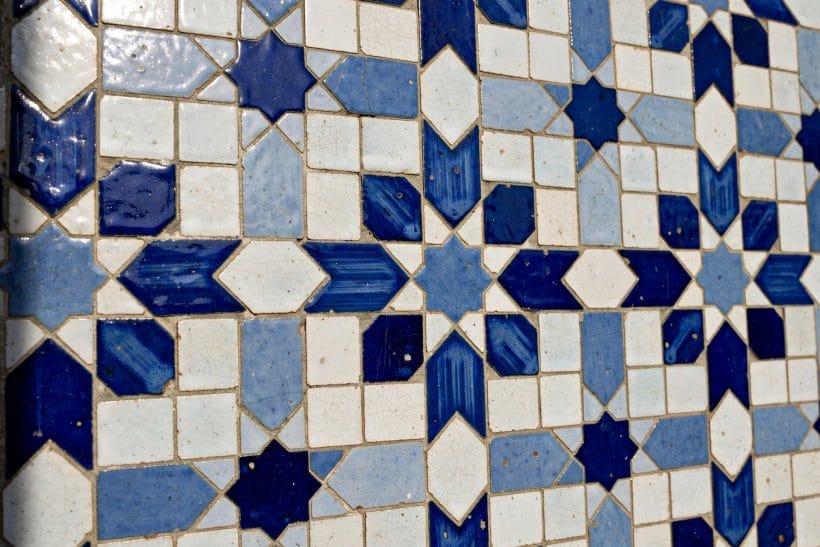
Moroccan pattern is overwhelmingly geometric: eight-pointed stars, trellis, interlacing grids and radiating medallions, worked out with compass and rule long before they are cut in tile or carved in plaster. The geometry is not cold — repeated at small scale and softened by handmade edges, it shimmers like water.
8. Layering without chaos
Several patterns can share a room because they take turns: a busy floor under plain walls, a patterned tile field framed by a plain border, a riotous rug beneath simple cushions. The rule is alternation — pattern, rest, pattern — and it is the same rule that keeps ceramic tile living room ideas from overwhelming a floor.
9. Pattern in small crafts
Where a whole surface is too much, pattern shrinks into objects: an inlaid tray table, a carved stool, embroidery along a cushion edge, the pierced skin of a lantern scattering pattern as light. Small doses carry the style’s DNA into rooms that could never take a tiled wall.
5. Tile: Glazed Surfaces With a Living Surface
10. Zellige character
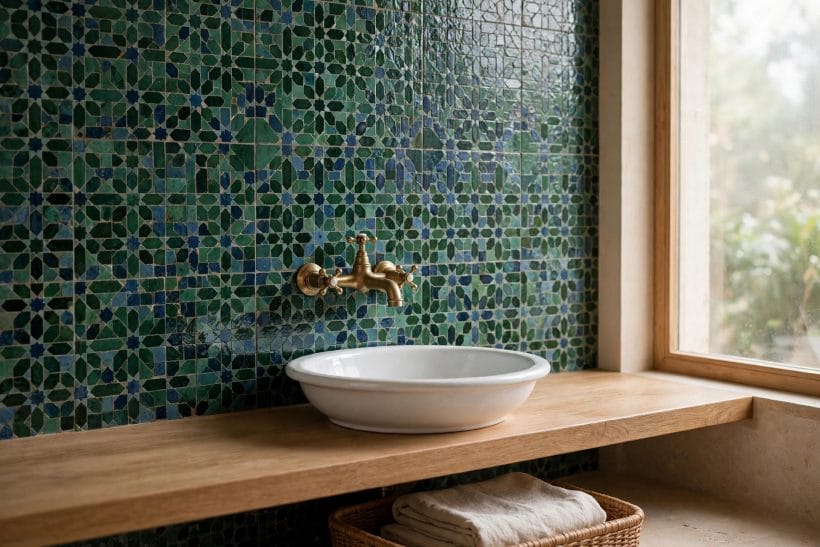
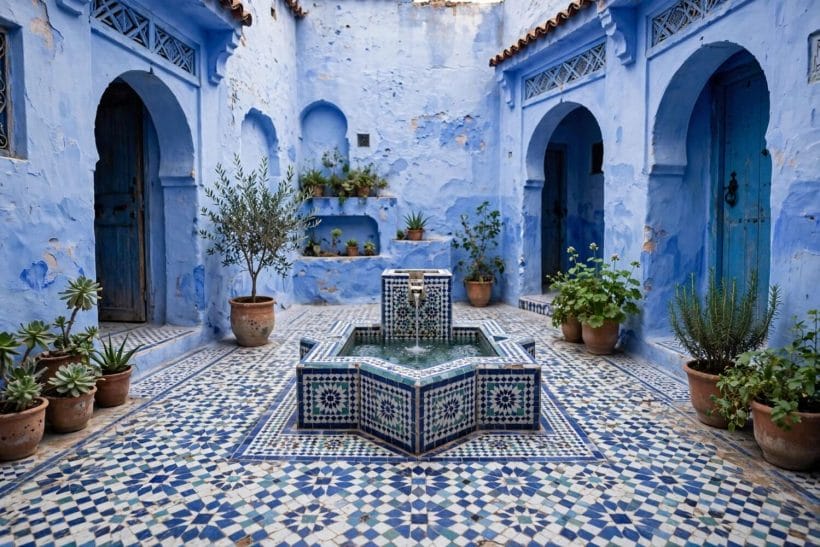
The famous mosaic tilework — small glazed pieces cut by hand and set edge to edge — is prized precisely because no two pieces sit perfectly flat or share exactly the same tone. Light moves across it all day. Machine-made tiles that imitate the look aim for the same lesson: variation is the luxury.
11. Where tile belongs
Tile climbs where water and wear demand it and where the eye lands: fountain and courtyard walls, kitchen and bathroom splash zones, stair risers, fireplace surrounds, table tops. Used as wainscot-high fields with plaster above, it gives a room its jewel layer without closing it in — a trick that also works for the patterned fields in black and white tile bathroom ideas.
12. Floors of tile and stone
Underfoot, the classics are patterned cement-style tiles, plain terracotta, and stone in warm limestone tones, often laid as a patterned field inside a plain border like a rug made of minerals. Floors stay matte; the shine is saved for walls and metal.
Care is simpler than the fragility suggests: glazed tile wants only washing and the avoidance of harsh scouring; the grout lines, being many, want resealing on the same rhythm as any bathroom tile. What tile cannot survive is being treated as a printed surface — it is a mineral skin, and it ages the way stone does, deepening rather than wearing out.
6. Arches, Niches and Carved Plaster
13. The keyhole arch
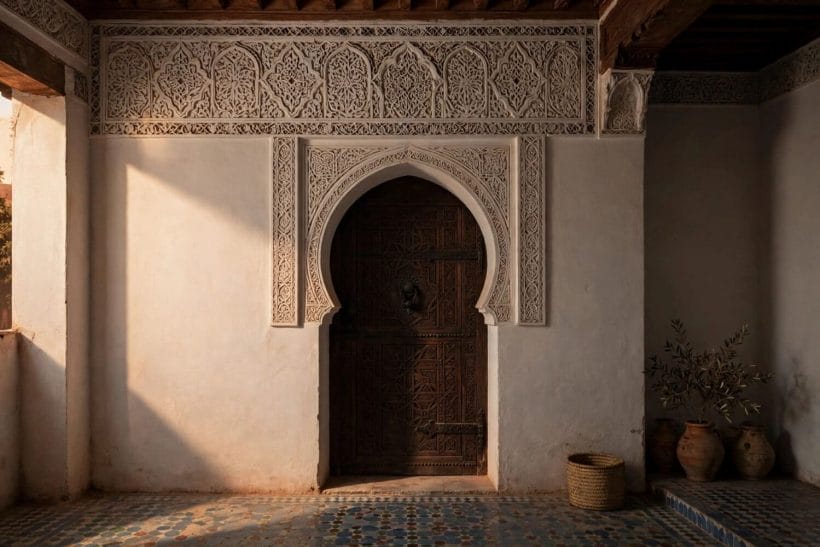
The style’s signature opening swells wider than a semicircle before narrowing at its springing — the keyhole or horseshoe arch — used for doorways, niches, mirrors and even headboards. It softens a room’s geometry the way a curved back softens a chair: everything rectangular around it relaxes.
14. Carved plaster
Plaster in skilled hands is a carving material: friezes of interlace and calligraphic bands run at cornice height, and muqarnas — the stalactite-like carved cells — gather in the corners of grand rooms. At home scale the same idea survives as a carved plaster panel or a deeply moulded niche.
15. Niches and built-in benches
Walls in this style are thick and useful: arched niches hold lamps and pottery, and masonry benches built along a wall, heaped with cushions, replace freestanding sofas. The built-in habit is worth borrowing anywhere — it is architecture doing the furniture’s job, as the built-in benches of the bungalow interior ideas also show.
7. Metal, Lanterns and Light
16. Pierced metal lanterns
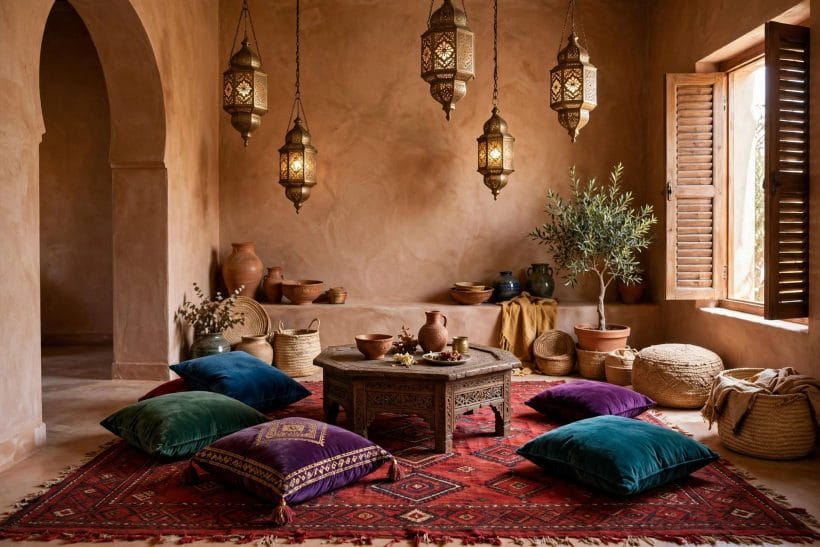
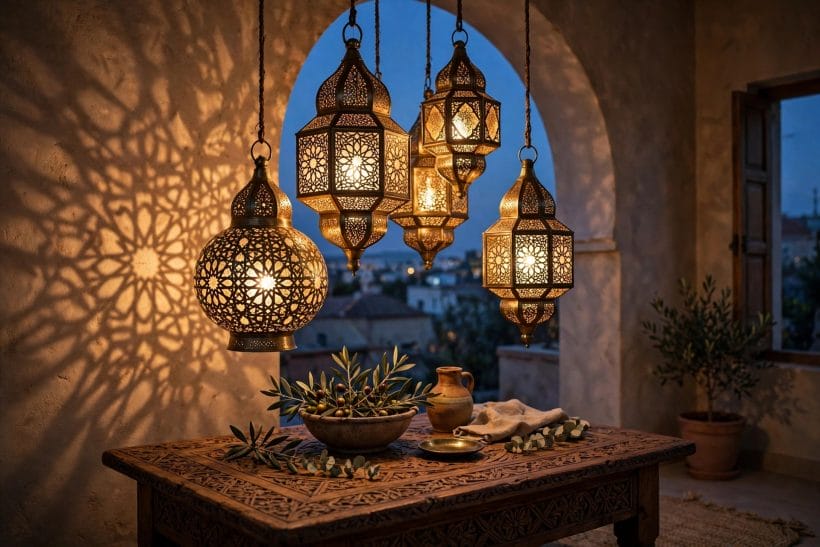
The lantern is the style’s lamp and its jewellery in one: brass, copper or silvered metal pierced with hundreds of small holes, so a single bulb becomes a constellation and the walls receive a lace of light. Hung in odd-numbered clusters at uneven heights, they do the work chandeliers do elsewhere — at a murmur instead of a blaze.
17. Light kept low and warm
Moroccan rooms are lit like evenings: low sources, warm tones, light thrown onto carved and tiled surfaces rather than into eyes. Candles in coloured glass, lanterns on the floor, sconces washing a plaster frieze — the aim is glow with shadow left in it, the opposite of the evenly lit modern box.
18. Metal beyond lamps
The same metals recur everywhere: engraved tray tables on folding stands, hammered bowls and teapots, studded and inlaid doors, mirror frames of pierced or bone-inlaid wood. Metal is the style’s connective tissue, the glint that ties tile to textile.
Practical note for modern wiring: lanterns made as candle lamps convert readily to electric with a little professional help, and should be converted — open flames inside pierced metal near textiles is the tradition’s one habit not worth importing. Electric conversions keep the patterned light and lose only the fire risk.
8. Textiles: Rugs, Cushions and Low Seating
19. Rugs with a tribal grammar
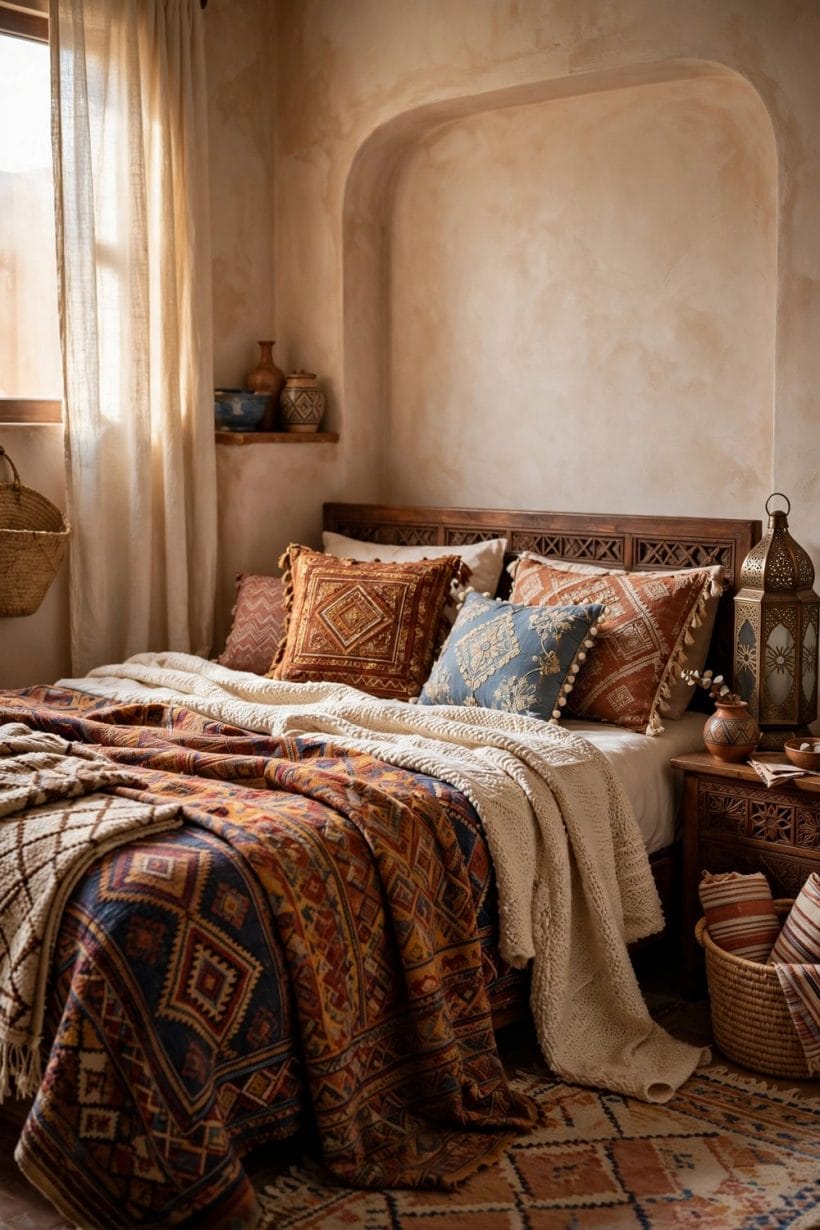
Moroccan rugs range from deep-pile, ivory-ground tribal weavings with wandering dark line patterns to flatwoven kilims in saturated stripes. Both share a handmade looseness — motifs that drift, borders that improvise. A single such rug can furnish a plain room’s entire personality.
20. Cushions as furniture
Seating in this style is low and soft: floor cushions, poufs of embroidered leather, daybeds and benches buried in pillows of silk, wool and brocade. The informality is deliberate — rooms arrange themselves around conversation and tea rather than around a screen.
21. Layers of cloth
Textiles layer as freely as pattern: rugs over tile, throws over cushions, sheer curtains filtering courtyard glare, canopies and draped cloth softening a ceiling line. Nothing is precious; everything is touchable. That tactile depth is what photographs of the style can never quite capture and rooms must.
9. Moroccan Style Room by Room
22. Living rooms
Start with the ground — warm plaster tones, a serious rug — then build the low seating line, add carved or inlaid tables, and finish with lantern light. One tiled or carved feature, on the fireplace wall or an alcove, gives the room its jewel without a full renovation.
23. Bathrooms and kitchens
These are tile’s home ground: a glazed splashback in deep green or blue, a tiled shower or bath surround, brass taps and a pierced-metal light. Kitchens take the same recipe with the addition of open shelves for pottery and hammered pans. Keep grout tones quiet so the glaze does the talking.
24. Bedrooms and courtyards
Bedrooms soften the palette — ivory weaving, pale plaster, pattern confined to the bed’s textiles and one carved screen — while courtyards and patios take the full treatment: tile, fountain, lanterns and shade. The courtyard is where the style began, and even a small terrace answers well to it, much as the enclosed gardens in courtyard landscaping ideas suggest.
10. Bringing It Home Without Overdoing It
25. Start with one strong piece
The safest route in is a single authentic-feeling anchor — a rug, a cluster of lanterns, a carved screen, a tiled table — set against calm, plain surroundings. One strong piece reads as taste; ten competing ones read as a souvenir shop. The measured, one-idea-at-a-time approach is the same discipline that makes Scandinavian home design ideas work at the opposite pole of ornament.
26. Respect the crafts
Where you can, buy the real handmade thing from its makers and traders rather than a printed imitation: the irregular glaze, the hand-knotted pile and the pierced-by-hand lantern carry the style in a way surface prints never will. Fewer, better pieces is not a compromise here; it is the tradition.
27. Keep the rests plain
Every successful Moroccan-style room keeps its rests: plain plaster walls, quiet floors, unpatterned upholstery somewhere in the mix. Pattern needs silence around it to sound like music. If a room feels like too much, the cure is rarely removing the beautiful thing — it is quieting what surrounds it.
Final Considerations
Moroccan style endures because it is built from real materials worked by hand — plaster, clay, cedar, brass and wool — arranged by rules anyone can learn: earth first, jewel second, pattern in layers with plain rests, and light kept low and warm. Borrow those rules in any measure, from a single lantern to a whole courtyard room, and the style gives back what it has always given the houses it comes from: shade, glow and welcome.

0 Comments