

A quarter acre is smaller than you think — and larger than you imagine, once every bed, tree and hen is in its right place.
This complete small-scale plan divides one modest plot into clear zones, then connects them with paths, water and compost, so a small farm feeds a household without eating its weekends.
1. The Shape of a Quarter Acre: Zones Before Beds
A good quarter acre farm layout begins with zones, not with a shopping list of plants. On a plot this size — roughly a generous town garden or a small paddock corner — every square metre must hold one job, and the layout works when those jobs sit in the right relationship. Put the house and its deep beds at one end, where the kitchen door opens onto the herbs and salads you pick daily. Give the orchard rows the long middle ground, where trees can grow undisturbed for decades. Reserve one far corner for small livestock, close enough to feed in the rain, far enough that summer smells drift away from the house. Let paths, the compost yard and water storage stitch the three together.
Walk the plot in every season you can before you commit. Note where the sun stands at breakfast and at dusk, where frost settles, where rain runs and pools, and which boundary the prevailing wind leans on. Those observations decide orientation more honestly than any compass point: beds run to catch light, trees shelter the garden from wind, and the livestock corner sits downwind and downhill of the house. If your ambitions or your family grow beyond this scale, the same zoning logic stretches gracefully — compare the half acre homestead layout with zones for gardens, animals and water, and keep the hub of small-home thinking in the wider tiny house floor plans collection in mind for the dwelling end of the plot.
| Zone | Share of the plot | What goes there | Water | Key rule |
|---|---|---|---|---|
| House and deep beds | The house end, roughly two-fifths | Cottage, kitchen garden, deep beds, herbs, greenhouse or cold frames | House supply and roof tank | Daily crops within a few steps of the kitchen door |
| Orchard rows | The long middle, roughly a third | Fruit trees in rows, soft fruit, comfrey and mulch crops underneath | Drip line from the main tank | Plant once, harvest for decades — spacing is forever |
| Small livestock corner | The far corner, roughly a tenth | Poultry run, rabbit hutches, small shelter, feed store | Drinker line and a standpipe | Downwind, downhill, and reachable in bad weather |
| Paths, compost and work yard | The remainder, woven between zones | Main path, compost bays, tool shed, wood store, parking | Standpipe at the yard | Every zone reachable by wheelbarrow without lifting |
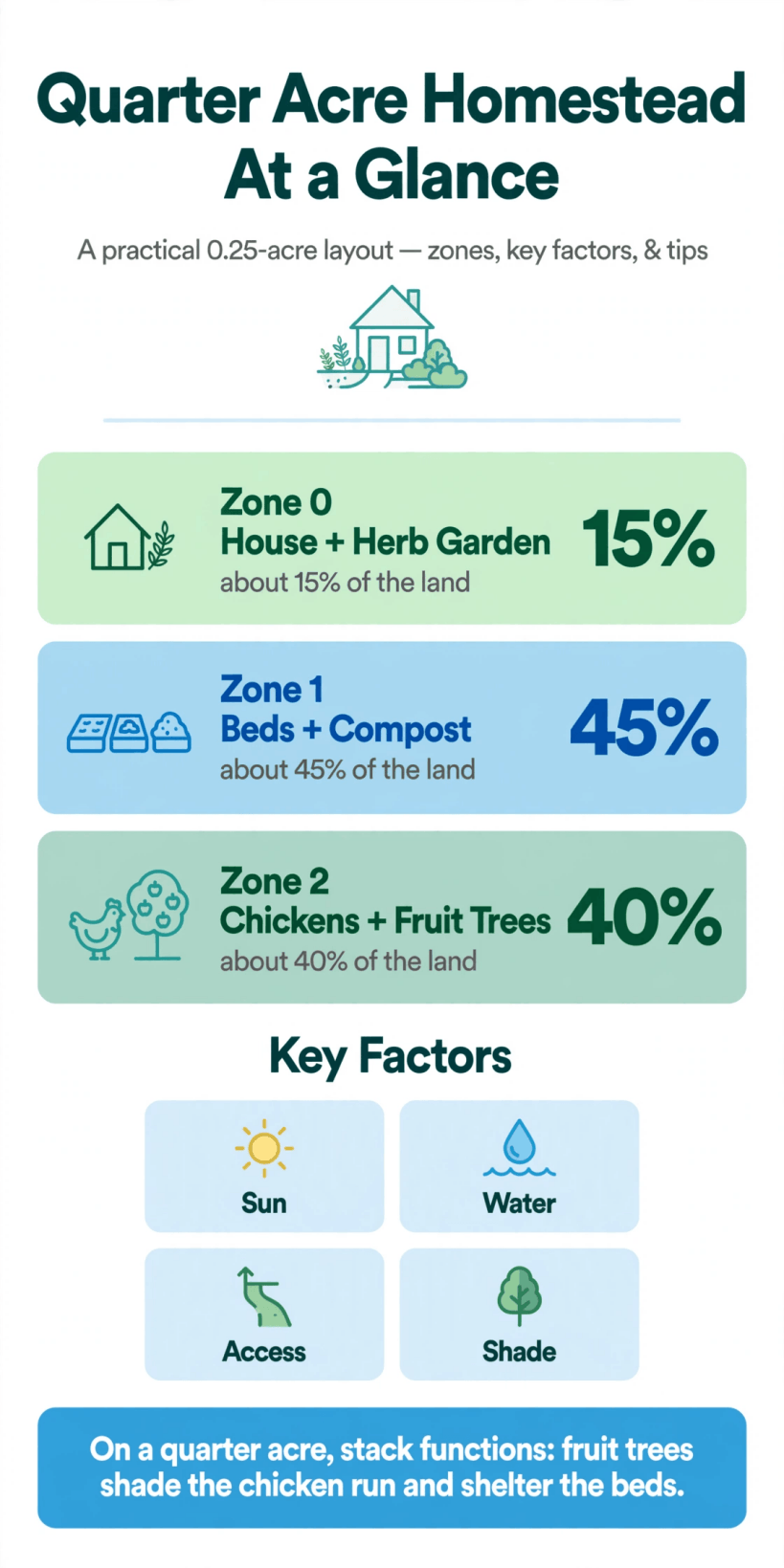
At a glance: the four zones of the small farm compared — fix the zones first, then fit beds, trees and animals inside them.
2. The House End: Deep Beds Close to the Kitchen
The house end of a small farm earns its keep every single day, so it deserves the deepest soil and the closest attention. Build deep beds here — wide, rich, permanent beds you never walk on, fed with compost year after year — and plant them with the crops that reward daily picking: salads, herbs, spring onions, courgettes, beans and the soft fruit you eat standing in the garden. High-value, high-attention crops belong within sight of the kitchen window, because a crop you see is a crop you harvest at its peak, water before it wilts and protect before the pigeons find it.
Keep this zone intensive and small enough to finish. A handful of deep beds, worked little and often, will out-produce a sprawling allotment of neglected rows, and the surplus energy belongs to the orchard and the animals. Add cold frames or a small greenhouse against the sunniest wall to stretch the season at both ends, and keep a water butt at the corner of the roof for the seedlings. Families planning this house end as the start of something larger — a cottage joined later by a second small dwelling for parents or adult children — will find the multi-building thinking in these family compound layouts for generations living together pairs naturally with a farm layout, since gardens and commons serve several small homes as happily as one.
3. Orchard Rows: Small Trees, Long Returns
An orchard is the slowest and kindest investment on a small farm. Plant fruit trees in straight rows down the middle of the plot, spaced for their mature spread rather than their nursery size, and choose varieties grafted on dwarfing or semi-dwarfing roots so a quarter acre can hold a real collection — eating and cooking apples, pears, plums, a cherry under netting — without any tree shading the garden into surrender. Rows, rather than a scattered planting, let you mow, mulch and harvest along a line, and they leave the alleys between trees wide enough for a barrow of compost and, in time, for hens to patrol under supervision.
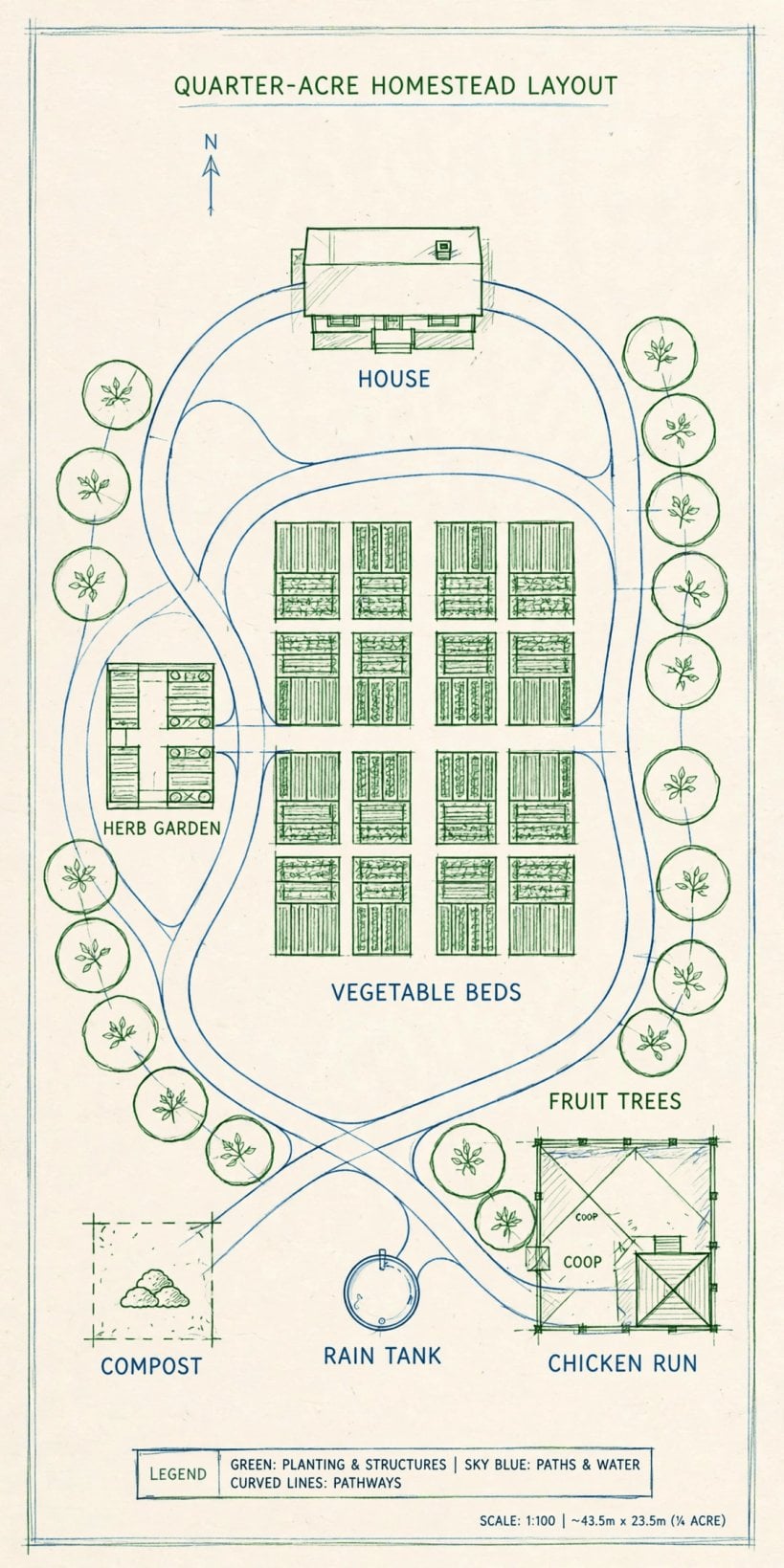
The labelled diagram above shows the arrangement to copy: house and deep beds at one end, tree rows running the length of the plot, livestock tucked into the far corner, and the compost yard where every path crosses. Underplant the rows with comfrey and clover, which feed the soil and the bees, and mulch each tree with the woodchip the paths surrender each winter. An orchard planted in year one is shading picnics by year five and out-produces every other zone in stored food — bottled, dried and frozen — by year ten. Few other plantings on the farm repay patience so completely.
4. The Small Livestock Corner: Poultry and Rabbits
Small livestock belong on a quarter acre, but in their corner and at their scale. A modest flock of hens is the classic choice: eggs daily, manure for the compost, enthusiastic pest control in the orchard and personalities that make the morning round a pleasure rather than a chore. Rabbits suit the scale too, quiet and economical in hutches along the fence, converting garden surplus into manure and, for many families, meat. What a quarter acre cannot honestly hold is large grazing animals; a single goat or pig will eat the plot’s spare capacity, churn the paths to mud and turn a balanced small farm into a feed-buying operation with a garden attached.
Site the corner like a professional. Downwind of the house for summer air, downhill for drainage, on the driest ground the far end offers, with a fence that respects the fact that foxes and dogs plan their visits professionally too. Build the shelter once, build it dry, and give the run a rotation if space allows — two smaller paddocks rested in turn stay green, while one permanent run becomes bare earth and a parasite hotel. Keep feed under cover in the work yard, in metal bins, and carry it down the main path; the day feed lives beside the hutches is the day rats take up residence. Start with hens alone for the first year. The corner will teach you its capacity, and livestock added after that lesson stays a joy rather than a burden.
5. Paths That Work: Wheelbarrow First
On a small farm, paths are not decoration; they are the machine that moves compost in, produce out and you everywhere, three hundred days a year. Lay one main path from the gate to the livestock corner, passing the work yard and running beside the orchard rows, and build it to wheelbarrow standard: wide enough for a loaded barrow and a person, firm enough to stay passable in February, and straight enough that nobody has to lift and shuffle at corners. Woodchip over a firm base suits most small farms — cheap to lay, kind underfoot, and eventually compost itself — while the few yards outside the kitchen door and the animal gate earn harder surfacing, because those stretches carry the heaviest daily traffic in the worst weather.
Branch paths can be humble: grass strips between beds, stepping stones through the orchard, a gravel spur to the greenhouse. What matters is that no zone requires a trespass across another. The gardener should reach the deep beds without crossing the hens’ run; the egg collector should reach the corner without picking through wet tree rows; the compost should travel from bay to bed without a single lifted step. Draw the paths on the plan before the beds, not after — the commonest small-farm mistake is a garden designed in summer enthusiasm and abandoned in winter mud, and it is almost always a path mistake wearing a planting costume.
6. Water: Roof, Tank, Well and the Daily Carry
Water decides what a quarter acre can grow, and the layout should treat it as a designed system rather than a hose and a hope. Start with the roof: the house and shed roofs are catchment surfaces, and gutters feeding a proper tank turn every storm into stored irrigation. Size storage for the dry spell your climate actually delivers, and place the tank high enough — or fit a small pump — so gravity does the daily work down the orchard drip lines and to the livestock drinkers. The principles in this guide to rainwater harvesting, roof catchment and tank sizing were written for single homes and apply unchanged at small-farm scale.
Where a well, borehole or spring is part of the property, give it the same careful placement: tested, protected from surface runoff, and uphill of any manure or compost drainage, always. Then plan the daily carry honestly. Seedlings at the house end need water at hand, not at the end of a hundred-foot hose dragged across the beds; the livestock corner needs a standpipe of its own, because carrying buckets to hens in ice is how wrists get broken and corners get neglected. Lay one buried line down the main path with standpipes at the yard and the corner before the beds are built and the trees are planted. Pipe laid in year one is invisible; pipe retrofitted in year five crosses every root and bed you own.
7. Compost, Manure and the Nutrient Loop
A small farm has no waste, only nutrients in transit, and the layout should make their journey short. Put the compost yard at the crossing of the paths — beside the work yard, between the garden and the livestock corner — in bays you can turn with a fork without moving anything else. Everything flows there: garden waste and lawn clippings from the beds, manure and bedding from the corner, leaves and woodchip from the orchard, ash from the stove. Finished compost flows back out along the same paths to the deep beds first, because they feed the household daily, then to the trees as mulch, then to any new bed being born.
Build at least three bays, because compost is a queue, not a pile: one filling, one cooking, one being used. Site them on bare earth for drainage and worms, screen them from the house with the tool shed or a hedge rather than hiding them at the far fence — hidden compost gets forgotten, and forgotten compost becomes a rat hotel with good intentions. Keep a covered bay or bins for food scraps the hens do not take, and a strict rule that manure from the corner rests and rots before it touches any bed growing food eaten raw. The loop is the whole secret of the small farm’s fertility: animals eat garden surplus, gardens eat animal manure, and the farmer’s job is mostly traffic management.
8. Fences, Shelter and the Working Yard
Fences on a quarter acre do several jobs at once and should be planned as one system. The boundary fence keeps your animals in and other people’s dogs out. Internal fences protect the garden from the hens — a laying flock loose in the deep beds for one afternoon will undo a month of work and enjoy it enormously — and divide the livestock corner’s rotation. Gates deserve the same care as fences: one at every crossing of path and boundary, wide enough for a barrow, hung to swing the way a person carrying feed actually walks. A fence plan drawn on paper in winter saves a season of escapes, apologies and eaten lettuces.
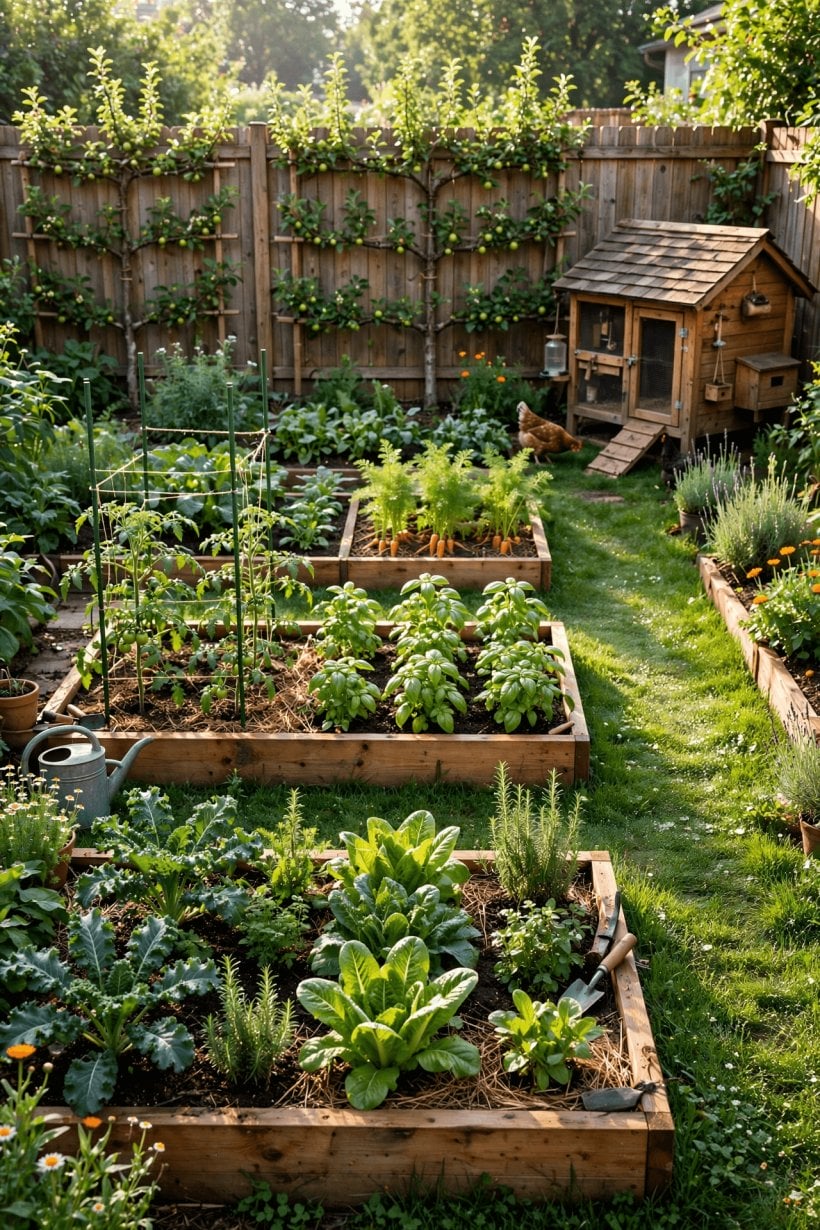
The working yard is the farm’s engine room, and the second diagram above shows it where it belongs: beside the compost, on the main path, near enough to every zone to serve them all. A tool shed with a lean-to for the barrow and the mower, a wood store seasoning next year’s fuel, a bench for sharpening, potting and repairing, and hard standing where deliveries and the occasional trailer can turn — that modest collection of structures is what separates a farm that runs smoothly from one that leaks time. Keep the yard ruthlessly ordered. On a quarter acre there is nowhere for clutter to hide, and every lost tool is lost within sight of the house.
9. Planting the Year: Rotation on a Small Scale
Small scale rewards planning the year as carefully as the land. Divide the deep beds into rotation groups — roots, brassicas, legumes, salads and fruiting crops — and move each group along the beds every season, so soil pests and diseases starve while manure and compost land where the hungriest crops will stand. Succession is the second discipline: a quarter acre feeds a household not by growing more at once, but by never letting a bed stand empty. As one crop finishes, its successor is already growing in a tray at the house end, and the bed turns over in a day.
Keep the plan written, on one sheet, where the whole household can see it. Record what grew where, what thrived, what the hens destroyed and what nobody actually ate — every small farm grows one crop purely out of optimism, and the record book is how that crop retires. Share surplus deliberately, too: the neighbourly networks described in these off-grid alternative communities, cohousing and ecovillages begin exactly here, with a basket of courgettes and a standing arrangement to swap skills, seeds and help at harvest. A quarter acre planned by the year stops being a plot and becomes a rhythm — sow, tend, harvest, preserve, rest — and rhythm, more than acreage, is what feeds people.
10. Costs, Rules and Scaling Up
Costs on a small farm arrive in a predictable order, and planning by that order keeps them honest. Fencing, water and the livestock shelter are the infrastructure of year one and typically the largest early outlay; trees are surprisingly modest by comparison, and deep beds cost mostly labour and compost. Running costs stay low when the nutrient loop works — feed for a small flock is the main recurring purchase, offset daily by eggs — and rise steeply when a farm imports fertility it could have made. As with any land-based household budget, the pattern matters more than any figure: spend once on shared infrastructure, keep the rest modest, and let the system compound. The broader reasoning in this overview of homesteading economics and financial independence off grid applies to a quarter acre exactly as it does to a full homestead.
Rules need the same realism. Local regulations govern what you may keep, build and sell from a small plot — livestock, structures, water use and food sales all vary — so verify the current position for your property before the first fence post, not after the first complaint. And when the quarter acre starts to feel small, scale by the zones, not by squeezing them: the same house end, orchard rows and livestock corner expand naturally into the fuller plan in this 1 acre homestead layout with zones for gardens, animals and water, where each zone of this little farm simply grows a bigger share. A layout that can grow without being redrawn is a layout that was honest at the start.
Final Considerations
A quarter acre will not make anyone rich, and it was never meant to. What it offers, laid out zone by zone, is a household that eats from its own ground in every season: salads from the deep beds by the door, fruit from rows that will outlive their planter, eggs from a corner flock, and soil that improves every year the loop keeps turning. Fix the zones before the beds, give water and paths the respect of infrastructure, start smaller than your enthusiasm and let the plan prove itself a season at a time. Small, complete and tended beats large, vague and exhausting — on a quarter acre, that is not a compromise. It is the entire art.


0 Comments