
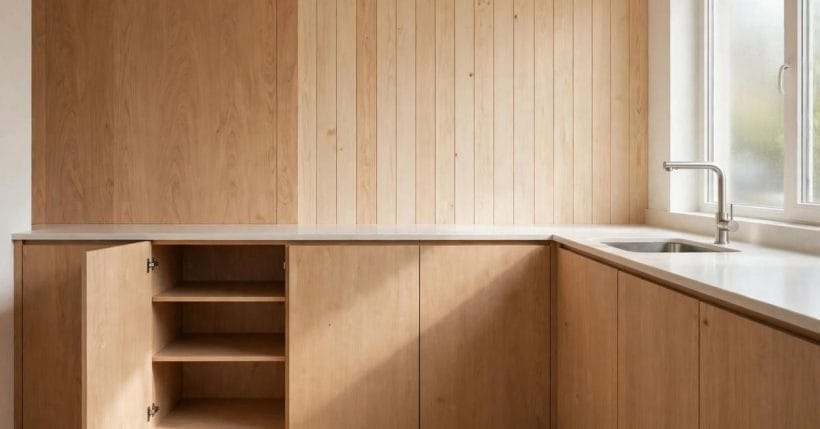
Choosing cabinets is one of those decisions that looks simple in a showroom and turns out to be anything but once the units are in your home. Doors get opened dozens of times a day, drawers carry real weight, steam and spills find every weak edge, and a finish that looked perfect under display lighting can read very differently in your own kitchen or bathroom. The way through all of that is not to hunt for a single verdict about which cabinets are good and which are not. It is to know what to check, in what order, and which questions to ask before you commit. This guide walks through those checks in general terms, so you can apply them to any range, in any home, and judge what you see with your own eyes rather than relying on someone else’s opinion.
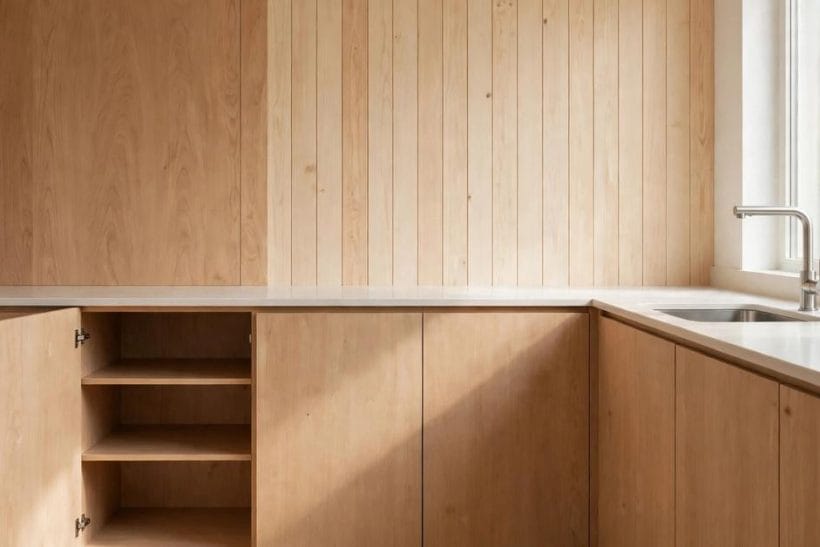
1. Start With the Room, Not the Catalogue
Before you look at a single door style, stand in the room where the cabinets will live and think about how it actually works. Where does the light fall during the day, and where does it disappear in the evening? Which wall catches steam from cooking or bathing, and which corner stays damp longest? A cabinet that suits a dry, sunlit room may not suit a steamy bathroom or a busy family kitchen, and the difference is rarely visible in a catalogue photograph. Take note of the room’s shape as well: the position of windows, doors, radiators, sockets and pipework all set limits on what can go where, and those limits should shape your shortlist before any brochure does.
Think next about who uses the room and how. A kitchen used by keen cooks needs different storage from one used mainly for reheating and making drinks. A bathroom shared by a whole household needs different access from a small cloakroom used by guests. Consider reach as well as capacity: the most generous cabinet is no help if the things you use every day end up on a high shelf you avoid or at the back of a deep cupboard you never open. Walk through an ordinary day in your mind, from morning to evening, and notice where you reach, where you stand, and where clutter tends to gather. Those habits are the real brief for your cabinets, and they matter more than any trend.
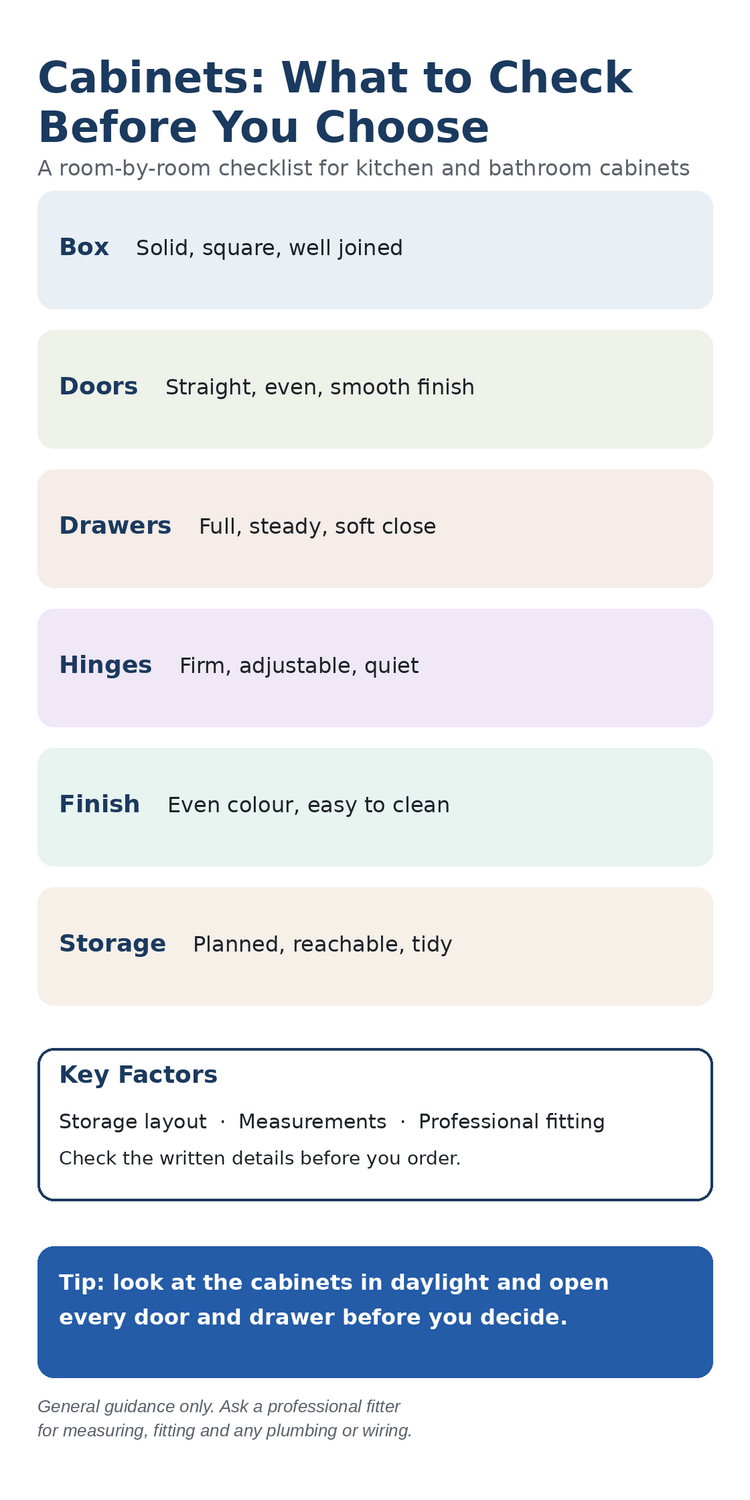
Finally, settle the look in broad terms before you fall for details. Decide whether you want the cabinets to blend quietly into the room or to stand out as a feature, and which colours and materials already in the room they need to sit alongside. Flooring, worktops, wall colour and existing fittings all set the tone, and a cabinet finish should be judged against them, not against a showroom wall. Bring samples home when you can, and look at them in the room itself, in daylight and in evening light, before making any decision. The infographic below sums up the checks in this guide at a glance.
2. Check the Box Before the Front
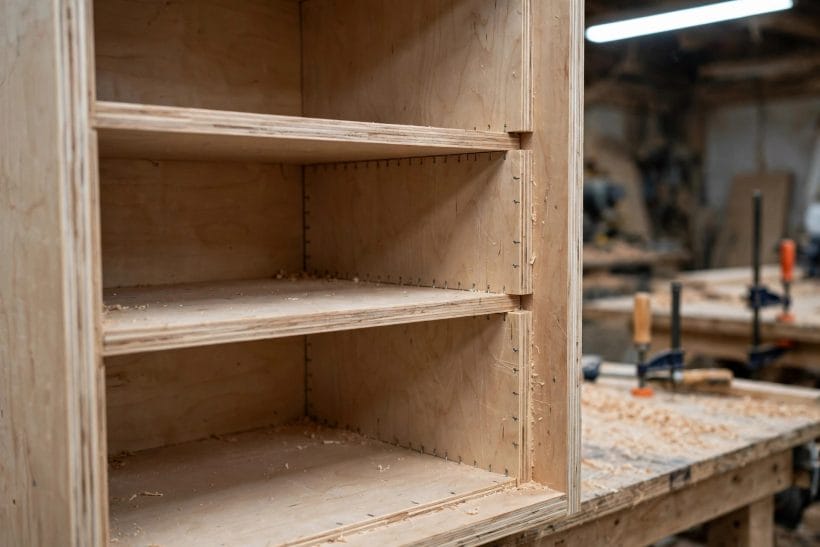
The front of a cabinet is what you see, but the box behind it is what does the work. When you can, look inside the unit rather than only at its face. A well-made box feels solid and square: doors sit evenly in their frames, shelves sit level, and the whole unit stands without rocking or twisting. Run your hand along the inside edges and corners and notice whether they feel clean and finished or rough and unfinished. Rough edges inside a cabinet are not just untidy; they can snag cloth, catch dust and make cleaning harder for the whole life of the unit.
Pay attention to how the box is put together. Joints should look neat and tight, with no visible gaps where panels meet, and the back panel should feel firm rather than thin and flexible. A back that bows when pressed, or a shelf that dips under a light load, tells you something about how the unit will behave once it is full of everyday things. If you are comparing ranges, compare them on the same basis: open the same kind of unit in each range, look at the same joints, and press the same panels. Small differences that seem trivial in the showroom tend to grow once a cabinet is loaded, used daily and exposed to changes in temperature and humidity.
Also check how the box is finished inside. A light, wipeable interior makes it far easier to spot spills and keep the cabinet clean, while a dark or rough interior hides marks until they become a problem. In rooms where steam is a regular visitor, such as bathrooms and kitchens, the inside finish matters as much as the outside one, because moisture finds its way into every unsealed edge over time. Ask what the interior is made of and how it should be cleaned, and be wary of any answer that cannot be given plainly. For a closer look at how cabinet construction is judged in general, see our guide to semi-custom cabinets and what to check before you buy.
3. Open Every Door and Drawer
There is no substitute for handling cabinets yourself. In a showroom, open every door and drawer on the display, and do it the way you would at home: with one hand, while holding something in the other, and without taking special care. A door that swings smoothly and closes with a soft, controlled movement will feel very different after months of daily use from one that needs a push, sticks halfway, or slams shut. Listen as well as look. Creaks, rattles and sharp clicks are all information, and they are much easier to notice before you buy than after the units are fitted.
Check how doors sit when closed. Gaps around a door should look even on all sides, and neighbouring doors should line up with each other rather than sitting high on one side and low on the other. Stand back and look along a run of doors: uneven lines that are barely noticeable up close can become very obvious once a whole wall of cabinets is in place. Open a door fully and check whether it clears neighbouring handles, worktops and appliances, and whether it stays open where you leave it or drifts shut on its own. These are small behaviours, but you will live with them every day.
Do the same for drawers. Pull each drawer out fully and push it back, and notice whether it travels smoothly along its whole run or catches partway. A drawer that runs well when empty may behave differently when loaded, so ask how it is expected to perform under normal household use, and whether its runners are designed to be adjusted if they settle over time. If a display drawer feels rough, stiff or loose, treat that as a warning rather than a quirk of the display: the display is usually the best example a range has to offer. The same hands-on approach applies to finishes and colours, as our guide to dark cabinets with dark floors shows for one particular pairing.
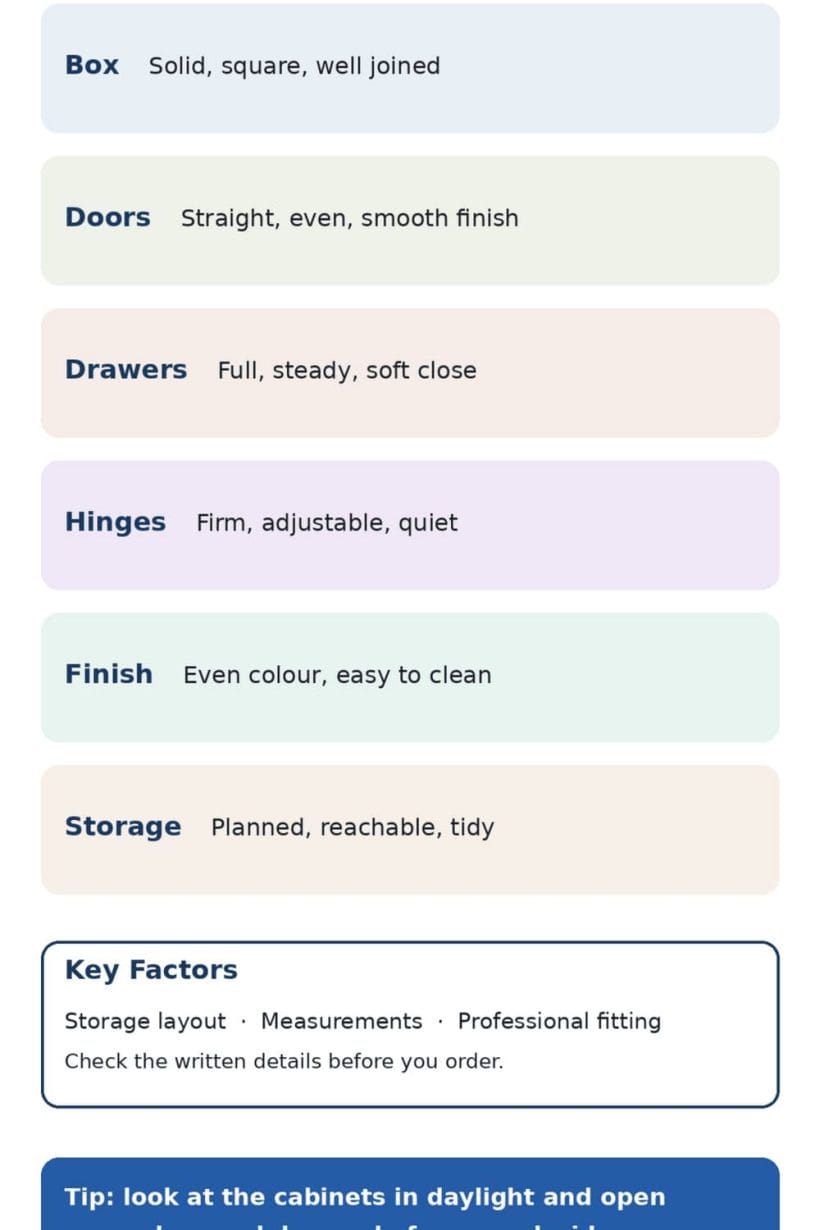
4. Test the Drawers and Runners
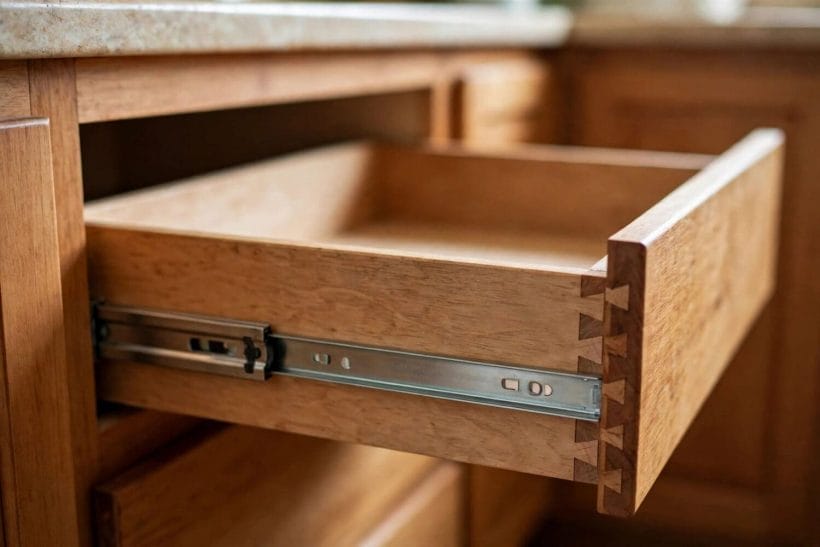
Drawers deserve their own careful check because they work harder than almost any other part of a cabinet. A drawer is pulled, pushed, loaded and sometimes leaned on, day after day, and its runners carry all of that movement. When you test a drawer, pull it out as far as it is designed to go and look at how much of it is actually usable: some drawers leave a surprising amount of space hidden at the back, while others give you full access to everything inside. Full access matters most in deep base units, where the back of a drawer is otherwise easy to forget and hard to reach.
Notice how the drawer feels at each point of its travel. It should move steadily without wobbling from side to side, and it should close without needing a shove or a careful aim. If the drawer has a soft-close action, test it with a normal push rather than a gentle one, and see whether it still settles quietly. Check the drawer box itself too: its sides and base should feel firm and well joined, and the front should sit squarely against the cabinet frame when closed. A drawer front that tilts or gaps at one corner will only become more noticeable once the drawer is in daily use.
Think about what each drawer will hold, and whether its size and depth suit that job. Shallow drawers suit cutlery and small tools, deeper ones suit pots, pans and bulky items, and a mix usually works better than a run of identical drawers. Ask whether drawer interiors can be divided or fitted with organisers later, since needs change over time and a drawer that can be rearranged will serve you far longer than one that cannot. And remember that heavy items belong low, where they are easier to lift and where a drawer is best able to carry them, rather than high up where every lift becomes a strain.
5. Hinges, Handles and Hardware
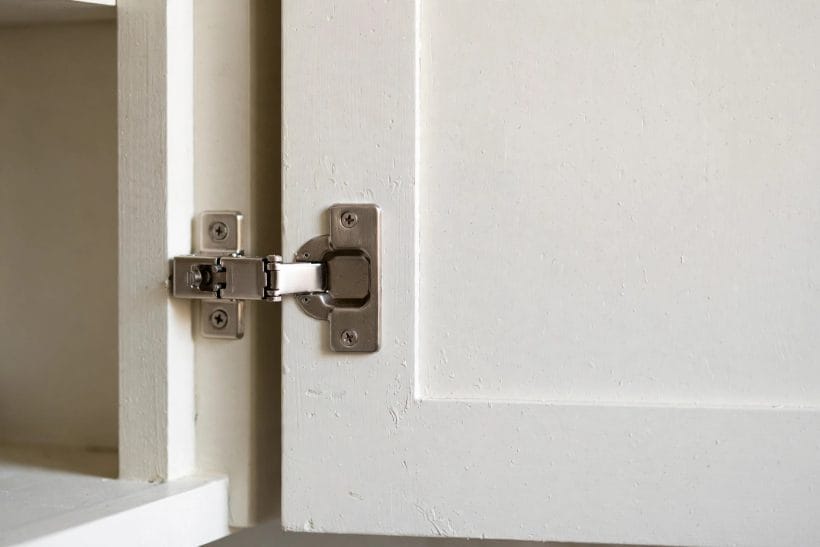
Hardware is the part of a cabinet you touch most, and it is often where the difference between a satisfying unit and an irritating one lives. Hinges should feel firm and allow the door to be adjusted, because doors settle slightly over time and a hinge that cannot be adjusted cannot be put right. Open a door and look at the hinge: it should sit neatly against both the door and the frame, with screws that feel tight and secure rather than loose or overworked. If a hinge looks strained, or if the door drops slightly when opened, that is worth noting before you order.
Handles and knobs deserve the same attention. Hold them as you would at home, with wet or busy hands, and notice whether they are comfortable to grip and easy to pull. A handle that looks elegant but is awkward to grasp will annoy you far more than a plainer one that works well. Check that handles are fixed firmly, with no wobble, and that their fixings do not snag clothing or catch on passing sleeves. In a household with small children, also consider whether handles have sharp edges or protruding ends that could catch, and whether doors and drawers can be fitted with safety catches if you need them.
Finally, ask about the hardware in general terms: whether hinges and runners are designed to be adjusted or replaced, and whether matching spares are likely to be available later. Cabinets last a long time, and the ability to tighten a hinge, replace a runner or swap a handle without replacing a whole unit is genuinely valuable. A supplier who can answer those questions clearly is giving you useful information; one who cannot may be selling you a unit whose future maintenance has not been thought through.
6. Doors, Finishes and Colour
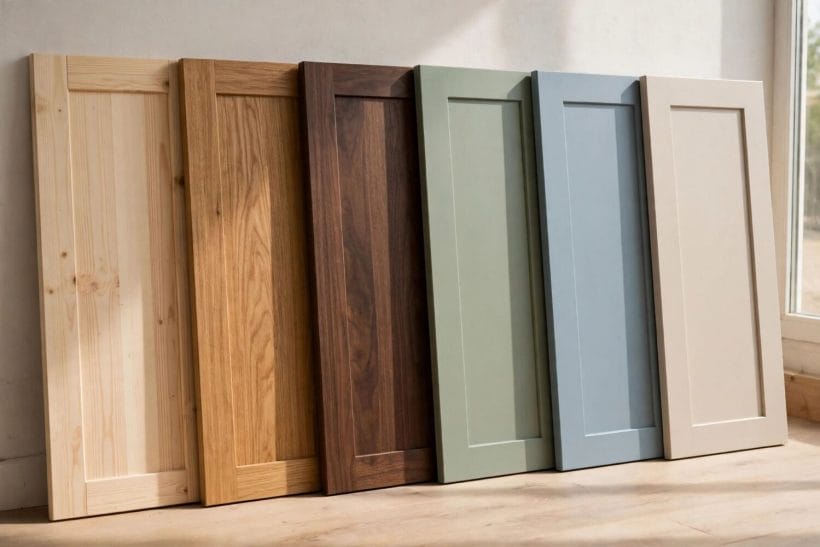
Door style sets the character of a room more than almost any other single choice, so it is worth taking your time here. Look at the range of profiles available in general terms: flat, plain doors give a clean, quiet look; framed or panelled doors add shape and shadow; glazed doors open a cabinet up and display what is inside. Each has practical consequences as well as visual ones. Flat doors are usually the easiest to wipe clean, panelled doors can gather dust in their recesses, and glazed doors need their contents to look presentable. Choose the style that suits both the room and the amount of upkeep you are willing to do.
Finish matters just as much as profile. A painted finish, a natural wood finish and a wrapped or laminated finish all behave differently with light, moisture and cleaning, and each shows wear in its own way. Look at samples in your own room, in daylight and in evening light, and run your hand over them: the finish should feel even and smooth, with no rough patches, bubbles or thin spots at edges and corners. Edges are the vulnerable places on any door, so check them closely, especially on doors that will sit near a sink, a cooker or a shower, where water and steam are regular visitors.
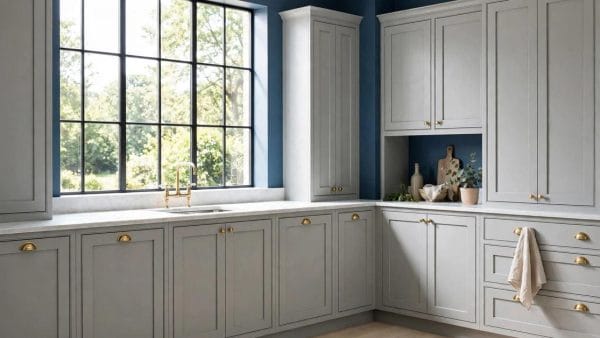
Colour deserves a calm decision rather than a rushed one. A colour that looks striking in a showroom can dominate a small room or clash with flooring and worktops you already have, while a quieter colour can make a room feel larger and more settled. Hold samples against your floor, your worktop and your wall colour together, and live with them for a few days if you can. Our guide to grey cabinets with blue walls shows how one pairing is judged, and the same approach, judging colours together in the real room, applies to any combination. If you are choosing bathroom cabinets, the painted finishes in our guide to light cabinets with a dark countertop offer a useful comparison of how light finishes behave in a steamy room.
7. Storage That Fits How You Actually Live
Capacity figures mean very little on their own; what matters is whether the storage inside a cabinet matches the things you actually own. Before you choose, take stock of what needs a home: the tall bottles, the awkward appliances, the baking trays that never fit anywhere, the cleaning products that need to stay out of reach. Then check, unit by unit, whether the cabinets you are considering can hold those things without forcing you to stack, squeeze or leave items on the worktop. A cabinet that looks generous but cannot hold a single tall item is less useful than a smaller one planned around real contents.
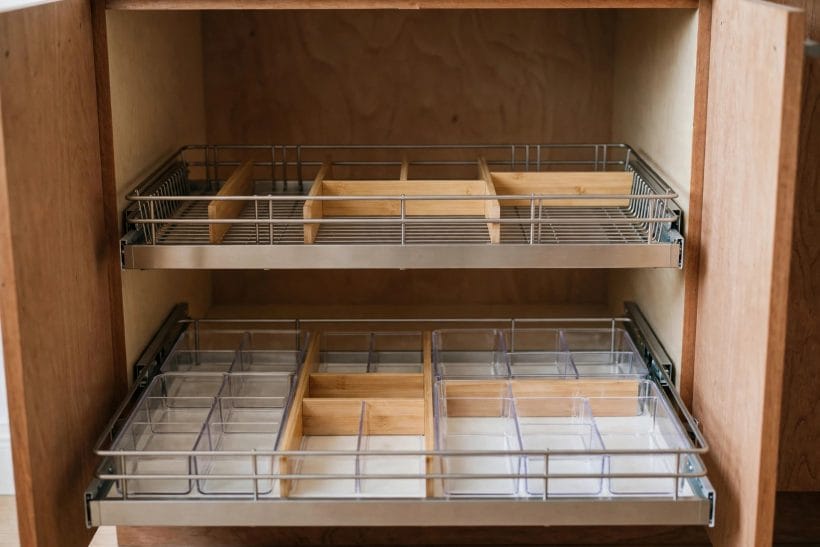
Look at how shelves and interiors can be arranged. Adjustable shelves are worth their weight in a household whose needs change, because they let you re-plan a cabinet as contents change rather than living with a layout that stopped working years ago. Pull-out shelves and organisers can transform a deep base unit from a dark hole into genuinely usable space, but only if they run smoothly and leave enough clearance for the things you store. Check that internal fittings do not waste more space than they save, and that they can be removed or moved if your needs change.
Corner units deserve special attention, since corners are where storage most often goes wrong. Open a corner unit and see how much of it you can actually reach, and whether its fittings help or hinder. A corner that looks clever in a diagram can still be awkward in practice, so test it yourself rather than trusting the drawing. The same principle applies to tall units and wall cabinets: check what you can reach comfortably, what needs a step, and what will simply never be used. Storage that cannot be reached is not storage at all, and planning around reach will save you years of frustration.
8. Measure Carefully and Plan the Fitting
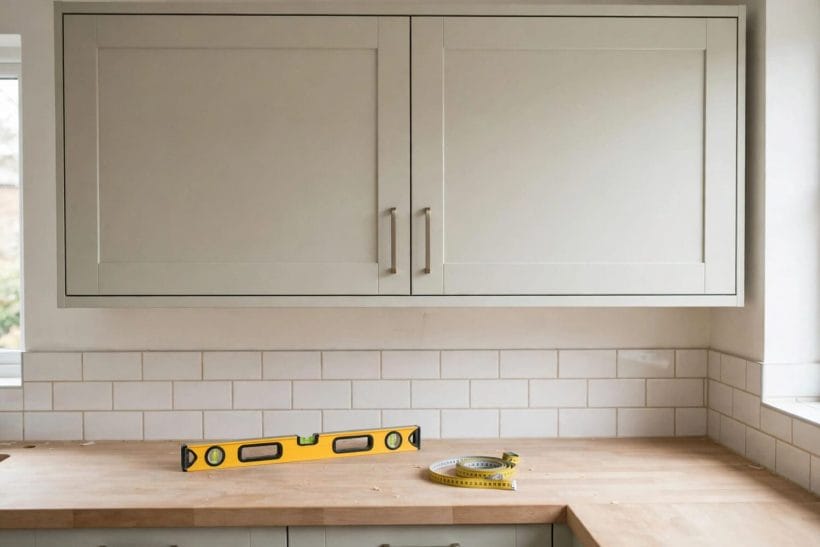
Measuring is the least glamorous part of choosing cabinets and the one where mistakes cost the most. Walls are rarely perfectly straight, floors are rarely perfectly level, and corners are rarely perfectly square, so a single quick measurement is never enough. Measure each wall in more than one place, note the position of every socket, switch, pipe and vent, and record the height of windowsills and the swing of every door. Keep a written record with a simple sketch of the room, and double-check every figure before it is used for ordering. If anything about the measuring feels uncertain, that is the moment to involve a professional rather than to guess.
Planning the fitting means thinking about sequence as well as space. Cabinets usually go in before worktops and after the room itself is prepared, and plumbing, wiring and ventilation all need to be in place at the right stage. Ask who is responsible for each stage, and what happens if a unit arrives damaged or does not fit as planned. A clear written plan, agreed before work starts, protects everyone: it sets out what is being supplied, what is being fitted, and what is expected of the room before fitting begins. Vague arrangements made on the day are where most fitting problems start.
Also think about access for the fitting itself. Large units need a clear route into the room, and stairways, narrow doors and tight turns can all cause problems that are much easier to foresee than to solve on delivery day. Note any awkward access in advance, and discuss it with whoever is supplying or fitting the cabinets. For wider kitchen planning, our kitchen ideas gallery shows how cabinets sit within whole-room layouts, which can help you picture the finished room before you commit.
9. Fitting Day and the Professional’s Role
Fitting cabinets is skilled work, and it is worth being clear about where professional help is needed. Levelling a run of units, fixing them securely to walls, aligning doors and drawers across a whole wall, and cutting neatly around pipes and obstacles all require experience and the right tools. A professional fitter will also spot problems early, such as a wall that is out of true or a floor that needs attention, and will know how to deal with them without compromising the cabinets. If your project involves plumbing, wiring, gas or structural changes, those parts of the work belong to qualified professionals, and no cabinet guide can substitute for their judgement.
On fitting day itself, keep the room clear and accessible, and check each unit as it goes in rather than waiting until the end. Look at alignment along each run, test every door and drawer as it is fitted, and raise any concern while it can still be adjusted easily. Small adjustments made during fitting are quick; the same adjustments made after worktops are on and the room is finished are far more disruptive. Take photographs as the work progresses, and keep a note of anything that was changed from the original plan, so that you have a record if questions arise later.
Once fitting is complete, go through the whole installation with the fitter before they leave. Open every door and drawer, check every alignment, and make sure you understand how to adjust hinges and runners, how to clean the finishes, and what to do if anything settles in the first weeks. A good handover covers all of that, and it is worth asking for it explicitly rather than assuming it will happen. If you are planning bathroom cabinets as well, our tiny house bathroom layouts and tiny bathroom ideas show how cabinets work in small, hard-working rooms where fitting accuracy matters even more.
10. Written Details Worth Reading Twice
Before you order, read the written details with the same care you gave to the cabinets themselves. The description of a range should tell you, in plain language, what the boxes, doors, drawers and finishes are made of, how they should be cleaned, and what is covered if something goes wrong. If a description is vague, or if a question about materials or care cannot be answered clearly, treat that as information in itself. A product whose details cannot be stated plainly is a product whose performance is hard to predict, and you will be living with that uncertainty for years.
Pay particular attention to care instructions and to anything the maker says about moisture, heat and cleaning products. Kitchens and bathrooms expose cabinets to steam, splashes and temperature changes, and a finish that needs unusual care may not suit a busy household. Ask how the cabinets should be cleaned day to day, what should be avoided, and how marks and small damage can be dealt with. Keep the care instructions somewhere you can find them, since the right cleaning routine is what keeps a good finish looking good.
Finally, keep every document from the order: the written description, the measurements, the plan, the delivery note and the care instructions. If anything needs attention later, those documents are what turn a conversation into a clear record, and they make it far easier for a supplier or fitter to help. Choosing cabinets well is mostly a matter of checking carefully, asking plainly and refusing to be rushed, and the time spent on those checks is repaid every day you open a door that runs smoothly and closes quietly.
Final Considerations
The soundest cabinet choice is rarely the most dramatic one or the one with the longest list of features. It is the one whose box is solid, whose doors and drawers run well, whose finish suits the room and the household, whose storage matches real contents, and whose fitting has been planned by someone who knows the work. Check the room first, handle the cabinets yourself, measure carefully, read the written details, and involve professionals for fitting and for any plumbing, wiring or structural work. Do those things, and you will have chosen cabinets on evidence rather than on hope, which is the only sound basis for a decision you will live with every day.


0 Comments