
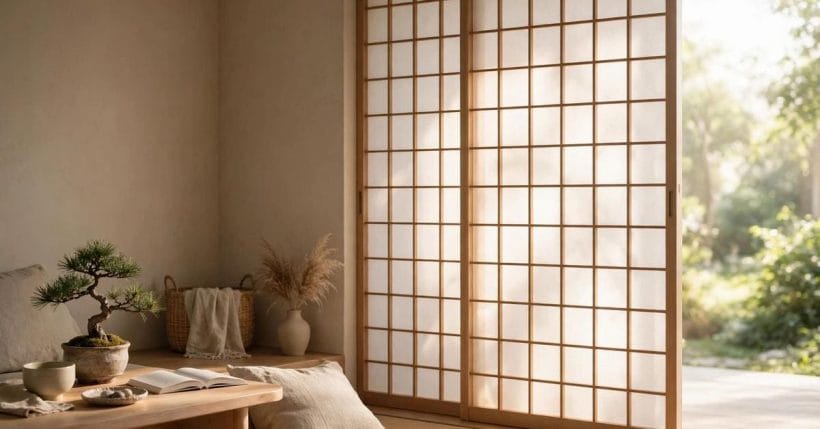
Some room dividers block light; shoji lends it. The Japanese screen of timber lattice and translucent paper has spent centuries doing one elegant thing — standing between spaces while letting daylight through — and modern homes, short on rooms and hungry for flexibility, keep rediscovering it.
This article is a design guide to the shoji screen in all its working forms: dividers, sliding doors, window coverings and cupboard fronts, the light it makes, the styles it flatters, and the care it asks in return.
1. Shoji Screens at a Glance
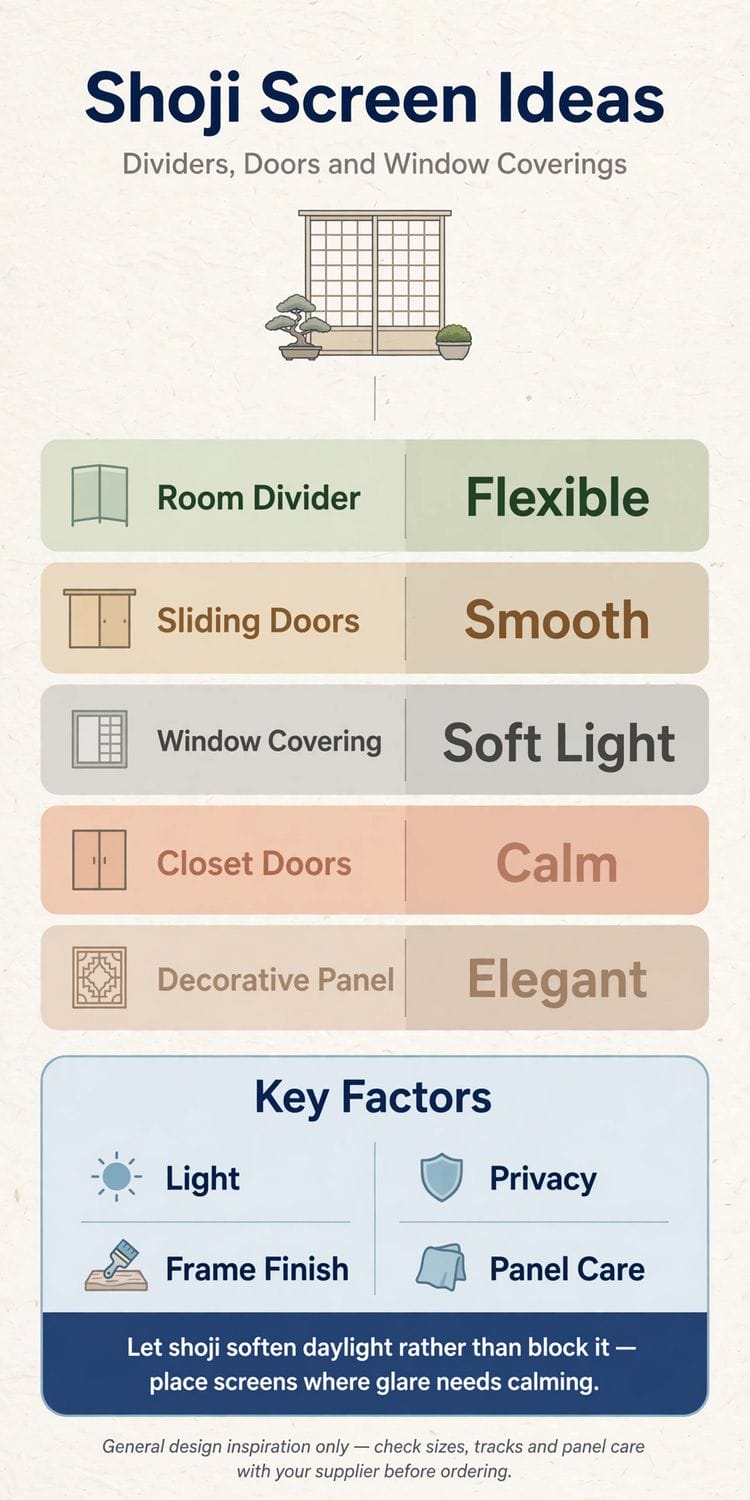
The central entity is the shoji screen: a framed panel of fine timber lattice backed with a translucent sheet, used in Japanese interiors as a movable wall, door or window covering. Its whole design is a negotiation between two goods that usually fight — privacy and daylight — and it wins by filtering light instead of stopping it. The modern interest in shoji is no mystery: open-plan living taught a generation of households that one undivided space is not always enough, and shoji is the gentlest way to divide it back.
| Question | Short answer |
|---|---|
| What exactly is a shoji screen? | A timber lattice frame with a translucent panel — traditionally paper — fitted as a divider, sliding door or window covering; the construction is described next |
| What does it do to light? | It diffuses daylight into a soft, even glow and holds privacy at the same time — the effect this article keeps returning to |
| Where can shoji be used? | Room dividers, sliding doors, window coverings and cupboard fronts — each gets its own section below |
| Is it fragile? | Traditional paper asks for gentle handling and is replaceable by design; modern panel materials trade a little softness for durability — care is covered at the end |
2. What a Shoji Screen Is
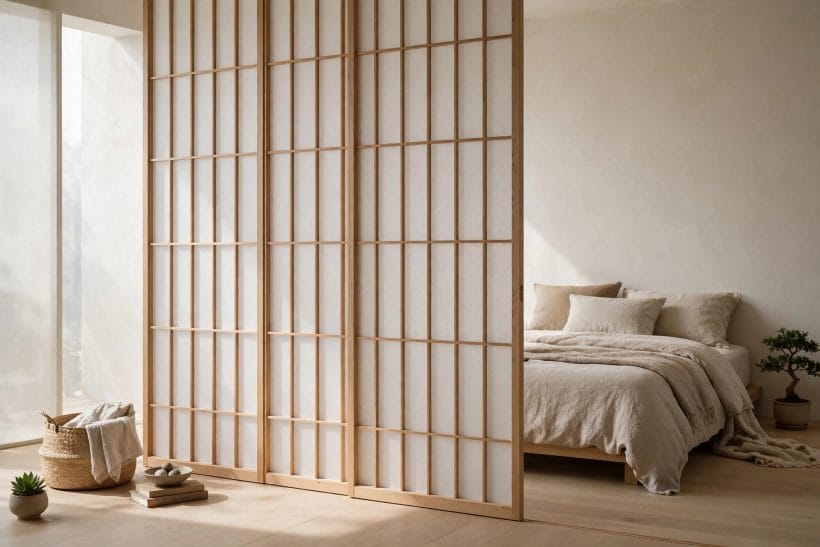
Strip a shoji to its anatomy and there are only two parts — a wooden grid and a sheet of light. Everything else is proportion.
1. The frame and the lattice
The frame is fine, straight timber, and inside it runs the lattice — a grid of slim wooden bars whose pattern can be a simple square repeat or one of many traditional geometric arrangements. The lattice is not decoration on the panel; it is the structure that holds the sheet, casts the famous shadows, and gives the screen its strength. Traditional lattice work is joined without nails, each bar notched into the next — a craft detail that explains both the price of fine screens and the clean way they age.
2. The translucent panel
Traditionally the sheet is washi, a Japanese paper chosen for the way it drinks light and returns it softly. Modern shoji often use synthetic papers or acrylic panels that imitate the diffusion while shrugging off the knocks paper cannot — a trade of a little atmosphere for a lot of practicality, judged room by room below.
3. A furnishing older than the rooms it divides
Shoji developed in Japanese domestic architecture as part of a whole system of flexible interiors — rooms defined by movable panels rather than fixed walls, changing with season, guest and hour. That heritage explains the screen’s temperament: it was never a wall that failed to be solid, but a boundary designed to be moved.
Modern manufacture has widened the family without changing its nature. Alongside traditionally made screens sit shoji-style products — wardrobe doors, window panels and folding screens built on the same lattice-and-diffusion principle in contemporary materials. The principle is the product: any panel that frames light this way is working in the shoji tradition, wherever it was made.
3. The Light Shoji Makes
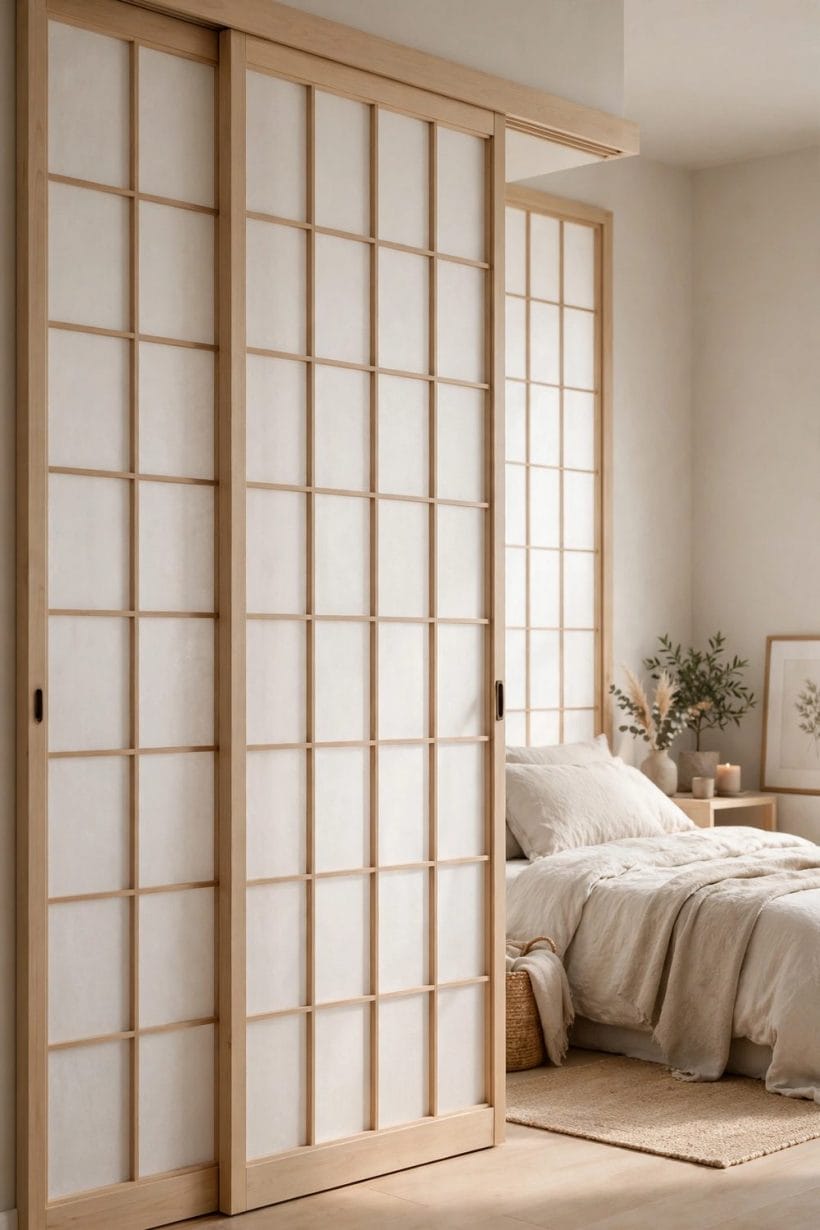
Ask anyone who has lived with shoji what it is for and they will talk about light before they mention privacy. Three effects make the reputation.
4. Diffusion, not blocking
A solid divider creates a dark side; a shoji divider creates a glowing one. Daylight passes through the panel spread evenly, so the borrowed side of the room keeps a soft, shadowless brightness — enough to read by near the screen, and always gentle on the eyes.
5. Privacy with daylight kept
The same diffusion that spreads light also scrambles silhouettes into softness: shapes register, details do not. It is the privacy of frosted glass with a warmer soul — the reason shoji serves so well between a sleeping area and a living one, or across a bathroom window.
6. The lattice’s shadow play
When sun strikes a shoji at an angle, the lattice prints its grid in light across floor and wall — a pattern that moves through the day like a slow clock. Designers who choose bold lattice patterns are choosing that shadow as much as the screen itself.
Evening reverses the trick. With lamps lit behind it, a shoji panel becomes the light source itself — a large, soft lantern that flattens glare and makes a room feel candlelit without a flame in sight. It is why shoji photographs so beautifully at dusk, and why a single panel behind a reading chair can change the whole temperament of a room’s last hours.
4. Room Dividers
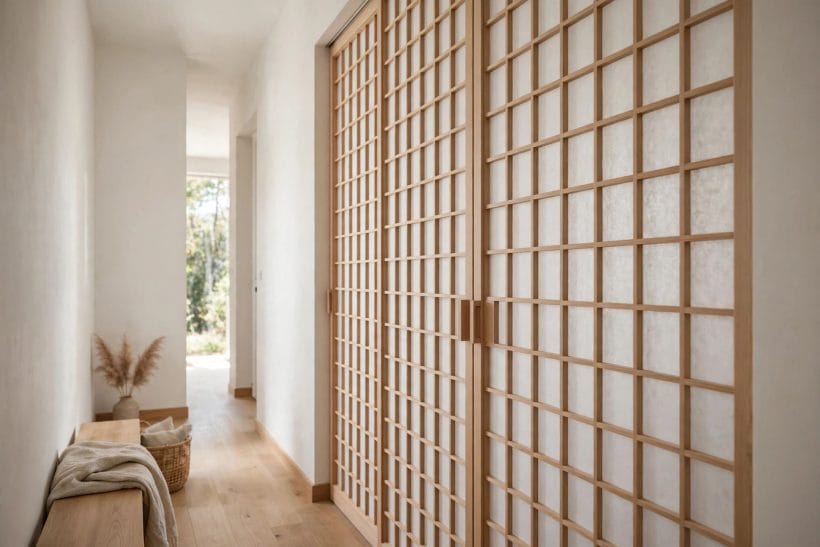
The divider is shoji’s most famous job, and the one most related to the flexible-room thinking behind our hidden doors and secret spaces survey — rooms that change their shape without builders.
7. Freestanding shoji screens
The folding screen — panels hinged to zig-zag across a corner or a studio’s middle — is the commitment-free version: no tracks, no fixings, a room divided in a minute and undivided in another. It suits renters, guests’ corners and home-working nooks that must vanish by evening.
8. Fixed partitions with shoji panels
Built-in partitions framed with shoji panels take the same idea seriously: a long room gains a bedroom, a studio gains an entry, and both halves keep daylight because the boundary glows instead of blocking. The lattice rhythm also gives open-plan spaces the architecture they often lack.
5. Sliding Shoji Doors
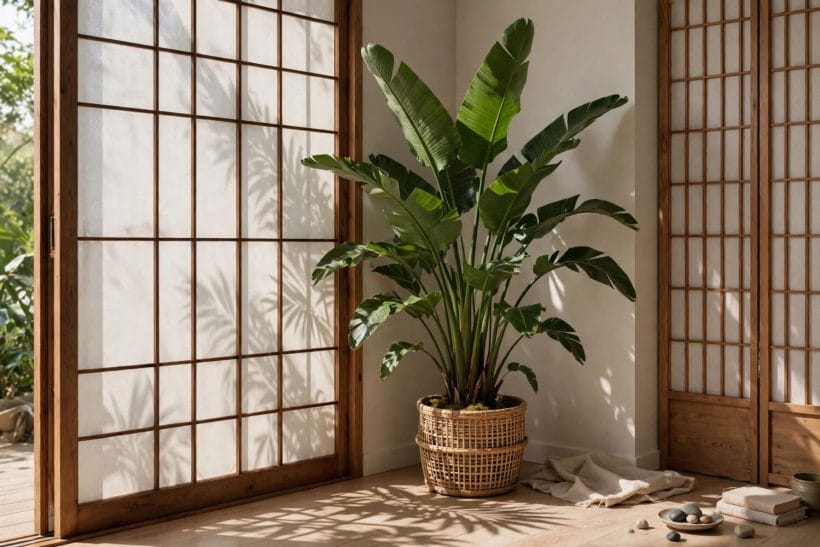
As a door, shoji slides rather than swings — and in small rooms, that single difference is worth a piece of furniture.
9. Sliding panels on tracks
Shoji doors run in grooved tracks, traditionally in the timber frame itself, today often on discreet modern hardware. They ask for no swing space, can span openings far wider than a hinged door, and stack or overlap to open a room up almost completely when the occasion wants one space again.
10. Cousins: fusuma and the opaque panel
Shoji’s traditional partner is the fusuma — an opaque sliding panel, often papered or painted, used where light should not pass. Homes mixing the two get a vocabulary of boundaries: shoji where daylight is shared, opaque panels where it is not, both sliding in the same architectural language.
11. Where sliding shoji earns its keep
En-suite entrances, wardrobe walls, studio zoning, the doorway between a kitchen and a dining space that sometimes wants to be one room — sliding shoji suits every opening that is used constantly and closed softly. It is a door that behaves like a curtain call: present, graceful, and gone when slid away.
One practical grace deserves naming: a sliding panel has no draught-swing and no handle arc, so it can pass within a hand’s breadth of furniture that would block a hinged door forever. In the small flats and narrow hallways where every door decision is argued over, that clearance is not a detail — it is the whole case for sliding.
6. Shoji at the Window
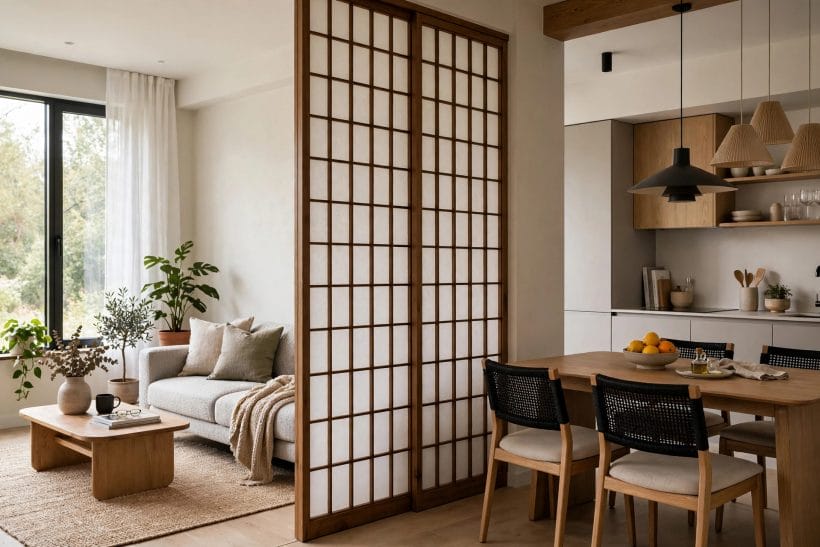
Fitted inside a window, shoji becomes the covering that solves the oldest window problem: the overlooked room that cannot afford to lose its light.
12. Shoji panels as window coverings
Fixed or sliding shoji panels inside the window frame give privacy at street level while the room stays bright — the panel diffuses both the view in and the glare out. In north-facing rooms that hoard every lumen, shoji coverings preserve a softness curtains would spend. A sliding arrangement is the flexible one: panels stacked to one side on a clear morning, drawn across by afternoon when the low sun or the street’s curiosity arrives.
13. Shoji over glass doors
Glazed doors and sidelights beg for the same treatment, and shoji answers with panels that slide or hinge over the glass — kin to the solutions in our glass door covering ideas survey, with the difference that shoji adds architecture: the lattice turns a plain glazed door into a designed object.
7. Closet and Cupboard Fronts
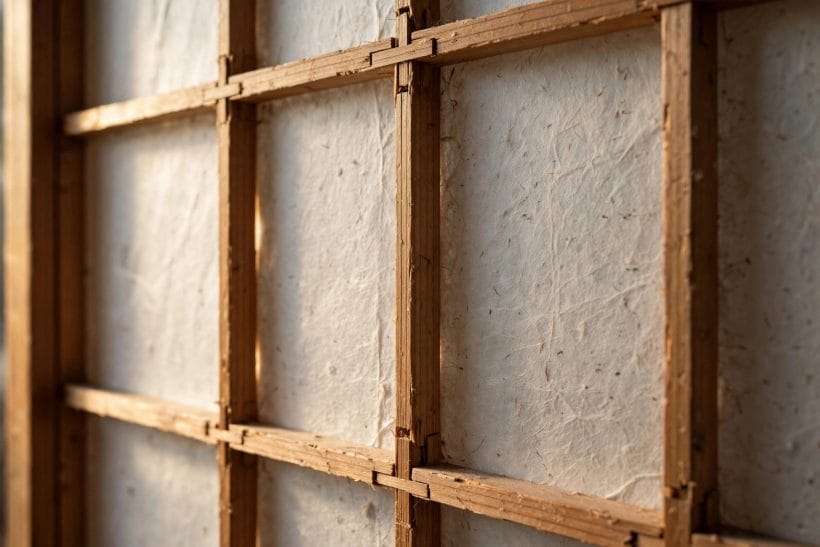
The quietest shoji job is the one it does on storage — fronts that make wardrobes and cupboards read as lit walls rather than furniture.
14. Wardrobe doors in shoji style
A run of shoji-fronted wardrobes turns the bedroom’s storage wall into the room’s calmest surface — especially when a soft light inside the wardrobe makes the panels glow faintly in the evening, the famous lantern effect. The lattice also breaks a long run of doors into a rhythm the eye enjoys.
15. Linen, larder and hallway cupboards
Smaller cupboards take shoji fronts just as happily: linen presses, hallway storage, the cupboard under the stairs. The translucent panel hints at contents without displaying them, and the consistent lattice lets several cupboards across a home speak the same design language.
16. The utility screen
Boilers, meters, washing machines — the necessary machinery of a home can stand behind a shoji screen that keeps air moving, light passing and ugliness politely veiled. It is the divider’s smallest job and one of its kindest.
A quieter benefit runs through all the storage uses: shoji fronts soften a room’s sound. Paper and timber absorb a little of the echo that hard cupboard doors bounce back, and a bedroom fronted in shoji feels hushed in a way visitors notice without identifying. Calm, in these rooms, is quite literally built into the doors.
8. Styling with Shoji
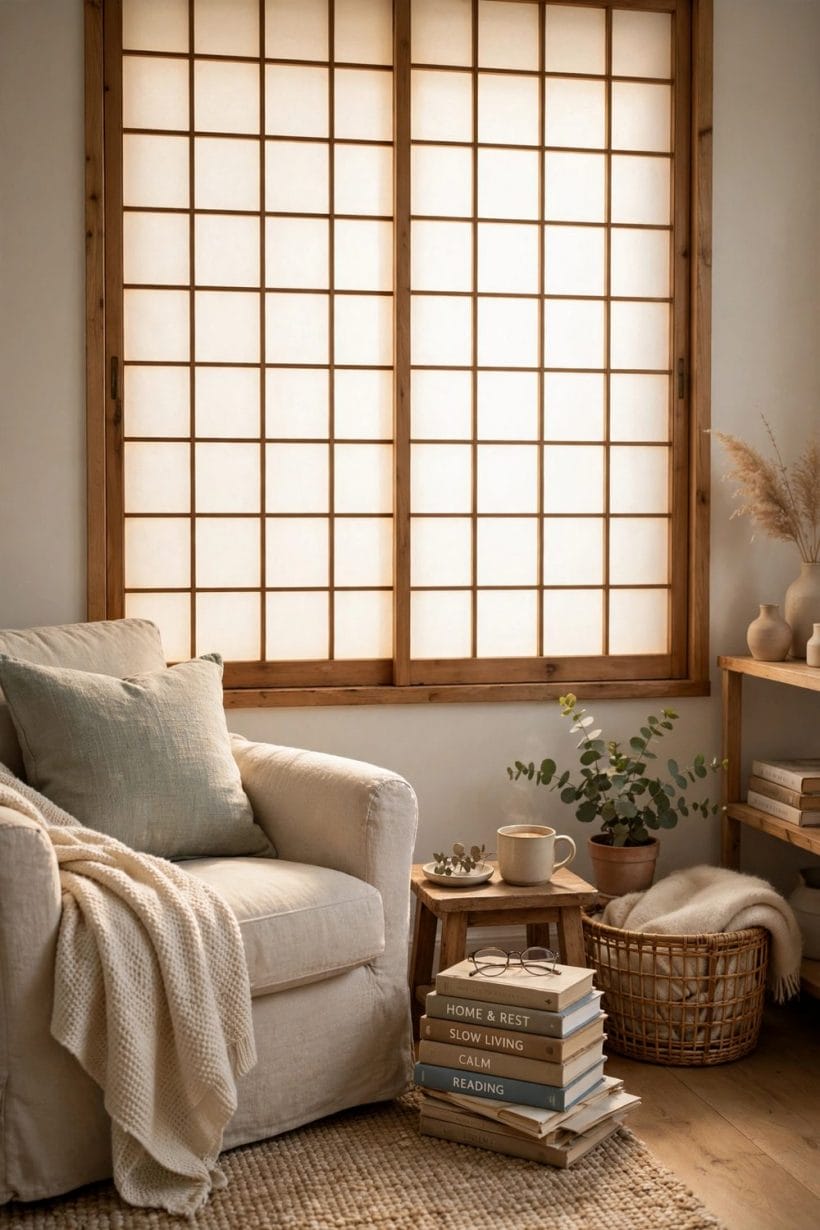
Shoji is a strong flavour that plays well with others — as long as the others share its calm. Three pairings cover most homes.
17. With minimal and zen-leaning interiors
The natural home of shoji is the uncluttered interior — low furniture, clear floors, a few beautiful objects — the world our zen interior design tiny houses guide explores. Shoji supplies the architecture such rooms deliberately lack, pattern without noise.
18. With warm timber, plants and woven texture
Shoji softens beautifully against the natural-material palette — timber floors, cane and rattan, linen, indoor planting — that our tropical interior design survey carries room to room. The lattice gives the greenery a geometry to climb against, and entryways styled after the japanese genkan tiny house entryways show the pairing at the front door.
19. Frame colour: natural, dark or white
Natural pale timber is the classic frame; dark-stained frames sharpen the lattice into graphic contrast and suit modern rooms; white-painted frames disappear into bright, Scandinavian-leaning spaces. The frame colour is shoji’s loudest styling decision — the lattice pattern whispers, the frame speaks.
Restraint is the styling rule that protects all three pairings: shoji already brings pattern, geometry and glow, so the rooms that flatter it keep other pattern quiet and let texture do the talking. One strong lattice, calm company — the screen should be the room’s calligraphy, not one of several competing scripts.
9. Shoji in Small and Tiny Spaces
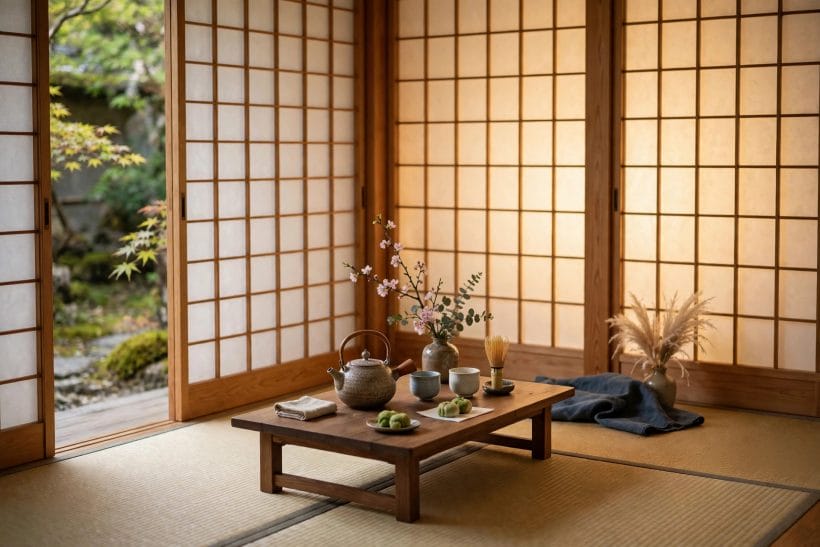
Small homes are where shoji stops being a style and becomes a strategy — the same zoning logic our tiny house interior designs survey applies to whole interiors, at the scale of a single panel.
20. Dividers that do not darken
Every solid divider in a small home steals light from the far side; shoji is the divider that pays it back. A studio zoned with shoji keeps one window serving two rooms, and the borrowed half never feels like the leftover half. The effect is partly measurement and partly morale: the screened sleeping corner keeps its dignity, the living corner keeps its brightness, and neither side of the studio feels like the compromise.
21. Doors that do not swing
A hinged door in a tiny home commands a circle of floor forever kept empty. Sliding shoji reclaims that circle for a chair, a shelf, a life — which is why tiny homes and shoji keep finding each other, centuries and continents apart.
For renters in small spaces, the freestanding screen offers the whole strategy without a single fixing: a sleeping corner screened for a guest, a work nook hidden at the day’s end, a dressing area conjured from a bedroom corner. It is the least permanent object in this article and, for many small homes, the most useful one.
10. Care, Repair and Choosing Well
Shoji’s care follows from its construction. Traditional paper panels ask for gentle hands and dry conditions, and they are designed to be re-papered — a maintenance rhythm Japanese households treat as ordinary, and a damaged panel is a repair, not a replacement. Modern synthetic panels forgive more and diffuse a touch less sweetly; the choice between them is the same trade this article has met throughout, atmosphere against convenience, and either can be right.
Choosing well comes down to frame quality — straight, well-joined timber, a lattice that does not flex, hardware that slides without argument — and to honest sizing: made-to-measure panels cost more than standard sizes and fit like tailoring. Those are the cost drivers, alongside the panel material itself and whether tracks are being built in.
The lattice pattern is the last choice and the most personal: a plain grid for calm, a finer repeat for formality, an asymmetric traditional pattern where the screen is meant to be looked at as much as through. Live with the pattern’s shadow before committing if you can — a sample panel in the window for a day teaches more than a catalogue ever will. Buy the frame as furniture, the panel as a consumable, and a shoji screen will divide your rooms, and light them, for a very long time.
Final Considerations
The shoji screen asks a home a pleasant question: which of your walls could be softer? A divider that glows, a door that glides, a window covering that keeps the day — few furnishings offer so much negotiation between the things a room wants.
Choose shoji where light is precious and space must flex, style it with calm materials and one clear frame colour, and care for it as the Japanese interior always has — as a living part of the house, maintained with pleasure rather than endured. The screen that lends light rarely wants to give the room back.




0 Comments