
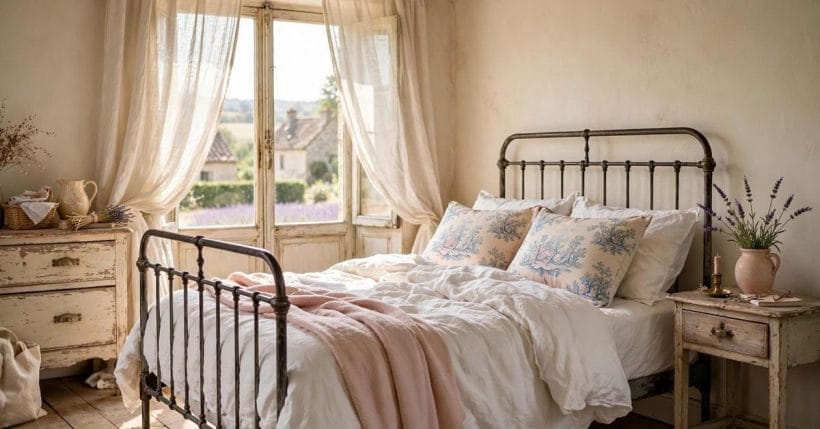
A French country bedroom does not try to impress you. It wins you over slowly — rumpled linen, a worn painted dresser, lavender drying by the window — until the room feels less decorated than remembered, like a farmhouse you have always known.
These seventy-five ideas build that room piece by piece: the bed first, then linen and toile, the soft palette, distressed wood, honest walls and country storage — every choice in service of rest.
1. French Country Bedroom at a Glance
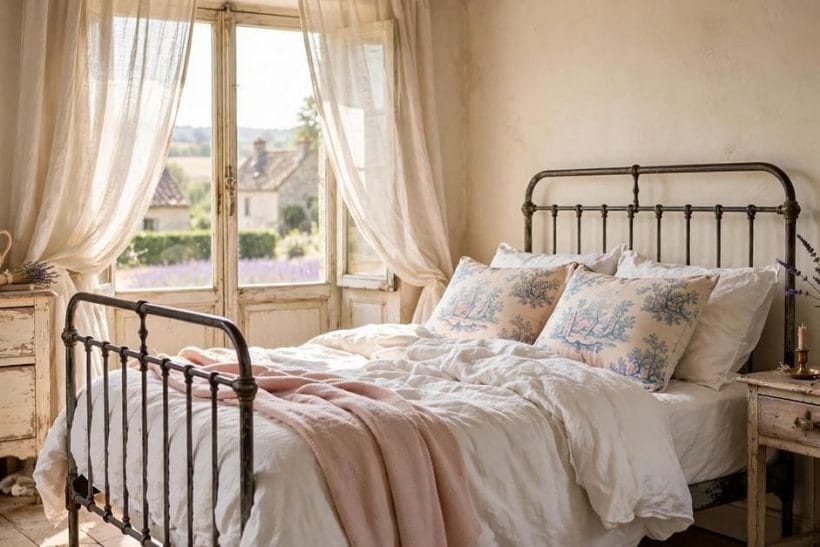
The central entity is the French country bedroom: a sleeping room in the rural French manner, where natural linen, toile patterns, painted and distressed wood, ironwork and a faded floral palette combine into comfort that looks inherited rather than bought. The room-wide survey belongs to the bedroom ideas pillar; this post is the style’s bedroom chapter. The same style keeps its own family across the house — the french country living room takes the public rooms, the french country bathroom carries it into tile and water, and the french country dining room sets its table — start here if the bedroom is your room, and let the family posts handle theirs.
| Question | Short answer |
|---|---|
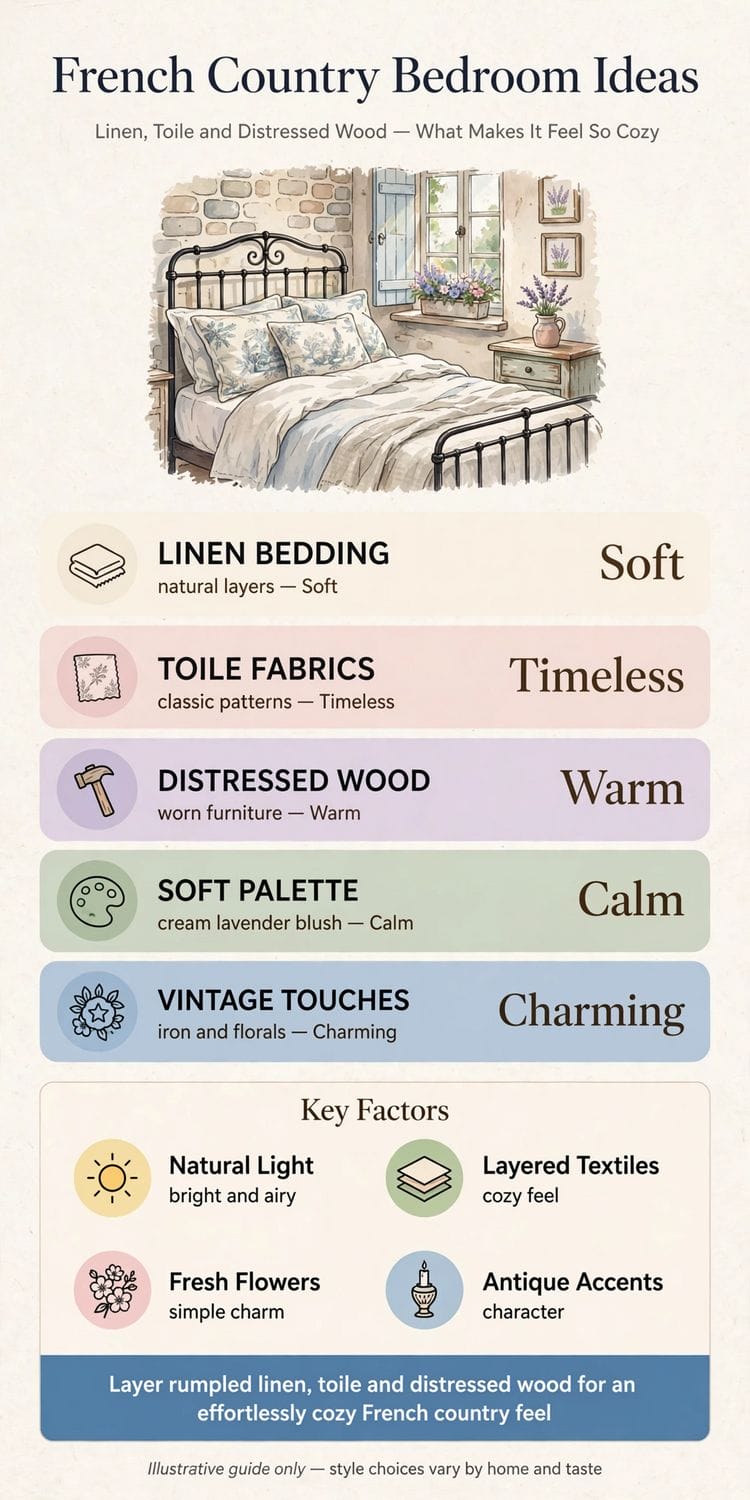
| What defines the style? | Natural fibres, toile and floral prints, distressed painted wood, iron accents and a soft faded palette — comfort with visible age, covered section by section below |
| Does it need a cottage or farmhouse? | No — the style travels: one iron bed, linen bedding and a worn dresser will turn an ordinary box room; the bones help but the layers do the work |
| Is it a formal style? | The opposite — rumpled, faded and mismatched are virtues here; perfection is the one thing that looks wrong |
| Where does the money go? | The bed and real linen first, then one or two genuinely old pieces; the rest is paint, fabric and patience — the last section weighs it up |
2. The Bed: Iron, Upholstery and Carved Wood
Everything in this room answers to the bed. French country beds are furniture with a past — iron rails, carved timber, cane and upholstery softened by decades — and the nine starting points below sort the frames before a single sheet is bought.
1. The black iron bedstead
The classic of the style: slim iron rails, a gentle arch, finials worn bright where hands have held them. Iron reads light against pale walls, suits every palette in this post, and never argues with the bedding layered over it.
2. The white-painted iron bed
Iron painted cream or soft white turns the same frame cottage-gentle — the choice where walls are coloured or the room is small. Chips at the corners are not damage here; they are the style’s signature, honestly earned.
3. The carved wooden bed
A carved timber headboard — cabriole curves, a shell or wheat motif at the crown — brings the farmhouse weight iron cannot. Keep the rest of the room quieter around it; one carved piece per room is the old rule.
4. The cane-panelled headboard
Woven cane set into a timber frame gives the bed air and texture at once, and reads beautifully against limewash. Cane suits warmer rooms and pairs with plain linen better than with busy toile.
5. The upholstered toile bed
A padded headboard covered in toile de Jouy is the style’s softest statement — the pattern does the decorating while the bedding stays plain. Choose the toile’s scene colour first; the room’s palette follows it.
6. The simple slatted farmhouse bed
Straight slats, honest joinery, no carving at all — the working farm’s bed, and the easiest to live with. It takes paint well, suits the plainer end of the style, and lets textiles carry the romance.
7. The daybed in the corner
A single iron or timber daybed along the wall serves spare rooms and small cottages: seat by day under a pile of cushions, bed by night. It is the style’s traditional answer to the room that must do two jobs.
8. The four-poster, countrified
A slim four-poster stripped of drapes and left bare-timbered reads French country rather than grand — height without heaviness. Hang nothing from it; the posts themselves are the ornament.
9. The low bed and the tall room
Where ceilings are beamed and low, a low frame keeps the bed under the timber line and the room breathing. Where ceilings soar, height in the headboard earns its keep. Match the bed’s ambition to the room’s bones.
3. Linen, Toile and the Layered Bed
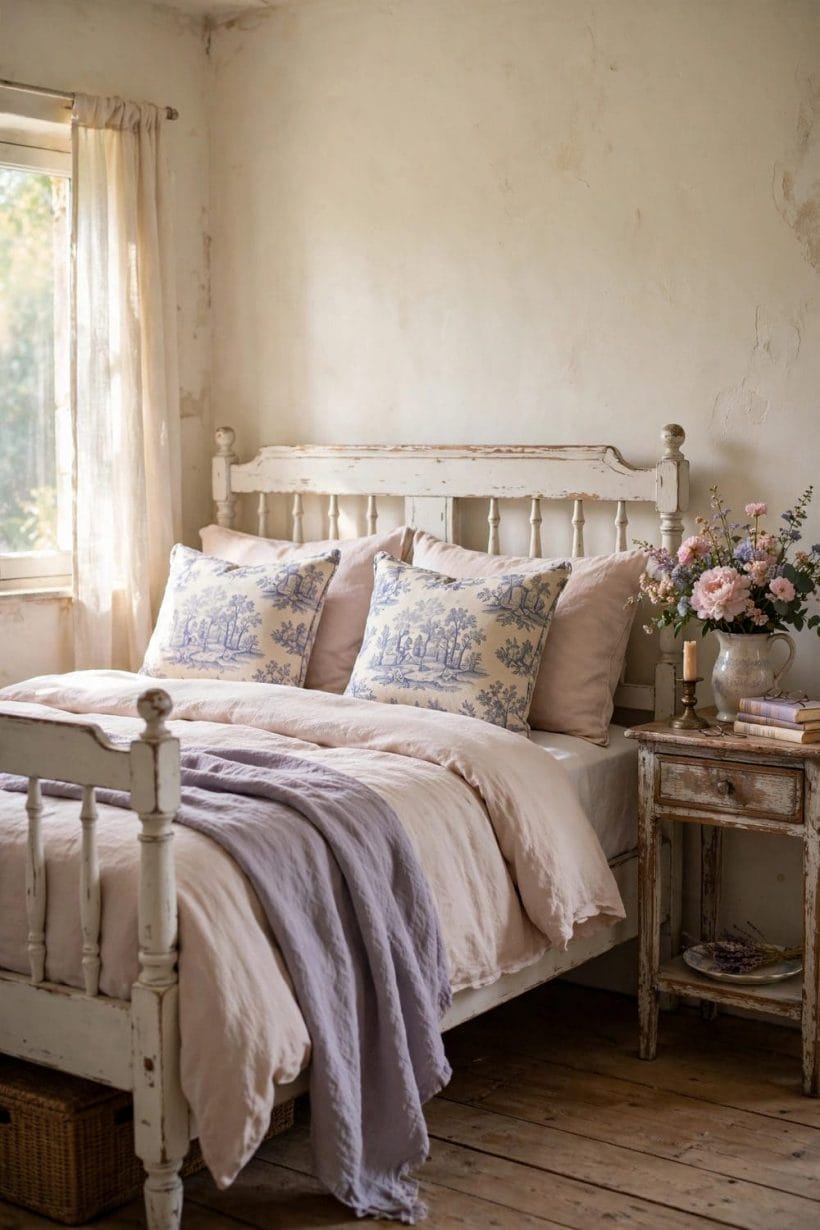
French country bedding is a layering discipline: natural fibres, one pattern allowed to sing, and a deliberate refusal to iron anything flat. These nine ideas dress the bed from the sheet outward.
10. Stonewashed linen sheets
Linen is the style’s foundation fabric — breathable, long-lived, and better rumpled than pressed. Stonewashed linen arrives soft and only improves; white and natural flax are the two colours that never date.
11. The toile duvet as the room’s picture
One toile — pastoral scenes in blue, red or charcoal on cream — can carry the whole room’s pattern. Everything else stays plain around it. Pick the toile first and let its colours set the palette section that follows.
12. Plain linen with a toile edge
The quieter route: plain linen bedding trimmed with a border or cushion of toile. The pattern appears as an accent rather than a field, which suits small rooms and pattern-shy sleepers.
13. The layered throw system
A quilt, a folded throw and a light blanket at the foot — three layers in related tones give the bed its countryside depth and let the sleeper adjust through the night. Cotton, wool and linen in any order that pleases the hand.
14. Cushions in odd numbers
Three or five cushions, mixed sizes, at least one in a faded floral — the arrangement should look gathered over years, not bought in a set. Feather inners slump the right way; foam never does.
15. The checked and striped accents
A single gingham or ticking-stripe cushion keeps toile from turning precious — farmhouse patterns steadying the romantic one. Red-and-cream checks are the traditional partner to blue toile.
16. White on white, texture doing the work
An all-white bed — linen sheet, cotton quilt, crochet-edged cases — is the style’s most restful register. Interest comes from weave and texture alone, and the light in the room becomes the colour.
17. The vintage quilt as heirloom
One genuinely old quilt, folded at the foot or spread whole, gives a new room instant ancestry. Vintage textiles ask for gentle washing and honest mending; the patches become part of the story.
18. The bed skirt question
A plain linen valance hides the under-bed and softens an iron frame’s legs — traditional in this style where beds sit high. Low modern frames skip it; let the bed’s height decide.
4. The Soft Palette: Cream, Lavender, Blush and Sage
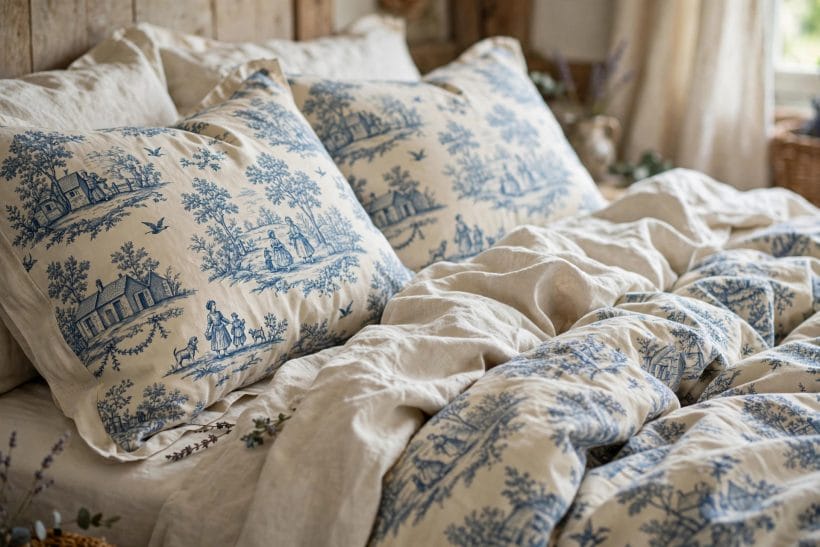
French country colour is sunlight remembered — every tone faded half a step from its garden original. The nine ideas below build the palette wall by wall and fabric by fabric; neighbouring colour-led rooms, like the yellow bedroom, show how a single hue takes a whole room when you want a bolder lane.
19. Cream and warm white walls
The default ground: warm off-whites that flatter linen, timber and skin. Cream walls forgive every other choice in the room and carry the style in spaces where colour feels risky.
20. Lavender, the provincial signature
Lavender — in a cushion, a throw, a bunch of dried stems by the bed — is the colour outsiders picture first. Used as an accent against cream and flax it stays fresh; used everywhere it turns theme-park.
21. Blush and faded rose
Rose tones washed almost to neutrality warm north-facing rooms and partner grey-green beautifully. Keep blush in textiles and flowers rather than on walls, where it can sweeten past the style’s honesty.
22. Sage and olive greens
The garden enters as sage: painted shutters, a green dresser, eucalyptus in a jug. Green is the palette’s ballast — the colour that stops cream and blush from floating away.
23. Toile blue and cornflower
Blue is the classic toile ground-note and the palette’s cool counterweight. Cornflower cushions on a cream bed are the single most recognisable French country gesture there is.
24. Ochre and wheat yellows
Sun-baked yellows — wheat, ochre, old gold — warm the palette’s autumn register. A mustard throw or a field of dried flowers gives a pale room its late-afternoon glow.
25. Faded red, used sparingly
The old madder reds appear in checks, stripes and toile scenes, almost never as a field colour. A little faded red keeps the soft palette from turning insipid.
26. Grey, the weathered neutral
Weathered grey — in linen, in painted wood, in a stone-coloured throw — is the palette’s shadow tone. It modernises the style gently and pairs with every colour above.
27. One palette across the whole room
Choose three tones plus white and hold the line: walls, bedding, furniture and flowers all drawn from the same faded handful. The discipline is invisible when it works — the room simply feels inevitable.
The palette’s test is the door test: stand in the doorway with the morning coming in and squint. If every colour in view could have been picked from the same garden on the same August day — petals, leaves, earth and sky all faded by the same sun — the palette holds. If one object glows at modern saturation, it is the intruder, and it goes to another room.
5. Distressed Wood and Painted Furniture
Furniture in this style is painted, worn, and older than the house it stands in — or honestly made to look so. These nine ideas furnish the room around the bed.
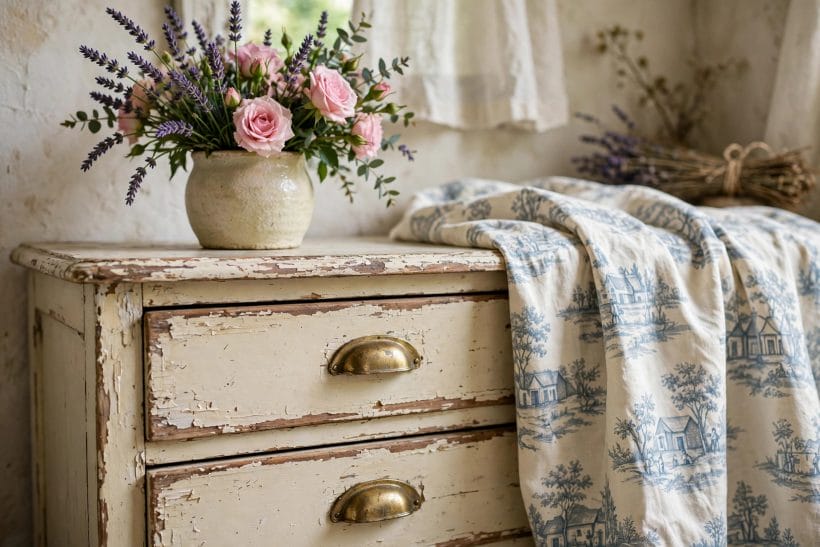
28. The painted dresser
A chest of drawers in chalky cream, sage or grey — edges rubbed back to timber — is the room’s second anchor after the bed. Original handles, however mismatched, beat new replacements.
29. The armoire as wardrobe
The tall French armoire holds the room’s storage and its architecture in one piece. Carved or plain, it replaces built-in wardrobes with furniture that can move house with you.
30. Bedside tables that do not match
Two different small tables — a stool on one side, a tiny dresser on the other — are the style’s preference, not its compromise. Symmetry is for grander rooms; the farmhouse takes what it has.
31. The washstand corner
A marble-topped or timber washstand with jug and basin recalls the room’s pre-plumbing past and still works as a dressing station. Even unused, it is the corner that makes visitors smile.
32. A writing desk by the window
A small painted desk under the light — for letters, lists and morning coffee — belongs to this style’s unhurried life. Keep it nearly bare: one lamp, one chair, nothing that hums.
33. The rush-seated chair
Woven rush or cane seats on timber chairs are the farmhouse standard, kind to linen trousers and lovely in raking light. One by the bed holds tonight’s clothes better than any valet stand.
34. Distressing honestly
Real wear gathers at handles, corners and feet. If you distress a new piece, work those places and stop — uniform sanding reads as costume, and the style can smell costume at fifty paces.
35. Mixing painted and bare timber
All-painted rooms turn saccharine; all-timber rooms turn heavy. The living mix is roughly half and half — a bare oak top on a painted dresser is the style in miniature.
36. Gilt, rationed
One small gilt mirror or frame, its gold rubbed dull, is the farmhouse’s permitted luxury. More than one and the room starts pretending to be a château, which it is not.
6. Walls, Beams and Stone: The Room’s Bones
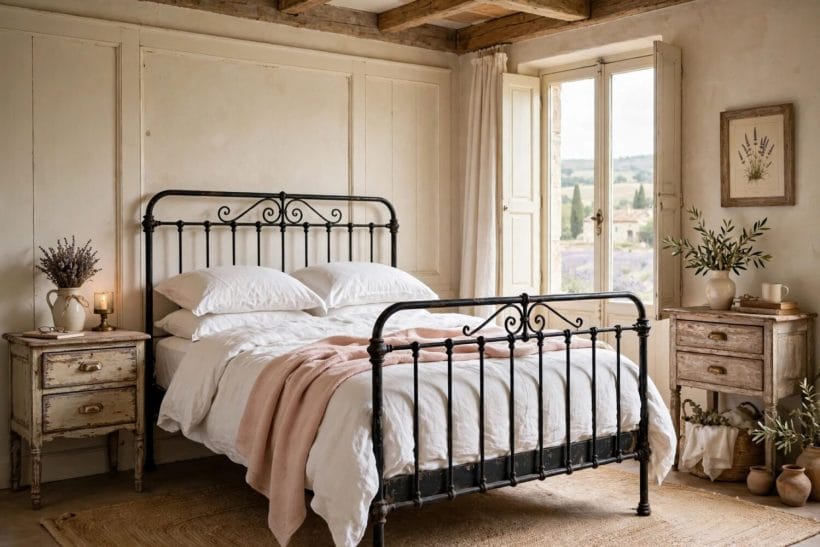
The style began in stone farmhouses, and its favourite rooms still show their structure. Where your bones are plasterboard, these nine ideas borrow the farmhouse’s surfaces honestly — the same instinct that animates the cottage interiors across the site.
37. Limewash and chalky wall finishes
Limewash gives walls the cloudy, breathing depth flat paint cannot — pools of tone that shift with the light. It is the farmhouse’s original finish and the quickest route from new plaster to old soul.
38. Exposed beams, kept honest
Real beams stay bare or oiled, never painted black for drama. Where beams are fake, make them timber, make them structural-looking, and let them carry nothing they could not actually hold.
39. A stone feature wall
One wall of stone — original, or thin stone slips over plaster — behind the bed grounds the room in its landscape. Stone asks for softness against it: the rumpled bed does that work.
40. Tongue-and-groove panelling
Vertical boarding to dado height or behind the bed adds farmhouse carpentry to plain rooms. Painted cream or sage, it survives knocks better than plaster and ages the right way.
41. Shutters inside the window
Interior louvred or boarded shutters — the provincial window treatment — filter morning light into stripes and replace curtains where fabric feels heavy. Painted to match the room’s green or blue note.
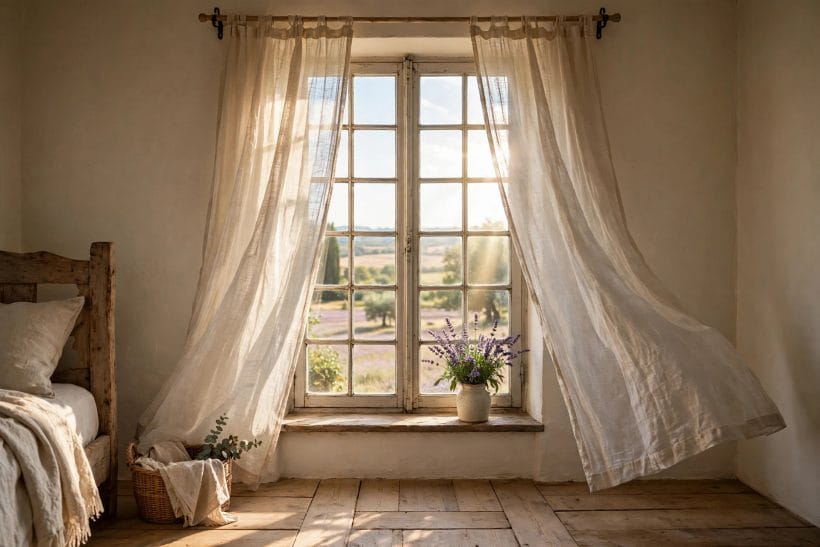
42. Sheer linen curtains
Where curtains are used, they are unlined linen, hung simply and left to move in the draught. The farmhouse window is dressed for light first and privacy second; sheers honour both.
43. A faded floral wallpaper, one wall only
A small-scale faded floral behind the bed can stand in for toile’s pattern at wall scale. One wall, small print, colours already in the palette — the wallpaper joins the room rather than starring in it.
44. Pictures hung low and lived-in
Small framed prints, botanical plates and one mirror, hung at sitting height and slightly unaligned by time. Gallery precision belongs to other styles; here, pictures look inherited because some of them should be.
45. The door as furniture
A ledged timber door, an old iron handle, a curtain of linen on a rail where the door should be — the room’s threshold is part of its furnishing in the farmhouse, and worth the small ceremony.
A word of honesty about borrowed bones: finishes like limewash, panelling and shutters work because they are real materials doing real jobs, not prints of them. The farmhouse forgives new materials — it was built from whatever the farm had — but it never forgives pretending. A plastic beam fools nobody at touching distance, and this is a style lived at touching distance.
7. Windows, Light and the Lavender Hour
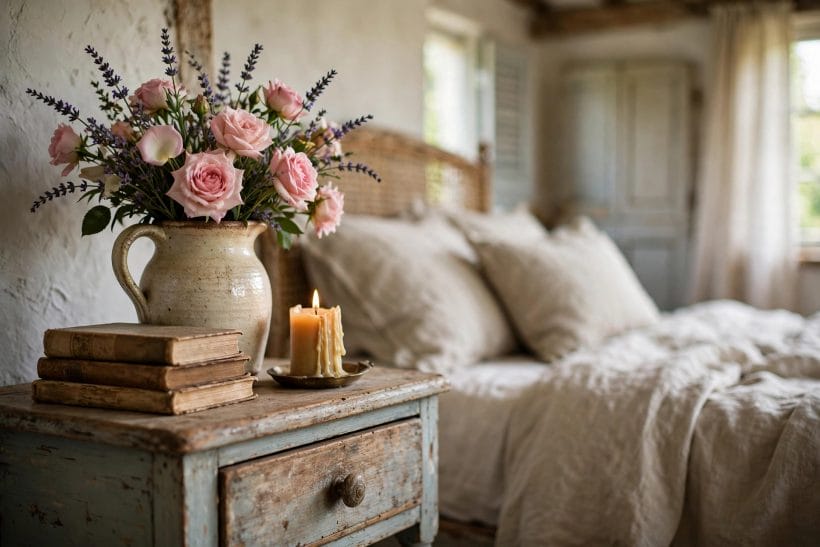
Provence is a light before it is a style. These nine ideas manage daylight and lamplight so the room keeps its golden register from dawn to the last page of the book.
46. South light, filtered not blocked
Strong sun fades toile and linen to the style’s beloved pallor — but bleaches patches unevenly. Sheers and shutters spread the light so the fading, where it comes, arrives evenly and gracefully.
47. Bedside lamps with linen shades
Two low lamps — ceramic, iron or turned wood bases under plain linen shades — give the bed its pool of warm light. Matching pairs are optional; matched warmth of bulb is not.
48. Candlelight as a design material
A candle on the washstand and one by the chair are this style’s original evening lighting, and still its prettiest. Keep them in sturdy holders, away from the linen, and treat them with the respect open flame deserves.
49. The mirror placed for morning
One mirror angled to catch window light doubles the room’s morning without a watt of power. The small gilt frame rationed in the furniture section earns its keep exactly here.
50. Blackout, the farmhouse way
Thick linen curtains on a second rail, or shutters closed over sheers, darken a country bedroom without a synthetic blind in sight. Sleep quality is a design feature; the style simply hides its mechanism.
51. A reading light that suits the room
A slim brass or iron reading lamp at the bedside does the focused work the pretty lamps cannot. One modern object per room, chosen plainly, never spoiled a farmhouse yet.
52. Strings of light stay outside
Fairy lights belong to the garden party, not the bedroom wall. Inside, this style takes its glow from lamps, candles and the window — restraint is what keeps the room grown-up.
53. Warm bulbs throughout
Every bulb in the room at the same warm temperature keeps linen creamy and skin kind at midnight. Mixed colour temperatures are the fastest way to make a soft room feel like an office.
54. The dawn-facing bed
Where the room allows, angle the bed to wake toward the window rather than the wall. The style’s whole palette was mixed by morning light; sleeping in its path is the final furnishing.
8. Storage the Country Way: Armoires, Baskets and Benches
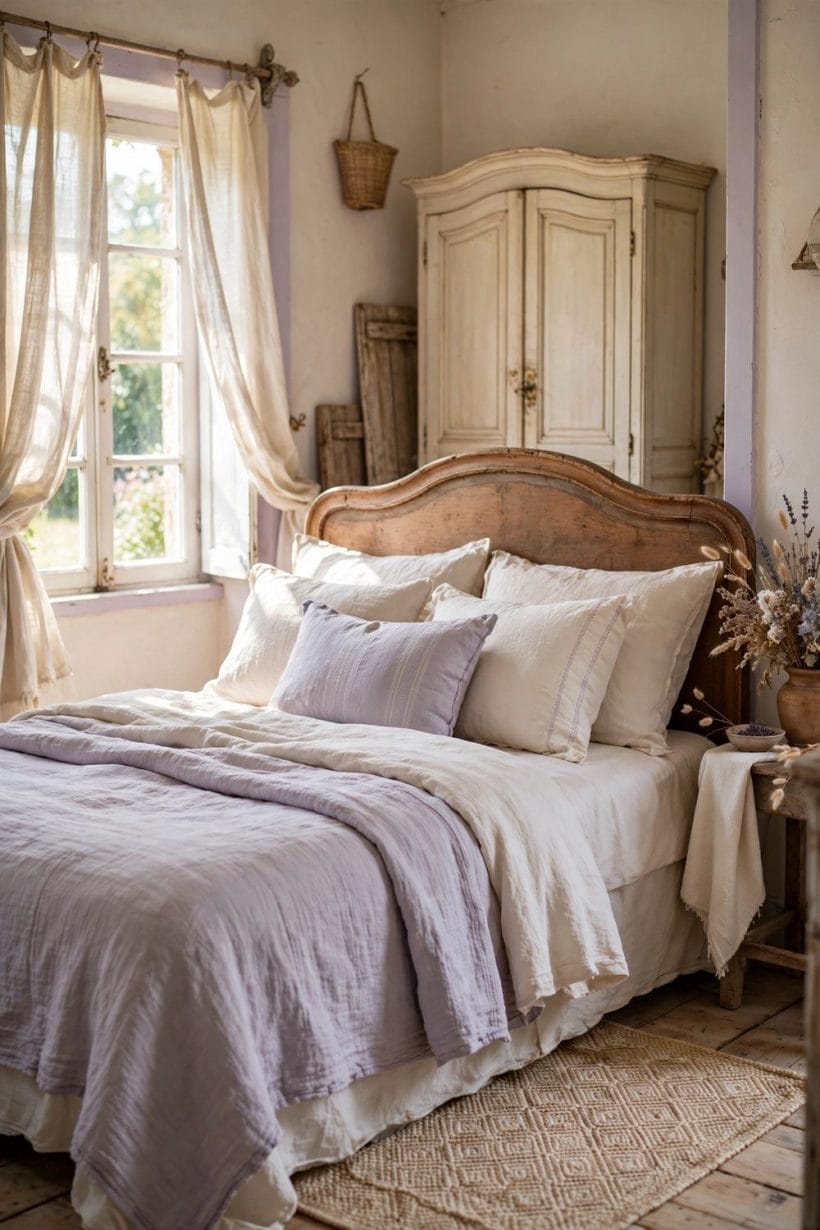
Country storage is furniture, not systems: things with doors, lids and handles that earn their floor space by being beautiful empty. Eight ideas put the room’s clutter away the farmhouse way.
55. The armoire does the wardrobe’s work
One great armoire — hanging space, shelves and a drawer in its base — replaces the fitted wardrobe entirely. Its doors closing on the day’s clothes is the room’s evening ritual.
56. Baskets everywhere they fit
Woven baskets take blankets, books, slippers and the miscellaneous drawer-overflow of real life. Under the bench, beside the chair, inside the armoire — the basket is this style’s unit of tidiness.
57. The blanket chest at the foot
A timber or painted chest at the bed’s foot stores the spare quilts and gives the room a place to sit while pulling on boots. It is storage, seat and footboard in one honest box.
58. Hooks and a peg rail
A row of iron or wooden pegs by the door takes dressing gowns, hats and tomorrow’s outfit. The farmhouse hangs things where they are used and calls the result decoration, correctly.
59. Under-bed drawers and baskets
The high farmhouse bed hides a season of storage beneath it — linen in summer, wool in winter. Flat baskets or old drawers on runners keep the space usable rather than dusty.
60. The linen press shelf
One open shelf of folded white linen, lavender bags tucked between the stacks, is storage as display — the farmhouse’s tidy heart on show. It asks only that folding be done with care.
61. A bench for the foot of the bed
A low bench takes the folded throw, the book pile and the morning’s laid-out clothes. Upholstered in ticking or left bare timber, it is the hardest-working seat in the room.
62. Jewellery and small things in dishes
Small ceramic dishes and old tins on the dresser corral rings, pins and watches. The style’s answer to the jewellery box is prettier and costs a charity-shop visit.
The measure of country storage is what the room looks like at bedtime, not at noon. If the day’s clothes, books, chargers and clutter can all be swallowed by the armoire, the chest, the baskets and the bench — leaving surfaces clear for the lamp, the candle and tomorrow’s flowers — the storage has earned the name. Everything visible after that closing-up is decoration, and it was chosen.
9. Floors, Rugs and the Barefoot Test
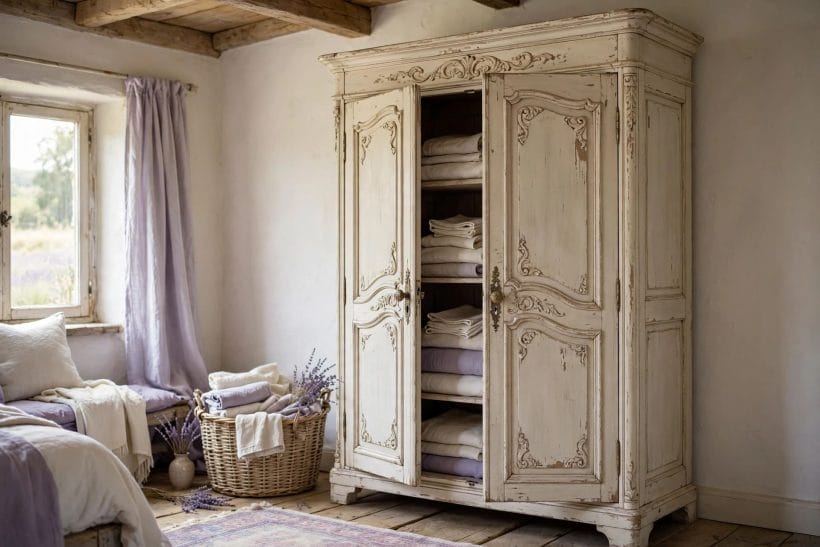
The farmhouse floor is timber, stone or tile — and always tested barefoot at midnight. Eight ideas finish the room at ground level.
63. Wide floorboards, left worn
Old boards with their gaps, knots and traffic-polish are the floor this style was invented on. Sand lightly if at all, oil or wax, and let the wear map the room’s life.
64. Painted floorboards
Where boards are poor, painting them — cream, stone or the traditional checkerboard in a faded pair of tones — is older than varnish. Painted floors wear into the style rather than out of it.
65. Stone and terracotta underfoot
Downstairs farmhouse bedrooms may keep their stone or terracotta tiles — cool in summer, warmed by rugs in winter. The tiles’ unevenness is their character; levelling them is erasing the point.
66. The faded woven rug
A flat-woven rug in faded reds, blues and creams beside the bed gives bare feet their soft landing. Faded is the operative word — a bright new rug shouts over a quiet room.
67. Rush and seagrass matting
Natural matting wall-to-wall or as a great square under the bed brings the harvest indoors. It smells faintly of summer, forgives dust, and suits the style’s plainest rooms best.
68. A sheepskin by the bed
One sheepskin where the feet land first is the farmhouse luxury that costs least and pleases most on January mornings. It shakes clean outside and asks for nothing else.
69. Layered rugs, country style
A small patterned rug over a larger natural one — the layers slightly askew — is the floor’s version of the layered bed. It reads gathered rather than fitted, which is the point.
70. Bare boards and painted stairs beyond
Where boards are beautiful and summers are warm, the floor can stay bare with a single runner’s worth of rug at the bedside. Restraint at floor level makes the dressed bed the room’s whole event.
10. Choosing Well: New, Vintage and Honestly Aged
The last five ideas are the judgement that separates a French country bedroom from a themed one — where to insist on the real thing, and where the modern copy serves better.
71. Buy the bed and the linen new if you must — and well
Sleep is not the place for compromise: a sound frame and real linen pay back every night. New iron beds and honest linen are made today in the old spirit; buy once, buy well.
72. Let furniture be genuinely old
The dresser, armoire and chairs are where age shows best and costs least — secondhand painted furniture is plentiful and priced below new. Check drawers run, joints hold and woodworm is history, not current affairs.
73. New pieces should keep quiet
Where new furniture is needed, let it be plain — slatted beds, simple chests, rush chairs — and let paint and time do the rest. Costume carving and factory distressing announce themselves instantly.
74. Textiles forgive reproduction
Modern toile printed on good cotton, new linen woven loosely, quilts made today in the old patterns — textiles are the safe place to buy new, because fabric ages by living rather than by label.
75. Add one thing at a time
The style’s deepest rule is patience: a room furnished in a weekend looks like a purchase; a room furnished over years looks like a life. Buy the bed, sleep, then let the room gather itself.
Costs here are the costs of patience more than of objects — the bed and real linen are the splurge, painted furniture is routinely cheaper secondhand than new, and the rest is paint, fabric and flowers. Spend on what touches sleep; save on everything that merely stands there looking French.
Final Considerations
Judge the room at two moments: dawn, when the sheers stripe the bed with light, and dusk, when the lamps come on and the colours deepen. If both moments feel calm, the room is finished — whatever the catalogue says is missing.
A French country bedroom is seventy-five small agreements between comfort and age: an honest bed, linen allowed to rumple, a palette faded like a garden in August, wood that shows its years and storage that doubles as furniture. Make those agreements one piece at a time, and the room will feel less decorated than inherited — which was always the point.

0 Comments