
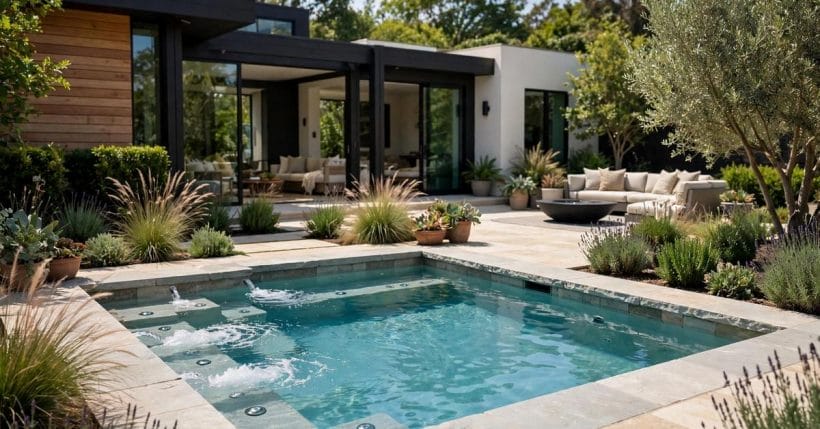
A spool is the answer to a familiar garden problem: the wish for water — real water, warm, with jets — in a plot that could never hold a pool.
This post defines the thing plainly, then builds it piece by piece: forms and shells, the benches inside, the jets and heating that make its spa half, its edges and covers, and the planting that gives its bathers privacy.
1. Spool Pool Ideas at a Glance
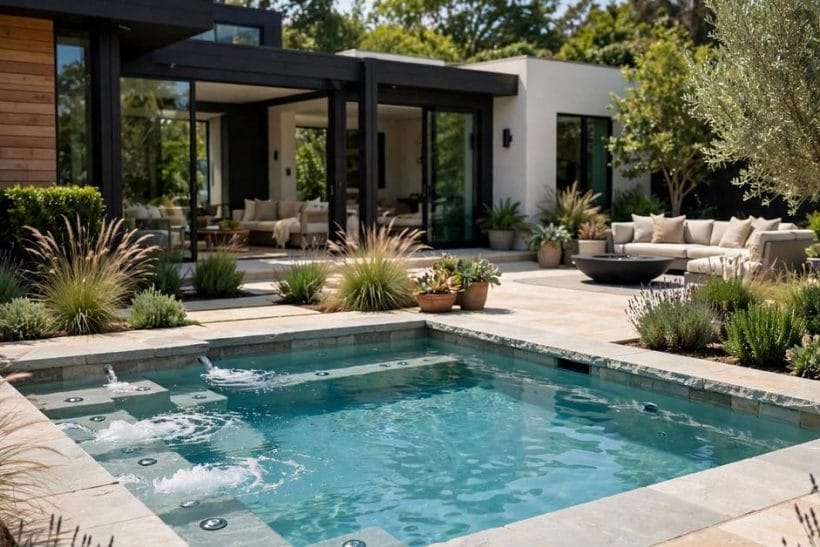
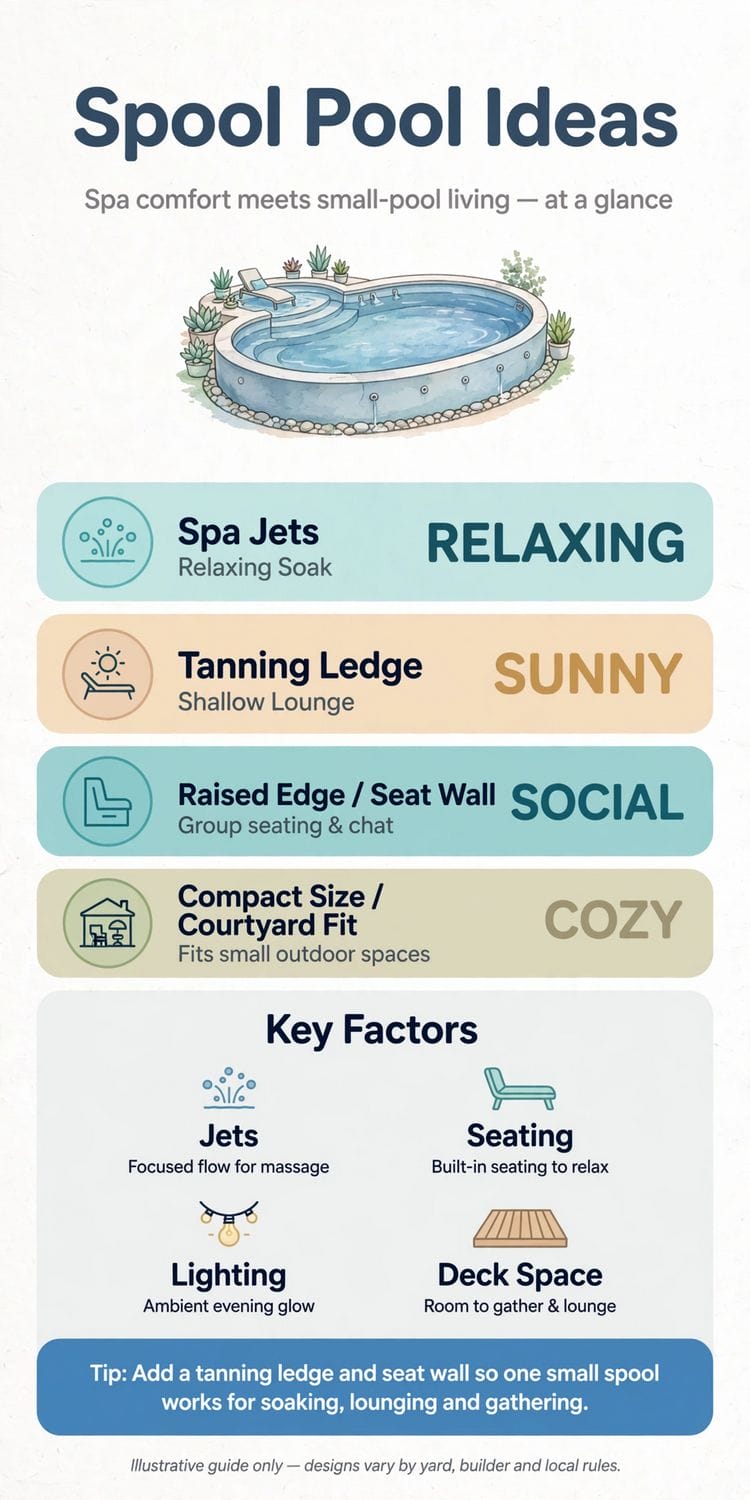
A spool pool is a compact hybrid: a pool small enough for a modest garden, fitted like a spa with bench seating, hydrotherapy jets and heating, so the same water serves a cool plunge in summer and a hot soak in winter.
| Question | Short answer |
|---|---|
| What exactly is a spool? | A spa-pool hybrid: small like a plunge pool, seated, jetted and heated like a spa |
| How is it different from a hot tub? | It is built into the garden like a pool, usually larger and deeper, and can run cool as well as hot |
| What is the most important design decision? | The seating — benches at a depth that puts shoulders under water |
| Does it need fencing or a barrier? | In many places yes; rules are local — check them before ordering |
| What keeps its running costs sane? | Insulation and a fitted cover, used every night |
2. What a Spool Is: Forms, Shells and First Layouts
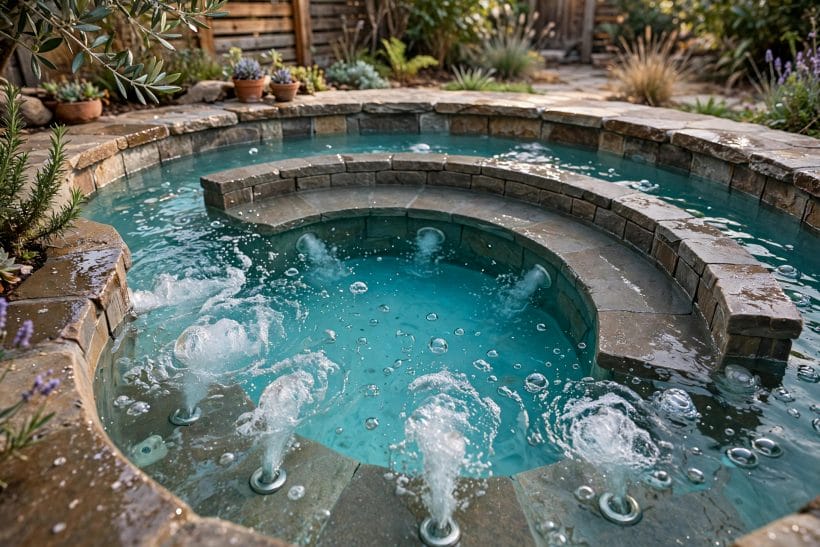
A spool earns its place by being two things honestly: small enough for a modest garden, deep enough to sit in up to the shoulders. The wider family is surveyed in pool ideas, and its neighbours are the raised structures of above ground pool design and the sheltered water of indoor pool ideas; this post keeps to the hybrid itself — its forms, its seating, its warmth and its edges.
1. Start with the classic rectangle: the spool in its simplest form
A straight-sided rectangle is the spool at its most practical: easy to cover, easy to heat, and honest about its small footprint.
2. Choose a square spool where the garden is nearly square
A square plan suits the leftover square of garden behind many houses, seating on two or three sides like a conversation pit filled with water. It is the most sociable of the small forms, every seat facing another.
3. Let a kidney curve soften a formal garden
A gentle kidney outline breaks the geometry of fences and paving, and its curve gives the seating a natural sweep.
4. Run a long, narrow spool along a boundary
A slim spool against a fence turns a dead side strip into the garden’s destination: bench along one side, a narrow step ledge along the other, and planting above the fence line to borrow the neighbours’ trees.
5. Sink the spool fully for a still, pond-like surface
A fully sunken spool sits at the garden’s level, its water a dark mirror among the planting.
6. Raise the spool so its wall becomes a seat
A raised spool wears its structure proudly: walls at sitting height double as garden seating, the plumbing hides within the raised body, and entry is by steps rather than a ladder.
7. Half-sink it to balance digging and presence
Half in, half out is the pragmatic favourite: less excavation than a sunken pool, less masonry than a raised one, and a rim at low-sitting height all round. Many spools end here once the levels are honestly drawn.
8. Add a tanning ledge at one end
A shallow ledge — ankle deep, wide enough for a lounger’s legs or a toddler’s supervised paddle — gives a small spool a second kind of water.
9. Build the spool in fibreglass for a fast, smooth shell
A preformed fibreglass spool arrives as one piece: smooth, quick to set, and limited to the maker’s shapes. For a standard rectangle on an ordinary plot it is often the shortest road from decision to first soak.
10. Choose a lined shell where the shape must be bespoke
A liner over a formed structure allows shapes the moulds do not offer, at a price in seams and in the liner’s eventual replacement.
11. Pour it in concrete where it must last like the house
Concrete is the permanent answer: any shape, any depth, tile or render over it, and a structure that outlasts its fittings.
3. Seating, Benches and Lounging Inside the Shell
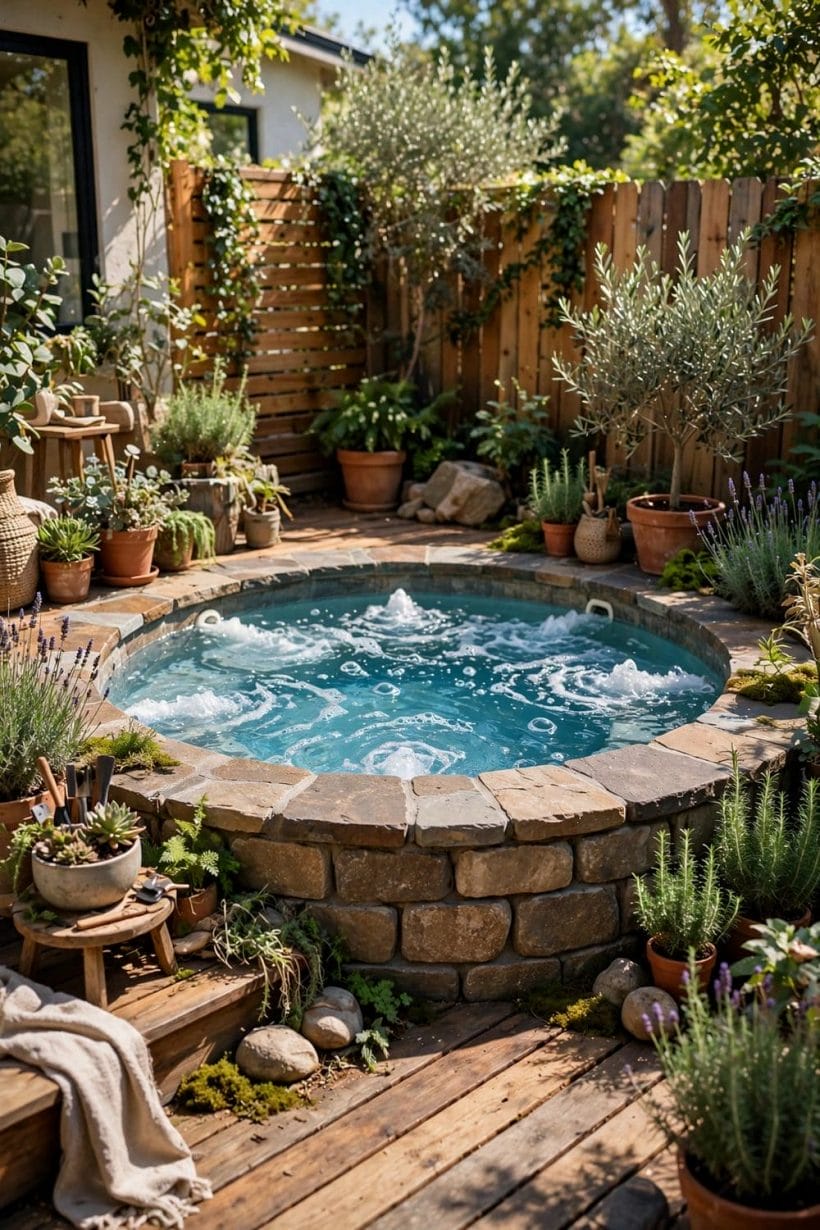
A spool is sat in, not swum in, so its inside is furniture. The layouts below treat the bench as the main event; the garden-scale settings they sit within are the ground of backyard pool ideas, while the water here stays close and sociable.
12. Run a bench along the full long side
One long bench is the spool’s simplest seat: a row of bathers shoulder to shoulder, backs to the jets, facing the garden. It seats the most people in the least water and suits the rectangle’s straightforward manners.
13. Wrap the bench around two sides in an L
An L of seating turns bathers toward each other at the corner — the natural place for conversation. The short arm of the L makes a perch for the one who wants only their legs in the water.
14. Bench three sides and keep one end for entry
Seating on three sides with steps at the fourth makes a small amphitheatre of water. It is the family arrangement: children on the steps, adults on the benches, everyone inside the same warm circle.
15. Add a corner seat deep enough to stretch out on
One generous corner, wide enough to recline across, gives the spool a lounger’s place without a ledge. It is where the book and the long soak live, and it anchors the seating plan around it.
16. Step the bench heights for adults and children
Two bench depths in one shell — a higher perch and a lower seat — let different bodies sit at their own right depth. Families feel the benefit daily; the steps between the levels double as extra perches.
17. Shape a contoured lounger into the shell
A moulded reclining form, body-shaped and jet-fed, is the fibreglass spool’s party piece. It takes the space of two seats and repays it as the most claimed place in the water.
18. Keep one stretch of water clear for a standing plunge
Not everyone sits. A clear corner, full depth and free of benches, serves the stand-up soak, the cool-down after the garden work, and the quick dip that is the spool’s weekday use.
19. Set benches deep enough for shoulders under water
The measure of a spool seat: sitting upright, the water should reach the shoulders without slouching. Benches drawn too shallow produce a row of bathers hunched in tepid air — check the depth on paper before the shell is ordered.
20. Use the entry steps as seats in their own right
Wide steps are never only steps. Given a proper tread depth they become the children’s bench, the cool seat at the water’s edge, and the place for the one who is only supervising — design them as furniture from the start.
21. Leave a dry-side perch at the rim
A section of wide coping at sitting height, right at the water, completes the circle: the dry seat for the partner, the grandparent, the one holding the towels. Sociable water needs its banks as much as its benches.
22. Face the seating toward the garden’s best view
Benches fix where faces point. Aim the main bench at the garden’s longest view — down the lawn, into the planting, toward the evening sun — and never at the fence, the bins or the back of the house.
4. Jets, Heating and the Spa Half of the Spool
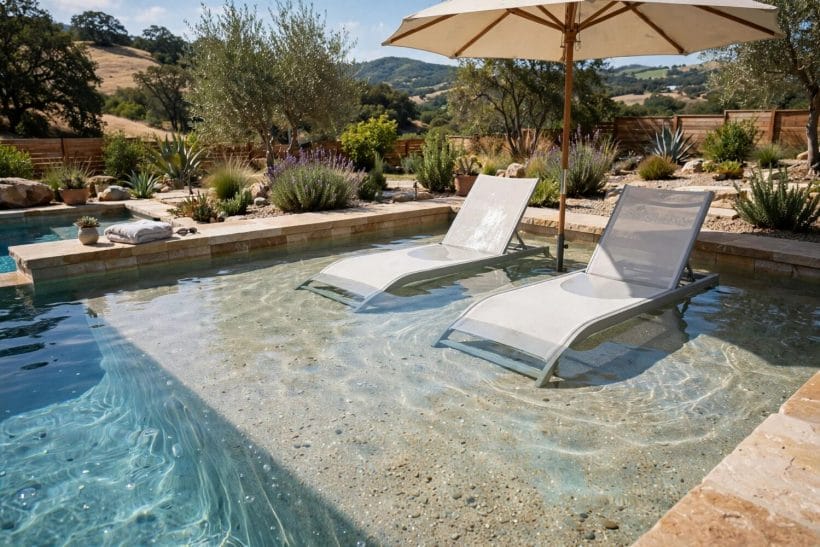
Heat is what makes a spool a spa, and a small volume of water is cheap to keep warm — the spool’s founding bargain.
23. Place back jets at sitting height along the main bench
Jets earn their keep against the lower back. A row along the main bench, spaced for two or three bathers, is the arrangement every other jet decision serves; scatter them elsewhere only after the backs are provided for.
24. Add a pair of stronger jets for the one deep seat
One seat with firmer jets — the therapy seat — gives the spool its reason on a weekday evening. Mark it by position, at the corner or the end, so it is found in the dark without negotiation.
25. Use air bubblers in the bench for a gentle effervescence
Air jets in the seat itself give a soft, champagne fizz rather than a massage. They suit the social soak and the long conversation, and they are kind to bathers who find water jets too much.
26. Keep the jet count honest for the pump’s sake
Every jet is a claim on the pump. A small spool with a dozen modest jets outperforms a showpiece whose twenty jets share one struggling pump — ask what each jet gets with all of them open, and design to that answer.
27. Heat with a heat pump where the spool soaks year-round
For a spool kept warm through the seasons, a heat pump moves heat rather than making it and is the running-cost answer in most climates.
28. Choose simple electric heating for occasional use
A spool heated only for weekends can live with straightforward electric heating, trading running cost for simplicity and silence. The honest question is how often the water will truly be hot; the heater follows that answer.
29. Borrow the sun with a solar contribution
In a sunny garden, solar heating can carry the shoulder seasons and take the chill off a summer plunge. It rarely carries a winter soak alone, but as a partner to another heater it quietly lowers the year’s bills.
30. Insulate the shell like the water is money — it is
Heat leaves through the shell, the surface and the pipes. Full insulation, insulated pipe runs and above all a well-fitted cover decide what a spool costs to keep warm; the heater merely pays the bill the insulation sets.
31. Fit a proper thermal cover and use it every night
Most of a spool’s heat escapes upward, overnight, into the sky. A fitted insulated cover, closed whenever the water is empty, is the single measure that pays for itself fastest — and it keeps leaves, frogs and worse out of the water.
32. Let a cool spool be a plunge pool in high summer
Heating off, jets gentle, water cool: the same shell becomes the garden’s plunge in a heatwave. Designing the plant to run cold as happily as hot doubles the spool’s working year without another litre of water.
33. Keep controls where wet hands can reach them
The bather should command heat and jets from the water, not from a plant cupboard across the garden. Controls at the rim, simple enough for wet fingers and failing light, are a safety matter as much as a comfort.
5. Decking, Coping and the Edge of the Water
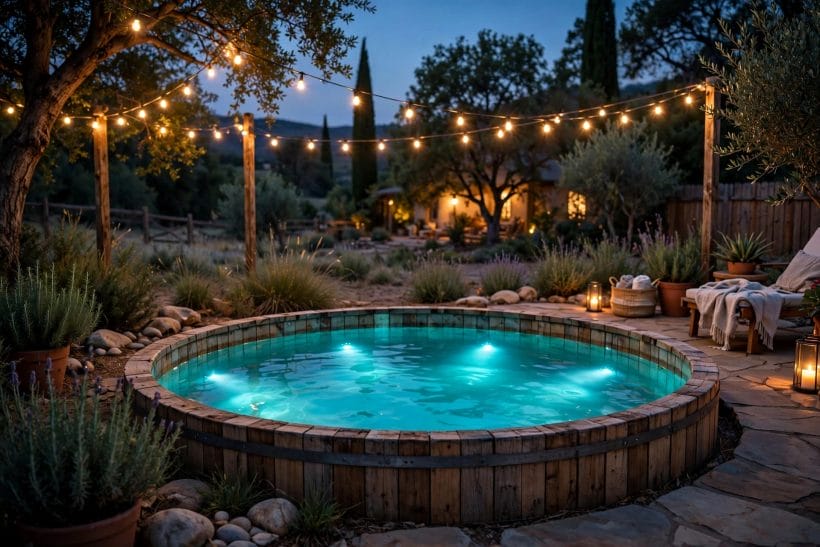
The rim is where the spool meets the garden, and where wet feet meet the ground. Edge choices here answer to the same family of decisions as the settings in small pool ideas — but the spool’s edge doubles as seating, step and table, so it works harder.
34. Cape the rim in stone wide enough to sit on
A stone coping at sitting width is the spool’s rim, bench and drinks shelf in one. Pale stone stays coolest underfoot and shows the water’s colour honestly; its edge should be eased, never sharp, where bare legs will swing over it.
35. Run timber decking flush to a raised spool
Decking brought level with a raised spool’s rim makes one continuous platform of the whole arrangement — water inset in wood. Keep the boards’ gaps and fixings barefoot-friendly, and the timber specified for permanent damp.
36. Lay anti-slip paving on the wettest routes
The path from spool to door is travelled wet, daily, in the dark. Its surface must grip when soaked and soapy; test a sample under a hose with bare feet before committing the garden to it, whatever its dry showroom manners promised.
37. Step down into a sunken spool with wide, shallow steps
Entry steps into a sunken spool should be broad, even and clearly edged, with the last step visible through the water.
38. Give a raised spool proper entrance steps
A raised spool is climbed into, so its steps are a small staircase: even rises, a grippy tread, a rail where the household needs one.
39. Roll the cover away on a reel or a lift
A cover that is heavy to move will be left off, and its savings with it. A reel, a lift or a folding arrangement suited to the spool’s shape makes closing-up a one-person, one-minute habit — which is the only kind that survives.
40. Keep a towel and robe station at the rim
Hooks, a small bench or a weatherproof box within arm’s reach of the water decide whether the spool is used on cold evenings. Shivering journeys to a distant shed are how good spools fall out of a household’s habits.
41. Light the edge for night bathing
The rim must be findable in the dark: low lights at the steps, a glow under the coping, the water lit from within. Night is the spool’s finest hour, and its edge is where the dark is negotiated.
42. Drain the surround away from the shell
Splash, rain and the cover’s runoff all need somewhere to go that is not back into the water or under the decking. Falls and a simple channel, planned before paving, keep the edge clean and the structure dry.
43. Plant the rim’s far side, never its working side
Keep the entry and cover sides clear for feet and machinery; let the far rim carry the planting the bathers look at.
44. Set the coping’s colour against the water
A pale rim makes the water read blue and bright; a dark rim deepens it to a reflective ink.
6. Planting, Privacy and the Garden Around It
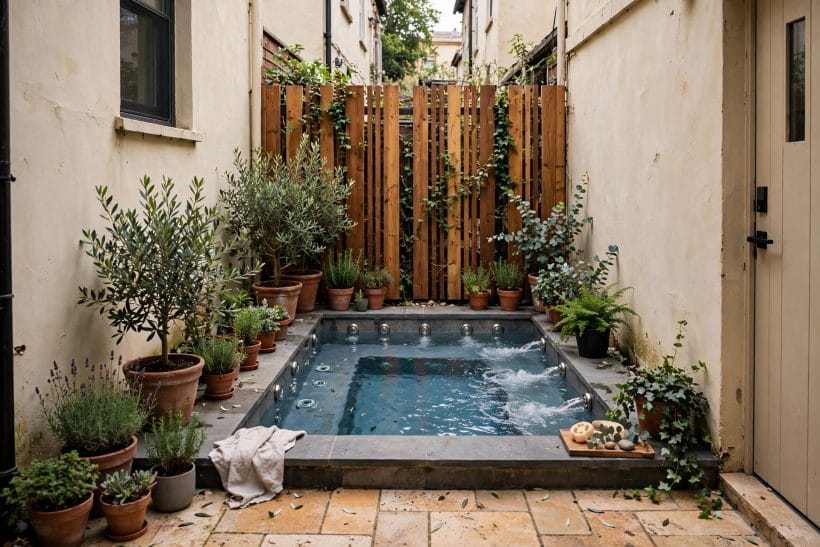
A spool is a room without walls; planting and screening give it privacy and its bathers a view worth steaming in. The spirit is the one behind pool house ideas — a small architecture of leisure — carried here with shrubs and fences instead of a building.
45. Screen the spool with a hedge that grows to shoulder height
A hedge at the water’s edge, grown to cover a seated bather, is the softest privacy there is.
46. Use a slatted screen for instant, architectural privacy
Timber or composite slats give privacy the day they are fixed and suit the spool’s straight lines.
47. Borrow height from a pergola over one end
A pergola over the entry end gives shade, a place for a climbing plant, and the feeling of a ceiling that makes a spool a room.
48. Keep shedding trees at a distance
Blossom, leaves, seeds and bird lime all find still warm water. Plant the generous, messy, beautiful trees where their fall lands on grass, and give the spool’s own planting a tidy habit and evergreen manners.
49. Plant in big pots at the rim for changeable green
Large pots of architectural green — grasses, small palms where climate allows, clipped shapes — compose the view from the bench and can be moved, swapped or wintered. They are the renter’s hedge and the impatient gardener’s friend.
50. Aim the main bench at a planted focal point
Bathers look outward for long, quiet minutes. Give the view an ending: a specimen shrub, a small statue, a birdbath, a pot group at the garden’s far point.
51. Keep a windbreak on the weather side
Wind steals heat from water and from wet shoulders alike. A screen, hedge or fence panel on the prevailing side calms the surface, keeps the cover honest and makes winter soaking possible rather than theoretical.
52. Light the planting, not the bathers
Night lighting belongs in the shrubs and on the paths: uplight a stem, wash a fence, mark the steps.
53. Add an outdoor shower at the rim
A simple cold or warmed shower beside the spool rinses the garden off before the soak and the soak off after it.
54. Give the spool a small garden building if space allows
A shed-scale changing hut, a store for cushions and chemicals, or a tiny sauna beside the water turns a spool corner into a destination. Even a handsome store box dignifies the arrangement and hides its working clutter.
55. Respect the neighbours’ windows as you would your own
Privacy runs both ways: check what the spool’s bathers overlook as well as what overlooks them. A screen placed with the neighbours’ sightlines in mind keeps the peace that makes a garden relaxing in the first place.
7. Covers, Fencing and Keeping It Safe
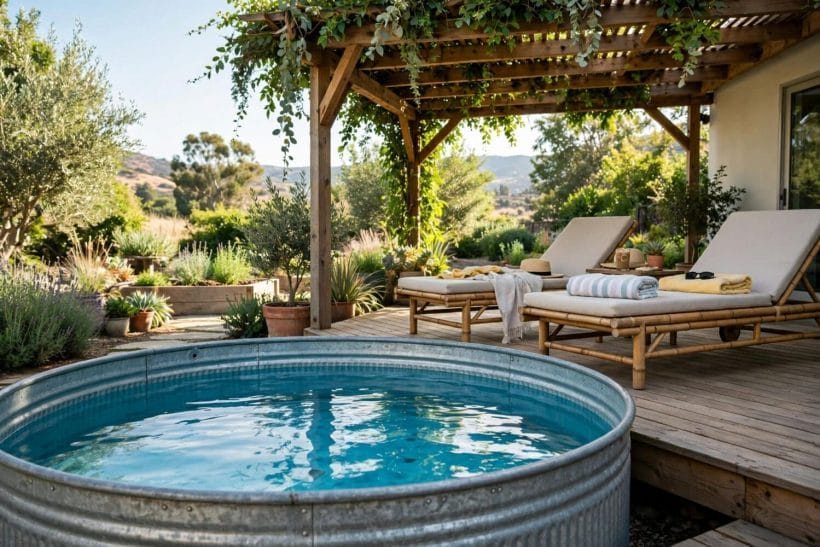
Warm, still, inviting water in a family garden carries duties that no amount of planting dissolves. Everything here is stated generally on purpose: fencing, barrier and water-safety rules differ by place, and the local requirements govern — check them before the shell is ordered, not after it is filled.
56. Fence or barrier the water as local rules require
Many places require a barrier around any pool-like water, spools included, with self-closing gates and prescribed heights and gaps. The rules are local and specific; learn them first and let them shape the design rather than fight it afterwards.
57. Choose a lockable hard cover as a second line
A rigid, lockable cover rated to bear weight is both the heat-saver and a real barrier when closed. It is the strongest single safety measure a spool can wear, and in some places it satisfies requirements a fence otherwise would.
58. Keep the water supervised — no fitting replaces it
Covers, fences and alarms are backstops. Children in and around a spool are supervised, always, by an adult whose only job it is; rota the duty on long afternoons so it is never nobody’s.
59. Set the spool where the house can see it
A spool visible from the kitchen or the sitting room is watched by the house’s ordinary life.
60. Fit a water alarm where the household wants one
Alarms that sound when the water is disturbed add a layer for houses with toddlers and visiting grandchildren. They false-alarm and they are forgotten to be armed — treat one as a supplement to barriers and supervision, never a substitute.
61. Keep chemicals locked, labelled and away from the water’s edge
Water-care chemicals live locked, dry, in their own containers, out of children’s reach and away from the rim. Decanting into drink bottles and storing under the bench are the two habits this idea exists to prevent.
62. Give the plant gear an electrical once-over by a professional
Pumps, heaters and lights beside water belong on protected circuits, installed and periodically checked by a qualified electrician under local rules. Water and electricity are a combination where enthusiasm is not a qualification.
63. Keep the rim and steps free of the slip hazards
Algae films, soap scum and smooth wet stone conspire at the edge. Regular cleaning of the waterline and steps, grippy surfaces where feet land, and a house rule of walking — not running — on wet paving keep the common accident uncommon.
64. Warm water and health: keep the water cared for
Warm water rewards bacteria that cold water discourages, so a spool’s water care — filtration, testing, dosing as its maker directs — is a health duty, not a cosmetic one.
65. Plan the empty state as carefully as the full one
Holidays, winters and the months when life is busy all leave the spool empty of people. Its cover closed and locked, its water cared for or drained under guidance, its chemicals stored — the unattended spool deserves a written routine the household actually follows.
8. Finishes, Lighting and the Finishing Touches

The last choices are the ones the eye and the skin actually meet: the shell’s colour, the water’s light, and the small furnishing of a very small resort.
66. Choose a pale interior for bright, lagoon-like water
A white or pale shell gives the classic bright blue, shows the water’s clarity honestly, and suits sunny gardens. It also shows every leaf and footprint — the pale spool belongs to the tidy or the well-covered.
67. Choose a dark interior for a reflective, pond-like spool
Slate, deep grey and black shells turn the surface into a mirror of sky and planting, heat the water a whisper faster in sun, and hide the bottom entirely. They are moody, modern and forgiving of debris.
68. Tile the waterline where the eye rests longest
A band of tile at the waterline dresses the exact strip a bather stares at, hides the scum line’s worst, and gives a plain shell its one ornament. Glass mosaic catches the light; large format keeps the calm.
69. Light the water from within for the evening soak
One underwater light, warm in tone and set opposite the main bench, turns the spool into the garden’s lantern. Coloured light is a mood some love; the warm white that flatters skin and stone is the safer permanent choice.
70. Hang a shade over part of the water
A sail, an umbrella in the ledge socket or the pergola’s cloth over one end gives the summer spool a cool half. Shade also protects the water’s chemistry and the bather’s shoulders through the long middle of the day.
71. Furnish the rim like a room: cushions, a table, a tray
Weatherproof cushions on the rim bench, a low table for glasses that are not glass, a floating tray for the book — the spool’s furnishing is small, deliberate and entirely what makes it feel like a resort rather than a tank.
72. Keep glass away from the water
Drinks belong in unbreakable vessels anywhere near a spool; broken glass in water is invisible and serious. Pretty acrylic and enamel serve the part without the risk, and the rule costs one sentence in the house’s habits.
73. Add sound gently: a small water feature or nothing
A slim water blade or a gentle overflow edge gives the spool a voice that masks road noise and slows the mind.
74. Store the kit in one handsome place
Test strips, the skimmer, the cover’s handle, the spare towels: one box, one home, at the rim. A spool whose kit wanders the garden looks neglected by Thursday; a kit with a home keeps the whole arrangement crisp.
75. End with the night view from the house
The spool’s final test is the one from the back door after dark: lit water, a composed rim, planting in soft shadow.
9. Checks and Mistakes: Before the First Purchase or the First Fitting
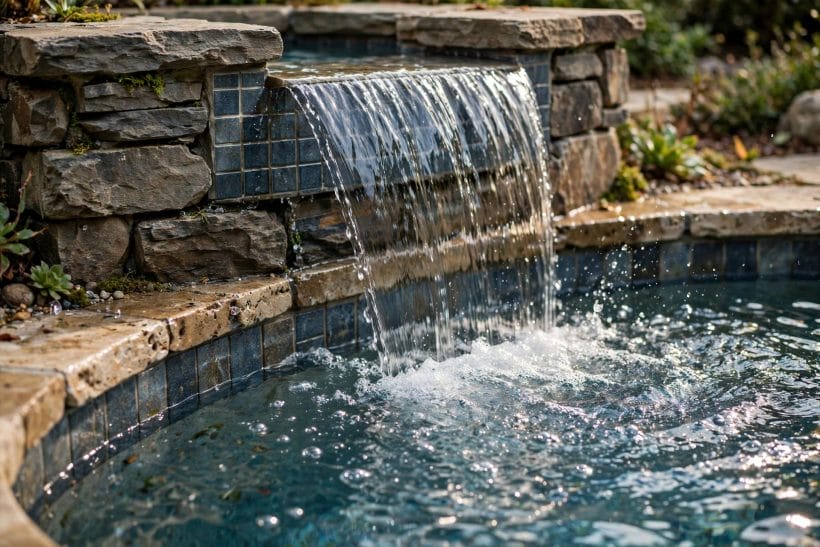
The spool’s classic mistakes are errors of proportion: benches too shallow to soak in, jets counted instead of powered, a heater sized for a brochure rather than a winter.
Duties before delight: barriers, gates and covers follow local rules that must be checked for the actual property; electrics beside water belong to qualified installers on protected circuits; warm water needs its care routine kept.
Finally, sit in the plan before building it: chairs where the bench will run, at the hour the spool will be used, facing what the bathers will face.
10. Costs and Pulling It Together
Costs follow the spool’s own order: the shell and its installation are the capital, heating is the commitment, and the cover is the saving.
Pull the arrangement together by treating the spool as a room: one material at the rim, one colour inside, planting as its walls and light as its ceiling.
Final Considerations
A spool succeeds when it is used in February as happily as in July — warmed, covered, sat in up to the shoulders while the garden sleeps around it.
Begin with the bench section and the barrier rules, in that order, and the rest of the spool tends to fall into place behind them.

0 Comments