
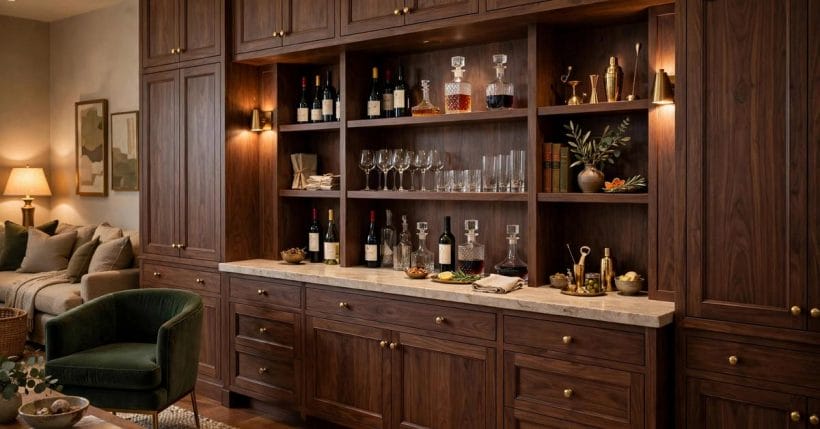
The dry bar is the home bar with the plumbing left out — and that omission is its genius.
This post builds one properly: where to put it, the cabinets and counters that need no plumber, shelving that displays the collection, the ice and cooling that replace the tap, the styles from club to coastal, and the back wall that gives it theatre.
1. Dry Bar Ideas at a Glance
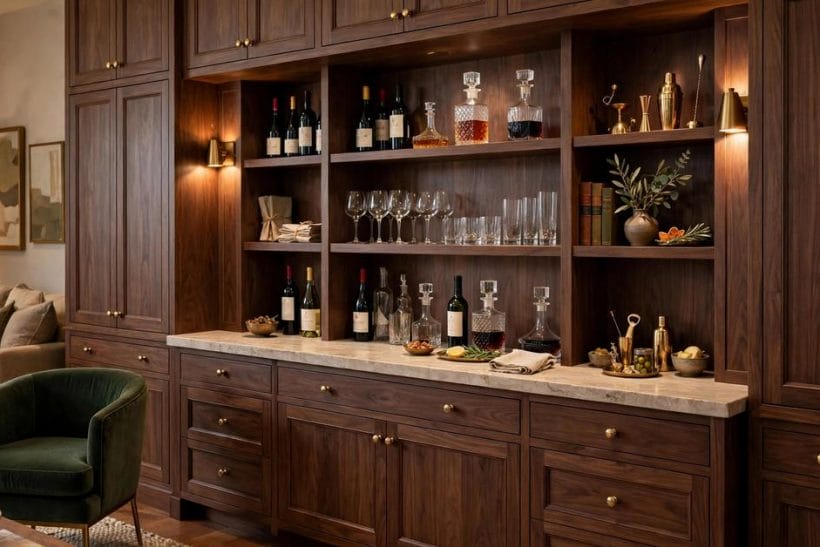
A dry bar is a drinks station without a sink or any plumbed water — the counterpart of the wet bar, which has one.
| Question | Short answer |
|---|---|
| What makes a bar ‘dry’? | No sink and no plumbed water — ice and a fridge do the cold work instead |
| Where can a dry bar go? | Almost anywhere: a dining wall, a stair nook, an alcove, a cupboard |
| How do drinks stay cold? | A serious ice bucket, frozen reserves, and optionally a small drinks fridge |
| What is its biggest advantage? | No plumbing costs or constraints — the budget goes into cabinetry and display |
| What does it need every evening? | Ice, a cloth, a water jug for guests, and a two-minute closing ritual |
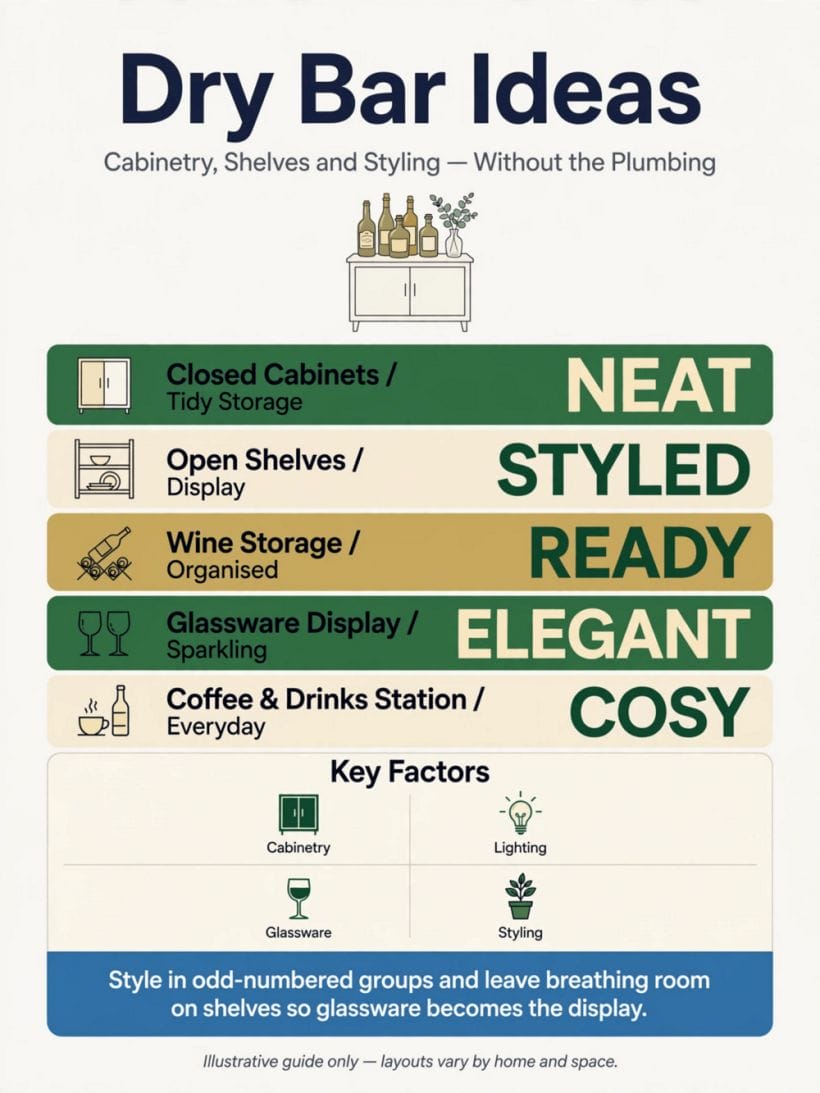
2. Choosing the Spot: Nooks, Walls and Under-Stair Spaces
A dry bar goes anywhere a wet bar cannot, which is almost everywhere. The wider family is gathered in home bar ideas; this post keeps strictly to the sink-free branch — the cabinetry, shelving, cooling and display that serve drinks without a single pipe.
1. Take the dining room’s spare wall
The dining room is the dry bar’s natural home: the drinks live where they are served, the cabinetry answers the room’s own furniture, and no guest ever queues at a kitchen sink’s substitute.
2. Use the nook under the stairs
The understair triangle — too low for a person, perfect for bottles — becomes a bar with a counter at its tall end and shelving stepping down the slope.
3. Convert a spare cupboard into a hidden bar
A closet or a deep cupboard, fitted with shelves, a counter ledge and light inside its doors, is a bar that vanishes when closed.
4. Claim the hallway’s wide stretch
A generous hallway or landing with one deep wall can carry a slim bar — cabinets shallow enough to pass, shelving above — right on the route between kitchen and sitting room, where a drinks station is actually used.
5. Build it into the sitting room’s alcove
Chimney alcoves and the bays beside a fireplace were made for this: a counter at serving height, shelves rising into the alcove’s height, and the room’s firelight doing the rest. The alcove’s symmetry flatters the arrangement.
6. Let a corner carry an angled bar
A corner counter, cut on the diagonal or wrapped in an L, turns dead corner volume into the room’s social hinge. Corners gather people anyway; the bar simply gives the gathering its excuse and its equipment.
7. Fit one inside a piece of furniture
A sideboard, a credenza, an armoire with its interior fitted for bottles and glasses — the furniture bar needs no building at all and moves house when its owners do.
8. Give the conservatory or garden room a bar end
A garden room’s end wall, shelved and countered, serves the summer evenings where they happen. Keep glassware out of fierce sun, choose materials that shrug off humidity, and let the bar face the garden it serves.
9. Use the landing outside the bedrooms for a nightcap station
A small landing bar — a cabinet, a kettle’s quieter cousins, the evening’s last drink — suits houses whose entertaining is small and late. It asks for discretion in scale and gives the floor its own tiny ceremony.
10. Place it where guests naturally gather, not where space is left
The failed bar is always in the room nobody uses. Place the dry bar on the household’s real map — the room where people already end up standing with a glass — and it will be used weekly rather than admired annually.
11. Keep it clear of the bathroom-and-bedroom traffic
A bar needs nearness to the gathering and distance from the private: not on the route to the bathroom, not against a bedroom wall of thin construction. Sound and bustle are the bar’s weather; bedrooms deserve a different climate.
3. Cabinetry and Counters Without the Plumbing
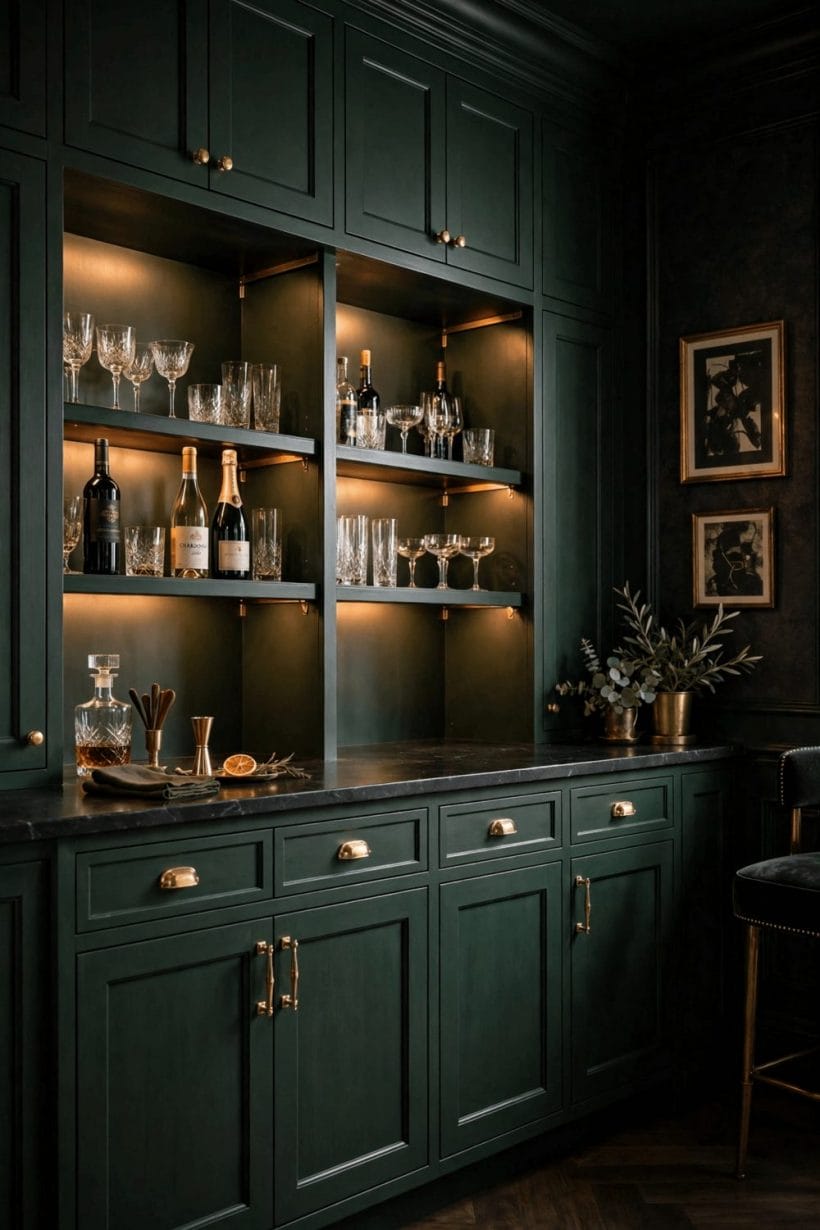
No sink means no plumber, no drainage, no waterproofing drama — the budget goes into joinery instead. It is the route taken by the compact arrangements in small home bar ideas, where every centimetre of cabinet is asked to work.
12. Run base cabinets and a single counter, sideboard-fashion
The simplest dry bar is a sideboard that knows its purpose: cupboards below for bottles standing upright, drawers for the tools, one unbroken counter for mixing and serving. It suits any room and asks only for a wall.
13. Build tall: cabinets below, shelves above, in one composition
The full-height bar wall — base cabinets, counter, then open shelves or glass-fronted uppers to the ceiling — turns a serving point into the room’s architecture. It stores a household’s whole drinks life in one glance.
14. Choose a counter that forgives rings and spills
Stone, sealed timber, laminate with a stone’s manners, metal where the style allows: the dry bar’s counter is a workbench for liquids. Whatever its material, it should wipe clean without ceremony and age without complaint.
15. Leave a knee-space section for a stool
One stretch of counter without cabinets beneath it invites a stool and a lingerer, turning a serving point into a place to sit.
16. Fit a drawer for the tools of the trade
Openers, pourers, measures, the knife for citrus, the cloth for spills — a shallow drawer fitted or divided for the kit keeps the counter clear and the rituals quick.
17. Add a lockable cabinet where the house needs one
Houses with children, teenagers or lodgers may want the good bottles behind a lock. A lockable section within the run — or doors that take a discrete lock — is a design decision made once, honestly, at the drawing stage.
18. Use a tray as the mixing station on the counter
A large tray corrals the working bottles, the ice bucket and the spill zone into one lift-away unit. It tidies in seconds, carries to the garden as a set, and protects the counter beneath better than any sealant.
19. Give bottles their true heights in the shelving plan
Bottles are tall and their shelves must be measured for them — the spirits shelf, the shorter shelf for mixers and syrups, the drawer for the rest. Measure the household’s actual bottles before a single shelf is fixed.
20. Choose glass-fronted uppers where the collection is handsome
Glass doors display the glasses and the better bottles while keeping the dust off — the dry bar’s china cabinet. In a dusty or sunny room they are not vanity but maintenance, and they light beautifully from within.
21. Keep a waste solution within reach
Caps, corks, citrus peel, the failed garnish: a small bin inside a cabinet or a bowl that lives on the counter keeps the bar tidy at the moment of making, not at the end of the evening.
22. Light the counter from the shelf above
A strip of light under the shelf or cabinet above turns the counter into a stage and the mixing into a pleasure rather than a squint.
4. Shelving and Display: Bottles, Glassware and Open Storage
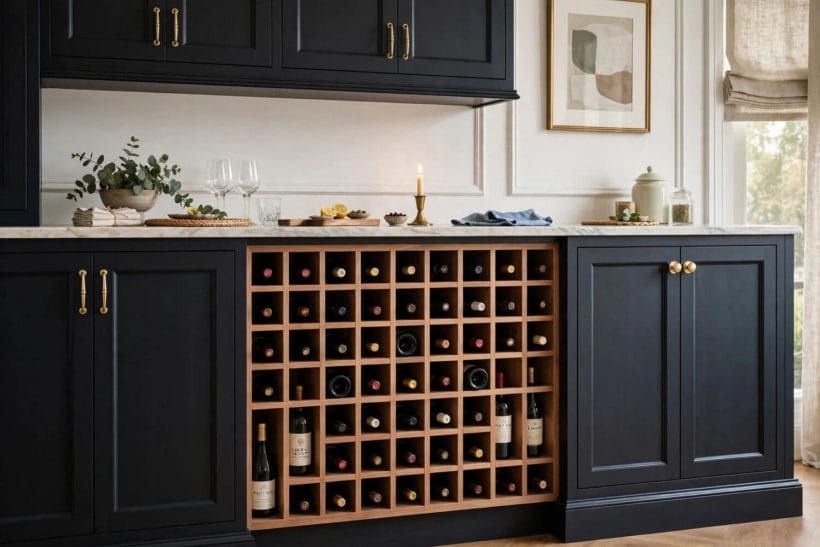
Display is half of a dry bar’s purpose: the bottles are its decoration and its menu. In basement rooms the same shelving does similar duty among the arrangements in basement bar ideas — but the dry bar’s shelves must also replace the sink’s utility, holding everything within a step.
23. Float thick shelves for the bottle line
Deep floating shelves, chunky enough to read as architecture, carry the bottle row with nothing visible holding them.
24. Back the shelves with mirror for depth and sparkle
A mirrored back doubles the bottles, throws the light around and makes a shallow bar feel deep. It is an old bar-keeper’s trick and a good one, provided the household enjoys the sight of its collection twice over.
25. Back them with a dark colour for a cellar mood
Deep green, oxblood, near-black: a dark back wall makes glass and labels glow like a cellar’s treasures. In a pale room the dark-backed bar is the accent; in a dark room it is the natural order of things.
26. Hang glassware beneath a shelf on rails
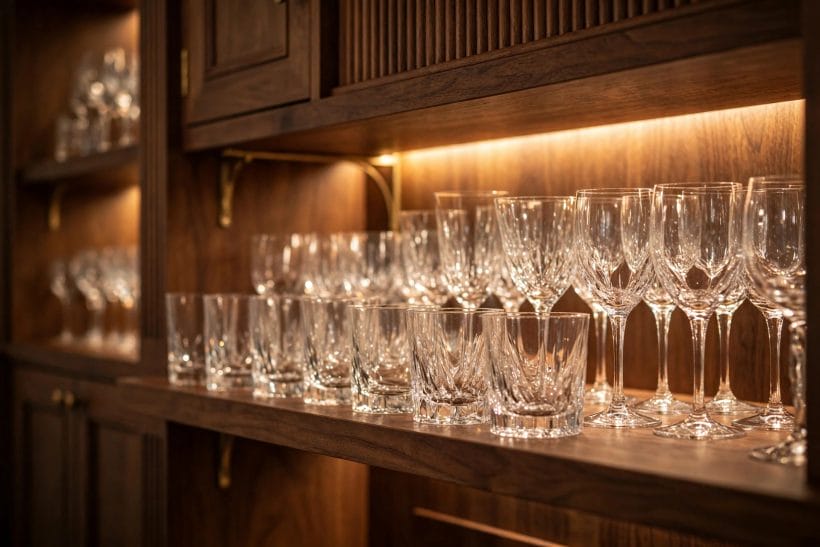
Stemware hung by its feet from rails under a shelf stores the glasses in the air they were designed for, clears the shelf for bottles, and puts a sparkle at eye level.
27. Keep the everyday glasses on open shelves, the best behind glass
The week’s glasses live open and reachable; the inherited and the delicate live behind doors. The division is the dry bar’s housekeeping in one rule — and it keeps the open display from becoming a dust-gathering museum.
28. Arrange bottles by height, then by family
Tall at the back or the centre, families together — the gins with the gins, the dark spirits in their row.
29. Leave deliberate gaps: display is editing
A shelf at eighty percent is a display; at a hundred it is storage wearing display’s clothes.
30. Add a wine rack’s geometry to the composition
A run of bottle cubbies or a diagonal rack gives the shelving its rhythm and stores wine as it should be stored, on its side. Even a short rack changes the bar’s whole geometry from cupboard to cellar.
31. Use the top shelf for height and ceremony
The top shelf, reachable by a small step, holds the tall, the rare and the decorative — decanters, the ceremonial bottles, the things poured on occasions. Every bar needs its altar shelf, and its height is exactly the point.
32. Display the tools as part of the arrangement
A handsome shaker, the brass measure, the crystal mixing glass: the working tools, kept out, are the bar’s jewellery and its honesty.
33. Rotate the display with the seasons
The summer shelf is pale and botanical; the winter shelf is dark and spiced. Rotating a few bottles and one or two objects with the year keeps the bar feeling tended — and reminds the household what it owns before it buys more.
5. The Drinks Working Kit: Ice, Cooling and Small Appliances
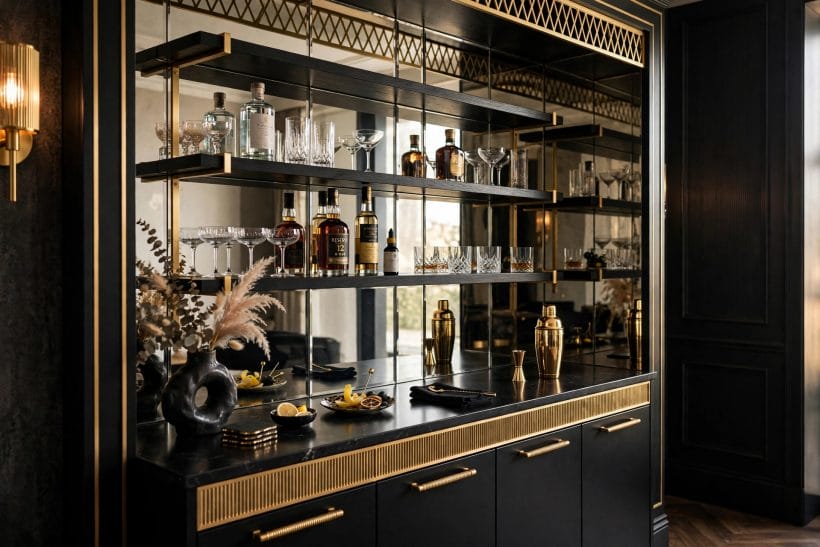
The dry bar’s one technical problem is cold: no plumbing, no water line, yet drinks want ice. The solutions below are the standbys — and they are why the dry bar pairs so well with the lounging arrangements in man cave ideas, where the same no-plumbing logic rules.
34. Keep a serious ice bucket as the bar’s engine
A double-walled, well-lidded bucket is the dry bar’s heart: ice from the kitchen freezer, carried in once, serves the evening. Size it honestly — a bucket too small is a host’s treadmill between bar and kitchen all night.
35. Use a countertop ice maker where evenings are long
A small countertop machine makes cubes steadily through an evening and frees the freezer entirely. It needs only a socket and a jug of water — the dry bar’s one concession to machinery, and for regular entertainers, easily its best buy.
36. Fit a slim drinks fridge beneath the counter
A small under-counter fridge keeps mixers, white wine and garnishes at serving cold and ends the kitchen traffic for everything except ice.
37. Freeze large cubes and spheres for slow drinks
Big ice melts slowly and dilutes kindly — the right ice for the drinks that are sipped, not rushed. Moulds live in the freezer, cost little, and raise the bar’s whole standard more than any bottle on its shelf.
38. Store a frozen reserve for the unexpected evening
A bag of ice in the freezer’s corner, rotated as it is used, means the dry bar is always one bucket away from ready. Hospitality fails on empty freezers more often than on empty shelves.
39. Keep sparkling water and mixers cold and dated
Flat tonic is the dry bar’s small tragedy. Keep mixers refrigerated once opened, dated with a pencil, and replaced without sentimentality — the cheapest quality rule in this entire post.
40. Add a kettle’s rival: hot water for winter drinks
Mulled and hot drinks want hot water at the bar. A small kettle on a tray, or a flask filled before guests arrive, extends the dry bar into winter without a pipe being laid — the no-plumbing principle bends for a kettle, gladly.
41. Provide a drip tray under the ice and the mixing
Meltwater and splashes are the dry bar’s weather. A tray under the bucket and the mixing station catches the evening’s drips before the counter does, and it lifts out for emptying in one motion at the night’s end.
42. Keep a water jug at the bar for the guests’ sake
Water and glasses for it, at the bar, without being asked: the mark of a thoughtful host and the dry bar’s quiet duty.
43. Choose tools that wash in a bowl, not a sink
Without a sink, the kit should be small, honest and easily rinsed: a measure, a spoon, a knife, a board, a shaker that comes apart.
44. Keep a linen cloth as the bar’s uniform
One good cloth — for spills, for polishing glass, for carrying the hot thing — lives at the bar and nowhere else.
6. Styles: Classic, Modern, Rustic and Built-In Looks
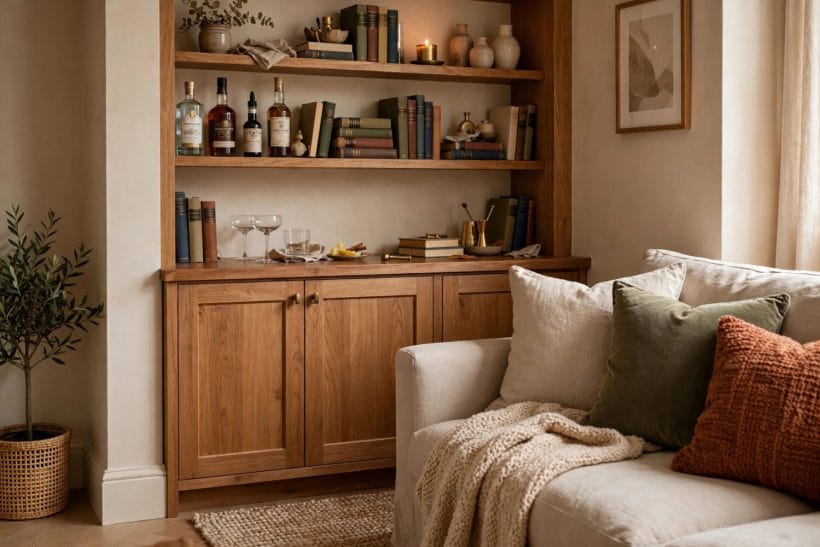
Style is where the dry bar joins the room’s story. A bar in a dining room answers the room in front of it — the arrangements surveyed in dining room ideas set the terms — while a bar in a hall or a garden room can afford a character of its own.
45. The classic club look: dark timber, brass and glass
Mahogany tones, brass rails, glass shelves and a lamp’s warm pool: the club dry bar is the type’s ancestral form. It flatters traditional rooms, forgives a mixed collection of bottles, and looks better with age and use.
46. The modern line: flat fronts, stone and steel
Handleless cabinets, a stone counter, steel and black accents, bottles arranged like objects in a gallery — the modern dry bar is quiet until the light strip comes on, when it performs.
47. The rustic bar: reclaimed timber and iron
Salvaged boards, iron brackets, enamel and stoneware: the rustic dry bar wears its materials’ history openly. It belongs in farmhouses, cabins and garden rooms, and it improves with every ring and scratch the evenings add.
48. The mid-century sideboard bar
A long low credenza in warm timber, sliding doors, the bottles behind one and the glasses behind the other, a record playing somewhere near: the mid-century bar is furniture first and a bar on opening — the most graceful disguise in this post.
49. The built-in library bar
Fitted among bookshelves, the bar becomes one bay of the library: bottles where the novels thin out, a counter at the reading room’s end. For bookish houses it is the most natural bar there is, and the wittiest.
50. The mirrored glamour bar
Mirrored fronts, glass shelves, chrome and a little theatre in the lighting — the glamour bar is dressed for evening and knows it.
51. The garden-room bar in painted timber
Painted in a garden colour, fitted with galvanised and enamel workaday pieces, the garden-room bar takes its cue from the plants outside its glass. It serves the summer and winters quietly among the overwintering pots.
52. The industrial bar: scaffold, steel and crate wood
Pipe frames, steel tops, crate timber and bare bulbs give the industrial bar its workshop honesty. It is the easiest style to build from honest parts and the hardest to make look accidental — every bracket shows, so every bracket matters.
53. The coastal bar in pale wood and rope
Whitewashed timber, pale counters, woven and rope details, glass the colour of the sea’s edge: the coastal dry bar belongs to bright rooms and holiday houses, and it makes even a weekday lemonade feel like a shore leave.
54. The scandi bar: pale, plain and calm
Pale wood, white walls, a few beautiful objects and nothing else — the Scandinavian dry bar proves the type can be quiet. Its discipline is its decoration: three bottles, two glasses, one plant, all of them chosen.
55. Match the bar’s style to the room, or deliberately against it
A bar that continues its room’s style disappears into competence; a bar that contrasts — the club bar in a white room, the steel bar in a timber one — becomes the room’s event.
7. Lighting, Backsplashes and the Back Bar Wall
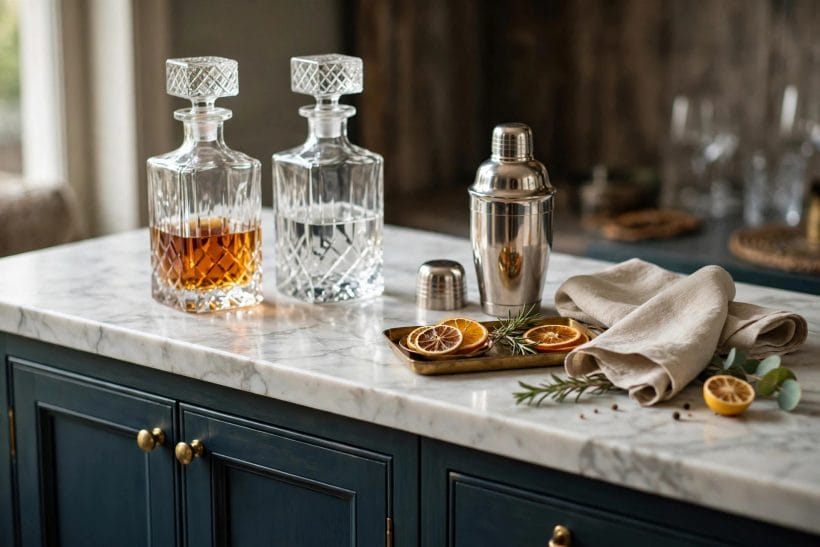
Without a sink, the dry bar’s back wall is free to be pure theatre: no taps to work around, nothing to waterproof beyond a splash’s reach. This wall, more than the cabinets, is what guests remember.
56. Paper the back wall for a bar with a backdrop
A bold wallpaper behind the shelves — botanical, geometric, a dark floral — gives the bar its stage set for the price of a roll.
57. Paint it deep and let the bottles glow
The simplest backdrop of all: one deep colour behind the shelving, against which every label and every glass edge catches the light. It costs a tester pot’s commitment and flatters more collections than any other treatment.
58. Tile the splash zone in something with a shine
Behind the counter, a run of glazed tile — the bar’s only concession to its wet work — wipes clean and throws the light back in ripples.
59. Panel it in timber for the club effect
Vertical boards or proper panelling behind the shelves gives the bar its club-room depth and hides a multitude of wall sins. Stained dark it is the classic; painted, it suits the country and coastal versions equally.
60. Light the shelves from within or above
Strips hidden under each shelf turn the bottle line into a lit frieze and the glasses into lanterns.
61. Add a small lamp for the evening pool of light
A little lamp on the counter or a shaded wall light beside the bar gives the arrangement its domestic scale — the difference between a bar that is lit and a bar that glows.
62. Hang a mirror or art where the bottles thin out
Where the collection leaves a gap in the shelving, a small mirror, a framed print or a menu-like board fills it with intention. The bar wall is a composition; its empty places deserve the same care as its full ones.
63. Use the wall for the bar’s one piece of wit
A framed quotation, a vintage sign, the household’s own small joke in a frame — one, only one, and genuinely meant.
64. Keep sockets planned, hidden and sufficient
The ice maker, the fridge, the kettle, the light strips: the dry bar’s wall needs more sockets than it admits to. Plan them at counter height, inside cabinets or under shelves, before the backsplash makes them a retrofit’s regret.
65. Let the ceiling join in: a pendant over the counter
One pendant centred on the bar gives it a pool of light and a sense of occasion from above, marking the spot in an open room the way an island pendant marks a kitchen.
8. Serving, Seating and Finishing Touches
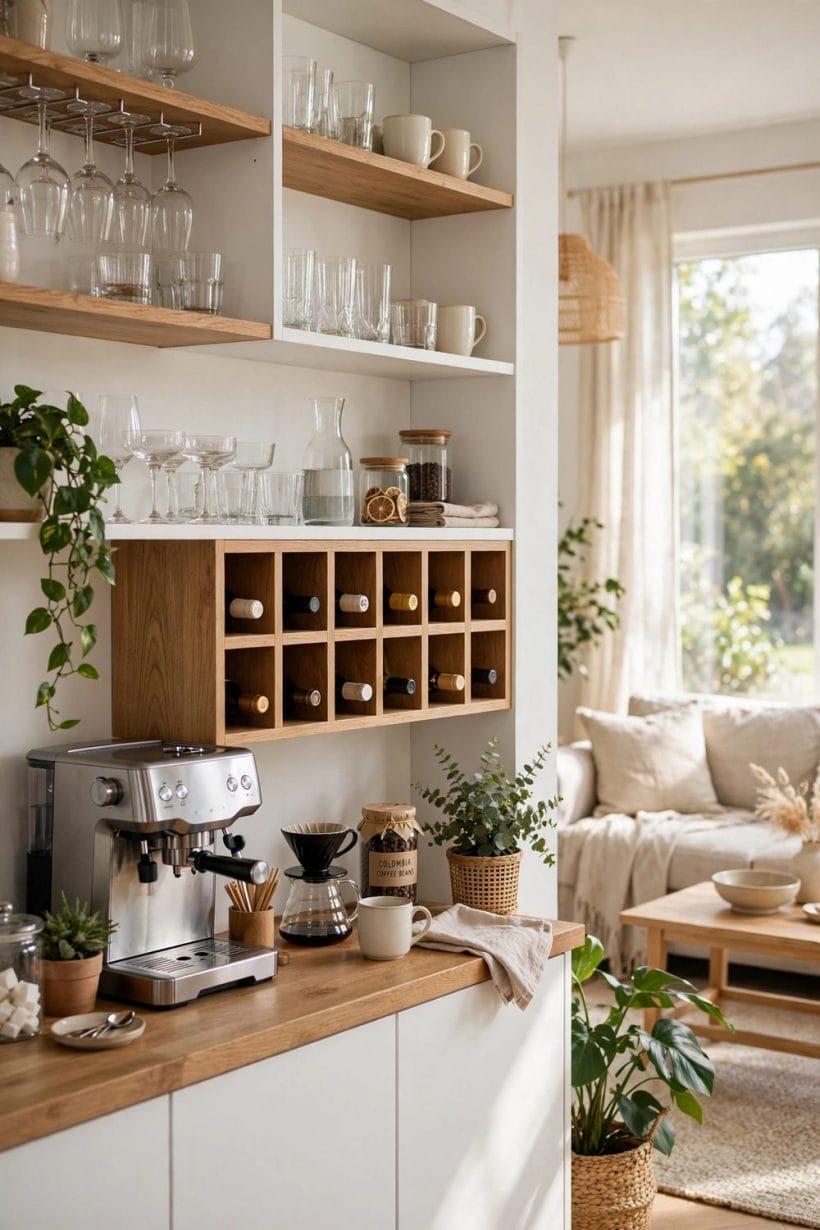
The last ideas are hospitality itself: how the bar serves, where its people stand and sit, and the small finishes that turn a cabinet run into the room’s favourite address — the sort of finishing that home design ideas treats as the difference between a room and a home.
66. Give standing guests an elbow’s worth of counter
Bars are stood at. A clear stretch of counter at standing height, free of display, where a guest can rest a glass and an elbow, is hospitality in built form — reserve it deliberately and police it against the evening’s clutter.
67. Place two stools, never one
One stool is a perch for the bartender; two make a conversation. A pair at the knee-space, matched and sturdy, turns the dry bar into the smallest café in the house — and the most used seats in it, some weeks.
68. Keep a drinks trolley’s freedom in reserve
A small trolley, loaded from the bar and wheeled to the garden or the fireside, extends the dry bar’s territory through the whole house. The bar stays the cellar and the studio; the trolley is its travelling stage.
69. Stock for the guests you have, not the bar you imagine
The honest dry bar serves its household’s real drinks beautifully rather than every drink adequately. A short, fresh, well-kept stock beats a dusty parliament of bottles — and the shelving stays a display instead of an archive.
70. Add the non-drinkers’ shelf with equal ceremony
Good alcohol-free bottles, the interesting sodas, the bitters and cordials, given their own proud shelf and the same glasses as everyone else — hospitality is measured by how the abstaining guest is served, and the dry bar should pass that test in style.
71. Keep a small book of the house’s own recipes
A notebook or a card box at the bar — the household’s proportions, the guests’ favourites, what worked at the last party — turns the bar into a practice with a memory.
72. Finish with fresh things: citrus, herbs, ice
A bowl of citrus, a pot of mint or rosemary at the counter’s end, ice made fresh: the living garnishes that separate a working bar from a display of bottles.
73. Give the bar a closing ritual
Bottles capped, ice emptied, cloth folded, light dimmed: a two-minute closing that returns the bar to its portrait state every night. The ritual is why some bars look perennially ready and others look permanently recovering.
74. Let the bar grow by editing, not by adding
Collections swell; shelves do not. The finished dry bar is maintained by the rule of one in, one out — each new bottle retiring a lesser one — so the display stays a portrait of the household’s taste at its best, not its whole history.
75. Judge it by a Tuesday, not a party
The dry bar’s success is not the party it survives but the ordinary evening it improves — the one drink, made well, at a handsome counter in a lit corner of home.
9. Checks and Mistakes: Before the First Purchase or the First Fitting
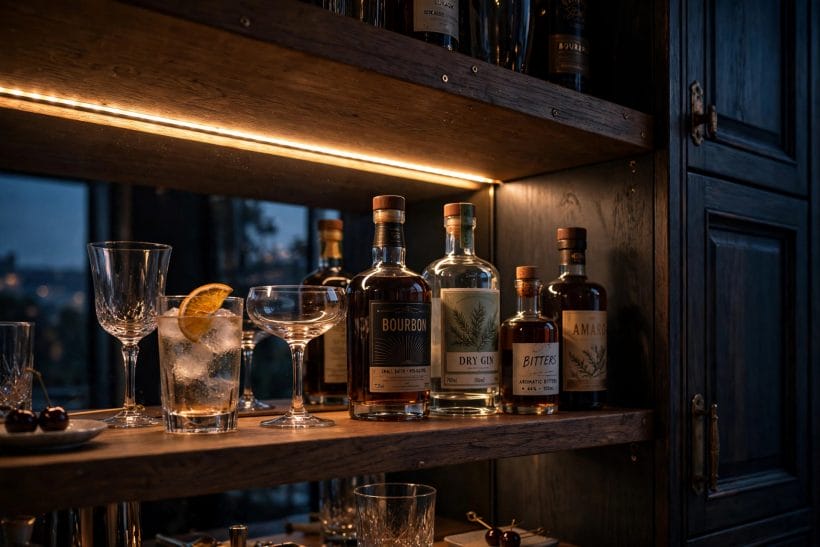
The dry bar’s classic mistakes are mistakes of placement and plumbing envy: a bar built in the room nobody uses, and a budget spent pretending it is a wet bar — a toy sink with no supply, a drain to nowhere.
Plain duties deserve their sentences: anything electrical near ice and meltwater wants proper installation and care; a lockable cabinet is the honest answer where children or teenagers share the house; and local rules on home bars are rarely more than common sense — but the household’s own rules about access deserve to be designed in, not improvised.
Finally, test the bar with its real evening before calling it finished: make the household’s actual drinks at it, carry the ice its actual distance, wash its actual tools in a bowl.
10. Costs and Pulling It Together
Costs follow the type’s mercy: with no plumbing to buy, the money divides between cabinetry, the counter and cold — a fridge being the one splurge that changes daily life.
Pull the arrangement together with one style decision carried through — the club, the modern line, the rustic board — and one light decision: warm light at the shelves.
Final Considerations
The dry bar succeeds when guests drift to it without being led — when the corner with the lit shelves and the good ice becomes the room’s natural standing place.
Start with the spot where your household already gathers, and let the bar earn its place there — the rest is shelving.

0 Comments