

Stairs are the route everyone uses half-asleep, carrying laundry, or herding kids and dogs after dark. One shadowy tread is all it takes for a nasty miss.
The fix is easier than you think. These eight ideas for stair lighting indoor projects make every step clear, calm and genuinely beautiful — starting with a simple plan.
1. Plan First: What Good Stair Lighting Has to Do
Before you buy a single fitting, walk your staircase at the times you actually use it: early morning, dusk and the middle of the night. Notice where shadows pool, where daylight already helps, and where your eyes struggle to judge the edge of each tread. Good stair lighting does three jobs at once. It shows the nose of every step clearly, it avoids glare that blinds you halfway up, and it looks intentional rather than like an afterthought bolted on for safety.
Think in layers rather than one heroic fitting. A gentle wash at foot level handles the safety job, a mid-level light adds depth and character, and a ceiling or pendant light lifts the whole stairwell for cleaning, decorating and busy family traffic. You rarely need all three layers at full brightness at the same time, which is why dimmers and sensors matter just as much as the fittings themselves. If you are planning a wider refresh, our round-up of tiny house interior design ideas shows how lighting choices in one compact room can echo through the rest of a small home.
Finally, check the practical side early. Note where power already runs near the stairs, whether walls are solid or hollow, and whether you can reach a loft void or under-stair cupboard for cabling. Any new fixed wiring should be planned with local rules in mind, and if you are unsure about a circuit, ask a qualified electrician to confirm what is safe and permitted in your area before you commit.
| At a Glance | Best Choice | Why It Works |
|---|---|---|
| Best for pure safety | Recessed step lights | Every tread edge is lit evenly, with no glare at eye level |
| Best for ambience | LED strip under treads or handrail | A soft, floating glow that flatters wood and paint |
| Easiest retrofit | Wall sconces or plug-in guide lights | Little or no chasing into walls on many staircases |
| Most dramatic | Pendant over the stairwell | Turns a tall, plain void into a real feature |
| Best for night trips | Motion-sensor lighting | Comes on hands-free and fades off again by itself |
| Best finishing touch | Warm dimmers and matched colour temperature | Keeps every layer calm, cosy and consistent |
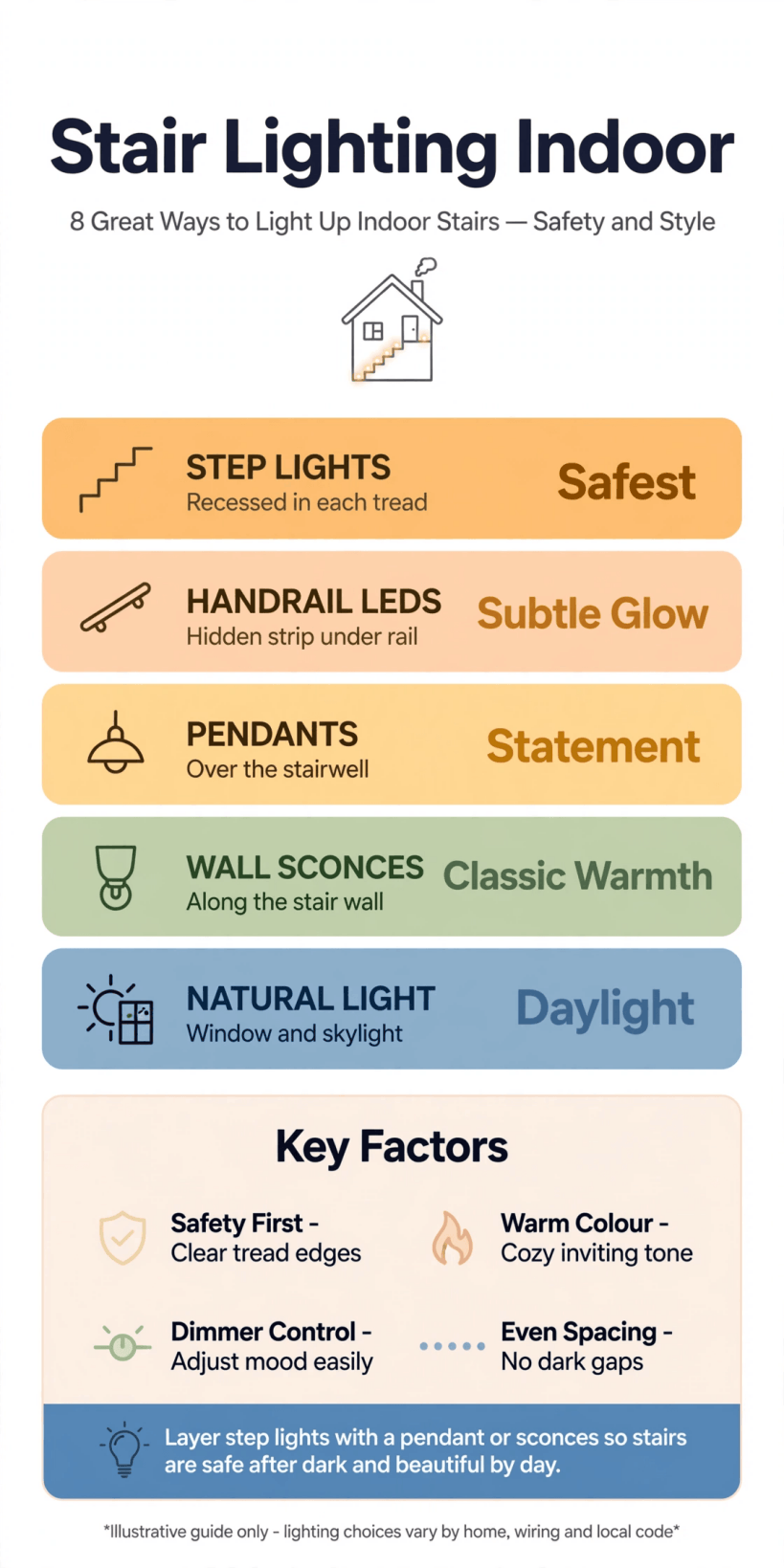
The eight approaches in this guide at a glance — start with step-level safety, then layer in ambience and a statement light where your stairwell allows it.
2. Way 1: Recessed Step Lights That Wash Every Tread
If safety is the priority, recessed step lights are hard to beat. Small fittings sit in the wall just above each tread, or in the riser itself, and wash a low, even pool of light across the step below. Because the light source stays low and shielded, you see the tread edge clearly without being dazzled, which is exactly what tired eyes need at 2 a.m. Space them on every step for a formal rhythm, or on alternate steps for a softer, more relaxed feel on a short flight.
Position matters more than brightness. A modest fitting placed close to the tread usually outperforms a powerful one mounted too high, which can cast your own shadow across the steps you are about to use. Choose warm-white lamps so timber and carpet keep their natural colour, and look for fittings with a louvre or frosted lens if your staircase is narrow. In a compact home, this low, calm approach pairs beautifully with the restraint shown in these minimal interior design ideas for tiny houses, where every fitting earns its place.

Installation is the one catch: recessed fittings need wall depth and a planned cable run, so they suit renovations and new builds best. If your walls are solid masonry, surface-mounted mini step lights give a similar effect with far less disruption. Either way, put the circuit on its own switch or sensor so the stairs can glow gently without lighting the whole landing like a runway.
3. Way 2: LED Strips Hidden Under Treads or the Handrail
LED strip is the stylist’s favourite because the source disappears and only the glow remains. Run it in a slim channel under the nose of each tread and the staircase seems to float, each step outlined in a ribbon of light. Tucked under a handrail instead, it washes the wall and treads from above while giving your hand a soft guide on the way down. It is a particularly kind option for open-riser and floating stairs, where bulky fittings would spoil the lines.
Use a proper aluminium channel with a diffuser rather than bare strip stuck straight to timber. The channel hides the individual dots, spreads the light evenly, protects the strip from vacuum cleaners and shoes, and acts as a heat sink that helps the LEDs last. Keep the driver — the small power supply — somewhere ventilated and reachable, such as an under-stair cupboard, so a future replacement is a five-minute job rather than surgery on the staircase.
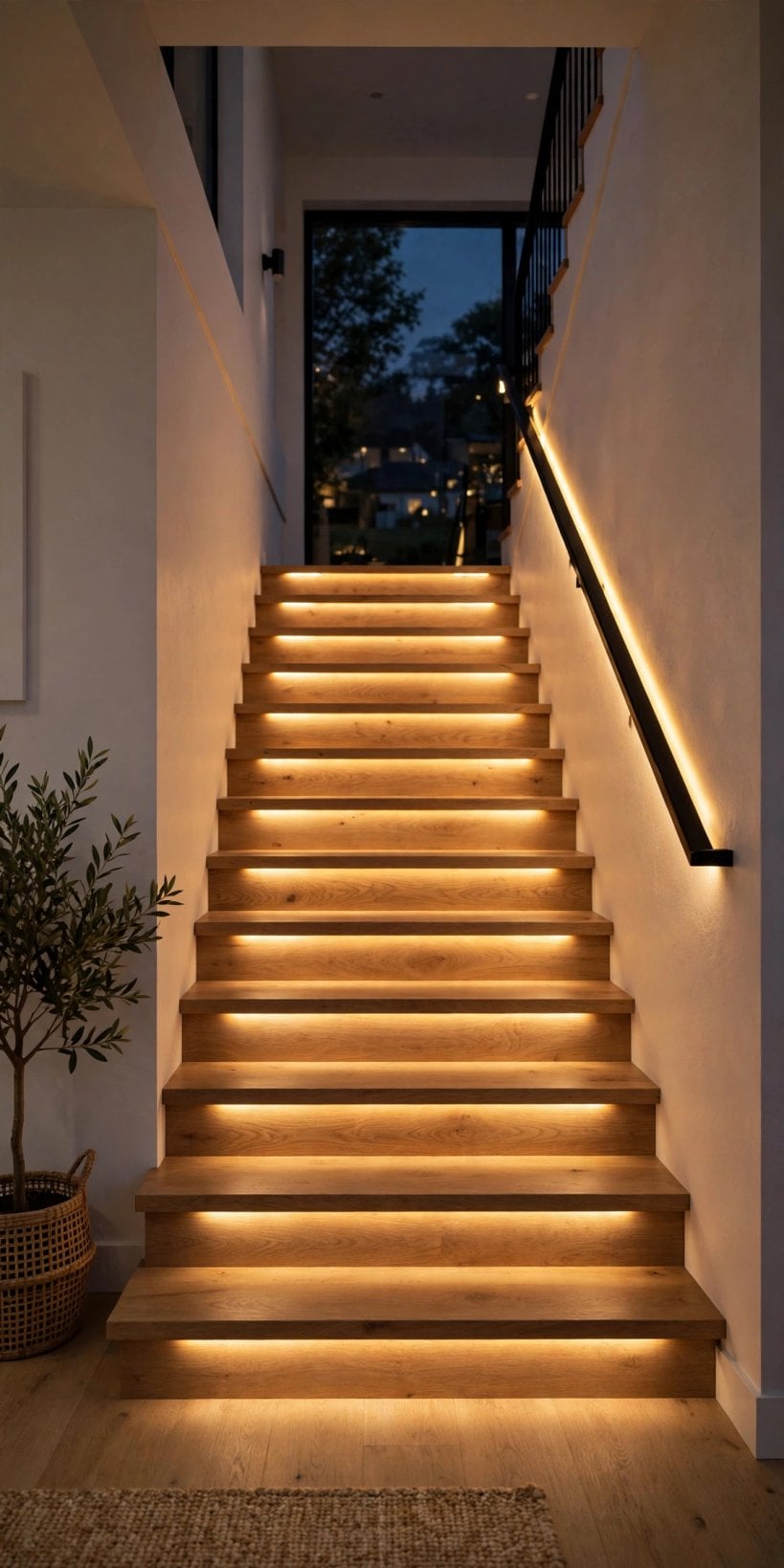
Warm white is the safest colour choice for homes, and a dimmer is close to essential: full brightness for hoovering the stairs on a Saturday, a low ember for the midnight trip to the kitchen. If you love the layered look, combine strip with one other idea from this list rather than adding more colours — a single calm scheme always reads as more expensive than a rainbow.
4. Way 3: Wall Sconces for Rhythm, Warmth and Character
Sconces are the classic choice, and they still earn their keep. A run of matching wall lights climbing the stair wall gives rhythm to a long flight, throws gentle light both up and down, and doubles as decoration on what is often the biggest blank wall in the house. Choose uplighters for a soft ceiling bounce on low stairwells, downlighters when you want the treads themselves emphasised, or shaded fittings when the staircase passes close to eye level and glare is a risk.
Spacing is a design decision, not just an electrical one. Evenly spaced sconces suit traditional homes and give a reassuring, hotel-like regularity. On a turn or half-landing, a single larger statement sconce can mark the pause point and light the change of direction, which is where most missteps happen. Keep fittings clear of the handrail line and picture frames, and mock the positions up with painter’s tape before any drilling — live with the tape for a day and climb the stairs a few times.
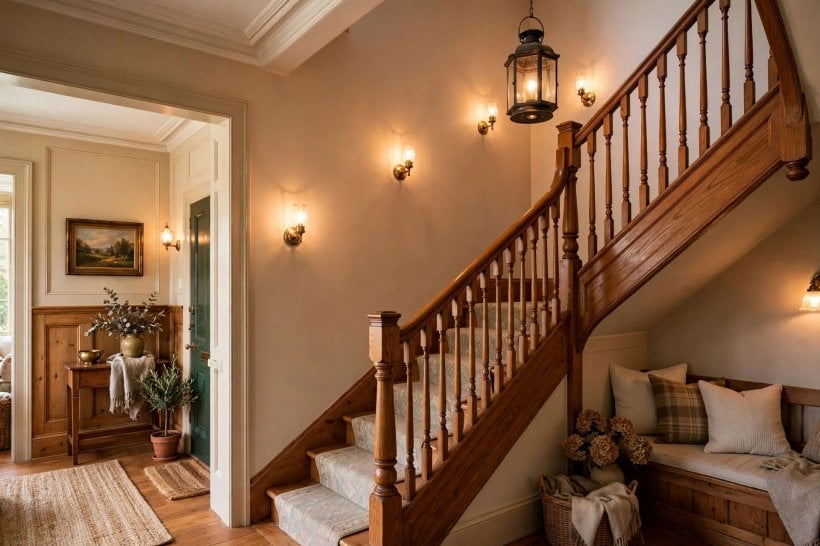
Sconces also play nicely with the decorating layer of a hallway. The same metal finish or shade fabric can echo through door furniture and frames, an approach that works well in the schemes gathered in our tiny house decorating ideas. Where chasing walls for cable is impossible, plug-in sconces with a neat cord cover offer a renter-friendly version of the same look.
5. Way 4: A Pendant or Chandelier Over the Stairwell
A tall stairwell is wasted on a bare bulb. A pendant, cluster or modest chandelier dropped into the void gives the whole staircase a centrepiece, lights several levels at once, and makes the daily trip upstairs feel a little grander. Long drops suit double-height voids, while a cluster of smaller pendants at staggered heights can follow the slope of the stairs themselves. This is the layer to have fun with: glass, rattan, blackened metal or paper shades all change the mood of the hall below.
Clearance is the golden rule. Anyone climbing the stairs, carrying a laundry basket or moving furniture needs comfortable headroom at every point, and tall household members should test the lowest position before it is fixed. Hang the fitting so it lights the landing and the turn rather than dangling directly over the steepest part of the flight, and put it on a dimmer so it can shift from bright task light to a warm evening glow.

Changing bulbs at height is nobody’s favourite job, so choose long-life LED lamps and, if the ceiling is very tall, ask your electrician about a fitting that can be lowered or reached safely from the landing. The effort is worth it: in open-plan and compact homes alike, one beautiful pendant does the visual work of several smaller fittings, a trick you will also see in these modern tiny house interior ideas.
6. Way 5: Light Built Into the Handrail Itself
The handrail is the one part of the staircase your hand already trusts, so building light into it feels instantly natural. Slim LED channels can be routed into the underside of a timber rail, or fitted into a purpose-made metal rail, washing the treads from the exact line you hold as you climb. The effect is discreet by day — the rail simply looks like a rail — and quietly luxurious by night.
This option rewards planning. A new handrail can be ordered or made with the channel already prepared, while retrofitting an existing rail depends on its thickness and material. The cable needs an invisible route at one or both ends of the rail, often into the newel post or the wall, so discuss the details with whoever is making or fitting the rail before it is installed. Keep the light continuous rather than broken into segments; an unbroken line reads as calmer and helps your eye judge distance on the way down.

Handrail lighting pairs especially well with plain, well-finished joinery elsewhere in the hall. If you are renewing the staircase as part of a bigger project, the sequencing lessons in our guide to building your own tiny house — services first, finishes last — apply just as well to a single staircase in a family home.
7. Way 6: Low-Level Guide Lights Along the Skirting
Sometimes the kindest light is the smallest one. Low-level guide lights — tiny fittings in the skirting board, the wall just above it, or the side string of the staircase — mark the route like a quiet runway without waking the whole house. They are ideal for the trip from a bedroom to a bathroom, for children who dislike total darkness, and for older relatives who need orientation more than brightness.
Because they sit low, guide lights flatter floor finishes and show up dust and obstacles exactly where your feet need to know about them. Keep the colour warm and the output modest; the goal is a gentle path, not a landing strip. On a straight flight, fittings on one side are usually enough. On winders and turns, add one at the change of direction so the awkward treads never sit in shadow.
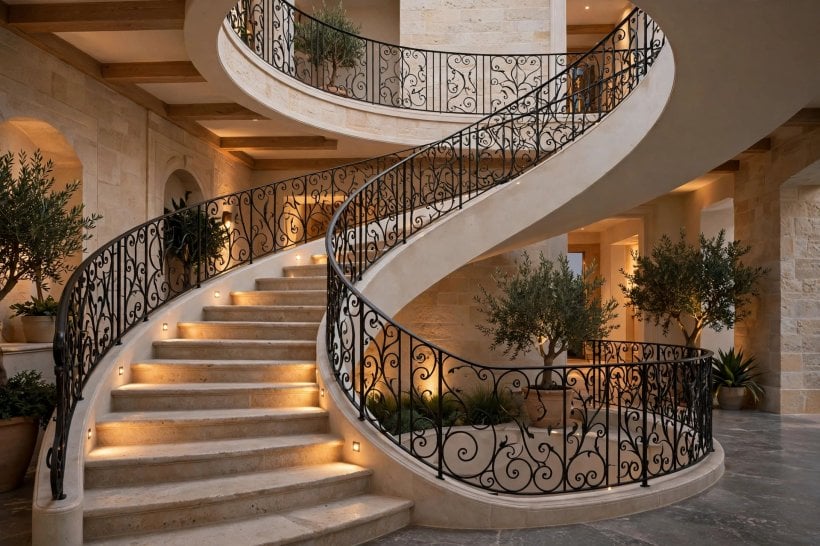
Guide lights are also one of the friendliest retrofits. Battery and plug-in versions exist for testing the idea, and low-voltage wired versions can often run from a nearby socket circuit — but always check with a qualified electrician what is permitted in your home rather than guessing. Start with the plug-in experiment, live with it for a month, and only commit to the wired version once the positions have proved themselves on real midnight walks.
8. Way 7: Motion Sensors for Hands-Free Night Lighting
A light that arrives when you do — and leaves shortly after — changes how a staircase feels at night. Motion sensors can run any of the fittings above, but they shine with step lights, strip and guide lights, bringing them up gently as you approach and fading them down once the stairs are empty. No fumbling for switches with a mug in each hand, no landing left blazing until morning, and no arguments about who left the hall light on.
Sensor placement is the whole game. One sensor at the bottom and one at the top covers most flights, angled so they notice a person stepping onto the stairs rather than a cat crossing the hall. Set the run-on time long enough for a slow, careful climb — a light that gives up halfway helps nobody — and choose fittings or controls that fade rather than snap off. Many households set night-time sensor lighting to a lower brightness than the evening scene, which protects sleepy eyes.

Sensors also earn their keep on the energy bill, since the stairs are lit for minutes a day instead of hours. For more whole-home thinking on using space and resources wisely, browse our tiny house and small-space interior design guide — the same less-but-better logic applies to lighting in homes of every size.
9. Way 8: Borrow Daylight, Then Layer Smart Controls
 The eighth way starts before any fitting: daylight. A glazed door at the top of the stairs, a borrowed-light window from a landing, pale paint on the stairwell walls and a mirror that bounces light down the flight can transform daytime safety, when plenty of trips still happen. Keep window treatments sheer or fully openable on stairwell windows, and avoid dark, heavy stair runners that swallow what light you have — contrast at the tread edge is a safety feature, not just a style choice.
Then let simple controls tie the whole scheme together. Two-way switching at the top and bottom of the stairs is the baseline every home deserves. Add dimmers for the evening layer, and, if you enjoy smart controls, a single ‘night’ scene that brings step lights and guides up low while the pendant sleeps. Keep a manual switch that always works, whatever the app or hub is doing — guests, grandparents and babysitters should never need instructions to light the stairs.
This layered, daylight-first thinking suits homes that open the stairs to living space, where the staircase is on show all day. You will find the same approach running through our home interior design ideas for tiny houses: fix the natural light first, then add the fewest electric lights that make the space feel complete.
10. Colour Temperature, Dimming and Mistakes to Avoid
More stair lighting indoor projects are spoiled by mismatched light than by any other single cause. Lamps described with the same words can glow very differently, so pick one warm colour temperature for the whole staircase — the cosy end of the range suits timber, carpet and evening use — and buy every lamp and strip to match it. Test one fitting first, at night, before ordering the full set.
The common mistakes are easy to dodge once you know them. Avoid a single bright ceiling light as the only source: it throws your own shadow onto the treads ahead of you. Avoid cool, blue-toned light in the evening, which feels clinical and wakes everyone up. Avoid glossy tread finishes that mirror a fitting into your eyes, and avoid placing a bright fitting exactly where it reflects in a picture frame or mirror on the stair wall. Finally, avoid over-lighting: stairs should feel calm and readable, not like a departure lounge.
Dimming deserves a last word. A scheme that can drop to a low, warm level gets used far more than one that only does full brightness, and it costs little more if planned from the start. Make sure dimmers, lamps and LED drivers are confirmed compatible before purchase — flicker on a staircase is not just annoying, it is distracting exactly where steady vision matters.
Final Considerations
The best staircase lighting is the kind you stop noticing: every tread readable, no glare, a little beauty on the way up to bed. Start with the safety layer — step lights, strip or guides — then add character with sconces or a pendant only where your stairwell invites it. Keep the colour warm and consistent, give night-time trips a sensor or a low scene, and let daylight do the daytime shift for free.
Plan the wiring before the decorating, test positions with tape and plug-in lights, and bring in a qualified electrician for anything beyond changing a fitting you already have. Do that, and the most ordinary route in your house becomes one of the calmest, safest and prettiest — eight small decisions that pay off every single night.


0 Comments