
1. 55 Gallon Drums at a Glance
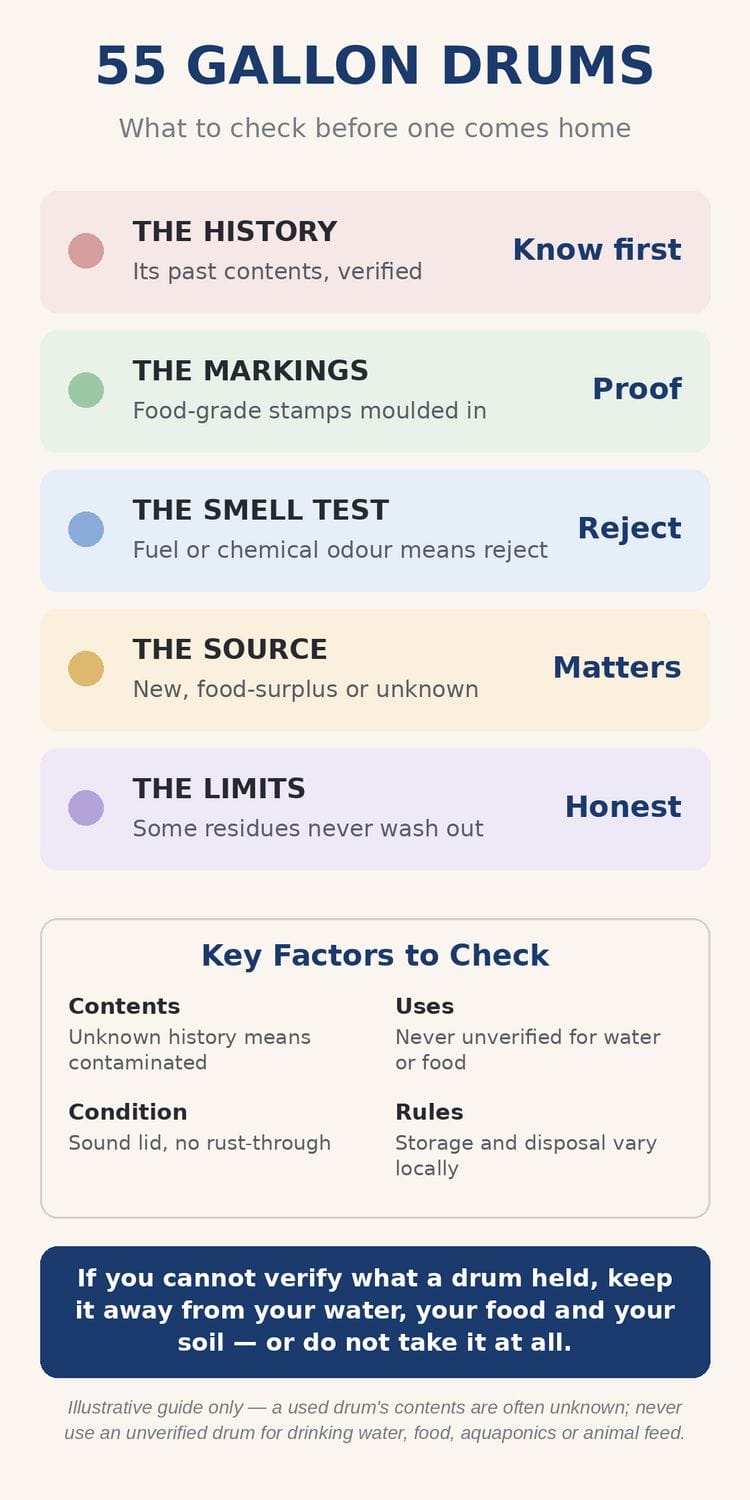
Start with the warning, because the warning is the point of this post. A used drum is a container with a past, and that past is usually unknown: drums of this size have carried everything from cooking oil to fuel, solvents and farm chemicals, and a rinse does not rewrite what soaked into a plastic wall or lingered in a seam. So the checks below come before any project. If a drum’s history cannot be verified, it does not touch drinking water, food, aquaponics or animal feed — not after washing, not after airing, not ever. Read the table as a gate, not a formality.
| Part | What It Covers | Why It Matters |
|---|---|---|
| THE HISTORY | Its past contents, verified | Know first |
| THE MARKINGS | Food-grade stamps moulded in | Proof |
| THE SMELL TEST | Fuel or chemical odour means reject | Reject |
| THE SOURCE | New, food-surplus or unknown | Matters |
| THE LIMITS | Some residues never wash out | Honest |
If you cannot verify what a drum held, keep it away from your water, your food and your soil — or do not take it at all. Everything after this section is how to run that verification, and what a drum that passes it can honestly do in a garden.
2. The Question Behind the Question
The search that brings most people here — where to get a 55 gallon drum for free — skips the only step that matters. “Free” describes a price, not a history, and the two travel separately: the cheapest drum in the county can be the one that held something you would never knowingly bring home. So the honest answer to the question is a better question: what will the drum do, and what proof of its past does that job require? A planter that will hold soil and ornamentals asks little. A rain barrel watering vegetables asks more. Anything touching drinking water, food, fish or animal feed asks for a verified food-grade past or a drum bought new — and no bargain changes that arithmetic.
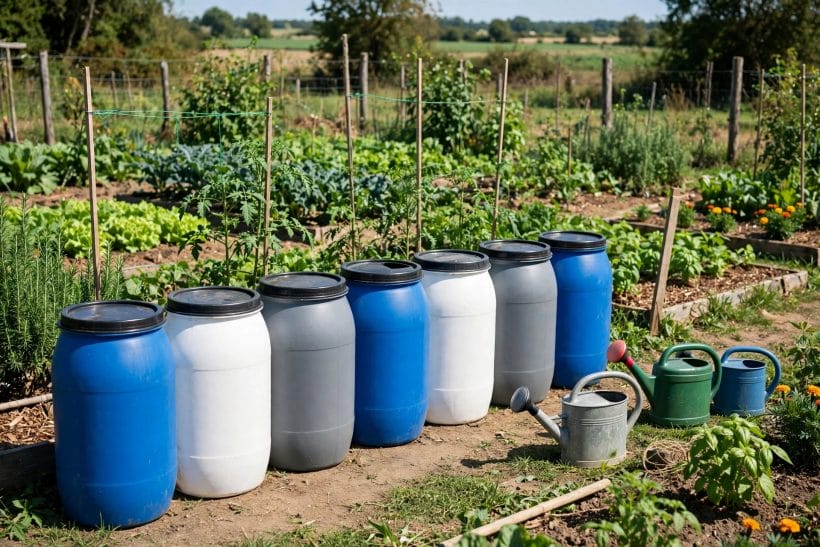
Work out the job first, then shop for the drum that can prove it belongs in it. The sections that follow run in the order a careful buyer actually works: history, markings, the senses, the source — and only then the projects.
3. Know the History: Verified Contents or Nothing
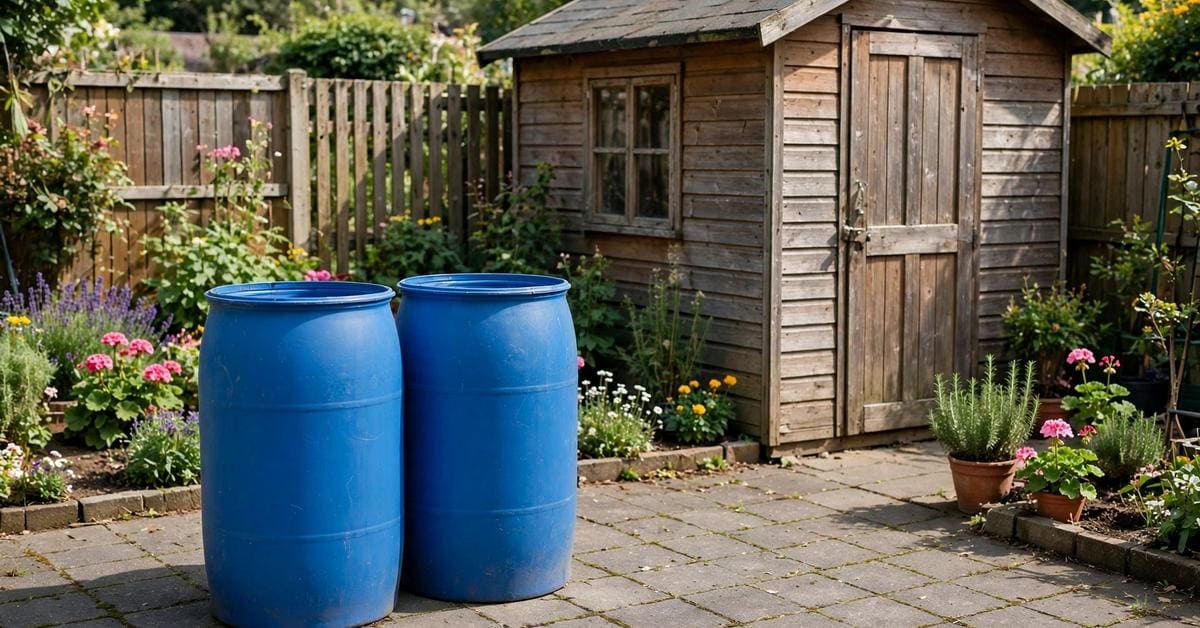
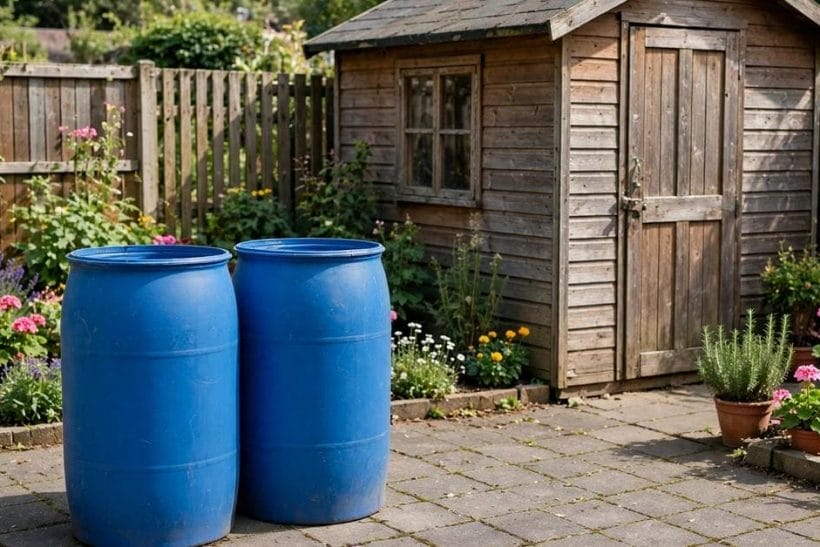
A drum’s history means what it actually carried, established by evidence — not by the seller’s shrug, not by the colour, not by the fact that it “looks clean”. Evidence looks like this: the drum comes from a food business whose contents are known because that is all the business handles; the original label survives and names a food product; a reconditioner supplies it as food-grade with the paperwork of their trade. The rain barrel in the photograph is the dream everyone starts with — roof water for the garden — and even it, watering plants you may eat, wants a history you can state out loud.
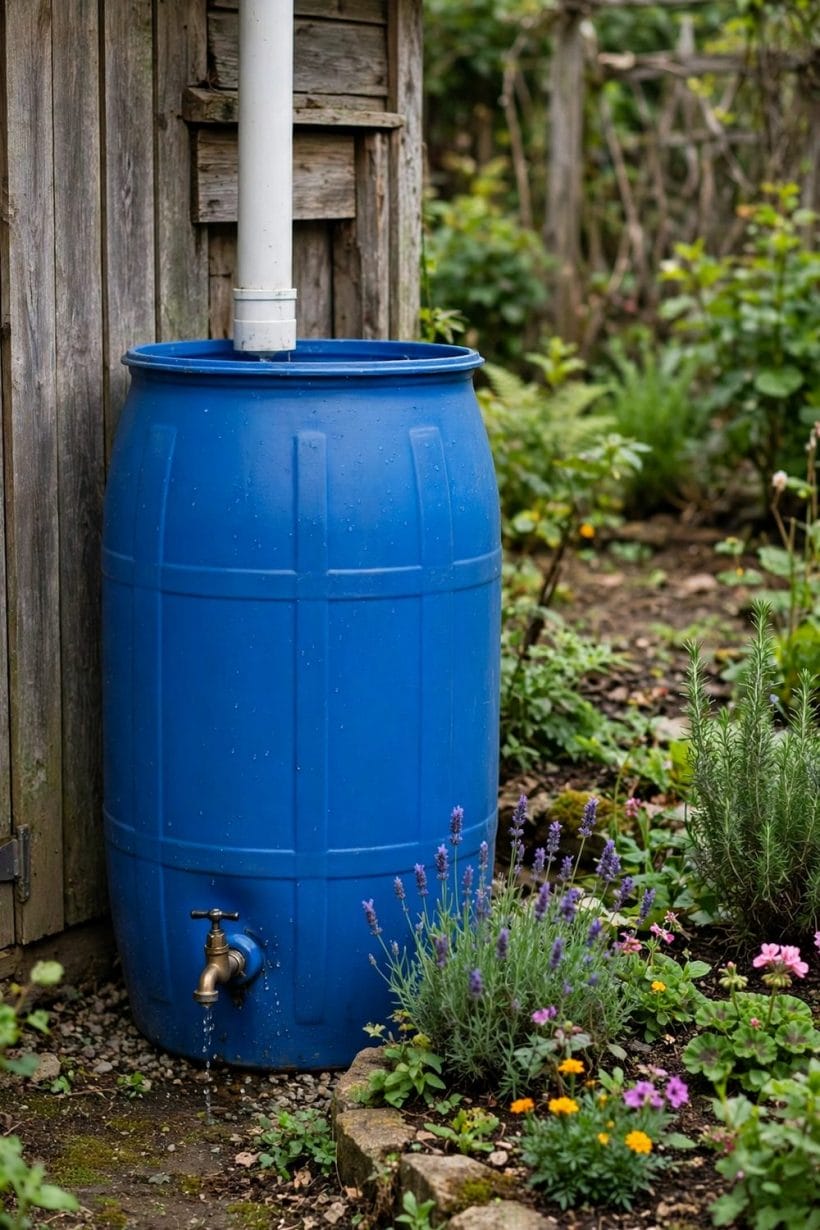
Against that standard, weigh the usual stories honestly. “It only had soap in it” is a claim, not a verification. “It smells fine” is a test, covered below, but a weak one — many hazardous residues are odourless. “The last owner washed it” tells you about the last owner’s intentions, not the drum’s past. When the history cannot be pinned down, the drum is not a bargain with a question mark; for anything that touches food or water, it is simply the wrong drum.
4. Reading the Drum: Markings, Stamps and Codes
Plastic drums carry their biography moulded into them, if you know where to look. Turn the drum over and around: the recycling code in its triangle describes the plastic family, and food-grade production is typically declared in the moulding or on a surviving label with the maker’s name and the drum’s intended use. A drum made for food announces it; a drum made for chemicals announces that too, in hazard diamonds, warning panels and product names that no amount of scrubbing turns into a food container.
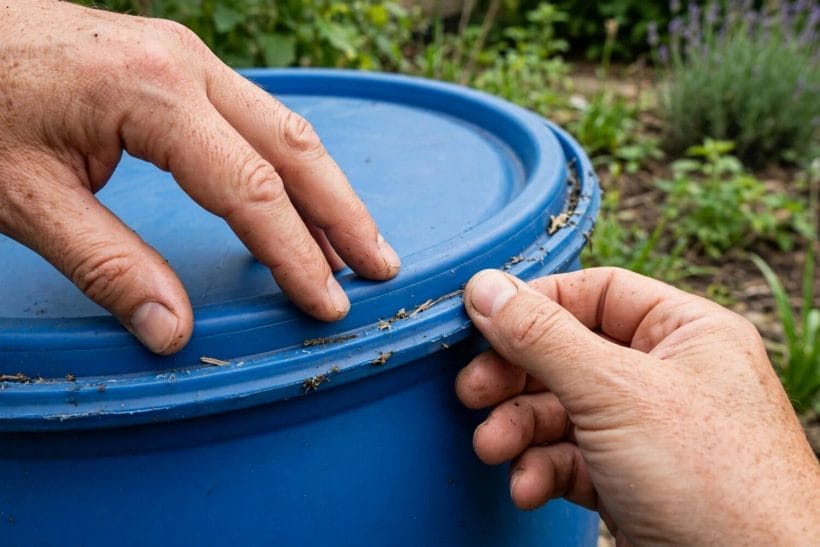
Read the lid and rim as carefully as the walls — the photograph’s hands are doing the right job. Original seals, tamper bands and the maker’s closures suggest an unbroken chain from a known filling; swapped lids, stained threads and improvised caps suggest a drum that has lived several lives. Steel drums ask the same reading in a different accent: painted linings, rust blooms and stencil marks from their filling days. Any marking you cannot interpret is a reason to slow down, not a detail to wave past.
Two cautions belong with the markings. A label describes the drum’s first filling, and honest drums keep it for life — but a label can also be peeled, swapped or simply wrong about everything after the first owner, which is why the label supports the history rather than replacing the seller’s evidence. And a drum with every marking removed has not been “cleaned up for sale”; it has been anonymised, and an anonymous drum fails the first gate however bright its plastic looks.
5. The Smell, Look and Feel Tests
Your senses are the second gate, and they work as rejectors, not approvers. Open the drum outdoors and smell the inside air: fuel, solvent, pesticide sharpness or any chemical sweetness is an instant and final rejection — drums like that leave with the seller, whatever the price. Then look: staining that survives in the plastic, oily rainbows, residue rings, scum lines and a cloudy film that wipes off on a cloth all say the past is still present. Run a hand around the seams, lid seat and bung threads, where residues collect and cracks begin.
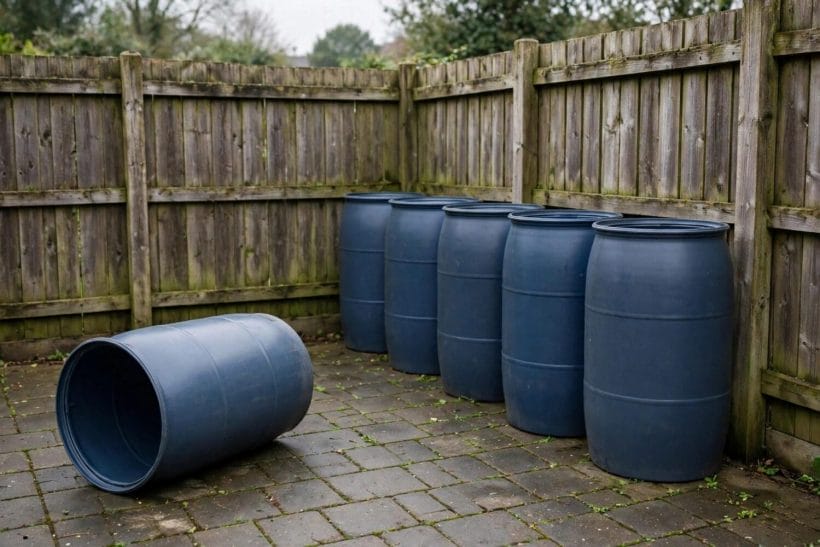
Understand what these tests cannot do. Passing them means the drum failed to disqualify itself on the day; it does not certify the contents of the last decade. Odourless contaminants exist, absorbed chemicals can leach slowly from plastic walls, and sunlight-aged plastic behaves differently from new. That is why the senses serve the history check rather than replacing it — a drum with paperwork and a clean smell is a candidate; a drum with only a clean smell is a story you are telling yourself.
6. Uses That Fit a Verified Drum
Once a drum passes — verified history, food-grade markings, clean tests — the garden opens up. The prettiest second life is the planter: a drum halved or cut to a trough takes soil, drainage and a crowd of flowers, and its past matters least where nothing edible grows in it; the container garden ideas collection shows what generous containers do for small spaces. Whole drums store what gardens accumulate — canes, netting, tools, the odds and ends that otherwise colonise the shed — and a sound lidded drum beside the garden shed ideas in your plan keeps them dry and findable.
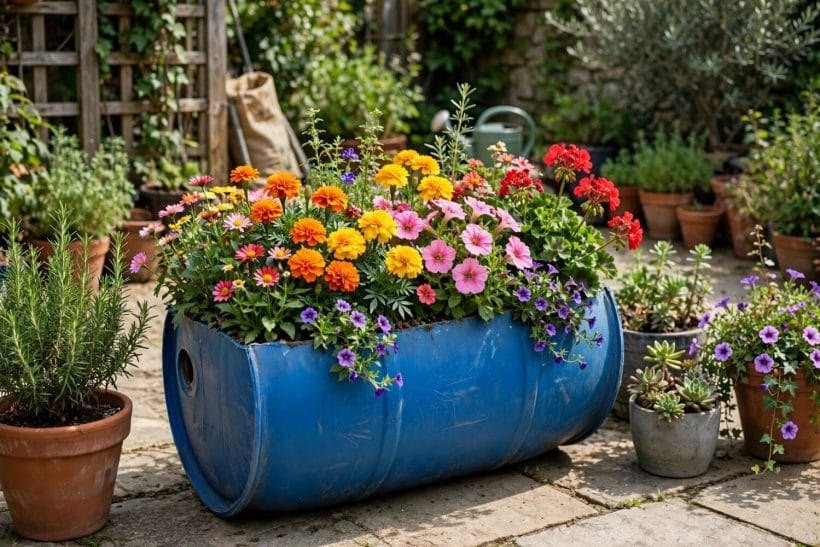
Even here, keep the ladder of caution. Soil for ornamentals is the forgiving end; soil for food crops deserves a drum whose past is verified food, not merely unstained. A drum that fails verification is not automatically rubbish — it can still serve far from food and water entirely, as a workshop bin or a form for a garden project — but it never climbs back up the ladder by being washed.
7. Compost Drums and Working Storage
The compost corner is where a good drum earns its keep for years: a lidded drum contains the heap, keeps it moist and tidy, and turns at a lift of the lid — the chemistry of what happens inside is covered in the composting 101 guide. Compost touches future food only through soil, which is exactly why the drum feeding it still wants a clean, verified past; the garden’s circle is only as clean as its containers. Working storage is the other honest living: drums hold water-butt overflow kit, irrigation parts and frost fleece for the off-grid gardens way of working, and a row of them gives a tiny house garden the cupboard it has no room for indoors.
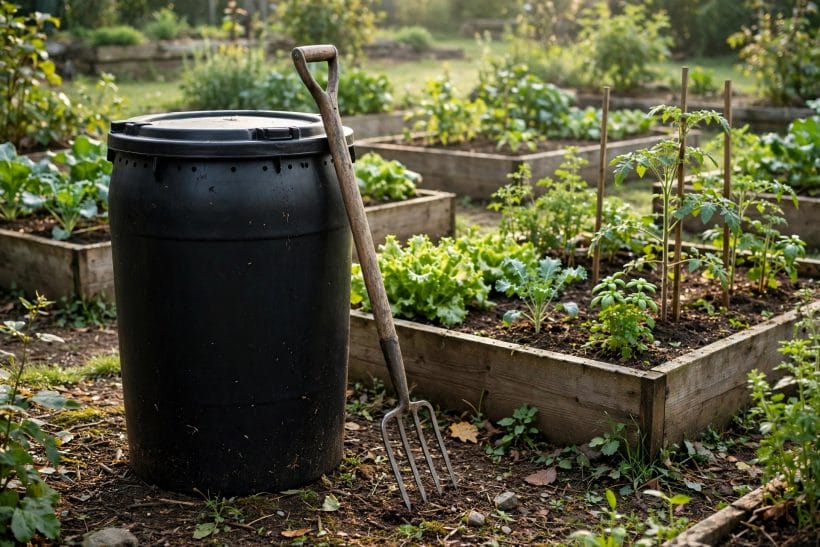
Set working drums on level ground, out of the strongest sun if the plastic is old, and label each one with its job and its provenance the day it arrives. The label is not bureaucracy; it is how the household remembers, three winters later, which drum was the verified one — and which one never was.
8. Where Drums Legitimately Come From
The legitimate sources share one trait: they can tell you what the drum held. New drums from packaging and agricultural suppliers arrive with their material and intended use stated — the surest route for anything touching food or water, and the honest benchmark against which every “bargain” should be measured. Food businesses — bakeries, pickling and drinks producers, food wholesalers — shed drums that carried ingredients, and a drum collected from the business itself, matched to what that business handles, carries a verifiable story. Reputable reconditioners grade and certify drums as their trade.
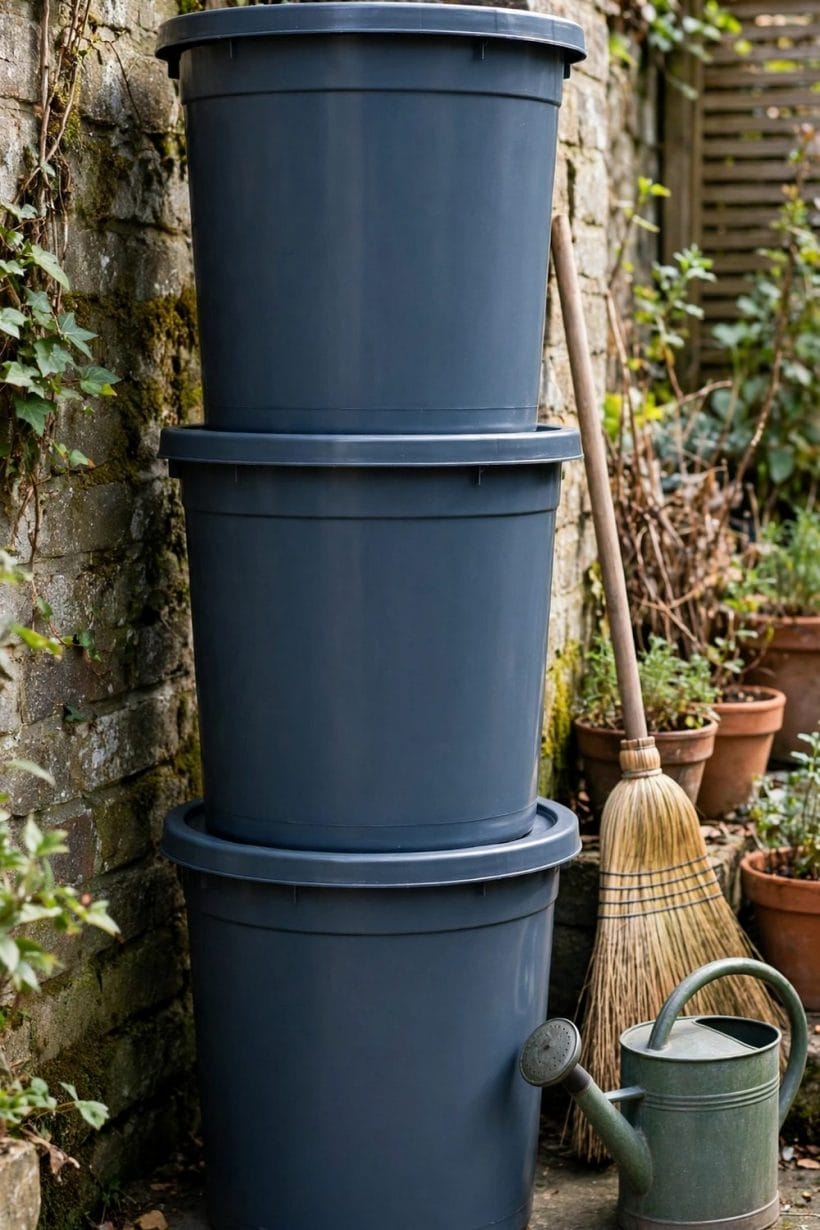
And “free”? Free drums exist — a food business glad to skip disposal, a neighbour’s verified spare — but the word does no safety work. Treat every drum, free or dear, to the identical gates: history, markings, senses. A drum that cannot pass them is not free; it is a disposal problem someone has handed you, priced at your garden’s health.
Ask for the trail, too. A legitimate source can usually show something — an invoice line, a delivery note, the product the drum matches in their own stores — and a seller unbothered by the question is a good sign in itself. A seller who cannot or will not say what the drum held has answered the only question that mattered; believe the answer and shop elsewhere, where the story comes with the drum.
9. Rain Barrels: Garden Water From a Verified Drum
The rain barrel is the project that starts most drum hunts, and done properly it is a good one: a verified food-grade drum under a downpipe, lidded against mosquitoes and debris, watering the ornamental beds and — where its provenance is genuinely food-grade — the vegetables. Sizing the barrel against the roof that feeds it is its own piece of arithmetic, covered in the guide to rainwater harvesting, and the rules about collecting rain at all vary by place, which the round-up of the legality of collecting rainwater works through.
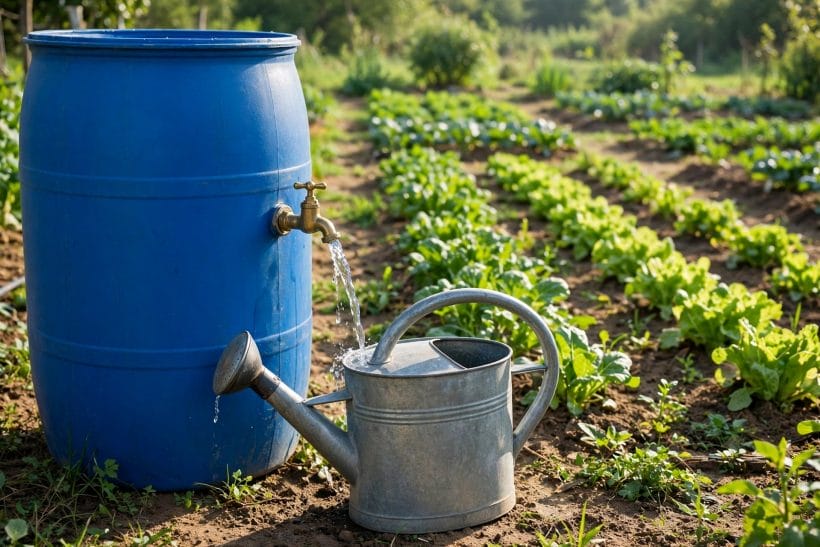
Two lines never move. Roof water is garden water, not drinking water, whatever the drum — roofs contribute their own contaminants before the drum’s history is even asked. And a drum of unknown past does not become a rain barrel by being rained into: if you cannot verify it, the vegetables it would water are the argument for buying the drum new.
10. The Hard Lines: Never Uses, Cleaning Limits and Walking Away
End where the post began, with the lines stated flatly. Never use a used drum of unverified history for drinking water, for storing or growing food, for aquaponics, or for animal feed and watering — no washing regime promotes it into those jobs. On cleaning itself, be honest about the limits: hot water, detergent and scrubbing remove surface dirt and recent, soluble traces, and that is all they remove; chemicals absorbed into plastic walls, lodged in seams or bound in residues are not reliably removed by any household method, which is why “cleaned” is not a synonym for “safe”. A drum you reject still needs a responsible ending — local waste services and reconditioners take drums for proper disposal or industrial reuse, and dumping or burning a suspect drum just moves its contents into the air and soil. If a suspect drum is already on your property, store it as the unknown it is while it awaits that ending: upright, lidded, out of the sun, away from wells, drains, food growing and children’s play, and labelled with what you do and do not know about it. Walking away from a drum costs nothing. The drums worth having — verified, marked, clean-tested — are worth having precisely because the gate was real.
Final Considerations
A 55 gallon drum is one of the garden’s most useful objects and one of its least forgiving bargains. Source it the way this guide ran: job first, history verified, markings read, senses consulted, and the hard lines kept for water and food. Do that, and the drum by the shed is simply a good tool — labelled, purposed, and trusted exactly as far as its evidence reaches, and no further than that, ever, for anyone. Skip it, and no saving justifies the story you will never know.




0 Comments