

In a small home, nothing hides. Every chair is in every photograph, every mistake is met forty times a day — which is why small spaces are where timeless design stops being a taste and becomes a survival skill.
This guide distils the moves that outlast trends at small scale: proportion, honest materials, closed storage and colour carried by objects, room by room.
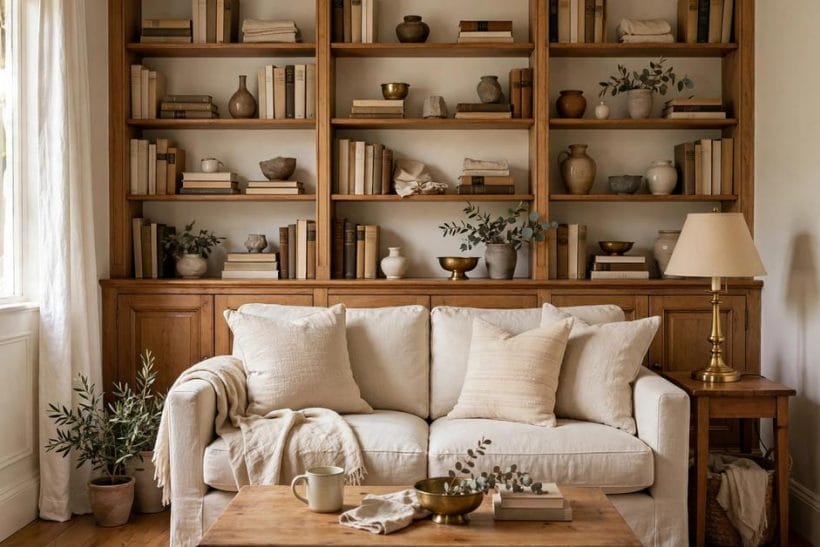
1. Small Home Decorating at a Glance
Small home decorating is the furnishing and finishing of compact dwellings, and its timeless form rests on attributes that never change: proportion fitted to the room, a clear path through it, honest materials, storage built in and closed, and colour applied to movable things rather than fixed surfaces. This guide owns the timeless principle across the whole small home; the individual small rooms — patio, closet, bedroom, bar and living room — keep their own lane posts, linked here and not absorbed.
| Question | Short answer |
|---|---|
| What actually makes a small room look dated? | Almost never its size and rarely its style: the dated look comes from themed gestures, imitation materials and clutter — the record of storage that failed. Rooms built on proportion, real materials and closed storage can be photographed in any decade without embarrassment. |
| What is the single most timeless small-space move? | The clear path with furniture at the edges and life in the middle — the parlour and studio plan that has served every generation, because bodies and doors have never changed fashion. Get the layout’s geometry right and every later choice becomes easier to keep. |
| Which colours are timeless in small homes? | A structure rather than a shade: a light warm-neutral field, mid-tones supplied by natural materials, and colour carried by objects and textiles that can move. Any specific shade can date; the structure has not, because it separates what is fixed from what is free. |
| How many pieces of furniture does a small room need? | As few as serve its life honestly — each one right-sized, most of them working twice, and each with a home for the awkward things it must hold. The count matters less than the test every piece passed: that it would still be welcome and still be working in twenty years. |
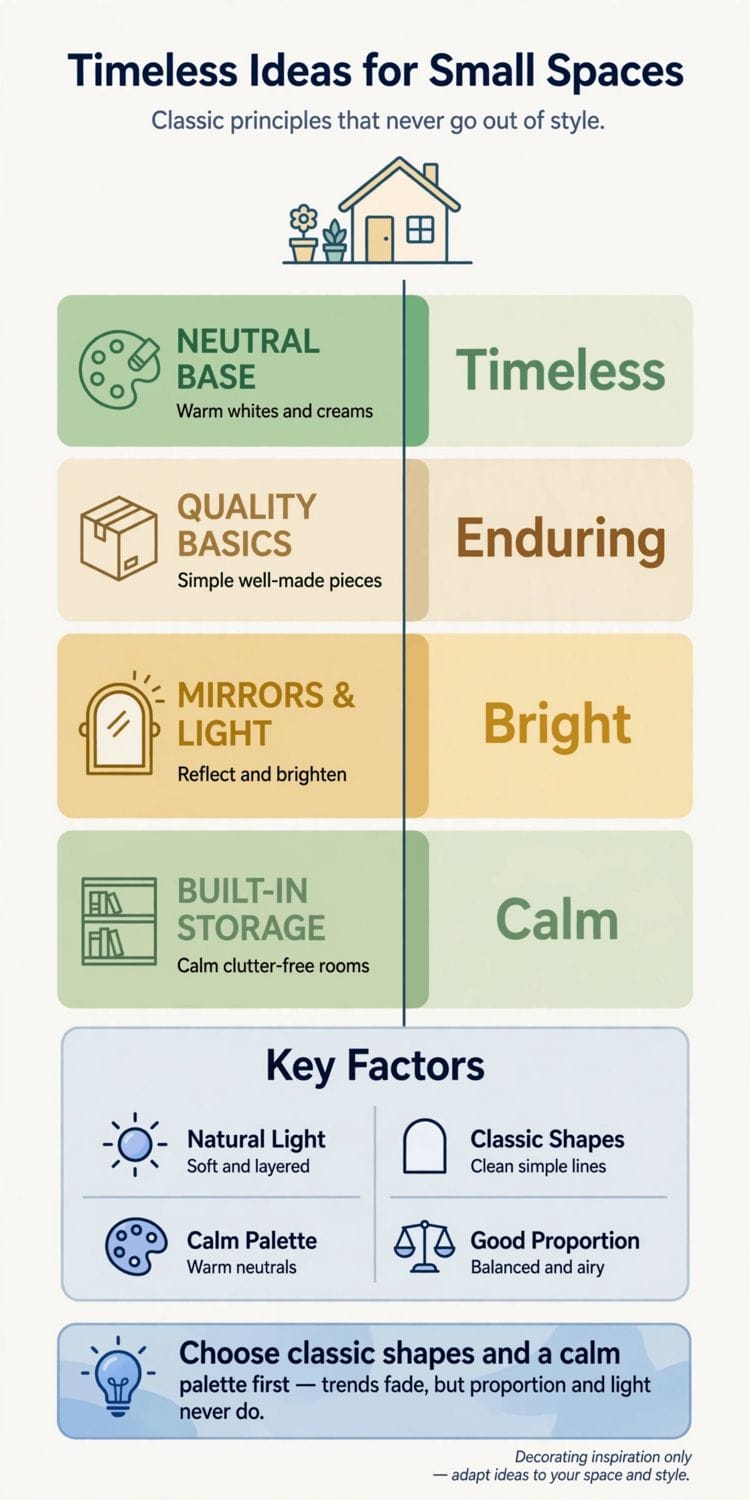
2. What Timeless Means When Space Is Scarce
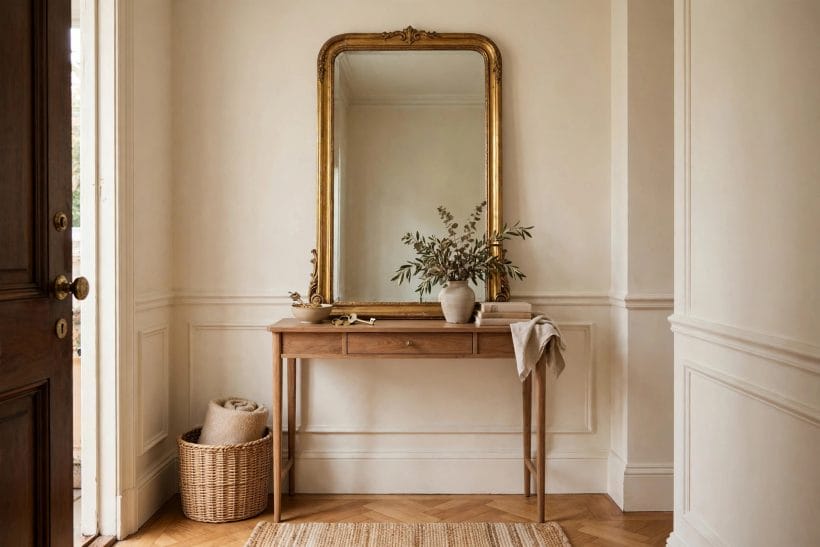
Timeless is not a style; it is a survival record. A design choice is timeless when it keeps working — and keeps pleasing — after the photographs that inspired it have dated, and in a small space the test is harsher than anywhere, because nothing can be hidden, rotated away or apologised for by sheer square footage. Every object in a small room is on permanent display, including the mistakes.
Proportion before decoration
The timeless small room is first a matter of fit: furniture scaled to the room, clearances kept honest, one clear line for the eye to travel. Decoration applied to bad proportion dates instantly, because the eye reads the discomfort before it reads the style — and keeps reading it for years.
Honest materials age; imitations date
Timber, stone, linen, wool, brass and ceramic improve or at least soften with use, and a small room built from them can be redecorated by changing almost nothing. Materials that imitate other materials date at the speed of the imitation’s fashion — the first rule of the timeless small home is that everything in it is what it appears to be.
Editability is the hidden attribute
A timeless room can absorb change: a new chair, a child’s arrival, a decade’s different work. Fixed, themed, single-gesture rooms cannot — they can only be replaced. In small spaces, where replacement means upheaval, the room that welcomes editing is the room that lasts.
3. Layout: The Decisions That Outlast Every Trend
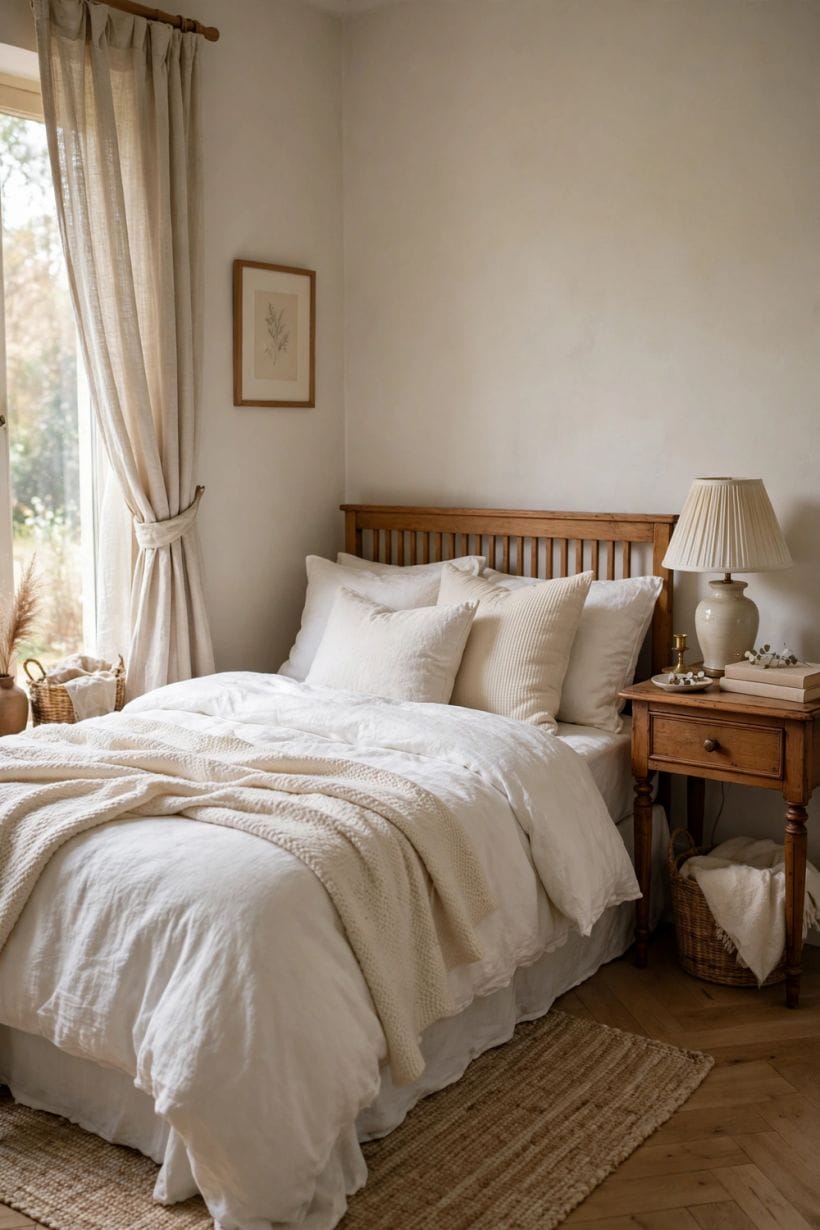
Layouts outlive styles because bodies do not change fashion: people still need to walk, sit, reach, eat and sleep in the same geometries. The small-space layout rules that follow are the ones found, unchanged, in good small rooms of every decade — and they connect directly to the site’s wider living room ideas pillar, where the same geometry is worked at family scale.
One clear path, honestly kept
Every small room needs a single obvious route through it that nothing blocks — not the sofa’s corner, not the open cupboard door, not the chair pulled out. Rooms that respect their path feel calm at any size; rooms that fight it feel small at any size.
Furniture against walls, life in the middle
The enduring small-room arrangement pushes storage and seating to the edges and keeps the centre as shared, flexible floor. It is the cottage parlour’s plan and the studio flat’s plan alike, because it is the only plan that lets a small room change its mind daily.
Height is the small room’s spare room
Walls are floor space stood upright: tall storage, high shelves, pictures hung with the ceiling in mind. Rooms that use their height read as architecture; rooms that furnish only their lower half read as storage with seating in it.
Zones without walls
A rug, a light, a change of level or a bookcase’s back can divide a small open room into living, working and sleeping territories more gracefully than any partition. Zoning is the small home’s substitute for doors, and it has never gone out of date because it answers a permanent need.
The door swing and the drawer pull
Timeless layouts are drawn with the room in motion: doors opening fully, drawers pulling clear, chairs pushing back from tables without striking anything. A small room planned only as a still photograph will betray itself at the first meal; the plans that last were drawn by people who imagined living in them at full speed, with the shopping coming in and the ironing board going up.
4. Colour and Light: The Enduring Palette
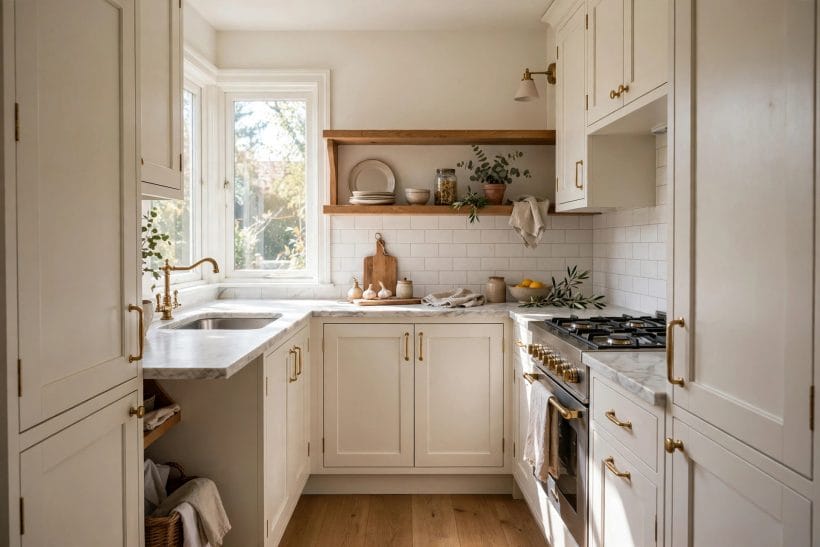
Colour is where small rooms date fastest — and where they can most easily refuse to. The enduring palette is not a list of fashionable shades but a structure: a light, warm-neutral field; natural materials supplying the mid-tones; and colour arriving by object, textile and art, where it can be changed in an afternoon.
The light field
Pale walls in a warm white or a soft neutral make small rooms feel larger and, more importantly, stay compatible with everything the years bring. The field’s job is recession; the moment a wall colour becomes the room’s loudest statement, the room has a date stamped on it.
Mid-tones from materials, not paint
Timber floors and furniture, woven textiles, stone and ceramic supply the palette’s middle register — tones that cannot date because nobody chose them from a chart. A room whose mid-tones are materials can change its accents endlessly without repainting anything.
Colour by the object
One coloured chair, a curtain, a rug, a door: small rooms take colour best in pieces that can move, be re-covered or be given away. This is the small home’s economy, and it is why the most timeless small rooms photograph as neutral rooms containing a few beloved colourful things.
Light layered at three heights
Ceiling light for use, lamp light for faces, low light for evening: the three-layer scheme belongs to no decade because it belongs to the body. In small rooms each layer also marks a zone, so the lighting plan and the floor plan become the same drawing.
5. Furniture: Fewer, Better, Exactly the Right Size
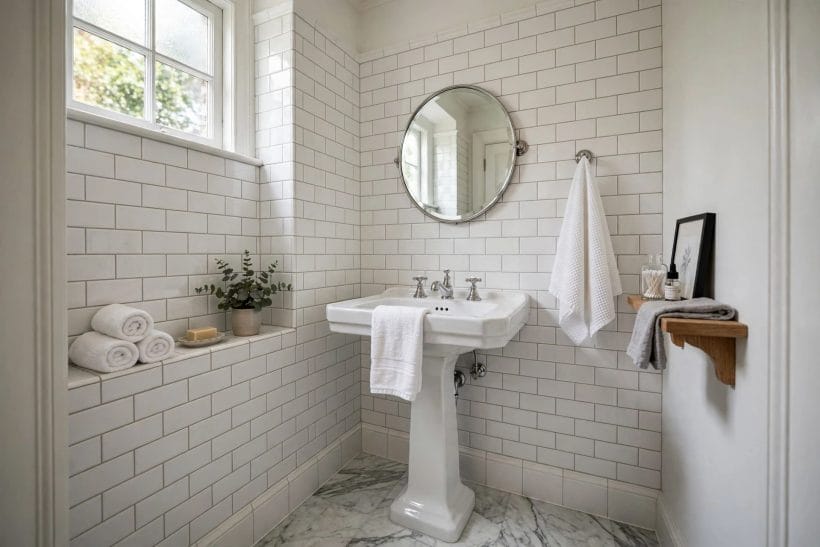
Timeless small-space furniture is a short list written carefully: a seat that truly fits its sitters, a table that earns its footprint daily, storage that closes. The governing sin is not cheapness or plainness — it is the almost-right piece, bought for a room it nearly fits, apologised for at every use.
The right-size rule
Measure the room, then the piece, then the route the piece must travel to reach the room. Small-space classics are compact because their makers respected all three measurements; the overstuffed and the miniature-dollhouse are the twin failures, equally uncomfortable, photographed from opposite ends of the same mistake.
Pieces that work twice
A bench that stores, a table that extends, a stool that is also a side table and a step: dual-duty furniture is the small home’s oldest technology, visible in ship cabins and farmhouse kitchens centuries before it was named. It never dates because the need never does.
Quality where hands land
Spend first where the body touches — the chair’s arms, the table’s edge, the bed, the tap, the handle. These are the points where a small room declares its quality daily, and where a well-made piece outlasts three fashionable replacements.
The heirloom test
Before any significant piece enters a small home, it faces one question: would this still be welcome, and still be working, in twenty years? The test does not forbid pleasure or personality — it forbids only the piece whose charm depends on this year’s context, because in a small room there is nowhere for dated charm to hide.
6. Storage: Built Into the Architecture, Not Added to It
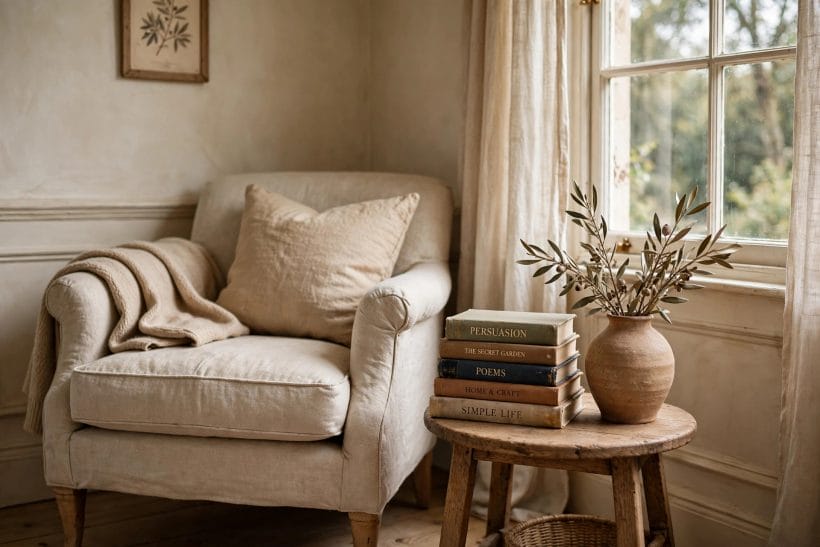
Clutter is what actually dates a small room, because clutter is the visible record of a storage plan that failed. Timeless small homes treat storage as architecture — planned with the room, closed with doors, and sized for the household’s real belongings rather than its aspirations. The dedicated treatment of the smallest storage room is small closet ideas; this section draws the whole-house principle.
Closed before open
Open shelves photograph beautifully and live badly in small homes, where every displayed object is always on duty. The enduring ratio is mostly closed storage with a little open display, edited hard — the room reads calm because its working parts are behind doors.
The full-height, full-depth discipline
Storage that stops short of the ceiling wastes the small home’s scarcest dimension and creates a dust shelf into the bargain. Built-in or tall pieces, taken to the ceiling and planned around the room’s real objects — the vacuum, the suitcases, the board games — are the difference between storage and furniture that merely has doors.
A home for the awkward things
Ironing boards, mops, sports kit, the spare duvet: small homes fail at their awkward objects, not their books. A timeless plan names a place for each awkward thing before the pretty storage is drawn, because an object without a home becomes the room’s permanent, dating clutter.
7. Room by Room: The Lanes in Miniature
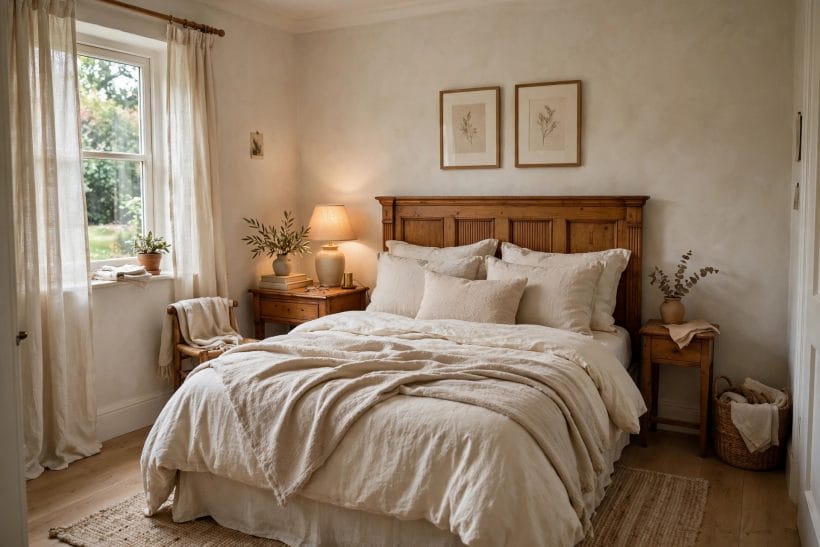
The principles land differently in each room, and the site’s lane posts carry each room’s full treatment. What follows is the timeless filter applied room by room — the questions to ask in each — with the lanes linked rather than repeated.
The small living room
Seat the household first, guests second, and let one beautiful thing carry the room’s character. The published small living room ideas work the room in full; its timeless core is a right-sized sofa, closed storage and a clear path, in any decade’s upholstery.
The small bedroom
Sleep is the least fashionable activity in the house and the least forgiving of gimmicks: bed first, darkness and quiet engineered honestly, clothes behind doors. The lane is small bedroom ideas; the timeless note is that a bedroom’s luxury is calm, and calm never dates.
The small patio and the threshold
Outdoor small space obeys the same laws: right-sized pieces, honest materials, one clear route, storage that closes against weather. Small patio ideas carry the full survey; timelessly, a small patio is a room whose ceiling is the sky, and it should be furnished with the same seriousness.
The small bar, nook and corner
Even the smallest luxury corner — a home bar, a reading nook — lasts when it is built like the rest of the house rather than themed like a set. Small home bar ideas show the corner at full strength; its timeless version is timber, glass and restraint, not signage.
8. Trends: Taking What Lasts, Skipping What Dates
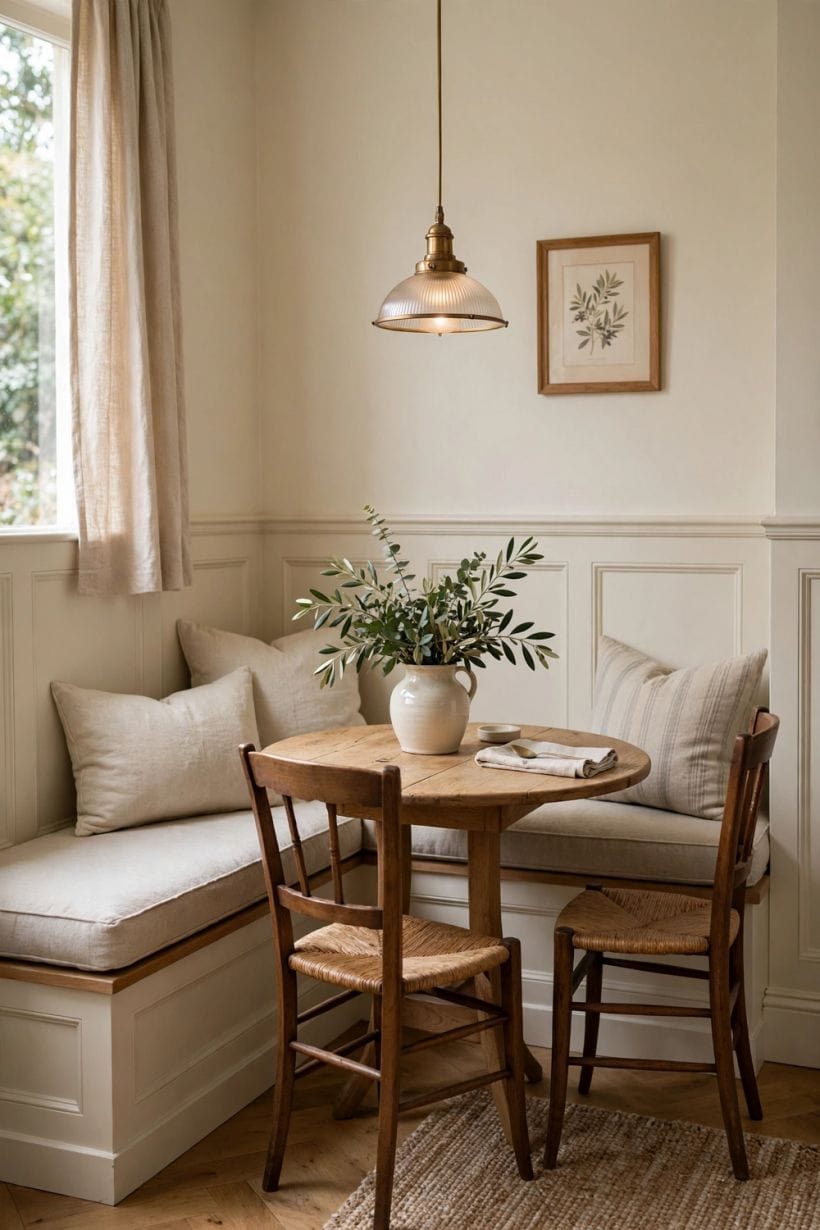
No home is built outside its decade, nor should it be — a timeless small home is not a period reconstruction. The skill is triage: letting each era contribute the pieces that answer permanent needs, and declining the ones whose only argument is novelty.
What to take from any trend
Take improvements in function without hesitation — better lighting, kinder mattresses, cleverer storage mechanisms — and take any aesthetic idea that survives the heirloom test. A trend that returns every generation is not a trend at all but a classic on its rounds, and it may be adopted with confidence.
What to leave
Leave the themed room, the single-gesture paint effect, the furniture shaped like something else, and any material pretending to be another. Each depends for its charm on being unexpected, and in a small home the unexpected is encountered forty times a day until it is merely tiring.
The photograph test
When a choice tempts, imagine it photographed and dated. If the imaginary caption — the year it was done — embarrasses the choice, the room will deliver that embarrassment in person, daily, for years. The test is unfair to genuinely good new ideas about once a decade; it is right the other nine times.
9. Mistakes, Maintenance and the Long View
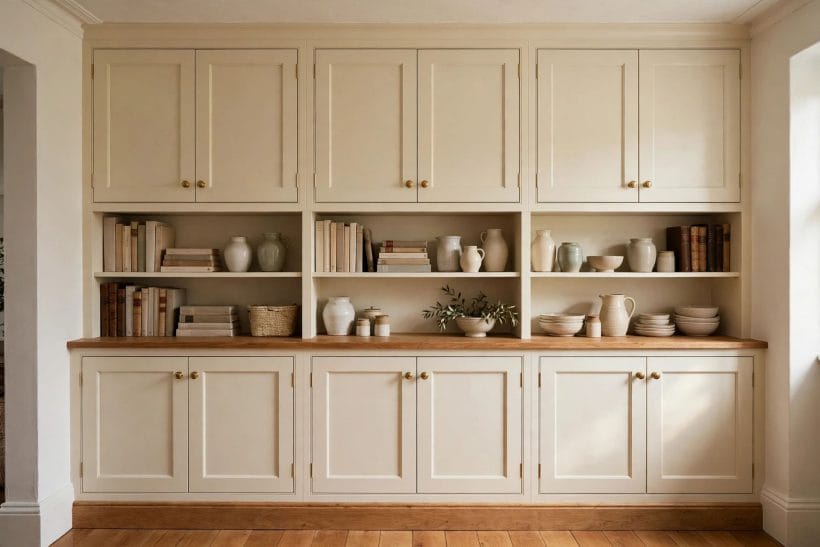
Timeless rooms are maintained, not merely designed. Paint refreshed in the same colour, timber oiled, textiles repaired, one object edited out for every two that enter: the long view is a habit, and it is the reason some small homes photographed decades apart look like the same calm room growing older gracefully.
The one-in, one-out discipline
Small homes stay timeless by arithmetic: the volume is fixed, so the contents must be too. Every arrival interviews for the place of a departure. Households that keep this rule never need a purge, and their rooms never acquire the layered, dated sediment that purges exist to remove.
When to break the rules
For love, cheerfully: the impractical inherited chair, the ridiculous beloved lamp. A timeless room is a discipline in service of a life, not a substitute for one — and a small home with nothing irrational in it has edited out the very things its photographs will be loved for.
10. Costs and Pulling It Together
Costs follow the long view, stated qualitatively as this guide states everything: fewer, better pieces cost more at the till and less across the years, because the timeless small home’s true expense is replacement — of the dated theme, the failed storage, the almost-right sofa. Built-in storage and one well-made chair are the classic places where spending once, properly, retires a whole category of future spending.
Pull the guide together in its own order: proportion first, path second, materials honest, storage closed, colour movable, and every piece passed through the twenty-year question. A small home decorated on those terms does not chase timelessness — it simply never gives fashion anything to expire. The wider map of small and large rooms alike gathers under home design ideas.
Final Considerations
The loveliest small homes share a secret the photographs cannot quite show: they were not decorated once, but edited continuously — a life being lived carefully in a small volume, which is the oldest domestic art there is.
Begin with the path. Clear one honest route through your busiest small room, move one imitation thing out and one real thing in, and close one door on one cluttered shelf. Three moves, an afternoon — and the room will already be harder to date than it was this morning, and kinder to live in by this evening, which is the only review timeless design has ever really cared about.

0 Comments