

A small closet does not fail for lack of inches. It fails for lack of zones, and the difference between the two is one honest afternoon.
These small closet ideas rebuild the little cavity as a system: measured, zoned by frequency, double-hung where clothes are short, one row deep where they fold, and kept by habits measured in minutes.
1. Small Closet Ideas at a Glance
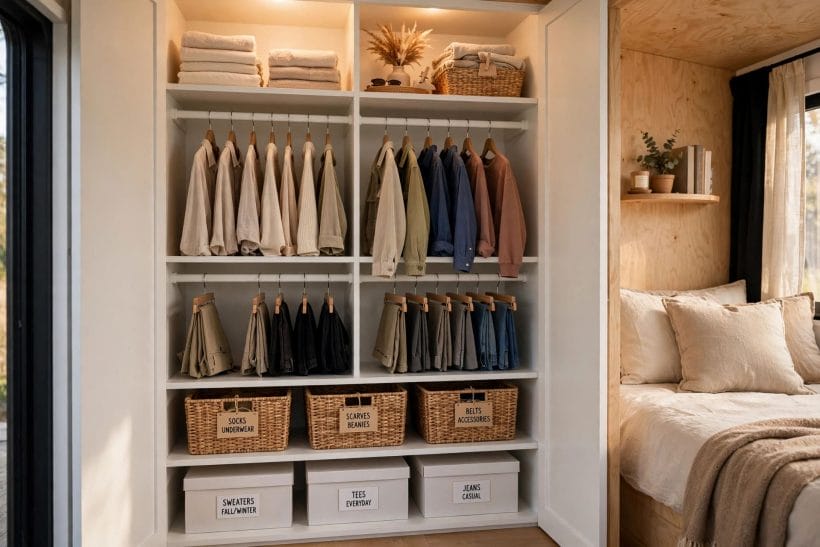
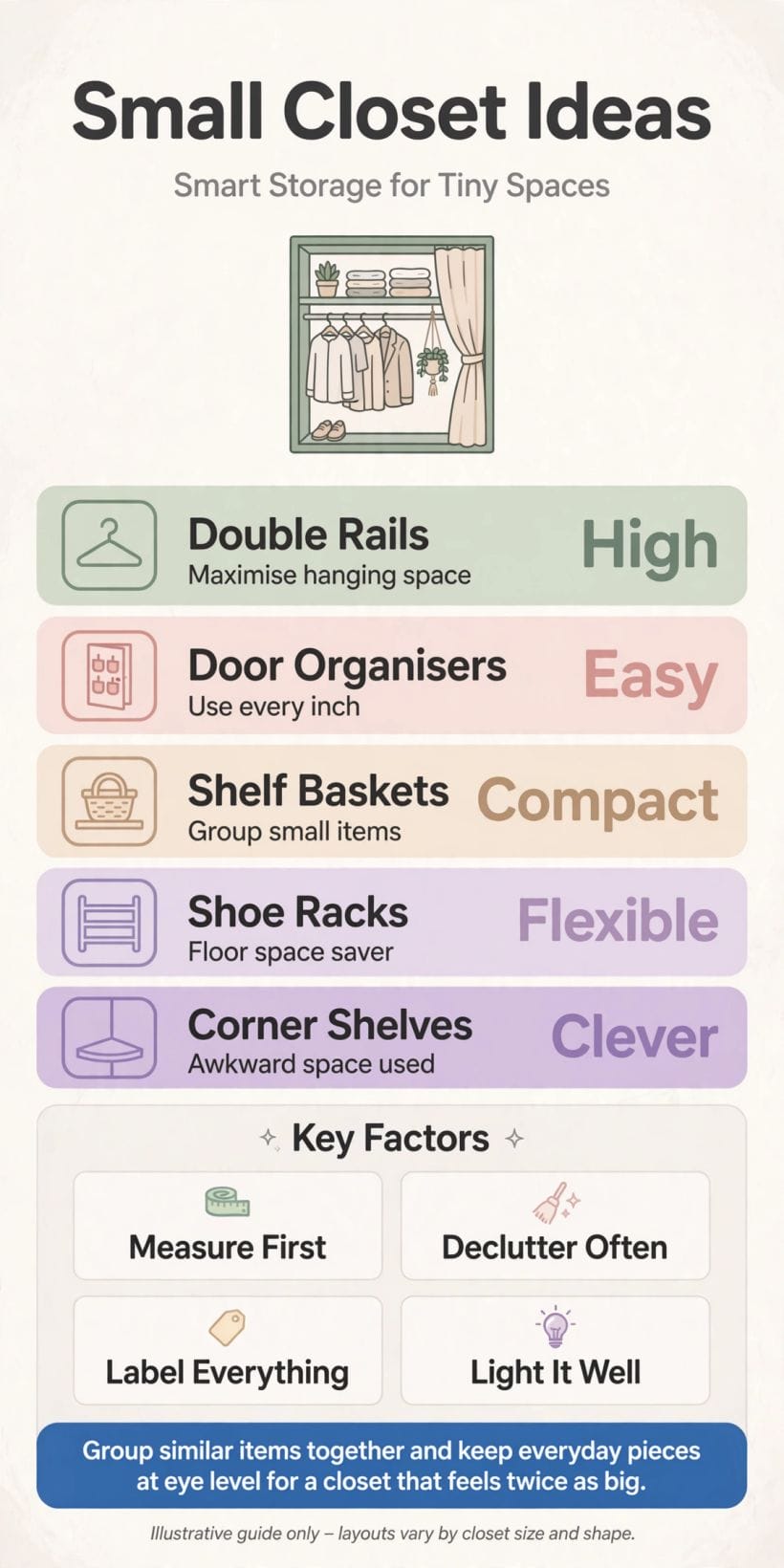
The central entity is the small closet: a single-door wardrobe cavity serving a full adult clothing life from a short rail and a few shelves. Its attributes are its true measured interior and its dead spaces, the rail and how its length is doubled, the folded half in drawers and boxes, the forgotten surfaces of door and floor, and the keeping habits that hold the whole system at working density. It is a child of the closet cluster’s pillar, and its governing rule is frequency: what is used weekly lives at the hand, what is rare lives at the edges, and nothing lives anonymously.
| Question | Short answer |
|---|---|
| What is a small closet’s first move? | Empty it completely, measure the true interior, and zone the bare space by frequency of use. |
| How is hanging space doubled? | A second rail under the shirts zone, where most clothes hang at half height. |
| What depth should shelves hold? | One row deep, always; a hidden second row is stock the owner will forget and rebuy. |
| Which surface is most wasted? | The door’s back: a full wall of hooks and pockets that most small closets never use. |
| What keeps it working? | A five-minute weekly reset, a resident donation bag, and one-in-one-out on the rail. |
2. The Small Closet Itself: Measure, Empty and Zone
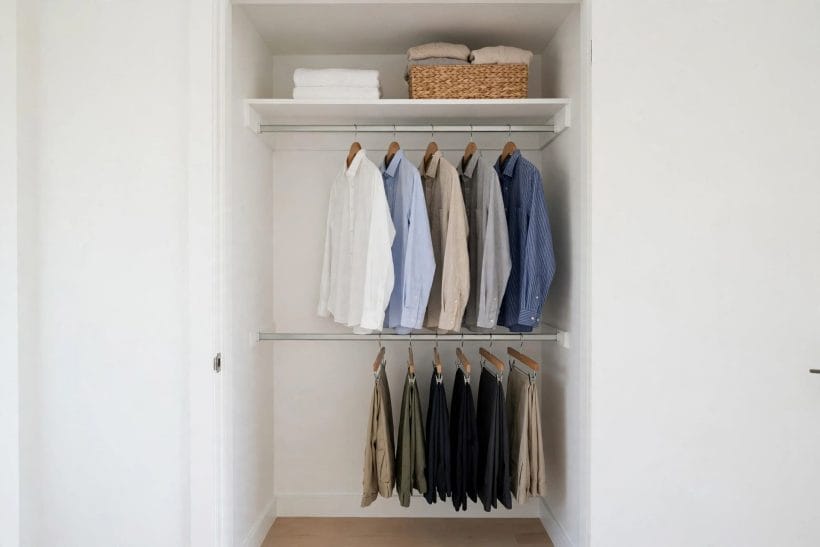
A small closet is not a failed large one; it is a different instrument, played by zoning rather than by volume. It belongs to the wider family surveyed in the closet ideas pillar, and this post stays inside the small-space lane throughout: every idea assumes a single door, a short rail and shelves that must each earn their height.
1. Measure the true interior
Measure width, depth and height inside the closet itself, including the awkward returns beside the door that eyes skip.
2. Empty it completely first
Take everything out before redesigning anything. A closet reorganised around its existing piles keeps its old failures; a closet emptied, cleaned and zoned from bare walls gets a plan based on the space, not on the habits that filled it badly.
3. Zone by frequency, not by category
Assign the reachable middle to what is worn weekly, the low zone to shoes and heavy things, the high zone to what is rare.
4. Keep one rail, honestly loaded
A single rail loaded at a density where hangers slide is worth two rails crushed solid. Clothes need air and visibility to be chosen; a rail you cannot move a hanger along is storage that has quietly stopped working.
5. Map the dead spaces
List the closet’s dead spaces explicitly: above the door, under the hanging clothes, the floor corners, the door’s back. In a small closet the dead spaces together often equal a whole extra shelf unit, waiting only to be named and fitted.
6. Decide what leaves the closet
Move the true outsiders, luggage, archives, the other season’s bulk, to storage elsewhere in the home if it exists.
7. Light it before you judge it
Fit a small light, battery or wired, before finalising any layout.
8. Plan the door’s swing into the layout
Check what the door, or the room’s furniture, does to access: a closet whose left half is blocked by an open door or a bed needs its daily zone on the reachable side.
9. Work in vertical layers
Think of the closet as stacked layers, floor, rail, shelf, top shelf, each with one job. Naming the layers turns a muddled cavity into four small, solvable problems, and small closets are won layer by layer rather than all at once.
10. Keep the plan drawable
Sketch the final layout on one page and keep it inside the door. A small closet stays organised when its owner can see the intended order at a glance; without the sketch, entropy wins a little ground every single week.
11. Leave a margin deliberately empty
Hold back a small margin of rail and shelf unfilled. A closet at total capacity cannot absorb a new purchase, a gift or a season change without disorder; a closet with a margin absorbs them as routine.
3. Rails and Hanging: Doubling the Working Length
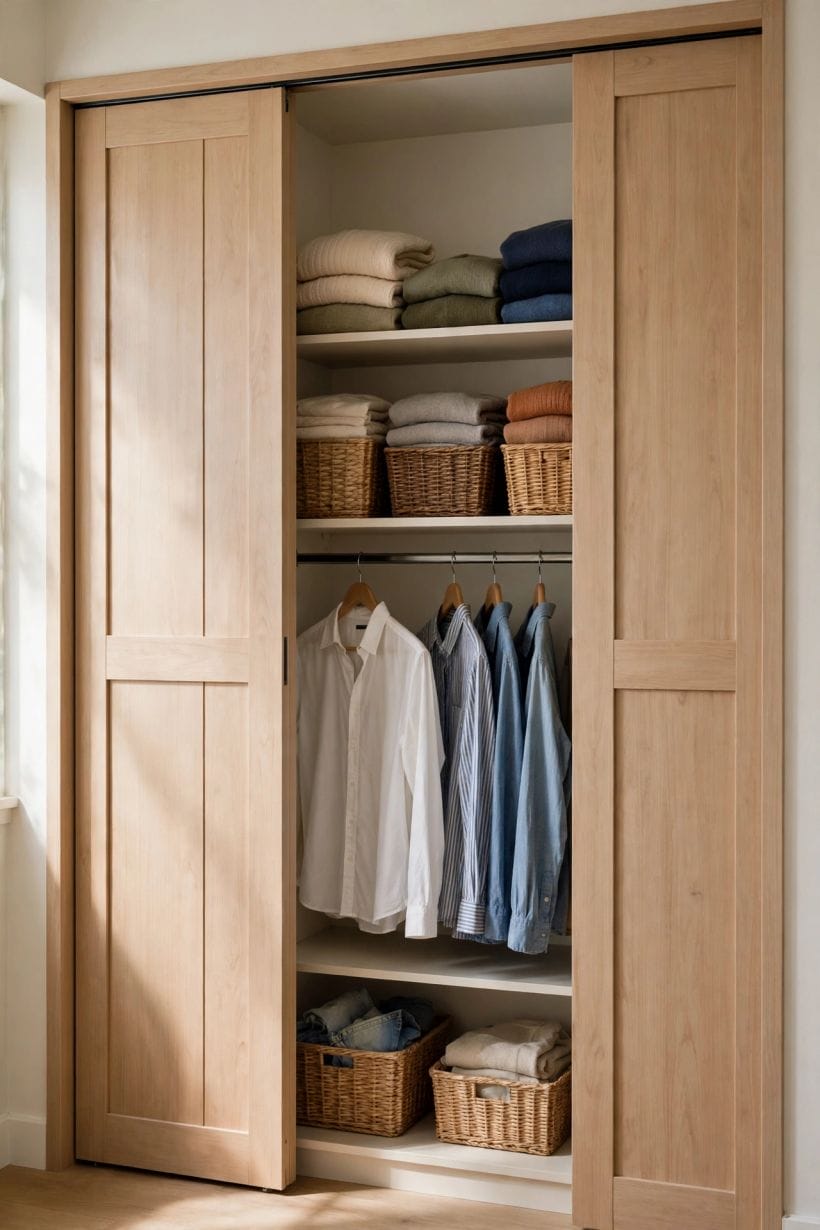
Hanging space is the small closet’s scarcest resource, and this section is about doubling its useful length without touching a wall. Its grander relative is the walk-in closet ideas post, whose layouts assume a room of their own; everything here assumes the opposite, and wins the space back by arrangement instead.
12. Double-hang the shirt zone
Fit a second rail beneath the main one across the shirts-and-trousers half of the closet. Most hanging clothes are half-height, and the classic small closet wastes the entire lower half of its rail wall on air above the shoes.
13. Hang trousers folded over hangers low
Trousers folded over a hanger take half the drop of clipped full-length hanging, so they belong on the lower rail of a double-hung section. Grouping all the half-height clothes together is what makes the double rail possible at all.
14. Reserve one full-length slot only
Keep a single narrow full-length section for coats and dresses, sized to the true count of long garments.
15. Slim hangers, all matching
Replace mixed bulky hangers with one slim profile throughout. Slim hangers return visible rail length in a small closet, and matching hangers slide, align and read as order, which quietly encourages the owner to keep them that way.
16. Grade clothes by colour within type
Arrange each garment type in a light-to-dark run. Grading is not decoration: it makes a specific shirt findable in seconds, exposes duplicates honestly, and turns choosing into scanning rather than excavation.
17. Cascading hangers for vertical sets
Use cascading or tiered hangers for matched sets and light blouses where rail length is desperate.
18. The tension-rod second rail
Where fittings must stay reversible, a spring tension rod makes a serviceable second rail for light clothes. It suits rented homes and growing children alike, and it proves the double-hang layout before anything permanent is drilled.
19. Hooks on the side walls for the odd shapes
Belts, scarves, ties and bags hang better on hooks along the closet’s side returns than on the rail. The returns are too shallow for hangers and perfect for hooks, and clearing these wanderers off the rail returns it to clothes alone.
20. Keep the rail’s ends for the rare
The far ends of a rail are its least reachable ground, so the formal, seasonal and seldom-worn belong there. Daily clothes at the centre, ceremony at the edges: a rail arranged by reach is a rail that stays arranged.
21. One in, one out on the rail
Adopt the rule that a new hanging garment retires an old one. Small closets cannot grow, so their contents must rotate; the rule keeps the rail at working density forever instead of until the next sale season.
22. Raise the rail, gain a shelf
If the closet is rebuilt, set the main rail high and put the gained height below into drawers or shoe shelves.
4. Shelves, Drawers and Boxes: The Folded Half
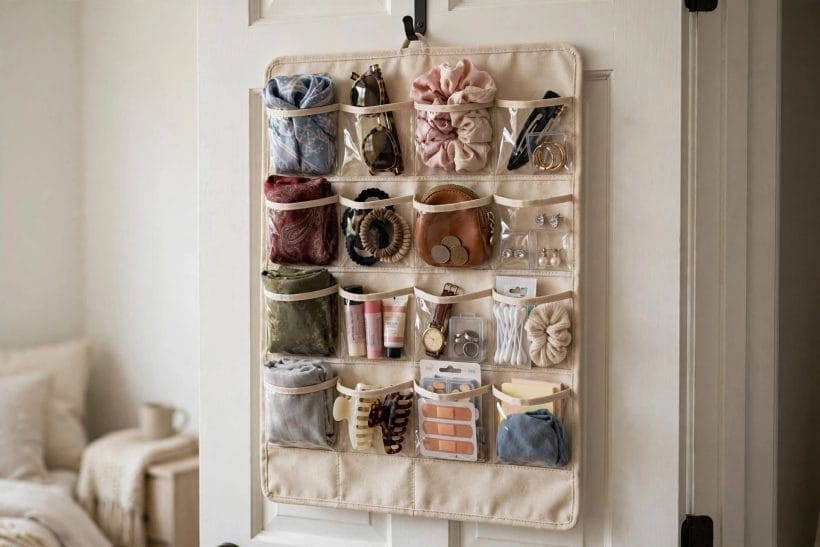
Much of a wardrobe is not hung at all, and the folded half is where small closets either become systems or become piles. The discipline is borrowed from the tiny house organization strategies post: shallow, visible, one row deep, applied here to knitwear, linen and everything that folds.
23. File-fold into shallow drawers
Fold knitwear and tees file-style, upright in shallow drawers or boxes, so every piece shows its edge. Flat piles hide their bottom two-thirds and collapse when raided; filed clothes are all visible, all reachable, and stay folded because nothing is excavated.
24. One row deep, always
Shelves and boxes in a small closet should hold a single row of folded clothes or containers.
25. Clear or labelled, never anonymous
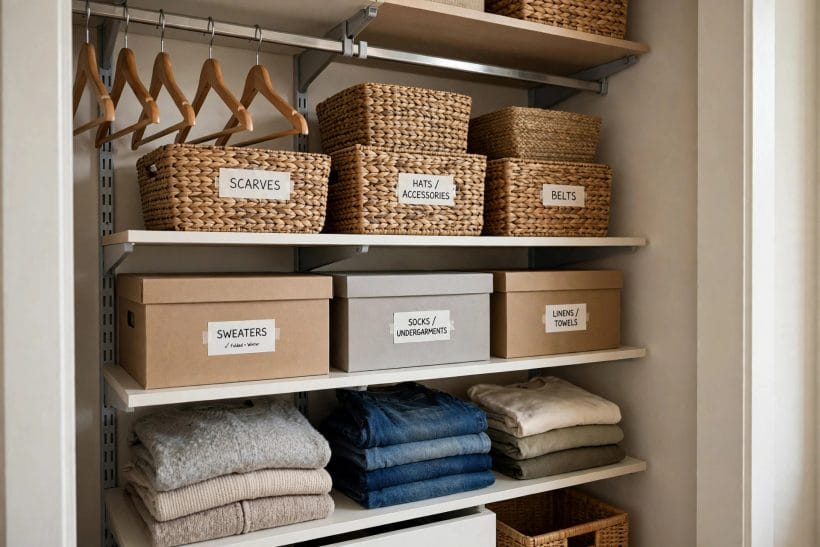
Use clear-front drawers and boxes, or label every opaque one on its face. Anonymous boxes in a small closet are opened rarely and trusted never; a labelled box is a promise the system can keep at speed.
26. Dividers inside drawers
Fit simple dividers in the drawers for underwear, socks and small garments. Undifferentiated drawers become soup within a week; divided drawers keep their categories visible, countable and quick to restore after laundry.
27. Stack boxes to the shelf, not past it
Size stacked boxes to fill their shelf’s height exactly, neither rattling loose nor wedging. A stack that fills its layer reads as furniture; a stack that stops short invites a miscellaneous pile on top, which is where order goes to die.
28. Shelf risers for the tall shelf
Where a shelf’s height is wasted, a small riser splits it into two working levels for folded stacks or boxes. Tall single shelves are the folded wardrobe’s version of the single high rail: impressive volume, mostly air.
29. Baskets for the soft and shapeless
Give scarves, gym clothes, hats and other shapeless things open baskets they can be tossed into. Some categories will never be folded by mortals; a basket makes their honest storage look intentional instead of defeated.
30. Keep linen with its room’s logic
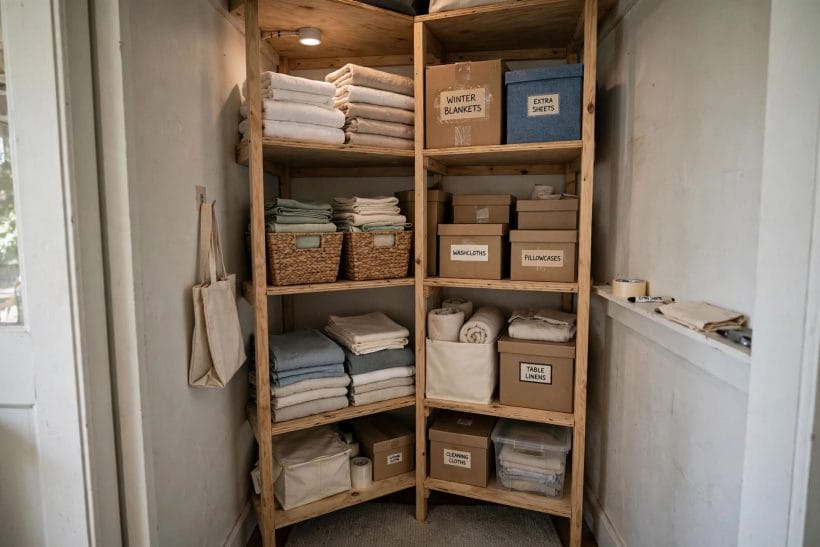
Store spare bedding as complete sets folded inside one of their own pillowcases, on the closet’s high shelf. Sets stored whole are grabbed whole; separates stored by type guarantee a midnight hunt through three shelves for one matching sheet.
31. A laundry-return shelf
Reserve one small shelf or basket landing zone for clean clothes awaiting rail or drawer space. Laundry fails at the return journey; a designated landing keeps clean clothes from living on the bed while the closet pretends not to notice.
32. Rotate the season into the top layer
The out-of-season wardrobe goes to the top shelf and the under-bed boxes in labelled sets, swapped twice a year. Rotation keeps the working layers at working density and turns the season change into a scheduled hour instead of a permanent overflow.
33. Count before buying storage
Count the actual folded categories and their volumes before purchasing any drawer or box. Storage bought by guess mismatches its contents within a month; storage bought by count fits like it was made, because in effect it was.
5. Shoes, Doors and the Forgotten Surfaces
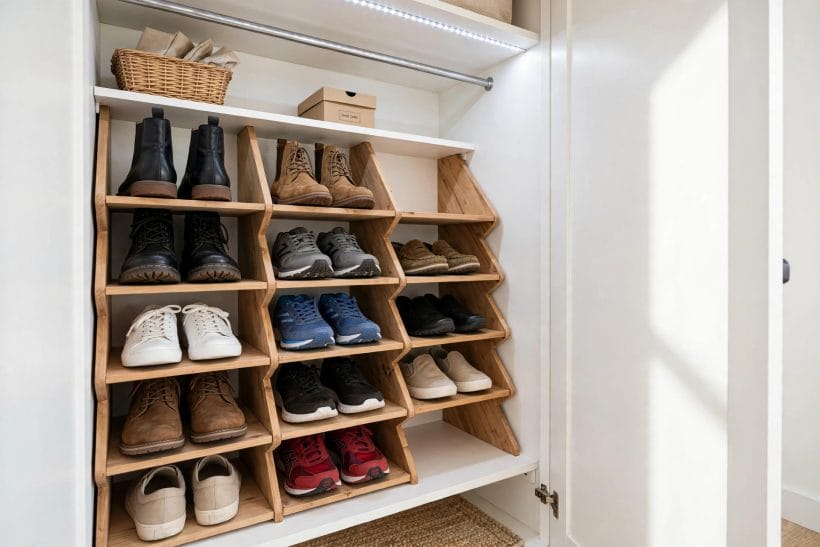
The surfaces nobody plans, the door, the floor, the narrow returns, carry a small closet’s margin of victory. Entry storage works the same trick at the house’s door, as the mudroom ideas post shows; this section applies it inside the closet, where every forgotten surface is unclaimed capacity.
34. The door’s back is a whole wall
Fit the door’s back with hooks, a pocket organiser or a slim rack for shoes, belts and bags.
35. Shoe shelves angled or tiered
Store shoes on a tiered or angled rack at the closet floor so every pair shows its toes.
36. One pair out, the rest in
Keep only the week’s working shoes in the closet’s prime floor space, with the remainder boxed and labelled above. Shoes multiply quietly and eat floor faster than any other category; a working set plus an archive keeps both honest.
37. Boots upright with inserts
Store boots standing with simple inserts or rolled magazines holding their shape, along the closet’s deepest return. Boots flopped flat consume triple their upright footprint and crease where they fold; upright boots behave like the tall shoes they are.
38. Over-door hooks for tomorrow’s outfit
A hook or two on the door’s room side holds tomorrow’s chosen clothes and the day’s returned jacket. Giving the in-between garments a sanctioned place keeps them off the chair, the bed and the closet floor in one small move.
39. Bags nested and visible
Store handbags and totes nested inside each other, standing on a shelf with their shapes supported. Bags stored flat in piles are bags never found; bags standing in a visible row get rotated, used and justified.
40. Use the floor corners deliberately
The floor corners beside the shoe rack suit a laundry basket, a shoe-care box or the steamer’s home. Corners left unplanned collect the miscellaneous drift of the whole room; corners assigned a tenant stay swept and useful.
41. A mirror on the door’s face
A mirror on the closet door’s room side removes the need for a separate one and speeds every morning decision.
42. Hooks at child height where children dress
In a family small closet, set one run of hooks at the child’s own reach for their daily clothes. Children hang what they can reach and drop what they cannot; the hook’s height, not the child’s character, decides which.
43. Keep the door itself unblocked
Whatever is fitted to the door, check it swings and closes fully without striking the rail or shelves. A door organiser that prevents closing has traded the closet’s tidiness for the room’s, which is no bargain at all.
44. Scent and air in a closed box
A small closet is a closed box of cloth, so give it air: a vented door gap, a cedar block or a lavender sachet renewed seasonally.
6. The Awkward Pieces: Long, Bulky and Strange-Shaped
Every wardrobe holds pieces the standard zones do not fit: the long coat, the ball gown, the ski jacket, the hat collection. A small closet survives them by giving each awkward class a named exception rather than letting exceptions colonise the working zones.
45. One long slot, strictly guarded
The full-length slot holds only what truly needs it, audited at every season swap. Long garments accumulate squatters, mid-length pieces that would hang happily on the lower rail, and guarding the slot is a permanent small duty.
46. Coats by weight on the strongest rail end
Hang the heaviest coats at the rail’s supported end, nearest its bracket or wall. Rails sag from their weakest point, and a small closet’s single rail carries the household’s heaviest garments as well as its lightest shirts.
47. Bulky knitwear folded, never hung
Heavy jumpers and knits go to the folded layers, where their weight rests instead of dragging on hangers. Hung knitwear stretches into hanger-shouldered ghosts; folded knitwear keeps its shape and its shelf footprint is honest.
48. Hats on hooks or a high shelf row
Hats need air around their crowns, so they live on individual hooks or standing in a row on the top shelf.
49. The occasion pieces, archived visibly
Formal and occasion clothes live in breathable covers at the rail’s far end or the top layer, labelled with what they are.
50. Sports kit in its own vented bag
Bulky sports and outdoor kit belongs in a vented bag or basket at the closet floor or on its own hook run, aired between uses.
51. Costume and uniform, kept together
Work uniforms, school uniforms and performance costumes stay grouped as complete sets in one zone. Sets scattered through a wardrobe assemble slowly under pressure; sets kept together are grabbed whole on the mornings that allow no searching.
52. The ironing and steaming answer
Decide where creased clothes are revived: a steamer stored at the closet floor, or a hook by the door for the morning’s garment.
53. Gloves, scarves and the small cold things
Cold-weather smalls live in one shallow drawer or a door pocket set, paired and visible. These are the most-rebought items in most wardrobes precisely because they store anonymously; a named shallow home ends the annual duplicate purchases.
54. What truly cannot fit, honestly exiled
A piece that cannot be stored without wrecking the system, the festival tent of a dress, the archive of a hobby, is stored elsewhere in the home without guilt.
55. Review the exceptions yearly
Once a year, audit the awkward pieces: worn, kept for a reason, or kept from habit. Exceptions are where wardrobes quietly bloat, and an annual honest hour at the closet’s edges protects everything the zones have won.
7. Shared Closets and Family Compromises
Many small closets serve two people, or one person and a family’s overflow, and sharing a small space is a negotiation built into shelves. The room-sharing version of this problem is worked in the small bedroom ideas post; here the sharing happens inside a single door, at hanger distance.
56. Divide by zone, not by garment
Partners sharing a small closet do better with a clean territorial split, a side or a layer each, than with merged categories. Merged rails mean two people’s mornings excavating the same hangers; territories mean each owner keeps their own order undisturbed.
57. The prime middle belongs to the earlier riser
Where one partner dresses earlier or in the dark, their zone takes the reachable, lit middle. Small courtesies of placement, decided once, prevent a thousand small morning frictions that couples otherwise blame on each other.
58. Double the small systems
Hooks, donation bag, laundry landing: in a shared closet each system needs a version per person, or the tidier partner becomes the system’s unpaid staff. Duplicated small systems are cheap; resentment is the expensive option.
59. Children’s reach in a family closet
Where a child’s clothes share the family closet, their zone sits at their height with their hooks, as argued in the door section.
60. Guests get a hook, not a zone
A shared small closet cannot hold a guest wardrobe, so guests are answered with a door hook and a drawer emptied by rota. Planning the guest answer in advance keeps hospitality from detonating the system twice a year.
61. Overflow treaties with the rest of the house
Agree explicitly what may overflow into the closet from the household, and what may not, with the linen and archives assigned their own homes. Unwritten treaties are broken by whoever is tidying fastest; written ones survive even December.
62. Two donation streams
Each owner keeps their own retiring bag, judged by their own hand. Shared donation decisions stall on diplomacy; separate streams keep the closet’s total falling at the speed of its faster editor, which is fast enough.
63. The shared top shelf, labelled by owner
The high layer, where both owners’ rare things live, works only when every box carries its owner’s name. At height, in dim light, unlabelled boxes are opened by hope; labelled ones are retrieved by knowledge.
64. A reset rota, fairly drawn
The weekly five-minute reset in a shared closet belongs to a rota, not to whoever cares most. Systems maintained by one partner and used by two collapse when the maintainer travels; a rota makes the closet nobody’s grievance.
65. Keep the door sketch bilingual
The layout sketch inside the door should mark both owners’ zones in their own terms. A plan both users recognise is a plan both users restore, and restoration by either hand is what a shared system is for.
8. Keeping It: Habits That Hold the System
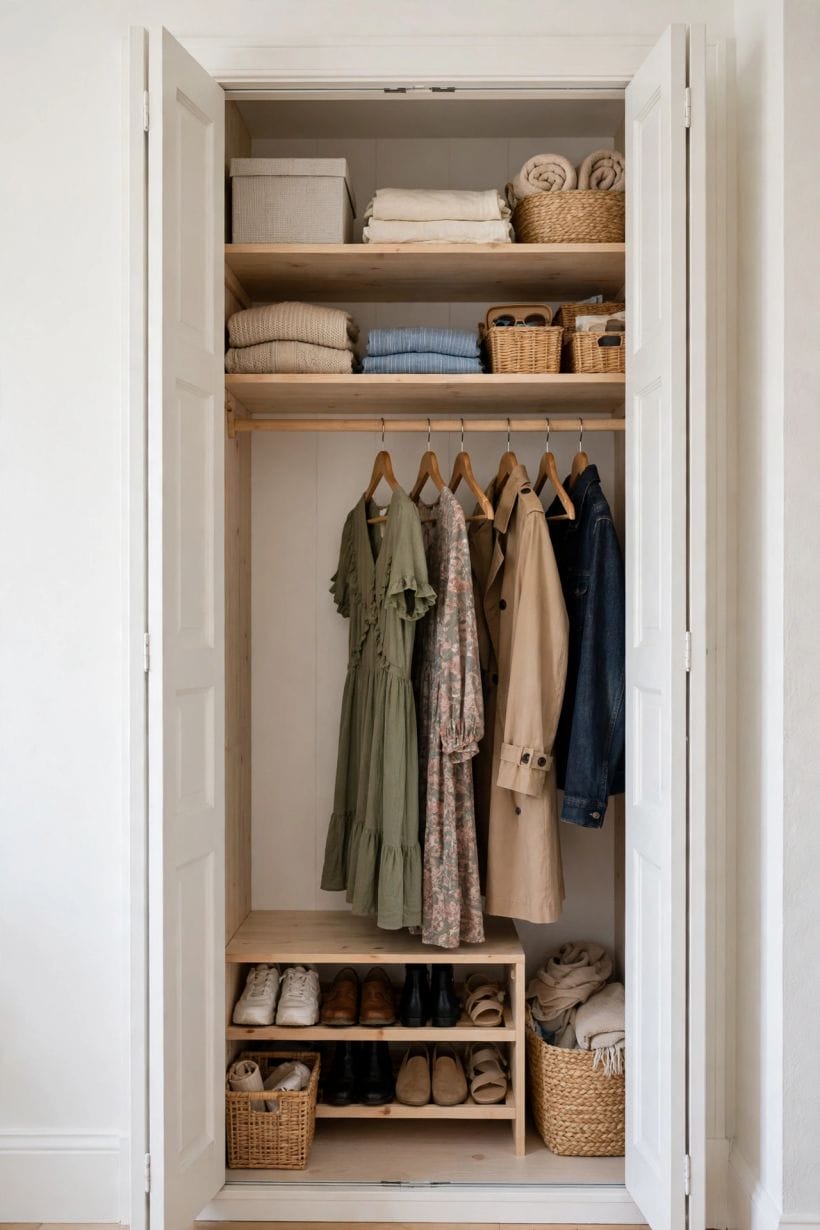
A small closet is a habit wearing furniture. The laundry end of the clothing cycle is planned in the laundry room ideas post; this closing section covers the closet’s own habits, the small weekly behaviours that keep a tight system tight instead of slowly silting up.
66. The five-minute weekly reset
Once a week, spend five minutes returning strays, straightening the rail’s grading and rescuing the floor.
67. Laundry returns the same day
Put clean laundry away on the day it is folded, into its zones, not onto the closet’s threshold. The landing shelf helps, but the habit rules: laundry parked becomes laundry lived-around, and the system’s edges blur from exactly that spot.
68. Shop against the sketch
Buy clothes against the closet’s plan, checking which zone has room before purchasing. A small closet turns shopping into a capacity question, and owners who ask it before the till keep wardrobes that fit their storage instead of mocking it.
69. The hanger test for new clothes
A new garment earns rail space by displacing a weaker one, judged honestly at the rail. The test keeps quality rising and quantity capped, and it converts the closet’s limit from a frustration into an editor.
70. Store the pantry way, visible and rotated
The small closet’s shelving discipline has a kitchen cousin in the walk-in pantry post: one row deep, labelled, oldest forward. Clothes rotated and visible get worn; clothes buried get forgotten and bought twice.
71. Season swaps on the calendar
Fix the two season swaps as calendar events with an hour allowed, boxes labelled for their return. Swaps that are scheduled happen in daylight with music on; swaps that are not happen in a crisis, badly, in front of guests arriving.
72. A donation bag always resident
Keep a bag or box in the closet permanently for the retiring stream, emptied whenever it fills. Giving discards a resident home removes the decision friction that keeps unworn clothes occupying prime rail for years.
73. Repair quickly or release
Mend, re-button and clean promptly, or let the garment go. The repair pile is a small closet’s silent tax, squatting in prime space for months; a strict fortnight rule keeps it from ever forming.
74. Teach the system to its users
Everyone who dresses from the closet learns its zones from the sketch on the door. Systems kept by one person and raided by others fail; systems understood by all their users survive contact with family life.
75. Photograph the good state
Keep one photograph of the closet in its intended order on the door beside the sketch. On the tired evening when restoration feels impossible, the photograph is the plan, the standard and the proof it can be done in minutes.
9. Checks and Mistakes: Before the First Purchase or the First Stone
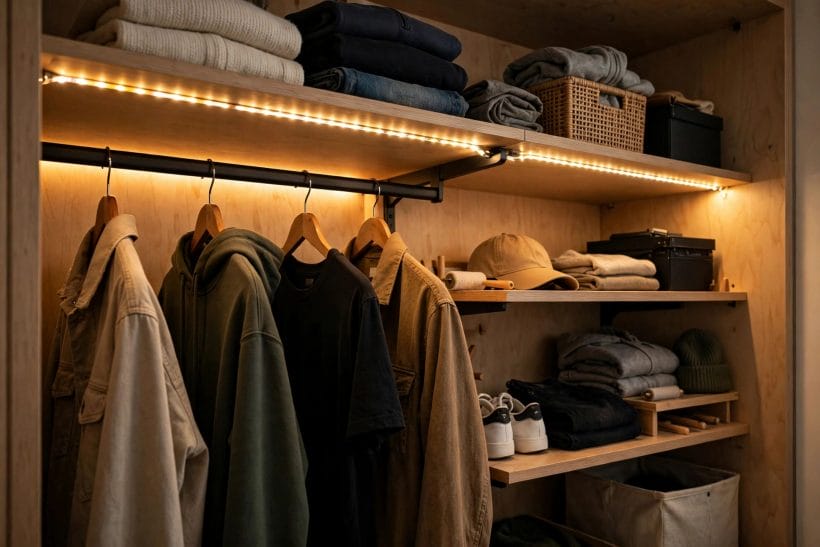
Measure twice before drilling anything, and check for pipes and wires in closet walls before rails and shelves are fixed. Check also that added drawers and racks leave the door swinging and closing freely, and that nothing fitted inside blocks the light or the owner’s reach to the rail’s far ends.
The commonest small-closet mistake is buying organisers before counting possessions: the boxes arrive in the wrong sizes and the system is compromised from its first day. The second is storing the household’s archives in a working wardrobe. Count first, evict the outsiders, zone by frequency, and only then buy a single box.
Test any new layout for one full week of real mornings before making it permanent. A system that survives Monday’s rush, laundry day and a formal evening in the same week is a system; one that only works on the quiet Sunday it was built is a photograph.
10. Costs and Pulling It Together
Costs in a small closet are mercifully modest and follow the fittings: slim hangers and hooks first, then drawers or boxes, then any built work. Money is well spent on the door’s equipment and the light, the two upgrades that change daily use, and wasted on elaborate organisers for possessions that should have left the closet entirely. The cheapest capacity in the whole project is eviction: the season’s bulk and the household archive stored elsewhere.
Pull the closet together in the order of its layers: measure and zone, double the rail, file the folded half, equip the door, floor and returns, then set the habits. A small closet finished in that order stops being the room’s apology and becomes what it should have been all along: the hardest-working square metre in the home.
Final Considerations
A small closet rewards exactly the virtues a small house does: honesty about what is owned, a place for everything that remains, and systems sized to real life rather than to wishes. Build it by frequency, keep it one row deep, and it will serve a full wardrobe from a cavity its owner once apologised for.
Start with the empty closet and the sketch, double the rail where the short clothes hang, and give the door its working back. The inches were always there; they were only waiting to be assigned.



0 Comments