

The best seat in the house might be a single wall: two shelves, a counter, a fridge below — and everything a good drink needs within one unhurried arm’s reach.
These are mini bar ideas kept honestly small: one wall, one corner or one cupboard, planned, stocked and kept at a footprint any house can spare.
1. Small Home Bar Ideas at a Glance
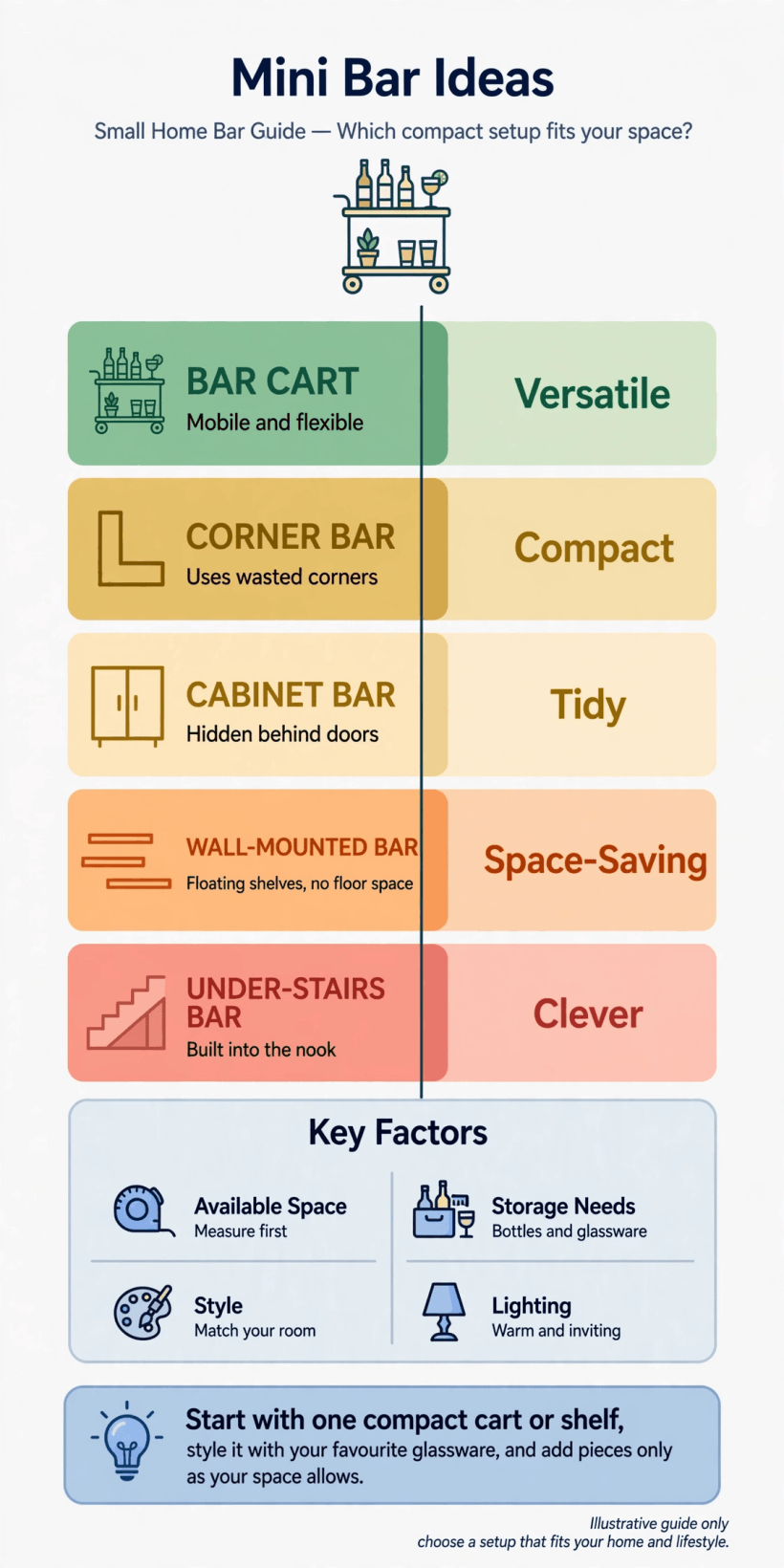
The small home bar is a drinks station fitted into one wall run, one corner, one cupboard or one cart: a counter at working height, shelving one row deep above it, cold storage and the unglamorous trio — towel, bin, water — beneath or beside. Its attributes are the host’s triangle (bottles, tools, ice within a step), the guest’s side (two stools, a standing ledge, a satellite table), honest services (dry by default, wet only at volume) and a closing ritual that returns the room to itself. It is the small-space member of the home-bar family — the mini bar ideas end of it; the pillar post covers the family’s full range.
| Question | Short answer |
|---|---|
| How much space does it need? | One wall run, one corner, one tall cupboard — or a single rolling cart. |
| Wet bar or dry bar? | Dry for most homes: a jug, a bowl and a near kitchen cover real needs. |
| What matters most? | The host’s triangle: bottles, tools and ice reachable without a step. |
| How many bottles? | A working set for the drinks you actually make — edited like a library. |
2. The Small Bar Itself: One Wall, One Corner, One Welcome
The small bar is a single gesture, not a shrunken pub: one wall, one corner or one tall cupboard fitted to pour, mix and serve without moving a step. It is the small-space child of the home bar ideas pillar, which covers bars of every size; its closest relative is the single wall home bar, and this post stays strictly inside the small footprint they share.
1. Measure the gesture, not the room
A small bar needs a counter’s length of wall, the depth of a bottle, and standing room for one host.
2. One wall is the classic canvas
A single unbroken wall run — shelves above, counter below, fridge beneath — is the small bar’s founding plan.
3. The corner bar doubles a dead angle
Corners are where rooms keep nothing. A corner counter with shelving climbing both returns turns the house’s most wasted angle into its most social one, at the price of a little joinery care where the two walls meet.
4. The cupboard bar closes its doors
A tall cupboard, armoire or built-in cabinet fitted inside as a bar is the small footprint’s diplomat: open, it serves; closed, the room is a study again.
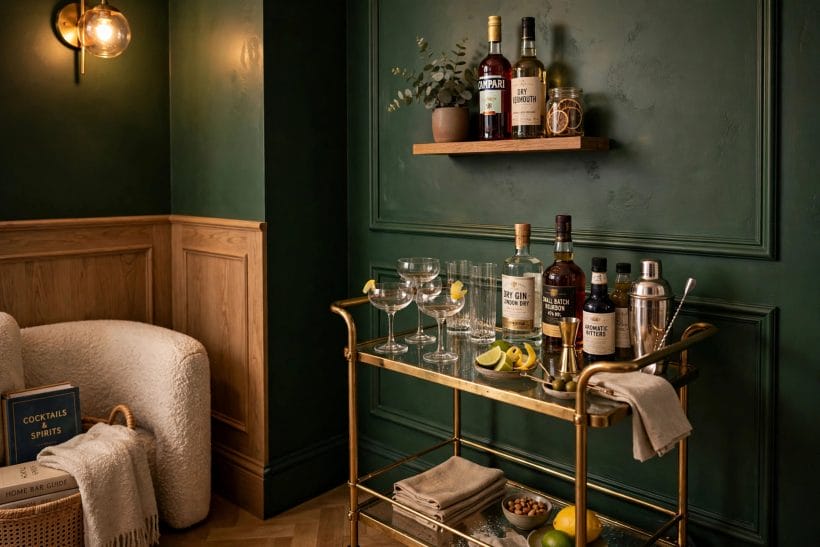
5. A bar cart is the smallest bar of all
One good cart — bottles below, tools and glasses above, wheels that actually roll — is a complete small bar that follows the party from kitchen to terrace.
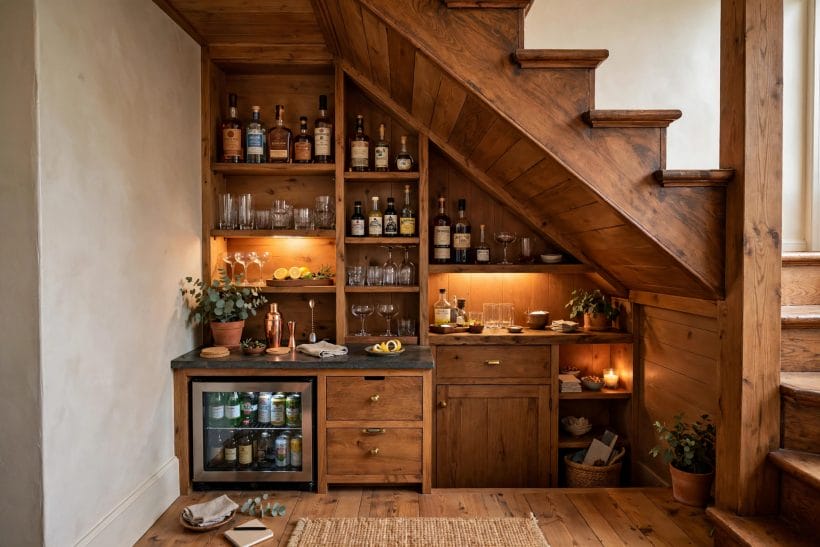
6. Under the stairs, behind the slope
The understair triangle, too low to stand in and too present to waste, fits bottles, a fridge drawer and shelving beautifully. A small bar there turns the house’s most awkward volume into its most discovered one.
7. Between two rooms, a serving hatch of shelves
A shelved divider or a wide doorway fitted one side as a bar serves two rooms from one footprint. The host works in the quieter room; the guests gather in the livelier; the bottles live between them.
8. The window bay bar
A deep window bay, with a low counter under the sill and stools in the light, makes the sunniest seat in the house into its bar. Daylight on glassware is decoration no evening lighting can match.
9. Keep the host’s triangle tiny
Bottles, tools, ice: the host should reach all three without a step. A small bar fails when its owner crosses the room mid-pour; lay the three points out on the counter’s length before fixing a single shelf.
10. Decide the bar’s closed face
Shelves open, doors closed, curtain drawn or cart parked — every small bar needs its resting appearance decided in advance.
11. Let one material lead
Timber, black metal, stone, painted joinery: choose the small bar’s single leading material and let everything else quieten. In a tiny footprint, one voice reads as design; three read as clutter.
3. The Counter and What Stands On It
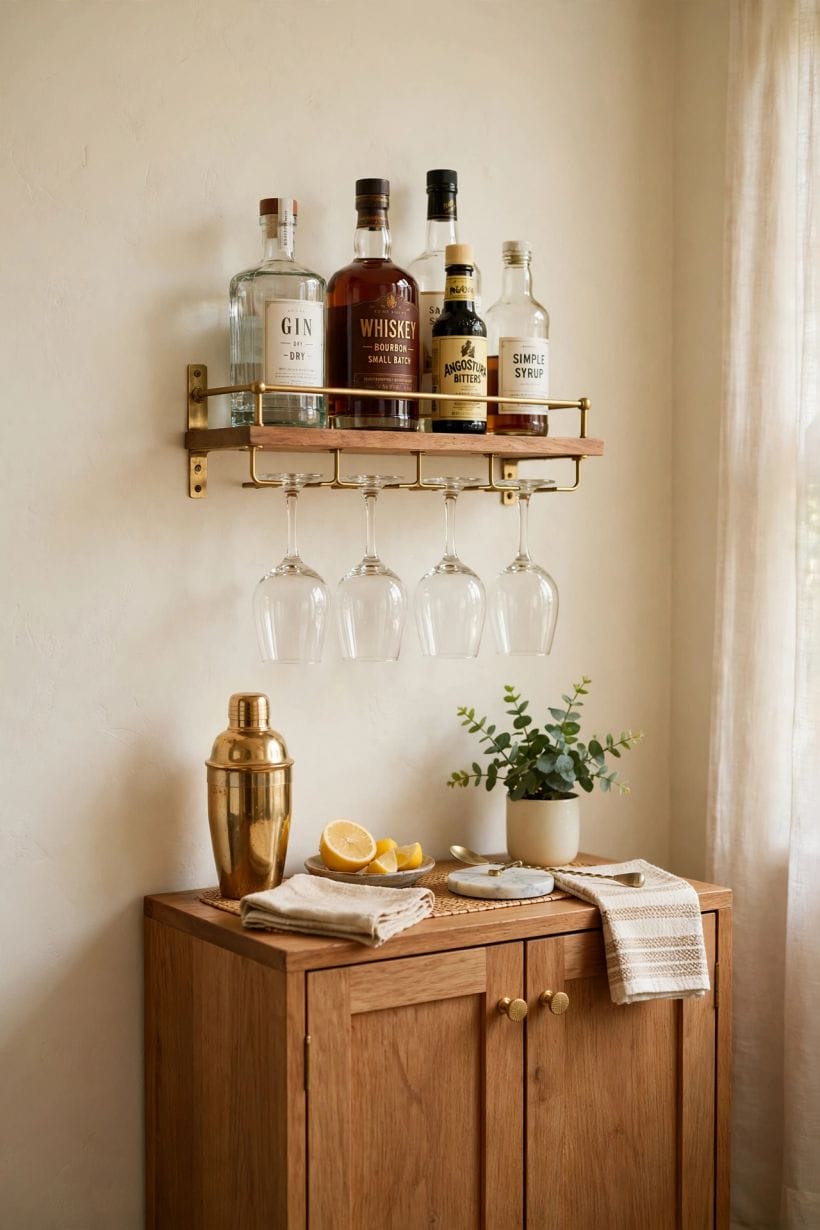
The counter is the small bar’s whole stage, and its surface choice is the decision examined in home bar countertops — here the counter is planned at small scale: a worktop deep enough for a shaker and a board, standing over storage, with everything on it earning its place daily.
12. Depth for a shaker, not a kitchen
A bar counter needs to hold a mixing glass, a board and a resting bottle — a worktop far shallower than a kitchen’s.
13. Standing height decides the stools
Set the counter at the height its use dictates — standing bar height for perch-and-chat, lower for seated drinks — and buy stools after, to match.
14. A timber top forgives glass
Wood takes the ring, the knock and the spill with the least drama and the easiest repair, and it warms a wall of bottles. Oiled and maintained, it is the small bar’s classic surface for good reasons.
15. Stone and steel at the wet end
Where ice and water live, a stone or steel insert takes the wet work and wipes clean in a second.
16. Leave a landing strip empty
A stretch of counter kept deliberately empty — for the tray, the arriving bottles, the guest’s glass — is the hardest-working space on the bar. A counter fully decorated is a shelf wearing a costume.
17. The rail and the lip
A small brass or timber rail at the counter’s edge keeps bottles from migrating and glasses from skating. It is a ship’s detail, and small bars, like ships, are arranged by people who respect movement.
18. Under-counter is the bar’s cellar
Fridge drawer, bottle store, bin and towel all live beneath the counter in the well-planned small bar. What cannot fit beneath does not belong to the bar — it belongs to the kitchen, and should visit only when needed.
19. One board, one knife, one cloth
The working kit on the counter is three things: a small board, a fruit knife, a clean cloth. Everything else is either in the host’s hand during service or stored — counters cluttered with tools pour slowly.
20. Light the counter from above the shelves
A strip or small pendants above the worktop put light where mixing happens and leave the room’s mood intact. The bar that glows from its own shelves needs no other decoration at night.
21. The back bar is a mirror or a material, never both busy
Behind the bottles, either a mirror that doubles the glassware’s sparkle or a calm material that lets the bottles be the colour. A busy backdrop behind busy bottles is the small bar’s commonest visual failure.
22. Keep the counter’s front plain
The face guests see — panels, boards or a simple painted front — should be the bar’s quietest surface. The theatre is on top; the front is the curtain, and curtains are plain for a reason.
4. Storage in Inches: Shelves, Cubbies and Hidden Depth
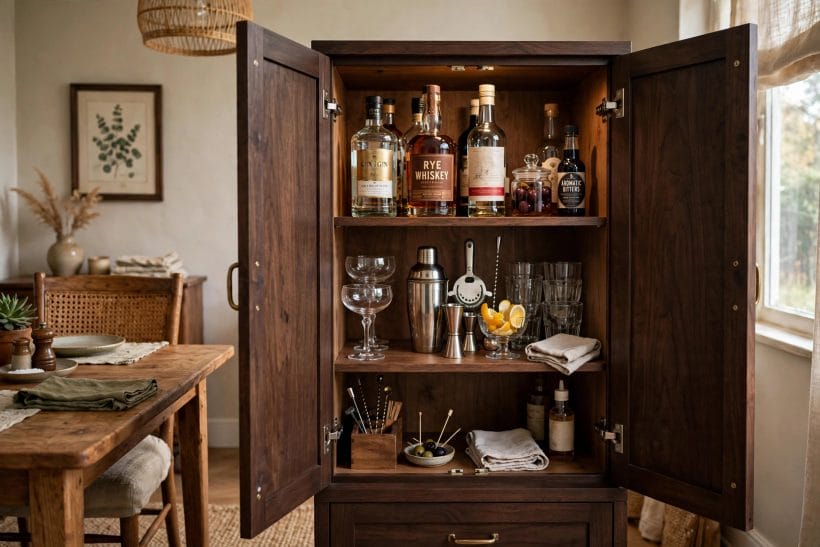
A big bar stores by the case; a small bar stores by the bottle, the glass and the inch. The discipline is the same one that governs every small system in a small house: frequency decides position, and nothing is kept that is not poured, used or loved.
23. Shelves at bottle height, glasses above
Set shelf spacing from the actual bottles and glasses it will hold, tallest on the lowest shelf. Wasted vertical air is the small bar’s silent tax — measure the tallest resident before fixing a single bracket.
24. One row deep, always
Small-bar storage is a single row: what stands behind another bottle does not exist. One row deep keeps the inventory honest, the dusting possible and the choice at pouring speed to exactly what the eye can take in.
25. The working set versus the collection
A handful of bottles does the week’s pouring; the rest is a collection and should be stored as one — elsewhere, darker, calmer. The small bar’s shelves hold the working set; pride of place is earned by use.
26. Glasses where the hand expects them
Everyday glasses on the shelf the host’s hand reaches first, the special glasses higher and fewer. Glass storage doubles as the bar’s sparkle — keep it washed, uncrowded, and out of the splash zone.
27. Cubbies for the awkward citizens
Vermouths, bitters, syrups and the odd liqueur live in a cubby grid or a shallow tray, upright and labelled by their own bottles. Small things stored loosely become the bar’s junk drawer within a month.
28. A drawer for tools, lined and divided
Jigger, strainer, spoon, opener, pourers: one shallow drawer, divided, everything visible at a glance. Tools stored in a heap are tools lost mid-service; the drawer is the small bar’s toolbox.
29. Ice lives closest to the counter
The freezer drawer, the ice box or the bucket’s parking place must sit within the host’s triangle. Ice fetched from another room breaks the small bar’s spell every single round.
30. Towels, bin and water within reach
The unglamorous trio decides whether a small bar stays pleasant: a towel on a hook, a small bin beneath, water for rinsing and diluting at hand. Bars that skip them become sticky, then dusty, then furniture.
31. The overflow lives in one honest box
Party surplus — extra glasses, the second ice supply, the borrowed bottles — keeps one box in one cupboard, not a diaspora across the house. When the box empties, the bar is back to itself.
32. Label shelves only by living there
Live with the arrangement a month before fixing labels, dividers or final positions. Small systems reveal their true traffic slowly, and the shelf that looked right in the plan is often one hand’s width wrong.
33. Edit the bottles like a library
Finished, duplicated and never-poured bottles leave. A small bar’s shelves are its face, and a face crowded with the unchosen reads as storage. Keep the poured, the loved and the beautiful — in that order.
5. Seating, Standing and the Guest’s Side
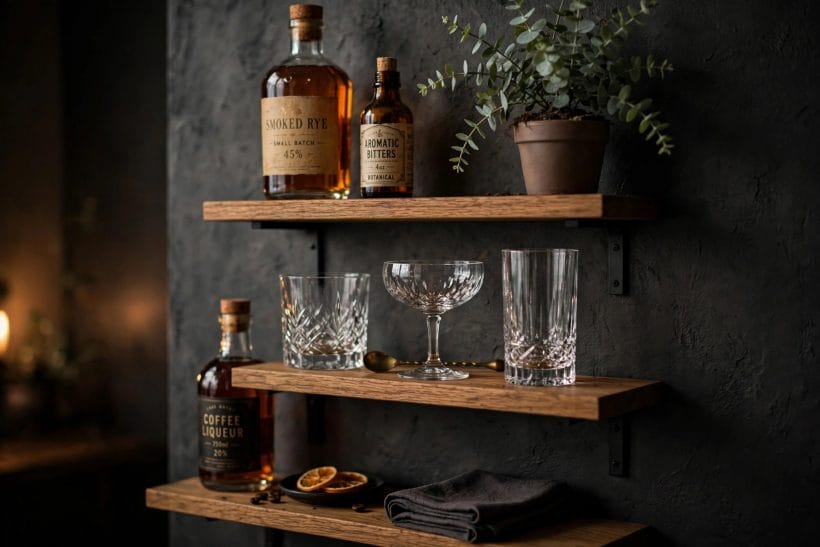
A small bar is a social machine, and its other half is the guest’s: where they stand, perch and put a glass down. In open rooms the bar usually borrows the family’s everyday territory, which is why it plans so naturally beside the family room ideas in this cluster — the bar serves the room; the room gives it an audience.
34. Two stools are a bar; four are a crowd
A small bar seats two at the counter and stands the rest — and that ratio is its charm. More stools than counter length turns hospitality into a queue; plan perching for two, standing for the room.
35. Stools that tuck completely away
Backless stools that slide fully beneath the counter return the floor when the bar closes. In small rooms the bar’s daytime footprint is its stools’ parking, so choose stools the counter can swallow.
36. A ledge for the standing guest
A narrow shelf or rail-height ledge on the guest side gives standers a glass-rest and the gathering a shape. People lean where a ledge invites them; place the invitation where you want the party to pool.
37. Leave the host’s working corridor clear
Behind the counter is a workplace: a body’s depth of clear floor, no stool backs, no plant stands, no dog bed. Guests drift; the plan must not. Mark the corridor in the arrangement and defend it cheerfully.
38. Face the room, never the wall
The host pours facing the guests, the room and the light — never into a corner with an audience at their back.
39. One low table completes the circuit
A small side table near the standing group catches the overflow glasses, the water jug and the bowl of something salted. Bars without a satellite table grow rings on every surface in the room.
40. Chairs pulled up beat chairs built in
Flexible seating — two good chairs that wander in for long evenings — out-serves any fixed banquette at small scale. The small bar’s gatherings change size weekly; its furniture should change as easily.
41. Keep a path to the kitchen open
Ice, water, glasses and the inevitable spill all travel the kitchen path. Arrange the bar so that path never crosses the guests’ cluster — the host slips behind the party, not through it.
42. Sound: soft surfaces near the bar
Glass, bottles and voices are bright sounds; a rug under the stools, curtains at the window and upholstery nearby keep a small bar’s noise convivial rather than clattery. Plan the acoustics with the shelves.
43. The guest’s eye level is the shelf line
Standing guests read the bar at shelf height: that is where the best bottles, the plant and the picture belong. The counter’s clutter is the host’s view; the shelves are the guests’ — dress accordingly.
44. End the evening by closing the bar
Doors shut, cart parked, counter cleared, stools tucked: a closing ritual returns the room to itself. Small bars that never close sprawl; the ritual is ten minutes that buys the room’s whole next day.
6. Water, Ice and Power in a Small Footprint
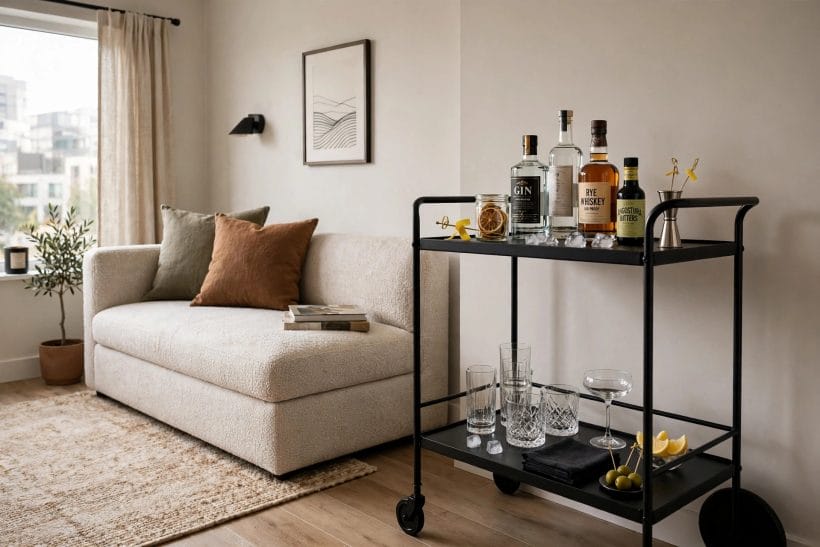
Services make or unmake the small bar. A dry bar — no plumbed water — is the honest default at this scale; a wet bar is a plumbing project, and both are planned properly here, with all pipe and cable work stated as what it is: a job for qualified professionals under local rules.
45. The dry bar is a complete bar
No sink, no drain, no apology: most of the world’s great small bars are dry. A water jug, a waste bowl for ice melt, and a kitchen within walking distance cover every real need at this footprint.
46. A small sink earns its plumbing only at volume
Hosts who entertain weekly at numbers may justify a prep sink; everyone else is buying a second washing-up station. Decide by rounds served, not by the showroom’s photograph of a sink full of ice.
47. Ice three ways, honestly compared
The bucket (flexible, melts, sociable), the countertop maker (convenient, a machine to house), and the freezer drawer (seamless, the costliest). The small bar’s right answer is the one whose weekly reality matches its owner’s patience.
48. Fridge drawer versus the kitchen run
A small under-counter fridge keeps mixers, wine and garnish inside the triangle — worth it when the kitchen is far or the entertaining frequent. Near a kitchen, it duplicates a machine the house already owns.
49. Power points at the back of the counter
Blenders, a kettle for toddies, the maker’s socket: power belongs at the counter’s back edge, planned before joinery, installed by an electrician. Trailing leads across a wet counter are how small bars earn bad stories.
50. Lighting is a service too
The bar’s light — shelf strips, a pendant, a lamp — wants its own switch by the host’s hand, not across the room. Wiring it with the counter’s power, professionally, is one job done once.
51. Drainage is a floor question
Even dry bars spill. A floor that forgives water at the bar’s strip — timber sealed, stone, tile — and a cloth that lives at the counter decide whether a spill is an anecdote or a stain.
52. Ventilation for the smoky and the steamy
Citrus oils, ice melt and a room of guests warm a small bar’s corner. An opening window or the house’s ordinary ventilation, thought about once, keeps the corner fresh without machinery.
53. Water for guests is part of the bar
A water jug and glasses on the bar, always, not on request. It is hospitality’s oldest rule and the small bar’s cheapest grace — and it keeps the host’s rounds kind.
54. Keep chemicals and cleaning under, separate
Polishes, spare gas and cleaning things live below, away from garnish and glass, in the bar’s one closed compartment. Small footprints forgive nothing about careless neighbours on a shelf.
55. Plan services before beauty, always
The order is fixed: water, ice, power, light — then shelves, surfaces and styling. Every beautiful small bar that disappoints was decorated before it was serviced; every plain one that delights got the order right.
7. Where It Lives: Basements, Dens and Borrowed Corners
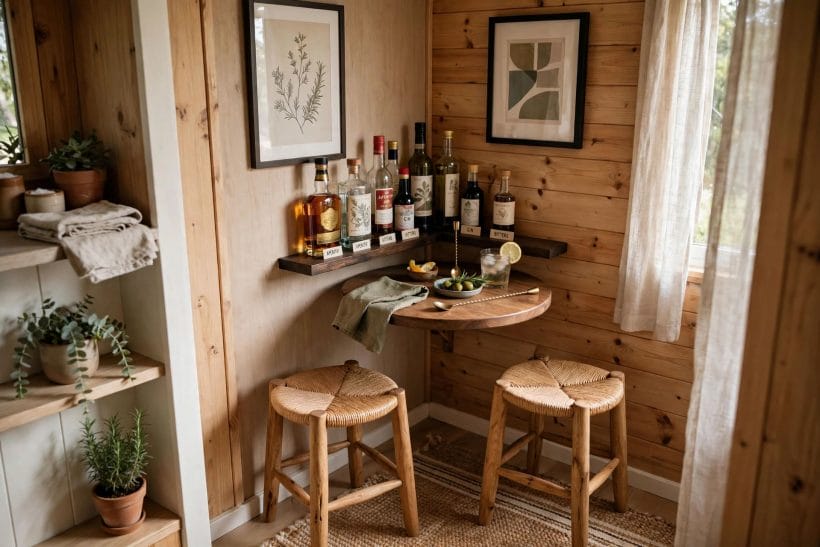
The small bar’s address book is the house’s leftover spaces. The warmest of them is the finished lower floor, planned alongside the basement ideas pillar, and the liveliest is the den surveyed in the game room ideas — both rooms that were invented for exactly this kind of gathering.
56. The basement corner bar
One corner, a run of shelving, a fridge and the basement’s forgiving floor: the classic small-bar address.
57. The den’s shelf bar
A game room needs refreshment within reach of the table and the screen: one shelf run and a cart often beat a built bar, keeping the room’s floor for play. Mobility is the den bar’s native virtue.
58. The dining room’s serving bar
A sideboard-height bar along the dining room’s spare wall stages wine and water where meals happen. It pours before dinner and serves during it — the hardest-working, least theatrical bar in the house.
59. The spare room’s double life
A guest room that hosts four weekends a year can hold a cupboard bar behind doors without surrendering an inch of its welcome. The bar borrows the room; the room barely notices.
60. The study bar for one reader
A tray, two bottles, a glass and a carafe on a study shelf is a bar at its most distilled: service for one or two, at reading pace.
61. The terrace and garden bar
A weatherproof cabinet or a cart that summers outside brings the small bar to the garden’s edge.
62. The kitchen’s own far end
In an open kitchen, the counter’s far peninsula end, dressed with shelves above, becomes the bar without a single new fitting. Guests stay on their side; the cook keeps the working side; the room hosts both.
63. The rental bar: nothing fixed
Cart, tray, cupboard insert, a shelf that hangs on existing screws: the renter’s bar is fully reversible and fully real. Small bars were born freestanding — the fitted versions are the newcomers.
64. The inherited sideboard
A family’s spare sideboard, buffet or bureau is a bar waiting for a tray and a decision. Furniture with a past gives a small bar its instant character — the one kind money in a showroom cannot buy.
65. Choose the address by the gathering
Map where people actually collect in your house at seven in the evening, and put the bar at that map’s edge. Bars placed by symmetry sit empty; bars placed by traffic are never alone.
8. Keeping a Small Bar: Stock, Glass and Restraint
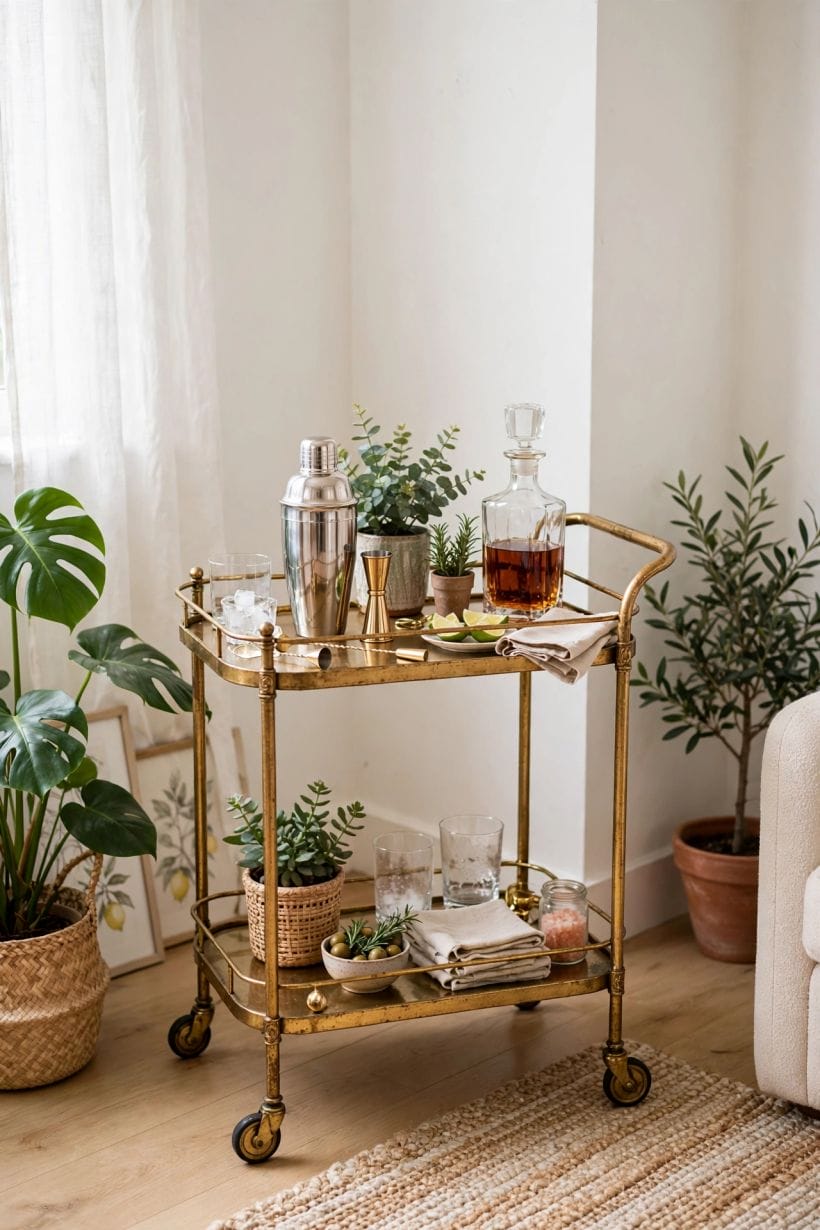
The last word is upkeep, because a small bar is kept or it is lost: a handful of bottles poured often, glassware washed and few, and a host who edits. It lives among the house’s social rooms, under the same roof as the living room ideas pillar — and like them, it is judged on an ordinary evening, not a party.
66. Stock for the drinks you actually make
The working shelf holds the ingredients of three or four loved drinks, bought well and replaced as they empty. A bar stocked for imaginary cocktails in other people’s houses pours nothing with conviction.
67. One great bottle beats five fine ones
At small scale, splurge by concentration: the single best bottle the shelf can justify teaches more taste than a rank of the merely good. Guests remember the pour, not the inventory.
68. Glasses: two shapes, honestly sufficient
A tumbler and a stemmed glass cover nearly everything a small bar serves; add a third shape only when a loved drink demands it. Glassware multiplies like hangers if it is not edited like books.
69. Fresh things are a shopping rhythm, not storage
Citrus, herbs, soda and ice are bought little and often, on the house’s ordinary shopping rhythm. The small bar keeps almost nothing perishable — its freshness is a habit, not a stockpile.
70. Wash up as part of the pouring
The host who rinses as they go keeps the small bar possible: the counter clears itself in real time, and the morning after holds no archaeology. At this scale there is no staff; there is only sequence.
71. The cloth, the bin, the spare shelf
Restock the towel, empty the small bin, return the overflow box: three two-minute jobs after every gathering. A small bar’s tidiness is never a project — it is a tail on the evening.
72. Rotate the shelf with the seasons
Warm drinks and dark spirits forward in winter; bright, cold and sparkling in summer. One shelf moved four times a year keeps a tiny inventory feeling like a changing cellar.
73. Know two drinks perfectly
The host’s reputation at a small bar rests on two drinks made flawlessly, every time, without measuring the mood. Depth at two points beats a menu at twenty — the bar is small; let its mastery be complete somewhere.
74. Refuse the merchandise creep
Branded mats, novelty openers, souvenir everything: the small bar’s shelves have no room for jokes told twice. Keep the tools plain and the bottles speaking — restraint is this bar’s house style.
75. Let the bar be dark sometimes
Not every evening is a bar evening. A small bar kept stocked, clean and closed, asking nothing, is a pleasure held in reserve — the surest sign it was sized, stocked and kept by someone who understands it.
9. Checks and Mistakes: Before the First Purchase or the First Stone
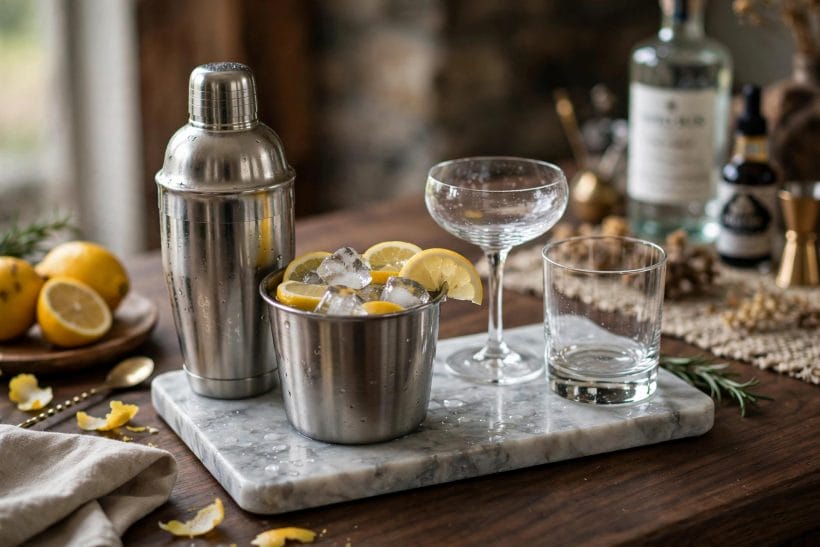
The small bar’s checks are physical. Stand in the host’s place and pour an imaginary round: every reach should land, every step should be unnecessary, the ice should be closer than the door. Then stand in the guest’s: a stool that tucks away, a ledge for the glass, a sightline to shelves worth reading. A bar that passes both standings will work on the night.
The mistakes are appetite mistakes: a sink bought for a fantasy, shelves deeper than one row, a footprint that eats the room it was meant to serve. Hold the measure from the first section — one wall, one corner, one cupboard — and let the pillar post tempt you only when the house, not the evening, asks for more.
10. Costs and Pulling It Together
A small bar is the cheapest room in hospitality to build well. Its first tier is a cart or a tray and the discipline of the working set: the bar as an object. The second is a fitted wall — shelves, counter, a fridge drawer — the bar as furniture. The third, rarely needed, is the wet bar’s plumbing and power, priced as the building work it honestly is.
What the money should never chase is size: every tier pours the same drinks. Spend on the counter’s surface, the fridge’s quietness and the two stools’ comfort — the three things hands and guests actually meet — and let the rest be simple, one row deep, and easy to keep.
Final Considerations
Within its family, this post owns the small end: the pillar pours for bars of every scale, the single-wall and countertop specialists go deeper on their parts, and the rooms it lives in — basement, den, family room — are surveyed in their own posts, all linked above.
Fit one wall honestly, stock it for the drinks you love, and close it when the evening ends. A small bar kept that way is never a compromise version of a bigger one. It is the original idea, at the size a house actually has.

0 Comments