

Search online and you will find confident lists naming states where tiny houses are supposedly banned outright. Almost all of them are wrong in the same way: they mistake a collection of local barriers for a statewide prohibition. The plain truth is that a tiny house is very rarely illegal because a state passed a law against tiny houses. It becomes illegal, in practice, when a specific house in a specific place cannot satisfy the minimum-size code, the foundation rule, the zoning district, or the occupancy limit that happens to govern that parcel, and those rules are written county by county and city by city, not in a state capitol.
That distinction is not pedantry; it is the difference between giving up on a whole state and solving a local problem. This explainer walks through the five real barriers that make tiny houses illegal in practice, explains why the county map matters more than the state map, and then shows the two workarounds, the accessory dwelling route and the park or community route, that legally place tiny homes in places where a standalone tiny house would fail. No statute numbers, no invented state claims, just the mechanisms, so you can check your own county with clear eyes.
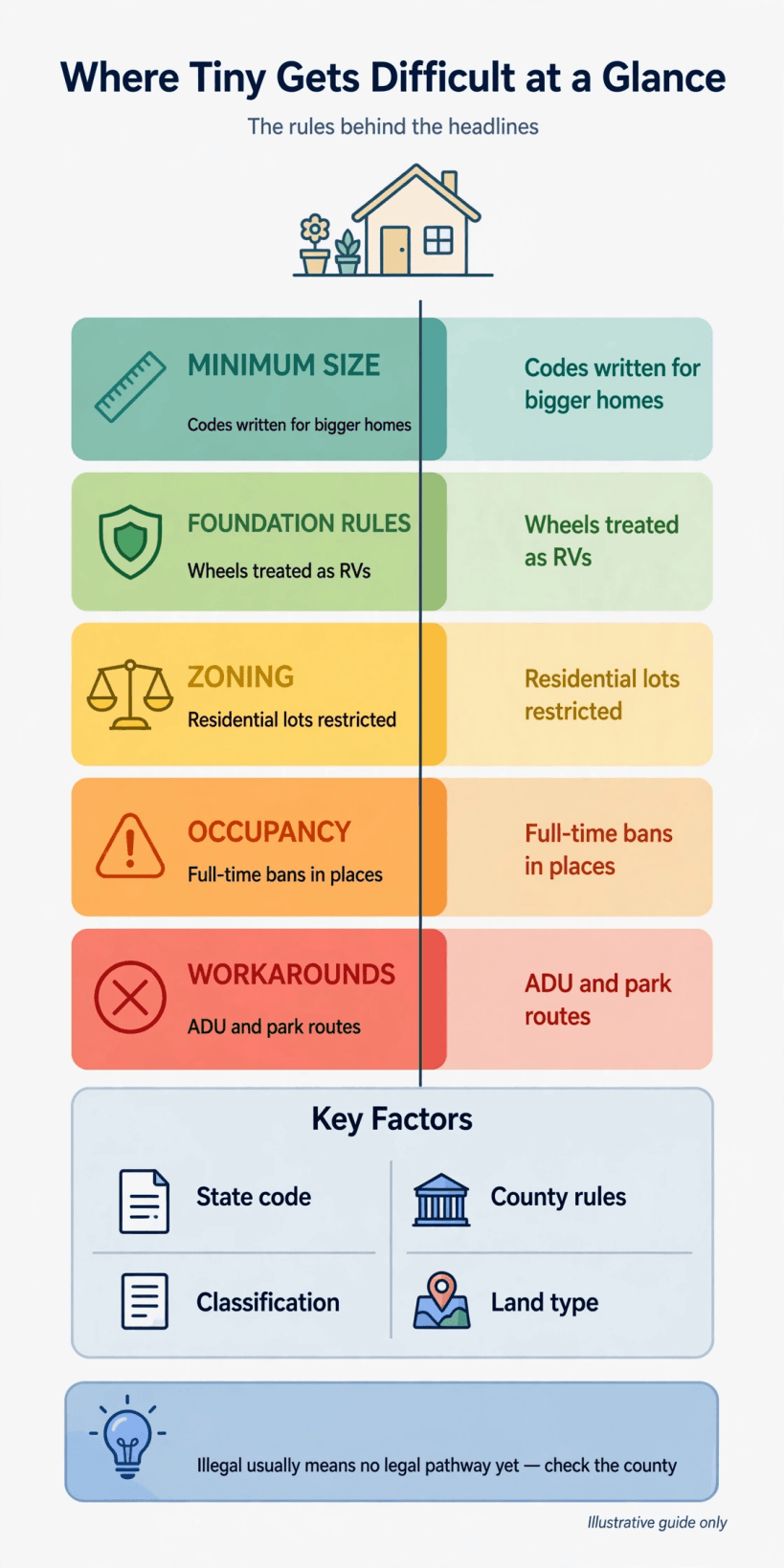
The Real Barriers at a Glance
| Barrier | How it makes a tiny house illegal | What to check locally |
|---|---|---|
| Minimum-size codes | The dwelling is smaller than the smallest home the code allows | The minimum floor area and room sizes in the adopted building and zoning codes |
| Foundation rules | The code recognises only homes on permanent foundations | Whether a house on wheels or on a chassis can be a dwelling at all |
| Zoning districts | No district in the area lists a tiny house as a permitted use | The permitted-use table for the exact parcel’s district |
| Occupancy limits | Living in a vehicle or RV is limited to a set number of days | The rules on RV occupancy, camping on your own land, and renewals |
| Utility and sanitation rules | There is no lawful way to supply water or handle waste | Septic, sewer, and water requirements for a new dwelling |
1. The Short Answer: Bans Are Rare, Barriers Are Everywhere
Start with the honest headline: outright statewide bans on tiny houses are rare to the point of being the wrong thing to search for. Housing legality in the United States is mostly local law. States adopt model building codes, sometimes with amendments, but zoning, the body of rules that decides what may sit on a given parcel, is written by counties and municipalities. A state can therefore contain, at the same moment, counties where a foundation tiny home is an ordinary permitted house, counties where a tiny house is welcome only as an accessory unit, and counties where no legal pathway exists at all.
So when a headline says a state has banned tiny houses, translate it: somewhere in that state, some combination of size, foundation, zoning, and occupancy rules closes the door, and a writer generalised it. Your job is the opposite of generalising. Take the five barriers in the table one at a time, test your target county against each, and you will learn more in an afternoon than any national list can tell you, because your house will live under one county’s rules, not under a national mood.
2. Barrier One: Minimum Dwelling Size
The most common barrier is arithmetic. Building and zoning codes have historically required dwellings, and rooms within dwellings, to meet minimum sizes, and a house designed around a trailer bed can fall below those floors in total area, ceiling height, or the size of its one main room. Where such minimums apply and no small-dwelling provision softens them, a tiny house is not refused out of hostility; it simply does not fit the definition of a legal dwelling, and a permit cannot be issued for a home the code cannot describe.
The counterweight is that model codes have evolved. Small-dwelling provisions exist in the model-code world, but they only help where a jurisdiction has actually adopted them, which is exactly the local question you must ask. Our explainer on the IRC Appendix Q rules for tiny homes walks through how those provisions work and what adoption means, and reading it before you call the building department will let you ask the single most useful question in this whole field: has this county adopted the small-dwelling provisions, or not?
3. Barrier Two: Foundation and Permanency Rules
The second barrier is what your house stands on. Many code and zoning systems are built around the assumption that a dwelling is permanently attached to land, on a foundation, immovable in the ordinary course of life. A tiny house on wheels breaks that assumption twice: it sits on a trailer, and it can leave. Some jurisdictions respond by classifying it as a vehicle rather than a home, and vehicles are governed by an entirely different and much less comfortable set of rules about where they may be occupied and for how long.
This is why two identical tiny houses can have opposite legal fates on the same street, one on a foundation treated as a small house, the other on wheels treated as a recreational vehicle. If foundation placement is your plan, prepare for what it involves on the ground: our guide on how to prepare land for a tiny house covers permitting, excavation, and utility hookups step by step, and it makes clear that permanency is a construction project, not a paperwork mood.
4. Barrier Three: Zoning Districts That Never Mention Tiny Houses
Zoning works by lists. Each district, residential, agricultural, mixed-use, and the rest, carries a table of permitted uses, and anything not listed is, by default, not permitted. Tiny houses are a new enough housing form that many zoning codes simply never mention them, and silence in a zoning code does not mean freedom; it usually means the use is prohibited until the code is amended or a variance is granted, neither of which is in your control as a buyer.
The practical skill is reading the list for near matches. Does the district permit accessory dwellings, manufactured homes, recreational vehicles as temporary housing, or small single-family homes without a size floor? Each near match is a possible doorway, and each absence is information too. Agricultural and rural districts are often more flexible about structures and temporary occupancy than suburban residential districts, but often is not always, and the only version of the list that counts is the one attached to your parcel’s district on the day you check it.
5. Barrier Four: Occupancy Limits and Vehicle Rules
Suppose your house is classified as a recreational vehicle. A second clock now starts: many jurisdictions limit how long a person may live in an RV, even on land they own, to a set stretch of days, sometimes tied to a building permit for a permanent home under construction, sometimes simply a hard cap with no renewal. Park or camp beyond the limit and the arrangement is illegal no matter how tidy, quiet, and harmless it is, and enforcement typically begins with a complaint and a letter rather than any dramatic raid.
Occupancy rules also hide in unexpected places: prohibitions on living in a vehicle on a residential lot, rules about how many unrelated people may share a dwelling, and requirements that a lot contain one principal home before anything else may be occupied. None of these were written about tiny houses, and all of them can decide a tiny house’s legality. When you check a county, ask not only “may I place it” but “may I sleep in it, every night, all year,” because those are different permissions and confusing them is the most common beginner’s mistake in this field.
6. Barrier Five: Utility and Sanitation Requirements
The fifth barrier is plumbing. A legal dwelling must dispose of water and waste lawfully, and in much of the country that means an approved septic system sized and sited through a permitting process, or a connection to a sewer where one exists. Land that cannot pass a percolation test, cannot fit the required setbacks for a septic field, or sits over a water table the health department will not accept can be land on which no new dwelling, tiny or otherwise, may legally be added, whatever the zoning says.
Water supply raises parallel questions: a well permit, a municipal connection, or, in off-grid designs, whether the local rules accept alternative systems at all. These are health-department questions, separate from the planning office, and they deserve their own call. Our tiny house utilities guide explains the power, water, and sewage arrangements tiny homes actually use, so you can describe your intended setup precisely and hear a precise answer instead of a general warning.
7. Why County by County Beats State by State
Given five barriers, all locally written, the state-level question dissolves. The same state can hold a city with an accessory-dwelling programme that welcomes tiny homes, a rural county with flexible agricultural rules, and a suburban county whose size minimums and vehicle rules close every door, and all three are the real answer for their own territory. This is also why rules change at different speeds in different places: a county amends its code, a city adopts small-dwelling provisions, and the map redraws itself one jurisdiction at a time, leaving every printed state ranking out of date somewhere.
It is also why the ecosystem test works: places whose rules genuinely function tend to accumulate visible tiny living, builders who know the local process, and officials who answer questions from experience. Our survey of US cities with strong urban agriculture and sustainable living codes found the same pattern in a neighbouring field, that workable codes and active practitioners gather together. Absence is a signal too: if nobody in a county is visibly doing the thing you plan, ask why before assuming you will be the first to succeed.
8. Workaround One: The Accessory Dwelling Route
The most reliable workaround reframes the tiny house as an accessory dwelling unit on a lot that already holds a main home. Instead of asking a county to accept a new kind of principal house, you ask it to accept a small second unit under rules written for granny flats, backyard cottages, and garage conversions, categories many jurisdictions have spent years liberalising for reasons that have nothing to do with tiny houses. The tiny home gains a legal identity the system already understands, with defined rules for size, setbacks, parking, and hookups.
The ADU route has its own conditions, and they matter: the lot owner may need to live on site, the unit’s size may be capped relative to the main house, and wheels may or may not be accepted, with some programmes requiring a foundation. Read the programme as it is written, not as advocates summarise it. Where it fits, though, the ADU route converts an illegal standalone placement into a permitted one without changing the house at all, only its legal story, and that is the cleanest demonstration in this article that legality is a classification game.

9. Workaround Two: Communities, Parks, and Hosted Land
The second workaround borrows somebody else’s legality. A tiny house community, a park that permits long-term tiny occupancy, or a private host whose land use already allows the placement has solved the zoning problem at the property level, and residents rent the benefit. This is why so many tiny dwellers who could not legalise a standalone lot live perfectly legally a few miles away inside a community fence: the house did not change, the land’s permissions did.
Choose the borrowed legality carefully, because its terms vary as much as counties do. Our comparison of tiny house communities vs RV parks explains the differences in rules, costs, and culture, and our guide on how to start your own tiny house community shows, from the organiser’s side, exactly which zoning problems a community has to solve, knowledge that helps you judge whether a community you are considering has actually solved them. Ask any host or park for the permission in writing and the occupancy terms in plain language.
10. How to Check Your County Before You Buy or Build
Here is the whole article as a procedure. Get the parcel’s zoning district and read its permitted uses and size rules. Ask the building department whether the adopted code includes small-dwelling provisions and what foundation a dwelling requires. Ask planning whether an ADU pathway exists and whether it accepts a unit on wheels. Ask the health department about septic and water for the parcel. Ask, in one sentence, whether a person may occupy a tiny house on that land all year, and get the answers by email so the record survives the conversation.
Do this before money moves, because every barrier in this article is cheap to discover in advance and expensive to discover afterwards, when the remedy may be a foundation you had not budgeted, a community lot across the county, or a move you had not planned. Our tiny house moving guide prices that last remedy honestly, and it is best read as motivation rather than as a plan. An afternoon of county questions is the cheapest insurance in tiny living, and unlike most insurance, it pays out in certainty rather than in claims.
Final Considerations
Tiny houses are rarely illegal by name and often illegal by accumulation: a size floor here, a foundation assumption there, a zoning list that never mentions them, an occupancy clock, a septic rule. Each barrier is local, written, and checkable, and two established workarounds, the accessory dwelling route and the community or park route, legally place tiny homes every day in jurisdictions where a standalone house on wheels would fail. Refuse the seduction of state rankings. Check your county, in writing, before you buy, build, or tow, and you will never need to ask whether tiny houses are legal in a state again, because you will know the only version of the answer that can house you: the one for your parcel.


0 Comments