

Kansas rewards a particular kind of honesty. The state does not pretend the wind is a minor detail, and neither should your building plans. This is a landscape of section-line roads, wheat and pasture running to a horizon that never quite arrives, and small towns where buildable land still trades at prices the coasts forgot decades ago. A tiny house is no provocation here — Kansans have lived in modest farmhouses, bunkhouses and lean-to additions for generations. What the state demands in return is respect for its two governing realities: rules that are written county by county, ranging from full zoning ordinances to almost none at all, and weather — wind, hail and tornado season — that will eventually test every roof, tie-down and footing you install. Understanding tiny house laws in Kansas means sorting your project by county first, and by storm exposure a close second.
This guide covers the full Kansas picture: the legal status of tiny houses on wheels versus foundations, the state’s unusually hands-off approach to residential building codes and what fills the vacuum, the minimum-size rules hiding in city ordinances, county zoning including the genuinely unzoned counties, accessory dwelling units in the cities, where you can legally live, and the permit, septic and storm-shelter decisions that shape a safe build. The trade-offs are stated plainly: land is cheap and regulation is often light, but light regulation transfers risk to the owner, and an unsafe or uninsurable house is no bargain at any price. Verify every specific with the county or city that governs your parcel; what follows is a verification map, not legal advice.
1. Tiny House Laws in Kansas at a Glance
| Question | Kansas in brief |
|---|---|
| Statewide building code? | No statewide residential code governs most one- and two-family homes; cities and counties adopt their own — so the answer depends entirely on the jurisdiction, and some rural counties enforce no building code at all |
| Who controls zoning? | Cities within their limits and counties outside them — and a number of Kansas counties, mainly in the west, have no zoning whatsoever |
| Tiny house on wheels classified as? | A recreational vehicle — titled as a vehicle, welcomed in parks and campgrounds, generally not a lawful full-time dwelling on a standard lot |
| IRC Appendix Q? | Only where a city or county code adoption includes it; in code-free counties the question is moot — but its standards are still the right design target |
| Statewide minimum house size? | None from the state; minimums live in city ordinances and subdivision rules |
| Kansas’s big advantage | Some of the cheapest buildable land in America, much of it under little or no zoning |
| The hidden gatekeeper | Water and waste — wells, rural water districts and county septic approval — plus a storm plan the sky will eventually test |
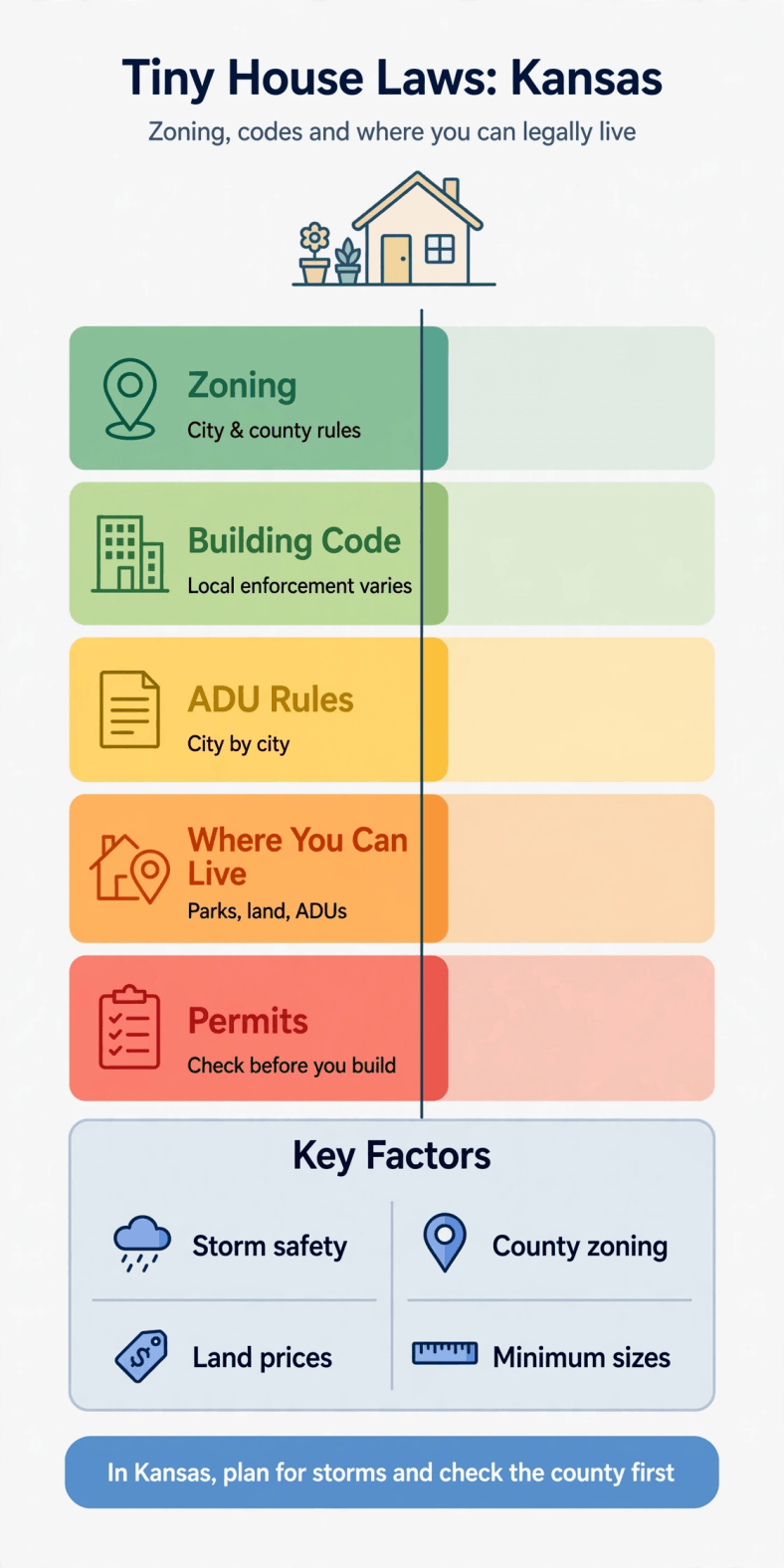
Two facts organise everything else in this guide. First, Kansas governs small houses locally to a degree few states match — the county courthouse, not the statehouse, is where your project lives or dies. Second, the state’s weather is an engineering input, not a backdrop: wind load, anchoring and shelter belong in the same first conversation as zoning, and this guide treats them that way.
2. On Wheels vs On Foundation: Legal Status
A tiny house on wheels is, in Kansas practice, a recreational vehicle. It is titled and registered as a vehicle, and zoning ordinances — where zoning exists — treat it as temporary accommodation rather than a dwelling. Campgrounds, RV parks and manufactured-home communities are its lawful habitats; full-time residence on an ordinary lot is generally prohibited in zoned cities and counties, and wheels do not become legal tender just because the county is relaxed. Kansas adds one consideration most states do not: a wheeled unit is the worst possible structure in a tornado. It cannot be anchored like a building, it must never be sheltered in during severe weather, and any long-term THOW plan in Kansas is incomplete without a proper storm shelter on the site and a rehearsed plan to be in it. For the paperwork side, how to register a tiny house as an RV covers titling, and what RVIA certification means for a tiny house covers the build certification that parks and insurers look for.
A tiny house on a permanent foundation is a dwelling, and in zoned, code-adopting Kansas it is processed like any other house: zoning compliance, permits, inspections, septic approval and taxation as real property. In the unzoned, code-free counties it may involve little more than a septic permit and a driveway — but it remains a dwelling in law, mortgageable and insurable in a way a wheeled unit is not. The classification caution is the same as everywhere: a factory-built tiny home on a steel chassis is likely a manufactured home, federally built to the HUD code and subject in Kansas to installation and anchoring standards when it is placed — tie-downs and foundation systems are not optional garnish in wind country, they are the difference between a house and debris. Ask which category your unit occupies before the land purchase, not at delivery.
3. Building Codes in Kansas: Local, Absent, or Storm-Driven
Kansas is one of the states with no statewide residential building code for ordinary one- and two-family homes. Code adoption is a local choice: Wichita, the Kansas City suburbs, Topeka, Lawrence, Manhattan and other cities enforce residential codes derived from the International Residential Code with local amendments, complete with permit counters and inspection sequences. Large parts of rural Kansas enforce no building code at all. For a tiny foundation house this produces the widest regulatory spread in this guide series — the same 320-square-foot design can face a full plan review in one county and no official scrutiny whatsoever in the next. Neither extreme changes the physics. The work a Kansas tiny house must survive is set by wind maps, snow in the north-west, expansive clay soils along the eastern tier, and a heating-and-cooling swing from sub-zero January nights to triple-digit August afternoons.
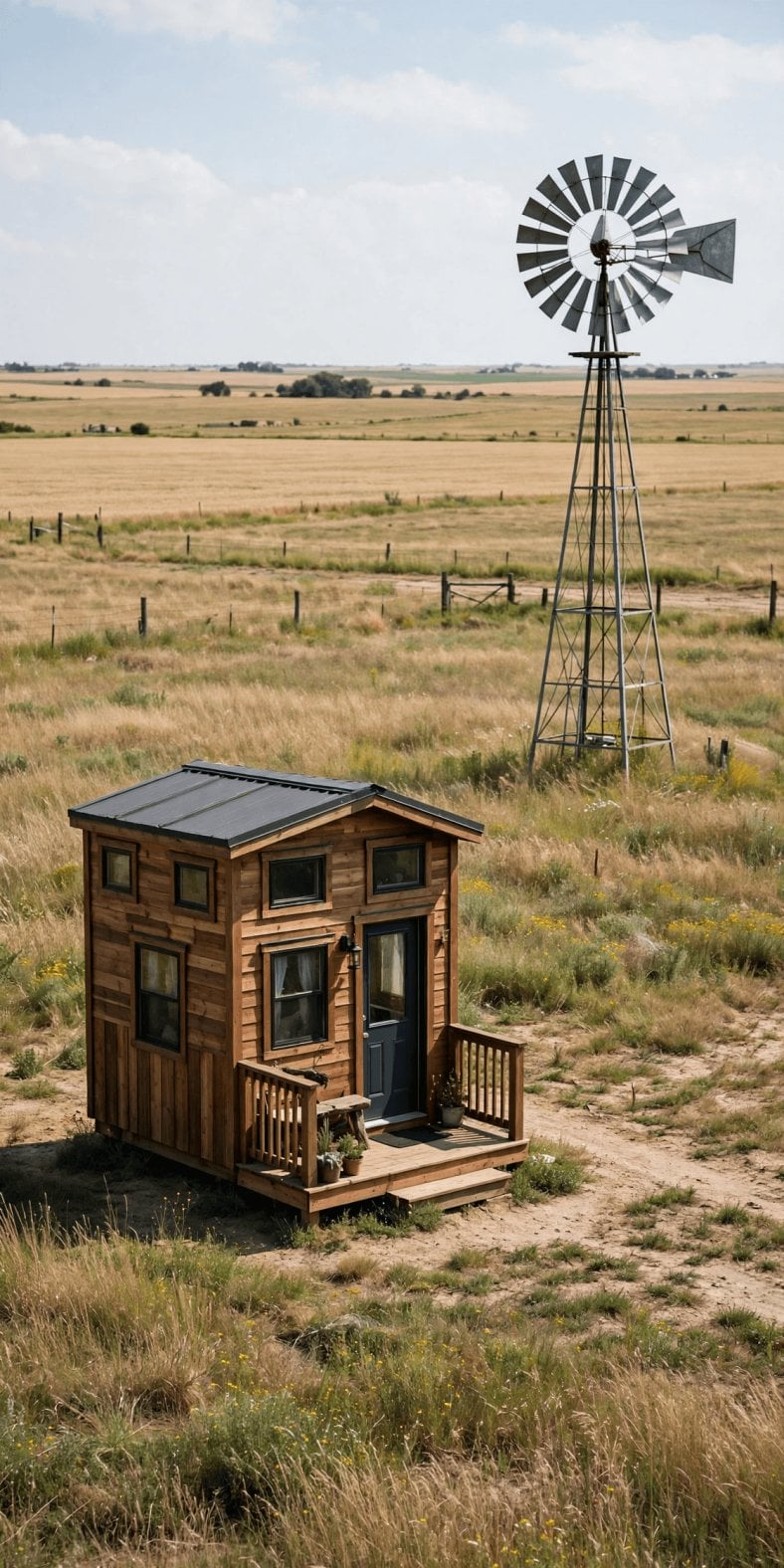
Where a local code applies, IRC Appendix Q — the tiny-house provisions for lofts, ladders and compact stairs — is available only if the local adoption includes it, so ask the building department before designing around it; how IRC Appendix Q works for tiny homes explains what to ask for. Where no code applies, adopt the code’s storm logic voluntarily: a continuous load path from roof to footing, rated connectors, anchored sill plates, and roof geometry detailed for uplift. And plan the shelter. Kansas does not generally impose a statewide storm-shelter mandate on ordinary houses, but building a sleeping space in tornado country without a safe room or shelter within reach is an engineering failure whatever the law says — prefabricated shelters and in-ground units are a standard Kansas budget line, and they belong in yours.
4. Minimum Sizes: A City Question in Kansas
Kansas sets no statewide minimum house size. Minimum floor areas are a city habit: many Kansas city ordinances specify minimum dwelling sizes for new homes, and the figures — commonly several hundred square feet and rising well above that in affluent suburbs — vary by district inside the same city. Johnson County’s suburbs are the predictable strict end; older industrial cities and small towns are often more permissive, sometimes surprisingly so for in-fill cottages. Counties that zone generally focus their dwelling rules on lot size, setbacks and manufactured-home placement rather than floor area, and unzoned counties impose nothing at all. Above the public layer sit subdivision covenants, which around Wichita and the Kansas City metro routinely demand minimums beyond the ordinance — private law that no county variance can waive.
The checks, in writing, for the exact parcel: the city or county ordinance’s minimum floor area and its measurement method (ground floor only, or loft included — decisive for lofted designs), the recorded covenants, and whether your build will be treated as a manufactured home with its own placement standards. Note the pattern that saves money statewide: because unzoned and lightly zoned Kansas land is abundant and cheap, a minimum-size obstacle is never worth fighting. Move one township over and the obstacle frequently vanishes — a luxury tiny-house buyers in most states do not have.
5. Zoning and Placement: From Johnson County to No Zoning at All
Kansas zoning follows the national template with one famous exception. Cities zone inside their limits; county zoning, where adopted, governs unincorporated land; agricultural districts dominate the rural map and typically accept a single-family dwelling as a permitted use, subject to setbacks, lot standards and any floodplain overlay. The exception: a substantial number of Kansas counties — concentrated in the western half of the state — have never adopted zoning at all. In those counties there is no district to comply with, no use permit for a house, and often no building permit either. What still applies everywhere is the surrounding framework: county floodplain rules tied to the national flood insurance programme along rivers and creeks, septic regulation, driveway entrance permits on county and state roads, and any easements or severed mineral rights on the deed — in Kansas, oil, gas and wind-energy interests may be separated from the surface, and a wind lease on a neighbouring section is a planning fact worth knowing before you buy a view.
Placement craft in Kansas is mostly about wind and water. Read the flood maps as seriously here as on any coast — the Kansas and Arkansas river systems and their tributaries have produced repeated damaging floods, and county floodplain administrators enforce elevation and permitting rules in mapped areas. Site the house with a shelterbelt or terrain break if the parcel offers one, orient the narrow face to the prevailing storm direction where the design allows, and follow the documented approach in how to talk to zoning officials about a tiny house for the jurisdictions that do have officials. In unzoned counties the conversation shifts to the health department and the rural water district — smaller desks, same importance.
6. ADUs in Kansas: The City Route
Accessory dwelling units are the structured path to a legal small home in Kansas’s cities. Wichita, Lawrence, Topeka and a growing set of suburbs have ADU provisions in their ordinances — permissions for backyard cottages, garage conversions and internal flats, usually conditioned on the main house remaining, limits on the unit’s size relative to the primary dwelling, parking and sometimes owner-occupancy. College towns feel the pressure most: Lawrence’s housing market has made accessory units a live policy topic for years, and ordinances there and elsewhere have been revised recently and will be again. Treat every summary, this one included, as a pointer to the current city ordinance and a call to the planning desk, not as the permission itself.
In unincorporated Kansas the ADU label mostly disappears, replaced by the older rural pattern of the second farmhouse, the hired man’s house and the in-law cottage. Zoned agricultural districts may allow a second dwelling on a large parcel outright or by conditional use; unzoned counties ask nothing at the zoning desk at all. The governor, as in most of this series, is sewage: Kansas counties administer on-site wastewater rules, and a second dwelling means a second system or a documented expansion of the first. Land that makes the second home effortless on paper can still fail at the soil — which is why the county conversation in section 8 outranks the floor plan.
7. Where You Can Legally Live in a Tiny House in Kansas
Kansas’s lawful options, ranked: First, a tiny house on a foundation on your own land — available in zoned counties where dwellings are permitted and at full scale in unzoned counties, at land prices that make this the centre of the Kansas story. Second, an ADU or permitted second dwelling under a city programme or a county agricultural allowance. Third, extended residence in a licensed RV park, campground or manufactured-home community approved for it — the approval attaches to the site, which is the substance of the differences between tiny house communities and RV parks, and in Kansas any park plan must come with the park’s storm shelter arrangements identified in advance.
Fourth, the informal pattern — a wheeled unit or unpermitted cabin on rural land — is more widespread in Kansas than in most states precisely because so much Kansas has no zoning to breach. Describe it honestly anyway: the dwelling may violate nothing locally and still be uninsurable at full value, unfinanceable, awkward to sell with the land, and exposed on the one axis Kansas never negotiates — the weather. The county sanitarian’s septic rules also continue to apply in most counties whatever the zoning map says, and unpermitted sewage remains the commonest way an invisible homestead becomes visible. In Kansas the informal route is rarely stopped by an inspector; it is stopped by a storm, a lender or a buyer. Build for all three audiences from the start.
8. Permits, Septic and Inspections: The County Sanitarian’s Desk
The Kansas permit stack depends on the jurisdiction’s appetite. In code-adopting cities it is the full sequence — zoning confirmation, building permit, staged inspections, final approval. In code-free counties the stack collapses to the health layer, which operates almost everywhere: on-site wastewater approval under state environmental standards administered by the county, usually through a county sanitarian or environmental office. Expect a soil evaluation on the parcel, a system sized to the home’s bedrooms, separation distances from wells and water lines, and inspection at installation. Kansas has one distinctive lawful alternative: where tight soils defeat conventional absorption fields, a properly designed and permitted wastewater lagoon is an accepted rural solution on suitable parcels — unglamorous, effective, and a genuine reason some Kansas acres work that would fail elsewhere. Water supply is the twin decision: rural water districts reach deep into Kansas farm country and a district tap, where available, is usually the cheapest reliable answer; otherwise a drilled well, with quality and depth varying sharply by geology, especially over the declining Ogallala aquifer in the west.
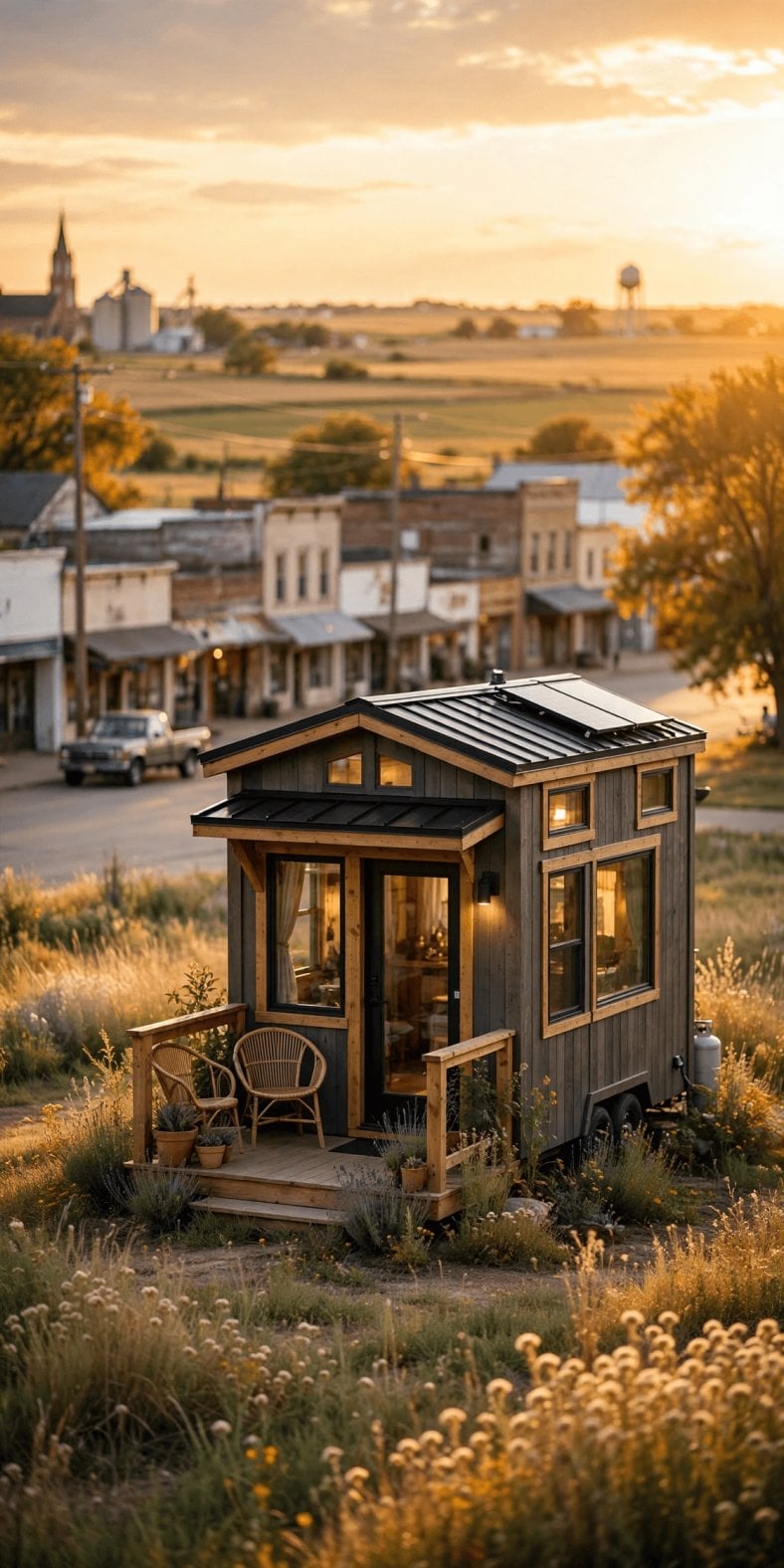
The remaining approvals are routine: electrical service from the utility or rural electric cooperative, propane where gas lines do not run, and the driveway entrance permit. Sequence the work behind the water and septic answers using how to prepare land for a tiny house as the order of operations, and add the Kansas-specific line items early: shelter installation, anchoring hardware, and hail-resistant roofing, which insurers price openly here. Keep every document — septic permit, well log, any building permits and the shelter paperwork. In a state where many rural homes were built with no file at all, a documented tiny house sells at a premium precisely because the next buyer’s lender can read it.
9. Local Examples: Wichita, Lawrence and the Unzoned West
Wichita is Kansas’s best-value full system: a real code and permit programme, a consolidated city-county planning structure, ADU permissions worth reading closely, and house-and-land prices that still leave room for a small build done properly. The Kansas City suburbs in Johnson County sit at the opposite pole — excellent services, strict ordinances, minimum sizes and covenants that push tiny projects toward ADU routes or out of the subdivisions entirely. Lawrence blends university demand with active code enforcement: promising for accessory units, procedural for everything, and surrounded by townships where the rural route opens up quickly.
The rural west is where the Kansas proposition becomes extreme: counties with no zoning, no building code, land priced lower than almost anywhere in the continental United States, and townships where a small house is a rounding error in the landscape. Its trade-offs are equally extreme and must be priced honestly: well depth and water quality over a declining aquifer, wind exposure with no shelterbelt unless you plant one, hail, distance to hospitals and hardware stores measured in hours, and winter storms that close roads for days. Eastern Kansas, by contrast — rolling, wooded, wetter — behaves more like neighbouring Missouri: more counties zoned, more code presence, easier water, higher land prices. Choosing your Kansas is choosing which half of that ledger you prefer.
10. Practical Steps to Go Legal in Kansas
Kansas asks less paperwork than most states and more engineering honesty. Work this order:
- Establish the jurisdiction: city or county, whether zoning exists there at all, and the district rules for dwellings and RV occupancy where it does.
- Check the private layer: subdivision covenants, easements, and — Kansas-specific — severed mineral, oil, gas or wind rights on the parcel.
- Solve water and waste before closing: rural water district availability or a well evaluation, plus the county septic or lagoon feasibility for the site.
- Ask the code question: which residential code, if any, is enforced, whether Appendix Q is included, and what permits a small dwelling needs.
- Design for the sky: continuous load path and anchoring, hail-rated roof, frost-depth footings, and a storm shelter or safe room in the base plan — not as an upgrade.
- Confirm services and access: electric cooperative timelines, propane delivery, and the driveway entrance permit for the road frontage.
- Permit what exists, document everything: septic records, well log and inspection sign-offs are the resale file in a state full of undocumented houses.
Utilities strategy deserves the same front-loaded treatment: work through tiny house utilities: power, water and sewage options while the plan is still pencil — Kansas combines long rural service runs, serious heating and cooling loads in a small envelope, and water decisions (district tap, well, or hauled storage in the driest counties) that shape the whole budget. The closing trade-off is the state’s signature: Kansas will leave you alone to an extent that surprises people — and in exchange expects you to have thought about wind, water and waste like an adult. Meet that expectation and the little house on the section road is as legal as it is alone.
Final Considerations
Kansas’s framework is a filter for seriousness rather than a barrier to small houses. Where rules exist — a city’s floor-area minimum, a county’s septic standard, a floodplain line — they are specific, published and survivable. Where rules are absent, the obligations do not disappear; they migrate to the owner, who must supply the code’s judgement about anchoring, sanitation and shelter personally. The failures this guide exists to prevent are correspondingly practical: a suburban lot whose covenants nobody read, a western parcel whose well nobody priced, a wheeled unit somebody planned to ride out a storm season in.
Price those three things honestly and Kansas may be the easiest state in this series in which to end up legal, because its default settings — cheap land, agricultural zoning that expects houses, counties that mind their own business — already lean your way. The tiny house at the end of a gravel section road, anchored, plumbed, sheltered and owned outright, is not exploiting a loophole in Kansas. It is the landscape’s oldest idea, rebuilt at 300 square feet.