

South Dakota sells itself on openness — open prairie, open counties, a political culture that leaves landowners alone — and for tiny houses much of that reputation is earned. Many counties have no zoning at all, land prices outside the growth corridors stay within reach, and small towns actively want new residents. Then winter arrives, the Black Hills tourist economy enters the chat, and the details start to matter: a county with no zoning still has septic rules, a cheap lot near Sturgis may be worth more as a vacation rental than a home, and a house that shrugs off a mild autumn must survive a January cold snap with wind. Tiny house laws south dakota is a story of freedom with homework attached.
This guide works through the homework: how wheeled and foundation houses are classified, the state building code framework, minimum sizes, zoning in zoned and unzoned counties alike, accessory dwellings, the places you can legally live full-time, permits and winter-proof construction, examples from Sioux Falls to Rapid City to the small towns that want you, and the practical steps that separate an easy project from an exposed one. The summary up front: South Dakota is one of the most permissive states in this series for a foundation tiny house — provided the build respects the climate and the septic system respects the soil.
1. Tiny House Laws in South Dakota at a Glance
The table below answers the questions South Dakota readers ask first. Watch who answers each one: often the honest answer is that nobody at the state level does — counties, cities and the physics of a northern-plains winter divide the decisions between them.
| Question | South Dakota in brief |
|---|---|
| Are tiny houses legal in South Dakota? | Generally yes. A small house on a foundation, built to code on land where dwellings are allowed, is a legal home, and large parts of the state impose no zoning permission step at all. |
| Is a tiny house on wheels a house or an RV? | An RV or vehicle for most official purposes. Full-time living in one belongs in campgrounds, RV parks and other places local rules allow, not automatically on any residential or rural lot. |
| Which building code applies? | South Dakota has a state building code framework based on international model codes, but adoption and enforcement of residential standards vary by jurisdiction — many rural counties do not inspect houses at all, which shifts responsibility, not standards, onto the builder. |
| How small can a house be? | Where residential codes are enforced, room, ceiling and exit minimums apply rather than a whole-house minimum. Some city zoning ordinances set minimum dwelling sizes; many unzoned counties set none. |
| Are backyard cottages and ADUs allowed? | They depend on city ordinance. Growing cities increasingly discuss or allow accessory units; smaller towns often handle them case by case. Rural land usually turns on septic capacity instead. |
| Where can I live in one full-time? | In a foundation house on suitable land, in an allowed accessory unit, in a manufactured-home community, or in parks and campgrounds for wheeled units within their stay rules. |
| What surprises buyers most? | Winter. Snow loads, frozen water lines, wind exposure and heating costs punish casual construction, and Black Hills tourism inflates land and restricts rentals near the attractions. |
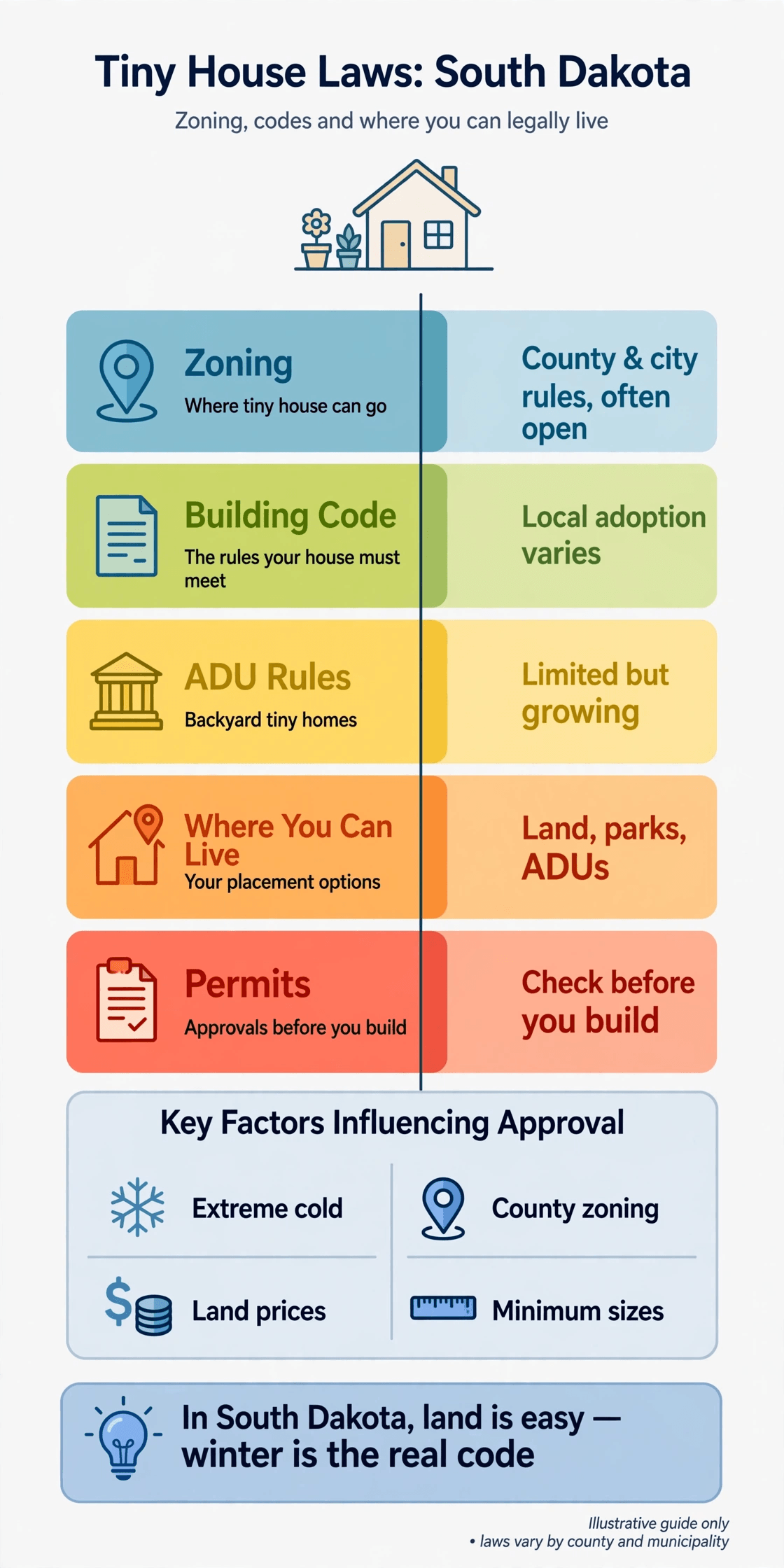
Tiny house laws in South Dakota at a glance — always confirm details with your county or city before you buy.
Read the table with a map beside it. East River and West River, the local shorthand for the halves divided by the Missouri, differ in rainfall, soils, growth and government; the Black Hills differ from both. A rule of thumb that works in a Turner County corn township may be meaningless in a Pennington County canyon.
2. Legal Status: What Counts as a Dwelling in South Dakota?
South Dakota sorts small homes by construction and mobility. A site-built house on a permanent foundation is a dwelling in the ordinary legal sense. A manufactured home follows the federal HUD construction code and its own placement and titling rules. A tiny house on wheels is generally treated as a recreational vehicle or vehicle, however domestic its interior looks, which is why RVIA certification for tiny houses matters for parks and insurers even here.
Classification still drives finance and insurance in a low-regulation state: lenders and underwriters apply their own standards when counties do not, so read tiny house insurance for wheels vs foundation before assuming a cheap, uninspected build is a saving. An uninspected house that cannot be insured or resold has not avoided the code conversation; it has postponed it to a worse moment.
3. Building Codes for Tiny Houses in South Dakota
The state’s building code framework draws on the international model codes, while residential enforcement is famously local: cities and some counties inspect, many rural counties leave construction to the owner and the market. That freedom is real and valuable, and it tempts builders to treat code as paperwork. Resist that reading. The residential code’s core — structure for snow and wind loads, safe stairs and lofts, egress windows, sanitation, and heating that cannot poison or freeze the occupants — is a description of what survives a Dakota winter, not bureaucracy for its own sake.
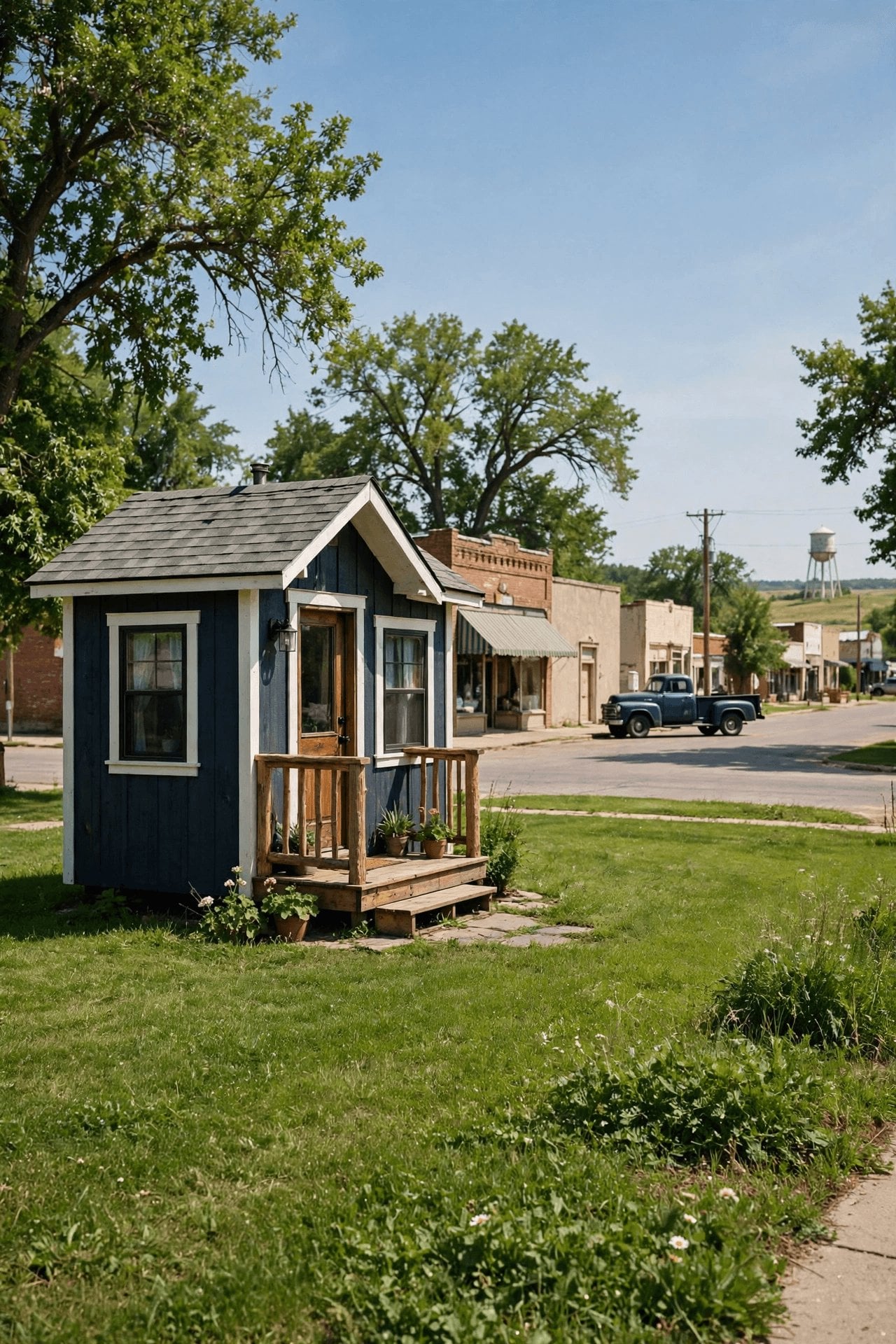
Build for the climate first. Design snow loads rise in the Hills and the northeast; frost depth drives footings deep; water lines need burial below frost or engineered protection, and skirting a wheeled or manufactured unit is a heating decision, not a cosmetic one. Envelope quality pays back faster here than almost anywhere — work through how to insulate a tiny house before choosing wall assemblies, and size heating for the coldest week, not the average month.
4. Minimum Size and Occupancy Rules
No statewide minimum house size greets a South Dakota builder. Where the residential code is enforced, its room-level minimums — habitable room area, ceiling heights with loft allowances, a bathroom and kitchen, safe exits — shape the smallest legal plan, and a competent tiny design meets them. Whole-house minimum floor areas, where they exist, are city choices: some municipal zoning ordinances require minimum dwelling sizes that exclude the smallest footprints in certain districts, while many counties ask nothing about size at all.
Occupancy and rental rules matter most in the Hills and the cities. Short-term-rental ordinances, lodging taxes and neighbourhood complaints can all land on a tiny house used as a tourist rental, and definitions of family or household can affect shared living arrangements. Ask the size question and the use question separately; a house can be the right size and still be the wrong use for its lot.
5. Zoning and Placement: Open Counties and Their Limits
This is the headline freedom: many South Dakota counties administer no comprehensive zoning, so a dwelling is simply a use the landowner chooses, subject to building, septic, floodplain and access rules rather than a permission hearing. Zoned counties and cities are more conventional, with districts, setbacks and sometimes minimum sizes — start with zoning laws for tiny houses for the questions that sort one from the other, and remember that no-zoning never means no rules.
Private restrictions fill some of the vacuum. Subdivisions around Sioux Falls, Rapid City and the Hills commonly carry covenants with minimum house sizes and foundation requirements, and rural land can carry easements or be split under county subdivision rules that affect how many dwellings a parcel supports. Then the land itself votes: preparing your land for a tiny house — road access in mud season, well yield, septic soils and power distance — decides more South Dakota projects than any ordinance.
6. Accessory Dwelling Units (ADUs) in South Dakota
Accessory dwellings follow the state’s pattern: no single statewide entitlement, city-by-city answers. Sioux Falls and other growing cities have been modernising their ordinances under housing pressure, and accessory units appear in those conversations as gentle density; smaller communities often decide through conditional-use or variance-style processes; and on rural land outside city zoning, a second small dwelling usually turns on septic design and county subdivision rules rather than an ADU ordinance at all.
Ask any city the standard four questions — maximum size, owner-occupancy, parking, and rental limits — and add a fifth that is pure South Dakota: how is the unit heated and protected through winter if it sits empty between occupants? A frozen, burst cottage is the state’s most predictable ADU failure, and it is a design and management question long before it is a legal one.
7. Where You Can Legally Live in a Tiny House in South Dakota
The secure full-time options: a foundation tiny house on land that allows dwellings — which in unzoned counties is most land — an accessory unit where a city allows one, a manufactured-home community, or a park or campground placement for a wheeled unit within its rules. The distinctions between those settings are set out in tiny house communities vs RV parks, and they matter in a state whose campground stock swells with the Sturgis rally and summer tourism.
Small towns deserve a section of their own in any honest account. Dozens of South Dakota communities actively recruit residents, sometimes with free or cheap lots and incentive programmes whose terms change — verify current offers directly with the town. The trade is real: easy placement and low land cost against distance to work, healthcare and services, and winters that make distance a safety question. For the right household that trade is the best tiny-house bargain in America; go in with eyes open.
8. Permits, Inspections and Utilities in South Dakota
Expect the permit load to vary by address more than in any neighbouring state. A city build may involve zoning confirmation, building permits and inspections; a rural county build may involve little more than a septic permit through the state environmental framework, electrical inspection, floodplain checks and driveway or approach permits. Whatever the county skips, do the invisible work properly anyway: septic sized and sited for the soil, electrical work inspected, and foundations below frost.
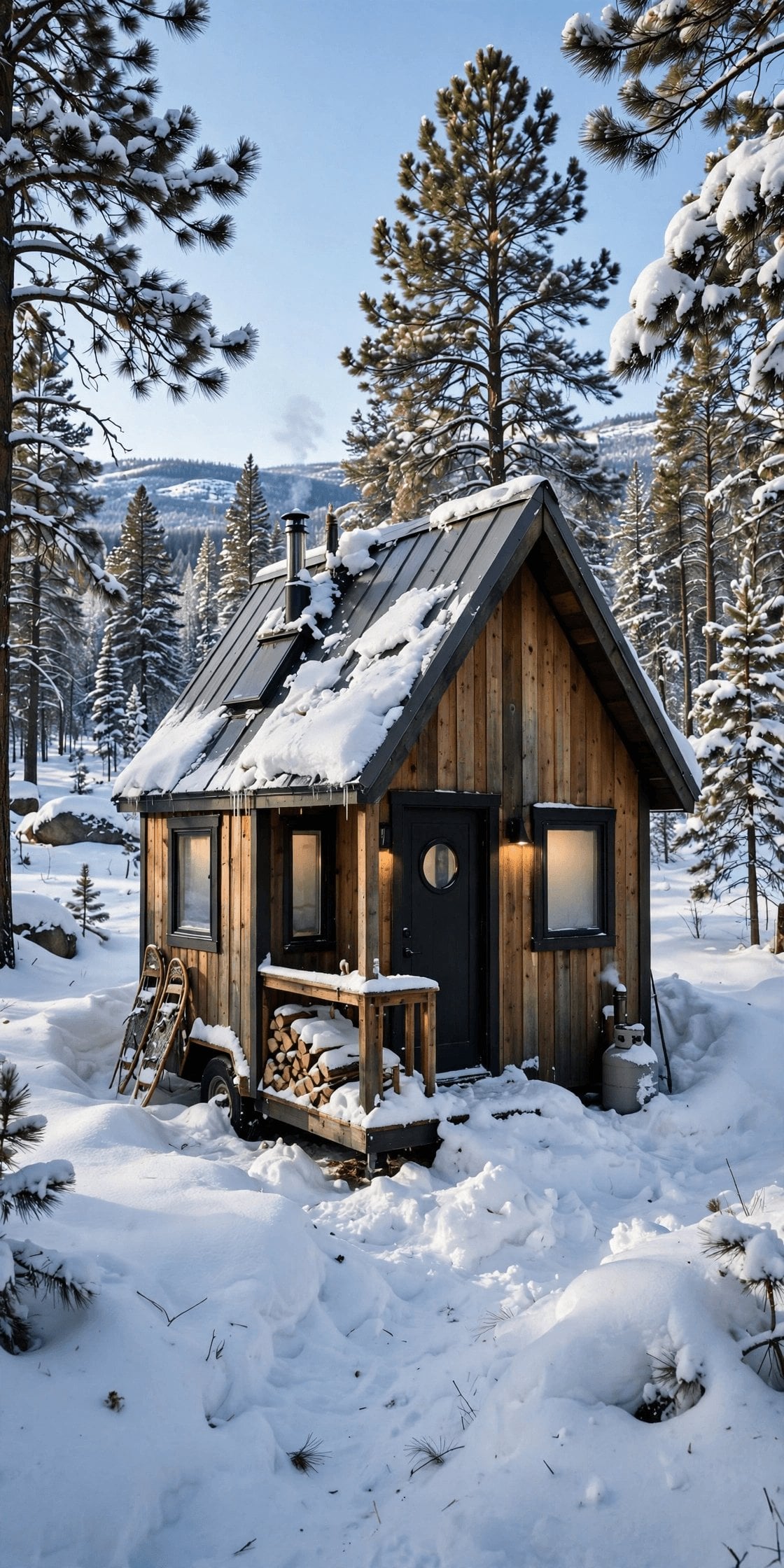
Utilities are the rural budget. Well drilling, septic installation, power-line extension and propane or alternative heating infrastructure routinely exceed the land price, so plan them with tiny house utilities: power, water and sewage before making an offer. In the west, also ask about water: availability and rights are local facts, and a beautiful dry section is a homesite only when a well or rural water line actually reaches it.
9. Notable City and County Examples
Sioux Falls is the growth pole: a real city permitting system, evolving housing ordinances and suburban covenants, with land prices that make small footprints pencil out as infill rather than as acreage living. Rapid City and Pennington County add Black Hills pressure — tourism, vacation rentals, wildfire-aware building in the forest edge, and county zoning that is very much alive despite the state’s open reputation. The Black Hills towns themselves mix resort economics with year-round housing scarcity, which is why tiny proposals there meet both welcome and scrutiny.
The small-town pattern repeats statewide: communities along the I-29 and I-90 corridors and in farming country where a code-light county, a motivated town and a serviced lot can align into the simplest legal tiny-house placement in the country. Treat every example as a lead to verify, not a conclusion — ordinances, incentive programmes and rental rules in these jurisdictions change, and the county auditor or city office is the only source that counts.
10. Practical Steps and Common Pitfalls
Step 1: Classify the build. Foundation, manufactured or wheeled decides your rules, finance and placement options before any land search begins.
Step 2: Identify the jurisdiction honestly. City, zoned county or unzoned county — write down which rules actually apply to the parcel, including covenants and floodplain.
Step 3: Design for January. Snow load, frost depth, insulation, protected plumbing and heating sized for the coldest week are the build, not upgrades to it.
Step 4: Price the invisible work. Septic, well, power distance and winter access belong in the first budget, alongside how to finance a tiny house.
Step 5: Confirm rental assumptions. If tourism income is part of the plan, verify short-term-rental rules for that exact address before counting a dollar of it.
The recurring pitfalls are assuming no zoning means no rules anywhere in the state, underbuilding for winter to save money that the first cold snap collects anyway, ignoring septic soils until after closing, buying Hills land at tourist prices for a year-round plan the rental rules do not support, and skipping inspections in places that do not require them — then meeting a lender or insurer who does. Freedom in South Dakota is genuine, and it transfers the diligence to you.
Final Considerations
South Dakota may be the easiest state in this series to place a tiny house legally, and one of the hardest to build one casually. Its open counties and welcoming small towns remove the permission barriers that dominate other states, while its climate and distances impose physical standards no ordinance needs to enforce because January enforces them. Buyers who respect both halves of that bargain — light government, heavy weather — find a state that mostly gets out of the way.
Start where the state itself starts: pick a classification, confirm the handful of rules that apply to one real parcel, and design the house for the winter that parcel actually gets. In South Dakota the paperwork is rarely the project. The project is a warm, water-tight, financeable small house standing where you are legally entitled to live in it — and that is entirely achievable here.