

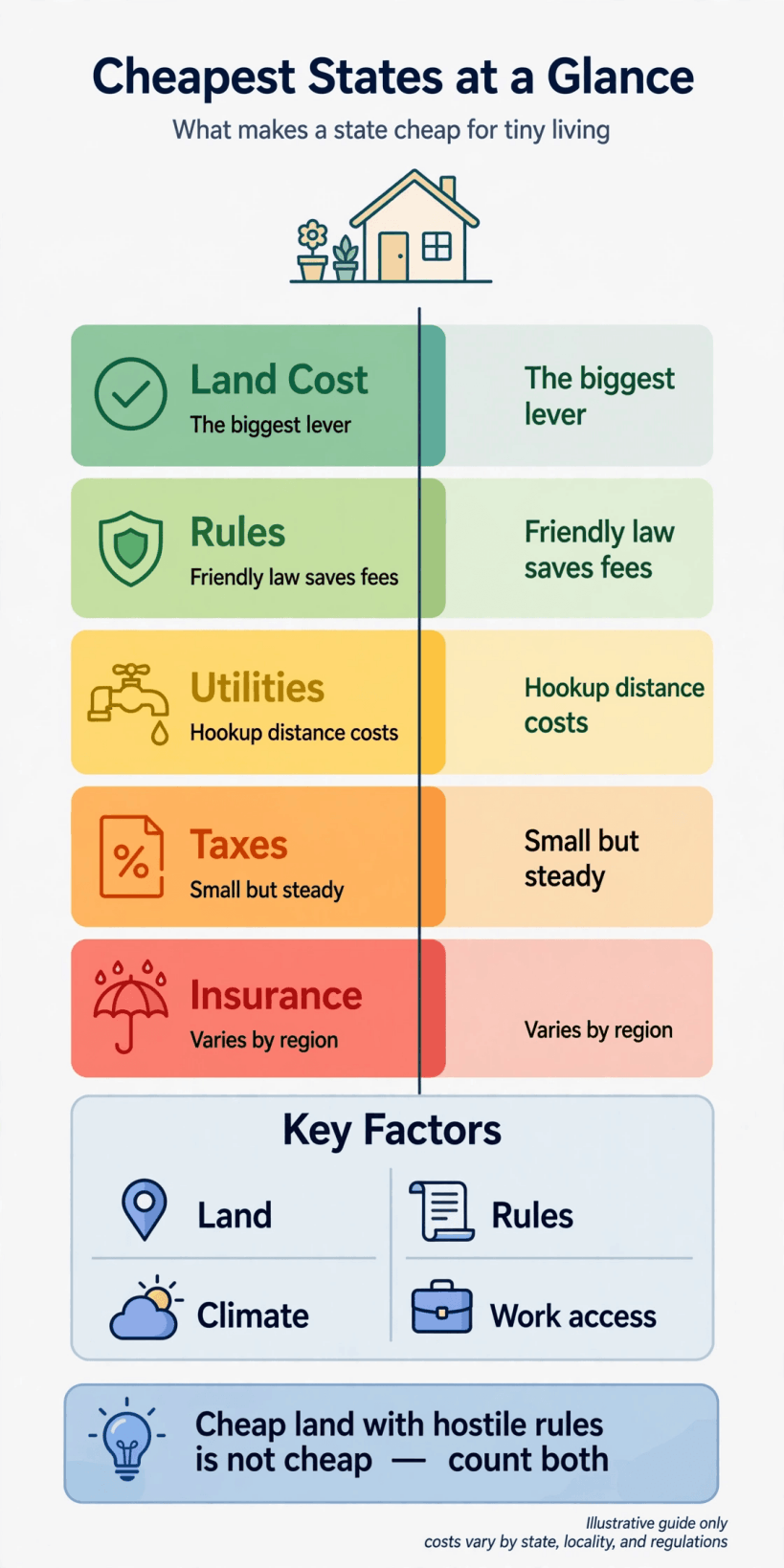
The cheapest place to live in a tiny house is rarely the place with the cheapest land, and it is never a place you can identify from a single list. Total cost is a stack: the land itself, the rules you have to satisfy before you may live on it, the distance utilities have to travel to reach you, the taxes and insurance that follow you every year, and the work you can actually reach from your front step. When readers ask about the cheapest states tiny house living can offer, the honest answer is a method, not a ranking carved in stone, because county rules and land markets change faster than any article can.
So this guide ranks the ten things that decide cheapness, in the order they usually hit your budget, and shows you how to apply them to any state you are considering. A state that scores well on most of these criteria will be genuinely affordable for tiny living; a state that fails two or three of them will be expensive no matter how its land is advertised. Work through the criteria with real local numbers you gather yourself, and you will know more than any generic ranking could tell you.
The Ranking at a Glance: Ten Cost Criteria in Budget Order
| Rank | Cost criterion | What drives it | How to check it |
|---|---|---|---|
| 1 | Land cost drivers | Distance from metros, zoning, demand | Compare several rural parcels and their permitted uses |
| 2 | Rule friendliness | Minimum-size codes, foundation and ADU rules | Read the county zoning code and ask the planning office |
| 3 | Utility distances | Power, water, and septic reach | Price the hookups for a specific parcel, not a county average |
| 4 | Property tax drivers | How land and small homes are assessed | Ask the county assessor how a tiny home would be treated |
| 5 | Insurance drivers | Classification, weather exposure, replacement value | Get quotes for the exact house type you plan |
| 6 | Work access | Commuting distance, local wages, remote-work signal | Map real commutes and test connectivity on site |
| 7 | Climate running costs | Heating, cooling, freeze protection | Budget seasonal energy for the local climate honestly |
| 8 | Parking alternatives | Community lots, private hosts, RV parks | Compare lot terms where you would actually live |
| 9 | Build and delivery costs | Local labour, transport distance | Quote the build and the move together |
| 10 | Exit costs | Resale demand and moving again | Check how easily tiny homes change hands locally |
1. Land Cost Drivers: The Purchase Everyone Underestimates
Land is the biggest single cheque in most tiny house budgets, and its price is driven by a handful of repeatable forces: distance from employment centres, the permitted uses attached to the parcel, road access, and whether the land can legally hold a dwelling at all. A very cheap parcel that cannot be lived on, cannot be reached in winter, or cannot take a septic system is not cheap; it is a future problem with a low sticker price. Rank land by usable, permitted, reachable acres, not by asking price alone.
Before comparing states, learn what preparing a parcel actually involves, because clearing, grading, driveways, and utility runs are part of the land cost even when they appear in a different budget column. Our guide on how to prepare land for a tiny house walks through that work step by step, and it will sharpen the questions you ask about every listing: What is already there, what is missing, and what will the county require before you can sleep on it legally?
2. Rule Friendliness: Where Permission Saves Real Money
The second-largest cost driver is invisible until it bills you: the rules. Minimum dwelling sizes, foundation requirements, and restrictions on accessory dwellings decide whether your tiny house is a home, a recreational vehicle, or a violation. A state whose counties commonly accept small dwellings, foundation tiny homes, or backyard units gives you more legal parcels to choose from, and more choice almost always means lower prices and fewer expensive workarounds.
Rule friendliness is a county habit more than a state slogan, so verify it where you will actually live. Read the zoning code, then call the planning office with a plain description of your house and listen to whether the answer is a pathway or a warning. Understanding the model-code side helps you speak the same language, which is why our explainer on the IRC Appendix Q rules for tiny homes is worth reading before those calls: you will recognise which provisions a county has adopted and which it has not.
3. Utility Distances: The Bill That Arrives Before You Move In
Utilities convert distance into money. A parcel far from the power line, the water main, or a viable septic field carries hookup work that can quietly rival the price of the land itself, and off-grid alternatives shift that cost into equipment, maintenance, and your own time. Two otherwise identical states can rank far apart on this criterion simply because one has more parcels with services already at the boundary and the other expects every owner to start from raw land.
Price utilities for a specific parcel rather than trusting impressions. Ask what is at the road, what extensions cost in that county’s process, and what a well, septic design, or solar setup would need to include for year-round living. Our tiny house utilities guide lays out the power, water, and sewage options side by side, and it will stop you from under-budgeting the least glamorous and most decisive part of cheap living.
4. Property Tax Drivers: The Quiet Line in the Budget
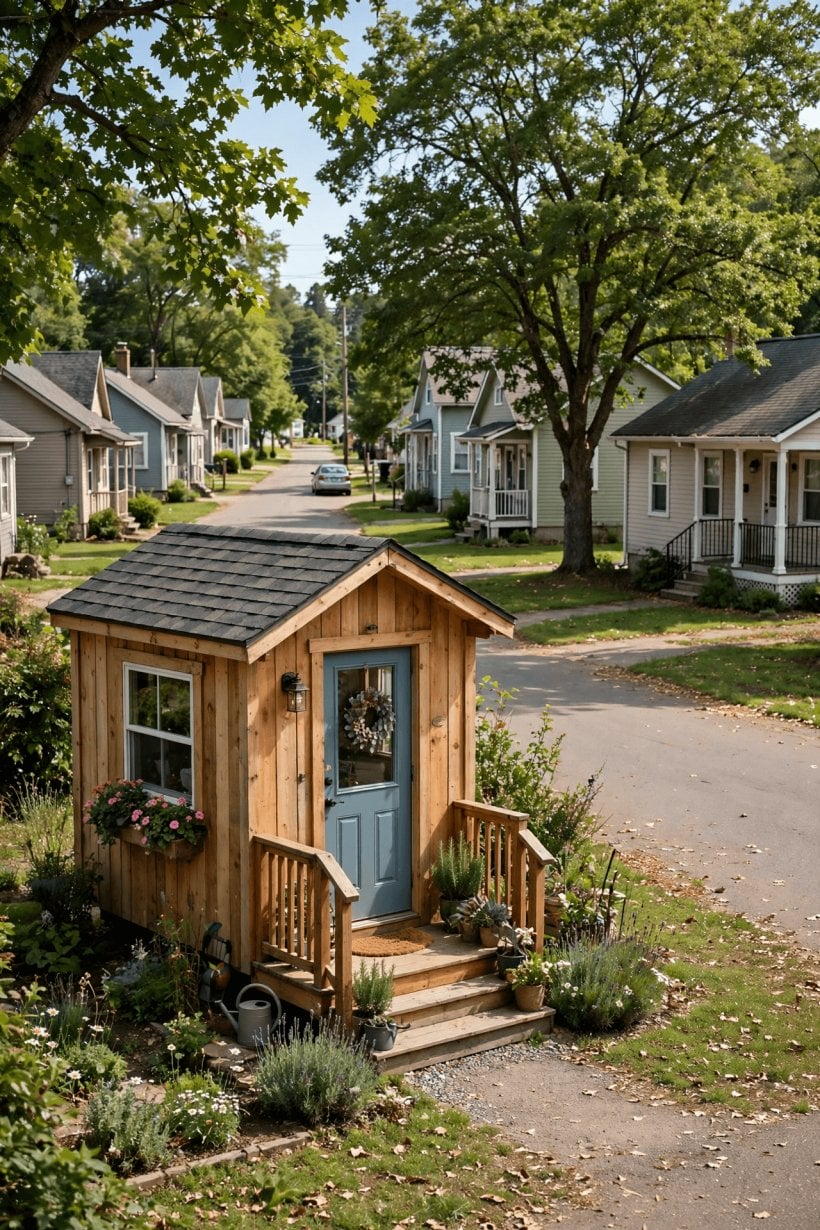
Taxes rarely decide a move on their own, but they compound. What matters for a tiny house is less a state’s headline tax reputation and more how your specific setup will be assessed: Is the tiny house taxed as real property, as a vehicle, or as an improvement on someone else’s land? Is the land itself assessed at residential, agricultural, or another rate, and what changes when you place a dwelling on it? Those classification answers, given by the county assessor, are worth more than any general tax ranking.
Ask the questions before you buy, in writing where possible. How a foundation tiny home is valued, whether a house on wheels is registered rather than assessed, and what permits trigger reassessment are all knowable in advance. A state where assessors have a clear, familiar category for small dwellings will cost you less in surprises than one where your house is an argument nobody at the counter has had before.
5. Insurance Drivers: Pricing a Small, Unusual Home
Insurance follows classification too. A certified house on wheels, a foundation tiny home, and a backyard unit are three different risks in an insurer’s eyes, and the weather of the state you choose sits on top of that: wind, hail, flood, freeze, and wildfire exposure all shape what cover costs and what it excludes. Cheap states for insurance are the ones where your house type is commonly insured and the local weather risks are modest, and both halves of that sentence need checking with real quotes.
Get quotes for the exact house and placement you are planning, not for a generic small home, and ask what the policy requires of you: tie-downs, skirting, foundation type, distance from water, or certification paperwork. Our guide on how to keep your tiny house safe covers the protection measures insurers like to see, several of which are worth doing for your own peace of mind whether or not anyone requires them.
6. Work Access: Cheap Is Expensive If You Cannot Earn
A low-cost state that separates you from your income is not low-cost. Rank work access honestly: commuting distance to the jobs you actually do, the depth of the local labour market if you change jobs, and, for remote workers, whether the specific parcel you want has connectivity that survives a working week rather than a weekend visit. Rural land is cheapest exactly where employment is thinnest, and that tension is the central trade-off of affordable tiny living.
Test, do not assume. Drive the commute at working hours, check signal at the parcel itself, and look at backup options if your main income wobbles. For remote workers, our guide to off-grid internet and staying connected in the wilderness explains the realistic options and their limits, and it may change which parcel in a cheap county is the genuinely affordable one.
7. Climate Running Costs: Heating, Cooling, and Water That Freezes
Climate is a monthly subscription you cannot cancel. States with mild winters and tolerable summers ask little of a small, lightly built home; states with hard freezes, deep snow loads, or long heat waves ask for insulation, skirting, heat tape, air conditioning, and the energy to run them, plus the design discipline to protect pipes and tanks. A tiny house magnifies both directions: cheap to heat in a kind climate, vulnerable in a harsh one if it was built for somewhere else.
Match the house to the climate before you match the state to your budget. Our guide on tiny house living in cold climates details what freezing weather demands of plumbing, humidity control, and insulation, and the same thinking applies in reverse to heat. If a cheap state’s climate requires rebuilding the house you already own, its ranking falls quickly once you price the upgrades honestly.
8. Parking Alternatives: The States That Give You Options
Not everyone buys land, and the cheapest states for tiny living are often the ones with the richest mix of alternatives: tiny house communities with lots, private hosts with legal placements, and parks that accept tiny houses on clear terms. Options create competition, competition steadies prices, and a renter who can move has protection that a renter with one possible lot does not. Rank any state partly by counting its legal parking pathways, not just its land listings.
Understand how those pathways differ before relying on them. Our comparison of tiny house communities vs RV parks explains the rules, costs, and culture on both sides, and our tour of tiny house communities for seniors shows how community models vary for one large group of tiny dwellers. A state rich in both models gives you a fallback if your first placement ends.

9. How to Score Any State Yourself in One Weekend
Here is the method that replaces every dubious ranking, including this one. Pick three real parcels in the state you are considering. For each, gather the land price, the county’s answer on legality, a utility estimate, the assessor’s classification answer, one insurance quote, and the real commute or connectivity picture. Score each parcel against the ten criteria in the table, drop any parcel that fails legality or utilities outright, and total the true first-year cost of the survivors.
Frameworks help you stay consistent, and our guide to where to buy land for eco-living, with its location scoring system, is an excellent template to adapt: it scores self-sufficiency factors in a structured way, and adding the tax, insurance, and rules criteria from this article turns it into a tiny-house-specific tool. Two evenings of this work will teach you more about a state’s real affordability than a month of reading listicles, ours included.
10. The Trade-Offs at the Bottom of Every Cheap List
Every inexpensive option hides a cost somewhere, and naming it is the last criterion. Very cheap land may mean long drives for everything, thin medical and school options, or resale difficulty when you leave. Very permissive areas may offer few services. Very low running costs may come with weather or isolation you will feel daily. None of these are reasons to walk away; all of them are reasons to walk in with your eyes open and your budget honest.
Finally, price the exit as well as the entrance. Moving a tiny house is a real project with real costs, as our tiny house moving guide explains, and a cheap state you may need to leave deserves a harder look than one you expect to stay in. The genuinely cheapest state is the one whose total stack, including leaving if life changes, fits your budget without wishful thinking doing the arithmetic.
Final Considerations
Affordable tiny living is a stack, not a slogan: land, rules, utilities, tax, insurance, work, climate, parking, delivery, and exit, added honestly for a real parcel in a real county. Use the ranking above as your checklist, gather the local numbers yourself, and distrust any list, anywhere, that gives you a state’s price without showing its criteria. Do that work and the cheapest state stops being a matter of opinion. It becomes the place where your specific tiny house, your income, and your life add up most comfortably, and that is the only ranking that was ever worth following.


0 Comments