

I have lived off-grid in my tiny house for over a decade — growing my food, following the seasons, and carrying my home wherever I travel. In those years I have heard hundreds of misconceptions, from skeptical relatives at holiday dinners to curious strangers at campgrounds. It is time the biggest ones met their match, with honesty and humor.
Tiny House Myths at a Glance
Three claims do most of the damage: that tiny houses cost next to nothing, that they are illegal, and that they belong only to the young and single. This guide takes the most repeated tiny house myths and checks each one against a decade of off-grid living — the real cost range, the zoning and building-code reality, and the twenty-five-to-seventy-five age spread of the people who actually live this way. What survives the checking is not magic. It is a lifestyle that rewards research, planning and disciplined budgets, and it repays them with lower bills, calmer rooms and a smaller footprint on the land.
| Attribute | The Reality |
|---|---|
| The claim of cheapness | A well-equipped tiny house runs from $30,000 to over $100,000 |
| The author’s own build | Around $45,000, off-grid with solar panels and rainwater collection |
| Legality | Not universally prohibited; zoning decides, place by place |
| Building codes | Door widths, emergency exits, utility connections and structural integrity still apply |
| Registration | Some states class a mobile tiny house as an RV, registered as a vehicle |
| Who lives tiny | Retirees, middle-aged downsizers and young families alike |
| Long-term savings | Lower energy bills, less maintenance and reduced property taxes |
| Financing | Credit unions, specialized lenders and RV financing |
| Lifestyle gains | Calmer rooms, stronger community and a smaller ecological footprint |
| The real requirement | Research, planning and conscious spending decisions |
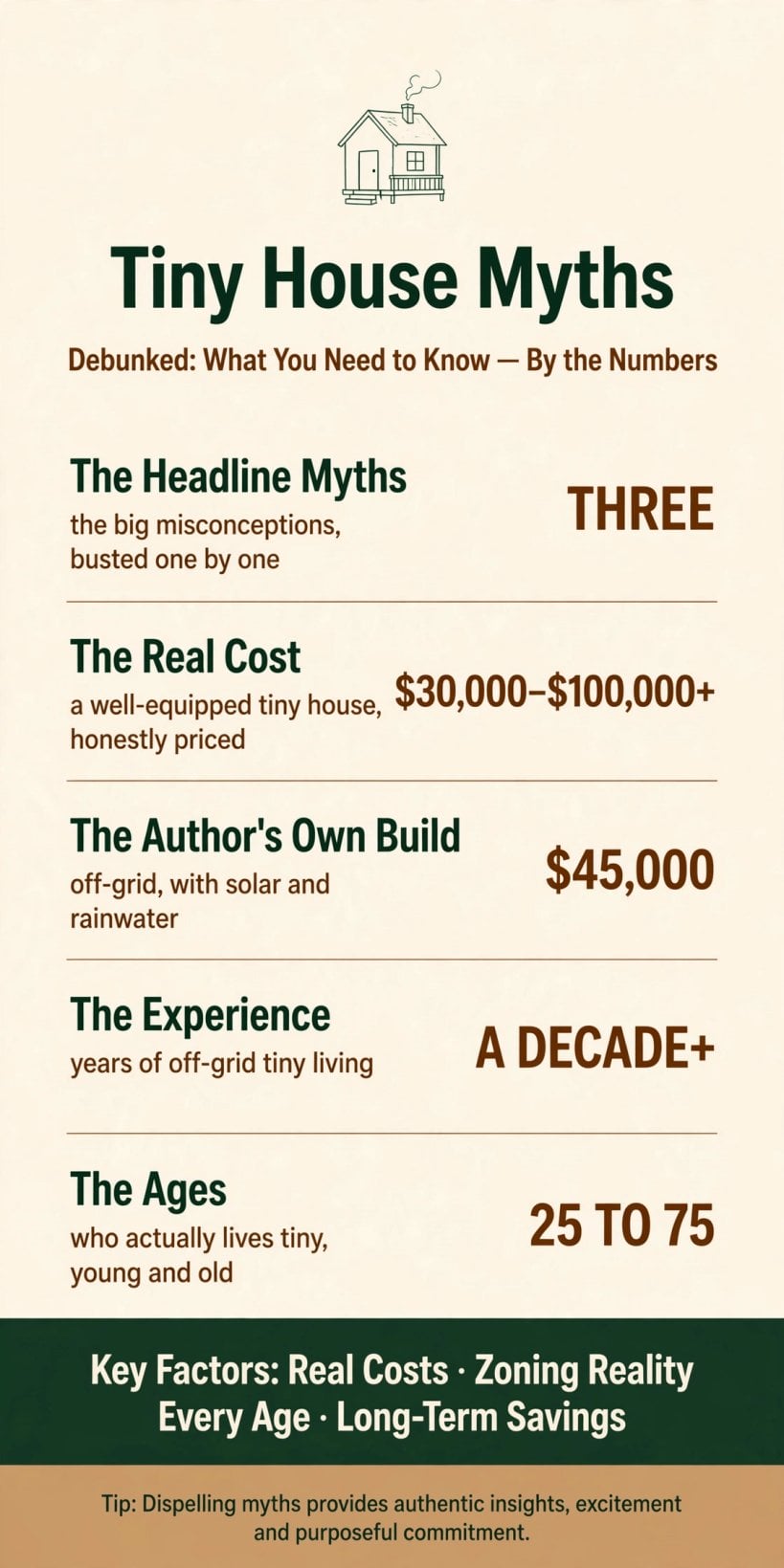
The three headline misconceptions, the honest cost range and the ages that actually live tiny — every figure from the original account.
1. Myth One: Tiny Houses Are Incredibly Cheap
We have all overheard the well-meaning stranger exclaim, “Wow, tiny houses cost next to nothing!” If only that were entirely true. A tiny house does typically demand less investment upfront than traditional large-scale housing, and that kernel of truth is what keeps this first myth alive. But the average cost of a well-equipped tiny house ranges from $30,000 to over $100,000, depending on materials, customization, mobility, and how much of the work is handed to professionals.
My own off-grid tiny house, with self-sufficient solar panels, rainwater collection, and custom woodworking, came in closer to $45,000. That figure bought independence from the grid, not luxury — and it was not pocket change. Cost reduction is never automatic. Luxury fixtures, custom furniture, technological gadgets, and premium materials will elevate the price significantly, and quality craftsmanship from reputable builders invariably costs more, because you are paying for meticulous attention and expertise that a small structure forgives far less readily than a big one. A badly fitted joint in a large house is an annoyance; in a tiny house it is a daily companion.

The honest summary is this: a tiny house is cheaper than a conventional house, not cheap in itself. The exceptional savings are real, but they arrive later — in energy bills, maintenance, and taxes — once the initial investment is behind you. Confusing the two is how budgets sour. Sections 6 and 7 below take the costs and the savings apart in full.
2. Myth Two: Tiny Houses Are Illegal
Of all the tiny house myths, this is the one that stops people before they start. So let us clear it up plainly: tiny houses are not universally prohibited. Their legality depends heavily on regional zoning laws, local jurisdictions, and the building codes in force where the home will sit. Rarely black and white, tiny house regulations operate in the gray, complex zones of municipal law.
In my travels across communities and campsites, I have encountered substantial variations. Some regions warmly embrace tiny homes on wheels, treating them as recreational vehicles with their own codes and registration process. Other areas require tiny homes to meet strict conventional residential standards. And some towns are innovatively reshaping their zoning laws to welcome tiny home neighborhoods enthusiastically. The map is a patchwork, and the only way to read it is locally — checking what your own jurisdiction actually says, the way you would check whether you can put a tiny house in your backyard before you ever order a trailer.
Hurdles exist — believe me, I have wrestled with a few bureaucratic tangles myself. But careful research, strong community networks, and honest dialogue with zoning authorities provide clarity. Collaborating closely with sustainable architecture firms, local municipalities, and tiny house associations demystifies the regulations and enables confident planning. Tiny houses are not fundamentally illegal; they simply require informed navigation.
3. Myth Three: Tiny Houses Are Only for Young People
“Some celebrity lives in a tiny house, but they’re young and single,” my uncle once exclaimed skeptically over a barbecue. This wildly popular misconception portrays tiny houses exclusively as youthful dwellings. Reality paints a far richer picture, and my off-grid travels prove it again and again: tiny houses know no age limit.
During one memorable community event, I shared morning coffee with Margot and Alan, retirees in their seventies passionately embracing the minimalist lifestyle in their beautiful tiny abode. They are not exceptions. From retirees downsizing to escape wasteful expenses, to middle-aged folks craving simpler daily existences, to young families seeking freedom from mortgage chains, the diversity astonished even me, a seasoned adventurer. The same spread shows up in tiny houses designed for seniors, where accessible layouts are the whole point.
Each demographic discovers benefits aligned with its own circumstances. The young value mobility, environmental responsibility, and cost savings. Mature residents appreciate accessible layouts, ease of maintenance, and strengthened community engagement. Whether you are twenty-five or seventy-five, minimalism gently strips life down to its essential meaning. Age remains nothing but a number in tiny house choices; the driving factor is adopting a life of simplicity, sustainability, and intentionality.
4. Zoning Laws: Where a Tiny House May Legally Sit
Every seasoned tiny homeowner shares war stories about zoning confusion, because zoning is where the abstract question of legality becomes a specific address. Regulations vary significantly nationwide. Some jurisdictions welcome tiny homes innovatively; others pose restrictions that can stop a build before it starts. Cities occasionally mandate minimum square footage, labeling tiny homes incompatible with the neighborhood by definition. Rural zoning, by contrast, remains typically more flexible.

The resolution demands homework. Contact local authorities early, consult sustainable architecture experts, and verify region-specific information rather than trusting national generalities or a stranger’s confident anecdote. The same homework pattern repeats across every alternative dwelling type — the process behind how zoning laws decide whether a yurt can be lived in is practically a template: classify the structure, find the district rules, and talk to the office that enforces them. Zoning is not a wall; it is a door that opens for people who knock with the right paperwork.
5. Building Codes and Property Registration
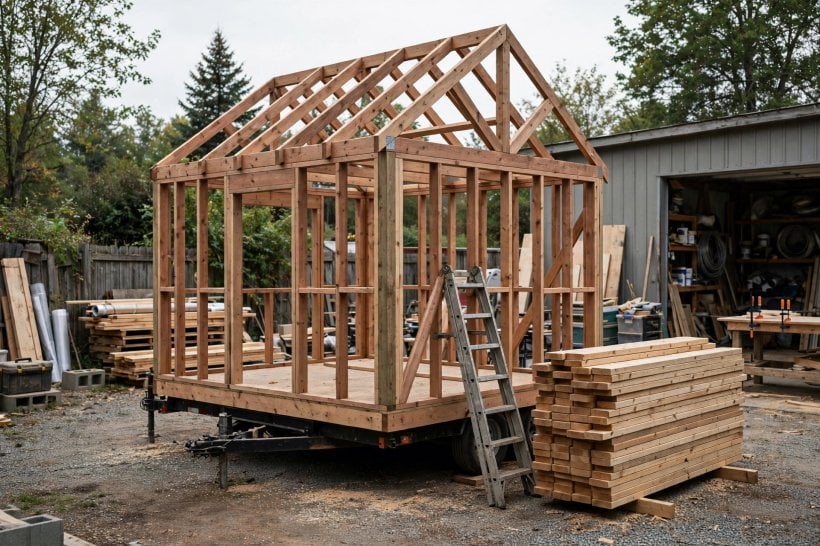
Building codes ensure a tiny home’s safety, durability, and security, and they do not disappear simply because the home shrinks. The key standards concern door widths, emergency exits, utility connections, and structural integrity — the unglamorous details that decide whether a small house is a home or a hazard. Relying on reputable builders, or on carefully planned DIY strategies that respect the same standards, mitigates construction headaches significantly.
The two systems also lean on each other. A home built carelessly to no standard invites trouble at registration, at resale, and on the road; a home built to recognized standards carries its credibility with it from office to office. This is why experienced owners treat code compliance as an asset rather than a burden — it is the closest thing a tiny house has to a passport.
Registration brings its own challenges, handled differently from traditional housing. States categorize tiny homes differently: some designate mobile tiny houses as RVs, mandating registration as vehicles through the DMV. Misinterpretations, omissions, or errors at this stage lead to frustrating delays that have nothing to do with the quality of the build. Careful organization and early consultation with DMV offices streamline the process enormously. Treat the paperwork as part of the build — a phase with its own checklist, its own lead times, and its own quiet satisfactions when it clears.
6. Initial Construction Costs, Explained Honestly
Compact does not cheaply equalize. The initial expense of a tiny house is determined by customization, features, and quality materials — the same forces that price any house, compressed into fewer square feet. Versatile, multi-functional furniture installations increase convenience and influence pricing at the same time. A bench that is also storage, a table that folds to a wall, a stair that is also a wardrobe: each is carpentry, and carpentry is hours, and hours are money.

This is why the $30,000 to $100,000+ range is so wide. At the lower end sit simple, owner-built shells on modest trailers; at the upper end, professionally built homes with premium materials, off-grid systems, and custom everything. Costs reflect homeowner preferences realistically. The planning failure is not spending at either end — it is budgeting for the lower end while specifying the upper. Price your actual list, with your actual materials and your actual level of hired help, and the number stops being a myth and becomes a plan.
7. Long-Term Savings and Financing Solutions
Here the money story turns in the tiny house’s favor. Tiny houses deliver measurable reductions: energy bills drop drastically, mortgages shrink or vanish, and renovation and maintenance costs contract with the floor plan. Over one decade, my own expenses declined dramatically compared with traditional home ownership, and lower real estate property taxes added to the effect. The savings are noticeable — but they stabilize after the initial investment, which is why the money side of the tiny house myths collapses in both directions. Neither “next to nothing” nor “a fortune” survives a decade of actual bills.
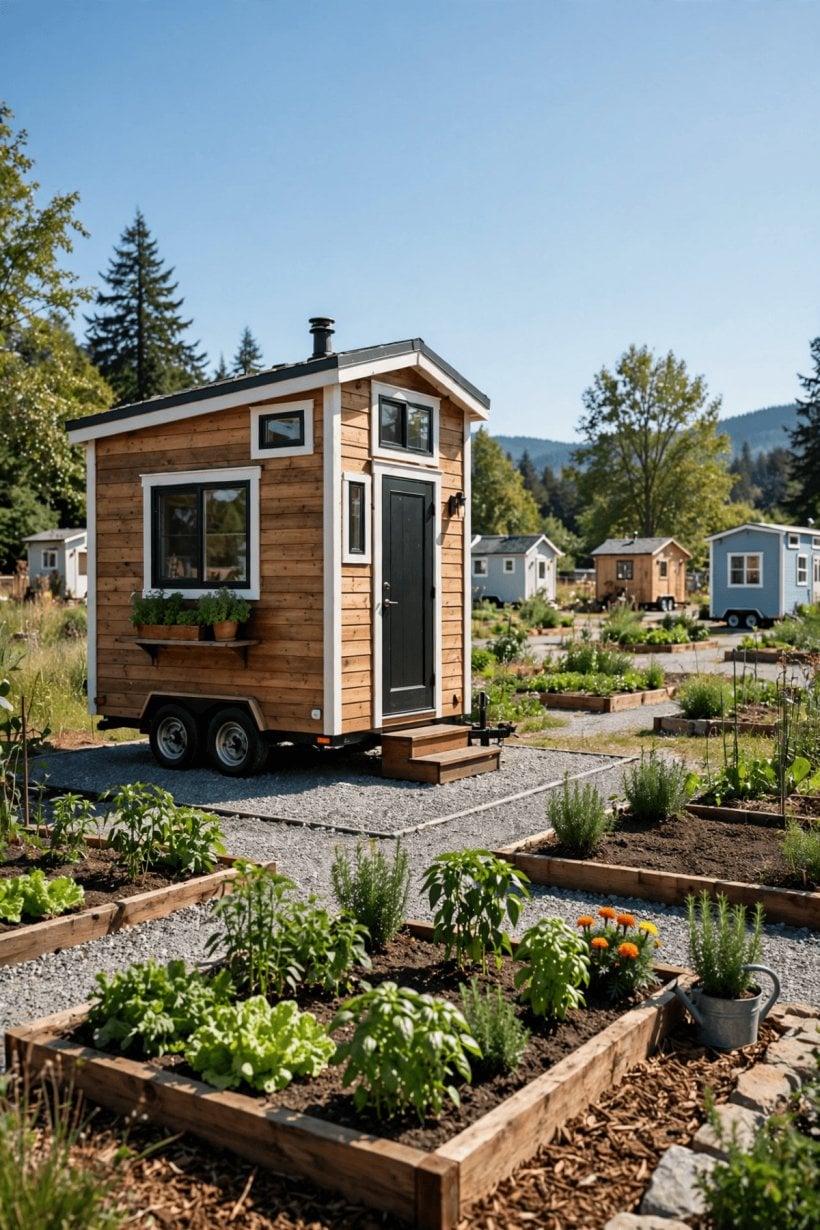
Financing puzzles frequently perplex tiny home aspirants, because financial institutions cautiously grant mortgages and evaluate each tiny home purchase on its specific circumstances. The working answers are alternative lending sources: credit unions, specialized lenders, and RV financing institutions that are eagerly accumulating tiny home loan experience. Innovative finance solutions increase annually, and understanding how you finance a tiny house before you fall in love with a design keeps the whole project honest. Budget first, borrow second, build third.
8. Embracing the Lifestyle Implications
The deepest misconceptions are not about money or law but about what daily life inside a tiny house actually does to a person. My minimalist journey began hesitatingly and swiftly blossomed — the difference was night and day. Decluttered living spaces dramatically improve mental and emotional well-being, reducing anxiety and fostering clarity and creativity. Freedom enhances and intentionality strengthens, aligning the rooms you live in with simplified, nourishing decisions. It is the same current that runs through what living in a tiny house off the grid actually involves: fewer inputs, chosen deliberately.

Community is the second surprise. Tiny house residents enthusiastically seek strengthened bonds, and shared sustainability values form strong foundations for them. Gatherings, workshops, and gardening groups facilitate genuine contact; as fellow enthusiasts confirm, neighbors quickly and authentically transform into friends. And the environmental ledger is real: lower energy use sharply decreases carbon footprints, small architectural footprints reduce ecological pressure immensely, and conscious consumer choices amplify biodiversity protection. The lifestyle implications are not sacrifices with good PR. They are the returns.
9. Practical Advice from the Tiny House Frontlines
Design first. A personalized tiny home needs practical functionality alongside aesthetics, with customizable options suited to your personality and daily rhythms. Multi-functional furniture boosts limited spatial flexibility tremendously, and creative layout design positively influences daily life — proper planning ensures satisfaction long after the novelty fades. Design for the Tuesday morning, not the magazine photograph.
Choose materials wisely. Environmentally conscious, recycled materials reduce adverse outcomes while adding character no showroom can sell: reclaimed local wood and recycled building materials personalize a home impressively, and the reasoning behind the benefits of sustainable building materials applies at tiny scale exactly as at large. Then live the systems: rainwater collection, solar energy harnessing — priced honestly in our breakdown of how much solar panels for a tiny house cost — composting toilets, and a personal herb garden quickly improve a tiny home’s efficiency while strengthening food autonomy. Commit to realistic, achievable sustainability objectives, and let them compound.
10. Ethical Considerations, Caring for the House, and the Future
Ethical obligation begins with conscious consumption: habits that promote community well-being and hold sustainability, community empowerment, and effective resource use in balance. Caring for the house is part of the same ethic. Regular maintenance remains a vital investment in longevity — consistent inspections and a diligent repair attitude maintain the home’s health and standards, guaranteeing a quality daily environment and extending the lifestyle’s viability. A tiny house rewards the attentive owner disproportionately, because every system is close enough to notice.
None of this care is abstract. A tiny house concentrates every consequence of ownership into a few square meters: a small leak announces itself, a neglected seal shows quickly, and a well-kept system rewards you immediately. Owners who build inspection into their seasonal rhythm — the same rhythm the off-grid year already teaches — find that maintenance stays small, cheap, and oddly satisfying, another quiet refutation of the idea that tiny living is fragile living.
The future implications are encouraging. Societal acceptance is positively influencing zoning changes that favorably benefit tiny homeowners, and sustainable architecture development is expanding significantly, forming favorable legislation that progressively enhances minimalist living’s adaptability. Other small-footprint forms ride the same current — small dome homes among them — while newcomers keep arriving through guides like these tips to kickstart a tiny house adventure. The direction of travel is clear: more shapes of small living, more places that allow them, and fewer myths standing in the doorway.
Final Considerations
Adopting tiny house living involves conscious reflection, and that is precisely what the myths prevent. They survive because they are simple — cost, legality, age — while the reality is textured: a $30,000 to $100,000+ decision, a zoning map to read, a community of twenty-five-to-seventy-five-year-olds already living the answer. The tiny house myths collapse the moment they meet one honest decade off-grid. What replaces them is better than the fiction: authentic insight, excitement, and a purposeful commitment to a rewarding, intentionally chosen journey. Check the claims, run your own numbers, read your own zoning map — then build the small life on facts.




6 Comments